
Europe Blue Hydrogen Production Market Size & Forecast:
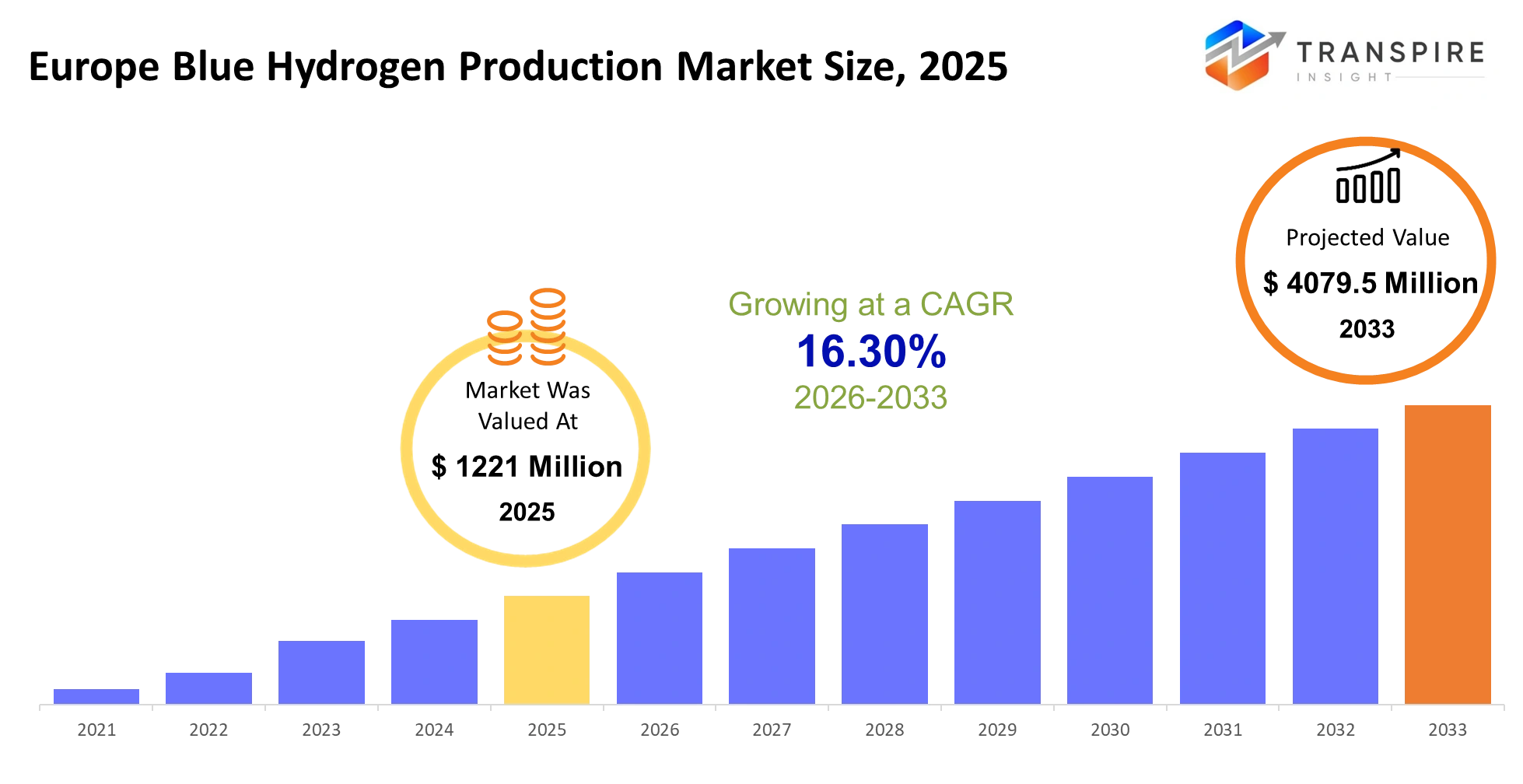
- Europe Blue Hydrogen Production Market Size 2025: USD 1221 Million
- Europe Blue Hydrogen Production Market Size 2033: USD 4079.5 Million
- Europe Blue Hydrogen Production Market CAGR: 16.30%
- Europe Blue Hydrogen Production Market Segments: By Type (Steam Methane Reforming, Autothermal Reforming, Others), By Application (Energy Generation, Industrial Use, Transportation, Others), By End-User (Energy Companies, Industrial Sector, Government, Others), By Technology (Carbon Capture, Storage, Others).
To learn more about this report,  Download Free Sample Report
Europe Blue Hydrogen Production Market Summary:
The Europe Blue Hydrogen Production Market size is estimated at USD 1221 Million in 2025 and is anticipated to reach USD 4079.5 Million by 2033, growing at a CAGR of 16.30% from 2026 to 2033. Blue hydrogen production in Europe enables the transformation of natural gas into hydrogen fuel while capturing all emitted carbon dioxide, which enables heavy industries and maritime operators to reduce their environmental impact without needing to change their entire fuel infrastructure. The system provides operational support to refineries and chemical plants and steel manufacturing facilities and developing hydrogen bunkering networks which require dependable and expandable environmentally friendly power sources.
The market has transitioned during the last three to five years from testing new technologies to using established systems because of government policies which include carbon pricing and hydrogen frameworks that give advantages to companies with decreased overall environmental effects. The energy crisis which followed the Russia-Ukraine war functioned as the main catalyst for change because it demonstrated Europe’s reliance on external gas supplies and led governments to find new methods of obtaining energy resources.
The combination of these elements has transformed the way people assess investment opportunities. Businesses now use blue hydrogen to demonstrate its value because it delivers both emissions reductions and energy independence and price consistency, which helps to speed up project permission processes and secure long-term product purchase contracts and carbon capture system connections.
Key Market Insights
- The Europe Blue Hydrogen Production Market in 2025 will be led by Northwestern Europe which controls 45 % of the market while UK, Netherlands, and Norway CCS clusters provide the main market force.
- The developing region of Southern Europe will experience its highest growth period until 2030 because hydrogen hubs located at ports in Spain and Italy will help implement maritime fuel systems.
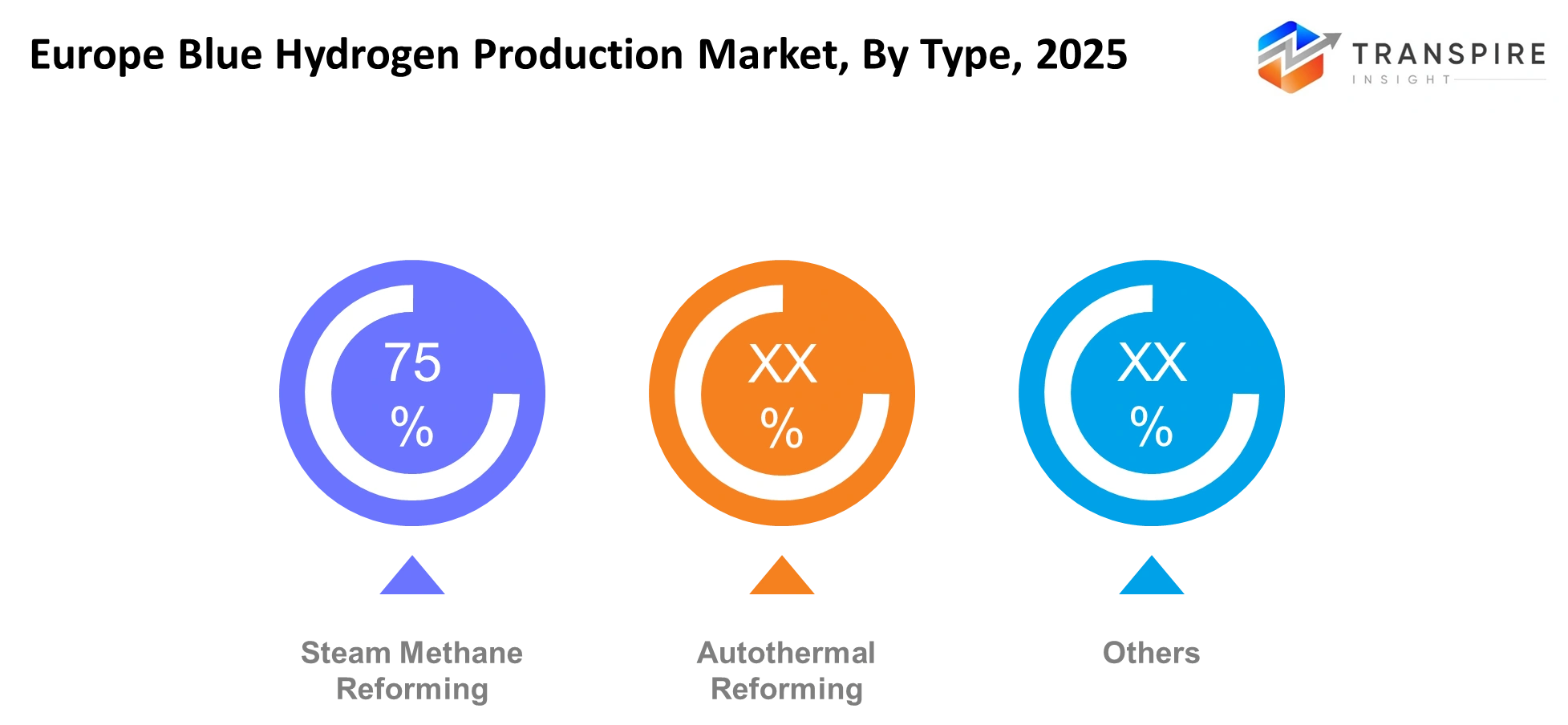
- The market for Steam Methane Reforming (SMR) with CCS will reach 60% market share in 2025 because of current infrastructure and economical retrofit solutions.
- Autothermal Reforming (ATR) maintains its second-largest market position because industrial plants need improved carbon capture capabilities.
- The ATR segment will experience its most rapid growth between 2025 and 2030 because developers need to achieve CO₂ capture rates above 95% for their regulatory needs.
- The refining and chemical production sectors will drive 2025 hydrogen demand because they will use hydrogen for ammonia and methanol production instead of grey feedstock.
- The development of maritime fuel applications which represent the fastest growing sector of the industry will receive support from hydrogen bunkering projects and decarbonization requirements established by major European ports.
- The industrial sector will account for approximately 65% of market share in 2025 because EU emissions regulations require steel and ammonia and refinery operations to reduce their carbon output.
- The energy system shows its most rapid expansion in both the energy sector and transport sector because hydrogen technology supports shipping operations and energy system power balancing functions.
What are the Key Drivers, Restraints, and Opportunities in the Europe Blue Hydrogen Production Market?
The European Blue Hydrogen Production Market experiences its most powerful growth when EU Emissions Trading System carbon pricing increases together with its hydrogen production regulations. Industrial players began reassessing grey hydrogen economics after carbon costs exceeded economically material thresholds throughout 2021. The business case for blue hydrogen became stronger because carbon capture rates exceeded the minimum requirements set by regulations. The businesses established enduring offtake contracts while they funded combined hydrogen and CCS system development to transform regulatory compliance into stable revenue sources which would accelerate project completion.
The most significant structural barrier is the limited availability of carbon capture, transport, and storage infrastructure. Blue hydrogen requires dependable CO₂ disposal systems which need investments of multiple billion euros and international collaboration and compliance with regulations. The systems face limitations to their expansion because of the time required to obtain permits and the availability of suitable geological sites. The bottleneck prevents the operation of large-scale plants while it raises project uncertainty and hinders short-term supply expansion despite existing hydrogen demand and government backing.
The development of industrial hydrogen clusters connected to shared CCS hubs presents a major opportunity. The North Sea basin area now develops integrated systems which enable multiple polluters to share CO₂ pipeline and storage facilities. This model decreases per-unit expenses while it speeds up the process of becoming larger. The clusters develop into mature systems which show Southern and Eastern European nations how to create stable models to develop their regional markets while attracting future investments.
What Has the Impact of Artificial Intelligence Been on the Europe Blue Hydrogen Production Market?
The hydrogen production operations now undergo transformation through artificial intelligence and advanced digital systems because these technologies enhance the operation of carbon capture units together with reformers and their emission control systems. AI-powered control systems enable operators to automate the operation of carbon capture units by handling three main tasks which include solvent circulation and pressure balancing and temperature control. The system maintains hydrogen production and CO2 emission control through its ability to adapt to raw material changes and maintain process parameters.
Machine learning models are also being applied to predictive maintenance and emissions forecasting. Equipment operators use sensor data analysis from compressors and reactors and pipelines to identify equipment degradation through early warning signals which enables them to arrange maintenance activities before equipment breakdowns happen. The method enables plant operations to gain 5 to 10 percent additional operational time and decrease unexpected downtime while it adjusts energy consumption for each unit of hydrogen produced. AI-based forecasting tools enable operators to synchronize production processes with carbon compliance objectives by forecasting capture performance based on different operational scenarios.
The process of adoption faces obstacles because of two main factors which include complex integration procedures and restricted data access. The presence of multiple industrial systems in most facilities creates data silos which pose challenges for organizations to develop accurate models and implement AI solutions throughout their operational sites.
Key Market Trends
- The European Union Emission Trading System has established carbon prices which exceeded €80 per tonne since 2021. This price increase has forced refiners and ammonia producers to substitute grey hydrogen with better emissions reduction solutions.
- Developers shifted from standalone plants to integrated hydrogen and CCS clusters. The North Sea area demonstrated better project funding capabilities which developers used to achieve larger operational efficiency.
- The Russia–Ukraine conflict created energy security problems which led to the government approving hydrogen production projects between 2022 and 2025.
- The operators of autothermal reforming systems established 95 percent capture rate targets which enabled them to meet the new emissions compliance standards after 2023.
- Industrial buyers increasingly signed 10–15 year offtake agreements which helped hydrogen projects secure funding through revenue prediction reduction.
- Major players such as Shell BP and Equinor expanded joint ventures after 2022 which marked a transition towards infrastructure sharing and risk-sharing business partnerships.
- The ports of Rotterdam and Antwerp started building hydrogen bunkering systems which indicate a new trend towards using maritime fuel systems for purposes different from industrial fuel demand.
- The development of CO₂ transport and storage networks progressed from national projects to international systems which enabled industrial clusters to implement scalable solutions by 2024.
- The capital allocation process began funding modular and scalable plant designs after 2023. This approach enables plants to expand their capacity in phases which matches demand growth and regulatory development.
Europe Blue Hydrogen Production Market Segmentation
By Type
Steam methane reforming currently holds the leading market share because European countries have established extensive operational capacity which works well with their current natural gas systems. Operators choose SMR because it needs less initial funding for carbon capture implementation than they would require to install new system designs. The second major market segment now experiences growth because autothermal reforming offers improved carbon capture performance and better operational efficiency in large integrated systems.
The development of other specialized pathways faces restrictions because of their expensive nature and limited potential for expansion. The business growth patterns show a transition toward technologies which maintain operational efficiency while achieving higher emissions standards. The upcoming five years will see investment money shift towards ATR because regulatory bodies will enforce stricter capture standards which require manufacturers to enhance system performance while investors will support facilities that operate according to established long-term compliance benchmarks.
To learn more about this report, Download Free Sample Report
By Application
The application of hydrogen shows its highest usage in industrial processes which include hydrogen use as a vital input for ammonia and methanol production and refining operations. The sectors they operate in choose low-carbon hydrogen because it helps them achieve their emission reduction goals while they continue to run their business operations. The two sectors which include energy generation and transportation for hydrogen testing currently work on developing power balancing systems and maritime fuel solutions.
The development of these sectors depends on two factors which include both infrastructure readiness and the availability of regulatory incentives. The industrial sector shows constant demand patterns which enable companies to establish long-term contracts and secure financing for projects. The future will see an increase in application diversity when port facilities and energy systems start using hydrogen because it will create new revenue opportunities for producers who will need to meet demand from multiple industries instead of just selling to their regular industrial customers.
By End-User
The industrial sector ranks as the top end-user since it needs to meet carbon pricing requirements and decarbonize current operations while maintaining production. Energy companies follow as key participants because they invest in hydrogen production to create diverse business operations which will protect their future energy supply systems. Government entities play a catalytic role by funding pilot projects and enabling infrastructure but account for a smaller share of direct consumption.
Industrial buyers show demand patterns which they use to select vendors who offer dependable services and predictable pricing, while energy firms concentrate on establishing their market position over extended periods. Suppliers who achieve successful equilibrium between these two priorities will determine future business expansion. Producers need to modify their contract agreements and supply methods because their development into transportation and electricity markets will create new consumer groups who have different usage patterns.
By Technology
The market depends on carbon capture systems because they serve as its main foundation through their ability to determine both compliance with regulations and success in commercial endeavors. The second essential component of the system depends on storage infrastructure which utilizes geological sites that include depleted gas fields to achieve permanent CO₂ storage. The development process needs to continue for transport and auxiliary technologies because they serve as vital connections between production areas and storage facilities.
The system faces current restrictions because it has both limited storage capacity and a permitting process that operates at a slow speed, which limits its ability to expand. The expansion of shared CO₂ networks will lead to improved technology integration which results in decreased costs per unit and increased operational safety. This development will drive industry-wide adoption because it lets producers increase production while meeting strict emissions regulations.
What are the Key Use Cases Driving the Europe Blue Hydrogen Production Market?
The main application of industrial hydrogen continues to be its use in refineries and ammonia plants which currently operate with embedded hydrogen systems. These facilities adopt low-carbon hydrogen to comply with EU carbon pricing while maintaining continuous production and avoiding costly process redesign.
The maritime transport sector and power systems now experience growing demand for new applications. Port operators in hubs such as Port of Rotterdam are developing hydrogen bunkering for shipping fleets while utilities test hydrogen blending for grid balancing and backup generation in energy-intensive regions.
The production of steel now requires direct reduced iron processes as new use cases emerge together with hydrogen trade corridors that link different countries. The Northern European market shows high potential to develop through its current early-stage projects which rely on infrastructure development and long-term supply contracts.
|
Report Metrics |
Details |
|
Market size value in 2025 |
USD 1221 Million |
|
Market size value in 2026 |
USD 1417.6 Million |
|
Revenue forecast in 2033 |
USD 4079.5 Million |
|
Growth rate |
CAGR of 16.30% from 2026 to 2033 |
|
Base year |
2025 |
|
Historical data |
2021 - 2024 |
|
Forecast period |
2026 - 2033 |
|
Report coverage |
Revenue forecast, competitive landscape, growth factors, and trends |
|
Regional scope |
Europe (Germany, United Kingdom, France, Italy, Spain and Rest of Europe) |
|
Key company profiled |
Shell, BP, TotalEnergies, Air Liquide, Linde, Air Products, Equinor, Engie, Siemens Energy, Mitsubishi Heavy Industries, Honeywell, ExxonMobil, Chevron, ADNOC, OMV. |
|
Customization scope |
Free report customization (country, regional & segment scope). Avail customized purchase options to meet your exact research needs. |
|
Report Segmentation |
By Type (Steam Methane Reforming, Autothermal Reforming, Others), By Application (Energy Generation, Industrial Use, Transportation, Others), By End-User (Energy Companies, Industrial Sector, Government, Others), By Technology (Carbon Capture, Storage, Others). |
Which Regions are Driving the Europe Blue Hydrogen Production Market Growth?
The market exists in Northwestern Europe because the region depends on the United Kingdom, Netherlands, and Norway as its core market countries. The EU ETS system and national hydrogen strategies both provide financial advantages which promote the use of low-carbon hydrogen technologies through their strong carbon pricing policies. The region possesses operational port facilities which include Port of Rotterdam and its extensive network for carbon capture and storage throughout the North Sea area. The ecosystem enables the execution of extensive initiatives through its ability to establish permanent business agreements and facilitate international CO₂ transportation which enables the region to maintain its leadership position.
Western and Central Europe follow as stable contributors, with countries such as Germany and France focusing on industrial decarbonization rather than export-oriented hydrogen hubs. The steel and chemicals and refining sectors maintain constant hydrogen requirements which create demand for these markets. The regulatory frameworks of the system experience continuous development which builds investor trust although the system lacks the immediate need found in top-performing areas. The system brought stability enables consistent income production which continues to flow throughout the time needed for major infrastructure development to achieve its full capacity.
The fastest-growing area in Europe now belongs to Southern Europe which Spain and Italy currently lead. The recent funding of port facilities and hydrogen corridors has established new routes which enable ships to use hydrogen fuel while facilitating international energy transportation. The governments of these nations expedite approval processes to transform their countries into hydrogen transit centers and hydrogen export stations. The expansion process creates pathways which enable companies to enter the market and acquire basic supply chain operations which will develop from 2026 until 2033.
Who are the Key Players in the Europe Blue Hydrogen Production Market and How Do They Compete?
The European Blue Hydrogen Production Market shows moderate competitiveness because major energy and industrial gas companies control existing projects while new companies enter the market through partnerships. The existing companies maintain their market share through their existing gas distribution networks and petroleum refining facilities and their capability to access carbon sequestration systems. Organizations compete through their ability to implement complete projects which enable them to manage expenses by connecting hydrogen production facilities with carbon capture and storage systems. The development of technological capabilities permits organizations to achieve better operational performance through superior carbon capture technologies. The decision-making process for investment in projects depends on project location and the availability of necessary infrastructure.
Shell plc operates integrated energy hubs which produce hydrogen through CCS and renewable energy sources to achieve emissions reduction and long-term contract supply stabilization. BP plc establishes regional clusters through its partnerships with industrial customers to create production demand which enables the company to expand operations with reduced business risk. Equinor ASA establishes its market presence through its extensive North Sea carbon storage operations which permit the company to manage CO₂ transportation and storage activities.
Air Liquide uses its knowledge in industrial gases to create better hydrogen purification and distribution systems which enable it to serve complex industrial customers. Linde plc focuses on developing modular plant systems together with advanced process engineering capabilities that support rapid system implementation and operational expansion. The companies use joint ventures together with international infrastructure initiatives and extended customer purchase agreements to enhance their market presence while establishing obstacles that prevent smaller companies from competing.
Company List
- Shell
- BP
- TotalEnergies
- Air Liquide
- Linde
- Air Products
- Equinor
- Engie
- Siemens Energy
- Mitsubishi Heavy Industries
- Honeywell
- ExxonMobil
- Chevron
- ADNOC
- OMV
Recent Development News
In May 2026, BP Reconsiders Stakes in UK Carbon Capture Projects Linked to Blue Hydrogen Infrastructure: BP announced plans to sell stakes in the Net Zero Teesside and Northern Endurance Partnership CCS projects in the UK, signaling a strategic reshuffle in low-carbon investments. These projects are closely tied to Europe’s future blue hydrogen ecosystem because they provide the carbon storage backbone required for hydrogen production from natural gas with CCS.
Source: https://www.theguardian.com
In May 2026, Equinor Reports Strong Q1 2026 Energy Earnings Amid Continued European Low-Carbon Focus: Norway’s Equinor posted higher first-quarter operating profits in 2026 while continuing investments tied to Europe’s decarbonization strategy, including hydrogen and CCS-linked infrastructure. The company remains one of Europe’s key participants in blue hydrogen and industrial carbon management development.
Source: https://www.reuters.com
What Strategic Insights Define the Future of the Europe Blue Hydrogen Production Market?
The Europe Blue Hydrogen Production Market is moving toward tightly integrated hydrogen and carbon management systems which function as a unified value chain for all production activities and transportation processes and storage operations. The shift toward hydrogen production needs to meet EU regulations which require complete life cycle assessment of emissions because these regulations now provide more benefits for companies which can prove their entire environmental performance. The future market expansion will benefit companies which possess both hydrogen production capabilities and CO₂ network operations while companies that lack these connections will face difficulties.
The hidden danger emerges from green hydrogen technology which requires electrolyzer systems to become more affordable while renewable energy sources become more accessible. The probability of blue hydrogen assets becoming less valuable exists when the cost of production reaches the same level as other options because existing contracts only protect areas which have permanent governmental backing.
The North Sea CO₂ networks present a new business opportunity because these networks allow different countries to work together on projects while sharing expenses. The market participants need to establish strategic alliances with these networks because this will provide them with both initial entry and sustained market dominance.
Europe Blue Hydrogen Production Market Report Segmentation
By Type
- Steam Methane Reforming
- Autothermal Reforming
- Others
By Application
- Energy Generation
- Industrial Use
- Transportation
- Others
By End-User
- Energy Companies
- Industrial Sector
- Government
- Others
By Technology
- Carbon Capture
- Storage
- Others
Frequently Asked Questions
Find quick answers to common questions.
The approximate Europe Blue Hydrogen Production Market size for the market will be USD 4079.5 Million in 2033.
The key segments of the Europe Blue Hydrogen Production Market are By Type (Steam Methane Reforming, Autothermal Reforming, Others), By Application (Energy Generation, Industrial Use, Transportation, Others), By End-User (Energy Companies, Industrial Sector, Government, Others), By Technology (Carbon Capture, Storage, Others).
Major players in the Europe Blue Hydrogen Production Market are Shell, BP, TotalEnergies, Air Liquide, Linde, Air Products, Equinor, Engie, Siemens Energy, Mitsubishi Heavy Industries, Honeywell, ExxonMobil, Chevron, ADNOC, OMV.
The current market size of the Europe Blue Hydrogen Production Market is USD 1221 Million in 2025.
The Europe Blue Hydrogen Production Market CAGR is 16.30%.
- Shell
- BP
- TotalEnergies
- Air Liquide
- Linde
- Air Products
- Equinor
- Engie
- Siemens Energy
- Mitsubishi Heavy Industries
- Honeywell
- ExxonMobil
- Chevron
- ADNOC
- OMV
Recently Published Reports
-
Apr 2026
Active Power Filter Market
Active Power Filter Market Size, Share & Analysis Report By Type (Shunt Active Power Filters, Series Active Power Filter, Hybrid Active Power Filter), By Application (Harmonics Mitigation, Reactive Power Compensation, Voltage Regulation, Power Factor Correction), By Phase (Single Phase, Three Phase), By End-User Industry (Manufacturing, Healthcare, Commercial, Automotive, Oil and Gas, Others), and Geography (North America, Europe, Asia-Pacific, Middle East and Africa, South and Central America), 2021 - 2031
-
Apr 2026
Electrical Transformer Market
Electrical Transformer Market Size, Share & Analysis Report By Core (Closed, Shell, and Berry), By Insulation (Gas, Oil, Solid, Air, and Other), By Phase (Single, and Three), By Rating (100 MVA to 500 MVA, 501 MVA to 800 MVA, and 801 MVA to 1200 MVA), and Geography (North America, Europe, Asia-Pacific, Middle East and Africa, South and Central America), 2021 – 2031
-
Apr 2026
Hydraulic Piston Pumps Market
Hydraulic Piston Pumps Market Size, Share & Analysis Report By Type (Axial Piston Pumps, Radial Piston Pumps), By Operating Pressure (Low Pressure, Medium Pressure, High Pressure), By Application (Construction, Mining, Agriculture, Automotive, Oil & Gas, Industrial Machinery, Others), By End-User (OEMs, Aftermarket), and Geography (North America, Europe, Asia-Pacific, Middle East and Africa, South and Central America), 2021 – 2031
-
Apr 2026
Laboratory Gas Generators Market
Laboratory Gas Generators Market Size, Share & Analysis Report By Product (Nitrogen Gas Generator, Hydrogen Gas Generator, Zero Air Gas Generator, Purge Gas Generator, TOC Gas Generators, Others), By Application (Gas Chromatography, Liquid Chromatography-mass Spectrometry (LC-MS), Gas Analyzers, Others), By End-user (Life Science, Chemical & Petrochemical, Food & Beverage, Others), and Geography (North America, Europe, Asia-Pacific, Middle East and Africa, South and Central America), 2021 – 2031