

Europe Transportation Management Systems Market Size & Forecast:
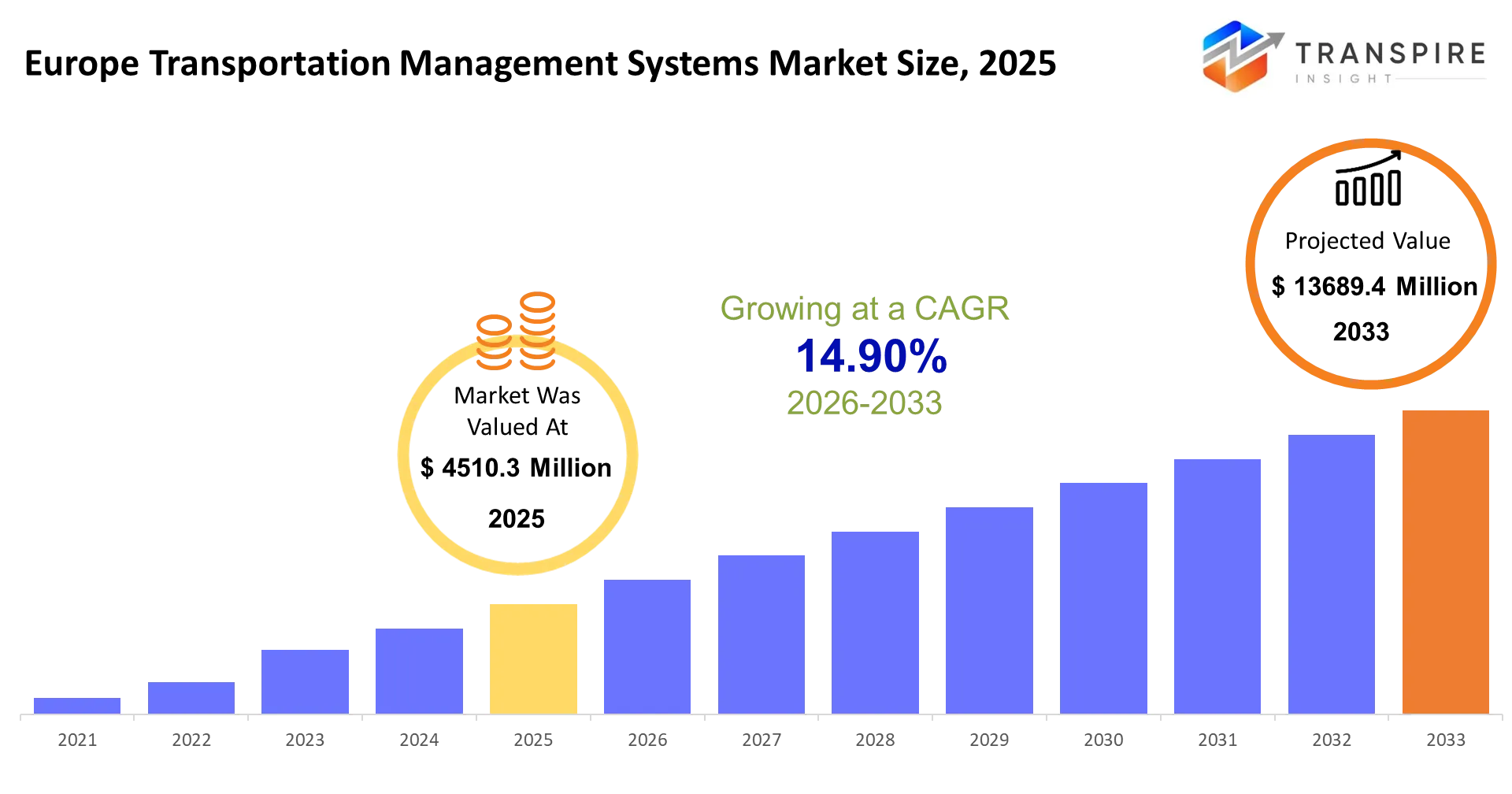
- Europe Transportation Management Systems Market Size 2025: USD 4510.3 Million
- Europe Transportation Management Systems Market Size 2033: USD 13689.4 Million
- Europe Transportation Management Systems Market CAGR: 14.90%
- Europe Transportation Management Systems Market Segments: By Type (On-premise, Cloud-based, Others), By Application (Fleet Management, Route Optimization, Freight Management, Others), By End-User (Logistics, Retail, Manufacturing, Others), By Component (Software, Services, Others).
To learn more about this report,  Download Free Sample Report
Europe Transportation Management Systems Market Summary:
The Europe Transportation Management Systems Market size is estimated at USD 4510.3 Million in 2025 and is anticipated to reach USD 13689.4 Million by 2033, growing at a CAGR of 14.90% from 2026 to 2033. The European Transportation Management Systems function as the central operational system which enables shippers and carriers and logistics providers to execute their actual goods movements through route planning and load optimization and freight cost management and real-time shipment tracking. The system resolves operational problems which result in wasted travel distance and late deliveries and incomplete tracking through different transportation systems.
The market has undergone a complete transition during the last three to five years because it has moved away from on-premise software toward cloud-based platforms that use APIs to connect with warehouse systems and carriers and customs data. The supply chain disruption which occurred after the COVID-19 pandemic and the following geopolitical conflicts served as the main trigger which demonstrated how fragile traditional logistics planning systems had become.
The disruption forced organizations to establish resilience as a primary strategic goal which they needed to achieve without losing their ability to control expenses. The implementation of TMS platforms which provide dynamic rerouting and predictive analytics and cross-border compliance automation has become a key investment area for organizations. The current growth pattern shows how organizations now depend on their software systems because TMS usage directly impacts their ability to deliver reliable services and maintain profit margins and operational flexibility.
Key Market Insights
- The European Transportation Management Systems Market is primarily controlled by Western Europe which will achieve approximately 45% market share during 2024 because of its established logistics system and its advanced digital technology usage.
- Northern Europe will experience the highest growth rate until 2030 because of its smart logistics development and its implementation of government-supported digital freight corridors.
- The TMS market will see its cloud-based solutions reach 60% market share in 2024 because organizations rapidly adopt SaaS solutions and use them to build their logistics networks through cloud-based systems.
- The second largest market segment consists of in-house systems which large companies use to operate their complex supply chain networks that depend on existing systems.
- The TMS market will experience its highest growth between 2025 and 2030 through AI-based systems which use predictive analytics to drive business expansion.
- The applications of freight planning and route optimization lead the market because they offer control over costs while achieving fuel savings which make up 35% of market share.
- Demand for complete shipment visibility drives the market for real-time tracking and visibility solutions which represent the fastest growing application of the industry.
- Third-party logistics providers (3PLs) lead the market with ~40% share, leveraging TMS platforms to manage multi-client, multi-modal operations efficiently.
- The retail and e-commerce markets will experience their most rapid expansion because of the challenges involved in delivering products to customers through their last mile and their need to support multiple sales channels.
What are the Key Drivers, Restraints, and Opportunities in the Europe Transportation Management Systems Market?
The Europe Transportation Management Systems Market develops because companies need to adopt real-time data-driven logistics solutions which became necessary after supply chain disruptions from the pandemic and more strict international shipping regulations. Disruptions showed how badly companies need visibility because their current systems use fixed routing which leads to financial loss and therefore companies now choose to implement cloud-based TMS systems which offer them flexible planning options. Companies started to view TMS as a tool for protecting their revenue after freight costs started to fluctuate and the company faced penalties for not meeting service requirements. The adoption rate has improved because companies that ship large quantities of goods and third-party logistics providers have achieved better results from route optimization which brings them additional financial benefits.
Transport systems and warehouse operations and customs procedures continue to face their biggest integration challenge because transport management system platforms need to connect with outdated systems which remain operational throughout these three areas. Many European enterprises still rely on region-specific IT architectures and carrier networks that lack standardized data formats. The existing system fragmentation creates problems because it lengthens implementation time and raises initial expenses which leads to delayed nationwide implementation that lasts for several years. Mid-sized firms choose not to invest because of this which results in lower market penetration and restricts solution providers from earning immediate income.
AI-powered predictive logistics which use TMS platforms to create their foundation present a major opportunity for growth in Eastern Europe because of its developing digital infrastructure. Smart freight corridor development together with IoT-enabled fleet systems creates a favorable environment which enables the use of advanced analytics. Predictive ETA together with automated exception management systems enable companies to decrease their dwell time while improving their asset utilization.
What Has the Impact of Artificial Intelligence Been on the Europe Transportation Management Systems Market?
The European transportation management systems undergo transformation through artificial intelligence which introduces automated systems to handle their complex compliance demands and operational processes. The AI-powered control systems of the system now execute fleet compliance verification because they verify driver hours and customs records and emissions data against established regulatory limits. The IoT sensors at maritime-linked logistics facilities monitor scrubber performance systems and exhaust gas cleaning technology to create automated systems which maintain emission standards through emission control without human intervention. This system reduces compliance risk while it decreases administrative responsibilities which span across operations in multiple countries.
The system uses machine learning models to achieve its extended predictive capabilities. The operators use predictive maintenance algorithms to detect vehicle and onboard system wear patterns which lead to future breakdowns while emissions forecasting models determine output levels based on various routing and load scenarios. The systems achieve route planning optimization through their analysis of traffic conditions and weather patterns and fuel consumption trends which results in more precise decision-making.
The results demonstrate their measurable effects. Companies achieve better fleet availability through their routing efficiency improvements which save 8 to 15 percent in fuel expenses and their quicker regulatory reporting processes which lower their penalty risks and operational expenses. The main problem with data remains because organizations face difficulties with both data separation and system integration expenses. The combination of disconnected carrier systems and inconsistent sensor data creates challenges for mid-sized operators who need to deploy AI technologies at scale because it decreases system reliability.
Key Market Trends
- The usage of cloud-native TMS platforms by large shippers who need to expand their operations and connect with systems in real time has reached over 60 percent since 2020.
- Business enterprises increased their spending on automated compliance modules after Brexit and new EU customs regulations entered effect because these systems reduced manual documentation errors and sped up cross-border operations.
- Logistics operators have moved from static route planning to AI-driven dynamic routing, cutting empty miles by 10–15% and improving delivery predictability across volatile freight corridors.
- Real-time visibility platforms have evolved from optional tools to core infrastructure, with over 70% of 3PLs integrating live tracking into daily operations by 2024.
- The integration of IoT-enabled fleet data has increased since 2021 which lets systems track fuel consumption and emissions and driver performance in multiple countries for transportation networks.
- The growth of e-commerce has changed how customers shop which forces retailers to implement TMS systems that enable them to manage same-day deliveries and last-mile deliveries instead of planning bulk shipments.
- SAP SE and Oracle Corporation have developed AI-based platforms which use predictive analytics to improve their main logistics operations.
- TMS providers and digital freight platforms have improved their collaboration since 2022 which enables operators to find available carriers at the moment and enhances capacity management when demand changes.
- Mid-sized companies have postponed technology adoption because of high integration costs but the new SaaS pricing structure which became available after 2021 has started to reduce obstacles that prevent businesses from implementing solutions.
- European Union member states now require companies to monitor their emissions through TMS systems which has led to a higher demand for carbon reporting and optimization solutions.
Europe Transportation Management Systems Market Segmentation
By Type
The market share of cloud-based solutions which offer both fast deployment and low initial costs together with seamless system connection to carrier and warehouse components has reached its highest point. After 2020, large companies started moving from their on-premise data systems to software as a service because they needed to access their data remotely while supporting business growth. The majority of small businesses nowadays select subscription-based pricing systems because these models enable them to pay according to their actual usage, while only highly regulated sectors adopt hybrid operating models.
The segment experiences growth through API connectivity and real-time data exchange and vendor-managed updates which decrease IT responsibilities. The upcoming development will create completely cloud-native systems which enable logistics networks to work together while vendors need to develop better security systems and data management protocols and systems which operate across multiple platforms to keep their enterprise customers.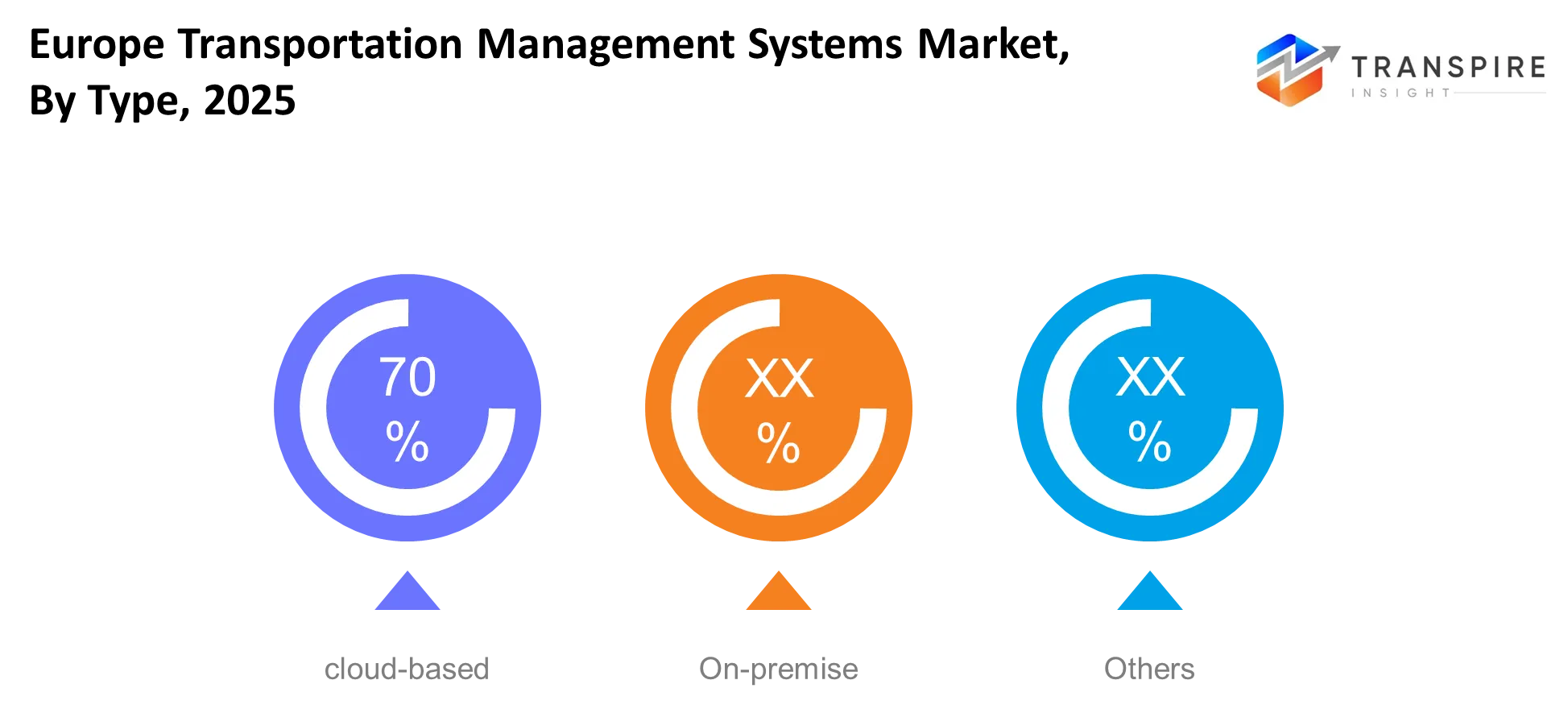
To learn more about this report, Download Free Sample Report
By Application
The main application of freight management together with route optimization which directly reduces operational costs while enhancing delivery performance generates the highest market share. The development of fleet management solutions now employs telematics technology together with driver compliance monitoring systems to improve their cross-border operational capabilities. The need for real-time visibility applications has surged because companies want to track their shipments through different transportation modes and handle unexpected problems without delay.
All application areas demonstrate a transformation from fixed schedule development to real-time data-powered continuous optimization processes. Predictive capabilities will drive future development because they enable systems to forecast delays while automatically rerouting and load optimization. The solution providers need to develop their operations through advanced analytics together with machine learning technology to achieve demonstrable efficiency improvements.
By End-User
Logistics providers handle complex transportation systems which require them to serve multiple clients simultaneously throughout the day. Retail and e-commerce sectors follow closely because they struggle with last-mile delivery solutions while trying to meet their urgent product delivery requirements.
Manufacturing firms use transportation systems to achieve their inbound and outbound logistics synchronization needs throughout their just-in-time production operations. The adoption patterns of businesses depend on two factors which include their operational complexity and their ability to protect profit margins. The future digital tools market will grow when mid-sized enterprises gain access to more affordable digital tools. Vendors will need to create solutions which match the operational needs of different business sectors while providing the ability to customize settings according to their unique business requirements.
By Component
The software system which operates core platforms for planning mission execution and analytics functions accounts for most of its total software components. The implementation and integration services together with their support functions make up a vital yet marginally smaller section which requires system operators to match their new technologies with their current systems. The demand for managed services has grown because organizations do not have the necessary skills to operate and enhance their complex technological systems.
Digital transformation progress together with system upgrade requirements drives the growth of service offerings. Future direction indicates tighter coupling between software and services, with vendors offering end-to-end solutions that include consulting, deployment, and performance optimization. The trend will establish continuous income streams which will help solution providers build enduring relationships with their customers.
What are the Key Use Cases Driving the Europe Transportation Management Systems Market?
The primary application of freight planning together with route optimization generates maximum demand because fuel expenses and driver resources and delivery fines create direct impact on profit margins. The large logistics companies together with manufacturing companies depend on these systems to merge shipments and choose the best shipping companies and perform real-time route changes especially during times of heavy traffic in European transportation routes.
The retail industry and third-party logistics sector are growing their adjacent applications which now depend on real-time shipment tracking and automated compliance management as essential requirements. E-commerce companies apply these tools to oversee their last-mile delivery operations whereas cross-border businesses utilize automated customs paperwork to minimize delays which occur after regulatory shifts including Brexit.
The upcoming use cases involve AI-based predictive ETA systems together with carbon emissions monitoring tools that comply with EU climate regulations. Sustainability-minded shippers together with fleet operators are choosing these solutions to achieve their transport operation goals which require more precise reporting and greater reductions in emissions.
|
Report Metrics |
Details |
|
Market size value in 2025 |
USD 4510.3 Million |
|
Market size value in 2026 |
USD 5177.6 Million |
|
Revenue forecast in 2033 |
USD 13689.4 Million |
|
Growth rate |
CAGR of 14.90% from 2026 to 2033 |
|
Base year |
2025 |
|
Historical data |
2021 - 2024 |
|
Forecast period |
2026 - 2033 |
|
Report coverage |
Revenue forecast, competitive landscape, growth factors, and trends |
|
Regional scope |
Europe (Germany, United Kingdom, France, Italy, Spain and Rest of Europe) |
|
Key company profiled |
SAP, Oracle, IBM, Descartes, Manhattan Associates, Trimble, MercuryGate, Blue Yonder, Infor, TMW Systems, C.H. Robinson, JDA, McLeod Software, Transporeon, Freightview |
|
Customization scope |
Free report customization (country, regional & segment scope). Avail customized purchase options to meet your exact research needs. |
|
Report Segmentation |
By Type (On-premise, Cloud-based, Others), By Application (Fleet Management, Route Optimization, Freight Management, Others), By End-User (Logistics, Retail, Manufacturing, Others), By Component (Software, Services, Others) |
Which Regions are Driving the Europe Transportation Management Systems Market Growth?
Western Europe leads the market because it has strict regulatory systems and developed transportation networks and its logistics networks use advanced digital technology. Germany, France and Netherlands require companies to use automated transport management systems because they have established strict emissions standards and cross-border compliance rules. The Port of Rotterdam and Port of Hamburg serve as major ports which handle high cargo volumes, while needing effective routing and coordination systems. The active logistics ecosystem creates permanent innovation through its network of logistics companies, digital cargo platforms, and business IT solution providers.
Northern Europe operates as a stable region which possesses advanced technology, but its development proceeds through sustainable practices instead of business expansion. Sweden and Denmark invest in public projects that support their development of green transport corridors and digital freight solutions. The region maintains steady policy implementation through its strong partnership between government agencies and logistics companies and this practice results in continuous system adoption without any significant disruptions. The stable operations of Northern Europe provide important long-term revenue streams, particularly through its advanced analytics and emissions tracking solutions.
Eastern Europe has become the fastest growing region because of its quick logistics modernization efforts and infrastructure development projects. The countries of Poland and Romania expanded their road and rail systems which improved their position as important transit centers between Western Europe and Asia. The rising need for transport optimization solutions and cross-border coordination tools has increased because of growing foreign investment and nearshoring activities. The period from 2026 to 2033 will provide new business opportunities to investors who want to develop digital transport solutions that can grow and operate at low expenses.
Who are the Key Players in the Europe Transportation Management Systems Market and How Do They Compete?
The Europe Transportation Management Systems Market experiences competition between its two opposing forces, which are market consolidation and intentional market disruption. Large enterprise software vendors defend market share through their integrated platforms and their established customer relationships, while niche providers and digital freight platforms challenge them with their ability to implement solutions more quickly and their specialized product features. The current competition between businesses depends on technological advancements, especially in AI-based optimization and real-time tracking systems and application programming interfaces which link various transportation systems. Buyers increasingly evaluate vendors on interoperability and measurable cost savings rather than upfront pricing, which shifts advantage toward platforms that deliver continuous operational insights.
The company SAP SE establishes its main focus on achieving complete system integration with enterprise resource planning systems because this approach enables uninterrupted data exchange between procurement and warehousing and transport execution processes. The tight integration of these systems creates an effective switching barrier which prevents large manufacturers from changing their operations. Oracle Corporation uses advanced analytics and cloud infrastructure technologies to create a unique transport planning system which enables users to design scalable transport routes across complex global distribution networks. The two companies achieve business growth through their ongoing development of new products and their strategic collaborations with logistics service providers, which strengthen their business network.
Descartes Systems Group develops its business through solutions that focus on compliance requirements, particularly those which enable customs filing and regulatory messaging for cross-border activities of companies operating throughout Europe. Blue Yonder creates a competitive edge through its use of AI-based forecasting methods and its complete supply chain management system, which helps retailers who need to control unpredictable market demand. Trimble Inc. develops its business through hardware-software integration, which includes tracking systems and telematics for fleet operations as its main product line.
Company List
- SAP
- Oracle
- IBM
- Descartes
- Manhattan Associates
- Trimble
- MercuryGate
- Blue Yonder
- Infor
- TMW Systems
- C.H. Robinson
- JDA
- McLeod Software
- Transporeon
- Freightview
Recent Development News
In April 2026, Transporeon launches AI Natural Language Search: Transporeon, a Germany-based transport platform, introduced a new AI-powered Natural Language Search feature within its Autonomous Procurement system. The upgrade is designed to simplify freight matching for European carriers by removing complex filtering steps and enabling conversational search.
Source: https://www.transporeon.com
In April 2026, STG acquires Carrier Logistics, promises AI push for LTL operations: Private equity firm STG completed the acquisition of Carrier Logistics Inc., a long-established transportation management software provider for LTL carriers. The company plans to integrate AI-driven capabilities into the platform, strengthening European and global terminal-based transport execution systems.
Source: https://www.trucknews.com
What Strategic Insights Define the Future of the Europe Transportation Management Systems Market?
The Europe Transportation Management Systems Market is developing towards autonomous platforms which make decisions through AI systems that manage multiple interconnected networks by directing transportation routes and regulatory requirements and carrier selection processes. The system needs to handle three freight transportation challenges which include unpredictable freight price changes and complicated regulatory requirements and various transportation methods without the need for human operators.The next five to seven years will see value transition from individual software products towards complete systems which combine planning execution and predictive analytics into one operational control system.
A market risk that operates in the background emerges from the tendency of the industry to concentrate on few dominant platforms which restrict system compatibility and create stronger ties to proprietary systems. The situation will create obstacles for mid-sized companies which need to switch between systems while halting innovation. The emerging opportunity in carbon-intelligent transport optimization enables systems to choose routes which meet emissions targets that change with new EU regulations.
All market participants need to direct their financial resources towards developing open API-first systems which enable smooth system connections while safeguarding their ability to adjust to new regulatory requirements and digital logistics standards.
Europe Transportation Management Systems Market Report Segmentation
By Type
- On-premise
- Cloud-based
- Others
By Application
- Fleet Management
- Route Optimization
- Freight Management
- Others
By End-User
- Logistics
- Retail
- Manufacturing
- Others
By Component
- Software
- Services
- Others
Frequently Asked Questions
Find quick answers to common questions.
The Approximate Europe Transportation Management Systems Market size for the Market will be USD 13689.4 Million in 2033.
The key Segments of the Europe Transportation Management Systems Market are By Type (On-premise, Cloud-based, Others), By Application (Fleet Management, Route Optimization, Freight Management, Others), By End-User (Logistics, Retail, Manufacturing, Others), By Component (Software, Services, Others).
Major Players in the Europe Transportation Management Systems Market are SAP, Oracle, IBM, Descartes, Manhattan Associates, Trimble, MercuryGate, Blue Yonder, Infor, TMW Systems, C.H. Robinson, JDA, McLeod Software, Transporeon, Freightview.
The Current Market size of the Europe Transportation Management Systems Market is USD 4510.3 Million in 2025.
The Europe Transportation Management Systems Market CAGR is 14.90%.
- SAP
- Oracle
- IBM
- Descartes
- Manhattan Associates
- Trimble
- MercuryGate
- Blue Yonder
- Infor
- TMW Systems
- C.H. Robinson
- JDA
- McLeod Software
- Transporeon
- Freightview
Recently Published Reports
-
Apr 2026
3D Optical Profiler Market
3D Optical Profiler Market Size, Share & Analysis Report By Type (Desktop 3D Optical Profiler, and Portable 3D Optical Profiler), By Technology (Confocal Technology, and White Light Interference), By End-Use Industry (Manufacturing, Research Institutions, Automotive, Aerospace and Defense, Medical Devices, and Other), and Geography (North America, Europe, Asia-Pacific, Middle East and Africa, South and Central America), 2021 - 2031
-
Apr 2026
Depth Sensor Market
Depth Sensor Market Size, Share & Analysis Report By Type (Infrared Depth Sensors, Time-of-Flight (ToF) Sensors, Stereo Vision Sensors, Structured Light Sensors, Ultrasonic Depth Sensors), By Application (Automotive, Robotics, Gaming, Consumer Electronics, Industrial Automation, Healthcare, Security & Surveillance, Others), By End Users (Automotive Manufacturers, Consumer Electronics Companies, Healthcare Providers, Industrial Companies, Security Agencies, Gaming Companies, Robotics Companies, Others), and Geography (North America, Europe, Asia-Pacific, Middle East and Africa, South and Central America), 2021 – 2031
-
Apr 2026
Digital Manufacturing Market
Digital Manufacturing Market Size, Share & Analysis Report By Component (Hardware, Software, and Services), By Technology (Robotics, 3D Printing, Internet of Things (IoT), and Others), By Application (Automotive and Transportation, Aerospace and Defense, Consumer Electronics, Industrial Machinery, and Others), By Process Type (Computer-Based Designing, Computer-Based Simulation, Computer 3D Visualization, Analytics, and Others), and Geography (North America, Europe, Asia-Pacific, Middle East and Africa, South and Central America), 2021 – 2031
-
Apr 2026
Digital Visa Services Market
Digital Visa Services Market Size, Share & Analysis Report By Type (Individual Travelers, Group Travelers), By Application (Tourism, Business Travel, Others), and Geography (North America, Europe, Asia-Pacific, Middle East and Africa, South and Central America), 2021 – 2031