
United Kingdom Cruelty-free Cosmetics Market Size & Forecast:
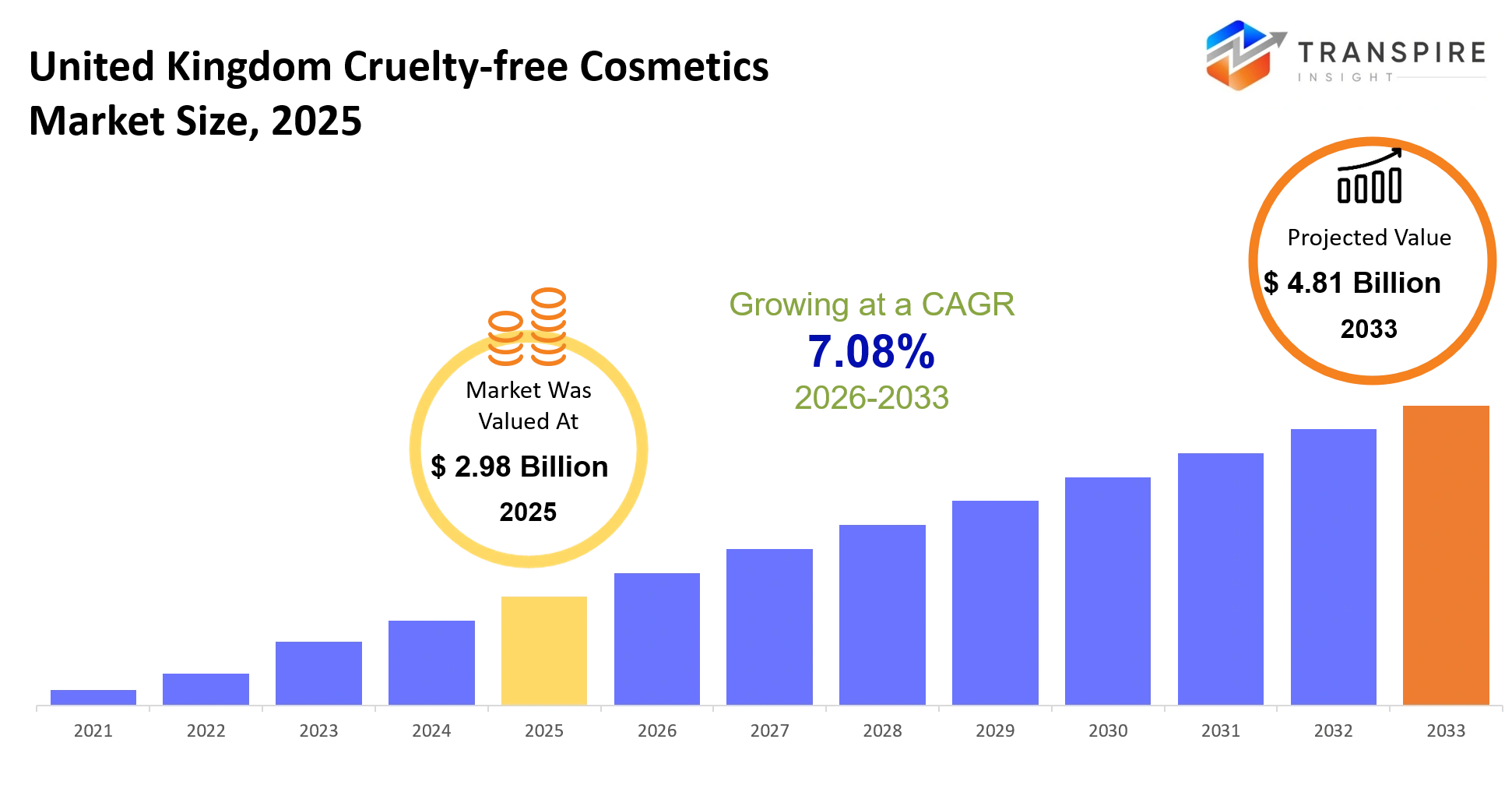
- United Kingdom Cruelty-free Cosmetics Market Size 2025: USD 2.98 Billion
- United Kingdom Cruelty-free Cosmetics Market Size 2033: USD 4.81 Billion
- United Kingdom Cruelty-free Cosmetics Market CAGR: 7.08%
- United Kingdom Cruelty-free Cosmetics Market Segments: By Product (Skincare, Makeup, Haircare, Fragrances, Bath & Body, Personal Care, Others); By Distribution Channel (Supermarkets, Specialty Stores, Pharmacies, Online Retail, Brand Stores, Others)
United Kingdom Cruelty-free Cosmetics Market Summary
The United Kingdom Cruelty-free Cosmetics Market was valued at USD 2.98 billion in 2025. It is forecast to reach USD 4.81 billion by 2033. That is a CAGR of 7.08% over the period.
The United Kingdom market for cruelty-free cosmetics allows customers to gain access to beauty and personal care products that help to avoid using formulations and production processes with animal testing. For brands and retailers, it becomes possible to create product ranges that are aligned with growing expectations regarding the ethics of purchasing without sacrificing product quality. Over the last five years, the market experienced the transformation of its structure when cruelty-free certification and ingredient sourcing became standard criteria instead of distinctive qualities of premium products. The reason behind such development is increased demand for the monitoring of supply chains worldwide after the Brexit when many companies had to reevaluate their approach to sourcing, compliance, and product labeling. With the investments made into innovative testing processes, traceable ingredients, and certification, the trust of consumers grows, and the possibility of making products premium becomes greater. This helps to increase the usage of products and generate additional margin for companies.
Key Market Insights
- England occupies the top position in United Kingdom Cruelty-free Cosmetics market in terms of revenue generation, contributing around 78% to the overall market value in 2025, aided by an extensive retail presence and robust brand image.
- Scotland emerges as the highest growing region between 2025–2032, owing to rising penetration of sustainable beauty and premium cosmetic retail offerings.
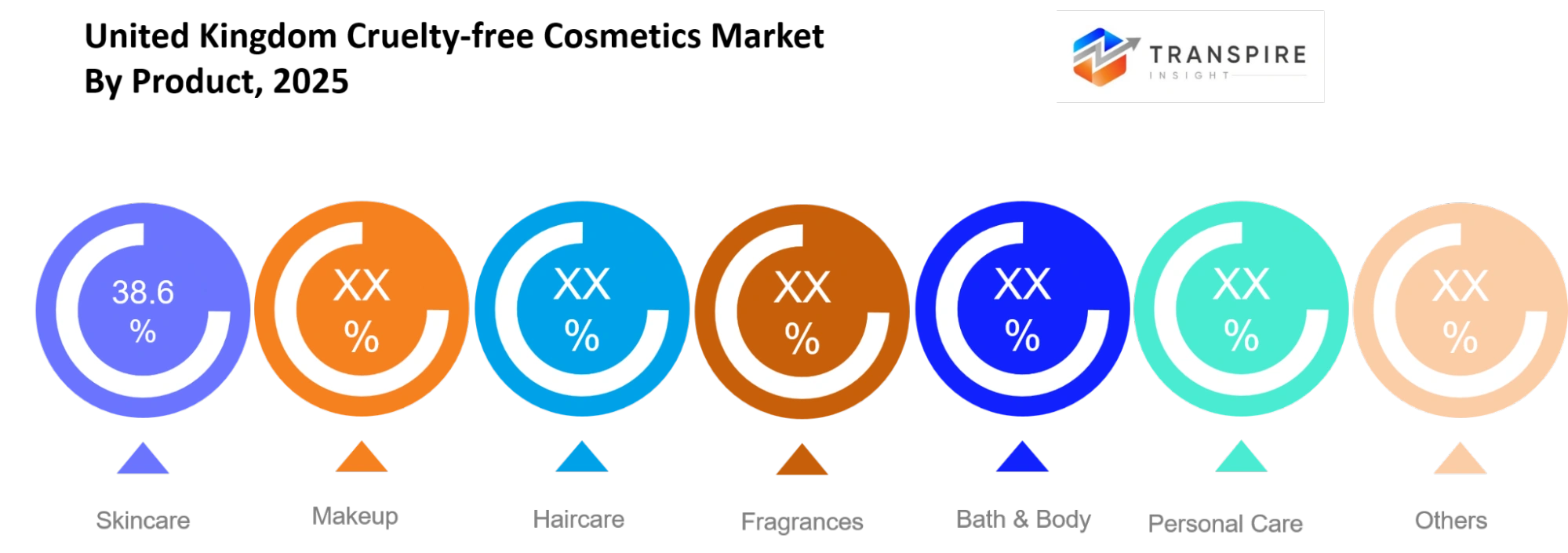
- Skincare dominates the market with nearly 34% revenue share in 2025, backed by development of innovative vegan and cruelty-free ingredients.
- Makeup ranks second in the market, propelled by innovation of premium products and increasing demand for ethically sourced color cosmetics.
- Haircare is estimated to emerge as the most rapidly growing segment in the coming years up to 2032.
- Females constitute approximately 72% of total market demand in 2025, which makes them the key consumer application for the skincare and cosmetics segments.
- Grooming for men is the fastest growing application segment, driven by increasing product offerings and increasing usage of premium personal care products.
- Individual consumers constitute more than 88% market share in 2025, enabled by sales via supermarkets, specialty stores, drug stores, and online retail platforms.
- Salons & professional beauty providers make up the fastest growing end user segment, led by demand for certified ethical and premium cosmetics brands.
- The Lush, The Body Shop, e.l.f. Beauty, Charlotte Tilbury, Fenty Beauty, and Rare Beauty brands continue to be important players in the United Kingdom Cruelty-free Cosmetics Market with varied range of products.
What are the Key Drivers, Restraints, and Opportunities in the United Kingdom Cruelty-free Cosmetics Market?
The major factor behind the development of the United Kingdom Cruelty-free Cosmetics Market is the high utilization of cruelty-free products that are certified by the retailers. At present, retailers take into account certificates such as Leaping Bunny and Cruelty Free International to increase the confidence of customers and remove any ambiguities. Moreover, innovations in safety tests for the alternative technologies and traceability of ingredients enable manufacturers to offer more certified products without lowering the quality of the products.
The key restraint on the United Kingdom Cruelty-free Cosmetics Market is the difficulty of ensuring certified cruelty-free supply chain of the companies. Verification of all raw material suppliers, contract manufacturers and tests is complicated and takes significant efforts. It is especially difficult for small brands that do not have sufficient resources. As a result, product development process takes more time, certification becomes costly and expansion of market into new categories goes slower than consumer adoption rate.
Opportunity for the expansion in the market lies in the combination of cruelty-free certification and products made with the help of biotechnology along with product development using AI. Through research and development in active ingredients produced from laboratory techniques and precision fermentation, companies can reduce dependency on traditional ingredient sources, making the process sustainable and consistent. It would enable companies to innovate faster and develop products quicker to become competitive in the premium UK beauty market.
What Has the Impact of Artificial Intelligence Been on the United Kingdom Cruelty-free Cosmetics Market?
AI and digital innovations are changing the United Kingdom cruelty-free cosmetics sector by enhancing product development, supply chain visibility, and customer engagement. AI-enabled formulation platforms assess Billions of ingredient combinations to discover animal-free ingredients meeting performance, safety, and regulatory specifications through reduction in the time taken to conduct research and development activities. Predictive analytics helps manufacturers predict future demand trends, optimize stock and identify sourcing risks associated with cruelty-free ingredients, hence eliminating shortages and surplus in inventory. Computer vision is used in automating inspections at the production stage, which results in uniformity of products produced and minimizes wastage during production processes. In the retail sector, AI enables the use of recommendation engines to provide customers with suitable product recommendations, leading to increased conversions and enhanced customer loyalty. Blockchain-based traceability systems are used to determine the origin of the ingredients and compliance of the supplier to build positive reputations for brands. Digital technology can be beneficial for the timely introduction of new products and meeting regulatory requirements and improving efficiencies. But the wider implementation of AI is impeded by the costly integration of digital technologies into very fragmented networks of suppliers and absence of standard quality data about cruelty-free ingredient procurement and certification.
Key Market Trends
- Since 2021, large retail companies have increased the range of certified products that are cruelty-free, bringing ethical beauty products to the mainstream market.
- Companies integrate cruelty-free products along with vegan products and products with refillable packaging due to the transition to more transparent and responsible approaches to product development.
- AI-driven formulation platforms have accelerated the process of product development, selecting suitable ingredients without the need for actual tests before the product development.
- Since Brexit, companies have improved their supply chain management, including the process of certification for different countries' ingredients supply chains.
- Digital brands have increased consumer sales via personalization of the product recommendation process and virtual skin diagnosis.
- The firms that have increased their launch of products with cruelty-free certified badges include Lush, The Body Shop, e.l.f. Beauty, and Charlotte Tilbury.
- Third-party certification is becoming more influential as a buying criterion compared to ethics that come from companies themselves, hence the need to allocate more resources towards compliance and traceability.
- Transparency in the composition of ingredients has increased, where companies are providing detailed information regarding their sourcing and formula for their products.
- The contract manufacturers have put into place specialized manufacturing procedures that facilitate easier cruelty-free certification without contamination of other cosmetic products.
United Kingdom Cruelty-free Cosmetics Market Segmentation
By Product:
Skincare takes a high ranking spot owing to the daily use and purchase routine. Skincare products such as cleansers, moisturizers, serums, sun protection products, and lip care products have steady sales of cruelty-free items at all price levels. New product development involves creation of plant-based products, fragrance-free products, and dermatologically tested formulas that improve the quality of the product line. Constant innovations bring a number of new formulas, textures, and packaging in order to meet the current beauty trends.
The category of makeup is also essential owing to foundation, concealer, lipstick, mascara, and eye cosmetics that have cruelty-free certification. There is also significant sales growth in the hair care market owing to sulfate-free shampoos, conditioners, hair masks, and styling products. Products for personal care are also represented by a variety of body lotions, deodorants, and hand care products.
By Distribution Channel:
Offline retail is still responsible for capturing a large chunk of sales as people are able to compare the products before buying them in supermarkets, drugstores, beauty specialty stores, and departmental stores. Offline retailing provides an opportunity for product demonstrations, consultations from professionals, and promotions that play an important role in making purchasing decisions. Known retail chains create more shelf space for certified cruelty-free products in response to the changed purchasing behavior. The premium beauty stores enhance the category development through launching exclusive products.
Online retailing shows more dynamic development as online shopping is known to have larger product offerings, competitive prices, and convenience of home delivery. Website of brands and e-commerce sites have all the necessary information about ingredients, certification information, and consumer feedbacks on the products. Digital marketing and personalized product recommendations increase consumer involvement and motivate repeat purchases.
What are the Key Use Cases Driving the United Kingdom Cruelty-free Cosmetics Market?
The daily skin care regimen is still the key use case driving revenue growth of the United Kingdom cruelty-free cosmetics market. The need for a regular supply of cleansers, moisturizers, serums, and sunscreens is guaranteed by the frequency of the skincare regimen, which entails product repurchasing. In addition, cruelty-free certifications will increase brand loyalty among buyers who look for ethical products and their quality.
There is an expansion in the range of applications of certified cruelty-free cosmetics in makeup and hair care lines. The popularity of professional beauty salons that use certified cruelty-free cosmetics in treatments and hair styling grows, and high-end retailers extend their cruelty-free product portfolio to meet the needs of customers.
Potential application areas of cruelty-free cosmetics are biotech skincare products formulated using laboratory-synthesized ingredients and personalized beauty products created with the help of AI technology. Additionally, refillable cosmetics and digital ingredient traceability of cosmetics are emerging. Such innovations are expected to provide opportunities for premium beauty categories in the forecast period.
|
Report Metrics |
Details |
|
Market size value in 2025 |
USD 2.98 Billion |
|
Market size value in 2026 |
USD 2.98 Billion |
|
Revenue forecast in 2033 |
USD 4.81 Billion |
|
Growth rate |
CAGR of 7.08% from 2026 to 2033 |
|
Base year |
2025 |
|
Historical data |
2021 - 2024 |
|
Forecast period |
2026 - 2033 |
|
Report coverage |
Revenue forecast, competitive landscape, growth factors, and trends |
|
Regional scope |
United Kingdom |
|
Key company profiled |
Lush, The Body Shop, e.l.f. Beauty, Pacifica Beauty, BYBI Beauty, Tropic Skincare, Charlotte Tilbury, Fenty Beauty, Hourglass Cosmetics, Rare Beauty, Revolution Beauty, Dr. Pawpaw, Beauty Kitchen, PHB Ethical Beauty, Weleda |
|
Customization scope |
Free report customization (country, regional & segment scope). Avail customized purchase options to meet your exact research needs. |
|
Report Segmentation |
By Product (Skincare, Makeup, Haircare, Fragrances, Bath & Body, Personal Care, Others); By Distribution Channel (Supermarkets, Specialty Stores, Pharmacies, Online Retail, Brand Stores, Others) |
Which Regions are Driving the United Kingdom Cruelty-free Cosmetics Market Growth?
The UK Cruelty-Free Cosmetics Market is primarily dominated by England since the combination of both the largest customer base in the country along with the greatest number of beauty brands, factories and distribution networks is present there. Commercial centers such as London, Manchester and Birmingham provide great conditions for the presence of high-end beauty retailers, pharmacies and supermarkets, and even e-commerce fulfillment centers that contribute to great accessibility. Availability of independent certifiers, marketing companies and research centers makes it possible to quickly produce and promote products on the market.
Scotland is not as dominant as England, yet it still offers stable market revenues due to some unique characteristics. The development of the regional market is fostered by premium natural beauty brands, advanced health and wellness sector and customers who prioritize local ingredients and sustainable production. Retail expansion happens steadily through specialty stores and online sales without rapid launches across the country. Such kind of market structure gives companies the possibility to earn stable revenues without excessive competition.
Wales has become the leading regional market since the investments in independent beauty companies and direct-to-customer sales continue to increase. The manufacturers of Wales are developing their products based on cruelty-free cosmetics as the development of the online market allows small companies to sell their goods throughout the UK without the need to have extensive physical stores. The development of sustainable manufacturing and regional entrepreneurship has also promoted the launch of new products and the growth of brands. In 2026-2033, these trends will create investment opportunities for both investors and start-ups.
Who are the Key Players in the United Kingdom Cruelty-free Cosmetics Market and How Do They Compete?
In the UK-based market for cruelty-free cosmetics, the level of competition is not very fragmented, with large beauty corporations in the market along with ethical brands and companies operating online. Differentiation in this regard involves less pricing and certifications, formulation of products, ingredients and innovation. Market-leading brands maintain their market position by developing new ranges of certified products whereas new players try to stand out in terms of business model of direct consumer approach, reusability of packages and fast product developments. Partnership with retailers and online interactions have become critical elements for maintaining visibility and retaining customers in the market.
The Lush Company has been able to differentiate itself in terms of offering fresh handmade products with minimum packaging and cruelty-free certification backed by ingredient disclosure. The company maintains its market position by launching refilling programs and offering exclusive products at company retail stores. The Body Shop Company relies on its certification of ethical sourcing and community trade.
E.l.f. Beauty stands out in the market place through offering cruelty-free products at affordable prices without compromising on innovation in product lines. Frequent new product launches and robust marketing campaigns enable the brand to adapt fast to emerging trends in the beauty industry. The brand positioning of Charlotte Tilbury is enhanced through the use of superior formulations, luxury branding, and technologically advanced beauty consultation services.
Company List
- Lush
- The Body Shop
- e.l.f. Beauty
- Pacifica Beauty
- BYBI Beauty
- Tropic Skincare
- Charlotte Tilbury
- Fenty Beauty
- Hourglass Cosmetics
- Rare Beauty
- Revolution Beauty
- Dr. Pawpaw
- Beauty Kitchen
- PHB Ethical Beauty
- Weleda
Recent Development News
In 2026, Cruelty Free International continued expanding its Approval Programme with additional approved beauty brands. The independently audited certification program strengthened supply chain verification and supported wider adoption of certified cruelty-free cosmetics across the United Kingdom. Source:https://www.crueltyfreeinternational.org
In January 2024, The Body Shop became the first global beauty brand to achieve 100% Vegan Society-certified product formulations across skincare, body care, haircare, makeup, and fragrance. This certification reinforced the company's leadership in ethical and cruelty-free beauty while strengthening consumer confidence in certified products. Source:https://www.globalcosmeticsnews.com
What Strategic Insights Define the Future of the United Kingdom Cruelty-free Cosmetics Market?
In the coming five to seven years, the UK cruelty-free cosmetics industry will see a change from competition based on certifications to competition based on science through which biotechnology, new ingredient innovation, and traceability in the digital form will drive the creation of value. Such changes will be triggered by increasing need for transparency in the supply chain and consumer inclination towards independently certified ethical products that deliver performance. The less recognized threat in the coming years will be increased reliance on the few number of certified ingredient suppliers, thereby making it expensive for firms in terms of sourcing cost and product development process. In contrast to such threats, AI-based formulation platforms and active ingredients derived from biotechnology can provide an excellent opportunity for firms as it allows innovation quickly while remaining within the realm of being cruelty-free.
United Kingdom Cruelty-free Cosmetics Market Report Segmentation
By Product
- Skincare
- Makeup
- Haircare
- Fragrances
- Bath & Body
- Personal Care
- Others
By Distribution Channel
- Supermarkets
- Specialty Stores
- Pharmacies
- Online Retail
- Brand Stores
- Others
Frequently Asked Questions
Find quick answers to common questions.
The expected United Kingdom Cruelty-free Cosmetics Market size for the market will be USD 4.81 Billion in 2033.
Key segments for the United Kingdom Cruelty-free Cosmetics Market are By Product (Skincare, Makeup, Haircare, Fragrances, Bath & Body, Personal Care, Others); By Distribution Channel (Supermarkets, Specialty Stores, Pharmacies, Online Retail, Brand Stores, Others).
Major United Kingdom Cruelty-free Cosmetics Market players are Lush, The Body Shop, e.l.f. Beauty, Pacifica Beauty, BYBI Beauty, Tropic Skincare, Charlotte Tilbury, Fenty Beauty, Hourglass Cosmetics, Rare Beauty, Revolution Beauty, Dr. Pawpaw, Beauty Kitchen, PHB Ethical Beauty, Weleda.
The United Kingdom Cruelty-free Cosmetics Market size is USD 2.98 Billion in 2025.
The United Kingdom Cruelty-free Cosmetics Market CAGR is 7.08% from 2026 to 2033.
- Lush
- The Body Shop
- e.l.f. Beauty
- Pacifica Beauty
- BYBI Beauty
- Tropic Skincare
- Charlotte Tilbury
- Fenty Beauty
- Hourglass Cosmetics
- Rare Beauty
- Revolution Beauty
- Dr. Pawpaw
- Beauty Kitchen
- PHB Ethical Beauty
- Weleda
About the Authors

Chetan Dhatrak
I’m Chetan Dhatrak, a Senior Research Analyst at Transpire Insight, specializing in the Consumer Goods, Foods and Beverages industry. I focus on analyzing market trends, consumer behavior, competitive landscapes, and industry developments to deliver accurate, data-driven insights. My research at Transpire Insight is built on credible sources and in-depth analysis, helping businesses and readers better understand market dynamics, emerging opportunities, and evolving consumer preferences. I’m committed to creating reliable, well-researched content that supports informed decision-making and reflects the latest developments in the consumer goods and food & beverage sectors.

Chakradhar Khansole
Chakradhar serves as the Research Director at Transpire Insight, bringing over 8 years of experience in technology, innovation, and strategic market intelligence. He specializes in transforming complex market data into actionable business insights that enable organizations to make informed, growth-oriented decisions. Recognized for his strategic vision and analytical expertise, Chakradhar leads high-impact research initiatives, delivering comprehensive market assessments, competitive intelligence, and forward-looking industry analysis.
Recently Published Reports
-
Apr 2026
Bottled Water Market
Bottled Water Market Size, Share & Analysis Report By Product Type (Still Bottled Water, Carbonated Bottled Water, Functional Bottled Water, and Others), By Packaging (PET, Cans, and Others), By Sales Channel (Supermarkets/Hypermarkets, Convenience Stores/Drug Stores, Grocery Stores/Club Stores, Foodservice, and Others) and Geography (North America, Europe, Asia-Pacific, Middle East and Africa, South and Central America), 2021 - 2032
-
Apr 2026
Color Cosmetic Packaging Market
Color Cosmetic Packaging Market Size, Share & Analysis Report By Application (Mascara Packaging, Liquid Packaging, and Liquid Face), By Type (Tubes & Bottles, Pens & Markers, Compacts & Containers, and Droppers & Pumps), and Geography (North America, Europe, Asia-Pacific, Middle East and Africa, South and Central America), 2021 - 2031
-
Apr 2026
External Microphone For Camera Market
External Microphone For Camera Market Size, Share & Analysis Report By Type (Shotgun Microphone, Lavalier Microphone, and Others), By Application (Digital Camera, Professional Video Camera, and Others), and Geography (North America, Europe, Asia-Pacific, Middle East and Africa, South and Central America), 2021 - 2031
-
Apr 2026
Foot Orthotic Insoles Market
Foot Orthotic Insoles Market Size, Share & Analysis Report By Type (Pre-fabricated, and Custom-made), By Material (Thermoplastic, Composite Carbon Fiber, and Others), By Distribution Channel (Drug Stores, Hospitals & Clinics, and Others), and Geography (North America, Europe, Asia-Pacific, Middle East and Africa, South and Central America), 2021 - 2031