
Europe Natural and Organic Cosmetics Market Size & Forecast:
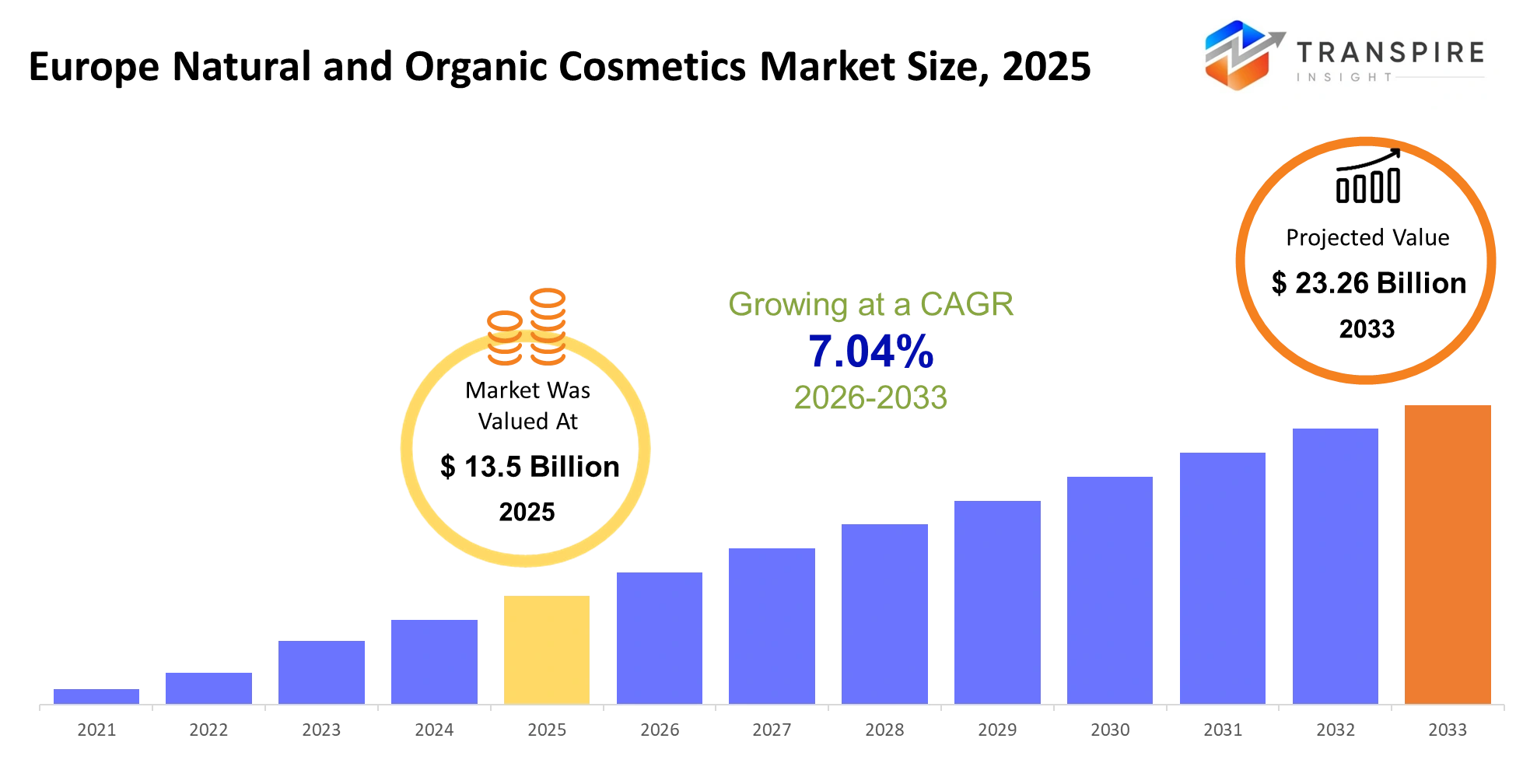
- Europe Natural and Organic Cosmetics Market Size 2025: USD 13.5 Billion
- Europe Natural and Organic Cosmetics Market Size 2033: USD 23.26 Billion
- Europe Natural and Organic Cosmetics Market CAGR: 7.04%
- Europe Natural and Organic Cosmetics Market Segments: By Type (Skincare, Haircare, Makeup, Fragrances, Personal Care, Others), By Application (Anti-aging, Skin Whitening, Moisturizing, Hair Treatment, Others), By End-User (Men, Women, Unisex, Others), By Distribution (Online, Retail Stores, Specialty Stores, Others).
To learn more about this report,  Download Free Sample Report
Europe Natural and Organic Cosmetics Market Summary:
The Europe Natural and Organic Cosmetics Market size is estimated at USD 13.5 Billion in 2025 and is anticipated to reach USD 23.26 Billion by 2033, growing at a CAGR of 7.04% from 2026 to 2033. The Europe Natural and Organic Cosmetics Market which began as a specialized wellness retail segment now serves to assist brands in meeting their new requirements for ingredient transparency and sustainable practices and skin safety standards which apply to all personal care products. Manufacturers are reformulating their skincare and haircare and color cosmetics products to decrease synthetic additives while achieving clean-label status and meeting environmental requirements that apply to packaging and sourcing.
The market has shifted during the past five years from boutique organic branding to science-backed bio-based formulation because major beauty companies now invest in plant-derived actives and biotech ingredients and refillable packaging systems. The European Green Deal together with new chemical regulations has intensified inspections which now examine petrochemical materials and product environmental effects throughout their complete life cycle. The pandemic created supply chain disruptions which revealed the industry's overreliance on imported raw materials, thus driving brands to establish local sourcing systems. Premium pricing power together with private-label growth enables retailers to generate revenue protection benefits through their expanded certified product shelf space.
Key Market Insights
- The Europe Natural and Organic Cosmetics Market 2025 saw Western Europe control almost 48% market share because of its established retail distribution systems.
- The market share of Germany in 2025 reached a major level because of its strong organic certification requirements and its high-end skincare products.
- Northern Europe represents the fastest expanding market until 2030 because of two factors which include sustainable beauty trends and refillable cosmetic packaging.
- France remains the top market for luxury organic beauty products because of its strong export business and established clean beauty manufacturing operations.
- The Europe Natural and Organic Cosmetics Market 2025 saw skincare products achieve 42% revenue share because of their high demand for facial care products.
- The second biggest market segment showed growth because customers bought sulfate-free shampoos and botanical oils and scalp wellness products.
- The segment of organic color cosmetics will experience the fastest growth until 2030 because companies introduce vegan makeup products which do not contain preservatives.
- The market for certified organic ingredients experienced substantial growth after 2022 because the European Union implemented new chemical compliance and labeling rules.
- The market distribution for personal care and skincare products reached 51% in 2025 because consumers wanted anti-aging solutions and products for sensitive skin.
- Men across Europe show increasing interest in grooming products because of new premium beard care and natural shaving items.
- The spa and wellness industry experiences rapid growth as hotels bring eco-friendly cosmetic items into their premium wellness programs.
- Women remained the leading end-user segment with approximately 67% share in 2025, supported by premium organic skincare purchasing patterns.
What are the Key Drivers, Restraints, and Opportunities in the Europe Natural and Organic Cosmetics Market?
The European Natural and Organic Cosmetics Market experiences its most powerful growth through European chemical regulations and sustainability regulations which become stricter under European Union Green Deal and the new cosmetic ingredient restrictions. The regulations required manufacturers to create new product formulas which used plant-based active ingredients and biodegradable materials and required traceable material sourcing methods. After manufacturers began following stricter compliance requirements, large retail and pharmacy chains started dedicating more space to approved certified products. The shift allowed brands to increase their premium product sales while generating additional revenue through their ability to meet certification and transparency demands. Companies which established proven ingredient tracing systems and refillable container systems gained quicker access to profitable retail markets throughout Germany and France and Nordic countries.
The market’s biggest structural barrier remains the high cost and limited scalability of certified organic raw materials. Botanical ingredients require controlled cultivation, seasonal harvesting, and compliance audits that cannot be expanded rapidly without affecting quality consistency. Europe relies on essential oil imports and natural preservatives and specialty extracts which originate from Asian and African and Latin American countries. Supply disruptions together with unpredictable agricultural yields result in increased production expenses which prevent price competition from conventional cosmetics and delay widespread market adoption.
The most promising field for sustainable growth prospects lies in biotechnology-based cosmetic formulation development. European companies are increasingly investing in laboratory-grown active ingredients and fermentation-based collagen substitutes and bioengineered antioxidant solutions which help decrease their reliance on climate-sensitive agricultural resources. France and Switzerland have developed into major innovation centers for biotech beauty manufacturing through collaborative research and development efforts between cosmetic companies and life sciences organizations.
What Has the Impact of Artificial Intelligence Been on the Europe Natural and Organic Cosmetics Market?
Artificial intelligence together with advanced digital technologies creates revolutionary changes for the Europe Natural and Organic Cosmetics Market through their better formulation methods and their ability to trace product movement throughout the supply chain and their capability to create customized products. Cosmetic manufacturers increasingly use AI-driven analytics platforms to evaluate ingredient compatibility, stability performance, and consumer skin-response patterns before commercial product launches. The process of developing organic skincare and haircare products becomes faster because this method decreases formulation development time while decreasing testing expenses. European beauty brands currently use machine learning models to project their raw material requirements while they develop optimal sourcing methods to acquire botanical extracts which helps them minimize procurement delays and waste of inventory.
Digital skin diagnostic tools together with AI-powered recommendation engines provide online businesses with better conversion rates to premium natural cosmetics.Brands use facial analysis software together with predictive algorithms to create personalized product recommendations which consider the user's hydration status and sensitivity level and their exposure to different environmental conditions.. The systems help companies keep their customers and drive higher spending by consumers who buy directly from their websites. Automated production monitoring systems further enhance manufacturing efficiency by detecting formulation inconsistencies and reducing batch rejection rates.
AI adoption has significant operational challenges because multiple ingredient databases exist and certification standards show variation among different suppliers. The absence of standardized digital documentation among small organic cosmetic manufacturers leads to decreased algorithm performance which makes it challenging to implement predictive analytics on a large scale within their current production operations.
Key Market Trends
- European cosmetic brands increased their use of fermentation-based preservatives because EU chemical regulations became more stringent between the years 2021 to 2025.
- The skincare industry started to use refillable packaging as a common solution after Western European countries implemented packaging waste regulations which began in 2023.
- L'Oréal and Beiersdorf started to invest more in biotechnology research because they wanted to decrease their need for natural resources which are influenced by climate conditions.
- The direct-to-consumer natural beauty market experienced substantial growth after 2020 because AI technology enabled better skin diagnostics which led to improved product recommendations and customer retention.
- Organic color cosmetics became a more profitable product category because vegan certification standards began to matter in European retail markets from 2024 onwards.
- The period from 2021 to 2023 experienced supply chain disruptions which forced manufacturers to establish local sourcing partnerships for their essential oils and herbal extracts and active ingredients.
- The Nordic countries saw a quicker adoption rate of premium natural beauty products because sustainability programmes introduced refill infrastructure and circular packaging programs in the region.
- After 2022 independent clean beauty brands began working with dermatology laboratories to prove their product effectiveness which helped them compete with international cosmetics companies.
- European pharmacy chains experienced rapid growth of private-label organic skincare products because retailers wanted to achieve better profit margins while maintaining control over certified sourcing standards.
Europe Natural and Organic Cosmetics Market Segmentation
By Type
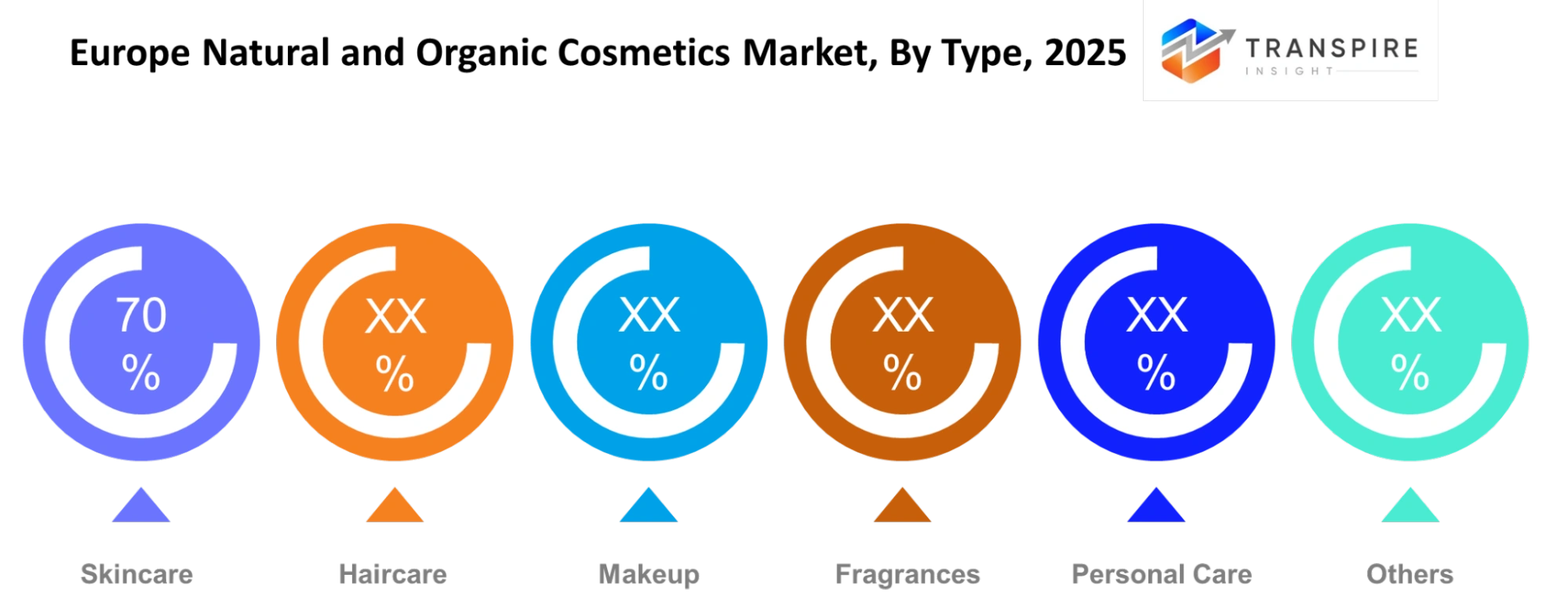
The market leader in skincare products achieves success because its products have high prices and customers purchase them regularly and people throughout Europe accept them as standard. The anti-pollution creams and botanical serums and microbiome-friendly formulations of pharmacy and specialty retail channels achieve better performance results than traditional products. The haircare market requires sulfate-free shampoos and scalp treatment oils and herbal conditioners which people use for their sensitive skin needs.
The makeup market experienced its first major growth wave after 2022 when retailers started to offer more vegan pigments and preservative-free products until 2025. The demand for fragrances and personal care products remains steady despite ongoing sourcing difficulties which raise manufacturing expenses for natural essential oils. The company will direct its upcoming business development efforts toward creating biotechnology-based ingredients and designing refillable packaging solutions. The market demands that manufacturers enhance their investment in fermentation-based actives while they should establish local ingredient sourcing to achieve supply stability and maintain high profit margins.
To learn more about this report, Download Free Sample Report
By Application
The revenue from anti-aging applications exceeds all other sources because older consumers choose botanical products that have proven efficacy through clinical studies. The market for moisturizing products continues to thrive because consumers demand these products throughout the year and they show higher buying frequency across all skincare product categories. Western European markets for skin whitening products function at moderate levels because regulations and evolving beauty standards forced companies to shift their focus toward skin tone enhancement and barrier repair products.
The market for hair treatment products experienced increased growth because post-pandemic wellness trends created a new emphasis on scalp health and hair damage recovery methods. Current product development efforts focus on creating multifunctional products that deliver three benefits through one certified product which offers hydration and UV protection and anti-inflammatory effects. The natural cosmetics industry will develop closer ties between biotechnology and dermatological testing methods which will drive future product development. Investors show a growing preference for brands that can demonstrate their effectiveness through clinical research while customers choose to emphasize ingredient traceability and sustainable product development instead of marketing-driven organic certification.
By End-User
The primary user group for premium skincare products and anti-aging treatments and cosmetics with high price points consists of women. Unisex products gained significant traction after minimalist skincare trends expanded across urban European markets between 2021 and 2025. The men's grooming sector emerged as a fast-growing market because of increasing preference for beard oils and natural deodorants and botanical shaving products.
Younger consumers today prefer products that offer multiple functions and display their complete list of ingredients and provide reusable packaging solutions. Consumers who belong to older age groups prioritize product effectiveness and dermatological safety and duration of skin health results. Personalized skincare systems together with artificial intelligence product recommendations based on skin type and environmental conditions will create new business opportunities. Companies that achieve a balance between high-end product image and their operational capabilities will succeed in retaining customers while retailers will increase shelf space for gender-neutral items and scientifically proven natural products.
By Distribution
The physical retail stores maintain their status as main distribution centers because premium cosmetic customers require them to test products, consult dermatologists, and confirm ingredient details before making their purchases. Urban markets benefit from specialty stores which provide selected product collections that customers believe to have authentic certified organic products. The online market experienced significant growth after 2020 because various digital skin diagnostic tools and influencer marketing methods and subscription-based beauty platforms made it easier for consumers to buy products online.
Pharmacy chains enhanced their market reach by adding more private-label natural skincare products and increasing the display area for clinically proven botanical items. Price-sensitive consumers who value affordability more than certification standards create distribution challenges for traditional mass-market distribution channels. The future distribution methods will use digital personalization together with localized retail shopping experiences. Companies plan to spend more funds on their omnichannel systems and direct-to-consumer delivery networks and AI-based recommendation technology to boost customer involvement and increase sales of premium items in European beauty markets.
What are the Key Use Cases Driving the Europe Natural and Organic Cosmetics Market?
The main purpose of the market exists to support natural skincare products which people use for their anti-aging and moisturizing and sensitive-skin needs. European consumers increasingly prefer botanical serums which barrier-repair creams and preservative-free facial products because retailers and dermatology clinics now prioritize ingredient transparency and clinically validated formulations.
Hair wellness and men’s grooming applications are gaining stronger traction across urban retail channels. The market for sulfate-free shampoos and scalp recovery oils and natural beard care products experienced rapid growth after pharmacy chains and specialty stores dedicated more shelf space to wellness-oriented personal care items during the period between 2022 and 2025.
The emerging use cases include microbiome-friendly skincare and biotechnology-derived cosmetic actives which are designed for allergy-prone consumers. Hospitality and luxury spa operators are also integrating refillable organic amenities into premium wellness programs as sustainability regulations reshape procurement standards across European tourism and lifestyle sectors.
|
Report Metrics |
Details |
|
Market size value in 2025 |
USD 13.5 Billion |
|
Market size value in 2026 |
USD 14.45 Billion |
|
Revenue forecast in 2033 |
USD 23.26 Billion |
|
Growth rate |
CAGR of 7.04% from 2026 to 2033 |
|
Base year |
2025 |
|
Historical data |
2021 - 2024 |
|
Forecast period |
2026 - 2033 |
|
Report coverage |
Revenue forecast, competitive landscape, growth factors, and trends |
|
Regional scope |
Europe (Germany, United Kingdom, France, Italy, Spain and Rest of Europe) |
|
Key company profiled |
L'Oréal, Estée Lauder, Unilever, Procter & Gamble, Johnson & Johnson, Beiersdorf, Amway, Natura & Co, The Body Shop, Yves Rocher, Burt's Bees, Weleda, Dr Hauschka, Avalon Organics, Forest Essentials. |
|
Customization scope |
Free report customization (country, regional & segment scope). Avail customized purchase options to meet your exact research needs. |
|
Report Segmentation |
By Type (Skincare, Haircare, Makeup, Fragrances, Personal Care, Others), By Application (Anti-aging, Skin Whitening, Moisturizing, Hair Treatment, Others), By End-User (Men, Women, Unisex, Others), By Distribution (Online, Retail Stores, Specialty Stores, Others). |
Which Regions are Driving the Europe Natural and Organic Cosmetics Market Growth?
The market is led by Western Europe because it has a developed cosmetic manufacturing system and it enforces strict ingredient rules and its certified organic products have strong retail distribution. The dermatological research facilities in Germany and France and Switzerland enable these countries to conduct skin research while their citizens consume premium beauty products. Multinational cosmetic companies are making investments throughout the region for biotechnology-based product development centers and reusable packaging technology. Strong certification systems together with retailer compliance requirements establish high entry barriers which enable established companies to sustain their market power and maintain customer loyalty.
Northern Europe stands as the second biggest regional market because its development patterns differ from Western Europe. The Nordic countries maintain market stability through their established sustainability practices and their citizens preference for basic skincare products and their ongoing development of sustainable packaging solutions. Regional brands prioritize the creation of products that require minimal water usage together with their use of local plant materials and their commitment to achieving carbon neutrality instead of focusing only on high-end market strategies. The region experiences steady income growth while environmental procurement requirements in pharmacy and wellness sectors create dependable revenue streams.
The retail industry in Eastern Europe is growing at the fastest rate among all regional markets because of its modern retail developments and increasing availability of high-quality personal care products. The growth of e-commerce between 2022 and 2025 brought about higher investments from local distributors and international cosmetic companies. The manufacturing industry in Poland Hungary and the Czech Republic expanded its operations which resulted in better supply chain management and decreased need for imported complete products. The period from 2026 to 2033 will present valuable business opportunities for mid-sized companies and contract manufacturers and ingredient suppliers who want to expand their operations in a cost-effective manner.
Who are the Key Players in the Europe Natural and Organic Cosmetics Market and How Do They Compete?
The beauty industry market maintains a degree of fragmentation because multinational beauty corporations compete with local organic companies and independent clean-label businesses. The major cosmetic companies maintain their market position through investments in biotechnology and dermatological research facilities and national retail collaborations, while new companies compete by disclosing their product ingredients and obtaining special industry certifications. Companies now compete through their product development methods and environmental material sourcing and innovative packaging solutions which extend beyond price-based competition. Retail shelf access and verified organic certifications also influence competitive positioning because pharmacy chains and specialty retailers now apply stricter product validation requirements across European markets.
L'Oréal invests its resources into developing new products through biotechnology research while creating digital solutions for personalized user experience. The company establishes its unique identity through extensive research collaborations and cutting-edge skin assessment tools which enable online retailers to provide expert skincare suggestions to their customers. Weleda uses biodynamic agriculture methods to generate products which attract customers who believe in the authenticity of natural ingredients. The company uses its extensive knowledge of botanical product sourcing to maintain its high-end status in pharmacy and wellness distribution markets.
Beiersdorf expands its product line by developing skincare solutions that target microbiomes and creating refillable packaging systems which help the company meet European market sustainability requirements and environmental regulations. Natura &Co establishes its natural beauty brand through ethical sourcing methods while using environmentally friendly supply chain operations to create a distinct brand identity that sets it apart from traditional beauty product makers.
Company List
- L'Oréal
- Estée Lauder
- Unilever
- Procter & Gamble
- Johnson & Johnson
- Beiersdorf
- Amway
- Natura & Co
- The Body Shop
- Yves Rocher
- Burt's Bees
- Weleda
- Dr Hauschka
- Avalon Organics
- Forest Essentials
Recent Development News
In April 2026, Vichy Expands Wellness-Focused Natural Skincare Portfolio: Vichy accelerated its push into holistic skincare and hair wellness with new collagen and anti-hair-loss products. The company also expanded collaborations with medical and wellness institutions, signaling growing investment in dermatologist-led natural beauty innovation across Europe.
Source: https://www.vogue.com
In February 2026, L’Oréal Reports Strong European Growth Despite Asia Slowdown: French beauty giant L'Oréal announced a 6% rise in quarterly sales, supported by strong demand in Europe and North America. The company highlighted continued momentum in haircare and premium skincare categories, reinforcing Europe’s position as a resilient market for natural and science-backed cosmetics.
Source: https://www.reuters.com
What Strategic Insights Define the Future of the Europe Natural and Organic Cosmetics Market?
The European Natural and Organic Cosmetics Market is undergoing a structural transformation which leads to science-based premiumization because it requires companies to use biotechnology and clinical validation and supply chain traceability instead of relying on conventional organic certification. The next five to seven years will see manufacturers shift toward bioengineered actives and refillable systems and localized sourcing models because regulatory pressure on synthetic ingredients and packaging waste will force them to do so. Companies that possess advanced formulation capabilities and direct control over their ingredient procurement networks will benefit from this transition more than companies that depend solely on their marketing of clean beauty products.
The industry faces an unrecognized risk because raw materials depend on specific regions which experience unpredictable agricultural conditions. The industry faces pricing instability and supply shortages because essential oil and plant extract and natural preservative supply chains depend heavily on a small number of botanical suppliers who need to operate across climate-affected growing areas.
Microbiome-based skincare products and lab-grown cosmetic actives create new business opportunities in France and Germany and Switzerland because biotechnology research funding is increasing. Companies should focus on establishing long-term strategic partnerships with biotechnology laboratories and regional ingredient producers to achieve supply chain resilience and maintain their compliance with regulatory requirements.
Europe Natural and Organic Cosmetics Market Report Segmentation
By Type
- Skincare
- Haircare
- Makeup
- Fragrances
- Personal Care
- Others
By Application
- Anti-aging
- Skin Whitening
- Moisturizing
- Hair Treatment
- Others
By End-User
- Men
- Women
- Unisex
- Others
By Distribution
- Online
- Retail Stores
- Specialty Stores
- Others
Frequently Asked Questions
Find quick answers to common questions.
The approximate Europe Natural and Organic Cosmetics Market size for the market will be USD 23.26 Billion in 2033.
The key segments of the Europe Natural and Organic Cosmetics Market are By Type (Skincare, Haircare, Makeup, Fragrances, Personal Care, Others), By Application (Anti-aging, Skin Whitening, Moisturizing, Hair Treatment, Others), By End-User (Men, Women, Unisex, Others), By Distribution (Online, Retail Stores, Specialty Stores, Others).
Major players in the Europe Natural and Organic Cosmetics Market are L'Oréal, Estée Lauder, Unilever, Procter & Gamble, Johnson & Johnson, Beiersdorf, Amway, Natura & Co, The Body Shop, Yves Rocher, Burt's Bees, Weleda, Dr Hauschka, Avalon Organics, Forest Essentials.
The current market size of the Europe Natural and Organic Cosmetics Market is USD 13.5 Billion in 2025.
The Europe Natural and Organic Cosmetics Market CAGR is 7.04%.
- L'Oréal
- Estée Lauder
- Unilever
- Procter & Gamble
- Johnson & Johnson
- Beiersdorf
- Amway
- Natura & Co
- The Body Shop
- Yves Rocher
- Burt's Bees
- Weleda
- Dr Hauschka
- Avalon Organics
- Forest Essentials
Recently Published Reports
-
Apr 2026
Bottled Water Market
Bottled Water Market Size, Share & Analysis Report By Product Type (Still Bottled Water, Carbonated Bottled Water, Functional Bottled Water, and Others), By Packaging (PET, Cans, and Others), By Sales Channel (Supermarkets/Hypermarkets, Convenience Stores/Drug Stores, Grocery Stores/Club Stores, Foodservice, and Others) and Geography (North America, Europe, Asia-Pacific, Middle East and Africa, South and Central America), 2021 - 2032
-
Apr 2026
Color Cosmetic Packaging Market
Color Cosmetic Packaging Market Size, Share & Analysis Report By Application (Mascara Packaging, Liquid Packaging, and Liquid Face), By Type (Tubes & Bottles, Pens & Markers, Compacts & Containers, and Droppers & Pumps), and Geography (North America, Europe, Asia-Pacific, Middle East and Africa, South and Central America), 2021 - 2031
-
Apr 2026
External Microphone For Camera Market
External Microphone For Camera Market Size, Share & Analysis Report By Type (Shotgun Microphone, Lavalier Microphone, and Others), By Application (Digital Camera, Professional Video Camera, and Others), and Geography (North America, Europe, Asia-Pacific, Middle East and Africa, South and Central America), 2021 - 2031
-
Apr 2026
Foot Orthotic Insoles Market
Foot Orthotic Insoles Market Size, Share & Analysis Report By Type (Pre-fabricated, and Custom-made), By Material (Thermoplastic, Composite Carbon Fiber, and Others), By Distribution Channel (Drug Stores, Hospitals & Clinics, and Others), and Geography (North America, Europe, Asia-Pacific, Middle East and Africa, South and Central America), 2021 - 2031