
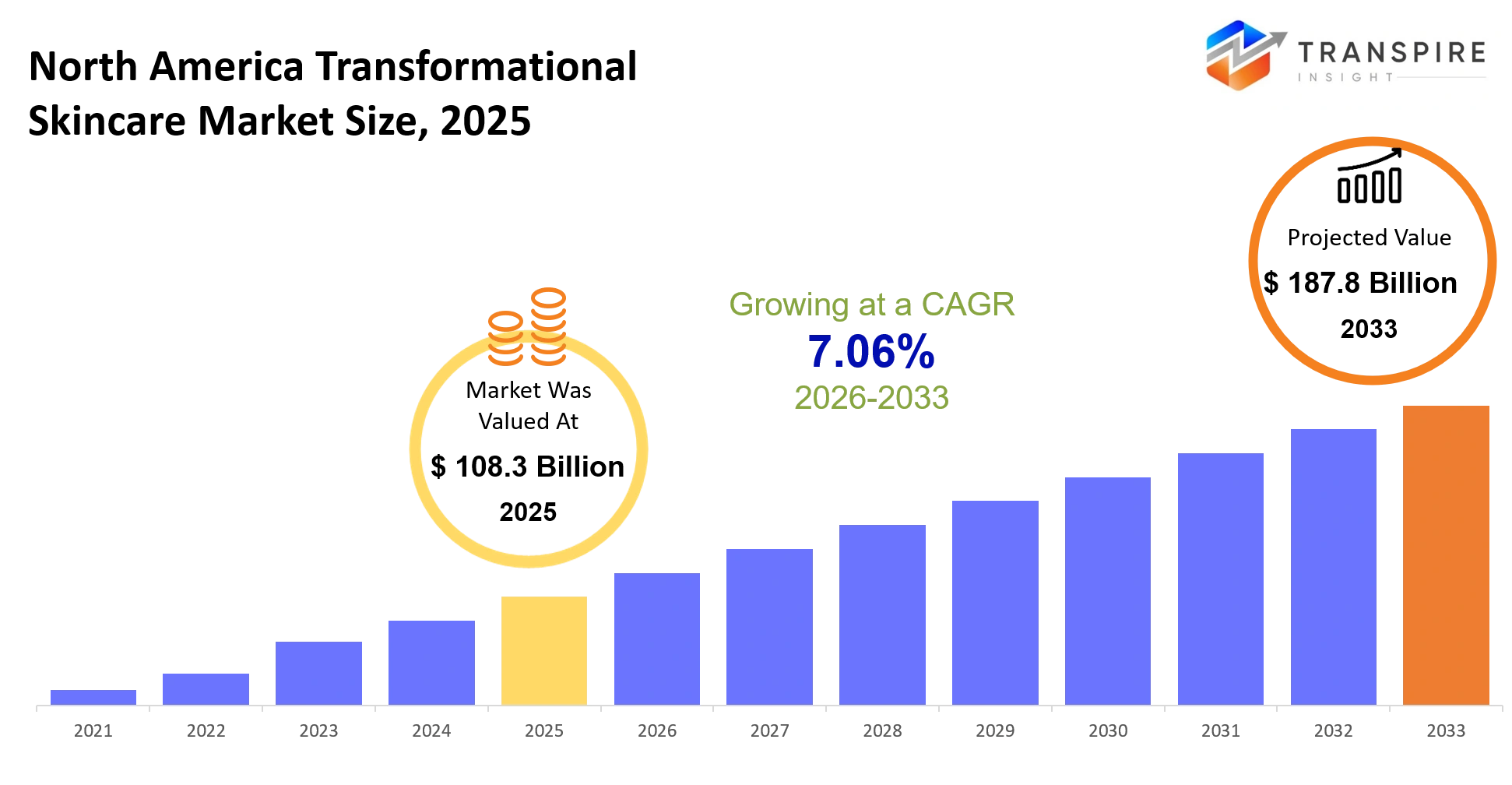
North America Transformational Skincare Market Size & Forecast:
- North America Transformational Skincare Market Size 2025: USD 108.3 Billion
- North America Transformational Skincare Market Size 2033: USD 187.8 Billion
- North America Transformational Skincare Market CAGR: 7.06%
- North America Transformational Skincare Market Segments: By Product Type (Anti-aging Products, Brightening Products, Acne Treatment Products, Hydration Products, Others); By Ingredient Type (Retinoids, Hyaluronic Acid, Peptides, Vitamin C, Others); By Distribution Channel (Online Retail, Specialty Stores, Pharmacies, Supermarkets, Others); By End User (Women, Men, Teenagers, Others)
To learn more about this report,  Download Free Sample Report
North America Transformational Skincare Market Summary
The North America Transformational Skincare Market was valued at USD 108.3 Billion in 2025. It is forecast to reach USD 187.8 Billion by 2033. That is a CAGR of 7.06% over the period.
North America transformational skincare market kind of centers on products and services that really try to repair, resurface, or even biologically tweak skin conditions. It ranges from clinical dermatology and medspa treatments, to high-performance consumer routines that people use for acne, pigmentation, aging, and for that post-procedure recovery stage. Over the last five years the whole space has shifted in a more structural way toward convergence between medical aesthetics and everyday skincare, so prescription-grade actives and biotech-derived ingredients are getting folded more and more into retail, and also direct-to-consumer lines.
A major trigger was the COVID-19 disruption. It reduced in-clinic procedures and it also strained the ingredient supply chains, which basically pushed users toward at-home treatment systems and digital dermatology consultations. So brands started redesigning what they offer around continuous, personalized regimens, plus subscription style models. That, in turn, helped improve repeat purchase behavior, not just one-off buying.Because of all that, willingness to spend on premium solutions has strengthened too, and that means innovation in active delivery systems shows up as higher revenue per user.
Key Market Insights
- United States is basically dominating the North America Transformational Skincare Market with around 70% share in 2025, because advanced dermatology infrastructure plus really high consumer spending.
- Canada looks like the fastest-growing market in the North America Transformational Skincare Market during 2025–2030, and that is mostly tied to tele-dermatology uptake, aging population trends, and a stronger appetite for premium skincare products.
- Cosmeceutical skincare items pretty much lead the North America Transformational Skincare Market with almost 45% share in 2025, supported by dermatologist-recommended active ingredient blends.
- Medical aesthetic injectables sit in the #2 spot, backed by Botox, dermal fillers, and those minimally invasive services across city clinics and medspas.
- At-home transformational skincare devices are the fastest-growing segment through 2030, mainly pushed by AI-driven personalization, and also a post-pandemic pivot toward home-based treatment routines.
- Anti-aging use cases take the lead in the North America Transformational Skincare Market with about 40% share in 2025, since demand for clinical-grade skin rejuvenation solutions keeps climbing.
- After-procedure skin recovery, and hyperpigmentation management are showing the fastest growth among applications, spurred by laser-based treatments plus dermatology-led recovery protocols.
- Dermatology clinics and medspas still stay as the leading end-user category in the North America Transformational Skincare Market, with nearly 55% share in 2025.
- Direct-to-consumer online skincare channels are growing quickly as well, mostly due to subscription models, tele-dermatology integration, and personalized AI skincare diagnostic tools.
- Market leaders are strengthening their position through partnerships with dermatology clinics, medspa chains, and digital health platforms, so they can expand distribution and get that recurring revenue streams going, a bit more sustainably. In other words it’s about reach and repeat, not just one off deals.
What are the Key Drivers, Restraints, and Opportunities in the North America Transformational Skincare Market?
The North America Transformational Skincare Market is mostly powered by the quick move from dermatology-grade biotechnology into what people buy day to day in skincare. One big push here is the progress in peptide engineering along with controlled delivery systems, where active ingredients can move further into the skin layers and still show measurable clinical results. This whole shift really started to pick up pace after 2020, when medspa demand came back, and consumers began asking for something close to procedure-level results but from at-home products. Because of that, many brands are getting more revenue per person, mostly via premium pricing, subscription-style routines, and product ecosystems that are tied to dermatologist recommendations.
A major restraint, shaping the North America Transformational Skincare Market is the heavy regulatory and clinical validation workload around bioactive skincare claims. Compared with regular cosmetics, transformational skincare often needs dermatological testing, longer approval timelines, and solid evidence supporting real efficacy. So for mid-sized companies, there’s this kind of structural bottleneck, since they might not have the capital-intensive R and D setup. The result is slower time to market, plus a drop in innovation speed, meaning the market can’t grow as fast in the short term, even if consumers are genuinely open to advanced solutions.
There’s also an opportunity that seems to be forming around AI-driven personalized skincare diagnostics, especially when those tools connect with tele-dermatology platforms. Firms like L’Oréal and Johnson & Johnson have been investing in skin imaging tools that can read pigmentation, hydration, and aging-related signals in real time. When these technologies come together, they can support extremely tailored treatment plans, and they also tend to improve long-term customer stickiness, like retention that holds up over months rather than weeks.As digital health ecosystems start to mature across the bigger urban pockets in the United States and Canada, this technology is expected to unlock a more scalable, data driven progress across the North America Transformational Skincare Market .
What Has the Impact of Artificial Intelligence Been on the North America Transformational Skincare Market?
Artificial intelligence is kind of reshaping the North America Transformational Skincare Market by weaving in diagnostic, formulation, and customer engagement features into both clinical and everyday skincare ecosystems. In the automation side, AI-driven skin analysis tools and imaging kiosks are now helping dermatologists and medspas sort out cases like acne, hyperpigmentation, and those visible aging patterns, at the same time as they streamline consultation flows. This reduces the manual assessment time too, which sounds small but actually adds up. On the operational side, manufacturers tend to use machine learning to fine tune formulation trials, automate quality control on production lines, and handle inventory distribution more smoothly across retail and direct-to-consumer routes.
Then there are the predictive models, they boost overall performance by estimating where product demand might shift, lowering the odds of stockouts, and even supporting predictive maintenance for cosmetic manufacturing equipment. That improves uptime and usually cuts operational costs. These systems also boost marketing effectiveness, by surfacing high-propensity buyers and adapting individualized skincare regimens. The result is better conversion rates and stronger customer lifetime value across the North America Transformational Skincare Market, more or less.
Still, adoption can hit some structural friction. For example, there’s the limited supply of diverse, high-quality dermatological datasets, and the cost to integrate AI solutions into older clinic and retail infrastructure is often high. Also, real life is messy : skin tones vary, environmental conditions differ, and imaging quality is not always consistent, which can weaken model accuracy in the field. So even with strong commercial promise, full scale deployment can slow down, a bit unexpectedly.
Key Market Trends
- AI based skin diagnostic tools kind of expanded after 2021, and it sort of nudged dermatology consultations away from manual assessments toward data driven personalized treatment planning workflows. In real clinics it felt like the process became more, like, measured and guided by inputs rather than just visual judgment, even if people still call it “diagnosis”.
- Dermatology clinics started adopting biotech derived actives more and more after 2020, so the older traditional cosmetic formulations got pushed aside by clinically validated peptide and growth-factor solutions, sometimes with more emphasis on evidence than on feel.
- Also after COVID-19 the subscription skincare models grew pretty fast, because consumers seemed to move from one off purchases to continuous regimen based treatment adherence systems. In other words, not just “buy when needed”, but keep the cycle going, more like a steady routine.
- Medspa procedures then started integrating at-home recovery kits after 2022, which extended treatment cycles and (supposedly) improved post procedure compliance across cosmetic dermatology patients, even when patients were busy or far away.
- L’Oréal accelerated the AI skin imaging expansion from 2023, and it basically transformed retail consultations into algorithm guided personalized skincare recommendation systems. Like the consultation became less a conversation, and more of a quick reading plus guided selection, sometimes in under minutes.
- Between 2021 and 2025, regulatory scrutiny increased, and that pressured brands to strengthen clinical validation protocols before launching high potency, transformational skincare formulations. Basically, they had to prove it more before going big.
- Direct to consumer brands also expanded tele-dermatology partnerships, shifting customer acquisition away from retail dependence, and into digitally enabled physician backed recommendation channels. It felt like the “right product” came after a remote check, not just after browsing shelves.
- Ingredient sourcing then shifted toward biotech fermentation platforms after supply chain disruptions, so there was less reliance on traditional plant based active ingredient extraction.
- Finally, premium skincare pricing models evolved post-2022, and consumers were more willing to accept higher costs, as long as they got measurable clinical outcomes and faster visible results. People wanted results that looked justified, not only “premium branding”.
North America Transformational Skincare Market Segmentation
By Product Type
Anti-aging products are kind of in the front position in the North America Transformational Skincare Market, mainly pushed by solid demand from aging populations and early take up of clinical-grade skincare habits. This part seems to hold steady because many buyers really care about visible wrinkle reduction, better firmness, and the kind of long term skin repair results that you can actually track over time.
Momentum in this segment is fueled by upgrades in retinoid stabilization, peptide composites, and dermatologist supported treatment routines. After 2020 this shifted more toward science-led skincare consumption, at least that’s how it reads in the market. Also, there’s growing preference for non-invasive options instead of cosmetic procedures, which gives anti-aging formulations a bigger boost across medspas and retail channels.
During the forecast window, anti-aging items are expected to keep expanding via AI-personalized regimens and combination therapies. In other words, product teams will probably lean into multi-active formulas that promise faster visible outcomes, and that tends to raise willingness to pay higher prices, while also reinforcing brand devotion.

To learn more about this report, Download Free Sample Report
By Ingredient Type
Retinoids together with hyaluronic acid dominate ingredient usage in the North America Transformational Skincare Market, mostly because their clinical performance for skin renewal and hydration is well proven. They stay in a strong spot since dermatologists often suggest them for long term treatment plans and ongoing care protocols.
Growth in this segment is backed by biotechnology driven stabilization methods and encapsulation technologies that cut down on irritation, and at the same time help absorption speed up. Demand also moved higher because consumers leaned toward medically validated ingredient stacks instead of the more traditional cosmetic blends.
Next, development work will center on hybrid formulations blending peptides, vitamin C, and retinoid derivative types to boost multi functional performance. Ingredient suppliers along with formulators are also expected to put real money into fermentation based production processes so the whole thing scales smoothly and stays cost efficient.
By Distribution Channel
Online retail keeps a strong grip on the North America Transformational Skincare Market, mostly because subscription programs are widely adopted, and tele dermatology gets tied in too. Digital platforms tend to win on algorithm based personalization, plus easier access to products that are dermatologist recommended.
After 2020, growth here kinda gathered pace as people shifted away from in store consults, and toward AI supported skin analysis tools. Specialty stores and pharmacies still matter, but they increasingly lean on hybrid digital in store consultation frameworks, to keep customers engaged.
Looking forward, expansion will likely be led by direct to consumer ecosystems connected with virtual dermatology services. Retailers are expected to invest in AI recommendation engines, and real time skin tracking systems as well, so they can lift conversion results and support longer term customer retention.
By End User
Women are kind of the main end user group in the North America Transformational Skincare market, mostly because they show higher engagement with preventive skincare habits and they were quick to start trying premium cosmetic dermatology solutions. In practice this group keeps strong buying power, plus they usually stick with treatments in a steady way.
Growth for men, and also for teenagers, has been climbing, since more people are paying attention to acne management, pigmentation correction and the whole anti-aging prevention stuff earlier than before. A lot of that momentum, especially after 2021, was driven by social media influence and dermatology education campaigns, which made the topic feel more normal and accessible.
During the forecast period, the male and teenage segments are expected to expand faster than the more traditional groups. This is largely because skincare use is getting normalized across different demographics. Brands are then likely to roll out more simplified, performance-focused product lines for younger buyers and first-time users; this way they can boost penetration across the market, faster than before.
What are the Key Use Cases Driving the North America Transformational Skincare Market?
Anti-aging along with skin regeneration still feels like the main use case that’s moving the North America Transformational Skincare Market forward, and it’s mostly happening in dermatology clinics, plus medspa kind of spaces. The demand is strong because both consumers and clinicians really want a visible reduction in wrinkles, that whole elasticity loss thing and also photoaging, but they want it through clinically proven treatment protocols. This particular use case keeps bringing in strong repeat revenue, largely because treatment cycles run long and involve combination therapies, not just a single step.
More room to grow shows up in expanding applications, like post-procedure recovery support after laser resurfacing, chemical peels, or injectable treatments. That’s especially noticeable in specialty clinics and cosmetic dermatology centers. Also acne management still matters, especially for teenagers and young adults, and it keeps adding to demand. Part of the reason is prescription-linked skincare regimens, plus digital dermatology consultations that make access easier.
On the newer side, emerging use cases are showing up with AI-guided preventive skin aging programs that get paired with wearable skin sensors and tele-dermatology platforms. There’s also more traction around personalized pigmentation correction, driven by imaging diagnostics. That’s happening a lot in urban consumer segments who are looking for non-invasive, data-driven skincare interventions, and frankly they’re getting more comfortable with that kind of approach.
|
Report Metrics |
Details |
|
Market size value in 2025 |
USD 108.3 Billion |
|
Market size value in 2026 |
USD 116.5 Billion |
|
Revenue forecast in 2033 |
USD 187.8 Billion |
|
Growth rate |
CAGR of 7.06% from 2026 to 2033 |
|
Base year |
2025 |
|
Historical data |
2021 - 2024 |
|
Forecast period |
2026 - 2033 |
|
Report coverage |
Revenue forecast, competitive landscape, growth factors, and trends |
|
Regional scope |
North America (Canada, The United States, and Mexico) |
|
Key company profiled |
L'Oréal, Estée Lauder, Shiseido, Unilever, Procter & Gamble, Johnson & Johnson, Beiersdorf, Galderma, The Ordinary, Drunk Elephant, Paula’s Choice, Murad, SkinCeuticals, Neutrogena, CeraVe |
|
Customization scope |
Free report customization (country, regional & segment scope). Avail customized purchase options to meet your exact research needs. |
|
Report Segmentation |
By Product Type (Anti-aging Products, Brightening Products, Acne Treatment Products, Hydration Products, Others); By Ingredient Type (Retinoids, Hyaluronic Acid, Peptides, Vitamin C, Others); By Distribution Channel (Online Retail, Specialty Stores, Pharmacies, Supermarkets, Others); By End User (Women, Men, Teenagers, Others) |
Which Regions are Driving the North America Transformational Skincare Market Growth?
North America pretty much leads the global Transformational Skincare Market, and the United States really takes the dominant share because of more advanced dermatology infrastructure along with strong regulatory enforcement from agencies like the FDA. There is also a high concentration of medspas, cosmetic dermatology clinics, and biotech skincare manufacturers, which keeps the leadership steady. The region seems to profit from early take up of clinical-grade skincare, and there is strong integration between pharmaceutical research and consumer skincare innovation. Plus established reimbursement routes for specific dermatological treatments help keep the whole market stable and make premium product penetration easier.
Canada shows up as the second key contributor, not so much because of bigger scale but more because of regulatory consistency and a fairly stable healthcare integration. Provincial healthcare systems support access to dermatology, while private clinics keep expanding their premium skincare services without too much pushy commercialization. In a way, Canada is a little more restrained than the United States, with conservative adoption of new bioactive skincare formulations, so uptake stays steady but controlled. This kind of stability pulls in long term investments from global skincare firms that want predictable regulatory surroundings and lower market volatility, overall.
Mexico is now emerging as the fastest-growing area, and it’s mainly driven by increased investments in urban dermatology clinics and expanding medical tourism that centers on cosmetic procedures. Recent improvements in private healthcare infrastructure, plus cross-border skincare service demand, have sped up the adoption of advanced treatments. There is also broader availability of affordable aesthetic procedures, so consumer access goes beyond only premium urban segments. For investors, Mexico signals strong entry potential between 2026 and 2033, especially via clinic partnership, distribution networks, and cost-sensitive transformational skincare product lines.
Who are the Key Players in the North America Transformational Skincare Market and How Do They Compete?
Competition in the North America Transformational Skincare Market is still moderately consolidated at the top, but it gets pretty fractured in the mid-tier dermocosmetic space and with indie biotech skincare brands. The bigger incumbents kinda defend their share via clinical validation, skin physician partnerships, and AI-enabled personalization platforms, not really by racing toward lower prices. New entrants tend to nudge things forward using specialized peptide formulations, “clean biotech” actives and direct-to-consumer digital diagnostics. These days, tech integration and proven clinical efficacy end up mattering more than old-school brand storytelling.
L’Oréal leans into AI-driven skin diagnostics and dermocosmetic innovation. They use imaging tools and algorithm-based recommendations, aiming to link retail experiences to dermatology ecosystems. L’Oréal differentiates through SkinCeuticals and Lancôme clinical collaborations, and keeps expanding by acquiring biotech skincare startups plus digital skin analysis platforms. Estée Lauder, on the other hand, builds momentum through premium positioning and more advanced anti-aging formulations, using its Estée and Clinique lineups to reach higher-value consumers who still care about dermatology alignment. They also push growth through luxury retail partnerships, plus R&D work tied to peptide-based repair technologies.
Johnson & Johnson competes with medical-grade dermatology solutions, with a heavy emphasis on clinical credibility and hospital-linked skincare distribution channels. Galderma strengthens its footing through injectable aesthetics along with prescription dermatology products, and they focus on physician-led adoption across medspas. Procter & Gamble differentiates by leaning on scalable consumer skincare brands, plus data-driven personalization tools. They’re also expanding digital commerce capacity, aiming to catch younger demographics across the North America Transformational Skincare Market ecosystems.
Company List
- L'Oréal
- Estée Lauder
- Shiseido
- Unilever
- Procter & Gamble
- Johnson & Johnson
- Beiersdorf
- Galderma
- The Ordinary
- Drunk Elephant
- Paula’s Choice
- Murad
- SkinCeuticals
- Neutrogena
- CeraVe
Recent Development News
“In April 2026, Galderma entered a partnership with leading aesthetic practices through its ALASTIN Signature Practices program. The collaboration enhanced provider engagement and expanded adoption of peri-procedural skincare products across professional aesthetic treatment networks.https://www.galderma.com
“In March 2026, Estée Lauder announced the acquisition of the remaining ownership stake in Forest Essentials. The transaction strengthened Estée Lauder’s premium skincare portfolio and expanded access to the fast-growing luxury Ayurvedic beauty segment.https://timesofindia.indiatimes.com
What Strategic Insights Define the Future of the North America Transformational Skincare Market?
North America Transformational Skincare Market is kind of sliding, toward a precision-led AI integrated dermatology ecosystem where clinical skincare and diagnostics plus personalized treatment regimens kinda blend, into one ongoing care model. This movement is fueled by improvements in skin imaging, biotech sourced actives, and frankly a consumer mindset that wants outcomes you can measure, not only pretty cosmetic promises. Over the next 5 to 7 years, competition will probably stop revolving purely around formulation and start leaning harder on data ownership, and algorithm accuracy, more than anything else.
There’s also a less obvious risk, like regulation getting tighter around AI driven dermatology tools and the types of claims you can make about bioactive ingredients. That could end up delaying commercialization timelines, and it might raise compliance costs for established players and newer startups too. Another pressure point shows up from relying too much on a small group of biotech suppliers for high performance actives, which means the whole ecosystem can be exposed to supply concentration risk, even if demand grows.
At the same time, a clear emerging opportunity is real time skin health monitoring via wearable biosensors that connect with tele dermatology platforms, so treatment can be adjusted continuously. Market participants should probably put money in early on integrated data frameworks that bring diagnostics, formulation, and patient feedback in one loop, so they can lock in long term positioning and build recurring revenue streams.
North America Transformational Skincare Market Report Segmentation
By Product Type
- Anti-aging Products
- Brightening Products
- Acne Treatment Products
- Hydration Products
- Others
By Ingredient Type
- Retinoids
- Hyaluronic Acid
- Peptides
- Vitamin C
- Others
By Distribution Channel
- Online Retail
- Specialty Stores
- Pharmacies
- Supermarkets
- Others
By End User
- Women
- Men
- Teenagers
- Others
Frequently Asked Questions
Find quick answers to common questions.
The expected North America Transformational Skincare Market size is USD 187.8 Billion in 2033.
Key segments for the North America Transformational Skincare Market are By Product Type (Anti-aging Products, Brightening Products, Acne Treatment Products, Hydration Products, Others); By Ingredient Type (Retinoids, Hyaluronic Acid, Peptides, Vitamin C, Others); By Distribution Channel (Online Retail, Specialty Stores, Pharmacies, Supermarkets, Others); By End User (Women, Men, Teenagers, Others)
Major North America Transformational Skincare Market players are L'Oréal, Estée Lauder, Shiseido, Unilever, Procter & Gamble, Johnson & Johnson, Beiersdorf, Galderma, The Ordinary, Drunk Elephant, Paula’s Choice, Murad, SkinCeuticals, Neutrogena, CeraVe
The North America Transformational Skincare Market size is USD 108.3 Billion in 2025.
The North America Transformational Skincare Market CAGR is 7.06% from 2026 to 2033.
- L'Oréal
- Estée Lauder
- Shiseido
- Unilever
- Procter & Gamble
- Johnson & Johnson
- Beiersdorf
- Galderma
- The Ordinary
- Drunk Elephant
- Paula’s Choice
- Murad
- SkinCeuticals
- Neutrogena
- CeraVe
About the Authors

Chetan Dhatrak
I’m Chetan Dhatrak, a Senior Research Analyst at Transpire Insight, specializing in the Consumer Goods, Foods and Beverages industry. I focus on analyzing market trends, consumer behavior, competitive landscapes, and industry developments to deliver accurate, data-driven insights. My research at Transpire Insight is built on credible sources and in-depth analysis, helping businesses and readers better understand market dynamics, emerging opportunities, and evolving consumer preferences. I’m committed to creating reliable, well-researched content that supports informed decision-making and reflects the latest developments in the consumer goods and food & beverage sectors.

Chakradhar Khansole
Chakradhar serves as the Research Director at Transpire Insight, bringing over 8 years of experience in technology, innovation, and strategic market intelligence. He specializes in transforming complex market data into actionable business insights that enable organizations to make informed, growth-oriented decisions. Recognized for his strategic vision and analytical expertise, Chakradhar leads high-impact research initiatives, delivering comprehensive market assessments, competitive intelligence, and forward-looking industry analysis.
Recently Published Reports
-
Apr 2026
Bottled Water Market
Bottled Water Market Size, Share & Analysis Report By Product Type (Still Bottled Water, Carbonated Bottled Water, Functional Bottled Water, and Others), By Packaging (PET, Cans, and Others), By Sales Channel (Supermarkets/Hypermarkets, Convenience Stores/Drug Stores, Grocery Stores/Club Stores, Foodservice, and Others) and Geography (North America, Europe, Asia-Pacific, Middle East and Africa, South and Central America), 2021 - 2032
-
Apr 2026
Color Cosmetic Packaging Market
Color Cosmetic Packaging Market Size, Share & Analysis Report By Application (Mascara Packaging, Liquid Packaging, and Liquid Face), By Type (Tubes & Bottles, Pens & Markers, Compacts & Containers, and Droppers & Pumps), and Geography (North America, Europe, Asia-Pacific, Middle East and Africa, South and Central America), 2021 - 2031
-
Apr 2026
External Microphone For Camera Market
External Microphone For Camera Market Size, Share & Analysis Report By Type (Shotgun Microphone, Lavalier Microphone, and Others), By Application (Digital Camera, Professional Video Camera, and Others), and Geography (North America, Europe, Asia-Pacific, Middle East and Africa, South and Central America), 2021 - 2031
-
Apr 2026
Foot Orthotic Insoles Market
Foot Orthotic Insoles Market Size, Share & Analysis Report By Type (Pre-fabricated, and Custom-made), By Material (Thermoplastic, Composite Carbon Fiber, and Others), By Distribution Channel (Drug Stores, Hospitals & Clinics, and Others), and Geography (North America, Europe, Asia-Pacific, Middle East and Africa, South and Central America), 2021 - 2031