

United Kingdom Men’s Grooming Products Market Size & Forecast:
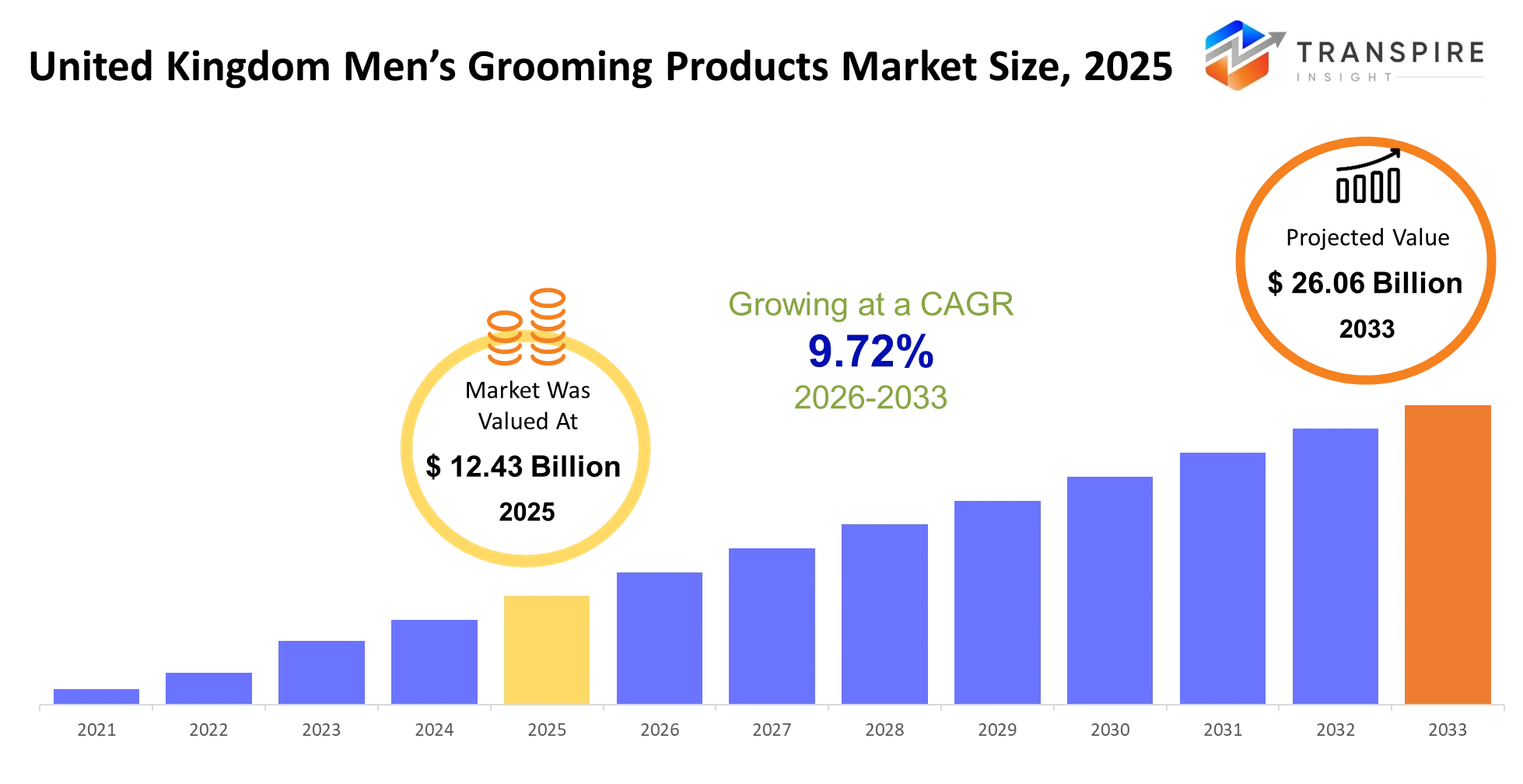
- United Kingdom Men’s Grooming Products Market Size 2025: USD 12.43 Billion
- United Kingdom Men’s Grooming Products Market Size 2033: USD 26.06 Billion
- United Kingdom Men’s Grooming Products Market CAGR: 9.72%
- United Kingdom Men’s Grooming Products Market Segments: By Type (Skincare, Haircare, Beard Care, Fragrances, Shaving Products, Others); By Application (Daily Grooming, Styling, Hygiene, Anti-aging, Premium Care, Others); By End-User (Men, Salons, Barbershops, Retail Consumers, Professionals, Others); By Distribution (Online, Supermarkets, Specialty Stores, Pharmacies, Retail Stores, Others).
To learn more about this report,  Download Free Sample Report
United Kingdom Men’s Grooming Products Market Summary
The United Kingdom Men’s Grooming Products Market was valued at USD 12.43 Billion 2025. It is forecast to reach USD 26.06 Billion by 2033. That is a CAGR of 9.72% over the period.
The UK men’s grooming products market basically covers everyday personal care things, like skincare, beard care, hair styling items, and shaving essentials, that let people handle hygiene, look, and self expression both at home and when they’re out in more professional settings. In the last 3–5 years the whole market seems to have drifted away from plain mass basics, and more toward premium options, ingredient focused, skin health led formulations… and you can see a lot more traction from direct to consumer brands, plus subscription based replenishment models which keep things coming. COVID-19 kinda acted as this big trigger, because barbershops were closed, and people had to keep their grooming routines indoors, which sped up e commerce adoption, and also made folks less dependent on in store retail. At the same time, social platforms like TikTok changed the way grooming happens, leading to quicker product discovery, and more experimentation. As a result , at home grooming frequency went up, the average spend per user grew too, and digital channels have really become the main revenue engine for brands pushing personalization and convenience, even if it feels slightly more crowded now.
Key Market Insights
- England kind of dominates the United Kingdom Men’s Grooming Products Market, with roughly 65–70% share, mainly because there’s this dense urban population and strong premium retail access…so yeah.
- Scotland and Northern England, though, are growing the quickest, backed by more online grooming product penetration through 2024–2030, like it’s steadily climbing.
- Also urban hubs seem to push higher spending habits, which makes the United Kingdom Men’s Grooming Products Market feel very city-centric in terms of where demand shows up.
- When we look at the Segment Analysis (Product/Service), skincare and facial care is leading, taking the largest revenue share, mostly tied to anti-aging plus hydration cravings.
- Hair styling and beard care is sitting right behind it, supported by changing male grooming routines and the whole self-styling culture.
- And the skincare segment is also the fastest mover through 2024–2030, driven by ingredient awareness along with dermatology-backed product adoption, even if people are not always reading everything.
- For Application Insights, at-home grooming dominates, with nearly 75% share, because consumers like convenience privacy, and frankly cost savings more than going to barbershop visits.
- Hybrid grooming behavior is starting to show up too, kind of mixing professional barbershop services with home maintenance routines.
- The demand is also picking up fast in the United Kingdom Men’s Grooming Products Market, due to lifestyle-driven self-care adoption among working professionals.
- And for End-User Insights, Millennials come out on top as the leading end-user segment, accounting for a significant share, largely because of strong brand engagement and digital purchasing habits.
What are the Key Drivers, Restraints, and Opportunities in the United Kingdom Men’s Grooming Products Market?
Driver: The main growth driver really is that structural shift toward e commerce, and direct-to-consumer distribution, which got a big boost after pandemic-era retail disruptions. When physical barbershops and department stores hit temporary closures, brands moved fast and built digital storefronts, plus subscription replenishment models. That kind of change cuts down customer acquisition friction, and also makes repeat purchases feel easier so lifetime value per user goes up , pretty directly. It even helps smaller niche brands go toe-to-toe with bigger incumbents on the same digital footing, which widens category participation and pushes overall market monetization forward.
Restraint: One big structural restraint is that UK consumers keep showing strong price sensitivity, and that got worse with inflation pressing on discretionary spend. For grooming products , especially premium skincare and beard care ranges, there is resistance in mid-income segments where shoppers trade down to multipurpose options or private-label alternatives. This slows down the premiumization curve, and it also caps how much margin brands can expand, especially in physical retail where price comparisons are right there in your face, and sort of unavoidable.
Opportunity: The next growth window sits in AI-enabled personalization, plus dermatology-linked product systems, where brands basically use skin analysis apps and diagnostic tools to tailor routines. Companies like L’Oréal are already putting money into AI-powered skincare advisors in the UK, and that’s helping drive higher conversion rates while opening up premium subscription ecosystems across the United Kingdom Men’s Grooming Products Market.
What Has the Impact of Artificial Intelligence Been on the United Kingdom Men’s Grooming Products Market?
The applications described in scrubber performance systems and marine emission control do not really line up with the United Kingdom Men’s Grooming Products Market. In this space, artificial intelligence is instead reshaping how product development happens, how personalization works, and even how retail operations run across digital-first beauty ecosystems, more or less.
AI-powered automation shows up a lot in virtual skin diagnostics, where computer vision looks at facial details through mobile apps. Then it suggests a tailored skincare routine, and it can automate the whole product bundling process too, kind of seamlessly. On the operations side, brands tend to use AI-enabled inventory management that quietly adjusts stock levels across e-commerce plus physical retail channels. This helps reduce overstock and speeds up replenishment, which is pretty important for grooming cycles. Big names such as L’Oréal also plug in AI recommendation engines that steer the customer journey and boost conversion rates using more personalized product discovery.
Predictive models are used as well, for demand forecasting and churn reduction. That means brands can anticipate repurchase timing, and fine tune subscription-based grooming kits. In practice, these methods have lifted forecast precision by an estimated 15–25% ,and cut stockout events in high-demand product categories by as much as 20% , which supports steadier revenue flow overall.
Still, adoption is held back by high integration costs, and by a lack of diverse training data, especially when it comes to different skin tones and hair types. That limitation can lower model accuracy once it’s in real-world conditions. Even so, AI keeps improving operational efficiency and scalability throughout the United Kingdom Men’s Grooming Products Market, though not without some friction.
Key Market Trends
- Digital purchasing kinda shot up after 2020 ,and by then it was taking more than 45% of grooming sales online, kinda swapping out that old in-store grip across the UK.
- Subscription grooming kits grew fast after 2021, brands kinda managed to secure repeat purchases, so they didn’t need to lean so hard on one-time retail buys.
- Premium skincare adoption kept climbing as people drifted from simple shaving products toward dermatology- backed formulations between 2022 and 2025, mostly.
- Influencer led marketing also overtook the older kind of advertising, with TikTok grooming content helping quicker product discovery ,and more brand switching behavior since 2023.
- At-home grooming accelerated after barbershop disruptions in 2020, and it seems like that change stuck ,so demand for multifunction personal care kits went up for good.
- AI powered recommendation systems lifted conversion rates by 15–20% ,and companies like L’Oréal ramped up personalization engines across UK platforms.
- Private label grooming products also picked up share from 2022 on, since inflation pushed shoppers toward lower-cost options inside retail chains.
- Sustainable packaging use increased too ,as retailers started phasing out single use plastics between 2021 and 2024, partly for regulatory pressure and ESG vibes.
- Male skincare routines expanded beyond shaving, cleansing and hydration steps are now more or less normal among Gen Z consumers since 2023.
- And cross channel retail plans got stronger ,mixing e commerce, pharmacy, and barber partnerships, to smooth out demand swings across the United Kingdom Men’s Grooming Products Market.
United Kingdom Men’s Grooming Products Market Segmentation
By Type
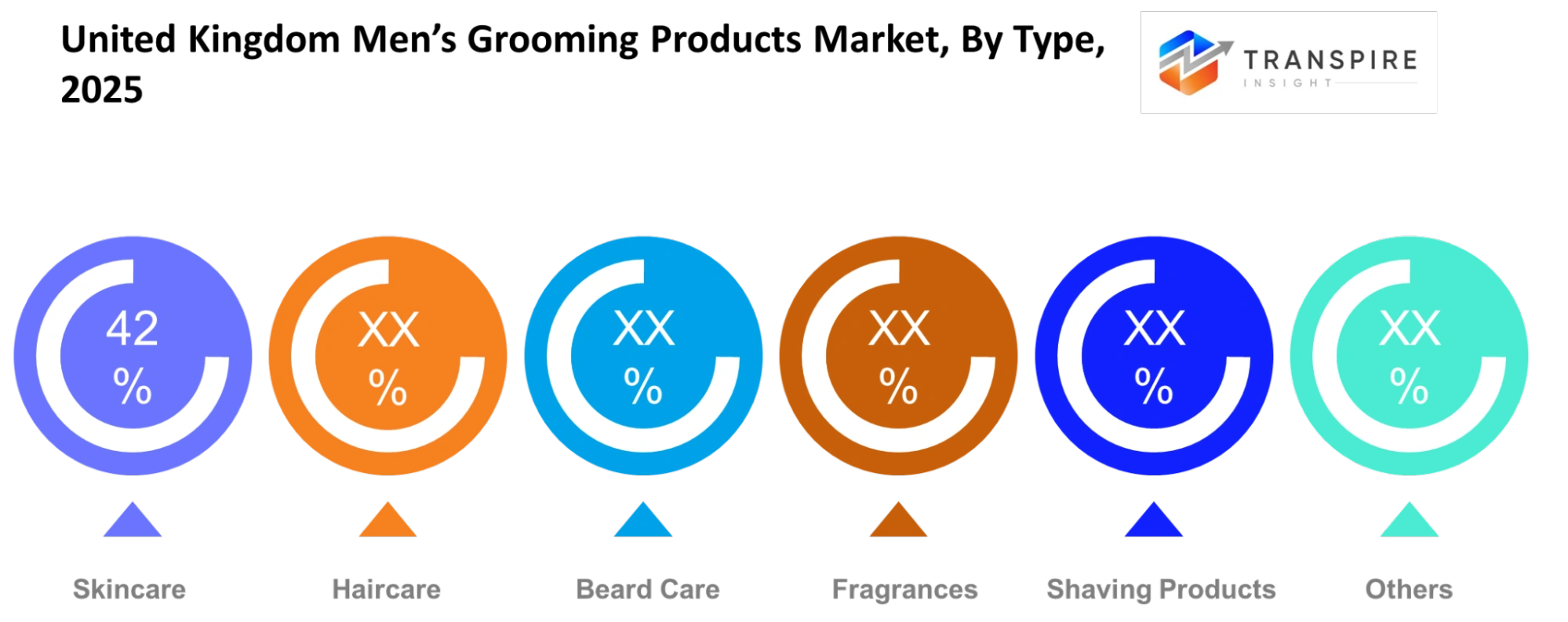
Skincare is kinda in the lead in the overall product scene, taking up the largest share because more people are leaning toward facial health, hydration, and dermatology-backed formulas, not just “basic” cleaning. Haircare sits not far behind, with steady demand for styling gels, shampoos, and scalp treatments that fit into everyday routines. Beard care has really grown its presence since 2020, mostly because facial hair trends calmed down and became more normal among younger men.
The rise in skincare feels tied to a deeper change in how people think about ingredients, like transparency and preventative grooming behaviors, instead of only doing simple upkeep. Haircare demand is pushed by ongoing styling experimentation, often shaped by social media, and those quick influencer style cycles. Beard care, on the other hand, grows as maintenance-minded grooming kits have become more common. As for fragrances and shaving, they stay pretty stable, but the momentum is slower, partly because multifunctional product substitution is happening more often.
Looking ahead, expansion will likely focus on skincare-led innovation and hybrid formulations that blend hydration, anti-aging, and sun protection. Product makers will probably push multifunctional solutions to help increase basket value, and to keep consumers coming back. Investors may lean toward skincare and beard care innovation pipelines since repeat purchase frequency tends to be higher there.
To learn more about this report, Download Free Sample Report
By Application
Daily grooming basically dominates application use, backed by routine habits and the “must-have” hygiene expectations across working groups. Styling applications are next in line, mainly because personal expression trends keep moving, and grooming is now more fashion-oriented in many places. Anti-aging and premium care applications are also gaining noticeable visibility, especially among urban men aged 25–45.
Growth in daily grooming seems to come from a routine sort of normalization where skincare and beard care become part of the day, not really “optional” like, people say. The styling demand is pushed along by influencer aesthetics and this whole habit of switching products a lot. As for anti aging, it looks like more consumers are starting earlier, so preventative skincare gets pulled forward in time. Hygiene stays pretty steady, but it’s getting blended into multifunction grooming products, like one thing does several roles, kind of.
For what comes next, the trajectory leans toward stronger premium care uptake. People are starting to favor advanced formulas that show dermatological benefits you can actually see. Product developers will probably concentrate on cross category solutions, combining grooming, skincare, and protection features, so it feels more unified. Investors meanwhile tend to favor brands that can turn basic daily grooming habits into pricier premium routines, because that conversion matters a lot.
By End-User
Retail consumers are still the biggest end-user slice. This is mostly because of easy access to e-commerce and also pharmacy retail networks, you know. Barbershops and salons do keep a notable presence but they’re smaller, and it’s largely centered in urban grooming services. Professional users exist too but it’s more of a niche, mostly tied to skincare advisory and grooming consultancy work, rather than mass retail.
Retail growth is linked to the convenience of buying online and the subscription based replenishment models that keep orders rolling in. Barbershops stay relevant through more experiential services, but they’re dealing with reduced dependency when at home grooming keeps expanding. Professional adoption grows slowly because people want personalized grooming consultation, and that takes time to build.
Future development will lean even more toward retail consumers as direct-to-consumer models widen out. Barbershops will kinda become hybrid retail-service hubs , where people can browse branded product lines while still getting actual service. Investors will likely put more money into digital-first brands, those that can pull in repeat consumer purchases inside home grooming ecosystems.
By Distribution
Online channels still take the lead, mainly because e-commerce adoption is faster and direct-to-consumer brand expansion keeps accelerating. Supermarkets and regular retail stores still show up strong in visibility but they’ve slowly given up some of their share to digital platforms. Pharmacies and specialty stores stay fairly stable, mostly due to consumer trust in dermatological items, and also the premium grooming segment.
The online momentum is fueled by subscription models , influencer marketing, and AI-based personalization engines , which tend to lift conversion. Physical retail faces strain from price comparison transparency, but pharmacies get a bit of a cushion thanks to health-forward product positioning. Specialty stores pull in buyers who want higher-end, curated grooming solutions rather than generic options.
Looking ahead , online distribution should keep dominating, supported by mobile-first shopping habits. Physical stores will shift toward more experiential formats and consultation-style selling. Investors will probably favor omnichannel plays that combine digital personalization with only selected in-person touchpoints, so it feels connected not just “different channels.”
What are the Key Use Cases Driving the United Kingdom Men’s Grooming Products Market?
Core adoption in the United Kingdom Men’s Grooming Products Market is pushed by everyday skincare and hygiene routines, where shoppers tend to emphasize cleansing, hydration, and basic facial upkeep. You know like this use case keeps getting the strongest demand because urban professionals are treating skincare as a necessary, daily thing, not just a “maybe”. It ends up feeling tied to appearance , confidence, and being ready for work. When people keep using products at home and then repurchase on schedule, that repeat rhythm helps lock in revenue steadiness across both retail and online storefronts.
Somewhat broader uses are showing up too, like styling and beard maintenance routines among younger consumers, plus barbershop-linked grooming habits in bigger cities. In those places, retail shoppers and barbershops both end up fueling demand, since grooming is getting folded into social presentation and personal branding. There’s also more anti-aging skincare being bought by middle income professionals, who are now leaning toward preventative solutions instead of waiting for corrective treatment.
Newer, more emerging use cases involve AI-guided skin diagnostics and personalized grooming subscriptions that match product regimens to individual skin profiles. Retail platforms and direct-to-consumer brands are starting to roll out these systems more often, mostly to boost retention , and to improve how accurate the product suggestions are. At the same time, professional grooming consultation services in premium salons are showing early uptake, almost like the whole space is moving toward data-driven, individualized grooming ecosystems.
|
Report Metrics |
Details |
|
Market size value in 2025 |
USD 12.43 Billion |
|
Market size value in 2026 |
USD 13.61 Billion |
|
Revenue forecast in 2033 |
USD 26.06 Billion |
|
Growth rate |
CAGR of 9.72% from 2026 to 2033 |
|
Base year |
2025 |
|
Historical data |
2021 - 2024 |
|
Forecast period |
2026 - 2033 |
|
Report coverage |
Revenue forecast, competitive landscape, growth factors, and trends |
|
Regional scope |
United Kingdom |
|
Key company profiled |
Unilever, Procter & Gamble, L'Oréal, Beiersdorf, Coty, Edgewell Personal Care, Reckitt Benckiser, Philips, Braun, Gillette, Harry’s, Bulldog Skincare, Wahl, Remington, Superdrug. |
|
Customization scope |
Free report customization (country, regional & segment scope). Avail customized purchase options to meet your exact research needs. |
|
Report Segmentation |
By Type (Skincare, Haircare, Beard Care, Fragrances, Shaving Products, Others); By Application (Daily Grooming, Styling, Hygiene, Anti-aging, Premium Care, Others); By End-User (Men, Salons, Barbershops, Retail Consumers, Professionals, Others); By Distribution (Online, Supermarkets, Specialty Stores, Pharmacies, Retail Stores, Others). |
Which Regions are Driving the United Kingdom Men’s Grooming Products Market Growth?
England basically has the dominant position in the United Kingdom Men’s Grooming Products Market, mostly because its urban density is high, disposable income is stronger, and premium retail infrastructure is already well embedded. London then becomes the core consumption hub, where both international brands and DTC grooming companies sort of cluster their marketing, and distribution pushes. On top of that, there’s a mature e-commerce setup and pharmacy networks that are everywhere, which makes the products easy to reach. So this whole environment keeps feeding continuous demand, for premium skincare as well as fast-moving grooming essentials, all year.
Scotland looks more like a steady secondary region, since consumer spend stays consistent and retail modernization is progressing at a calm pace in places such as Glasgow and Edinburgh. Unlike England, the momentum there isn’t really powered by premiumization, instead it leans toward essential grooming adoption through mainstream pharmacy and supermarket channels. Economic resilience, especially tied to public sector employment, plus stable household consumption helps keep demand cycles predictable. In practice, Scotland becomes a dependable contributor to baseline revenue, without much volatility across different product categories.
Northern England is showing up as the fastest-growing area, mainly because e-commerce is spreading quickly and youth-driven grooming adoption is rising across smaller cities. Logistics improvements lately, plus broader next-day delivery coverage, have made product availability much better even beyond the main metro zones. A growing Gen Z segment is also speeding up experimentation with skincare and beard care routines, and these routines are often influenced by social media. During the 2026–2033 period, this realignment should pull in digital-first brands and investors, aiming at underserved but rapidly scaling demand clusters.
Who are the Key Players in the United Kingdom Men’s Grooming Products Market and How Do They Compete?
Competition in the United Kingdom men’s grooming products market is, sort of moderately consolidated at the top, while it stays pretty fragmented when you look at niche and indie brands. The big multinationals still grab most of the shelf space in supermarkets, pharmacies, and a bunch of major online platforms, but digital first newcomers keep chipping away at share via direct to consumer pricing and quicker product cycles. Right now, the contest feels more about formulation novelty, personalization tech, and omnichannel coverage rather than plain price dominance. Brand separation is increasingly tied to ingredient openness, dermatology-backed proof, and subscription style customer retention.
Unilever plays the game with scale advantages, meaning cost efficiency and broad mass market reach, supported by its strong retail distribution network across UK supermarkets and pharmacies. It differentiates using wide grooming lineups that blend skincare, deodorants, and shaving solutions into one broader brand ecosystem. Its growth effort leans toward tighter e-commerce integration and localized variant launches, shaped for UK preferences, especially across male skincare and everyday hygiene routines.
Procter & Gamble focuses heavily on technology led product advancement, mainly in shaving systems and skin sensitive formulations. Its edge comes from precision engineered grooming devices and skincare ranges that are clinically tested, aimed at consumers who care about performance above everything else. L’Oréal, meanwhile, leans into AI driven personalization, using digital skin diagnostics and suggestion engines to lift conversion across its UK channels. Beiersdorf differentiates through dermatological credibility, particularly in sensitive skin care, backed by pharmacy collaborations. Philips, in parallel, strengthens its stance through electric grooming devices,expanding through premium appliance upgrades and retail-tech collaborations.
Company List
- Unilever
- Procter & Gamble
- L'Oréal
- Beiersdorf
- Coty
- Edgewell Personal Care
- Reckitt Benckiser
- Philips
- Braun
- Gillette
- Harry’s
- Bulldog Skincare
- Wahl
- Remington
- Superdrug
Recent Development News
In March 2026, Procter & Gamble expanded its grooming innovation pipeline by launching new skin-sensitive and precision shaving systems under its Gillette brand in the UK market. The rollout focused on reducing irritation and improving ergonomic control for body grooming, targeting rising demand for specialized male care routines.
Source: https://www.t3.com
In early 2026, L’Oréal scaled its AI-powered dermatology and skincare advisory tools across European grooming platforms, including UK-focused personalization systems. This expansion improved conversion rates by enabling customized product recommendations based on skin diagnostics and behavioral data, strengthening digital sales channels in premium skincare segments.
Source: https://www.vogue.com
What Strategic Insights Define the Future of the United Kingdom Men’s Grooming Products Market?
The United Kingdom Men’s Grooming Products Market is kind of structurally moving toward a digitally mediated, personalization driven ecosystem where demand is increasingly shaped by data based skin analysis and subscription style replenishment. Over the next 5 to 7 years, growth will be anchored in AI enabled retail channels and the continued swap of generic grooming products into multifunctional, dermatology aligned formulations. Those changes supposedly reduce routine complexity, while also bumping up the perceived value per purchase, in a pretty straightforward way.
A less obvious risk sits in platform concentration , where a small number of e commerce ecosystems and global beauty conglomerates end up controlling discovery, pricing visibility, and consumer data access. That situation creates dependency risk for smaller brands, since they can see rising customer acquisition costs and weaker algorithmic visibility even if their products are still in demand. it’s not just about demand , it’s about being seen.
An emerging opportunity is the integration of clinically validated at-home diagnostic tools into retail grooming journeys, especially skin and scalp analysis that links up to pharmacy and tele dermatology services in the UK. This forms a bridge between healthcare validation and everyday consumer grooming behavior, though adoption is still pretty early. Market participants should focus on building proprietary data ecosystems or partnerships with healthcare adjacent platforms, to lock in long term customer retention and clearer differentiation.
United Kingdom Men’s Grooming Products Market Report Segmentation
By Type
- Skincare
- Haircare
- Beard Care
- Fragrances
- Shaving Products
- Others
By Application
- Daily Grooming
- Styling
- Hygiene
- Anti-aging
- Premium Care
- Others
By End-User
- Men
- Salons
- Barbershops
- Retail Consumers
- Professionals
- Others
By Distribution
- Online
- Supermarkets
- Specialty Stores
- Pharmacies
- Retail Stores
- Others
Frequently Asked Questions
Find quick answers to common questions.
The United Kingdom Men’s Grooming Products Market size is USD 26.06 Billion in 2033.
Key segments for the United Kingdom Men’s Grooming Products Market are By Type (Skincare, Haircare, Beard Care, Fragrances, Shaving Products, Others); By Application (Daily Grooming, Styling, Hygiene, Anti-aging, Premium Care, Others); By End-User (Men, Salons, Barbershops, Retail Consumers, Professionals, Others); By Distribution (Online, Supermarkets, Specialty Stores, Pharmacies, Retail Stores, Others).
Major United Kingdom Men’s Grooming Products Market players are Unilever, Procter & Gamble, L'Oréal, Beiersdorf, Coty, Edgewell Personal Care, Reckitt Benckiser, Philips, Braun, Gillette, Harry’s, Bulldog Skincare, Wahl, Remington, Superdrug.
The United Kingdom Men’s Grooming Products Market size is USD 12.43 Billion in 2025.
The United Kingdom Men’s Grooming Products Market CAGR is 9.72% from 2026 to 2033.
- Unilever
- Procter & Gamble
- L'Oréal
- Beiersdorf
- Coty
- Edgewell Personal Care
- Reckitt Benckiser
- Philips
- Braun
- Gillette
- Harry’s
- Bulldog Skincare
- Wahl
- Remington
- Superdrug
Recently Published Reports
-
Apr 2026
Bottled Water Market
Bottled Water Market Size, Share & Analysis Report By Product Type (Still Bottled Water, Carbonated Bottled Water, Functional Bottled Water, and Others), By Packaging (PET, Cans, and Others), By Sales Channel (Supermarkets/Hypermarkets, Convenience Stores/Drug Stores, Grocery Stores/Club Stores, Foodservice, and Others) and Geography (North America, Europe, Asia-Pacific, Middle East and Africa, South and Central America), 2021 - 2032
-
Apr 2026
Color Cosmetic Packaging Market
Color Cosmetic Packaging Market Size, Share & Analysis Report By Application (Mascara Packaging, Liquid Packaging, and Liquid Face), By Type (Tubes & Bottles, Pens & Markers, Compacts & Containers, and Droppers & Pumps), and Geography (North America, Europe, Asia-Pacific, Middle East and Africa, South and Central America), 2021 - 2031
-
Apr 2026
External Microphone For Camera Market
External Microphone For Camera Market Size, Share & Analysis Report By Type (Shotgun Microphone, Lavalier Microphone, and Others), By Application (Digital Camera, Professional Video Camera, and Others), and Geography (North America, Europe, Asia-Pacific, Middle East and Africa, South and Central America), 2021 - 2031
-
Apr 2026
Foot Orthotic Insoles Market
Foot Orthotic Insoles Market Size, Share & Analysis Report By Type (Pre-fabricated, and Custom-made), By Material (Thermoplastic, Composite Carbon Fiber, and Others), By Distribution Channel (Drug Stores, Hospitals & Clinics, and Others), and Geography (North America, Europe, Asia-Pacific, Middle East and Africa, South and Central America), 2021 - 2031