

Global Men's Grooming Products Market Size & Forecast
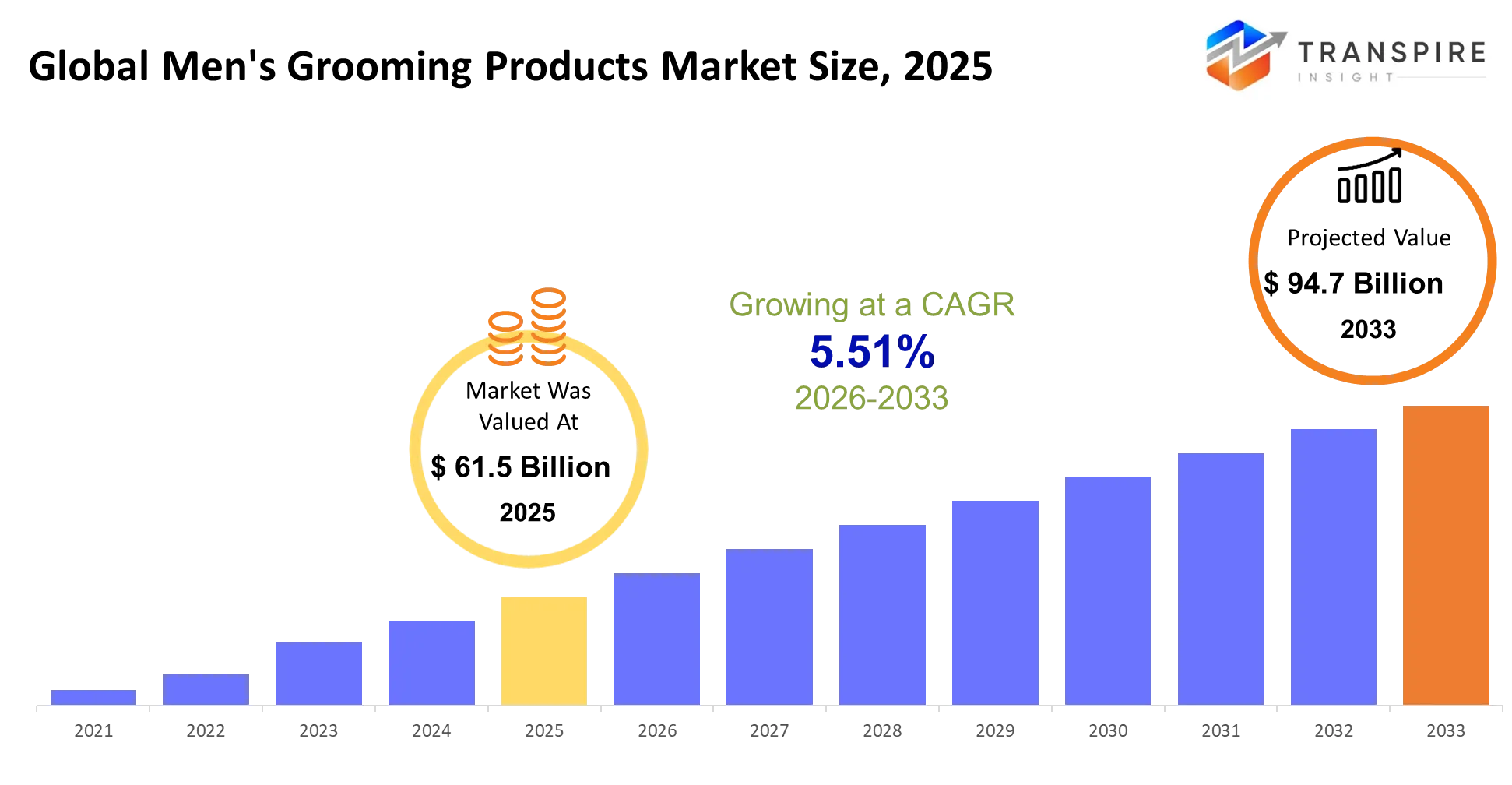
- Global Men's Grooming Products Market Size 2025: USD 61.5 Billion
- Global Men's Grooming Products Market Size 2033: USD 94.7 Billion
- Global Men's Grooming Products Market CAGR: 5.51%
- Global Men's Grooming Products Market Segments: By Product Type (Shaving Products, Skin Care Products, Hair Care Products, Fragrances), By Distribution Channel (Supermarkets & Hypermarkets, Online Retail, Specialty Stores), By End-User (Adults, Teenagers)
To learn more about this report,  Download Free Sample Report
Global Men's Grooming Products Market Summary
The Global Men's Grooming Products Market puts numbers to this shift: USD 61.5 Billion in 2025, growing to USD 94.7 Billion by 2033 at a 5.51% CAGR. The global men's grooming products market comprises personal care items tailored especially for male consumers - ranging from razors and shaving creams to moisturizers, anti-aging serums, hair shampoos, conditioners, styling products, perfumes, and aftershave formulations. Over the past ten years, this market has undergone quite a fundamental shift - thanks to the considerable change in cultural perceptions of male grooming. What was once considered somewhat of a niche product line or even a stigmatized area has evolved into a well-established mainstream and socially accepted segment where men really do spend their discretionary money on personal care products beyond just the essentials of hygiene.
The fundamental force driving this transformation is how we view grooming itself as masculine self-care rather than a form of vanity. Social media platforms particularly Instagram and TikTok have brought male grooming content into the mainstream through influencers and lifestyle creators whose audience base is comprised of Gen Z and millennial men who are actually seeking out advice on grooming and product recommendations themselves. Younger male consumers no longer see grooming as merely functional but more so as a lifestyle category with branded identity and prestige elements - similar to how women's beauty products function.
Market growth has significantly accelerated from 2019 through 2025 as men's grooming shifted away from common drugstore items to premium-positioned formulations - featuring ingredients like hyaluronic acid, retinol, and botanical extracts. This trend towards premiumizing supports higher profit margins and has really attracted more venture capital funding into specialized men's grooming brands such as Dollar Shave Club, Hims, and Keeps, which have disrupted traditional distribution channels and set up new consumer touchpoints through direct-to-consumer channels and healthcare integration itself.
Key Global Men's Grooming Products Market Insights
- North America holds the largest regional market share at approximately 38% of global men's grooming products revenue in 2025, driven by high disposable income, cultural acceptance of grooming as self-care, and strong e-commerce adoption among male consumers.
- Europe represents approximately 32% of global market revenue, anchored by strong brand heritage and established premium positioning of European grooming companies across Scandinavia, Germany, France, and the United Kingdom.
- Asia-Pacific is the fastest-growing regional market, expanding at a CAGR above 7.5% through 2033, driven by rising disposable income in China and India, growing middle-class consumer bases, and increasing social media influence on male grooming preferences.
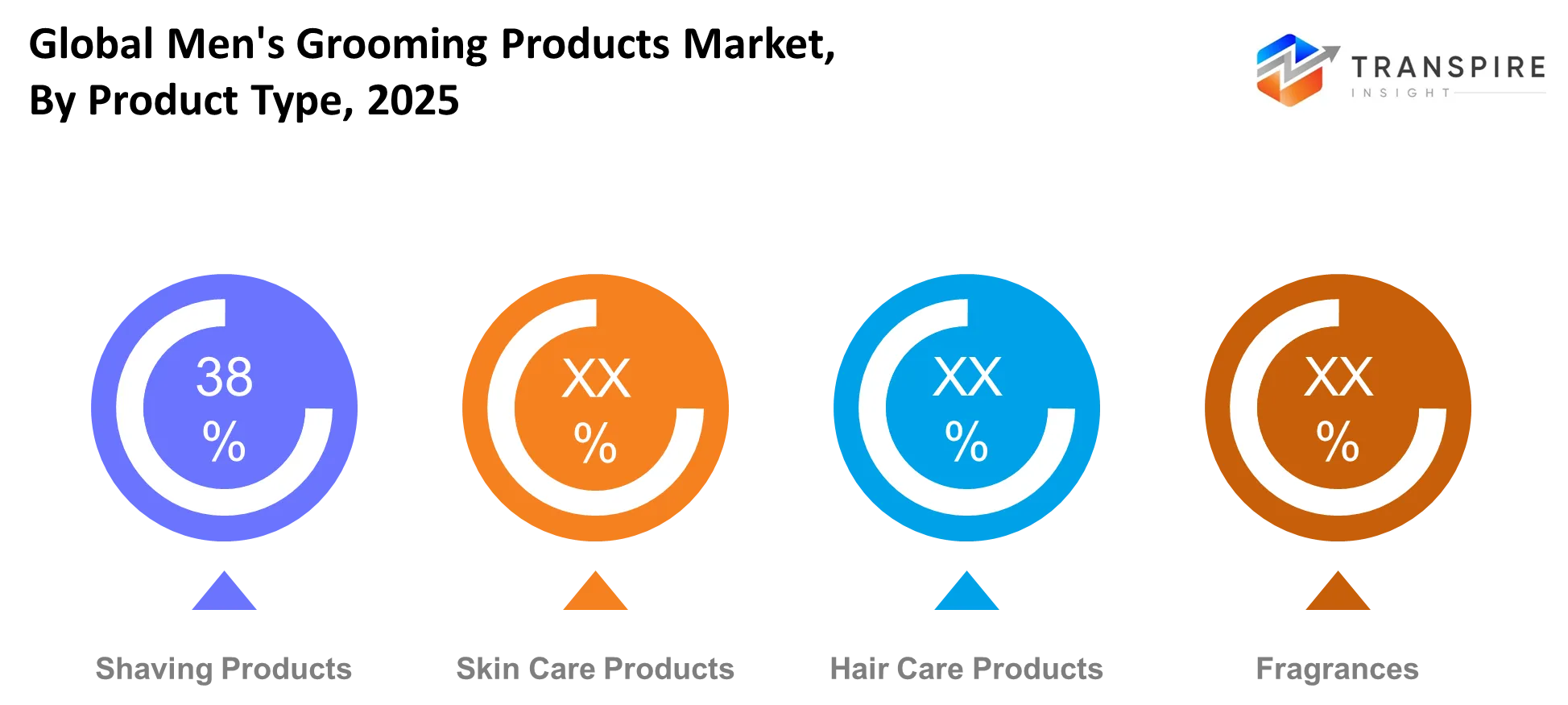
- Shaving Products command 38% of global product segment revenue in 2025, representing the core category that drives market volume through recurring purchases of razors, shaving gels, and aftershave products.
- Skin Care Products are the fastest-growing product category, projected above 7.2% CAGR through 2033, driven by men's increased awareness of anti-aging, sun protection, and dermatologically formulated skincare solutions.
- Supermarkets and Hypermarkets remain the dominant distribution channel at 42% of market revenue in 2025, though Online Retail is growing at 11.3% CAGR as male consumers increasingly purchase grooming products through Amazon, Nykaa, and brand-specific e-commerce platforms.
- Procter & Gamble Company and Unilever PLC together account for over 28% of global men's grooming products revenue through brands including Gillette, Old Spice, Axe, and Dove Men.
- L'Oréal S.A. has expanded men's grooming market share through acquisitions of premium grooming brands and innovative formulations targeted at conscious male consumers seeking quality over price.
- Direct-to-consumer brands have captured approximately 8% of market share since 2019 by offering subscription-based razor delivery, simplified product lines, and digital-native marketing that resonates with millennial and Gen Z male consumers.
- Premium and ultra-premium grooming products are growing 2.3 times faster than mass-market equivalents, with male consumers increasingly willing to invest in higher-priced formulations and specialty brands.
What are the Key Drivers, Restraints, and Opportunities in the Global Men's Grooming Products Market?
The primary driver of men's grooming market growth is the generational shift in grooming attitudes and social acceptance itself. Millennials and Gen Z men - who make up over 35% of all adult males in developed markets - see grooming as a form of self-care and personal development much more so than a utility or feminine practice. This change in attitude is really reinforced by social media influencers, celebrity endorsements, and content creators who have totally normalized quite extensive male grooming routines. Moreover, workplace professionalism standards in corporate, technology, and creative industries really reward very polished appearances even more, setting up economic incentives for men to invest in grooming products well beyond what they need to get by with.
The biggest structural restraint is just price sensitivity among male consumers in developing markets, where grooming products compete directly with really essential household essentials for any discretionary spending money. Even though premium products are growing in developed markets, a pretty big part of the world's male population still buys low-cost, mass-market grooming items mainly as purely functional products. Additionally, product commoditization in the shaving category creates a ton of price competition among established players, really squeezing margins in the highest-volume segment and making it very difficult to differentiate your products without investing in your brand or innovating with new ingredients.
The clearest opportunity going forward is the integration of grooming products with health and wellness platforms, especially in the context of hair loss treatment and anti-aging skincare. Telehealth companies like Hims, Roman, and Ro have actually successfully combined prescription hair loss medications with complementary grooming products, creating a whole new category that blends pharmaceuticals and everyday consumer products. As men become much more comfortable talking about hair loss, skin problems, and age-related issues through digital health channels, the market for dermatologist-recommended grooming formulations is really expected to expand quite a bit by 2033.
What Has the Impact of Artificial Intelligence Been on the Global Men's Grooming Products Market?
Artificial intelligence has really entered the men's grooming products market mainly through personalization engines and recommendation systems - these are customizing product suggestions based on your skin type, hair type, your way of living, and even your purchasing history. Online stores and beauty retailers are using AI-driven skin analysis tools - these let male consumers take a photo of their skin condition and receive super-targeted product recommendations, eliminating a major obstacle to skincare adoption among guys who may lack grooming knowledge or feel overwhelmed by skincare terminology itself.
AI-driven supply chain optimization has also had a big impact on the market by cutting down inventory waste and making it possible for faster product innovation cycles. Major manufacturers use machine learning to forecast demand patterns and optimize production scheduling - this is particularly key for time-sensitive products like seasonal fragrances and limited-edition grooming formulas. What's more, AI chatbots and customer service automation have really improved post-purchase support for subscription-based grooming services, reducing customer churn and improving lifetime value metrics that are really crucial for direct-to-consumer brands competing against established industry leaders.
Key Market Trends
- Premiumization accelerates as male consumers gravitate toward products with clinical benefits, such as hyaluronic acid serums, retinol-based anti-aging formulations, and dermatologist-recommended skincare solutions.
- Shaving Products remain the largest category at 38% of market revenue in 2025, though growth in this segment is moderating as male consumers diversify their grooming spend into skin care and hair care products.
- Skin Care Products are the fastest-growing category, above 7.2% CAGR, driven by men's increased awareness of sun protection, anti-aging concerns, and the normalization of multi-step skincare routines among younger males.
- Hair Care Products gain share as men increasingly invest in specialized shampoos, conditioners, and styling products, with men's hair care growing 6.8% annually through 2033.
- Fragrances experience moderate growth at 4.2% CAGR as the fragrance market matures in developed regions but expands in Asia-Pacific where personal fragrance adoption remains below Western levels.
- Online Retail channels grow at 11.3% CAGR, substantially outpacing supermarket and specialty store channels, as male consumers increasingly purchase grooming products through Amazon, Walmart.com, and brand-specific platforms.
- Supermarkets and Hypermarkets remain the dominant channel at 42% market share in 2025, though their growth rate of 3.8% CAGR trails online and specialty channels.
- Specialty Stores, including barber shops and men's grooming boutiques, are growing at 6.5% CAGR by creating curated shopping experiences and expert consultation that differentiate from commodity retail channels.
- Direct-to-consumer brands have captured 8% market share through subscription models, simplified product selection, and data-driven marketing that resonates with millennial and Gen Z male consumers.
- Sustainability and eco-conscious packaging have emerged as competitive factors among premium brands, with recyclable and refillable packaging attracting environmentally conscious male consumers willing to pay premium prices.
Global Men's Grooming Products Market Segmentation
By Product Type
Shaving products represent 38% of global men's grooming product revenue by 2025 and comprise razors, shaving creams, gels, foams, aftershave, and pre-shave products. This category drives market volume through recurring purchases - razors need regular blade replacement and shaving creams are consumable items bought every 4-8 weeks. The shaving category has seen a lot of change since 2012 with the appearance of subscription razor services such as Dollar Shave Club and Harry's, which have quite successfully captured market share from established brands by offering lower prices, very convenient home delivery, and direct digital communication with customers itself.
Skin care products are actually growing much faster than any other category, at a rate of over 7. 2% CAGR all the way up to 2033. This section includes moisturizers, anti-aging serums, face cleansers, sun protection products, and targeted solutions for acne and sensitivity. The growth driver is the normalisation of multi-step skincare routines among younger male consumers, influenced by social media content showing the anti-aging and health benefits of regular skincare. Brands like Kiehl's, Lab Series, and Clinique have rather successfully positioned men's skincare as a clinical, results-oriented category rather than a beauty or vanity purchase itself.
Hair care products span shampoos, conditioners, styling products, and hair loss treatments, growing at a rate of 6. 8% CAGR. Men are increasingly putting more investment in specialized hair care formulations tailored to hair type, scalp condition, and styling preferences themselves. Telehealth platforms have expanded the market for prescription hair loss treatments combined with related grooming products, creating an entirely new revenue stream for grooming companies itself.
To learn more about this report, Download Free Sample Report
By Distribution Channel
Supermarkets and hypermarkets make up 42% of our world's men's personal care product sales revenue in 2025. These retailers offer an incredibly wide selection of products, very competitive prices, and they're really quite convenient, making them the primary shopping spot for everyday consumers buying mass-market brands such as Gillette, Old Spice, and Axe. Growth in this channel is slowing down at 3. 8% CAGR as online retailing and specialty channels take over market share from mainstream retailing itself.
Online Retail is actually the fastest-growing sales channel, expanding at 11. 3% CAGR. Men consumers are more and more comfortable purchasing personal care products online through e-commerce sites, driven by convenience, having it delivered right to their homes, options for subscription, and exposure to premium and more niche brands that aren't even available in physical stores. Direct-to-consumer brands have really driven significant growth in online channels by building customer loyalty through digital advertising and subscription-based business models themselves.
Specialty stores, including quite a few independent barber shops, men's personal care boutiques, and professional salons, are growing at 6. 5% CAGR by offering a very curated selection of products, expert advice, and a really personalized shopping experience that really differentiates itself from mass-market retailing. These channels demand a lot more money - premium pricing - and they really attract consumers who are willing to spend extra for expert guidance and exceptional service itself.
By End-User
Adults account for the majority of men's grooming products consumption, representing approximately 68% of market revenue in 2025. Adult male consumers have established grooming habits, higher disposable income, and purchasing power to invest in premium and specialty products. This segment is relatively stable, growing at approximately 5.1% CAGR, as grooming habits mature and consumers commit to recurring purchases of preferred brands.
Teenagers represent approximately 32% of market revenue in 2025 and are growing at a faster rate of 6.8% CAGR. This younger demographic has higher engagement with social media content, greater exposure to male grooming influencers, and more liberal attitudes toward grooming as self-care. Brands increasingly target teenage males through social media channels and influencer partnerships, positioning grooming products as aspirational purchases that communicate identity and social status.
What are the Key Use Cases Driving the Global Men's Grooming Products Market?
The main use case is everyday personal hygiene and grooming routines amongst adult men - where shaving products, hair care and basic skincare really form the basis of our regular consumption habits. Typical adult male consumers purchase shaving cream or gel around six times per year, shampoo every couple of months, and cologne annually. This regular consumption pattern builds very predictable revenue streams for established brands and opens up possibilities for subscription-based distribution models which take advantage of consumer inertia and brand loyalty itself.
The emerging use case really gaining lots of traction is preventative anti-aging skincare amongst men aged 25 to 45, driven by social media education and the normalizing of male skincare routines itself. Men in this age group are increasingly investing in serums, moisturizers, and sun protection products so they can address early signs of aging - driven partly by professional requirements in face-to-face jobs and partly by social media exposure to male beauty and skincare content itself. This use case really supports premium pricing and higher margin products.
Another key use case is hair loss treatment and management for men experiencing male-pattern baldness. Telehealth platforms have completely changed this use case by combining prescription treatments such as minoxidil and finasteride with complementary grooming products - creating quite integrated solutions that address both medical and cosmetic aspects of hair loss itself. This hybrid health-and-grooming use case is really expanding rapidly and attracting consumers who previously wouldn't have considered purchasing grooming products for hair loss management itself.
Report Overview Table
|
Report Metrics |
Details |
|
Market size value in 2025 |
USD 61.5 Billion |
|
Market size value in 2026 |
USD 65.07 Billion |
|
Revenue forecast in 2033 |
USD 94.7 Billion |
|
Growth rate |
CAGR of 5.51% from 2026 to 2033 |
|
Base year |
2025 |
|
Historical data |
2021 - 2024 |
|
Forecast period |
2026 - 2033 |
|
Report coverage |
Revenue forecast, competitive landscape, growth factors, and trends |
|
Regional scope |
North America; United States; Canada; Mexico; Europe; United Kingdom; Germany; France; Italy; Spain; Denmark; Sweden; Norway; Asia-Pacific; China; Japan; India; Australia; South Korea; Thailand; Brazil; Argentina; South Africa; Saudi Arabia; United Arab Emirates |
|
Key companies profiled |
Procter & Gamble Company, Unilever PLC, L'Oréal S.A., Edgewell Personal Care Company, Beiersdorf AG, Colgate-Palmolive Company, Johnson & Johnson, Koninklijke Philips N.V., Coty Inc., Shiseido Company Limited, Reckitt Benckiser Group plc, Avon Products Inc., Amway Corporation, ITC Limited, Gillette Company |
|
Customization scope |
Free report customization (country, regional & segment scope). Avail customized purchase options to meet your exact research needs. |
|
Report Segmentation |
By Product Type (Shaving Products, Skin Care Products, Hair Care Products, Fragrances), By Distribution Channel (Supermarkets & Hypermarkets, Online Retail, Specialty Stores), By End-User (Adults, Teenagers) |
Which Regions are Driving the Global Men's Grooming Products Market Growth?
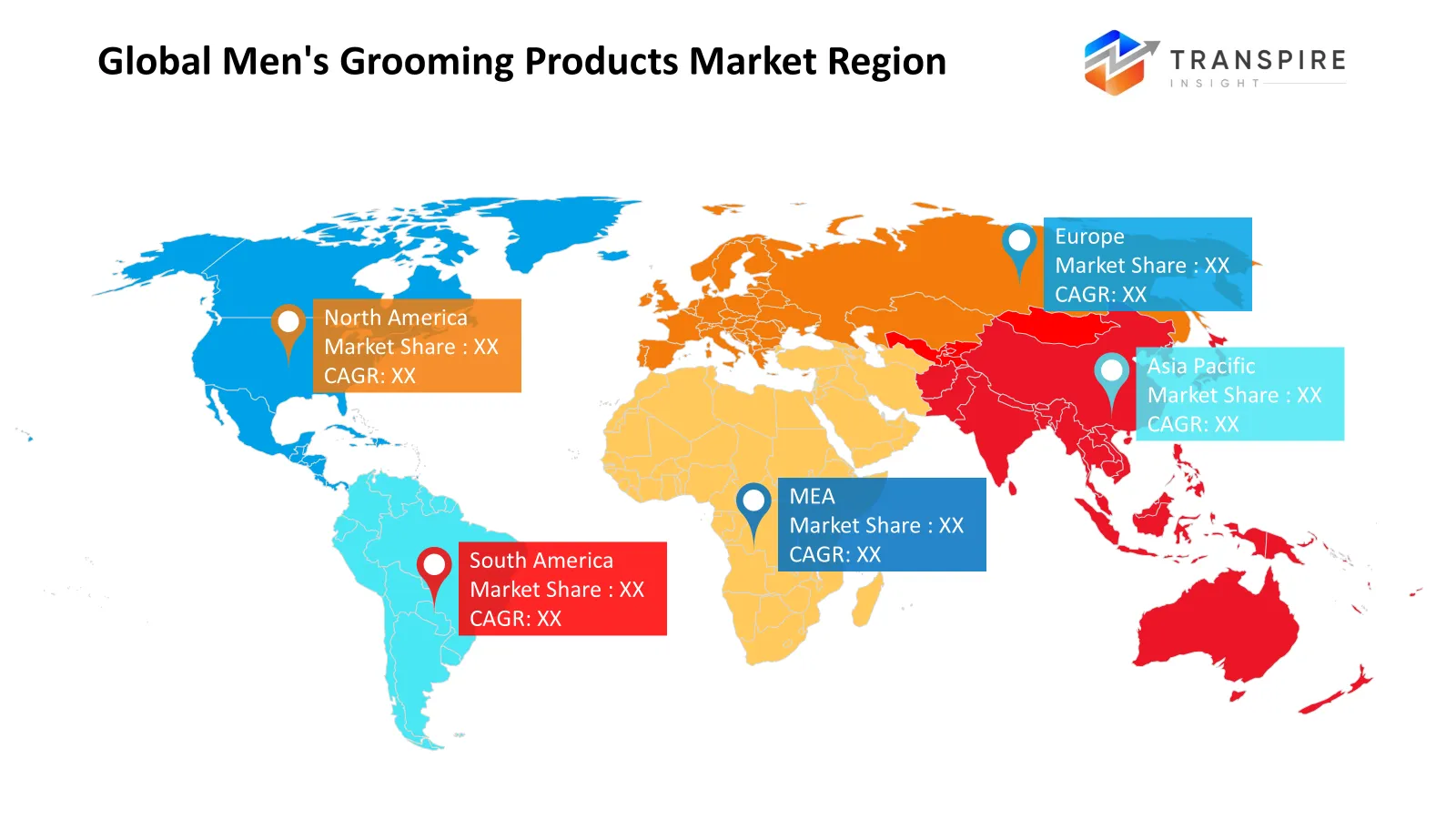
North America holds the largest market share at approximately 38% of global men's grooming products revenue in 2025. The United States dominates this region through high disposable income, cultural acceptance of male grooming as self-care, mature e-commerce adoption, and a concentration of both established multinational brands and emerging direct-to-consumer companies. American male consumers have the highest per-capita spending on grooming products globally, driven by strong brand loyalty, premium product positioning, and social media influence from grooming influencers and lifestyle creators.
Europe represents approximately 32% of global market revenue, anchored by strong brand heritage and premium positioning. Germany, France, Scandinavia, and the United Kingdom are key markets where established European grooming companies have built brand loyalty over decades. European consumers demonstrate strong preference for quality formulations and are willing to pay premium prices for dermatologically tested and clinically proven products. Sustainability and eco-conscious packaging are particularly important to European consumers, creating competitive advantages for brands emphasizing environmental responsibility.
Asia-Pacific is the fastest-growing region, expanding at a CAGR above 7.5% through 2033. China represents the largest growth driver due to rising disposable income, rapidly expanding middle-class consumer base, and increasing influence of social media on male grooming preferences. Japan maintains the highest grooming product consumption per capita in Asia due to cultural emphasis on personal appearance and grooming. India is an emerging growth market with young, smartphone-connected male population increasingly exposed to global grooming trends and willing to invest in premium products as income levels rise.
To learn more about this report, Download Free Sample Report
Who are the Key Players in the Global Men's Grooming Products Market and How Do They Compete?
The global men's grooming products market is dominated by multinational consumer goods companies with extensive distribution networks, established brand portfolios, and significant marketing budgets. Procter & Gamble and Unilever together account for over 28% of global market revenue through iconic brands including Gillette, Old Spice, Axe, and Dove Men. These incumbents compete through brand heritage, retail shelf space dominance, and economies of scale that enable aggressive pricing and promotion strategies.
L'Oréal S.A. has strategically expanded men's grooming market share through a combination of organic product line expansion and targeted acquisitions of premium grooming brands. The company positions men's grooming as a premium segment with scientifically formulated products that command higher price points than mass-market equivalents. Edgewell Personal Care Company, which owns Schick razors and Edge shaving products, competes directly against Gillette in the high-volume shaving products category through innovation and competitive pricing.
Direct-to-consumer brands including Dollar Shave Club, Harry's, and Hims have disrupted traditional distribution by building direct relationships with consumers through digital marketing and subscription-based business models. These newer entrants attract price-conscious and digitally native consumers who value convenience, simplicity, and data transparency. Telehealth companies such as Hims, Roman, and Ro have created a new competitive dynamic by integrating prescription medications for hair loss and erectile dysfunction with complementary grooming products, blurring the boundaries between healthcare and consumer grooming.
Global Men's Grooming Products Market Companies
- Procter & Gamble Company
- Unilever PLC
- L'Oréal S.A.
- Edgewell Personal Care Company
- Beiersdorf AG
- Colgate-Palmolive Company
- Johnson & Johnson
- Koninklijke Philips N.V.
- Coty Inc.
- Shiseido Company Limited
- Reckitt Benckiser Group plc
- Avon Products Inc.
- Amway Corporation
- ITC Limited
- Gillette Company
Recent Developments
In January 2026, Procter & Gamble announced the launch of Gillette SkinGuard, a new line of dermatologist-developed skincare products specifically formulated for men with sensitive skin following shaving. The product line expansion strengthens P&G's position in the premium men's skincare category and represents a strategic effort to build recurring revenue from premium grooming products beyond the declining high-margin razor blade market. https://www.pg.com
In February 2026, Unilever PLC completed the acquisition of a UK-based premium men's grooming brand specializing in natural and organic formulations. The acquisition provides Unilever with direct access to health-conscious male consumers and the growing premium grooming segment. The brand will operate as a standalone entity under Unilever's prestige portfolio, maintaining brand independence while leveraging Unilever's global distribution infrastructure. https://www.unilever.com
What Strategic Insights Define the Future of the Global Men's Grooming Products Market?
The men's grooming products market over the next five to seven years will increasingly bifurcate into two distinct channels and pricing tiers. On one end, mass-market grooming commodities distributed through supermarkets and online marketplaces will face intensifying price competition, margin compression, and consolidation among manufacturers. On the other end, premium and ultra-premium grooming products with clinical benefits, specialized formulations, and lifestyle positioning will grow substantially faster than the mass market, commanding higher margins and attracting venture capital funding into new brands and distribution models.
The most significant opportunity for market participants is integration with healthcare and telehealth platforms, particularly in the high-value hair loss and anti-aging skincare categories. As regulatory frameworks and consumer attitudes continue to normalize prescription medications for grooming-related concerns through digital health channels, early movers that successfully integrate pharmaceutical treatments with complementary consumer grooming products will build competitive moats through customer lifetime value and integrated product ecosystems.
Regional expansion in Asia-Pacific, particularly in China and India, will be critical for sustained revenue growth. Multinational companies must develop products and marketing strategies tailored to Asian male grooming preferences, which differ substantially from Western markets. Direct-to-consumer brands that establish themselves in Asian markets through social media and e-commerce channels before incumbent brands develop localized strategies will capture disproportionate value.
Global Men's Grooming Products Market Report Segmentation
By Product Type
- Shaving Products
- Skin Care Products
- Hair Care Products
- Fragrances
By Distribution Channel
- Supermarkets & Hypermarkets
- Online Retail
- Specialty Stores
By End-User
- Adults
- Teenagers
Frequently Asked Questions
Find quick answers to common questions.
The Global Men's Grooming Products Market size is expected to reach USD 94.7 Billion by 2033.
The key segments are By Product Type (Shaving Products, Skin Care Products, Hair Care Products, Fragrances), By Distribution Channel (Supermarkets & Hypermarkets, Online Retail, Specialty Stores), and By End-User (Adults, Teenagers).
Major players include Procter & Gamble Company, Unilever PLC, L'Oréal S.A., Edgewell Personal Care Company, Beiersdorf AG, Colgate-Palmolive Company, Johnson & Johnson, Koninklijke Philips N.V., Coty Inc., Shiseido Company Limited, Reckitt Benckiser Group plc, Avon Products Inc., Amway Corporation, ITC Limited, and Gillette Company.
The Global Men's Grooming Products Market size is USD 61.5 Billion in 2025.
The Global Men's Grooming Products Market CAGR is 5.51% from 2026 to 2033.
- Procter & Gamble Company
- Unilever PLC
- L'Oréal S.A.
- Edgewell Personal Care Company
- Beiersdorf AG
- Colgate-Palmolive Company
- Johnson & Johnson
- Koninklijke Philips N.V.
- Coty Inc.
- Shiseido Company Limited
- Reckitt Benckiser Group plc
- Avon Products Inc.
- Amway Corporation
- ITC Limited
- Gillette Company
Recently Published Reports
-
Apr 2026
Bottled Water Market
Bottled Water Market Size, Share & Analysis Report By Product Type (Still Bottled Water, Carbonated Bottled Water, Functional Bottled Water, and Others), By Packaging (PET, Cans, and Others), By Sales Channel (Supermarkets/Hypermarkets, Convenience Stores/Drug Stores, Grocery Stores/Club Stores, Foodservice, and Others) and Geography (North America, Europe, Asia-Pacific, Middle East and Africa, South and Central America), 2021 - 2032
-
Apr 2026
Color Cosmetic Packaging Market
Color Cosmetic Packaging Market Size, Share & Analysis Report By Application (Mascara Packaging, Liquid Packaging, and Liquid Face), By Type (Tubes & Bottles, Pens & Markers, Compacts & Containers, and Droppers & Pumps), and Geography (North America, Europe, Asia-Pacific, Middle East and Africa, South and Central America), 2021 - 2031
-
Apr 2026
External Microphone For Camera Market
External Microphone For Camera Market Size, Share & Analysis Report By Type (Shotgun Microphone, Lavalier Microphone, and Others), By Application (Digital Camera, Professional Video Camera, and Others), and Geography (North America, Europe, Asia-Pacific, Middle East and Africa, South and Central America), 2021 - 2031
-
Apr 2026
Foot Orthotic Insoles Market
Foot Orthotic Insoles Market Size, Share & Analysis Report By Type (Pre-fabricated, and Custom-made), By Material (Thermoplastic, Composite Carbon Fiber, and Others), By Distribution Channel (Drug Stores, Hospitals & Clinics, and Others), and Geography (North America, Europe, Asia-Pacific, Middle East and Africa, South and Central America), 2021 - 2031