

United Kingdom Compounding Pharmacies Market Summary
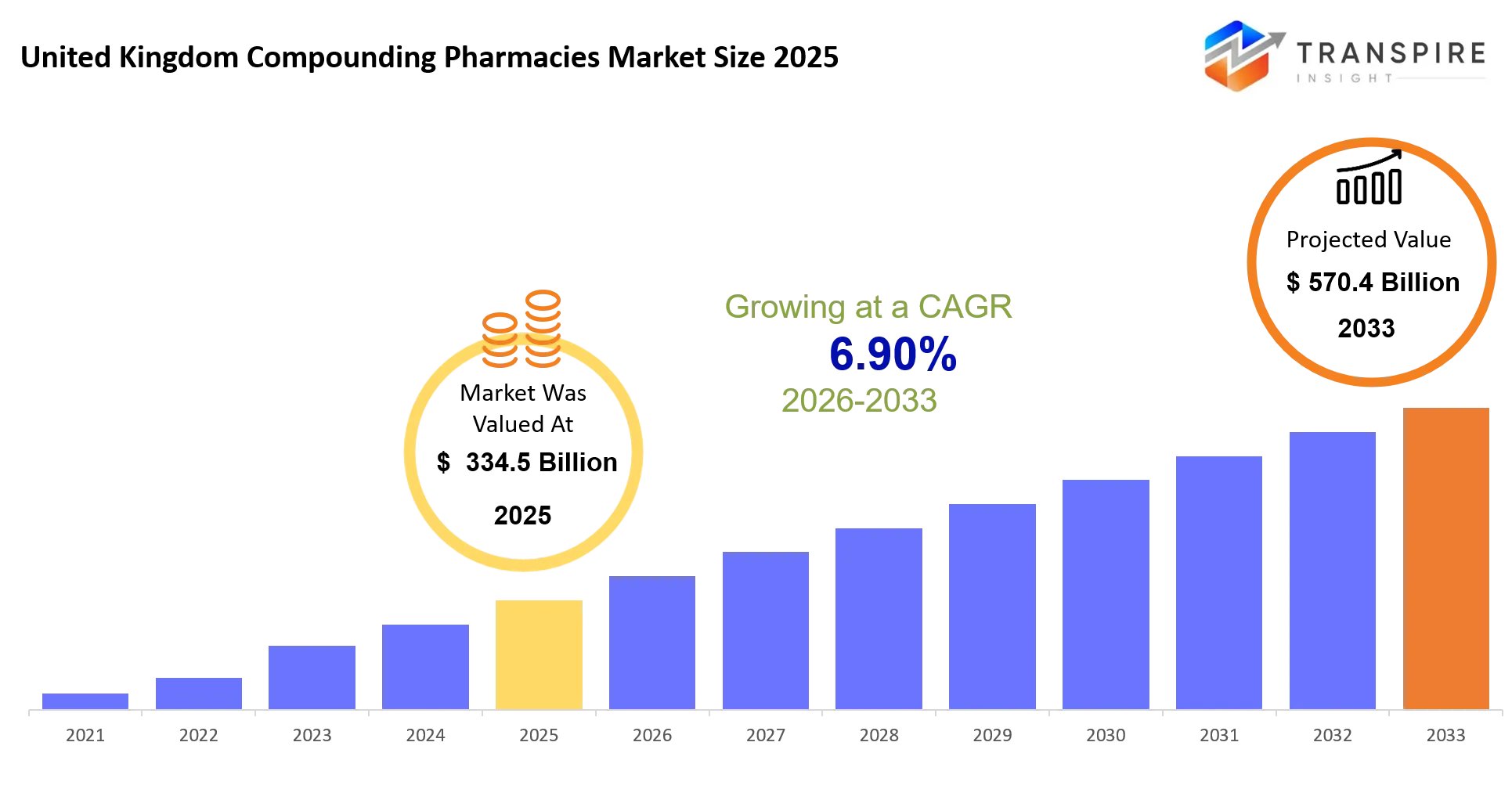
As per Transpire Insight Analysis the United Kingdom Compounding Pharmacies Market size is estimated at USD 334.5 Million in 2025 and is anticipated to reach USD 570.4 Million by 2033, growing at a CAGR of 6.90% from 2026 to 2033.
In the United Kingdom, compounding pharmacies are often trying to deal with treatment gaps that off the shelf, manufactured medicines just can’t handle properly, so they end up preparing customized formulations, adjusted for each individual person needs. A fair number of hospitals, specialist clinics, veterinarians, and community health providers use compounded medicines too, especially when commercial products are not available, have been taken off the market, come only in strange strengths or when the patient needs something that works with their allergies, swallowing issues, or those more tangled therapy scenarios. In practice, this method helps care keep moving across different clinical areas, and it also reduces the likelihood of interruptions in treatment, particularly when the timing gets really tight.
In the past three to five years, the market seems to have shifted toward more controlled and quality focused compounding, with better compliance routines, and more digital style management for prescriptions. After the COVID-19 period, medicine shortages and supply chain issues revealed how fragile access can be for commercially produced drugs, so healthcare teams leaned more heavily on licensed compounding services. Now, as clinicians want consistent access to therapies that match the patient, pharmacies with mature quality frameworks, specialized production ability, and regulatory know-how are taking on bigger institutional agreements and finding additional revenue paths across the United Kingdom healthcare system.
United Kingdom Compounding Pharmacies Market Size & Forecast:
- United Kingdom Compounding Pharmacies Market Size 2025: USD 334.5 Million
- Expected Market Value 2033: USD 570.4 Million
- Forecast CAGR: 6.90%
- Leading region in 2025: England
- Fastest Growing region: Scotland
- Key Profile: Specials Lab, Nova Laboratories, IPS Pharma, BCM Specials, Torbay Pharmaceuticals, Clinisupplies, LloydsPharmacy, Pharmaxo, Rosemont Pharmaceuticals, Bupa Pharmacy, Walgreens Boots Alliance, Fresenius Kabi, Medisca, Fagron, Triangle Compounding
Key Market Insights
- England really held the United Kingdom Compounding Pharmacies Market pretty hard, with about 82% market share in 2025 , kind of backed by dense hospital networks and specialist pharmacy setups that are already in place.
- Scotland meanwhile is expected to move the quickest in the 2026–2032 window, mostly because specialist healthcare services keep widening, plus there are new advanced pharmaceutical manufacturing investments going in.
- When it comes to what they’re making, sterile compounded medications were the front runner, taking close to 58% of the market in 2025, which matches the hospital demand for injectable and oncology preparations. Non-sterile compounded formulations stayed second, still helped along by dermatology pain management, pediatric, and hormone replacement therapies through 2025.
- For services, personalized biologic-support compounding should become the fastest-growing segment by 2032 , mainly from precision medicine adoption and the broader specialty care expansion.
- Looking at pharmacy use, hospital pharmacy applications captured around 61% market share in 2025, since complex inpatient treatments need customized sterile preparations and dosage readjustments.
- In terms of therapy focus, oncology and rare disease treatments are expected to be the fastest-growing application area across the whole forecast, due to expanding individualized treatment protocols.
- For end users, NHS hospitals remained top, at nearly 64% market share in 2025 , supported by centralized purchasing and specialized clinical expectations.
- Private specialty clinics are forecast to be the fastest-growing end-user category by 2032, pushed by personalized care models, and also more elective treatment expansion.
What are the Key Drivers, Restraints, and Opportunities in the United Kingdom Compounding Pharmacies Market?
Personalized medicine stays like the strongest growth driver in the whole market,even when it gets noisy around it. The push for precision health care keeps expanding, prescribers get a bit more room to choose, and recurring shortages of medicines make clinicians lean toward customized formulations when regular products simply can’t cover the clinical need. With refreshed quality standards and digital prescribing systems now in place, healthcare providers feel more comfortable using these options. And as more hospitals, plus specialist clinics, fold compounded medicines into their treatment pathways, procurement volumes climb, and pharmacies typically invest in stronger sterile production capacity too, which ends up directly backing higher revenue generation.
Still, regulatory compliance, plus sterile manufacturing expectations, are the biggest structural restraint. The validation costs are high, cleanroom upgrades require major spend, there’s an ongoing shortage of skilled staff, and continuous quality monitoring is basically non stop, so the entry barriers stay real and slow. Smaller providers often postpone facility upgrades because the capital requirement stays pretty heavy, and yes that part doesn’t cool down quickly. Approvals and capacity additions therefore progress slower, which keeps market penetration limited and can suppress revenue upside. From Transpire Insight review of regional procurement notices and product launch pacing, the supply chain concentration problem remains the primary execution risk.
Automation plus precise manufacturing feels like the real, durable shot at the future. With AI supported formulation validation, robotic sterile filling, and digital prescription checking, you can cut down on those prep mistakes while keeping output consistent. There’s also the push to invest in more advanced pharmaceutical manufacturing across England and Scotland, which makes the environment better for higher value compounded biologics and specialty treatments. And honestly, companies that put integrated digital quality systems in place will likely be more ready to win long term NHS and private healthcare contracts through the next decade, even if the path is a bit messy at times.
What Has the Impact of Artificial Intelligence Been on the United Kingdom Compounding Pharmacies Market?
Artificial intelligence along with digital technologies are, honestly, sort of reshaping compounding pharmacy operations, like they’re quietly changing everything about the way prescriptions get checked, how formulations remain uniform, how inventory stays in the right spot , and how regulatory duties are managed. It feels less like a big disruption and more like a steady , nuanced upgrade. AI-enabled applications can automatically review prescriptions , spot dosing inconsistencies, check whether ingredient pairings actually work together, and help with electronic paperwork. This trims down the hours spent on manual review while also making audit readiness feel a bit less chaotic. On top of that, automated environmental monitoring systems keep tabs on cleanroom conditions 24/7, so pharmacists can react fast when there’s even a small deviation before product quality gets touched.
Machine learning models are also leaning into demand forecasting more often these days. They look at prescription history, seasonal treatment trends, medicine shortages, and even hospital procurement rhythms. With those signals, pharmacies can improve how they position raw material inventories reducing discard and overstock, but still keeping enough supply for customized therapies. Digital workflow platforms then help with production scheduling , boost laboratory utilization, and speed up prep turnaround times, which means pharmacists and technical staff get used in a more thoughtful way. A lot of facilities mention better compliance outcomes too, largely because automated batch records and electronic quality management keep things in order.
Even so, adoption is not exactly even across the board. Connecting new systems to older pharmacy setups takes a big capital push, and solid clinical datasets for very customized formulations are still kind of thin. Smaller independent compounding companies, in particular, can end up with longer rollouts, because software validation , cybersecurity requirements , and staff training add up quickly. So the operational savings don’t always show up right away, at least not until deployment costs are truly covered.
Key Market Trends
- Sterile compounding capacity sort of expanded pretty much from 2022 into 2025, mainly because hospitals wanted dependable access to customized injectable medicines, especially when supply disruptions happened.
- Digital prescription processing has slowly swapped out the old manual workflows across many specialist pharmacies since after 2023, and that cut down transcription mistakes, while also making regulatory documentation look cleaner or more complete.
- NHS procurement more and more seems to prefer pharmacies that have validated quality systems, so investments followed, like automated environmental monitoring and electronic batch records.
- Personalized oncology and rare disease formulations got more traction starting in 2024, which kind of mirrors wider adoption of precision medicine treatment pathways across specialist hospitals.
- Robotics assisted sterile preparation is showing up as a competitive edge. It helps pharmacies raise production consistency and reduce the need for so much manual involvement by around 2026.
- Raw material sourcing strategies diversified later, after global pharmaceutical supply disruptions, with compounders setting up multiple qualified ingredient suppliers, for resilience and also to avoid single points of failure.
- During 2025, investment in AI enabled quality assurance platforms really sped up, in a way that strengthened formulation verification, inventory planning, and compliance reporting all at once.
- Also, private specialty clinics kept expanding partnerships with compounding providers between 2024 and 2026, supporting customized hormone therapy, dermatology care and pain management, basically.
- Meanwhile, leading providers continued putting money into cleanroom modernization, so they can manage larger production volumes while still satisfying shifting regulatory expectations for sterile pharmaceutical manufacturing more or less.
United Kingdom Compounding Pharmacies Market Segmentation
By Product Type :
Oral meds still take a big chunk, mostly because personalized capsules, tablets, and liquid formats kinda help patients who need very specific strengths or slight ingredient swaps that regular medicines just can’t handle. The demand is staying fairly strong, especially with pediatric and geriatric care, where flexibility tends to make safer treatment plans possible , more often than not. On top of that, topical medications also hold a noticeable portion, since dermatology clinicians often ask for creams, gels, and ointments that match individual skin conditions.
At the same time, consistent prescribing habits keep supporting steady pull across hospitals and specialty clinics, so it doesn't really dip. Sterile preparations show up as a high-value segment too, because they’re used in oncology, ophthalmology, and injectable therapies where strict quality controls are non-negotiable . Hormone therapies keep their footing via personalized hormone replacement programs, aimed at each person’s clinical context. Veterinary preparations keep growing as animal health providers look for customized formulations for different species, along with different dosage requirements. Then there are other specialized products that back niche therapeutic needs, and they also strengthen the service lineup across compounding pharmacies.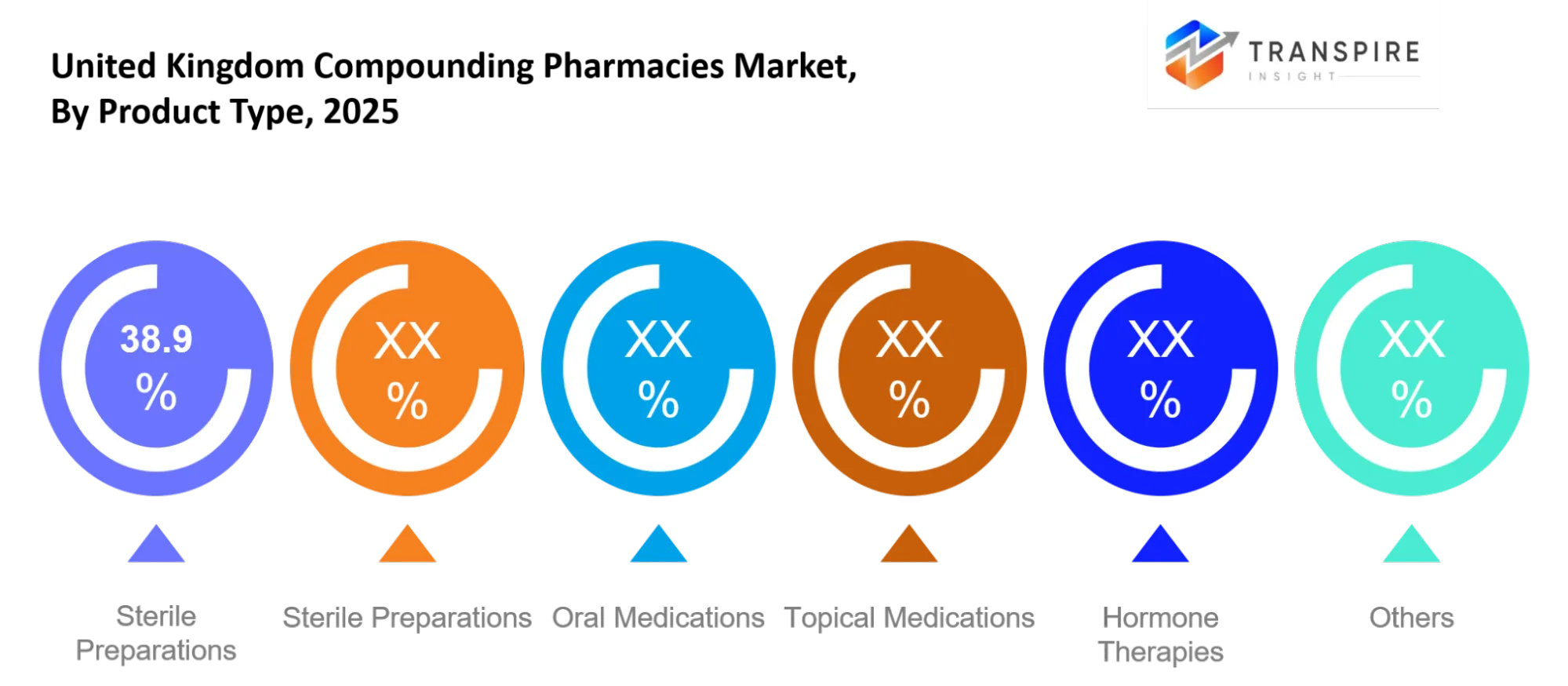
By Therapeutic Area :
Pain management still sits at the top, mostly because customized medicines let clinicians tweak the dosage strength, blend active ingredients, and also make the patient comfort a bit more manageable, in a way that feels more responsive. A lot of personal treatment plans end up needing formulations that aren’t really on the shelf as standard commercial pharmaceutical products, so the preparation has to be reworked case by case, just like that. Dermatology comes right after, because skin problems often require a tailor made approach of creams, ointments, and gels that really fit the exact clinical scene.Steady interest from specialist practices keeps prescription numbers rather consistent.
Hormone replacement therapy keeps growing too, since personalized dosing really helps with treatment flexibility when clinical needs shift over time. Pediatric uses still remain pretty significant, especially since children often need strengths that match their age, plus flavored medicines , or liquid preparations, to help make adherence better. Past that, other therapeutic areas—like rare diseases and supportive care—also give extra room for a more customized pharmaceutical formulation.Overall, broader clinical take up keeps diversifying the kind of service demand seen across different healthcare settings.
By Sterility :
Sterile compounding kind of leads the segment, because injectable medicines, ophthalmic preparations, and oncology treatments need controlled production spaces and very strict regulatory compliance stuff. Hospitals plus specialty care centers rely on validated sterile mixtures to back up those complicated clinical procedures. High manufacturing standards bring added value, but also help keep long-term institutional contracts steady. When companies keep investing in cleanroom facilities , it strengthens production capability across licensed providers, day by day.
Non-sterile compounding keeps a wide customer base going through oral medicines, topical formulations, hormone therapies, and pediatric treatments made per individual prescriptions . With more flexible production methods, pharmacies can respond fast to shifting clinical needs , without dropping quality too much. Other sterility categories cover specialized use cases where the preparation rules are a bit different. Overall, steady demand across sterile and non-sterile services helps sustain a more diversified business model.
By End User :
Hospitals end up taking the biggest chunk of the market because complicated patient situations often need custom made medicines that just can’t be pushed through standard pharmaceutical manufacturing processes. Specialized units such as oncology, intensive care, and pediatrics lean on compounded formulations so dosing stays right and the treatment rhythm continues without gaps. Big procurement agreements also help keep revenue fairly consistent for the providers that are properly qualified, and that matters a lot in practice. At the same time, solid regulatory compliance is still a must, especially when it comes to institutional purchasing choices.
Clinics keep moving toward personalized medicines in areas like dermatology, hormone therapy, pain management, and other niche care tracks. Homecare demand keeps rising too, since more long-term patients end up receiving tailored therapies outside the hospital environment. Even veterinary centers add a steady stream of chances, mostly through species-specific medicines that are prepared based on clinical needs. Besides that, other healthcare facilities contribute extra prescription volumes across a range of treatment settings.
By Distribution Channel :
Hospital pharmacies pretty much run the show in distribution, because inpatient treatment, quite often needs immediate access to sterile and also patient specific compounded medicines, at the same time. When clinical teams coordinate well with pharmacy staff, treatment efficiency improves, while the whole operation still has to keep strict quality expectations in place. Retail pharmacies still hold an important place in the system too, mainly for outpatient prescriptions covering dermatology , pain management, and hormone therapies. And yes, broad community access helps keep the prescription routine consistent.
Online pharmacies keep getting more attention lately, mostly via digital prescription processing , home delivery services, and a general better feel for repeat therapies. Secure ordering platforms help smooth communication between healthcare providers and pharmacy teams, and they also support more efficient order management. Other distribution options exist as well, especially when specialized procurement is needed for institutional or regional healthcare providers. The digital push will keep moving forward, and it should keep improving service accessibility across a range of patient groups.
By Compounding Type :
Pharmaceutical ingredient modification drives this section, because most treatment plans end up needing removal of allergens, preservatives, coloring agents, or other nonactive components that aren’t compatible with a specific patient. Tailored formulations also help with medicine shortages by producing clinically fitting substitutes, when the usual commercial products stay out of reach. The more adaptable formulation abilities , the better pharmacy impact becomes across multiple therapeutic fields. When steady clinical need keeps showing up, the service can keep growing long term.
Changing the dosage is also a key category since plenty of people need specific strengths that are not offered in commercially produced medicines. Flavoring support improves how well patients accept a remedy, especially in pediatric and veterinary care where follow through with treatment is still essential. Several other compounding approaches back up specialized clinical requests , which call for distinct preparation methods. Continued improvements in formulation technology will keep broadening what these customized pharmaceutical services can cover.
What are the Key Use Cases Driving the United Kingdom Compounding Pharmacies Market?
Hospital based sterile compounding is still kind of the main driver behind market activity. NHS hospitals and specialist treatment centers buy customized injectable medicines, plus ophthalmic preparations, and oncology formulations when the commercially available options just cannot satisfy particular clinical requirements, or when they do not maintain supply continuity. Because of strict regulatory standards and very patient safety focused rules, this whole use case ends up being the largest contributor to pharmacy service revenue, no doubt.
Dermatology and hormone replacement therapy keep growing as secondary applications too. Private clinics more and more source personalized topical formulations for long term skin issues, while endocrinology and women's health providers use tailored hormone therapies so dosing is aligned with the individual patient, something that standard products cannot always deliver, especially over time. Even veterinary centers rely on these tailored formulations for species specific treatment protocols, which is a detail that often gets overlooked.
Some emerging opportunities are showing up in precision medicine and rare disease management. Providers are starting to plug customized formulations into more advanced treatment pathways, mainly where patient groups are small and the therapy needs to be individualized. There are also digital prescribing platforms, and stronger regulatory oversight, which in turn are creating new openings for specialist compounders to support decentralized care and home based treatment programs during the forecast period.
|
Report Metrics |
Details |
|
Market size value in 2025 |
USD 334.5 Million |
|
Market size value in 2026 |
USD 357.5 Million |
|
Revenue forecast in 2033 |
USD 570.4 Million |
|
Growth rate |
CAGR of 6.90% from 2026 to 2033 |
|
Base year |
2025 |
|
Historical data |
2021 - 2024 |
|
Forecast period |
2026 - 2033 |
|
Report coverage |
Revenue forecast, competitive landscape, growth factors, and trends |
|
Regional scope |
United Kingdom (England, Scotland, Wales, Northern Ireland) |
|
Key company profiled |
Specials Lab, Nova Laboratories, IPS Pharma, BCM Specials, Torbay Pharmaceuticals, Clinisupplies, LloydsPharmacy, Pharmaxo, Rosemont Pharmaceuticals, Bupa Pharmacy, Walgreens Boots Alliance, Fresenius Kabi, Medisca, Fagron, Triangle Compounding . |
|
Customization scope |
Free report customization (country, regional & segment scope). Avail customized purchase options to meet your exact research needs. |
|
Report Segmentation |
By Product Type (Oral Medications, Topical Medications, Sterile Preparations, Hormone Therapies, Veterinary Compounds, Others); By Therapeutic Area (Pain Management, Dermatology, Hormone Replacement Therapy, Pediatrics, Others); By Sterility (Sterile, Non-Sterile, Others); By End User (Hospitals, Clinics, Homecare, Veterinary Centers, Others); By Distribution Channel (Retail Pharmacies, Hospital Pharmacies, Online Pharmacies, Others); By Compounding Type (Pharmaceutical Ingredient Alteration, Dosage Modification, Flavoring, Others) |
Which Regions are Driving the United Kingdom Compounding Pharmacies Market Growth?
England is taking up the biggest part of the United Kingdom Compounding Pharmacies Market, and it’s roughly 82% of the total revenue, so yeah. There’s strong NHS infrastructure, plus long-standing regulatory attention, and also the way specialist hospitals are clustered all together, which makes it easier for big scale compounding services to run. The region also has a pretty dense web of licensed compounding sites, pharmaceutical makers, ingredient suppliers and capable healthcare providers too , all of which helps keep production and distribution working in a reliable way. If hospital modernization keeps getting funded, along with digital prescribing systems and more sterile manufacturing capacity, then England should stay in the lead for most of the forecast, without much drama.
Scotland comes in as the second biggest region, mainly because the way care is delivered there leans heavily into specialist clinical services and consistent pharmaceutical standards, not just very high treatment volumes. Public healthcare funding stays fairly steady, and procurement is kind of predictable, so demand keeps showing up for tailored medicines across both hospitals and community settings. There’s also close cooperation between healthcare organizations and pharmaceutical manufacturing partners, and that supports smoother supply chains for patient specific formulations. Because of this, Scotland works as a dependable long-term revenue contributor for the market , going forward.
Wales is expected to see the quickest growth in the 2026–2033 period, after more funding in digital healthcare infrastructure and broader entry to specialist pharmacy services. Over time , the wider use of electronic prescribing, plus the modernization of regional healthcare facilities, has made it easier to reach customized medicines in both hospital environments and outpatient settings. There is also rising cooperation between NHS organizations and specialized pharmacy providers, which is quietly bringing in new chances for advanced compounding services , not only in big city areas. Taken together , these changes should open up appealing expansion paths for pharmacy operators and investors who are looking at less-served regional markets in the years ahead.
Who are the Key Players in the United Kingdom Compounding Pharmacies Market and How Do They Compete?
Competition across the United Kingdom Compounding Pharmacies Market is still kind of moderately fragmented, not fully consolidated or anything. You’ve got specialist compounders, contract manufacturers, and hospital focused providers, each one chasing a bit different clinical demand, and yes it can feel a little overlapping at times. What usually gives the edge is service quality plus regulatory compliance, plus sterile production capability, and formulation know how, not just simple pricing. Even so, established firms keep pushing production capacity, and they also tighten up digital quality systems. Meanwhile the smaller specialist pharmacies tend to win in their own way, through customized therapies, quick turnaround times, and sort of niche clinical depth.
Nova Laboratories sets itself apart with advanced sterile manufacturing and injectable pharmaceutical capabilities, which helps them handle complicated hospital treatments. They keep investing in production facilities, and that improves capacity for specialist medicines, while also supporting longer term institutional supply agreements. IPS Specials leans into patient specific formulations across multiple therapeutic areas, and they offer manufacturing flexibility that makes rapid response to unusual prescription requirements more achievable. They also use digital prescription processing along with strong formulation expertise, which supports smoother service delivery and helps with customer retention.
Target Healthcare Group is now, like, expanding the whole thing through investment in pharmaceutical manufacturing and contract development services, so they can build more production capacity for medicines that are customized. Torbay Pharmaceuticals is boosting its competitiveness by bringing together contract manufacturing know-how with new spending on quality assurance and sterile production, which means they can support NHS procurement in a more reliable way. Specials Laboratory is focusing on custom formulations for specialist healthcare providers, while also rolling out digital workflow systems that help prescription management, improve compliance paperwork, and keep day to day operations running smoother.
Company List
Nova Laboratories
BCM Specials
Clinisupplies
LloydsPharmacy
Pharmaxo
Bupa Pharmacy
Walgreens Boots Alliance
Fresenius Kabi
Medisca
Fagron
Triangle Compounding
Recent Development News
In February 2026, MedPal AI plc completed the acquisition of key assets from Universal Pharmacy Ltd. The acquisition included an NHS Distance Selling Pharmacy licence, equipment, stock, and pharmacy assets, supporting MedPal AI’s expansion of its automated pharmacy distribution capabilities and strengthening its UK digital pharmacy infrastructure.
Source https://www.investegate.co.uk/
In February 2026, Tilray Brands’ CC Pharma entered into a strategic agreement with Smartway Pharmaceuticals. The partnership aims to expand specialist pharmaceutical supply and parallel import distribution across the United Kingdom by combining CC Pharma’s GMP capabilities with Smartway’s national pharmaceutical distribution network, improving access through pharmacy and hospital channels.Source https://ir.tilray.com/
What Strategic Insights Define the Future of the United Kingdom Compounding Pharmacies Market?
The United Kingdom Compounding Pharmacies Market is kind of shifting, pretty structurally, toward more specialized patient tailored pharmaceutical solutions over the next 5–7 years, mainly because there’s growing demand for personalized therapies , harder formulations and also a stronger, better integration of digital dispensing systems. At the same time there is a sort of hidden risk around market concentration, since compliance costs and tighter quality standards might quietly push things in favor of bigger operators. That can squeeze smaller compounding pharmacies’ ability to compete, and then service diversity, it could take a hit.
Meanwhile there’s an opportunity that’s starting to show up too, especially with automated compounding technologies paired with electronic prescribing platforms. If that comes together well, it could raise precision and broaden access across underserved regions throughout the UK. Market participants should really keep their focus on investing in scalable quality control infrastructure, digital workflow systems, and regulatory know-how, so operational resilience holds up better while still matching the changing expectations inside healthcare.
United Kingdom Compounding Pharmacies Market Report Segmentation
By Product Type
- Oral Medications
- Topical Medications
- Sterile Preparations
- Hormone Therapies
- Veterinary Compounds
By Therapeutic Area
- Pain Management
- Dermatology
- Hormone Replacement Therapy
- Pediatrics
By Sterility
- Sterile
- Non-Sterile
By End User
- Hospitals
- Clinics
- Homecare
- Veterinary Centers
By Distribution Channel
- Retail Pharmacies
- Hospital Pharmacies
- Online Pharmacies
By Compounding Type
- Pharmaceutical Ingredient Alteration
- Dosage Modification
- Flavoring
Frequently Asked Questions
Find quick answers to common questions.
The Expected United Kingdom Compounding Pharmacies Market size for the Market will be USD 570.4 Million in 2033.
Key segments for the United Kingdom Compounding Pharmacies Market are By Product Type (Oral Medications, Topical Medications, Sterile Preparations, Hormone Therapies, Veterinary Compounds, Others); By Therapeutic Area (Pain Management, Dermatology, Hormone Replacement Therapy, Pediatrics, Others); By Sterility (Sterile, Non-Sterile, Others); By End User (Hospitals, Clinics, Homecare, Veterinary Centers, Others); By Distribution Channel (Retail Pharmacies, Hospital Pharmacies, Online Pharmacies, Others); By Compounding Type (Pharmaceutical Ingredient Alteration, Dosage Modification, Flavoring, Others).
Major United Kingdom Compounding Pharmacies Market players are Specials Lab, Nova Laboratories, IPS Pharma, BCM Specials, Torbay Pharmaceuticals, Clinisupplies, LloydsPharmacy, Pharmaxo, Rosemont Pharmaceuticals, Bupa Pharmacy, Walgreens Boots Alliance, Fresenius Kabi, Medisca, Fagron, Triangle Compounding.
The Current United Kingdom Compounding Pharmacies Market size is USD 334.5 Million in 2025.
The United Kingdom Compounding Pharmacies Market CAGR is 6.90% from 2026 to 2033.
Specials Lab
Nova Laboratories
IPS Pharma
BCM Specials
Torbay Pharmaceuticals
Clinisupplies
LloydsPharmacy
Pharmaxo
Rosemont Pharmaceuticals
Bupa Pharmacy
Walgreens Boots Alliance
Fresenius Kabi
Medisca
Fagron
Triangle Compounding
About the Authors

Pankaj Ghogare Patil
I am Pankaj Ghogare Patil, a Senior Research Analyst at Transpire Insight, specializing in the Pharmaceutical, Chemicals & Materials, Healthcare IT, and Biotechnology industry. My expertise lies in conducting comprehensive market research, analyzing industry trends, evaluating competitive landscapes, and translating complex data into actionable insights. At Transpire Insight, I closely follow emerging technologies, regulatory developments, and market innovations to create accurate, well-researched, and informative content that helps businesses and professionals make informed decisions. I am committed to producing credible, evidence-based articles that reflect industry best practices while making technical topics accessible and valuable for a broad audience.

Chakradhar Khansole
Chakradhar serves as the Research Director at Transpire Insight, bringing over 8 years of experience in technology, innovation, and strategic market intelligence. He specializes in transforming complex market data into actionable business insights that enable organizations to make informed, growth-oriented decisions. Recognized for his strategic vision and analytical expertise, Chakradhar leads high-impact research initiatives, delivering comprehensive market assessments, competitive intelligence, and forward-looking industry analysis.
Recently Published Reports
-
Jul 2026
Alopecia Treatment Market
Alopecia Treatment Market Size, Share & Analysis Report By Disease Type (Alopecia Areata, Cicatricial Alopecia, Traction Alopecia, Alopecia Totalis, Androgenetic Alopecia, Alopecia Universalis, and Other Disease Types), By Treatment Type (Topical Treatments, Oral Medications, Injectable Therapies, and Hair Transplantation), By Gender (Male, and Female), By Distribution Channel (Hospitals and Clinics, Retail Pharmacies, and Online Retailers), and Geography (North America, Europe, Asia-Pacific, Middle East and Africa, South and Central America), 2021 - 2031
-
Jul 2026
Medical Ultrasound Probe Market
Medical Ultrasound Probe Market Size, Share & Analysis Report By Type (Linear Type, Convex Type, Endocavitary Probe, Phased Array/Cardiac Probe, Transesophageal (TEE) Probe, and Others), By Application (Ophthalmology, Cardiology, Musculoskeletal, Oncology, Obstetrics & Gynecology, General Imaging, and Others), By End User (Hospitals & Clinics, Diagnostic Centers, Ambulatory Surgical Centers, and Others), and Geography (North America, Europe, Asia-Pacific, Middle East and Africa, South and Central America), 2021 – 2031
-
May 2026
Biosimilars Market
Biosimilars Market By Product Type (Monoclonal Antibodies, Recombinant Hormones, Erythropoietin, G-CSF, Others), By Indication (Oncology, Autoimmune Diseases, Blood Disorders, Diabetes, Others), By Manufacturing Type (In-House Manufacturing, Contract Manufacturing), By Distribution Channel (Hospital Pharmacies, Retail Pharmacies, Online Pharmacies), By Industry Analysis, Size, Share, Growth, Trends, and Forecasts 2021-2033
-
Apr 2026
Gastrointestinal Endoscopy Market
Gastrointestinal Endoscopy Market By Type (Rigid Gastrointestinal Endoscope, Flexible Gastrointestinal Endoscopes, Disposable Gastrointestinal Endoscope), By Procedure Type (Colonoscopy, Gastroscopy, Duodenoscopy, Enteroscopy, Flexible Sigmoidoscopy, Others), By Application (Diagnosis, Treatment), By End-Users (Hospitals, Ambulatory Surgical Centers, Specialty Clinics, Laboratories, Others), By Industry Analysis, Size, Share, Growth, Trends, and Forecasts 2021-2033