

Global Veterinary Services Market Size & Forecast:
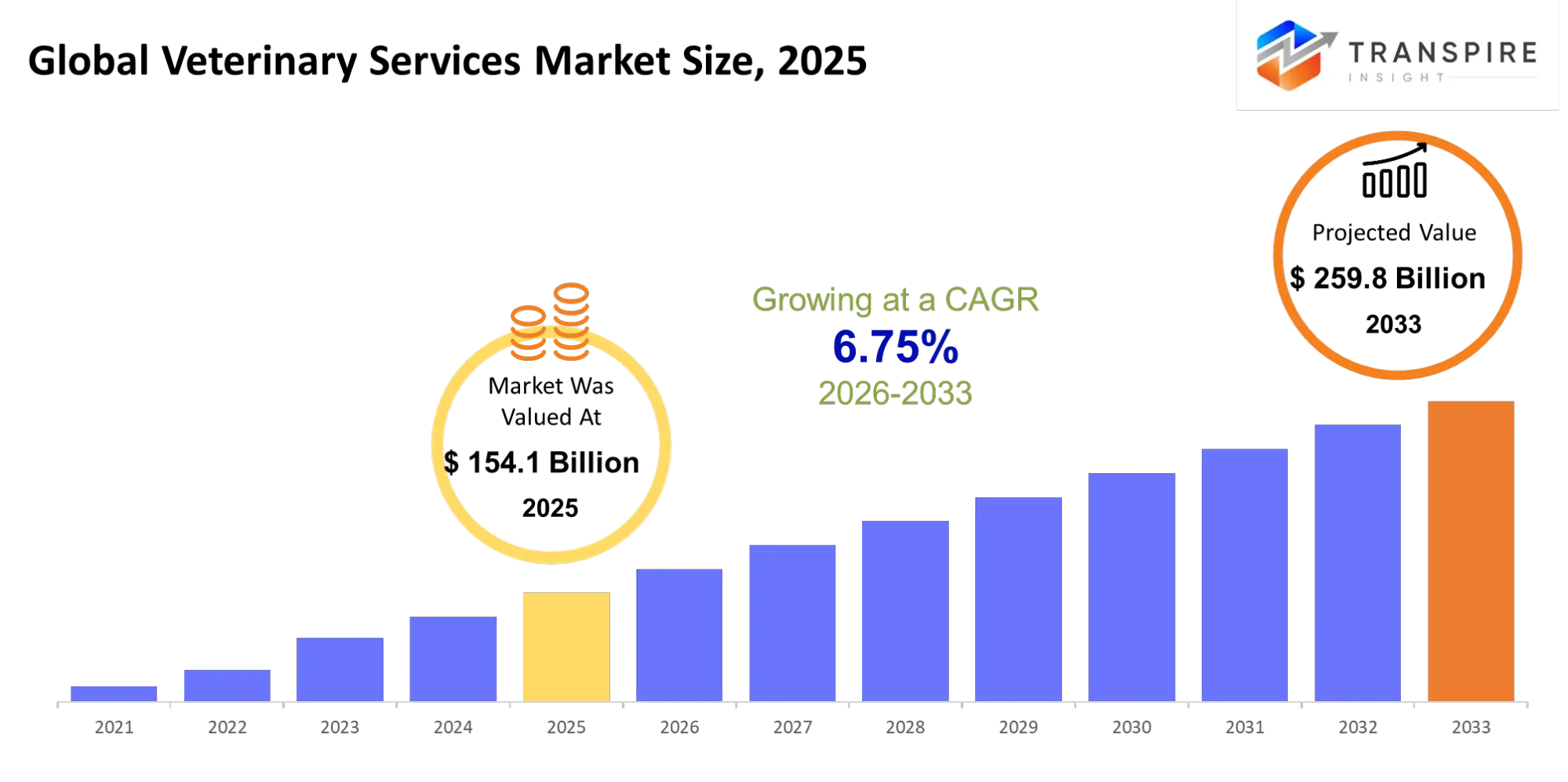
- Global Veterinary Services Market Size 2025: USD 154.1 Billion
- Global Veterinary Services Market Size 2033: USD 259.8 Billion
- Global Veterinary Services Market CAGR: 6.75%
- Global Veterinary Services Market Segments: By Service Type (Preventive Care, Diagnostics, Surgery, Dental Care, Emergency Care, Telemedicine, Rehabilitation, Others); By Animal Type (Companion Animals, Livestock, Equine, Poultry, Aquaculture, Exotic Pets, Others); By End User (Pet Owners, Farms, Zoos, Research Institutes, Others); By Delivery Mode (Hospital-based, Mobile, Home Care, Telehealth, Others); By Facility (Hospitals, Clinics, Specialty Centers, Diagnostic Labs, Others)
Global Veterinary Services Market Summary:
As per Transpire Insight Analysis, the Global Veterinary Services Market size is estimated at USD 154.1 Billion in 2025 and is anticipated to reach USD 259.8 Billion by 2033, growing at a CAGR of 6.75% from 2026 to 2033. This industry provides hands-on medical care, preventive treatments, complex surgeries, and remote health tracking for companion animals and livestock alike. Over the last few years - pet ownership skyrocketed alongside a cultural pivot that treats domestic animals like core family members. This cultural transition triggered a massive structural shift - veterinary clinics rapidly upgraded from basic reactive triage centers into high-tech networks offering advanced diagnostics, specialized oncology, and instant digital telehealth. As owners increasingly treat animal healthcare with the same urgency as human medicine, practices are buying sophisticated medical hardware and clinical software, driving continuous revenue growth across the entire animal care ecosystem.
Key Market Insights
The veterinary services sector - undergoing an operational pivot toward comprehensive, technology-driven care models that blur the lines between traditional clinical checkups and real-time electronic patient tracking. Driven by intense pet humanization and expanding livestock food safety standards, veterinary medical networks are shifting away from static, reactive treatment protocols. Instead, providers are deploying cloud-connected diagnostic suites, automated multi-site hospital workflows, and advanced telemedicine platforms to intercept chronic animal illnesses early and maximize long-term clinical efficiency.
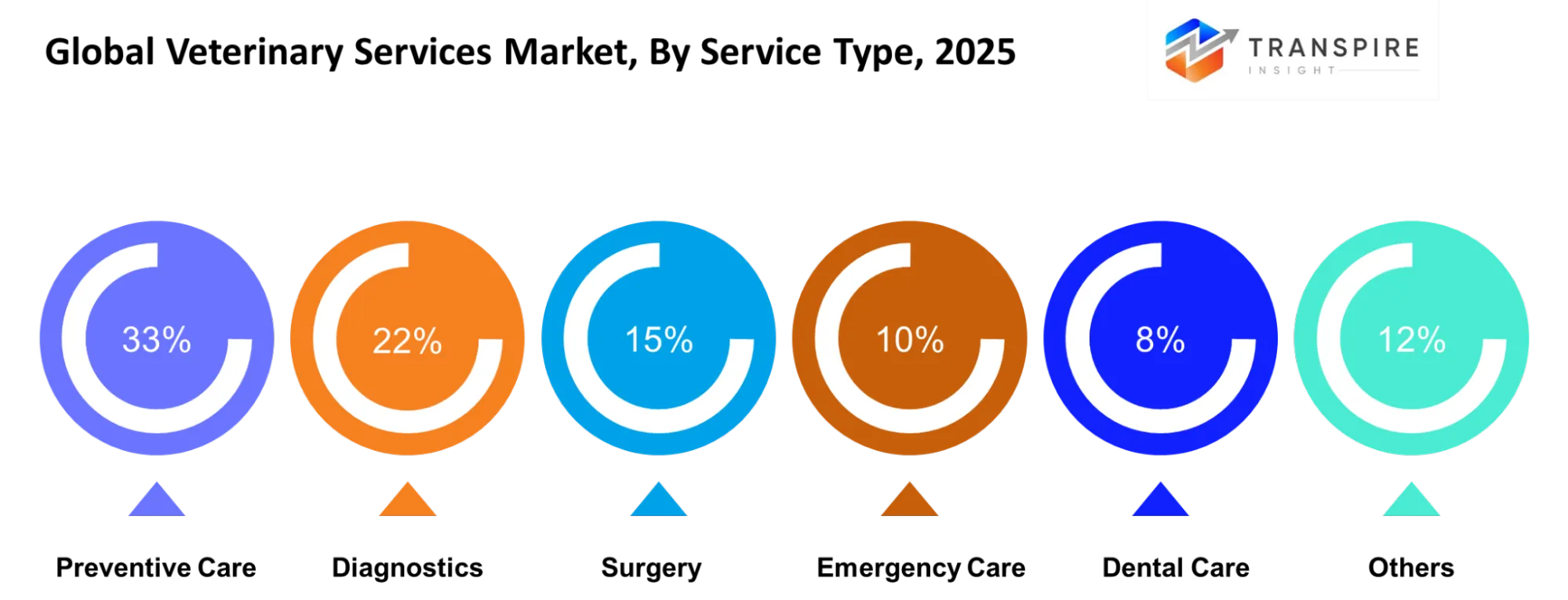
- Preventive Care holds the largest piece of the market at 33% — Global clinical operator Mars Veterinary Health is leveraging its massive Petcare Biobank genetic tracking datasets to introduce highly tailored biomarker screenings that flag chronic diseases before symptoms emerge.
- Diagnostics account for a substantial 22% footprint — Diagnostic pioneer IDEXX is deploying its innovative slide-free cellular analyzers and advanced machine-learning cancer screening panels to give local veterinarians instant, definitive in-clinic blood and tissue results.
- Surgery units lock down 15% of global revenue — Hospital network CVS Group is upgrading its core regional facilities with advanced minimally invasive surgical suites, a move that drastically slashes post-operative animal recovery times and minimizes in-hospital patient stress.
- Emergency Care maintains a steady 10% pocket of the market — Specialty network MedVet is installing integrated, real-time triage workflow software to accelerate high-risk patient processing across its major 24/7 emergency veterinary trauma hubs.
- Dental Care sits at an essential 8% revenue slice — Multiclinic operator VetPartners is embedding digital veterinary dental radiography and specialized ultrasonic scaling tools across its local clinics to handle growing owner demand for advanced animal periodontal therapy.
- Telemedicine Services represent the fastest-accelerating segment, growing at a 15.8% CAGR — Corporate group IVC Evidensia is embedding virtual telehealth consulting tools directly into its smartphone patient engagement applications, enabling remote virtual triage and continuous post-op checkups without stress-inducing clinic visits.
- North America commands the primary regional market stake with a 41% share — Driven by high pet insurance adoption and heavy family-level pet spending, major corporate practice chains like VCA are rapidly centralizing regional multi-hospital systems to maximize scale.
- Europe serves as a major secondary pillar with a 28% market slice — Corporate medical aggregator AniCura is establishing standardized, evidence-based care frameworks across its European clinic network to strictly track and optimize antibiotic stewardship in companion animals.
- The Asia Pacific corridor is expanding faster than any other region, charting a 16.7% CAGR — Driven by accelerating commercial livestock modernization and booming pet ownership, local agricultural and companion clinics are rapidly deploying automated point-of-care laboratory hardware to secure regional animal health.
What Strategic Drivers, Restraints, and Opportunities Define the Future of the Global Veterinary Services Market?
Driver
The rapid financial shift from reactive triage to comprehensive preventive medical care is dramatically scaling overall practice revenues. As domestic animals are structurally humanized within modern nuclear families, owners increasingly demand human-grade diagnostic and preventive checkups. This behavioral movement lowers financial barriers and expands the volume of clinical touchpoints per patient, heavily accelerating clinical testing rates and subscription-based wellness plan enrollments.
In May 2026, diagnostic leader IDEXX Laboratories highlighted a massive multi-decade growth opportunity during its operational roadmap updates, focusing heavily on expanding its cloud-based VetConnect PLUS platform and AI-driven Vetscan Imagyst analytics. This strategic software rollout integrates real-time digital cytology and automated biomarker tracking directly into daily clinical workflows. This technological deployment empowers local veterinary practices to scale up advanced early disease screening protocols and multi-layer clinical testing volumes, significantly expanding the capacity of local clinics to handle preventative healthcare demands.
Restraint
A severe structural shortage of licensed veterinary practitioners and high operational burnout rates consistently constrain total multi-hospital market capacity. Most specialized clinics face intense labor supply deficits, which prevents practice chains from scaling up physical overnight emergency care slots and continuous surgical operations.
Opportunity
The most lucrative growth window lies in embedding automated AI-driven triage screening models and remote wearable health-tracking frameworks directly into mobile veterinary application networks. Syncing real-time continuous physiological telemetry with automated cloud-based analysis layers allows remote clinical teams to intercept cardiovascular or metabolic failures instantly. This technical step unlocks massive new procurement streams from tech-focused companion animal owners across expanding metropolitan sectors.
What Has the Impact of Artificial Intelligence Been on the Global Veterinary Services Market?
Artificial intelligence is fundamentally restructuring how modern veterinary practices manage complex patient diagnostics and time-consuming administrative workflows. Instead of relying purely on slow manual microscope evaluations or reactive triage models—which exacerbate practitioner burnout and create severe consultation bottlenecks—clinics now deploy advanced deep learning software. These specialized AI engines handle automated whole-slide digital pathology scans - instantly mapping out parasitic counts, blood film anomalies, and skin cytology patterns directly within the examination room.
Beyond immediate in-clinic diagnostic speed, AI introduces powerful predictive capabilities and operational improvements into practice management systems. Advanced voice-to-text generative algorithms automatically capture conversational exam room interactions, instantly transforming unstructured vet-client dialogue into standardized, compliant medical charts without manual data-entry delays. However, a major integration limitation persists across legacy software infrastructures. Syncing modern cloud-based AI tools with older, disconnected local database management networks often results in incomplete read-write loops, forcing technicians to manually bridge system gaps during busy shifts.
In March 2026, clinical workflow solution provider CoVet officially released its specialized AI CoPilot platform update after winning the prestigious Purina Pet Care Innovation Prize. This enterprise software rollout integrates real-time vocal transcriptions and intuitive diagnostic assistive features directly into existing veterinary practice management systems. By using physics-informed and language-based neural processing to instantly generate structured medical summaries, the platform slashes documentation time by up to 40%, optimizing daily scheduling velocity and alleviating administrative compassion fatigue across strained animal healthcare hubs.
Key Market Trends
Rather than approaching animal medical care as a series of isolated, reactive clinic visits triggered only by obvious injuries or acute illness - the veterinary ecosystem is shifting toward highly automated, continuous wellness monitoring networks. This fundamental operational evolution transforms how veterinary facilities interact with animal owners, turning traditional episodic triage checkups into integrated, long-term care management frameworks that actively catch physiological changes before they escalate.
- Moving past unmonitored home recovery periods — Clinics deploy smart wearable collars to track post-op heart rate and kinetic telemetry, eliminating historical at-home blind spots.
- Traditional paper intake is shifting to digital pre-sorting — Practices ditch physical clipboards for cloud screening APIs that automatically flag breed-specific health risks before the exam.
- Manual pharmaceutical tracking is being replaced globally — Multi-site veterinary chains integrate auto-refilling inventory software directly into practice workflows to slash pharmacy overhead.
- Reactive diagnostics are giving way to anticipatory profiling — Clinics utilize high-volume biobank data to run early genetic screenings for geriatric pets before symptoms manifest.
- Standalone clinics are evolving into regional hospital clusters — Corporate consolidators build integrated, localized multi-hospital networks to share centralized, high-end specialty diagnostic infrastructure.
- One-off transactional billing is transitioning to subscription tiers — Practices bundle annual blood panels, dental care, and immunizations into monthly membership plans to secure steady recurring revenue.
- Paper-heavy charting loops are migrating to ambient AI copilots — Overburdened vets adopt real-time vocal processing tools to automatically turn exam-room dialogue into structured medical records.
- Fragmented legacy data is yielding to unified software suites — Facilities upgrade to centralized cloud systems that link point-of-care lab instruments and external reference labs onto a single timeline.
- In-clinic pharmacy pickup is turning entirely digital via auto-ship — Local practices embed white-labeled online pharmacy portals with automated renewal triggers to preserve long-term client retention.
Global Veterinary Services Market Segmentation
By Service Type
Preventive Care commands the leading market position with an authoritative 33% market share, functioning as the vital baseline for everyday practice operations. Diagnostics follow closely with a 22% revenue slice, while Surgery, Emergency Care, and Dental Care lock down 15%, 10%, and 8% shares, respectively, leaving remaining specialized interventions at 12%. The unique growth logic behind this service distribution is tied directly to the structural financial transformation of pet ownership, where humanized domestic pets are placed on subscription-based, lifelong wellness memberships. This behavioral shift ensures steady recurring revenue through routine diagnostic screenings and early disease interventions before symptoms arise. Conversely, Telemedicine Services act as the fastest-accelerating growth pocket, tearing ahead at an industry-leading 15.8% CAGR because owners demand instant digital triage over stress-inducing clinic trips. Future market dynamics will see the boundaries between physical checks and remote tracking vanish entirely, forcing practices to engineer unified hybrid care workflows where real-time wearable data seamlessly triggers automated clinic follow-ups.
By Animal Type
Companion Animals anchor the market landscape as the dominant financial driver of equipment and service procurement, while Livestock management workflows remain a massive secondary pillar. Equine, Poultry, Aquaculture, and Exotic Pets make up the remaining clinical operational base. The unique growth logic defining this distribution is the deep emotional and financial prioritization of household pets within modern nuclear families, leaving companion animal spending highly insulated from broader economic downturns. Concurrently, the commercial livestock and poultry segments are driven by non-discretionary corporate spending, where industrial farms invest heavily in automated herd health tracking to meet rigid regional food safety regulations and maximize livestock yields. Moving forward, the market will polarize into distinct architectural pipelines: agricultural veterinary services will focus entirely on large-scale population health monitoring and biosecurity, whereas companion animal services will evolve into hyper-personalized, high-end therapeutic specialties like oncology and regenerative medicine.
By End User
Pet Owners act as the heavyweight buyers in this market, dictating clinical care standards and service procurement schedules for the entire companion animal sector. Commercial Farms manage a massive volume of production animal care, while Zoos and Research Institutes present a highly stable, specialized institutional buyer base. The unique growth logic comes straight from disposable household income shifts: pet owners treat animal medical expenditures with human-grade urgency, shifting from cheap out-of-pocket transactions to robust, premium veterinary care models. The biggest future implication is a massive structural consolidation in how care is bought, where independent private clinics will rapidly shrink as centralized corporate health systems sign massive, multi-year wellness agreements directly with large corporate employers and pet insurance networks.
By Delivery Mode
Hospital-based care maintains the dominant global volume share due to the specialized infrastructure required for complex surgeries and intensive diagnostics. However, Telehealth and Mobile veterinary units represent the fastest-growing operational segments. The unique growth logic defining this mix is the intense industry push to combat severe practitioner burnout and localized labor shortages. Providing remote consults and targeted home care options enables corporate chains to optimize scheduling velocity and maximize the productivity of their existing veterinary staff without building expensive brick-and-mortar locations. Looking ahead, delivery infrastructures will adopt a decentralized "hub-and-spoke" model, where low-cost digital telehealth apps handle initial triage and routine monitoring, routing only complex medical or surgical cases to capital-intensive, regional specialty hospital hubs.
By Facility
Traditional veterinary Hospitals and Clinics command the leading historical position in market value, functioning as the essential operational baseline for local communities. Specialty Centers and dedicated Diagnostic Labs act as the highest-margin, fastest-growing institutional segments due to expanding multi-disciplinary clinical requirements. The growth logic is completely split by medical complexity: standard local clinics thrive on high-volume bulk preventative wellness plans, while specialty centers and high-tech labs are exploding because modern pet owners are willing to pay premium rates for advanced imaging, digital cytology, and specialized orthopedic surgeries. Future market dynamics will see a massive commercial expansion in standalone diagnostic testing hubs, forcing equipment manufacturers to optimize point-of-care laboratory hardware so that standard neighborhood clinics can match the speed and precision of massive centralized reference labs.
What Key Use Cases Driving the Global Veterinary Services Market?
Routine health monitoring and disease interception fuel the most significant financial share of the market, driven directly by subscription-based preventive care models. Veterinary networks deploy these workflows to administer scheduled immunizations, run baseline blood chemistry panels, and manage specialized weight-control programs, turning traditional episodic clinic visits into highly predictable, recurring practice touchpoints.
Expanding use cases are rapidly centering on advanced therapeutic interventions across metropolitan animal hospitals. Veterinarians utilize high-resolution digital imaging and point-of-care laboratory instruments to run complex orthopedic surgeries, execute precise dental scaling - administer targeted oncology treatments for aging companion animals.
Emerging use cases leverage digital healthcare platforms to transform remote clinical triage. Practice networks deploy continuous wearable telemetry tracking and automated cloud-based telehealth software to manage post-operative recovery periods and monitor chronic livestock diseases without requiring on-site practitioner interventions.
|
Report Metrics |
Details |
|
Market size value in 2025 |
USD 154.1 Billion |
|
Market size value in 2026 |
USD 164.5 Billion |
|
Revenue forecast in 2033 |
USD 259.8 Bn |
|
Growth rate |
CAGR of 6.75% from 2026 to 2033 |
|
Base year |
2025 |
|
Historical data |
2021 - 2024 |
|
Forecast period |
2026 - 2033 |
|
Report coverage |
Revenue forecast, competitive landscape, growth factors, and trends |
|
Regional scope |
United States; Canada; Mexico; United Kingdom; Germany; France; Italy; Spain; Denmark; Sweden; Norway; China; Japan; India; Australia; South Korea; Thailand; Brazil; Argentina; South Africa; Saudi Arabia; United Arab Emirates |
|
Key company profiled |
Mars Veterinary Health, VCA, AniCura, CVS Group, IVC Evidensia, MedVet, Ethos Veterinary Health, VetPartners, IDEXX, Zoetis, Patterson Veterinary, Dechra, VetStrategy, Greencross, Dairymaster |
|
Customization scope |
Free report customization (country, regional & segment scope). Avail customized purchase options to meet your exact research needs. |
|
Report Segmentation |
By Service Type (Preventive Care, Diagnostics, Surgery, Dental Care, Emergency Care, Telemedicine, Rehabilitation, Others); By Animal Type (Companion Animals, Livestock, Equine, Poultry, Aquaculture, Exotic Pets, Others); By End User (Pet Owners, Farms, Zoos, Research Institutes, Others); By Delivery Mode (Hospital-based, Mobile, Home Care, Telehealth, Others); By Facility (Hospitals, Clinics, Specialty Centers, Diagnostic Labs, Others) |
Which Regions are Driving the Global Veterinary Services Market Growth?
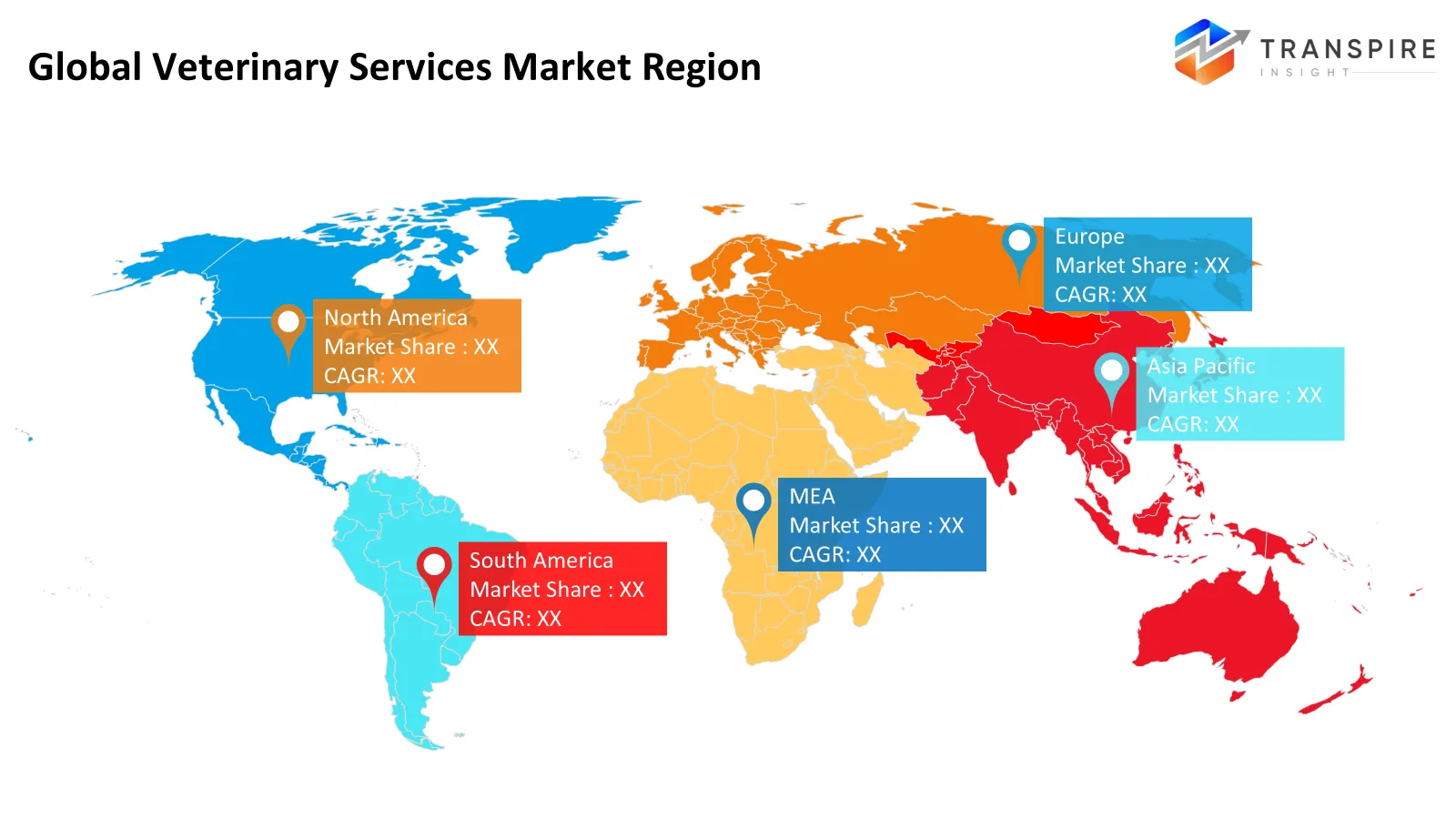
North America maintains a commanding grip on the global veterinary services market, capturing a dominant 41% of all worldwide industry revenue. This geographic hegemony is heavily driven by the profound cultural humanization of pets within modern households and high consumer disposable income levels. The regional ecosystem is structurally supported by high commercial pet insurance adoption rates and an expansive network of corporate multi-hospital veterinary consolidators. Consequently, local pet owners regularly seek advanced, human-grade preventative screenings, specialized surgeries, and multi-tier wellness memberships for their companion animals, keeping clinical practice revenues highly optimized.
In May 2026, leading animal health company Zoetis Inc. officially expanded its point-of-care diagnostics presence in North America by rolling out advanced cellular analysis updates for its specialized Vetscan OptiCell hematology platform. This strategic hardware and software deployment integrates automated complete blood count metrics directly into regional clinical testing workflows. This large-scale installation explicitly caters to North America's heavy operational shift toward instant, high-precision in-clinic diagnostics, empowering local veterinarians to catch complex underlying health issues without reference lab delays. [https://news.zoetis.com/press-releases/default.aspx]
Europe serves as a highly stable, predictable secondary pillar for the global market, locking down an essential 28% share of total industry demand. While North American growth is heavily dependent on fast-paced premium pet insurance spending, the European veterinary space is anchored by strict regional animal welfare legislations and rigid livestock traceability standards. This regional market stability is insulated by comprehensive government biosecurity policies and intensive, structured corporate oversight regarding responsible veterinary antibiotic stewardship. To maintain seamless clinical outcomes and high compliance, local practice groups steadily invest in standardized, evidence-based medical treatment guidelines and centralized professional development pathways.
The Asia Pacific region has emerged as the fastest-growing territory globally, accelerating at a market-leading CAGR of 16.7% to capture a 22% slice of global sales. This sudden structural shift is driven by the rapid commercial modernization of large-scale industrial livestock farms and a booming, urbanized pet ownership demographic across developing economic hubs. Historically, regional animal management focused primarily on baseline production triage, but the territory has now rapidly pivoted toward high-tech automated herd monitoring and automated point-of-care reference testing. Looking ahead, future procurement in this expanding corridor relies entirely on deploying advanced digital health platforms and decentralized veterinary screening tools capable of maximizing agricultural yields and securing biosecurity pipelines. In June 2026, major global agricultural and pet care provider Mars Pet Nutrition highlighted an aggressive expansion strategy across the expanding Indian sector - focusing its investment pipelines on hyper-personalized digital engagement and veterinary-backed nutritional tracking. This strategic corporate rollout pairs decades of research from the Waltham Petcare Science Institute with localized digital distribution infrastructure to address the unique preventative health needs of emerging markets. By integrating digital tracking tools and targeted wellness education directly into regional networks, this large-scale corporate campaign empowers the expanding territory to bridge traditional animal healthcare gaps and drastically accelerate localized clinical adoption rates.
Who are the Key Players in the Global Veterinary Services Market and How Do They Compete?
Competition in veterinary services has turned into a high-stakes ecosystem race, pitting massive hospital aggregators against specialized diagnostic tech providers. Top players no longer fight simple price wars. Instead, they are competing to lock down whole networks through proprietary data pools, clinical software tie-ins, and aggressive buyouts of independent neighborhood practices to capture lifelong animal healthcare spend.
Mars Veterinary Health dominates through sheer scale and corporate acquisition. By swallowing up independent clinics and grouping them under heavy-hitting regional brands like VCA and AniCura, Mars focuses on driving massive client retention. What sets them apart is their backend synergy. They actively use their proprietary Petcare Biobank data and predictive health algorithms to roll out subscription-based wellness tiers, turning unpredictable clinical triage into steady, predictable clinic revenue across thousands of locations.
IDEXX Laboratories takes the opposite approach, executing a high-margin tech innovation playbook. Rather than managing physical properties or dealing with veterinary staffing shortages, IDEXX positions itself as the digital backbone of local clinics. They hook practices by installing advanced in-clinic cellular analyzers, automated AI diagnostics, and seamless cloud networking. This hardware-first approach guarantees massive long-term volume because every test run creates an immediate, recurring stream of high-margin consumable sales.
Company List
- Mars Veterinary Health
- VCA
- AniCura
- CVS Group
- IVC Evidensia
- MedVet
- Ethos Veterinary Health
- VetPartners
- IDEXX
- Zoetis
- Patterson Veterinary
- Dechra
- VetStrategy
- Greencross
- Dairymaster
Recent Development News
In June 2026 - Merck Animal Health signed a definitive agreement to acquire poultry biodevice innovator TARGAN. This acquisition expands Merck’s commercial livestock footprint by integrating automated computer-vision and AI-driven sorting systems capable of processing 160,000 chicks per hour, drastically streamlining high-speed hatchery operations and poultry vaccine administration. [https://www.ncbiotech.org]
In September 2025 - international corporate operator CVS Australia acquired six veterinary hospitals through a strategic joint venture partnership with Sydney Animal Hospitals. This targeted geographic acquisition instantly scales CVS Group's presence to 51 clinical locations across Australia, shifting backend administrative workflows to centralized regional human resources and finance teams so clinical staff can maximize daily diagnostic and surgical output. [https://www.cvsukltd.co.uk]
What Strategic Insights Define the Future of the Global Veterinary Services Market?
The global veterinary services market is transitioning from an era of rapid, private-equity-backed clinic rollups to an intensely integrated "health system" model centered on longitudinal patient tracking.
A critical, hidden risk in this trajectory is the widening practitioner shortage and severe operational burnout, which is actively creating capacity ceilings and driving a 25% annual clinic staff turnover rate. However, an immense opportunity lies in leveraging this exact constraint by integrating white-labeled online pharmacy portals and automated e-commerce APIs directly into practice management systems to phase out inventory-heavy footprints.
To remain highly competitive - veterinary networks must aggressively transition away from transactional, one-off clinical billing models. Corporate leaders should proactively bundle annual diagnostic blood panels, routine dental prophylaxis, and ambient AI charting tools into comprehensive, subscription-based wellness tiers to secure predictable, recurring practice revenue while minimizing administrative overhead.
Global Veterinary Services Market Segmentation
By Service Type
- Preventive Care
- Diagnostics
- Surgery
- Dental Care
- Emergency Care
- Telemedicine
- Rehabilitation
- Others
By Animal Type
- Companion Animals
- Livestock
- Equine
- Poultry
- Aquaculture
- Exotic Pets
- Others
By End User
- Pet Owners
- Farms
- Zoos
- Research Institutes
- Others
By Delivery Mode
- Hospital-based
- Mobile
- Home Care
- Telehealth
- Others
By Facility
- Hospitals
- Clinics
- Specialty Centers
- Diagnostic Labs
- Others
By Regional Analysis
North America
- United States
- Canada
- Mexico
Europe
- Germany
- United Kingdom
- France
- Italy
- Spain
- Russia
- Rest of Europe
Asia Pacific
- China
- Japan
- India
- South Korea
- Australia
- Rest of Asia Pacific
South America
- Brazil
- Argentina
- Rest of South America
Middle East & Africa
- Saudi Arabia
- United Arab Emirates
- Qatar
- South Africa
- Rest of the Middle East & Africa
Frequently Asked Questions
Find quick answers to common questions.
The global veterinary services market size was valued at USD 154.1 Billion in 2025 and is poised to reach USD 259.8 Billion by 2033, expanding at a 6.75% CAGR.
Key segments for the veterinary services market are By Service Type (Preventive Care, Diagnostics, Surgery, Dental Care, Emergency Care, Telemedicine, Rehabilitation, Others); By Animal Type (Companion Animals, Livestock, Equine, Poultry, Aquaculture, Exotic Pets, Others); By End User (Pet Owners, Farms, Zoos, Research Institutes, Others); By Delivery Mode (Hospital-based, Mobile, Home Care, Telehealth, Others); By Facility (Hospitals, Clinics, Specialty Centers, Diagnostic Labs, Others).
Growth is primarily driven by the profound cultural humanization of pets within modern nuclear families, which has accelerated consumer spending on human-grade preventive care. This behavioral shift is backed by expanding pet health insurance adoption lines that directly lower out-of-pocket medical costs, enabling veterinary practices to increase routine diagnostic testing volumes and subscription-based wellness plan enrollments.
The global market is led by major veterinary service networks and providers including Mars Veterinary Health, VCA, AniCura, CVS Group, IVC Evidensia, MedVet, Ethos Veterinary Health, VetPartners, IDEXX, Zoetis, Patterson Veterinary, Dechra, VetStrategy, Greencross, Dairymaster.
North America holds a dominant 41% share of the global market, heavily dictating clinical care standards and corporate multi-hospital network consolidation trends. The region influences global dynamics through its high-income consumer base, heavy investment in state-of-the-art diagnostic infrastructure, and advanced pet insurance ecosystems that allow corporate consolidators to successfully scale centralized, regional specialty hospital clusters.
Lucrative opportunities exist in embedding automated AI-driven triage screening models and remote wearable health-tracking collars directly into practice networks to capture continuous physiological data. Additionally, practices can unlock high margins by deploying integrated online pharmacy portals and automated e-commerce APIs, transforming physical inventory overhead into seamless digital auto-ship models that secure lifelong client retention.
- Mars Veterinary Health
- VCA
- AniCura
- CVS Group
- IVC Evidensia
- MedVet
- Ethos Veterinary Health
- VetPartners
- IDEXX
- Zoetis
- Patterson Veterinary
- Dechra
- VetStrategy
- Greencross
- Dairymaster
About the Authors

Pankaj Ghogare Patil
I am Pankaj Ghogare Patil, a Senior Research Analyst at Transpire Insight, specializing in the Pharmaceutical, Chemicals & Materials, Healthcare IT, and Biotechnology industry. My expertise lies in conducting comprehensive market research, analyzing industry trends, evaluating competitive landscapes, and translating complex data into actionable insights. At Transpire Insight, I closely follow emerging technologies, regulatory developments, and market innovations to create accurate, well-researched, and informative content that helps businesses and professionals make informed decisions. I am committed to producing credible, evidence-based articles that reflect industry best practices while making technical topics accessible and valuable for a broad audience.

Chakradhar Khansole
Chakradhar serves as the Research Director at Transpire Insight, bringing over 8 years of experience in technology, innovation, and strategic market intelligence. He specializes in transforming complex market data into actionable business insights that enable organizations to make informed, growth-oriented decisions. Recognized for his strategic vision and analytical expertise, Chakradhar leads high-impact research initiatives, delivering comprehensive market assessments, competitive intelligence, and forward-looking industry analysis.
Recently Published Reports
-
Apr 2026
AI in Diabetic Retinopathy Market
AI in Diabetic Retinopathy Market Size, Share & Analysis Report By Type (Screening AI Systems, Diagnostic AI Systems, and Predictive AI Models), By Application Segment (Hospitals, Ophthalmology Clinics, Diagnostic Centers, and Research and Development), and Geography (North America, Europe, Asia-Pacific, Middle East and Africa, South and Central America), 2021 - 2031
-
Apr 2026
Psychometric Tests Market
Psychometric Tests Market Size, Share & Analysis Report By Type (Personality Tests, Ability/Aptitude Tests, Skill/Knowledge Tests, and Others), By Application (Talent Acquisition and Talent Management), and Geography (North America, Europe, Asia-Pacific, Middle East and Africa, South and Central America), 2021 – 2031
-
Apr 2026
Rare Biological Sample Collection Market
Rare Biological Sample Collection Market Size, Share & Analysis Report By Type (Isolation Kits & Reagent, Blood Collection Tubes, and Others), By Application (Oncology, Transcriptomics, Pharmacogenomics, and Others), and Geography (North America, Europe, Asia-Pacific, Middle East and Africa, South and Central America), 2021 – 2031
-
Jul 2026
Diabetic Retinopathy Market
Diabetic Retinopathy Market Size, Share & Analysis Report By Type (Proliferative Diabetic Retinopathy, and Diabetic Macular Edema (DME)), By Treatment Type (Anti VEGF Drug, Steroid Implants, Laser Surgeries, and Vitrectomy), and Geography (North America, Europe, Asia-Pacific, Middle East and Africa, South and Central America), 2021 – 2031
Our Clients







