

Middle East and Africa Veterinary Hospital Market Size & Forecast:
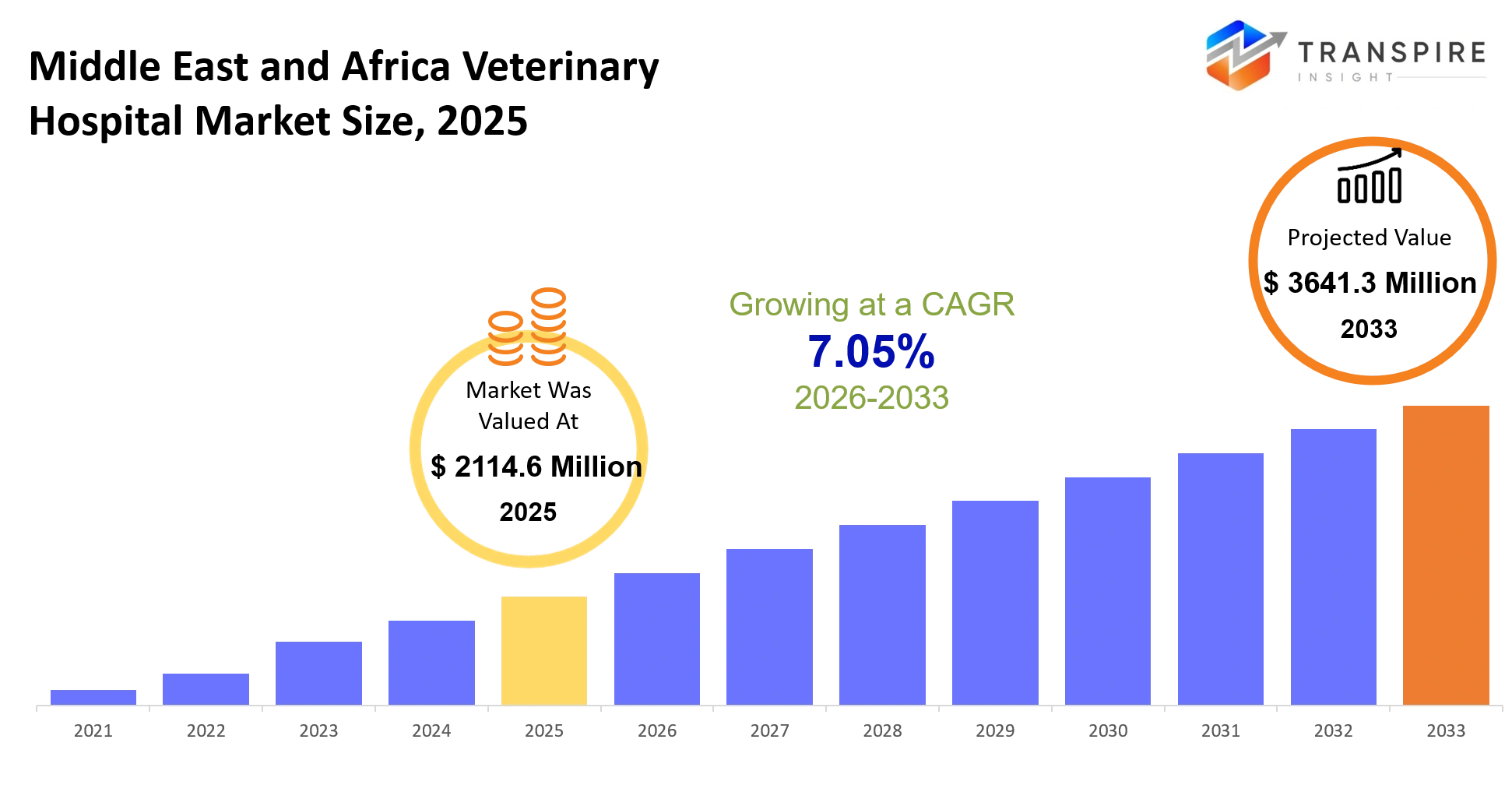
- Middle East and Africa Veterinary Hospital Market Size 2025: USD 2114.6 Million
- Middle East and Africa Veterinary Hospital Market Size 2033: USD 3641.3 Million
- Middle East and Africa Veterinary Hospital Market CAGR: 7.05%
- Middle East and Africa Veterinary Hospital Market Segments: By Service Type (Surgery, Diagnostics, Preventive Care, Emergency Care, Dental Care, Rehabilitation, Vaccination, Others); By Animal Type (Companion Animals, Livestock, Equine, Exotic Animals, Poultry, Others); By Ownership (Private Hospitals, Corporate Hospitals, University Hospitals, Government Hospitals, Others); By End User (Pet Owners, Farmers, Breeders, Zoos, Others)
Middle East and Africa Veterinary Hospital Market Summary
The Middle East and Africa Veterinary Hospital Market was valued at USD 2114.6 Million in 2025. It is forecast to reach USD 3641.3 Million by 2033. That is a CAGR of 7.05% over the period.
Veterinary hospitals sort of play a critical role across the Middle East and Africa, by providing medical, surgical, diagnostic, preventive, and emergency care for companion animals, livestock, equine species, and exotic animals, kind of the whole spectrum. these facilities help with animal health management, they improve livestock productivity, cut down disease-related economic losses, and they also push better pet wellness outcomes. Over the last five years, the market has moved away from just basic treatment type services, toward more integrated healthcare models , where advanced diagnostics, specialty surgeries, rehabilitation, and preventive care programs get bundled together. A big structural change has been the growing corporatization of veterinary services , with larger healthcare networks expanding into multi-clinic operations and using standardized care protocols.
Also, the expansion of pet ownership after lifestyle changes during the COVID-19 period sped up spending on veterinary services, and on more premium animal healthcare. Meanwhile, livestock disease management programs and food security efforts started pushing up their investments into veterinary infrastructure, like more funding here and there. In the end , these changes are basically causing higher service utilization rates, a wider range of treatment options, and stronger revenue creation across both companion animal care and livestock healthcare tracks.
Key Market Insights
- The Middle East and Africa Veterinary Hospital market is expected to hit USD 3.64 billion by 2033, while still, there’s this continued capital put into animal healthcare services.
- In 2025, the Gulf Cooperation Council countries made up roughly 38% of regional revenue, mainly because spending on pet health remained relatively high.
- Treatment for companion animals looked like the main driver, capturing almost 46% of the market share in 2025, pushed by more people choosing “urban pet keeping” and less rural dependence.
- Diagnostics brought in more than 22% of service revenue, benefiting from broader use of digital imaging, and laboratory testing tools that are now easier to adopt.
- Preventive care services showed solid momentum too, with vaccinations and routine wellness programs growing across many major city areas.
- Emergency care turned out to be the fastest-growing segment, and it’s projected to stay above 8% yearly growth during the forecast window.
- Livestock healthcare also held a meaningful portion, largely tied to government-backed disease monitoring, plus food security initiatives.
- Corporate veterinary networks expanded their regional footprint through acquisitions, alliances, and multi-clinic operating structures, not just single-site expansion.
- Practices like online booking calendars, teleconsultation offerings, and electronic patient records supported day to day efficiency across hospitals.
- Lastly, strategic investments from Mars Veterinary Health, IVC Evidensia, National Veterinary Associates, Banfield, and Medivet helped strengthen specialist capabilities while also diversifying the range of services.
What are the Key Drivers, Restraints, and Opportunities in the Middle East and Africa Veterinary Hospital Market?
The strongest growth driver comes from the kind of transformation of animal healthcare that shifts it away from reactive treatment into more preventive and specialty style care. Higher spend on pet wellness, together with stricter livestock disease control programs, has lifted the need for diagnostics, vaccination services , surgical interventions, and also rehabilitation therapies. Government-backed food security initiatives across multiple Middle Eastern and African states have further widened veterinary infrastructure investments. When hospitals add advanced imaging systems, laboratory diagnostics, and specialized treatment services, the average revenue per patient keeps rising while service utilization grows too, in a sort of steady momentum.
Still, there is a major structural snag: veterinary infrastructure and skilled professionals are not evenly spread. A lot of rural and developing zones deal with gaps in veterinary specialists, diagnostic equipment, and modern treatment facilities. Training veterinarians, and also building hospital networks, needs meaningful long term investment and it cannot be solved quickly. As a result , access to advanced care is postponed, hospital capacity gets restricted, and revenue potential is dampened in under served areas where livestock healthcare needs remain quite large.
One of the best opportunities sits with digital veterinary healthcare platforms, connected to existing hospital networks. Telemedicine, remote diagnostics, AI-assisted imaging interpretation, and electronic medical record systems are starting to take hold. Gulf countries and South Africa are becoming attractive choices for these investments, mainly because there’s better healthcare infrastructure, and overall technology adoption tends to be stronger there.
What Has the Impact of Artificial Intelligence Been on the Middle East and Africa Veterinary Hospital Market?
Artificial intelligence and advanced digital technologies are slowly but surely reshaping how veterinary hospitals run across the Middle East and Africa. You see more and more facilities using AI-enabled diagnostic platforms to look at radiographs, ultrasound images, and lab results faster, and with steadier consistency. Then there are automated booking systems, electronic medical records, and workflow management tools that ease the paperwork load, but also help with how they distribute resources in really busy clinical rooms, day to day.
On top of that, machine learning is feeding predictive healthcare models. When clinicians look through patient histories, treatment results, and wider disease patterns, they can spot the high risk situations earlier. After that, they often suggest preemptive steps before things get worse. Livestock focused centers in particular rely on predictive analytics to keep an eye on herd condition, flag potential disease outbreaks sooner, and tune vaccination planning. In practice, this can lower overall treatment costs, support better recovery outcomes, and make the whole operation run more smoothly, overall.
There’s also advanced analytics improving inventory handling. Hospitals can forecast what they’ll need for pharmaceuticals, and even vaccines, with more accuracy than before. That means fewer shortages, and it tends to protect financial results too. Still, adoption is not evenly spread, mostly because the implementation costs can be high, structured clinical data is not always readily available, and there’s a lack of staff who are properly trained to operate these AI-enabled systems. Smaller veterinary facilities in many areas find it hard to justify the investment which ends up delaying broader rollout, even if the practical benefits look pretty clear.
Key Market Trends
- Corporate veterinary networks ended up boosting regional clinic ownership by almost 15% from 2021 into 2025, which sort of made service standardization feel more consistent overall.
- Diagnostic imaging use really kept climbing, as hospitals put more money into digital radiography and upgraded lab capabilities, in a pretty clear way.
- Preventive care subscriptions also got more traction, with wellness plans helping raise client retention rates across a lot of urban veterinary centers, and that mattered.
- Then telemedicine consultations grew by over 20% each year in some Gulf markets, after they pushed ahead with digital healthcare investments.
- At the same time emergency and critical care facilities expanded their service capacity to manage the increased demand for animal healthcare that runs 24/7.
- On the livestock side, disease surveillance programs strengthened across Africa, which supported wider veterinary service rollout and better vaccination coverage.
- Mars Veterinary Health and other international operators kept enlarging multi-site delivery models, and it didn’t really slow down.
- Specialty services like oncology, orthopedics, and rehabilitation became easier to access through premium veterinary facilities.
- Electronic health records slowly replaced paper based systems in many urban hospitals, and that improved continuity of treatment as well as clinical efficiency.
- Finally partnerships between diagnostic technology providers and veterinary hospitals sped up adoption of data-driven tools for clinical decisions, overall.
Middle East and Africa Veterinary Hospital Market Segmentation
By Service Type
Surgery still counts as one of the core service categories, it covers routine procedures sort of, orthopedic interventions, soft tissue operations, and more specialized treatments too. Diagnostics kind of supports clinical choices, especially with imaging services, lab testing, pathology evaluation , and disease screening programs as well. Preventive Care leans into wellness examinations, health monitoring, parasite control, and catching early disease before it escalates. Emergency Care is for urgent medical conditions that need immediate clinical action, plus ongoing monitoring, until things stabilize.
Dental Care has actually become more important, because oral health management is now part of the regular animal healthcare programs. Rehabilitation services back recovery after surgery, injury, or those chronic mobility situations, using structured treatment plans that guide progress. Vaccination services keep being a major activity area, since disease prevention is still crucial for both companion animals and livestock, not just one group. Others also show up, like nutrition consulting , behavioral services, reproductive care, and specialty medical treatments , which help broaden the hospital service portfolios over time.
By Animal Type
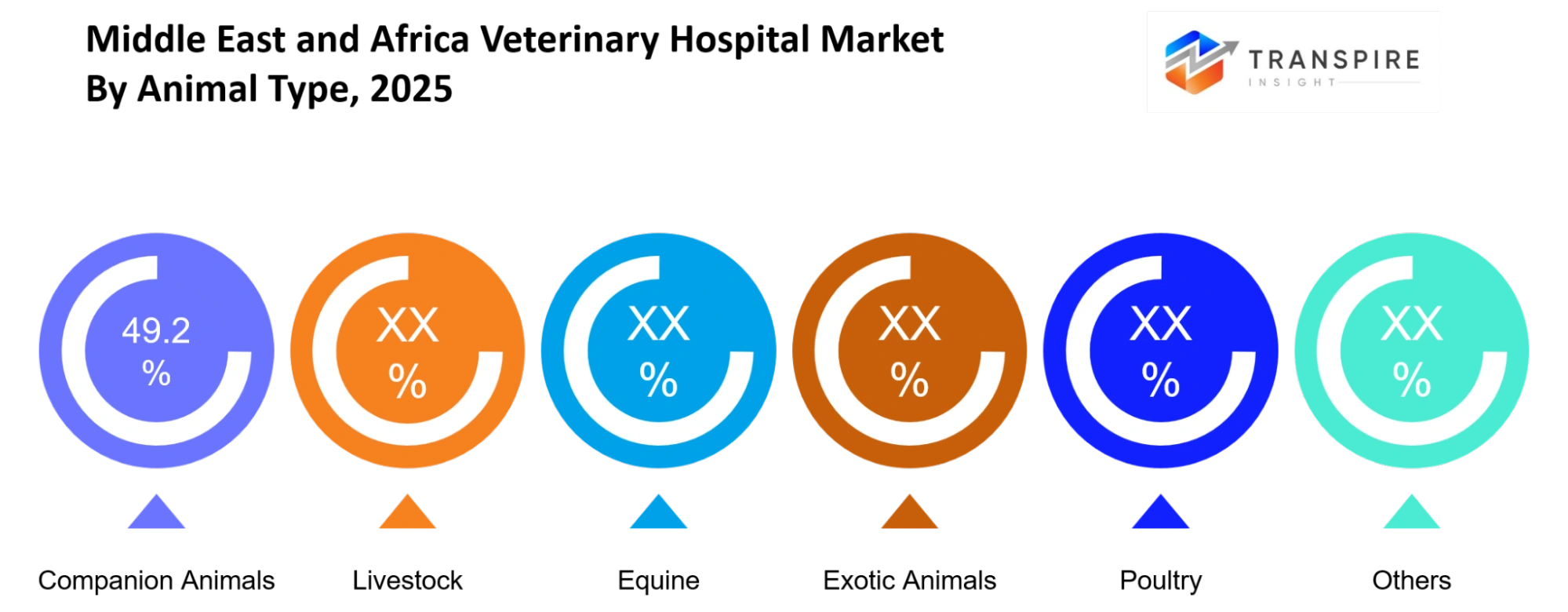
Companion Animals take up a substantial chunk of hospital visits, not just for routine wellness care but also for vaccines, diagnostic work, and specialized treatments that need more attention. Meanwhile livestock healthcare leans hard into disease prevention, reproductive management, boosting productivity, and keeping track of herd health continuously. Equine services, on the other hand, demand specialized know-how for performance assessment, injury treatment, surgical procedures, and rehabilitation support, pretty much the full spectrum. Then there are exotic Animals, who basically drive a need for customized diagnostic and treatment plans, because species-specific healthcare requirements can be really particular.
Poultry healthcare typically supports disease surveillance, runs vaccination programs, handles flock management, and aims at productivity optimization. Veterinary hospitals that serve agricultural markets often deliver integrated services that are shaped to fit commercial farming operations. Other services may include wildlife care, small mammals, reptiles, and also the more unusual cases where clinical expertise has to be specialized. Growth across these areas suggests broader diversification within animal healthcare services overall.
By Ownership
Private Hospitals basically operate on their own, and they tend to concentrate on localized service delivery, a more tailored kind of care, and relationships that stay close to the community. Corporate Hospitals work inside bigger veterinary networks, where things can be managed centrally, clinical protocols become standardized, and operational resources are shared—so, it kind of becomes more coordinated. University Hospitals bring in advanced treatment options, plus teaching and education programs, and also clinical research work, at the same time. In many cases, these places end up as referral centers too, especially when the medical problems are complicated.
Government Hospitals generally back public animal health initiatives, support livestock disease control programs, and help keep veterinary services accessible. Public-sector facilities also matter a lot for agricultural development and ongoing disease surveillance. Then there are other models as well, like nonprofit organizations and specialized healthcare centers, each serving smaller niche animal populations. With this variety of ownership, you get a wider range of service models across the whole regional healthcare ecosystem, not just one narrow approach.
By End User
Pet Owners are still the biggest end user group, because companion animal care needs steady preventive care, diagnostic steps, and actual treatment services. Farmers usually rely on veterinary hospitals for herd health routines, disease control, reproductive assistance, and those productivity uplift programs. Breeders, meanwhile, use veterinary knowledge to keep animal health on track, watch for genetics related problems, and help ensure the breeding results are actually successful. In the end these tasks drive a lot of the service demand.
Zoos do require more specialized veterinary services, like wildlife medicine, ongoing preventive healthcare, surgical care, and conservation support initiatives. Veterinary hospitals that work with zoological facilities often keep higher level capabilities for complicated animal management needs. Then there are the others, like animal shelters, rescue groups, research facilities, and institutional animal care providers. All these different end user needs, keep influencing how services get developed across the market.
What are the Key Use Cases Driving the Middle East and Africa Veterinary Hospital Market?
Companion animal health care still feels like the main use case that really keeps the veterinary hospital stuff running across the region. The hospitals deliver diagnostics, vaccinations, surgeries, long term or chronic disease care , and emergency treatment, all of that brings pretty steady patient numbers and recurring revenue too.
Livestock health management is more like the secondary angle, but it’s still important. Most commercial farms lean on veterinary services for disease surveillance, reproductive management, vaccination campaigns, and generally pushing productivity upward. Breeding facilities then add another layer of need, they use specialized veterinary support to improve animal wellbeing and keep production standards in place.
What’s growing lately are emerging applications, things like tele veterinary consultations, rehabilitation therapies, and more specialty clinical services such as oncology and orthopedics. Wildlife conservation programs, along with zoological healthcare services , are also opening up new opportunities for more advanced veterinary treatment capabilities in select regional markets.
|
Report Metrics |
Details |
|
Market size value in 2025 |
USD 2114.6 Million |
|
Market size value in 2026 |
USD 2260.5 Million |
|
Revenue forecast in 2033 |
USD 3641.3 Million |
|
Growth rate |
CAGR of 7.05% from 2026 to 2033 |
|
Base year |
2025 |
|
Historical data |
2021 - 2024 |
|
Forecast period |
2026 - 2033 |
|
Report coverage |
Revenue forecast, competitive landscape, growth factors, and trends |
|
Regional scope |
United States; Canada; Mexico; United Kingdom; Germany; France; Italy; Spain; Denmark; Sweden; Norway; China; Japan; India; Australia; South Korea; Thailand; Brazil; Argentina; South Africa; Saudi Arabia; United Arab Emirates |
|
Key company profiled |
Mars Veterinary Health, VetPartners, IVC Evidensia, National Veterinary Associates, AniCura, CVS Group, Medivet, Greencross, VetCare, PetVet, VCA, BluePearl, Banfield, VetStrategy, Ethos Veterinary |
|
Customization scope |
Free report customization (country, regional & segment scope). Avail customized purchase options to meet your exact research needs. |
|
Report Segmentation |
By Service Type (Surgery, Diagnostics, Preventive Care, Emergency Care, Dental Care, Rehabilitation, Vaccination, Others); By Animal Type (Companion Animals, Livestock, Equine, Exotic Animals, Poultry, Others); By Ownership (Private Hospitals, Corporate Hospitals, University Hospitals, Government Hospitals, Others); By End User (Pet Owners, Farmers, Breeders, Zoos, Others) |
Which Regions are Driving the Middle East and Africa Veterinary Hospital Market Growth?
In the Gulf Cooperation Council region the market revenue generation is leading, kind of, mainly because of hefty spending on companion animal healthcare, pretty advanced veterinary infrastructure, and also solid private sector investment. The United Arab Emirates and Saudi Arabia especially keep pushing forward, expanding specialty care facilities and diagnostic capabilities. Regulatory backing around animal welfare standards also helps, and honestly it makes more people use the services. With a healthcare ecosystem that already feels mature, the region holds its leadership position.
South Africa is another major contributor but the growth picture looks more unique, and it leans toward livestock healthcare, agricultural activity, and those established veterinary education systems. Here, the country can lean on relatively advanced veterinary infrastructure and ongoing investments in disease management programs. When agricultural output stays strong, it naturally brings recurring demand for veterinary services. Plus, economic stability keeps the market expansion steady.
The fastest growth is expected across emerging African markets like Kenya, Nigeria, and Egypt. Livestock industries are expanding, veterinary infrastructure is improving, and government-supported animal health programs are speeding up adoption. More recently, investments tied to agricultural modernization and food security initiatives have added extra weight to healthcare needs. Overall, these shifts are creating pretty appealing opportunities for hospital operators, investors, and technology providers, through 2033.
Who are the Key Players in the Middle East and Africa Veterinary Hospital Market and How Do They Compete?
Competition is still kind of fairly split up, with multinational veterinary groups, regional hospital operators, and smaller independent clinics all taking pretty diff approaches to grow. Things like service quality, what level of specialty care they can actually deliver, where they can operate, plus day to day operational efficiency have become the main ways they compete. The bigger players increasingly try to use their scale advantages, to standardize how care gets provided and also to broaden what kinds of specialty treatment they offer.
Mars Veterinary Health, stands out by running large multi brand veterinary networks that weave together specialty care, emergency services, and general practice. Banfield tends to lean into preventive healthcare programs and wellness plans, so they get a steady rhythm of client touchpoints. BluePearl is more about advanced referral medicine, emergency care, and specialty treatment services aimed at the trickier clinical situations.
IVC Evidensia is still pushing forward via acquisitions and network building, mainly to expand geographic reach and clinical depth. National Veterinary Associates emphasizes scalable hospital operations and leans on centralized management systems to make that work. Medivet tries to blend local clinical autonomy with wider network resources, so they can grow, without fully giving up that localized service delivery.
Overall, these firms keep putting money into technology platforms, specialty medicine, workforce development, and operational standardization. It all helps them lock in stronger competitive positioning, even as the market keeps evolving.
Company List
- Mars Veterinary Health
- VetPartners
- IVC Evidensia
- National Veterinary Associates
- AniCura
- CVS Group
- Medivet
- Greencross
- VetCare
- PetVet
- VCA
- BluePearl
- Banfield
- VetStrategy
- Ethos Veterinary
Recent Development News
In February 2026, IVC Evidensia introduced its new unified UK brand, "inspiring vet care." The initiative aligned more than 900 veterinary practices under a clearer client-focused identity while maintaining local clinical independence, strengthening service visibility and operational consistency.https://ivcevidensia.co.uk/news/ivc-evidensia-introduces-new-unified-uk-brand-insp
In February 2025, Mars Veterinary Health supported the launch of Shelters United's Veterinarian of Record Training Program through a grant initiative. The free online training program helps veterinarians and animal welfare organizations establish formal care partnerships, expanding access to veterinary services and supporting workforce development.https://www.mars.com/news-and-stories/press-releases-statements/expanding-access-care-free-veterinarian-of-record-training-program
In March 2026, IVC Evidensia continued strategic corporate development activities while preparing for a potential public offering and further strengthening its veterinary network operations. The move highlighted continued investment in scale, operational efficiency, and long-term growth across veterinary healthcare services.https://www.ft.com/content/6ac80891-28f0-43bf-8380-1c5b870e89b7
What Strategic Insights Define the Future of the Middle East and Africa Veterinary Hospital Market?
Over the next five to seven years, the market is expected to drift toward more integrated veterinary healthcare ecosystems that blend specialty medicine with digital health technologies, preventive care programs and multi location service networks, or something close to that. The main driver is basically the move away from episodic treatment toward continuous animal health management especially inside companion animal and commercial livestock segments.
There is also a less obvious risk, workforce concentration, in a way. The need for specialized veterinarians, surgeons, and diagnosticians is climbing faster than training capacity in several countries. If that stays true it could squeeze hospital utilization rates and push back expansion plans, even though the market fundamentals look pretty favorable.
At the same time, a notable opportunity is starting to show up around AI enabled diagnostics, telemedicine platforms, and connected livestock health monitoring systems. Right now adoption is still relatively limited today, but upgrades in infrastructure and ongoing healthcare digitization efforts are quietly setting up the conditions for broader deployment.
Market participants should focus on investment in clinical workforce development as well as scalable digital healthcare platforms. The organizations that merge specialist know how with technology enabled service delivery will likely be in a stronger spot to capture future growth and extend access into underserved markets.
Middle East and Africa Veterinary Hospital Market Report Segmentation
By Service Type
- Surgery
- Diagnostics
- Preventive Care
- Emergency Care
- Dental Care
- Rehabilitation
- Vaccination
- Others
By Animal Type
- Companion Animals
- Livestock
- Equine
- Exotic Animals
- Poultry
- Others
By Ownership
- Private Hospitals
- Corporate Hospitals
- University Hospitals
- Government Hospitals
- Others
By End User
- Pet Owners
- Farmers
- Breeders
- Zoos
- Others
Frequently Asked Questions
Find quick answers to common questions.
The expected Middle East and Africa Veterinary Hospital Market size for the market will be USD 3641.3 Million in 2033.
Key segments for the Middle East and Africa Veterinary Hospital Market are By Service Type (Surgery, Diagnostics, Preventive Care, Emergency Care, Dental Care, Rehabilitation, Vaccination, Others); By Animal Type (Companion Animals, Livestock, Equine, Exotic Animals, Poultry, Others); By Ownership (Private Hospitals, Corporate Hospitals, University Hospitals, Government Hospitals, Others); By End User (Pet Owners, Farmers, Breeders, Zoos, Others).
Major Middle East and Africa Veterinary Hospital Market players are Mars Veterinary Health, VetPartners, IVC Evidensia, National Veterinary Associates, AniCura, CVS Group, Medivet, Greencross, VetCare, PetVet, VCA, BluePearl, Banfield, VetStrategy, Ethos Veterinary.
The Middle East and Africa Veterinary Hospital Market size is USD 2114.6 Million in 2025.
The Middle East and Africa Veterinary Hospital Market CAGR is 7.05% from 2026 to 2033.
- Mars Veterinary Health
- VetPartners
- IVC Evidensia
- National Veterinary Associates
- AniCura
- CVS Group
- Medivet
- Greencross
- VetCare
- PetVet
- VCA
- BluePearl
- Banfield
- VetStrategy
- Ethos Veterinary
About the Authors

Pankaj Ghogare Patil
I am Pankaj Ghogare Patil, a Senior Research Analyst at Transpire Insight, specializing in the Pharmaceutical, Chemicals & Materials, Healthcare IT, and Biotechnology industry. My expertise lies in conducting comprehensive market research, analyzing industry trends, evaluating competitive landscapes, and translating complex data into actionable insights. At Transpire Insight, I closely follow emerging technologies, regulatory developments, and market innovations to create accurate, well-researched, and informative content that helps businesses and professionals make informed decisions. I am committed to producing credible, evidence-based articles that reflect industry best practices while making technical topics accessible and valuable for a broad audience.

Chakradhar Khansole
Chakradhar serves as the Research Director at Transpire Insight, bringing over 8 years of experience in technology, innovation, and strategic market intelligence. He specializes in transforming complex market data into actionable business insights that enable organizations to make informed, growth-oriented decisions. Recognized for his strategic vision and analytical expertise, Chakradhar leads high-impact research initiatives, delivering comprehensive market assessments, competitive intelligence, and forward-looking industry analysis.
Recently Published Reports
-
Apr 2026
AI in Diabetic Retinopathy Market
AI in Diabetic Retinopathy Market Size, Share & Analysis Report By Type (Screening AI Systems, Diagnostic AI Systems, and Predictive AI Models), By Application Segment (Hospitals, Ophthalmology Clinics, Diagnostic Centers, and Research and Development), and Geography (North America, Europe, Asia-Pacific, Middle East and Africa, South and Central America), 2021 - 2031
-
Apr 2026
Psychometric Tests Market
Psychometric Tests Market Size, Share & Analysis Report By Type (Personality Tests, Ability/Aptitude Tests, Skill/Knowledge Tests, and Others), By Application (Talent Acquisition and Talent Management), and Geography (North America, Europe, Asia-Pacific, Middle East and Africa, South and Central America), 2021 – 2031
-
Apr 2026
Rare Biological Sample Collection Market
Rare Biological Sample Collection Market Size, Share & Analysis Report By Type (Isolation Kits & Reagent, Blood Collection Tubes, and Others), By Application (Oncology, Transcriptomics, Pharmacogenomics, and Others), and Geography (North America, Europe, Asia-Pacific, Middle East and Africa, South and Central America), 2021 – 2031
-
Jul 2026
Diabetic Retinopathy Market
Diabetic Retinopathy Market Size, Share & Analysis Report By Type (Proliferative Diabetic Retinopathy, and Diabetic Macular Edema (DME)), By Treatment Type (Anti VEGF Drug, Steroid Implants, Laser Surgeries, and Vitrectomy), and Geography (North America, Europe, Asia-Pacific, Middle East and Africa, South and Central America), 2021 – 2031
Our Clients







