Europe Companion Animal Diagnostics Market Size & Forecast:
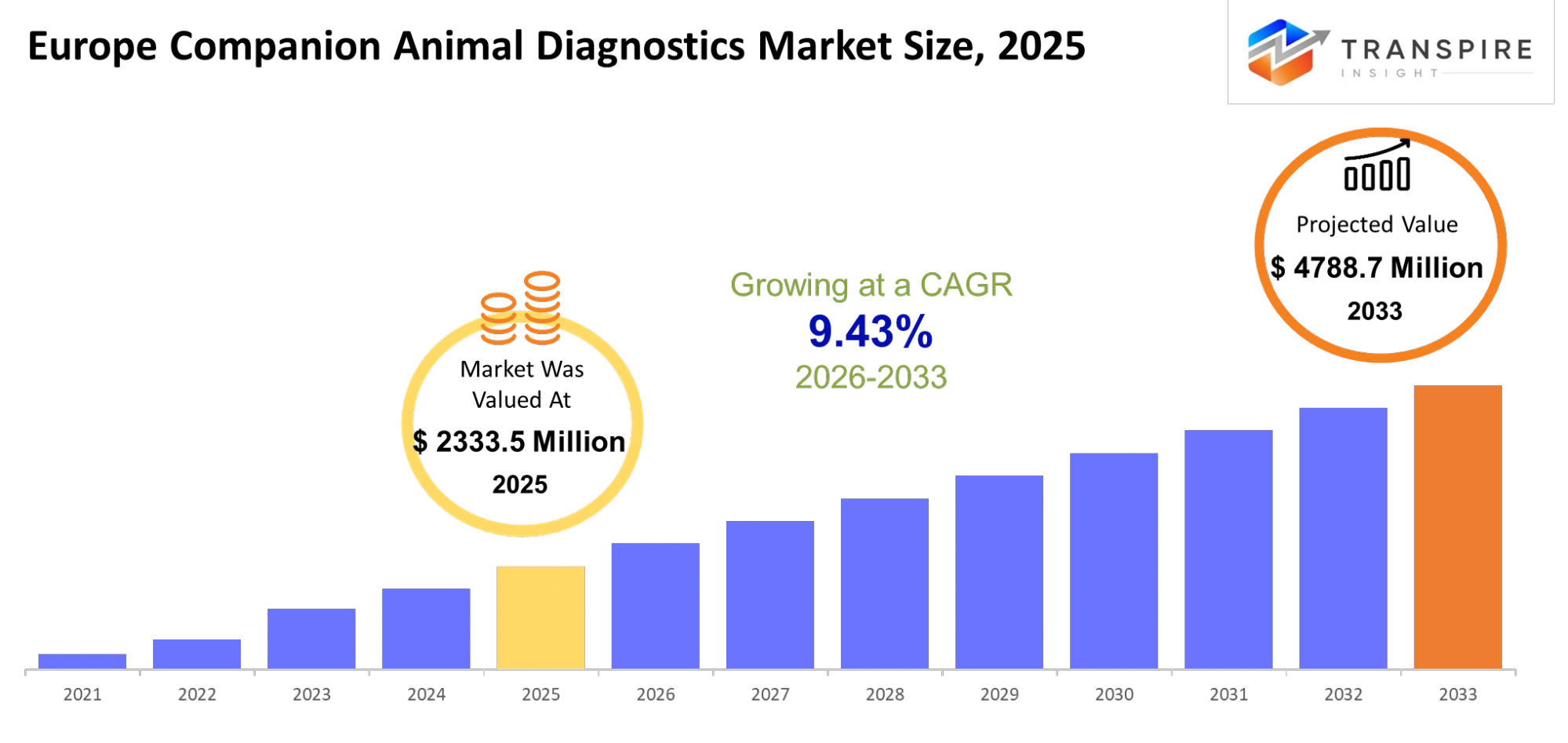
- Europe Companion Animal Diagnostics Market Size 2025: USD 2333.5 Million
- Europe Companion Animal Diagnostics Market Size 2033: USD 4788.7 Million
- Europe Companion Animal Diagnostics Market CAGR: 9.43%
- Europe Companion Animal Diagnostics Market Segments: By Type (Clinical Chemistry, Hematology, Immunodiagnostics, Molecular Diagnostics, Imaging, Others); By Application (Infectious Diseases, Chronic Diseases, Genetic Testing, Wellness Testing, Monitoring, Others); By End-User (Veterinary Clinics, Hospitals, Labs, Research Institutes, Pet Owners, Others); By Technology (PCR, ELISA, Rapid Tests, Imaging Systems, AI-based, Others)
To learn more about this report,  Download Free Sample Report
Europe Companion Animal Diagnostics Market Summary:
The Europe Companion Animal Diagnostics Market size is estimated at USD 2333.5 Million in 2025 and is anticipated to reach USD 4788.7 Million by 2033, growing at a CAGR of 9.43% from 2026 to 2033.
The European companion animal diagnostic sector within veterinary diagnostic markets shows industry development through changing consumer demand for swift and accurate pet health measurements together with modern molecular testing and digital imaging technologies which enhance diagnostic accuracy while European regulatory changes will affect both standardization methods and data management systems throughout the region. The integrated diagnostic systems which veterinarians and laboratories will use create a common framework that speeds up their work processes while maintaining animal health standards. The market will adjust based on the changing clinical needs of European healthcare facilities. The industry will achieve full compliance with European veterinary standards within an extended period.
What Has the Impact of Artificial Intelligence Been on the Europe Companion Animal Diagnostics Market?
AI technology is revolutionizing veterinary diagnostics for companion animals in Europe through its ability to analyze complex diagnostic information with greater precision. The European companion animal diagnostics market for artificial intelligence now includes machine learning technology which enables faster and more precise assessment of imaging data and pathology results and clinical records.
Market research capabilities have improved because this transition enables stakeholders to track emerging trends in the European companion animal diagnostics market and predict future demand with greater accuracy. Data-driven insights will become essential for both laboratories and veterinary clinics because the European companion animal diagnostics market will adopt predictive analytics into its normal operating procedures.
The European companion animal diagnostics market will benefit from smart automation technologies because these systems will enhance operational efficiency by decreasing the need for human work and boosting productivity throughout testing and reporting processes. AI-powered platforms will enhance supply chain coordination, helping reduce delays and optimize resource allocation. The European companion animal diagnostics market will see increasing personalized diagnostic pathways because algorithms will create specific health profile insights for each animal. The market will expand through these advancements, while artificial intelligence applications in European companion animal diagnostics will develop real-time monitoring and decision support capabilities which will transform market operations through technology-driven change.
Key Market Trends & Insights:
- The European market for companion animal diagnostics is led by Western Europe which holds 38% of the market share in 2025 because of its advanced veterinary infrastructure and high pet ownership rates.
- The Eastern European market for companion animal diagnostics will experience its highest growth between 2025 and 2030 because of increasing veterinary knowledge and the modernization of clinics.
- The Europe companion animal diagnostics market designates diagnostic imaging as its primary product segment which holds approximately 32% market share during 2025.
- The second largest segment of the market consists of clinical chemistry analyzers which veterinary hospitals use for their standard testing requirements.
- The molecular diagnostics market segment will experience its highest growth until 2030 because of increasing precision disease detection methods.
- The Europe companion animal diagnostics market shows its highest application share through infectious disease testing which accounts for about 40% of the market because of essential disease surveillance requirements.
- The oncology diagnostics field experiences its fastest development because veterinarians now have the ability to identify cancer cases in their companion animal patients.
- Veterinary hospitals represent the primary market segment which uses advanced diagnostic systems and employs qualified staff to achieve 45% usage of their services.
- The market for diagnostic laboratories will experience its most rapid growth because laboratories are now outsourcing their services while also needing special testing solutions.
- The European market for companion animal diagnostics achieves testing speed improvements and enhanced predictive analytics through continuous research and development funding because these investments support faster testing accuracy development.
Europe Companion Animal Diagnostics Market Segmentation
By Type:
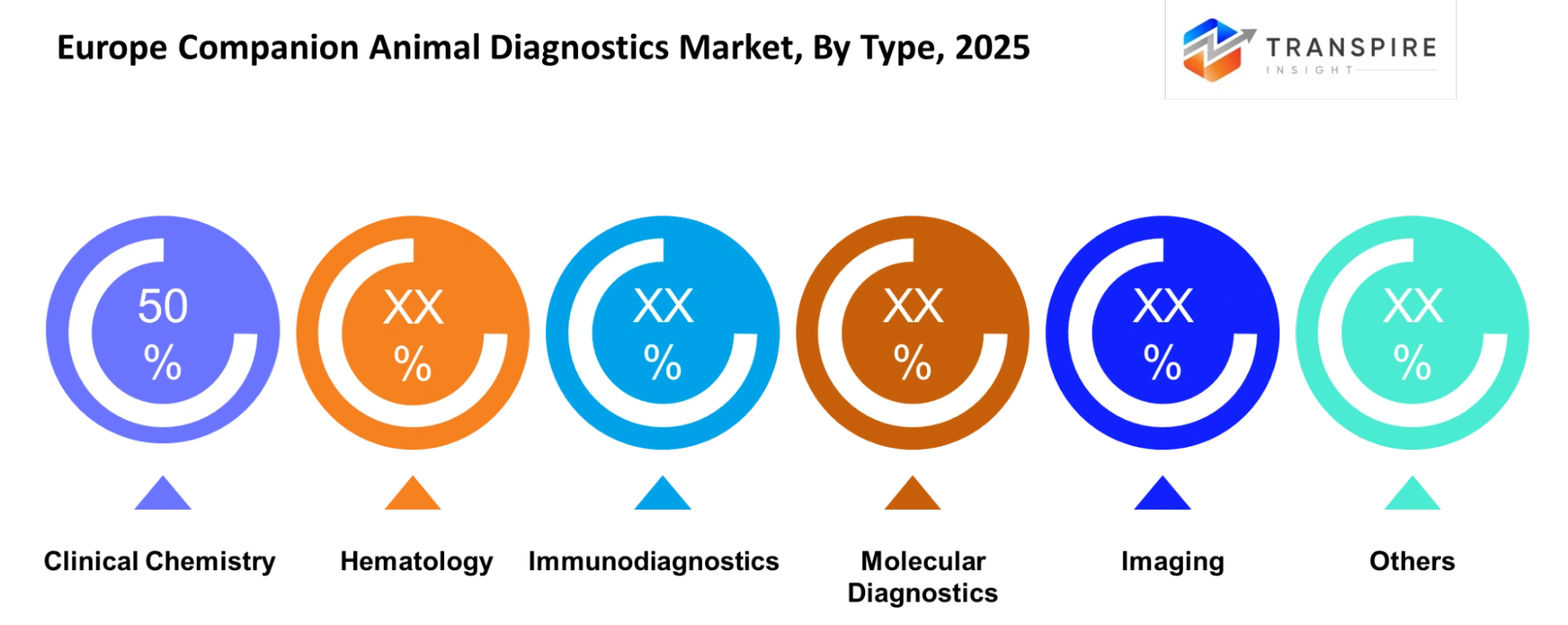
The two segments of the market divide into Clinical Chemistry and Hematology and Immunodiagnostics and Molecular Diagnostics and Imaging and Other diagnostic methods. The two diagnostic methods of immunodiagnostics and molecular diagnostics enable healthcare professionals to identify diseases through specific biological markers that they test. The Europe Companion Animal Diagnostics Market will achieve better veterinary care results through both imaging techniques and other diagnostic methods which will improve their capacity to deliver correct and timely medical assessments.
To learn more about this report, Download Free Sample Report
By Application:
The market divides into two segments which use testing for infectious diseases and chronic diseases and genetic testing and wellness testing and monitoring and other methods. The testing for infectious diseases remains a common practice because it helps identify pet diseases at their initial stages while doctors use chronic disease monitoring to develop treatment strategies for their patients. People are becoming more interested in genetic testing because it helps identify breed-specific health risks, whereas wellness testing enables users to maintain their health through disease prevention. The Europe Companion Animal Diagnostics Market will see an increase in monitoring applications because people will start using continuous health tracking technology more frequently.
By End-User:
The research study examines user groups which include veterinary clinics and veterinary hospitals and testing laboratories and research institutions and pet owners and additional user groups. Veterinary clinics serve as the primary veterinary facility for pet medical treatment because they allow veterinarians to access pet patients and require veterinarians to perform diagnostic tests whereas hospitals use their superior medical equipment to treat complex health conditions. Testing laboratories provide testing services to their clients who need external testing services whereas research institutes concentrate their efforts on creating new products and conducting experimental work. The European Companion Animal Diagnostics Market will change its service delivery systems because pet owners now want to test their pets at home.
By Technology:
The study focuses on six different technology segments which include PCR and ELISA and rapid tests and imaging systems and AI-based systems and additional technological systems. The human body requires PCR technology for complete identification of genetic material and infectious diseases while ELISA serves as a standard method for testing human immune system response. Medical staff members at the emergency department use rapid tests to provide immediate test results while they use imaging systems to perform internal body examinations. The European Companion Animal Diagnostics Market will achieve higher operational efficiency through AI-based tools which will provide better prediction and analysis capabilities to organizations that adopt advanced technological solutions.
What are the Main Challenges for the Europe Companion Animal Diagnostics Market Growth?
The expansion of the Europe companion animal diagnostics market faces technical and operational difficulties because diagnostic accuracy depends on three elements which include sample quality and device calibration and reagent performance. The different testing platforms produce unreliable results which makes it difficult for veterinary professionals to trust the results.
The European companion animal diagnostics market faces major challenges because strict regulatory requirements demand both quality certifications and veterinary diagnostic standard compliance for manufacturing and commercial activities. The advanced molecular and imaging-based instruments have high production costs which result in financial pressure that affects all providers. The Europe companion animal diagnostics market experiences product launch delays which occur during approval cycles and validation processes and these delays create extra difficulties for businesses that want to expand their innovative solutions.
The Europe companion animal diagnostics market faces multiple challenges because both adoption rates and infrastructure development progress at a slow pace. The market experiences service delivery issues because funding access remains limited and veterinary infrastructure distribution remains uneven throughout different regions. The Europe companion animal diagnostics market faces multiple challenges because lower-tier clinics fail to achieve digital integration which results in slow technology adoption across their operations.
The European companion animal diagnostics market operates under two main influences which include market competition and changing risk factors. Established companies face pricing pressure because alternative diagnostic technologies and cost-effective solutions enter the market. Organizations need to spend money on new technologies because of the fast-paced changes that force them to modernize their systems while the changing rules create additional problems for their business operations. The European companion animal diagnostics market will experience future growth barriers from these combined factors which create operational limitations for the entire industry.
Regional Insights
The European Companion Animal Diagnostics Market shows Western Europe as the top region because of its veterinary facilities and higher pet ownership rates and its citizens' dedication to animal healthcare expenditures. The countries of Germany and France and the United Kingdom show increasing use of modern diagnostic equipment. The Europe Companion Animal Diagnostics Market will experience stable growth because clinical standards will advance and people will become more aware of preventive healthcare.
The Europe Companion Animal Diagnostics Market shows Northern European regions as attractive markets because their strong veterinary systems combined with their early Digital Diagnostic Technology adoption create continuous market demand. Scandinavian countries use precise animal healthcare methods to develop their advanced testing capabilities. The veterinary diagnostic capabilities in southern Europe show progressive development because people will gain more knowledge through awareness campaigns and clinics will modernize their facilities.
The Eastern European market creates new business prospects because its veterinary facilities become better and people learn more about companion animals . Basic and mid-level diagnostic tools are becoming more popular in urban areas but they have not yet reached rural areas. The Europe Companion Animal Diagnostics Market will experience sustainable growth because veterinary services will continue to receive funding and better access to services will become available.
Recent Development News
In March 2026, Zoetis completed the acquisition of Neogen Corporation’s animal genomics division, strengthening its precision-focused diagnostic portfolio and expanding capabilities in genetic-based testing solutions for companion animals. The move reflects how major players in the europe companion animal diagnostics market are shifting toward advanced genomic and molecular tools to improve accuracy in disease detection. This development will also support broader adoption of predictive veterinary diagnostics across European clinical networks. https://www.coherentmarketinsights.com/industry-reports/veterinary-reference-laboratory-market (Coherent Market Insights reports)
In April 2026, Zoetis released its 2025 annual financial disclosures highlighting continued investment in diagnostic innovation and digital veterinary platforms, with increased focus on AI-supported testing workflows and rapid in-clinic solutions. The update signals stronger financial backing for innovation in the europe companion animal diagnostics market, especially in imaging and molecular diagnostics integration. These advancements will likely improve diagnostic speed and efficiency across veterinary clinics in Europe. https://s203.q4cdn.com/620628704/files/doc_financials/2025/ar/Zoetis-2026-Proxy-Statement.pdf (Zoetis reports)
|
Report Metrics |
Details |
|
Market size value in 2025 |
USD 2333.5 Million |
|
Market size value in 2026 |
USD 2548.2 Million |
|
Revenue forecast in 2033 |
USD 4788.7 Million |
|
Growth rate |
CAGR of 9.43% from 2026 to 2033 |
|
Base year |
2025 |
|
Historical data |
2021 - 2024 |
|
Forecast period |
2026 - 2033 |
|
Report coverage |
Revenue forecast, competitive landscape, growth factors, and trends |
|
Regional scope |
Europe (Germany, United Kingdom, France, Italy, Spain, Rest of Europe) |
|
Key company profiled |
IDEXX Laboratories, Zoetis, Heska, Virbac, Thermo Fisher, Bio-Rad, Agrolabo, Randox, Neogen, Fujifilm, Mindray, Siemens Healthineers, Abaxis, Eurofins, Qiagen |
|
Customization scope |
Free report customization (country, regional & segment scope). Avail customized purchase options to meet your exact research needs. |
|
Report Segmentation |
By Type (Clinical Chemistry, Hematology, Immunodiagnostics, Molecular Diagnostics, Imaging, Others); By Application (Infectious Diseases, Chronic Diseases, Genetic Testing, Wellness Testing, Monitoring, Others); By End-User (Veterinary Clinics, Hospitals, Labs, Research Institutes, Pet Owners, Others); By Technology (PCR, ELISA, Rapid Tests, Imaging Systems, AI-based, Others) |
How Can New Companies Establish a Strong Foothold in the Europe Companion Animal Diagnostics Market?
New companies entering the europe companion animal diagnostics market will require specialized expertise and technological innovation to establish trust with veterinary professionals. The company will experience reduced competition because it selects specific market segments which include rapid infectious disease testing and AI-supported imaging as its primary business areas. In the europe companion animal diagnostics market startups like SignalPET demonstrate artificial intelligence technologies through their radiology analysis system which enables faster and more reliable veterinary clinic diagnostics.
Strategic partnerships will play a key role in strengthening entry into the europe companion animal diagnostics market, especially through collaborations with veterinary hospitals, diagnostic laboratories, and research institutions. The company PetDx which creates liquid biopsy products for animal cancer detection demonstrates how focused research can solve existing treatment gaps. In the europe companion animal diagnostics market, aligning with local distributors and veterinary networks will also improve product reach and adoption rates.
The european companion animal diagnostics market requires businesses to maintain cost-effective operations and capacity for large-scale production because customer pricing preferences determine their buying choices. The new companies entering the market must develop affordable products that meet European Union regulations while implementing advanced technological systems. The use of cloud-based diagnostic systems together with intelligent automation technologies will enhance business productivity, which enables new companies to succeed in the changing european companion animal diagnostics market.
Key Europe Companion Animal Diagnostics Market Company Insights
The Europe Companion Animal Diagnostics Market shows intense competition because established companies like IDEXX Laboratories and Zoetis and Thermo Fisher Scientific and bioMérieux and Heska Corporation battle for market share. The companies develop advanced diagnostic systems which enable better testing accuracy and faster testing results. The European market for companion animal diagnostics will maintain strong competition because companies introduce new products and expand their veterinary service offerings.
The Europe Companion Animal Diagnostics Market shows new competitors and mid-sized businesses because they provide diagnostic solutions through affordable testing equipment and artificial intelligence-based diagnostic systems. The introduction of molecular testing and imaging systems drives industry competition while veterinary clinics establish partnerships, which enable wider system use. The European companion animal diagnostics market will experience ongoing competitive expansion as companies pursue growth through unique technological advancements and combined service offerings.
Company List
- IDEXX Laboratories
- Zoetis
- Heska
- Virbac
- Thermo Fisher
- Bio-Rad
- Agrolabo
- Randox
- Neogen
- Fujifilm
- Mindray
- Siemens Healthineers
- Abaxis
- Eurofins
- Qiagen
What are the Key Use-Cases Driving the Growth of the Europe Companion Animal Diagnostics Market?
The Europe companion animal diagnostics market links its main application to clinical disease detection because veterinary professionals need rapid testing to identify infectious and chronic diseases. The Europe companion animal diagnostics market expands because veterinarians increasingly use blood chemistry panels and imaging systems and molecular diagnostics to make better and quicker treatment choices. Pet owners will continue to drive clinics toward advanced diagnostic technologies because they become more aware about pet healthcare needs.
The Europe companion animal diagnostics market develops through preventive health screening which includes wellness testing and genetic risk assessment programs. Pet owners are seeking early detection tools for conditions such as cancer, diabetes, and hereditary disorders, which is increasing demand for regular diagnostic check-ups. The Europe companion animal diagnostics market now allows veterinary professionals to use monitoring tools which provide information about the extended health status of their companion animals.
The Europe companion animal diagnostics market receives support from veterinary hospital diagnostics and outsourced laboratory testing because these services provide better access to advanced testing procedures. Diagnostic labs are now receiving more complex cases which need advanced imaging and molecular analysis for their operational growth and productivity enhancement. The Europe companion animal diagnostics market will achieve better diagnostic results and operational efficiency through digital platform integration and artificial intelligence-powered solutions.
The europe companion animal diagnostics market will develop new business opportunities because at-home testing kits and mobile veterinary diagnostics create new use cases. The new technologies enable pet owners and veterinarians to experience better convenience through their ability to collect samples faster and share data instantly. The market will expand in the future because technological progress will enable more people to use the technology.
Europe Companion Animal Diagnostics Market Report Segmentation
By Type
- Clinical Chemistry
- Hematology
- Immunodiagnostics
- Molecular Diagnostics
- Imaging
- Others
By Application
- Infectious Diseases
- Chronic Diseases
- Genetic Testing
- Wellness Testing
- Monitoring
- Others
By End-User
- Veterinary Clinics
- Hospitals
- Labs
- Research Institutes
- Pet Owners
- Others
By Technology
- PCR
- ELISA
- Rapid Tests
- Imaging Systems
- AI-based
- Others
Frequently Asked Questions
Find quick answers to common questions.
The approximate Europe Companion Animal Diagnostics Market size for the market will be USD 4788.7 Million in 2033.
Key segments for the Europe Companion Animal Diagnostics Market are By Type (Clinical Chemistry, Hematology, Immunodiagnostics, Molecular Diagnostics, Imaging, Others); By Application (Infectious Diseases, Chronic Diseases, Genetic Testing, Wellness Testing, Monitoring, Others); By End-User (Veterinary Clinics, Hospitals, Labs, Research Institutes, Pet Owners, Others); By Technology (PCR, ELISA, Rapid Tests, Imaging Systems, AI-based, Others).
Major Europe Companion Animal Diagnostics Market players are IDEXX Laboratories, Zoetis, Heska, Virbac, Thermo Fisher, Bio-Rad, Agrolabo, Randox, Neogen, Fujifilm, Mindray, Siemens Healthineers, Abaxis, Eurofins, Qiagen.
The Europe Companion Animal Diagnostics Market size is USD 2333.5 Million in 2025.
The Europe Companion Animal Diagnostics Market CAGR is 9.43%.
- IDEXX Laboratories
- Zoetis
- Heska
- Virbac
- Thermo Fisher
- Bio-Rad
- Agrolabo
- Randox
- Neogen
- Fujifilm
- Mindray
- Siemens Healthineers
- Abaxis
- Eurofins
- Qiagen
Recently Published Reports
-
Apr 2026
AI in Diabetic Retinopathy Market
AI in Diabetic Retinopathy Market Size, Share & Analysis Report By Type (Screening AI Systems, Diagnostic AI Systems, and Predictive AI Models), By Application Segment (Hospitals, Ophthalmology Clinics, Diagnostic Centers, and Research and Development), and Geography (North America, Europe, Asia-Pacific, Middle East and Africa, South and Central America), 2021 - 2031
-
Apr 2026
Psychometric Tests Market
Psychometric Tests Market Size, Share & Analysis Report By Type (Personality Tests, Ability/Aptitude Tests, Skill/Knowledge Tests, and Others), By Application (Talent Acquisition and Talent Management), and Geography (North America, Europe, Asia-Pacific, Middle East and Africa, South and Central America), 2021 – 2031
-
Apr 2026
Rare Biological Sample Collection Market
Rare Biological Sample Collection Market Size, Share & Analysis Report By Type (Isolation Kits & Reagent, Blood Collection Tubes, and Others), By Application (Oncology, Transcriptomics, Pharmacogenomics, and Others), and Geography (North America, Europe, Asia-Pacific, Middle East and Africa, South and Central America), 2021 – 2031
-
Apr 2026
Patient Lift Pendant Market
Patient Lift Pendant Market By Product Type (Wired Pendants, Wireless, Programmable), By Operation Type(Manual, Electric), By End-Users (Healthcare Professionals, Patients), By Application (Hospitals, Homecare, Rehabilitation Centers, Others), By Industry Analysis, Size, Share, Growth, Trends, and Forecasts 2021-2033
Our Clients
.jpg)