Middle East and Africa Laboratory Proficiency Testing Market Size & Forecast:
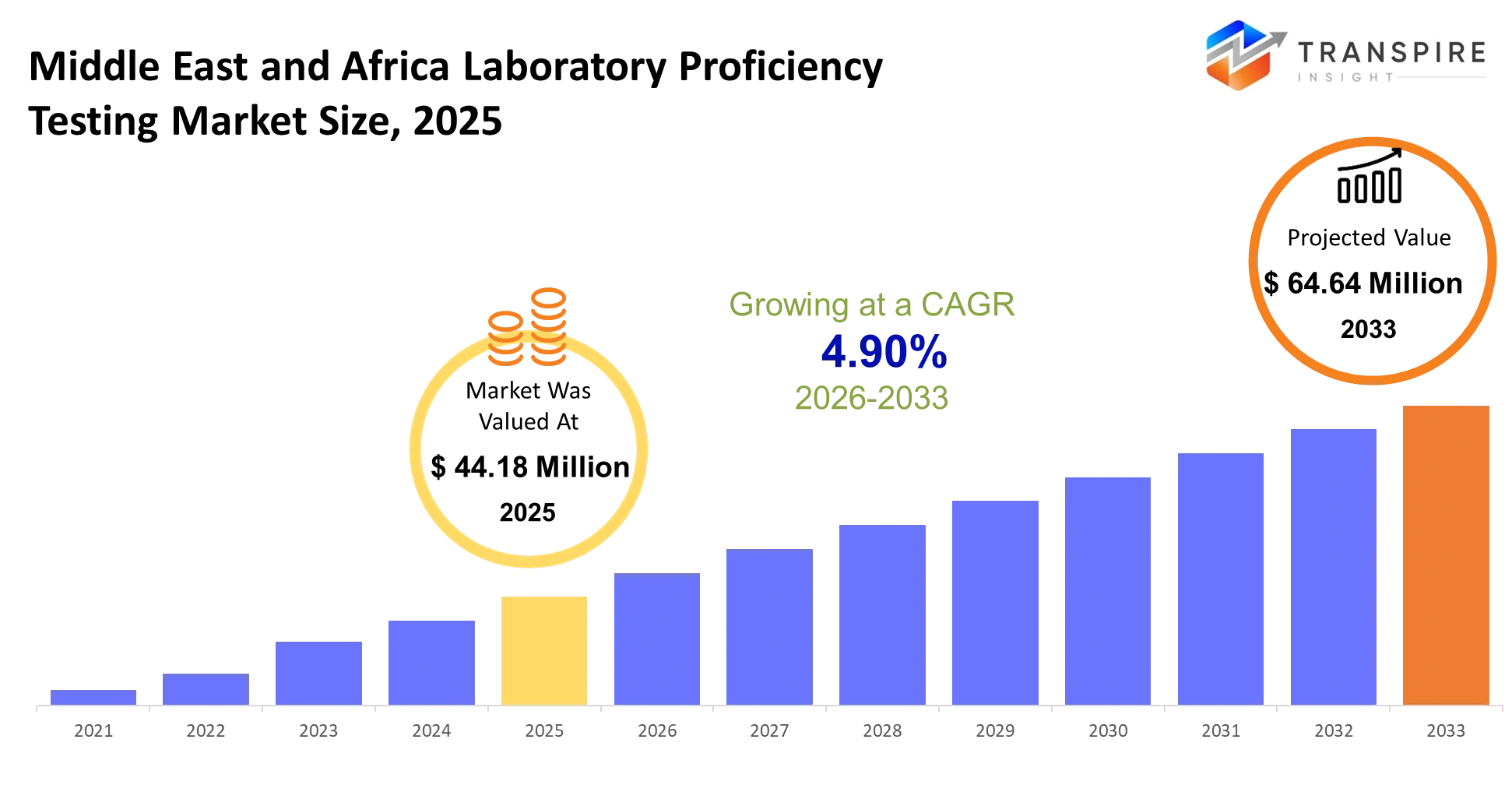
- Middle East and Africa Laboratory Proficiency Testing Market Size 2025: USD 44.18 Million
- Middle East and Africa Laboratory Proficiency Testing Market Size 2033: USD 64.64 Million
- Middle East and Africa Laboratory Proficiency Testing Market CAGR: 4.90%
- Middle East and Africa Laboratory Proficiency Testing Market Segments: By Type (Clinical, Analytical, Environmental, Food Testing), By Application (Healthcare, Food, Pharma, Environmental), By End-User (Labs, Hospitals, Research Institutes, Regulatory Bodies)
To learn more about this report,  Download Free Sample Report
Middle East and Africa Laboratory Proficiency Testing Market Summary:
The Middle East and Africa Laboratory Proficiency Testing Market size is estimated at USD 44.18 Million in 2025 and is anticipated to reach USD 64.64 Million by 2033, growing at a CAGR of 4.90% from 2026 to 2033. The market for laboratory proficiency testing in the Middle East and Africa, including the market comprising Saudi Arabia and United Arab Emirates, as well as South Africa, and the rest of Middle East and Africa, is set to expand in the years ahead, given the increasing demands on laboratories in terms of quality standards and standards of international testing. This will require more stringent verification of their performance, which will necessitate their using external evaluation programs that reflect realistic testing conditions. The digital environment will transform engagement by allowing for remote submission of data and quicker analysis. Customized programs will gain greater importance due to varying disease burden and industry requirements.
What Has the Impact of Artificial Intelligence Been on the Middle East and Africa Laboratory Proficiency Testing Market?
The analytical methods used in the Middle East and Africa laboratory proficiency testing market, which depend on artificial intelligence, will experience major changes because AI brings new data-based accuracy methods together with faster industry decision-making processes. AI in middle east and africa laboratory proficiency testing market operations will enhance how performance data is collected, interpreted, and benchmarked, allowing laboratories to identify deviations with greater accuracy. Machine learning algorithms will process vast datasets from multiple testing cycles, which will establish unknown performance trends and create predictive analytics that help organizations better understand future needs and market developments.
Artificial intelligence in middle east and africa laboratory proficiency testing market workflows will also streamline operational efficiency through smart automation. The system will handle all three tasks of routine validation, result comparison, and anomaly detection which will lead to less manual work and fewer chances of human mistakes. The shift will reduce operational expenses while delivering faster service, which will enhance supply chain management and resource distribution. Laboratories will be able to optimize procurement of testing materials and align participation schedules more effectively with regulatory timelines.
Artificial intelligence will enable Middle Eastern and African laboratory proficiency testing markets to achieve innovation and competitive advantages beyond their existing efficiency improvements. Advanced analytics will support personalized proficiency testing programs tailored to specific laboratory capabilities and regional requirements. The changing market trends will enable AI-powered insights to assist stakeholders in predicting upcoming regulatory changes which will allow them to adapt more quickly than their rivals while producing superior results and maintaining compliance and credibility in a highly monitored environment.
Key Market Trends & Insights:
- The laboratory proficiency testing market in the Middle East and Africa exists under Saudi Arabian dominance, which controls almost 28 percent of the 2025 market through its healthcare investment strategy.
- The United Arab Emirates shows the fastest-growing demand, projected to expand at over 8% CAGR through 2030, driven by advanced lab infrastructure.
- The market for clinical diagnostics proficiency testing reaches approximately 45% market share, which demonstrates the high demand for accurate disease detection.
- Infection control programs at hospitals and laboratories drive the testing market, making microbiology testing the second most valuable testing area.
- The molecular diagnostics market segment experiences its fastest growth rate, which will reach significant levels during the period between 2025 and 2030 because of precision testing implementation.
- The healthcare diagnostics field operates at maximum capacity through its applications, which account for more than 50% of market share, because testing needs for chronic diseases are on the rise.
- Pharmaceutical and biotech testing emerges as the fastest-growing application, supported by drug development and quality assurance demand.
- The testing activities in hospitals and clinical laboratories reach 60% market share because these facilities require ongoing testing for their operational needs and regulatory compliance.
- African markets create new opportunities for companies, which invest in product development and AI analytics while they enter these markets.
- Organizations achieve competitive advantages and improve operational performance through modern technology developments that include automation and digital reporting systems.
Middle East and Africa Laboratory Proficiency Testing Market Segmentation
By Type
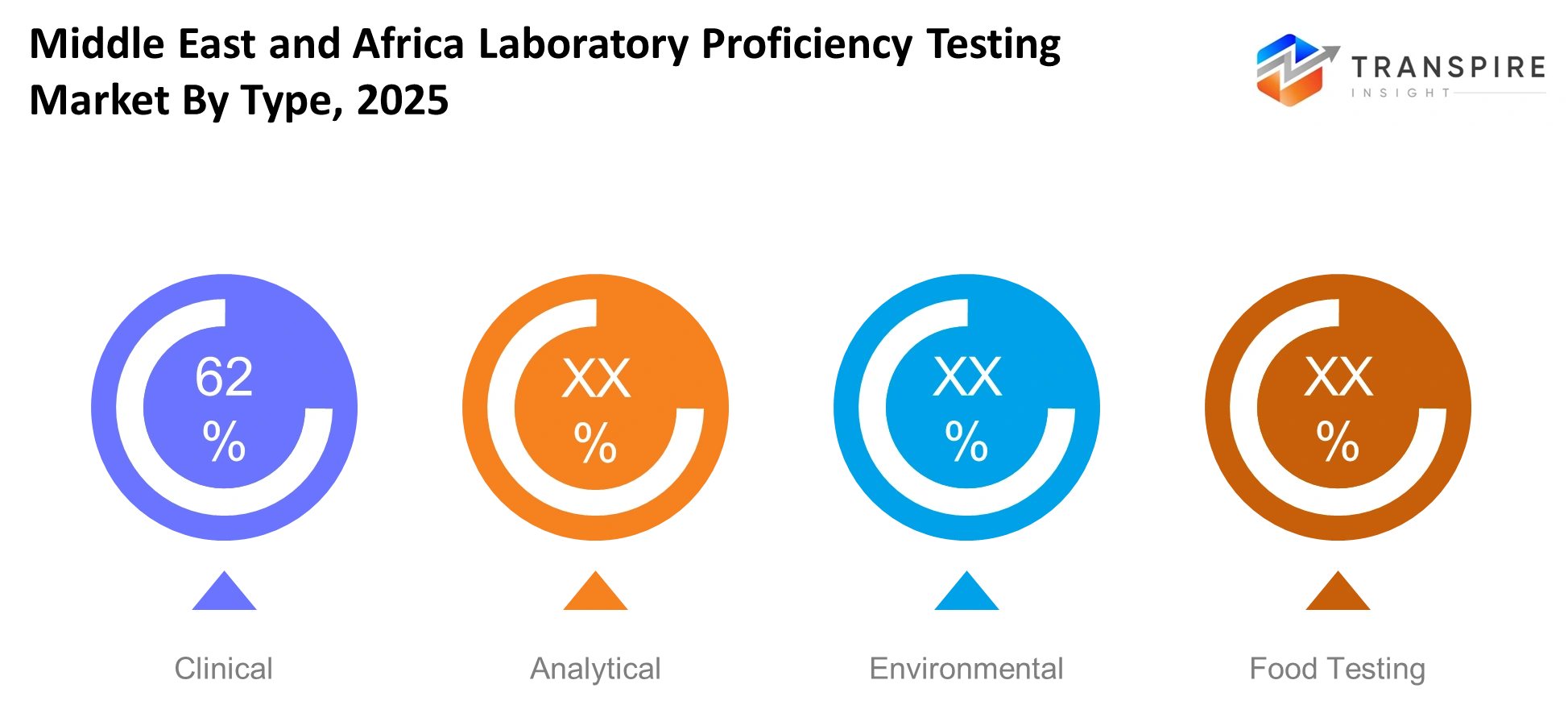
The laboratories will continue their primary work because they need to conduct clinical testing which helps them create precise medical assessments while ensuring patient protection throughout the medical system. The medical field will require formal assessment programs which enable them to check their results against established industry standards. The chemical and industrial analysis will use analytical testing because its exact results and stable performance will determine their operational choices. Governments will require stricter regulations for environmental testing because they need to monitor air and water and soil quality more effectively.
The testing of food products will grow because people become more aware of safety standards and export compliance regulations. Laboratories will implement proficiency programs that replicate actual contamination threats and testing procedures. The distinct types will show different regulatory standards however they will depend on the same assessment techniques. The implementation of digital reporting together with automated validation systems will enhance the testing process reliability for all testing methods.
To learn more about this report, Download Free Sample Report
By Application
Healthcare applications will become the primary healthcare solution because medical facilities need ongoing diagnostic services while they must fulfill rigorous accreditation standards. The laboratories will participate in external quality programs to maintain accurate disease detection and treatment planning abilities. The food sector will expand through its applications because supply chains need to grow more complex while certified safety requirements become more important. The testing programs will enable both national consumption and international trade operations to meet their required standards.
The pharmaceutical industry will use its applications to develop drugs and produce pharmaceuticals according to manufacturing standards while precision testing safeguards product safety and consistency. The environmental applications will grow as regulatory bodies increase their focus on sustainability initiatives and pollution management practices. The testing programs will validate monitoring processes while organizations use them to comply with current standards. The application area needs dependable benchmarking methods to build organizational credibility which results in public confidence.
By End-User
The main participants in this study will be laboratories because they require accreditation and ongoing performance assessment. The organization will achieve operational excellence through its implementation of proficiency testing which will help maintain performance standards. The programs will assist hospitals in evaluating their diagnostic capabilities while safeguarding patient health. The implementation of automated systems will enable quicker processes for result verification and report distribution.
Scientific research organizations will use proficiency testing to enhance their experimental accuracy and validate their research data. The governing agencies will manage the process implementation while they implement standard compliance checks to establish consistent operational procedures across different industries. The testing quality and responsibility will improve through collaboration among end-users in this project. The structured examination systems will establish operational transparency, which will create trust in laboratory results.
What are the Main Challenges for the Middle East and Africa Laboratory Proficiency Testing Market Growth?
The middle east and africa laboratory proficiency testing market faces operational and technical problems which create challenges for testing laboratories to achieve consistent results and scalable operations. Laboratories face challenges when they attempt to keep their sample quality constant throughout multiple testing cycles because this practice hinders their ability to perform accurate benchmarking tests. Performance evaluation processes become slower because of their complicated data handling requirements and their lack of digital system integration capabilities. Supply chain disruptions for reference materials create material delays, which result in market limitations and operational inefficiencies.
The Middle east and Africa laboratory proficiency testing market faces manufacturing and commercialization obstacles because of its need to comply with stringent regulatory requirements. International standards compliance requires providers to make their production system more complex, which results in higher operational expenses. The testing program implementation process becomes slower because of various delays that occur during the regulatory approval and certification process. Cost pressures prevent smaller providers from expanding their service offerings, which results in uneven market competition and restricted access to services.
The adoption of laboratory proficiency testing in developing middle eastern and african regions faces major challenges which require the laboratory proficiency testing market to overcome. The laboratory system faces three main challenges because it has insufficient infrastructure and lacks trained staff and people do not understand external quality assessment programs. Public healthcare systems face funding shortfalls which create barriers to investing in advanced testing technologies. The growth of standardized testing methods in developing nations faces multiple obstacles which prevent their adoption in emerging markets.
The market faces additional pressure because it competes with existing products and upcoming threats while new quality control methods and internal testing processes become more accepted. Provider strategies will experience ongoing changes because pricing pressures and new regulatory requirements are expected to keep developing. The market must balance two needs which require businesses to develop new technologies while keeping costs affordable.
Regional Insights
Saudi Arabia will lead regional demand because of its substantial healthcare investments and its enforcement of strict accreditation standards. Laboratories will implement structured testing programs which will enable them to achieve national quality standards. Government programs will drive the development of diagnostic facilities which will enable more people to participate in external assessment programs. Growth will continue because the demand for trustworthy clinical and industrial testing services keeps increasing.
The ongoing effort to modernize healthcare systems will enhance laboratory standards across all major metropolitan areas. The private sector will drive more companies to adopt proficiency testing programs. The digital integration process will enhance reporting precision while diminishing the occurrence of manual mistakes. The development of specialized testing centers will help organizations achieve their long-term plans for quality enhancement.
The United Arab Emirates will achieve fast progress because it has developed modern laboratory facilities and obtained worldwide accreditation. Laboratories will spend money to develop automated systems which will boost their testing accuracy and productivity. International demand for quality standards will lead organizations to join proficiency testing programs. The growth of the sector depends on two factors medical tourism and healthcare policies that establish innovative medical practices.
The existing regulatory framework will establish stable testing methods which public and private laboratories must follow. The implementation of digital platforms will make it easier to assess performance results. Global partnerships with providers will result in improved technological expertise. The organization will establish itself as the main diagnostic center for advanced medical testing through its dedication to research and development.
The established laboratory networks and research capabilities of South Africa will enable the country to maintain its important position. Laboratories use proficiency testing to check their international standard compliance according to testing standards. Public healthcare programs will create a need for precise diagnostic tests. The market will experience constant growth because organizations now prioritize tracking and managing diseases.
The testing quality will improve through laboratory training investments and infrastructure development according to laboratory testing procedures. Research institutes and healthcare providers need to work together to create innovative solutions. Testing facilities will open in rural areas which will lead to more people taking part in testing programs. Laboratories will achieve better performance results through ongoing regulatory oversight which ensures they meet standardized requirements.
The Middle East and Africa region will experience slow advancement as people become aware of quality assurance methods. Emerging economies will establish laboratory systems which will help them meet their rising medical and industrial requirements. The adoption of proficiency testing will increase as regulatory frameworks establish more solid structures. International partnerships combined with funding projects will drive business expansion.
The process of adoption will experience delays because certain areas have insufficient resources. The technical skill development and testing improvement will be achieved through training programs. The market share will expand because private laboratories are now setting up operations. Regional cooperation will establish testing standards which will lead to better quality results.
Recent Development News
In March 2026, The organization of the first Gulf Conference for laboratory Proficiency comes in line with the strategic orientation of the GCC Standardization Organization (GSO) to the development of Standardization and Quality infrastructure in the member states, which would contribute to the development of commerce and industry and the national economy in the Member States. The conference aims to spread awareness about proficiency testing activities available in the Member States, investigate the needs of laboratories and priorities in PT programs, and link the international PT providers for these programs, https://www.gso.org.sa/
In November 2025, Proficiency testing (PT) is a form of external quality assurance in which laboratories analyze identical samples and compare results to evaluate performance. It essentially provides an interlaboratory comparison that verifies a lab’s testing accuracy and competence. By identifying systematic errors and deviations, PT helps laboratories validate their methods and demonstrate their competency to stakeholders such as accreditation bodies and regulators.https://biopharmaapac.co/
|
Report Metrics |
Details |
|
Market size value in 2025 |
USD 44.18 Million |
|
Market size value in 2026 |
USD 46.25 Million |
|
Revenue forecast in 2033 |
USD 64.64 Million |
|
Growth rate |
CAGR of 4.90% from 2026 to 2033 |
|
Base year |
2025 |
|
Historical data |
2021 - 2024 |
|
Forecast period |
2026 - 2033 |
|
Report coverage |
Revenue forecast, competitive landscape, growth factors, and trends |
|
Regional scope |
Middle East and Africa (Saudi Arabia, United Arab Emirates, South Africa, Rest of Middle East and Africa) |
|
Key company profiled |
Bio-Rad, LGC Group, Merck, Thermo Fisher, QIAGEN, Randox, College of American Pathologists, Fapas, NSI Lab Solutions, Absolute Standards, ERA, Waters, Agilent, Shimadzu, Eurofins |
|
Customization scope |
Free report customization (country, regional & segment scope). Avail customized purchase options to meet your exact research needs. |
|
Report Segmentation |
By Type (Clinical, Analytical, Environmental, Food Testing), By Application (Healthcare, Food, Pharma, Environmental), By End-User (Labs, Hospitals, Research Institutes, Regulatory Bodies) |
How Can New Companies Establish a Strong Foothold in the Middle East and Africa Laboratory Proficiency Testing Market?
The new entrants who want to establish their operations in the Middle East and Africa laboratory proficiency testing market must develop strategies that clearly differentiate their offerings. Companies should concentrate on specific market segments which include molecular diagnostics and environmental testing because these areas show increasing demand for their products. The development of new businesses into problem-solving experts will require them to overcome two main regional obstacles which include the shortage of laboratory capacity and the existence of different regulatory frameworks.
The Middle East and Africa laboratory proficiency testing market will use technology-based innovations as its main method for achieving market success. Startups that combine AI-driven analytics with cloud-based reporting and automated result verification will become market leaders because they deliver precise results in less time. Emerging companies like Qnostics demonstrate how their focus on molecular quality controls will enhance testing reliability while smaller local startups develop digital-first proficiency testing solutions for their regional laboratories.
Market entry and expansion will achieve faster progress through strategic partnerships which bring additional benefits. The new companies will establish credibility through their partnerships with hospitals and diagnostic chains and regulatory bodies. Knowledge transfer and compliance alignment will be established through joint ventures with global proficiency testing providers. New market entrants will gain better industry trend understanding through these approaches which will help them compete more effectively.
The laboratory proficiency testing market in the middle east and Africa will achieve long-term success through businesses that create value while adapting to changing market conditions. Critical adoption barriers will be addressed by companies that invest in local solutions and develop flexible pricing models and training support for laboratory professionals. New companies will achieve sustainable competitive advantages through their innovation strategies which are aligned with regional needs and market development trends.
Key Middle East and Africa Laboratory Proficiency Testing Market Company Insights
Competition will always be shaped by multinational corporations and local organizations committed to providing top-notch services that are delivered fast and customized. Organizations will spend on technology that helps to ensure accuracy and efficiency in data gathering and reporting. An organization can retain its competitive edge by building a portfolio that consists of various testing procedures for industries like healthcare, food, and environmental testing.
Market edge will be fostered by forming partnerships, and this involves cooperation between the firm and laboratories and regulating agencies. A company is capable of building its unique market edge by entering regions where there are no available services. Automation technology and analysis software will make the provision of services more effective. The competitive edge will be realized in different regional markets through pricing strategies and problem-specific solutions.
Company list
- Bio-Rad
- LGC Group
- Merck
- Thermo Fisher
- QIAGEN
- Randox
- College of American Pathologists
- Fapas, NSI Lab Solutions
- Absolute Standards
- ERA, Waters
- Agilent
- Shimadzu
- Eurofins
What are the Key Use-Cases Driving the Growth of the Middle East and Africa Laboratory Proficiency Testing Market?
The market for laboratory proficiency testing services in the Middle East and Africa is expected to increase due to the need for accurate identification of diseases by the hospital and other clinical laboratories. Quality assessment tests will assist in validating test outcomes for diseases including infectious diseases and chronic diseases. The demand for certification will increase due to expansion and more stringent accreditation policies.
Laboratory proficiency testing market in the Middle East and Africa is expected to be influenced by two areas. These are food safety testing and environmental monitoring. Laboratories will require proficiency testing services to ensure that safety standards are met during the process of producing foods as well as exporting them. The environmental agencies will also benefit from the services offered in laboratory proficiency testing programs due to sustainability initiatives.
Proficiency testing in the laboratory market in the Middle East and Africa will witness high adoption rates due to the growing demand for testing services by the pharmaceutical and biotechnology industry. The manufacturers of drugs will depend on the proven techniques of testing so as to ensure that their products qualify for regulatory approval. It will help them carry out accurate clinical trials and have consistent production of the drugs, which will help them in their competitive advantage in the international market.
Industries such as those involved in testing materials, chemicals, and products will adopt proficiency testing programs in order to attain quality control and compliance with international regulations. Such laboratories will benefit from benchmarking systems due to the increase in the number of uses of testing programs in different industries.
Middle East and Africa Laboratory Proficiency Testing Market Report Segmentation
By Type
- Clinical
- Analytical
- Environmental
- Food Testing
By Application
- Healthcare
- Food
- Pharma
- Environmental
By End-User
- Labs
- Hospitals
- Research Institutes
- Regulatory Bodies
Frequently Asked Questions
Find quick answers to common questions.
The approximate Middle East and Africa Laboratory Proficiency Testing Market size for the market will be USD 64.64 Million in 2033.
Key segments for the Middle East and Africa Laboratory Proficiency Testing Market are By Type (Clinical, Analytical, Environmental, Food Testing), By Application (Healthcare, Food, Pharma, Environmental), By End-User (Labs, Hospitals, Research Institutes, Regulatory Bodies).
Major Middle East and Africa Laboratory Proficiency Testing Market players are Bio-Rad, LGC Group, Merck, Thermo Fisher, QIAGEN, Randox, College of American Pathologists, Fapas, NSI Lab Solutions, Absolute Standards, ERA, Waters, Agilent, Shimadzu, Eurofins.
The Middle East and Africa Laboratory Proficiency Testing Market size is USD 44.18 Million in 2025.
The Middle East and Africa Laboratory Proficiency Testing Market CAGR is 4.90%.
- Bio-Rad
- LGC Group
- Merck
- Thermo Fisher
- QIAGEN
- Randox
- College of American Pathologists
- Fapas, NSI Lab Solutions
- Absolute Standards
- ERA, Waters
- Agilent
- Shimadzu
- Eurofins
Recently Published Reports
-
Dec 2024
AI in Diabetic Retinopathy Market
AI in Diabetic Retinopathy Market Size, Share & Analysis Report By Type (Screening AI Systems, Diagnostic AI Systems, and Predictive AI Models), By Application Segment (Hospitals, Ophthalmology Clinics, Diagnostic Centers, and Research and Development), and Geography (North America, Europe, Asia-Pacific, Middle East and Africa, South and Central America), 2021 - 2031
-
Feb 2025
Psychometric Tests Market
Psychometric Tests Market Size, Share & Analysis Report By Type (Personality Tests, Ability/Aptitude Tests, Skill/Knowledge Tests, and Others), By Application (Talent Acquisition and Talent Management), and Geography (North America, Europe, Asia-Pacific, Middle East and Africa, South and Central America), 2021 – 2031
-
Feb 2025
Rare Biological Sample Collection Market
Rare Biological Sample Collection Market Size, Share & Analysis Report By Type (Isolation Kits & Reagent, Blood Collection Tubes, and Others), By Application (Oncology, Transcriptomics, Pharmacogenomics, and Others), and Geography (North America, Europe, Asia-Pacific, Middle East and Africa, South and Central America), 2021 – 2031
-
Dec 2025
Patient Lift Pendant Market
Patient Lift Pendant Market By Product Type (Wired Pendants, Wireless, Programmable), By Operation Type(Manual, Electric), By End-Users (Healthcare Professionals, Patients), By Application (Hospitals, Homecare, Rehabilitation Centers, Others), By Industry Analysis, Size, Share, Growth, Trends, and Forecasts 2021-2033
Our Clients
.jpg)