
Global Livestock Monitoring Robot Market Size & Forecast
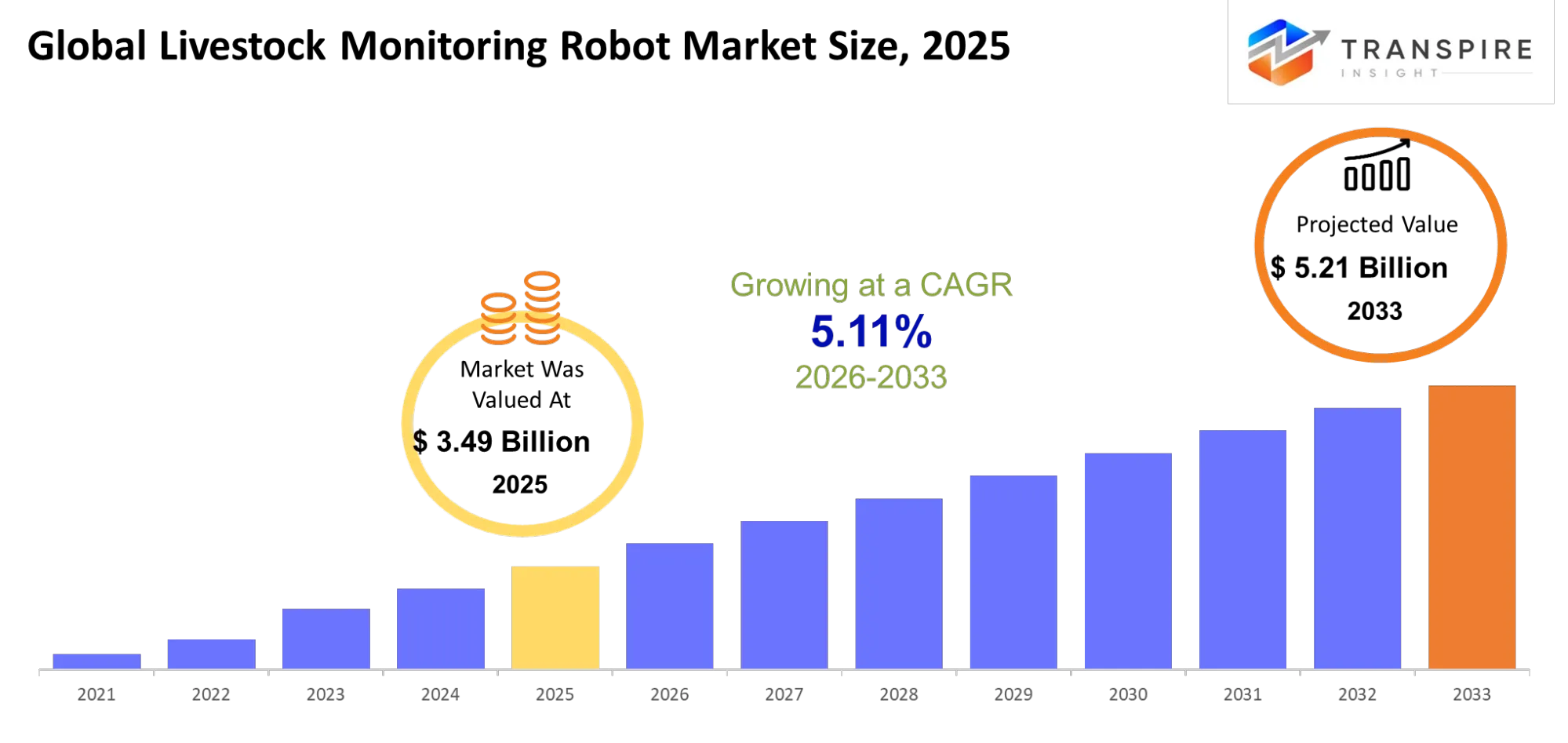
- Global Livestock Monitoring Robot Market Size 2025: USD 3.49 Billion
- Global Livestock Monitoring Robot Market Size 2033: USD 5.21 Billion
- Global Livestock Monitoring Robot Market CAGR: 5.11%
- Global Livestock Monitoring Robot Market Segments: By Robot Type (Milking Robots, Feeding Robots, Cleaning Robots), By Livestock Type (Dairy Cattle, Poultry, Swine), By Application (Milking Management, Feeding Management, Health Monitoring)
To learn more about this report,  Download Free Sample Report
Global Livestock Monitoring Robot Market Summary
The global livestock monitoring robot market puts numbers to this shift: USD 3.49 Billion in 2025, growing to USD 5.21 Billion by 2033 at a 5.11% CAGR. Farmers truly know that regular animal care really leads to steady yields. What has actually changed is who does the caring. Milking robots are now handling morning and evening rounds at thousands of dairy farms – no human actually touches a cow. Feeding systems give out very precise rations all automatically. Cleaning bots clean the barn floors right on schedule.
Labor really is the main thing here. In every significant livestock-producing nation, highly skilled farm workers are a lot harder to get and much more expensive to keep than they were ten years ago. A milking robot doesn't call in sick, doesn't demand overtime, and doesn't need a pension plan. For a 200-cow dairy operation doing two daily milking shifts, replacing those labor hours with automation typically pays back the investment cost within five to seven years. That math has convinced tens of thousands of farmers in Europe, North America, and now Asia-Pacific to make the switch.
The technology has also greatly outgrown its initial job description. Early milking robots would attach teat cups and collect milk itself. Today's systems track each cow's health in real time, point out early mastitis signs based on changes in milk conductivity, and feed that information into farm management software that a producer can see on a tablet from another continent. The monitoring layer is, in a way, much more valuable than the automation layer - and it really sets the high-end vendors apart from basic hardware providers.
Key Global Livestock Monitoring Robot Market Insights
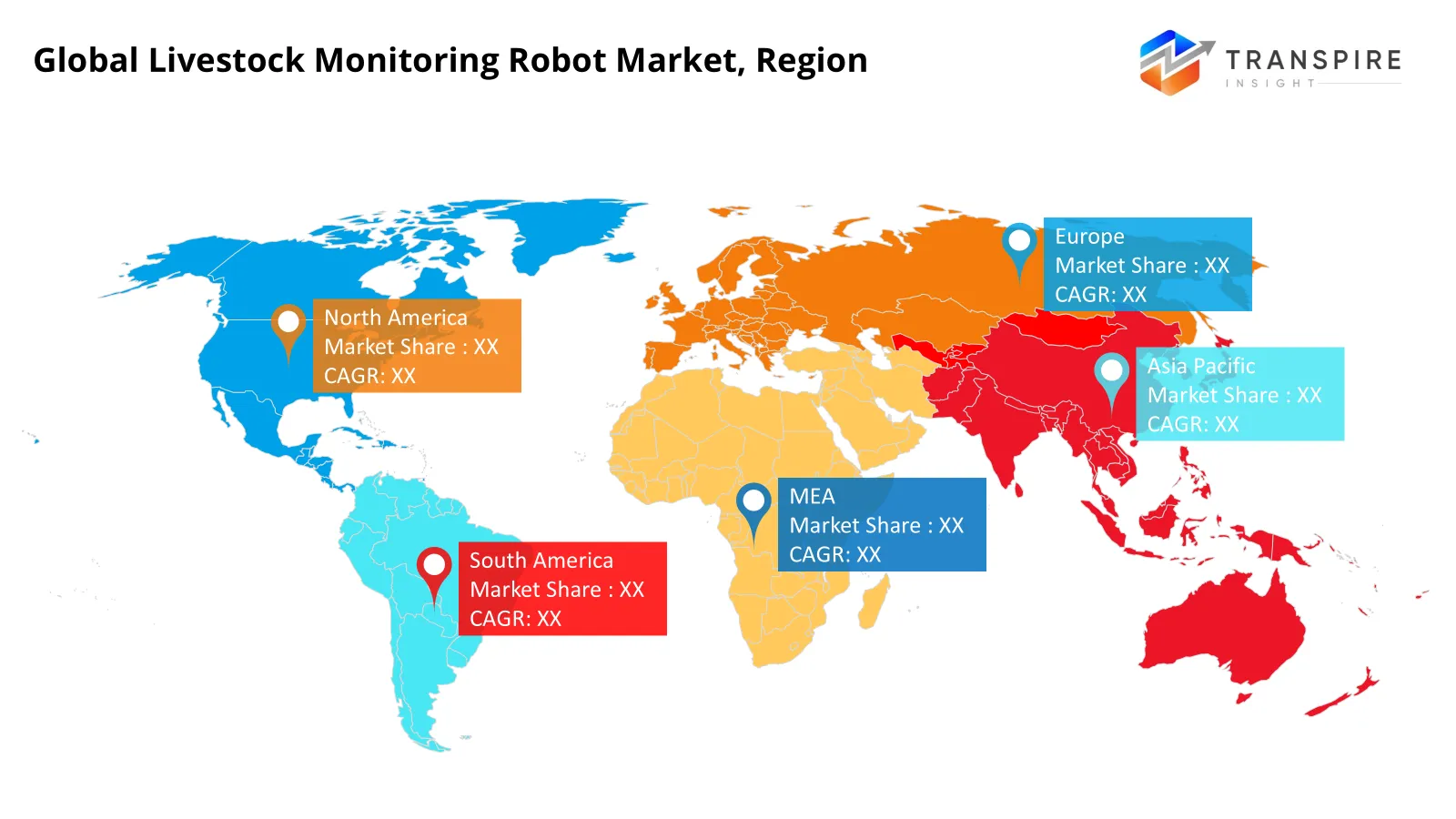
- Europe holds the largest share of the global livestock monitoring robot market at approximately 42% of revenue in 2025, driven by large-scale dairy operations in the Netherlands, Germany, Denmark, and Sweden where robotic milking adoption rates already exceed 30% of commercial dairy farms.
- North America is the second-largest market, accounting for roughly 28% of global revenue in 2025, with growth concentrated in Canadian dairy operations and large US commercial farms converting from conventional parlor milking to automated voluntary milking systems.
- Asia-Pacific is the fastest-growing region, expanding above 7% annually through 2033, led by China's government-backed dairy farm consolidation program and India's expanding commercial poultry sector adopting automated feeding and monitoring systems.
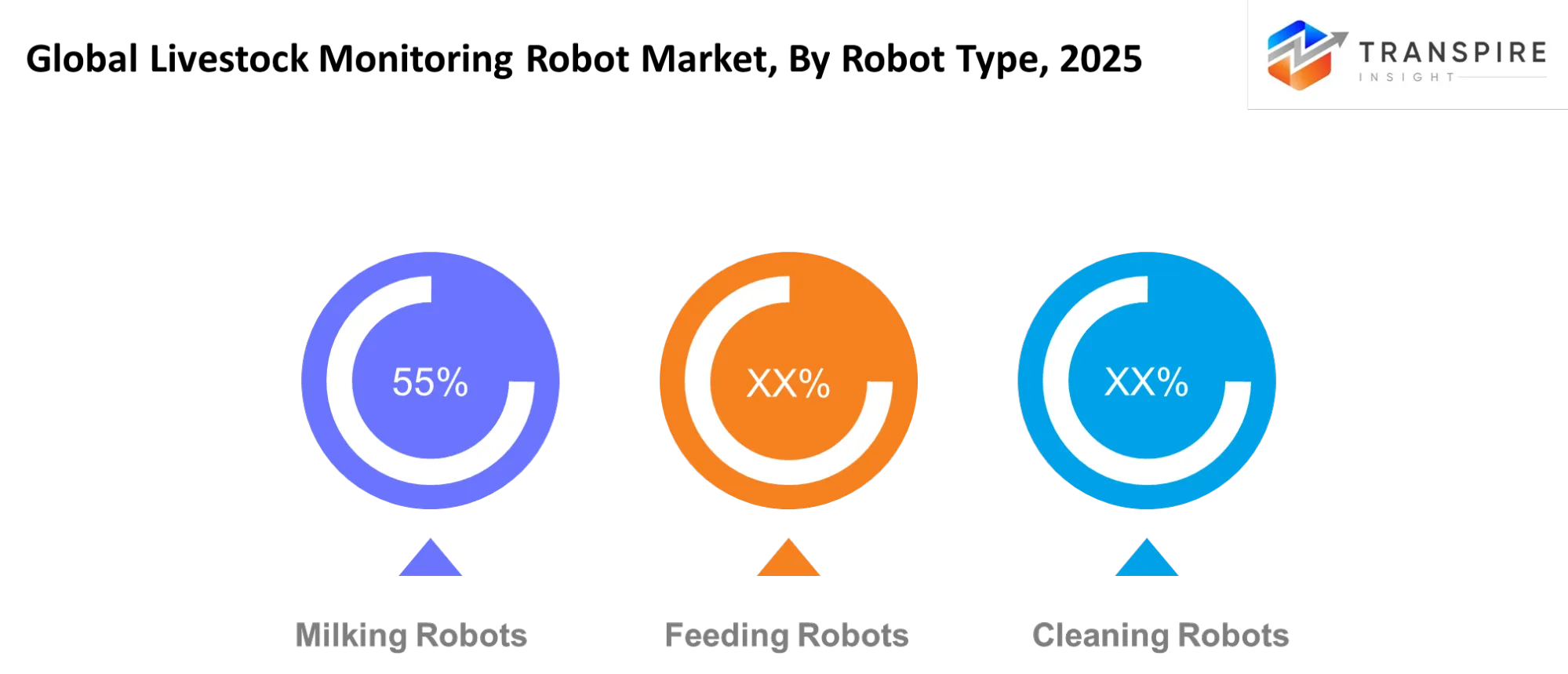
- Milking Robots hold 55% of global robot type revenue in 2025 because dairy cattle require twice-daily milking and the labor cost savings from automation are large enough to justify capital expenditure in markets with tight farm labor supply.
- Feeding Robots are the fastest-growing robot type, projected above 6% CAGR through 2033, as swine and poultry producers adopt precision feeding platforms that reduce feed waste by 8 to 14 percent and improve daily weight gain consistency.
- Dairy Cattle is the dominant livestock type segment at approximately 61% of total market revenue in 2025, reflecting the capital-intensive nature of commercial dairy farming and the productivity payback of milking and health monitoring automation.
- Health Monitoring is the fastest-growing application segment, expanding above 7.5% CAGR through 2033, as sensor technology and machine learning make real-time individual animal health scoring practical at commercial farm scale for the first time.
- DeLaval Holding AB and Lely International N.V. together account for approximately 35% of global milking robot revenue, competing primarily on service network coverage and proprietary farm management software platforms that create high switching costs for installed farms.
- Allflex Livestock Intelligence (Merck) and Zoetis Inc. are extending their animal health monitoring footprints into the robotics market, leveraging existing veterinary relationships and large installed bases of sensor tags to distribute monitoring robot products through trusted channels.
- Afimilk Ltd. and SCR Dairy Inc. compete on sensor-to-software integration depth, building platforms that aggregate milking data, reproductive status, health indicators, and feeding records into a single analytics layer that farm managers use for breeding and culling decisions.
What are the Key Drivers, Restraints, and Opportunities in the Global Livestock Monitoring Robot Market?
Farm labor shortages are the clearest and longest-running drivers. Commercial dairy, poultry, and pig operations in Europe and North America work in very tight rural labor markets - hiring highly skilled animal handlers becomes increasingly difficult and expensive all the time. A robotic milking system takes care of the most labor-intensive daily task on a dairy farm - all without the scheduling, training, and personnel turnover costs that human labor demands. Farm consolidation amplifies this effect much more: as individual operations grow to manage 500, 1,000, or 2,000 animals, the labor math really gets better since capital costs per head decrease while per-head labor costs in a traditional system remain exactly the same. Every percentage point increase in average farm size in a developed dairy market really opens up the potential market even further for robotic systems.
Capital costs remain the biggest hurdle for smaller and mid-sized producers - they make up most of the farms by number in almost every market. A single automated milking unit from DeLaval or Lely will cost you around USD 150,000 to USD 250,000 installed - and a dairy farm would need one unit per 50 to 70 cows. For a 100-cow operation, that would be a USD 300,000 to USD 500,000 investment - before you even add in any additional monitoring hardware or software subscription costs. Higher interest rates in 2022 and 2023 really stretched out payback periods and caused some buying decisions to slow down, especially in North America where variable-rate farm loans are very common. Vendors have responded with leasing and subscription-based financing models, but take-up among sub-200-cow operations still remains relatively limited - except in heavily subsidized European markets.
The clearest underpenetrated opportunity is really the poultry and swine sectors - where robotic monitoring adoption is behind dairy by 10 to 15 years. A chicken coop managing 50,000 birds could not possibly monitor individual bird health like a 200-cow dairy can - but it can deploy aerial drone monitoring systems, computer vision cameras for dead bird detection, and automated feeding systems with consumption tracking. These technologies are commercially available already, but adoption rates in poultry and swine remain below 5% of commercial operations all over the world. As sensor prices fall and vendors develop sector-specific software platforms, the productivity case for automation in these sectors will hit the same turning point that dairy crossed in Europe back in the early 2010s.
What Has the Impact of Artificial Intelligence Been on the Global Livestock Monitoring Robot Market?
The AI really makes its mark in this market by transforming sensor data into decisions farmers wouldn't have caught otherwise. A DeLaval or Lely milking robot gathers dozens of readings per cow per visit: milk quantity, conductivity, fat and protein percentages, flow rate, and teat condition. In the past, farm software presented this information in tables. Today, machine learning models running on cloud platforms analyze these data streams to create individual animal health scores, identify cows that may develop mastitis 24 to 48 hours before they show clinical signs, and suggest culling choices based on an animal's lifetime productivity path. The end result is a tangible decrease in subclinical mastitis rates - something that costs a dairy operation USD 200 to USD 400 per affected cow every year in lost production and treatment costs.
Reproductive efficiency is the second area where AI shows tangible farm-level benefits. Monitoring systems from Afimilk and SCR use accelerometer and activity sensor data to detect estrus events with greater accuracy and even sooner than a person could ever see. Farms that catch estrus reliably achieve conception rates 8 to 15 points higher than farms relying entirely on visual observation. At USD 300 to USD 500 per successful conception in a commercial dairy, the economic impact is rather straightforward to calculate. The companies that cracked this application first built lasting relationships with their customers because farmers who see better reproduction results don't easily switch platforms.
The challenge is that AI value is only available to farms with reliable data infrastructure, and most farms worldwide don't have it. Unpredictable internet connectivity in rural areas, old barn electrical systems that interfere with sensor signals, and the cost of integrating veterinary data all hinder how much of the AI layer farms can really utilize. The gap between what the technology can demonstrate in a controlled setup and what it really delivers on a working farm in rural Bavaria or Ontario is real, and vendors that acknowledge this gap honestly tend to hold onto their customers better than those that oversell.
Key Market Trends
- Europe holds approximately 42% of global market revenue in 2025, with voluntary milking system (VMS) penetration in the Netherlands, Sweden, and Denmark already exceeding 35% of commercial dairy operations and continuing to rise.
- Asia-Pacific grows above 7% annually through 2033, with China's dairy consolidation program targeting large-scale farms of 1,000 cows or more that are economically suited to full robotic milking system deployment.
- Milking Robots hold 55% of robot type revenue in 2025 and maintain their dominant share through the forecast period as voluntary milking system technology matures and becomes the default specification for new dairy barn construction in core markets.
- Feeding Robots are projected to grow above 6% CAGR through 2033, driven by precision feeding platforms that reduce feed waste by 8 to 14 percent and allow farm operators to adjust ration composition in real time based on individual animal production data.
- Dairy Cattle dominates the livestock type segment at 61% of revenue in 2025, but poultry and swine are growing faster as computer vision mortality detection and automated ventilation control systems gain traction in large commercial operations.
- Health Monitoring grows above 7.5% CAGR through 2033, the fastest-growing application segment, as sensor tag costs fall below USD 20 per animal and machine learning health scoring becomes a standard feature in farm management software subscriptions.
- DeLaval and Lely each launched fifth-generation milking robot platforms in 2024, adding on-board computer vision for teat condition scoring and real-time API connections to third-party herd management software, raising the baseline capability expectation in the market.
- Subscription-based financing for robotic milking systems gained share in 2023 and 2024, with DeLaval's 'Pay Per Use' program and Lely's subscription model allowing smaller operations to access automation without large upfront capital commitments.
- Pellon Group and Fancom are expanding their automated barn management systems in poultry markets across Southeast Asia, where large-scale integrators are standardizing on automated feeding, climate control, and mortality monitoring in new-build broiler houses.
- Zoetis Inc. and Allflex Livestock Intelligence are integrating real-time health monitoring data from sensor networks with veterinary prescription management platforms, building toward a connected animal health ecosystem where robot-collected data directly informs treatment decisions.
Global Livestock Monitoring Robot Market Segmentation
By Robot Type
Milking Robots hold 55% of the robot type segment in 2025. The economics are straightforward: twice-daily milking is the single most labor-intensive recurring task on a dairy farm, and a robotic system handles it indefinitely without breaks, scheduling conflicts, or turnover costs. One unit typically serves 50 to 70 cows, and farms that cross the 100-cow threshold generally find the payback period short enough to justify the investment. Through 2033, this segment grows steadily as new dairy barn construction increasingly specifies voluntary milking systems from the outset rather than retrofitting conventional parlors.
Feeding Robots are growing above 6% CAGR and represent the most active area of product development. Precision feeding platforms dispense individual rations calibrated to each animal's production stage, weight, and health status, reducing feed waste while improving daily weight gain consistency. Swine and poultry operations are driving this segment's growth, as these sectors lack the milking automation entry point that brought robotics to dairy but have large labor costs in feeding management that robotic systems can reduce substantially.
Cleaning Robots complete the barn automation picture. Automated scrapers and manure management systems run on continuous or scheduled cycles, keeping barn floors clean without requiring labor allocation to the task. The primary market is dairy, where floor hygiene directly affects hoof health and mastitis incidence. This is the smallest robot type segment in revenue terms but grows steadily as farms that already own milking systems add barn management automation as a natural extension of their existing infrastructure.
To learn more about this report, Download Free Sample Report
By Livestock Type
Dairy cattle represents 61% of the total market revenue in 2025 and really holds sway since commercial dairy farms have got that perfect mix of scale, capital access, and continuous labor needs - all of which make automation investments quite worthwhile. A 500-cow dairy with around-the-clock milking demands is the absolute economic profile for robotic systems - and this profile describes your average commercial operation in the Netherlands, Germany, and Canada. Dairy's dominance in this segment is pretty structural and will persist through 2033, though its share percentage will decline a bit as poultry and swine adoption speeds up more rapidly.
Poultry is the second-biggest livestock type segment - and the one with the largest gap between potential and current adoption. Broiler and layer operations looking after hundreds of thousands of birds per site have very clear economic incentives to automate feeding, mortality detection, ventilation, and egg collection. The real hurdle isn't capital cost relative to scale so much as system design complexity: poultry barn environments are dust-heavy, corrosive, and pretty tough for current robotic hardware generations to operate in reliably. Vendors that manage to solve the durability problem will really find a very large and underpenetrated market.
Swine operations are still quite early in their automation journey. Current robotic applications mostly focus on automated feeding, sorting by weight, and estrus detection using wearable sensor tags. The commercial swine sector's consolidation into very large integrated operations with 10,000 or more sows creates quite favorable economics for capital investment - and several European swine integrators are now running fully automated nursery-to-finishing barn systems as pilots. Wider adoption is expected to build from 2027 to 2030 as these pilot results become documented and shareable.
By Application
Milking management is the biggest application area - closely related to the supremacy of dairy cattle in our livestock breakdown. The application really covers not just the mechanical milking process itself but also the entire data collection layer: yield tracking per quarter, milk quality indicators, teat condition scoring, and automatic separation of off-specification milk. For a commercial dairy farm, this data layer is as valuable as the automation itself - because it reduces veterinary intervention costs and makes our culling and breeding decisions even more precise.
Feeding management is the fastest-growing application area after health monitoring. Farms operating automated total mixed ration (TMR) feeding systems with per-animal intake tracking report feed efficiency improvements of 8 to 14 percent compared to conventional group-feeding operations. This efficiency gain compounds over a full production cycle - making the payback case very clear for large-scale swine and dairy operations. Software integration really matters here: feeding management robots generate the most value when their intake data feeds directly into the same platform handling health and reproductive monitoring.
Health monitoring grows at a rate of above 7. 5% CAGR through 2033 and is the segment most directly influenced by advances in sensor hardware and machine learning. Individual animal health scoring, estrus detection, lameness assessment, and early disease flag systems all fall under this application. The commercial case is very clear: catching a clinical mastitis case one day earlier is worth USD 50 to USD 100 per cow in treatment cost and production loss avoidance. Multiplied across a 500-cow herd with a 25% annual mastitis incidence, the math produces ROI figures that make software subscription costs very easy to justify.
What are the Key Use Cases Driving the Global Livestock Monitoring Robot Market?
The dominant use case is voluntary milking system deployment on commercial dairy farms, where robotic milking replaces conventional two-times-daily parlor milking and lets cows self-select when to be milked. This voluntary milking approach typically increases milking frequency from 2 to 2.5 to 3 times per day per cow, raising milk yield by 5 to 10 percent in the year after installation. The productivity gain, combined with labor cost savings, is what closes the investment case for most buyers. DeLaval, Lely, and GEA Group collectively installed more than 30,000 voluntary milking units globally through the end of 2024, with the installed base continuing to grow as farms aged out of conventional parlor equipment.
Individual animal health monitoring is the use case gaining the most new adopters in markets where robotic milking is already established. Farms that installed milking robots between 2015 and 2020 are now upgrading to add real-time health monitoring through sensor tags, accelerometers, and camera-based lameness scoring systems. The business case is strongest for large operations managing over 200 cows, where subclinical disease events that go undetected for 24 to 48 hours can propagate through a herd before a farmer walking the barn would notice. Allflex and Zoetis are the primary vendors serving this upgrade cycle.
Automated barn environment management is emerging as the third major use case, covering ventilation control, manure management, temperature regulation, and lighting automation in poultry and swine facilities. Large integrated poultry companies in Europe and Southeast Asia are specifying fully automated barn management systems in new-build facilities, where the system controls every variable affecting bird welfare and feed conversion from day-of-chick placement to processing age. Fancom and Pellon Group lead this segment, with systems installed in facilities managing several million birds annually.
Report Overview Table
|
Report Metrics |
Details |
|
Market size value in 2025 |
USD 3.49 Billion |
|
Market size value in 2026 |
USD 3.675 Billion |
|
Revenue forecast in 2033 |
USD 5.21 Billion |
|
Growth rate |
CAGR of 5.11% from 2026 to 2033 |
|
Base year |
2025 |
|
Historical data |
2021 - 2024 |
|
Forecast period |
2026 - 2033 |
|
Report coverage |
Revenue forecast, competitive landscape, growth factors, and trends |
|
Regional scope |
United States; Canada; Mexico; United Kingdom; Germany; France; Netherlands; Denmark; Sweden; Norway; China; Japan; India; Australia; South Korea; Brazil; Argentina; South Africa; Saudi Arabia; United Arab Emirates |
|
Key companies profiled |
DeLaval Holding AB, Lely International N.V., GEA Group AG, BouMatic LLC, Fullwood Packo Ltd., Afimilk Ltd., Hokofarm Group B.V., DairyMaster Ltd., Waikato Milking Systems NZ Ltd., SCR Dairy Inc., Fancom B.V., Trioliet B.V., Pellon Group Oy, Allflex Livestock Intelligence (Merck), Zoetis Inc. |
|
Customization scope |
Free report customization (country, regional & segment scope). Avail customized purchase options to meet your exact research needs. |
|
Report Segmentation |
By Robot Type (Milking Robots, Feeding Robots, Cleaning Robots), By Livestock Type (Dairy Cattle, Poultry, Swine), By Application (Milking Management, Feeding Management, Health Monitoring) |
Which Regions are Driving the Global Livestock Monitoring Robot Market Growth?
Europe holds approximately 42% of global livestock monitoring robot revenue in 2025 and has held the dominant position since voluntary milking systems first reached commercial scale in the early 2000s. The Netherlands, Denmark, Sweden, and Germany have the combination of large-scale commercial dairy operations, strong farm credit access, and tight agricultural labor markets that made robotic milking economically compelling ahead of any other region. Dutch farms average 100 cows per operation and Dutch labor costs are among the highest in European agriculture, which produced an ideal early adopter profile for robotic milking. European Union Common Agricultural Policy subsidies for technology investment further accelerated adoption by reducing effective capital costs for qualifying farms during the 2010s and early 2020s.
North America accounts for roughly 28% of global market revenue in 2025. Canada is the more penetrated market because Canadian supply management dairy policy creates stable milk prices that support capital investment decisions, and Canadian farms average larger herds than US farms. The United States market is fragmented by geography and farm structure: the large concentrated animal feeding operations (CAFOs) in the Midwest and West Coast that represent the volume of US milk production have historically used conventional parlor milking at scale, and converting these operations to individual-animal robotic milking involves significant infrastructure capital. Growth in North America is concentrated in mid-size family operations of 200 to 600 cows in the Northeast and Great Lakes regions where labor constraints are most acute.
Asia-Pacific grows faster than any other region through 2033, above 7% annually. China is the primary driver: the government's dairy industry modernization initiative has consolidated production into large-scale farms of 1,000 or more cows that are the right size for full robotic milking system deployment. New Zealand and Australia have significant commercial dairy industries but face capital cost sensitivity given lower per-kilogram milk prices. India is the longer-range opportunity: the commercial poultry sector is expanding rapidly, large-scale dairy is growing alongside it, and government animal husbandry programs are beginning to reference automation as a farm modernization goal.
To learn more about this report, Download Free Sample Report
Who are the Key Players in the Global Livestock Monitoring Robot Market and How Do They Compete?
The global livestock monitoring robot market is quite highly concentrated at the top of the milking robot segment - with DeLaval Holding AB and Lely International N. V. holding together roughly 35% of global milking robot revenue. Both companies compete through their service network density - a robotic milking system that goes offline during a milking cycle creates immediate problems with animal welfare and production, and farmers buy from vendors whose technicians can arrive at their farm within hours rather than days. DeLaval's service organization covers over 100 countries while Lely operates through dedicated dealer networks in every significant dairy market. This service infrastructure is actually the primary barrier to entry for potential challengers.
GEA Group AG and BouMatic LLC compete as full-system dairy automation suppliers - offering milking, feeding, and barn management hardware within integrated packages that appeal to farm operators wanting to deal with just one vendor and one service contract. GEA's scale in industrial food processing equipment gives it some capital markets and manufacturing cost advantages that pure-play dairy robotics vendors simply can't match. BouMatic focuses on North America - where its dealer network and service coverage are competitive with the European leaders in the regions where North American dairy is concentrated the most.
Afimilk Ltd., SCR Dairy Inc., and Allflex Livestock Intelligence compete on the monitoring and data layer rather than the actual hardware itself. Afimilk's herd management software and SCR's sensor tag systems are installed on farms using many different hardware brands, making them quite effective competitors within the existing installed base rather than just new construction projects. Zoetis's acquisition of Allflex brought in a 40-million-animal sensor installation base into the company's animal health ecosystem - giving it a data distribution channel that no pure robotics vendor can match either. These monitoring-first companies are really building toward a world where the value captured in livestock automation is funneled to whoever owns the data platform, not whoever happens to sell the hardware itself.
Global Livestock Monitoring Robot Market Companies
- DeLaval Holding AB
- Lely International N.V.
- GEA Group AG
- BouMatic LLC
- Fullwood Packo Ltd.
- Afimilk Ltd.
- Hokofarm Group B.V.
- DairyMaster Ltd.
- Waikato Milking Systems NZ Ltd.
- SCR Dairy Inc.
- Fancom B.V.
- Trioliet B.V.
- Pellon Group Oy
- Allflex Livestock Intelligence (Merck)
- Zoetis Inc.
Recent Developments
In June 2025, Halter secured a Series D funding round of approximately US$100 million. The investment supported the expansion of Halter’s solar-powered livestock monitoring and virtual fencing platform, accelerating adoption of AI-enabled cattle management systems across dairy and beef farms.https://en.wikipedia.org
In March 2026, Nuwa Agricultural Technology launched its ‘Cleaning + AI Monitoring’ livestock robot. The AI-powered robotic platform was introduced to automate livestock barn cleaning and animal monitoring, strengthening the use of precision robotics in smart livestock farming operations.https://www.newsfilecorp.com
What Strategic Insights Define the Future of the Global Livestock Monitoring Robot Market?
The most consequential strategic shift of the next five years is the contest between hardware vendors and data platform companies for ownership of the farm management layer. DeLaval and Lely built their competitive positions on hardware quality and service networks. Zoetis built its position on veterinary relationships and a 40-million-animal sensor installed base. As the monitoring layer becomes more valuable than the hardware layer, the companies that own the data platform will capture more of the lifetime revenue from each farm installation. Hardware vendors that fail to develop defensible software positions will see their products commoditized by Asian manufacturers offering equivalent mechanical performance at lower capital cost.
The underappreciated geographic opportunity is Latin America, specifically Brazil and Argentina, which together account for substantial global beef and dairy production but have robotic farming adoption rates well below European levels. Brazilian commercial dairy operations are consolidating into large-scale farms that are increasingly economically suited to robotic milking investment. Labor cost is rising in Brazilian agriculture, farm credit programs are improving, and at least three major European robotic milking vendors are actively building dealer networks in the Brazilian south and southeast. The farm structure is right; the financing and service infrastructure is the constraint.
One thing the 5.11% CAGR does not capture is the volatility risk in this market. Milk prices, feed grain prices, and farm interest rates are all cyclically sensitive, and livestock equipment spending is one of the first categories farmers cut when margins tighten. The 2022 to 2023 interest rate cycle already slowed purchasing decisions in North America. Vendors with subscription and leasing revenue models are structurally better positioned to weather these cycles than those dependent on upfront hardware sales, and the competitive landscape will likely shift toward subscription models through the forecast period regardless of which company initiates the change.
Global Livestock Monitoring Robot Market Report Segmentation
By Robot Type
- Milking Robots
- Feeding Robots
- Cleaning Robots
By Livestock Type
- Dairy Cattle
- Poultry
- Swine
By Application
- Milking Management
- Feeding Management
- Health Monitoring
Frequently Asked Questions
Find quick answers to common questions.
The Global Livestock Monitoring Robot Market size is expected to reach USD 5.21 Billion by 2033.
The key segments are By Robot Type (Milking Robots, Feeding Robots, Cleaning Robots), By Livestock Type (Dairy Cattle, Poultry, Swine), and By Application (Milking Management, Feeding Management, Health Monitoring).
Major players include DeLaval Holding AB, Lely International N.V., GEA Group AG, BouMatic LLC, Fullwood Packo Ltd., Afimilk Ltd., Hokofarm Group B.V., DairyMaster Ltd., Waikato Milking Systems NZ Ltd., SCR Dairy Inc., Fancom B.V., Trioliet B.V., Pellon Group Oy, Allflex Livestock Intelligence (Merck), and Zoetis Inc.
The Global Livestock Monitoring Robot Market size is USD 3.49 Billion in 2025.
The Global Livestock Monitoring Robot Market CAGR is 5.11% from 2026 to 2033.
- DeLaval Holding AB
- Lely International N.V.
- GEA Group AG
- BouMatic LLC
- Fullwood Packo Ltd.
- Afimilk Ltd.
- Hokofarm Group B.V.
- DairyMaster Ltd.
- Waikato Milking Systems NZ Ltd.
- SCR Dairy Inc.
- Fancom B.V.
- Trioliet B.V.
- Pellon Group Oy
- Allflex Livestock Intelligence (Merck)
- Zoetis Inc.
Recently Published Reports
-
Apr 2026
Fiber Optic Faceplates Market
Fiber Optic Faceplates Market Size, Share & Analysis Report By Type (< 300 mm2, 300-350 mm2, and > 350 mm2, By Application (Night Vision, Holographic Imaging, Medical, and Others), and Geography (North America, Europe, Asia-Pacific, Middle East and Africa, South and Central America), 2021 - 2031
-
Apr 2026
High Temperature Superconductors Market
High Temperature Superconductors Market Size, Share & Analysis Report By Type (1G HTS, and 2G HTS), By Application (Power Cable, Fault Current Limiter, and Transformer), and Geography (North America, Europe, Asia-Pacific, Middle East and Africa, South and Central America), 2021 - 2031
-
Apr 2026
Industrial Plugs and Socket Market
Industrial Plugs and Socket Market Size, Share & Analysis Report By Type (Industrial Plugs, Industrial Sockets), By Current (Up to 32 A, 32 to 125 A, Above 125 A), By Protection (Dustproof and Splash Proof, Waterproof, Explosion Proof), By End User (Heavy Industries, Oil and Gas, Chemicals and Pharmaceuticals, Power Generation, Others), and Geography (North America, Europe, Asia-Pacific, Middle East and Africa, South and Central America), 2021 - 2031
-
Apr 2026
InGaAs Avalanche Photodiodes Market
InGaAs Avalanche Photodiodes Market Size, Share & Analysis Report By Type (1100 - 1700 nm, and 1000 - 1600 nm), By Application (Missile Warning System, Muzzle Flash Detection, Wafer Defect Inspection, Laser Rangefinders, and Others), and Geography (North America, Europe, Asia-Pacific, Middle East and Africa, South and Central America), 2021 - 2031