

Europe Collaborative Robots Market Size & Forecast:
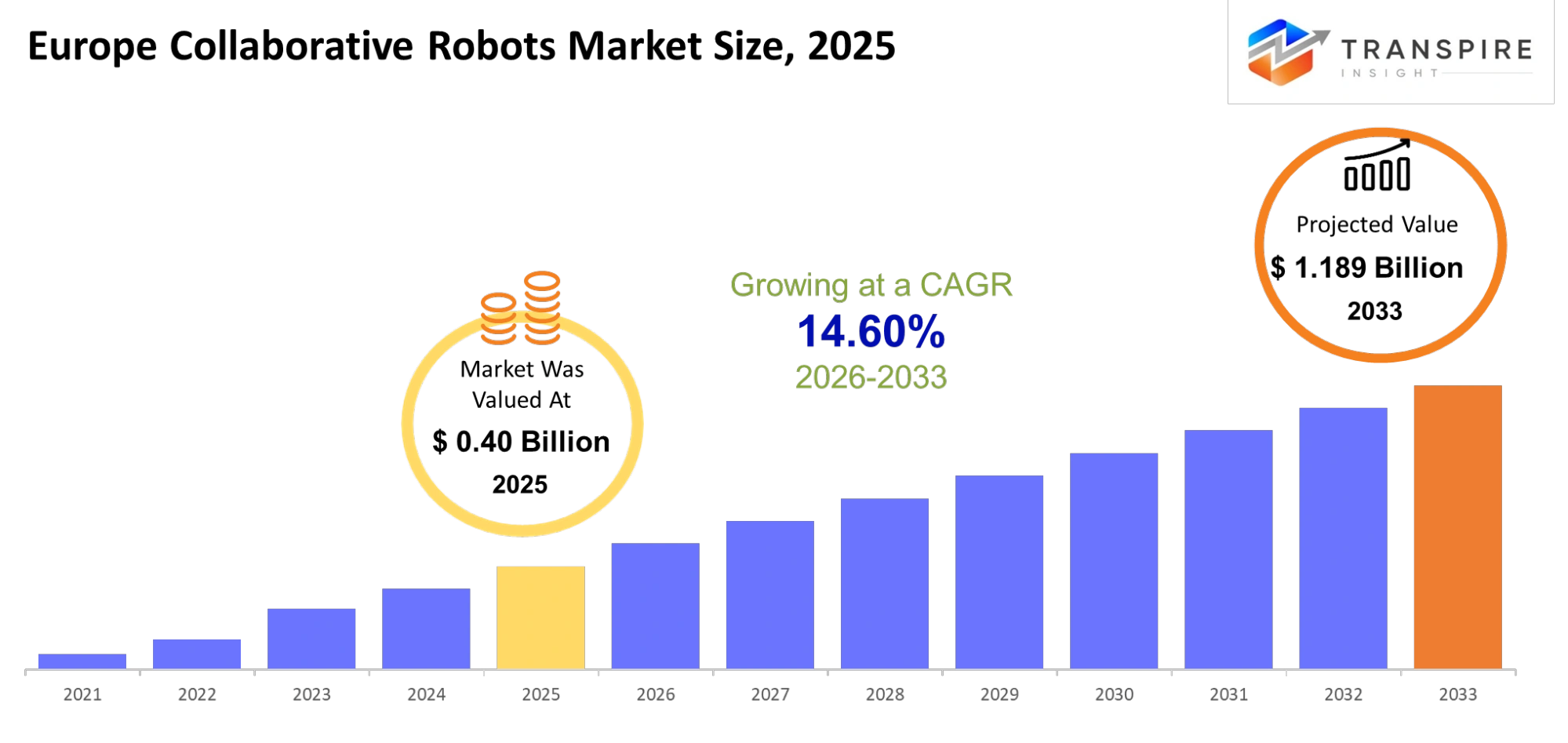
- Europe Collaborative Robots Market Size 2025: USD 0.40 Billion
- Europe Collaborative Robots Market Size 2033: USD 1.189 Billion
- Europe Collaborative Robots Market CAGR: 14.60%
- Europe Collaborative Robots Market Segments: By Type (Articulated Robots, SCARA Robots, Cartesian Robots, Dual-arm Robots, Mobile Robots, Others); By Application (Assembly, Packaging, Material Handling, Welding, Inspection, Others); By End-User (Automotive, Electronics, Healthcare, Food & Beverage, Manufacturing, Others); By Payload (Up to 5kg, 5–10kg, 10–20kg, 20–50kg, Above 50kg, Others)
To learn more about this report,  Download Free Sample Report
Europe Collaborative Robots Market Summary:
The Europe Collaborative Robots Market size is estimated at USD 0.40 Billion in 2025 and is anticipated to reach USD 1.189 Billion by 2033, growing at a CAGR of 14.60% from 2026 to 2033. The Market of Collaborative Robots in Europe within the industrial automation sector will continue to develop in such a way that manufacturers from Germany, Italy, and France would give preference to flexibility in manufacturing processes rather than inflexible assembly lines. The development of this market will be measured not by the scale of the market itself but rather how safe it is for humans to work together with machines in factories. The buyers of Europe will require the user interface to be more understandable, the implementation process to be quicker, as well as robots that would fit short manufacturing cycles due to custom orders.
What Has the Impact of Artificial Intelligence Been on the Europe Collaborative Robots Market?
The European collaborative robots market currently experiences its most significant transformation because artificial intelligence establishes new ways for machines to interact with human workers and industrial operations. The European collaborative robots market uses artificial intelligence to improve market research and data analysis capabilities by analyzing extensive data sets which include manufacturing line data and user feedback and operational system data. Companies can use this information to better track market developments which they want to use for their product development process. The European collaborative robots market uses artificial intelligence technology to enhance demand prediction capacity through predictive analytics which enables manufacturers to know when their production requirements will change so they can modify their production capabilities without waiting.
AI technology provides more than analysis functions because it boosts European collaborative robots market production efficiency through intelligent automation capabilities. Collaborative robots use machine learning algorithms to acquire knowledge from their ongoing tasks, which enables them to achieve better operational accuracy through optimized movement and decreased operational downtime. The AI-driven supply chain optimization system reduces expenses through better resource allocation and inventory management and logistics planning. The new advancements enable organizations to use greater efficiency while providing better customization capabilities which allow robots to perform different tasks according to their specific industry needs. The European collaborative robots market will achieve its competitive advantage through innovative solutions which provide scalable operations and enable organizations to make decisions based on data analysis.
Key Market Trends & Insights:
- The Germany region is a leader in the europe collaborative robots market, holding more than 30% market share in 2025, thanks to the country’s extensive industrial automation infrastructure and automobile industry.
- The Eastern Europe region is likely to witness the highest growth rate between 2026 and 2030, owing to the cost-effective expansion of manufacturing facilities and the increased use of robotics.
- Articulated collaborative robots have more than 40% market share because of their flexibility and extensive industrial uses.
- SCARA collaborative robots account for the second-largest market share, seeing a surge in use in the electronics industry and precise assembly operations.
- Dual-arm collaborative robots will see the highest growth rate up to 2030 because of their complex human-like movements.
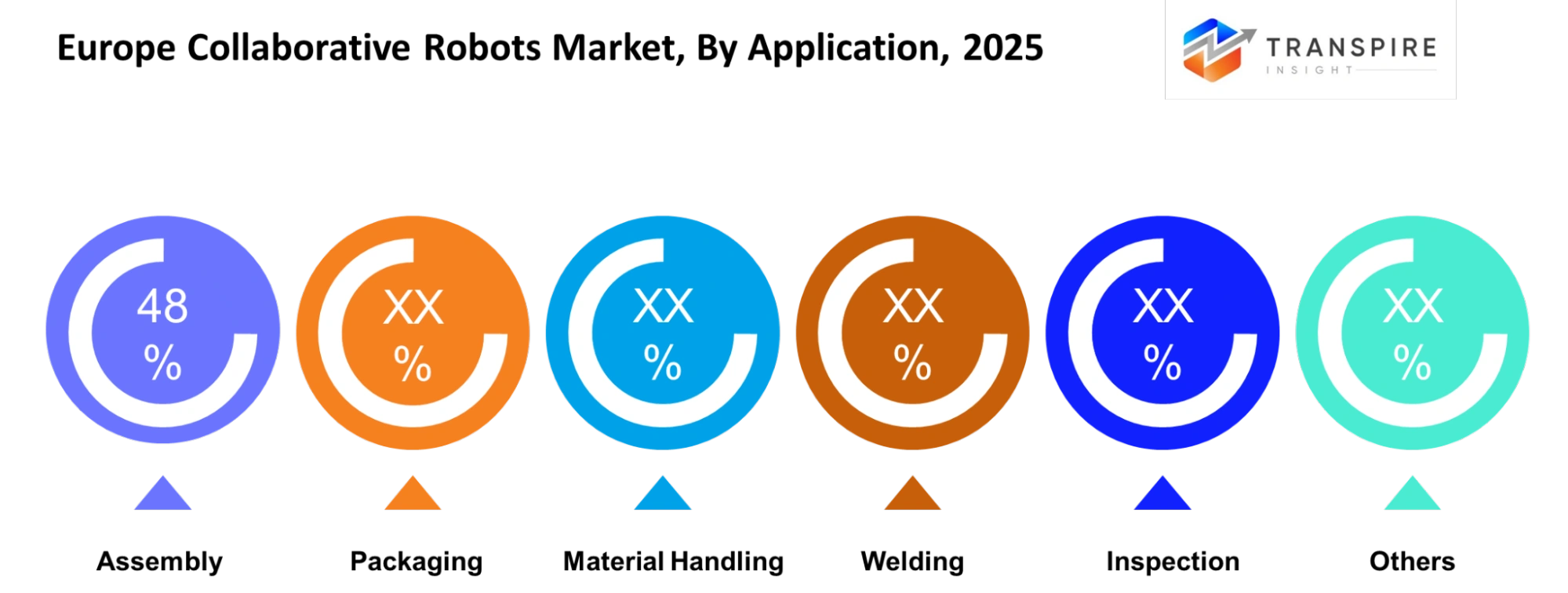
- Material handling is the leading application area, accounting for nearly 35% market share, thanks to automation in logistics and warehouses.
- Assembly is a potential end-use application, and its demand is set to rise significantly in the future because of customizations in production cycles.
- Automotive is the leading end-user industry, contributing over 25% market share to the market.
- Electronics is the fastest-growing end-user industry, owing to miniaturization and faster production speeds.
Europe Collaborative Robots Market Segmentation
By Type
Articulated robots will continue being favored owing to their adaptability and multi-axis motion ability for precise operation. SCARA robots will become popular in electronics and assembly industries owing to their fast and repetitive nature in operations. Cartesian robots will be used in environments that require linear motion capabilities, especially in packaging and material handling duties. The dual arm robots will improve operations requiring coordination like that of humans.
Mobile robots will increase in use in environments where station shifting will decrease manual labor and increase productivity. Robots other than the above will also have uses depending on the customization required in each industry. There will be an increased demand for these different robot types in line with modularization for easy deployment and programming.
By Application
The articulated robot is expected to be prevalent as a result of its flexibility and multi-axis motion. It will be used in manufacturing processes requiring agility and flexibility. The SCARA robot is also expected to get increased attention in the electronic and light assembly industries because of its suitability for fast and repetitive manufacturing processes. Cartesian robots will be employed in highly organized and linear environments, especially in packaging and transportation activities.
Robots for mobile application will have increased use in cases where there is the need for robots to move from one location to another. Other types of robots will have increased demand as a result of the growing need for customized applications. Demand will depend on the growing trend of having modular systems that can be easily programmed.
To learn more about this report, Download Free Sample Report
By End-User
Automotive industry will continue leading in terms of adoption because of the large volume of production along with the need for accuracy in the assembly process. Electronics will see rapid expansion due to small size of products along with the need for careful handling of these products while assembling them. The healthcare industry will utilize robotics in order to achieve precision in lab work along with production of medical devices.
General manufacturing industries will continue implementing robots as a way of reducing delays in the various stages of production process. Other end users will implement the use of robots depending on their needs along with the cost implication of doing so.
By Payload
Robot systems with maximum load capacities of 5kg will lead the pack in light-duty robot applications. The 5-10 kg and 10-20kg weight categories will be ideal for moderate duties. This will help in ensuring a combination of power and precision. Development in these weight classes will be driven by need for compact automation systems.
The 20-50kg weight class and the 50kg weight class will deliver services for heavy-duty robot operations which include automotive production and extensive manufacturing activities. In addition, these systems will deal with heavier payloads while still ensuring safety within the shared working environment. Other weight categories will cater for special purposes that will fall outside normal load requirements.
What are the Main Challenges for the Europe Collaborative Robots Market Growth?
Technical and operational issues are among the factors expected to pose hurdles in the europe collaborative robots market owing to system stability, accuracy amid changing workloads, and their integration with existing equipment. Most manufacturing plants will have to deal with obsolete technologies in the process of implementation of collaborative robot projects, thus taking more time. Technical restrictions on the handling of sophisticated operations and high speeds may become another limitation as well. Finally, supply chain interruptions involving sensors, semiconductors, and other critical materials will affect the scalability of the europe collaborative robots market.
Issues in production and manufacturing will also hinder the growth of the europe collaborative robots market. The production process is expected to be rather costly, as it will require the observance of the required European standards. As a result, companies will take longer to launch new products. Competitive pricing policies aimed at keeping prices affordable will become challenging for some businesses in the europe collaborative robots market.
These factors will limit the growth of the market, especially due to the shortage of skilled labor and the deficiency of technical knowledge necessary for managing and maintaining sophisticated robotics. Funding issues are common among small and medium-scale companies, thereby slowing down the adoption process, even though there are evident advantages related to increased productivity. There are also deficiencies related to infrastructure in some areas, which makes adoption difficult because organizations do not have the preparedness for smart automation.
Regional Insights
The market structure in Germany France and Italy will continue to develop because of industrial automation demand which exists due to their strong manufacturing base and their need for adaptable production systems. The development process will be shaped by safety regulations and human-machine interaction regulations which determine how systems should be designed and implemented. The need for accurate and efficient processes will determine which technologies different industries will choose to implement.
Ongoing labor market changes together with businesses need to maintain budget efficiency will result in permanent technology adoption among small and mid-sized businesses. Businesses will achieve better user experience and operational efficiency through their systems which use artificial intelligence together with advanced automation technologies. The industrial market will depend on three main factors which include technological advancements and tailored solutions and system dependability.
Western Europe maintains its leading position because of its developed infrastructure and strong industrial base and its early implementation of automated systems. The automotive and electronics sectors will drive Germany and France to become the leading countries in the market. Research and development investments will enhance the region's capacity to maintain its leadership status.
Eastern Europe will become a rapidly developing market because it offers businesses lower operating expenses while manufacturing capacity gets better. The growing foreign investment together with industrial growth will create a higher demand for robots that work in partnership with human operators. The regional development process will take place through a slow transition which helps emerging markets achieve better production capabilities and modernized systems.
Recent Development News
In April 2026, KUKA AG launched new robotic systems including KR CYBERTECH and KR AGILUS ultra at Interpack 2026, expanding its automation portfolio with AI-compatible operating systems and advanced packaging solutions.https://www.kuka.com
In April 2026, KUKA AG shifted strategic focus toward Asia and the United States due to slower AI adoption in Europe, signaling a regional investment realignment in robotics and automation markets.https://timesofindia.indiatimes.com
|
Report Metrics |
Details |
|
Market size value in 2025 |
USD 0.40 Billion |
|
Market size value in 2026 |
USD 0.458 Billion |
|
Revenue forecast in 2033 |
USD 1.189 Billion |
|
Growth rate |
CAGR of 14.60% from 2026 to 2033 |
|
Base year |
2025 |
|
Historical data |
2021 - 2024 |
|
Forecast period |
2026 - 2033 |
|
Report coverage |
Revenue forecast, competitive landscape, growth factors, and trends |
|
Regional scope |
Europe (Germany, United Kingdom, France, Italy, Spain, Rest of Europe) |
|
Key company profiled |
Universal Robots, ABB, FANUC, KUKA, Yaskawa, Omron, Bosch Rexroth, Techman Robot, Doosan Robotics, Rethink Robotics, Kawasaki Robotics, Epson Robots, Stäubli, Comau, Mitsubishi Electric |
|
Customization scope |
Free report customization (country, regional & segment scope). Avail customized purchase options to meet your exact research needs. |
|
Report Segmentation |
By Type (Articulated Robots, SCARA Robots, Cartesian Robots, Dual-arm Robots, Mobile Robots, Others); By Application (Assembly, Packaging, Material Handling, Welding, Inspection, Others); By End-User (Automotive, Electronics, Healthcare, Food & Beverage, Manufacturing, Others); By Payload (Up to 5kg, 5–10kg, 10–20kg, 20–50kg, Above 50kg, Others) |
How Can New Companies Establish a Strong Foothold in the Europe Collaborative Robots Market?
New entrants can build a strong position in the europe collaborative robots market by focusing on niche use cases where unmet demand still exists. Companies will not compete directly with established automation leaders but will focus on healthcare robotics and small-scale manufacturing and smart warehousing. The european market for collaborative robots will enable businesses to enter through specialized development of precision surgical robots and compact robotic systems designed for small and medium enterprises. The current industry trend shows buyers choosing customized solutions instead of standard systems.
The success of innovation strategies depends on their ability to implement artificial intelligence and machine learning and develop user-friendly human-machine interfaces. The development of lightweight robots, which new companies will create for the europe collaborative robots market, will enable users to set up robots easily, thus decreasing their operational difficulties. Local distributors and system integrators and research institutions provide essential partnerships for businesses, which will enable them to enter markets faster while building their reputation. The collaborations will assist with both product development and the process of meeting local regulatory requirements.
Wandelbots and other emerging companies are showing how software-based robotics systems make programming easier while they extend the technology's potential applications. Agile Robots develops automated systems that use advanced artificial intelligence to make intelligent machines. European collaborative robot market success will depend on technology differentiation and problem-solving capabilities while new companies will achieve success through their ability to innovate and create specific value.
Key Europe Collaborative Robots Market Company Insights
The demand from the industries of cars, electronics, and manufacturing will play a decisive role in influencing the adoption rates for this product category, based on the need to have efficient production systems. Safety standards and human-robot interaction will be among the key considerations for designing the product. Precision and minimal down times will be part of the criteria that will affect buying decisions in various industries.
Compatibility and performance improvement through AI and automation technology incorporation will be part of the improvements of the product. Ease of use and cost effectiveness will play a crucial role in determining the adoption rate of the products in the market.
The competition is going to continue being tough as the existing firms will concentrate on innovation, new products, and expansion of markets. Firms like ABB, KUKA, and Universal Robots will increase their market share through innovations and better logistics. Innovations and research and development will be very critical.
Organizations entering the industry for the first time will have niche products designed for specific industries and will offer value for money products. Strategic alliances will be crucial in allowing smaller organizations to enter new markets and compete effectively.
Company List
- Universal Robots
- ABB
- FANUC
- KUKA
- Yaskawa
- Omron
- Bosch Rexroth
- Techman Robot
- Doosan Robotics
- Rethink Robotics
- Kawasaki Robotics
- Epson Robots
- Stäubli
- Comau
- Mitsubishi Electric
What are the Key Use-Cases Driving the Growth of the Europe Collaborative Robots Market?
The Europe collaborative robots market is witnessing tremendous growth, considering their applications in different industries for precise processes that require flexibility. For instance, collaborative robots have been used in automotive manufacturing for assembly, support during welding operations, and product inspection, since consistency will minimize mistakes and increase efficiency. The Europe collaborative robots market is also seeing significant growth in the electronics industry, given that electronic devices need to be handled delicately.
Material handling and packaging will continue to be key application areas in the Europe collaborative robots market, since robots can be applied to pick, sort, and package products. This will help companies cope with increasing sales and minimize costs associated with employing more people. In the field of manufacturing, robots are also becoming increasingly common in machine tending and inspections due to consistent results.
The health care sector and food processing have recently become very significant areas for the europe collaborative robots market owing to the need for high levels of hygiene and precision. These robots help in the manipulation of laboratory processes, assembly of medical devices, as well as in food packaging operations. The varied uses of these robots clearly show that the europe collaborative robots market is set to expand with its specialized applications.
Europe Collaborative Robots Market Report Segmentation
By Type
- Articulated Robots
- SCARA Robots
- Cartesian Robots
- Dual-arm Robots
- Mobile Robots
- Others
By Application
- Assembly
- Packaging
- Material Handling
- Welding
- Inspection
- Others
By End-User
- Automotive
- Electronics
- Healthcare
- Food & Beverage
- Manufacturing
- Others
By Payload
- Up to 5kg
- 5–10kg
- 10–20kg
- 20–50kg
- Above 50kg
- Others
Frequently Asked Questions
Find quick answers to common questions.
The approximate Europe Collaborative Robots Market size for the market will be USD 1.189 Billion in 2033.
Key segments for the Europe Collaborative Robots Market are By Type (Articulated Robots, SCARA Robots, Cartesian Robots, Dual-arm Robots, Mobile Robots, Others); By Application (Assembly, Packaging, Material Handling, Welding, Inspection, Others); By End-User (Automotive, Electronics, Healthcare, Food & Beverage, Manufacturing, Others); By Payload (Up to 5kg, 5–10kg, 10–20kg, 20–50kg, Above 50kg, Others).
Major Europe Collaborative Robots Market players are Universal Robots, ABB, FANUC, KUKA, Yaskawa, Omron, Bosch Rexroth, Techman Robot, Doosan Robotics, Rethink Robotics, Kawasaki Robotics, Epson Robots, Stäubli, Comau, Mitsubishi Electric.
The Europe Collaborative Robots Market size is USD 0.40 Billion in 2025.
The Europe Collaborative Robots Market CAGR is 14.60%
- Universal Robots
- ABB
- FANUC
- KUKA
- Yaskawa
- Omron
- Bosch Rexroth
- Techman Robot
- Doosan Robotics
- Rethink Robotics
- Kawasaki Robotics
- Epson Robots
- Stäubli
- Comau
- Mitsubishi Electric
Recently Published Reports
-
Apr 2026
Fiber Optic Faceplates Market
Fiber Optic Faceplates Market Size, Share & Analysis Report By Type (< 300 mm2, 300-350 mm2, and > 350 mm2, By Application (Night Vision, Holographic Imaging, Medical, and Others), and Geography (North America, Europe, Asia-Pacific, Middle East and Africa, South and Central America), 2021 - 2031
-
Apr 2026
High Temperature Superconductors Market
High Temperature Superconductors Market Size, Share & Analysis Report By Type (1G HTS, and 2G HTS), By Application (Power Cable, Fault Current Limiter, and Transformer), and Geography (North America, Europe, Asia-Pacific, Middle East and Africa, South and Central America), 2021 - 2031
-
Apr 2026
Industrial Plugs and Socket Market
Industrial Plugs and Socket Market Size, Share & Analysis Report By Type (Industrial Plugs, Industrial Sockets), By Current (Up to 32 A, 32 to 125 A, Above 125 A), By Protection (Dustproof and Splash Proof, Waterproof, Explosion Proof), By End User (Heavy Industries, Oil and Gas, Chemicals and Pharmaceuticals, Power Generation, Others), and Geography (North America, Europe, Asia-Pacific, Middle East and Africa, South and Central America), 2021 - 2031
-
Apr 2026
InGaAs Avalanche Photodiodes Market
InGaAs Avalanche Photodiodes Market Size, Share & Analysis Report By Type (1100 - 1700 nm, and 1000 - 1600 nm), By Application (Missile Warning System, Muzzle Flash Detection, Wafer Defect Inspection, Laser Rangefinders, and Others), and Geography (North America, Europe, Asia-Pacific, Middle East and Africa, South and Central America), 2021 - 2031