

South Korea Delta Robot Market Size & Forecast:
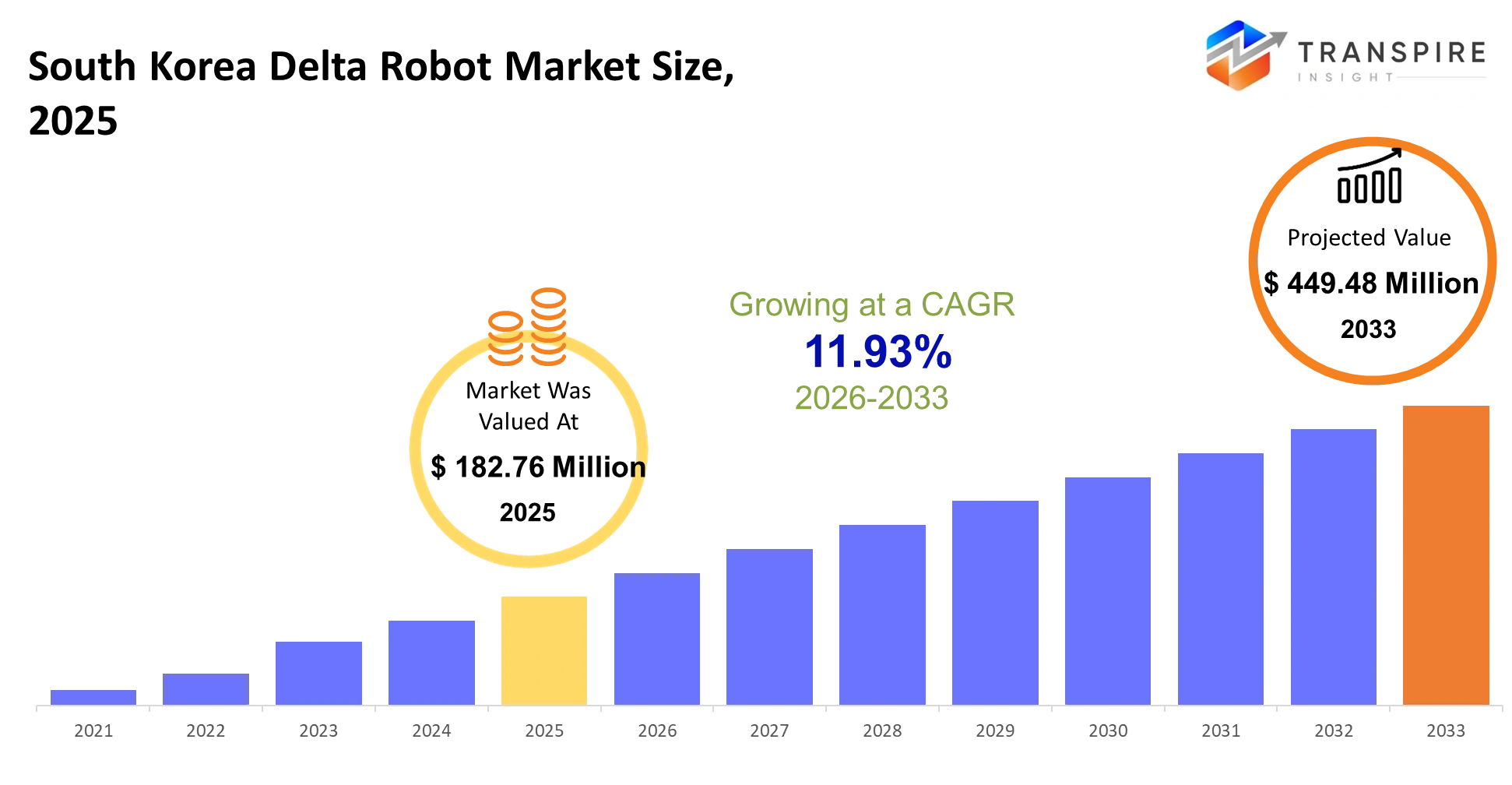
- South Korea Delta Robot Market Size 2025: USD 182.76 Million
- South Korea Delta Robot Market Size 2033: USD 449.48 Million
- South Korea Delta Robot Market CAGR: 11.93%
- South Korea Delta Robot Market Segments: By Type (3-axis, 4-axis, 6-axis, Custom Robots), By Application (Packaging, Pick & Place, Assembly, Food Processing), By End-User (Manufacturers, Food Industry, Electronics Companies, Logistics Firms)
To learn more about this report,  Download Free Sample Report
South Korea Delta Robot Market Summary:
The South Korea Delta Robot Market size is estimated at USD 182.76 Million in 2025 and is anticipated to reach USD 449.48 Million by 2033, growing at a CAGR of 11.93% from 2026 to 2033. The delta robot market in South Korea develops precision assembly systems and fast production lines for high speed manufacturing operations because of new consumer requirements and improvements in robotic technology. System design undergoes changes because safety compliance regulations and factory automation standards have been updated while technological progress enables more efficient operations and shifting consumer needs direct future system implementation.
The upcoming systems will utilize advanced vision-based robotics and flexible adaptive control systems to enhance production efficiency in electronics and semiconductor manufacturing facilities. Consumer preferences will increasingly shift toward personalized solutions that deliver rapid production results. The manufacturing process will undergo major changes because of the AI-powered robotics demand which will create new operational methods.
What Has the Impact of Artificial Intelligence Been on the South Korea Delta Robot Market?
The South Korea delta robot market experiences rapid changes because artificial intelligence technology establishes a new period of industrial automation which enhances accuracy and operational speed and enables organizations to make choices based on data. The South Korea delta robot market operations benefit from AI integration which helps companies conduct market research and data analysis by processing extensive data sets in real time.
Artificial intelligence adoption in South Korea delta robot market applications has enhanced both demand forecasting and trend prediction capabilities. AI-powered systems analyze historical data, seasonal fluctuations, and industry signals to deliver accurate forecasts, allowing companies to align production with market needs. This advanced smart automation system decreases equipment downtime while it increases production efficiency and guarantees that delta robots operate at their best across electronics, food processing, and pharmaceutical industries.
AI in south korea delta robot market ecosystems changes supply chain operations because it changes cost structures. The intelligent systems track inventory in real time and optimize inventory levels while they perform maintenance tasks to minimize operational expenses and risks. The artificial intelligence system in south korea delta robot market enables businesses to develop new products, create customized solutions and respond to customer needs more quickly which enables their business growth and operational efficiency and market supremacy.
Key Market Trends & Insights:
- The South Korean delta robot industry experiences major expansion because factories need accurate automation systems which operate at high-speed for material handling tasks.
- The South Korean delta robot market uses artificial intelligence to improve predictive analytics which helps factories make immediate decisions and boost their production efficiency.
- The Seoul metropolitan area controls the South Korean delta robot market because it will hold almost 45% of the market share in 2024 through its industrial development.
- Gyeonggi Province is the fastest-growing region which will experience more than 10% annual growth between now and 2030 because of its manufacturing clusters.
- 3-axis delta robots control more than 50% of market share in 2024 because they serve essential functions for packaging and assembly production lines.
- 4-axis delta robots serve as the second-largest market share holder because they provide better operational flexibility and precise control for executing complex operations.
- The segment of vision-guided delta robots shows the highest growth rate which will continue to expand until 2030 through the implementation of artificial intelligence.
- The electronics assembly sector maintains its leading position in the market with a 40 percent share because of strong demand from semiconductor and consumer electronics production.
- Food and beverage packaging stands as the fastest-growing application which shows 9 to 11 percent compound annual growth rate because of its hygiene and efficiency needs.
- The manufacturing sector leads with over 55% share, supported by automation adoption and labor cost optimization strategies.
- The main companies that operate in the South Korean delta robot market include ABB Ltd., FANUC Corporation, Yaskawa Electric Corporation, KUKA AG, and Mitsubishi Electric Corporation.
- The companies develop new products by combining artificial intelligence with vision systems to achieve better accuracy and operational efficiency.
South Korea Delta Robot Market Segmentation
By Type :
3-axis delta robots are used to perform basic pick-and-place functions which require high-speed operation through two-dimensional movement. The systems deliver affordable operations which maintain dependable performance for their use in repetitive testing tasks that require basic movement operations in secure testing areas.
4-axis delta robots enable operators to perform sorting and packaging tasks because the robots allow for multiple ways to move their arms. 6-axis robots enable complete motion freedom which allows operators to perform complex handling and assembly work. Custom robots are designed to meet specific industrial requirements, which require custom solutions to handle special production processes.
By Application :
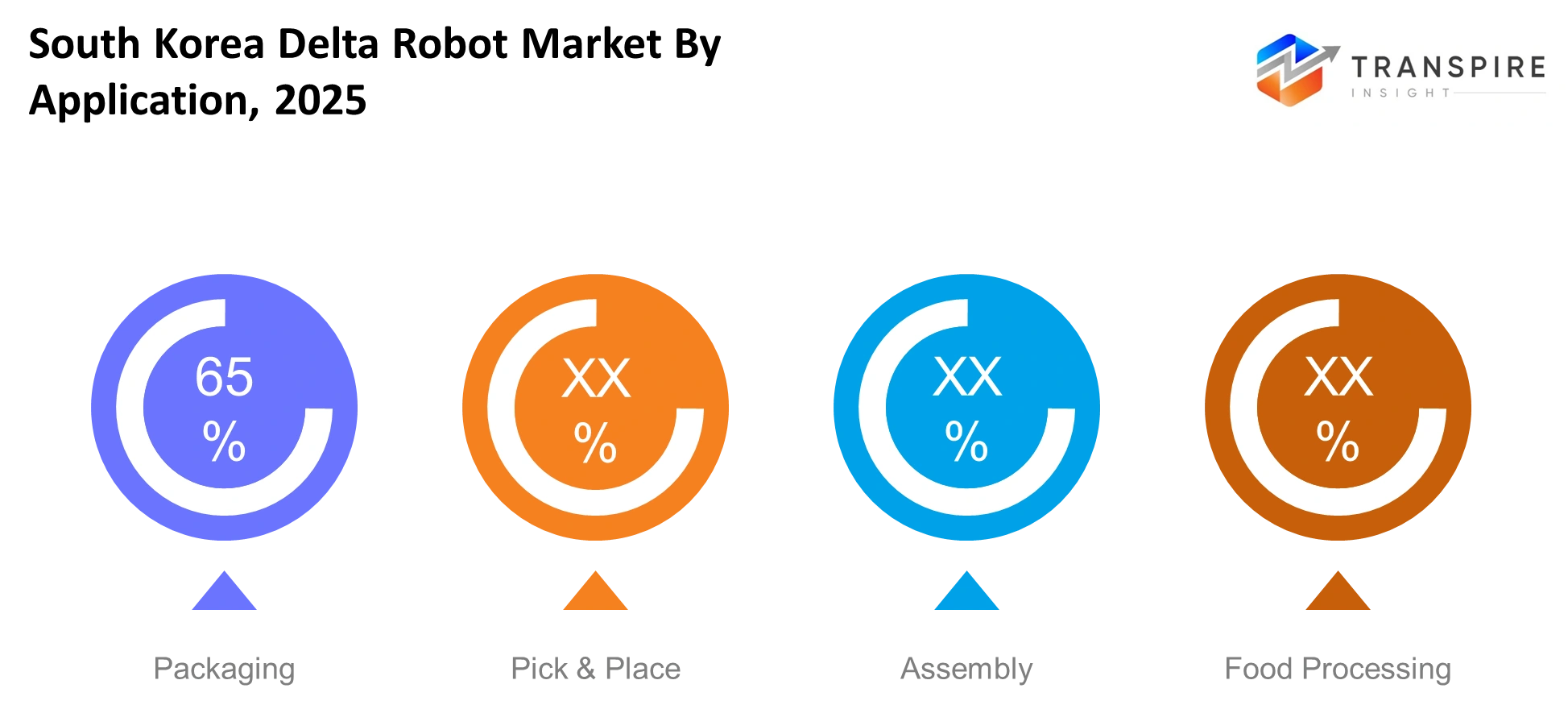
The demand for packaging applications remains strong because businesses need rapid and reliable methods for product transportation between their production lines. Delta robots provide essential support for pick and place operations because they deliver quick movement and exact location control which helps businesses achieve better results in environments with high production volume.
Assembly processes benefit from accuracy and repeatability, especially in industries dealing with small components. Food processing applications depend on hygienic design and gentle handling to protect product safety and maintain product quality. Delta robots in this segment support sorting, portioning, and packing while maintaining strict cleanliness standards required in food-related operations.
To learn more about this report, Download Free Sample Report
By End-User :
Manufacturers continue to adopt delta robots to streamline operations while decreasing their requirement for human workers. Production line implementation of this system increases operational efficiency because it enables uninterrupted production processes for companies that require standard quality production in their mass manufacturing operations.
The food industry uses these robots to maintain hygiene and speed in processing lines, while electronics companies depend on precision for handling delicate components. Delta robots have become a common choice for logistics companies because they help with sorting and distribution tasks while simultaneously increasing order accuracy and decreasing warehouse and supply chain turnaround times.
What are the Main Challenges for the South Korea Delta Robot Market Growth?
The South Korean delta robot market confronts multiple technological and operational difficulties which limit its ability to expand. The operation of high-speed delta robots depends on their need for exact calibration and stable performance, yet they encounter operational constraints when they attempt to handle both increased weight and advanced operational requirements. Supply chain interruptions which affect essential parts like sensors and controllers create distribution problems that hinder the growth and development of the South Korean delta robot market.
The South Korean delta robot market faces two main challenges which stem from manufacturing costs and operational difficulties. Small and medium enterprises face financial obstacles because advanced robotics systems entail high initial implementation costs. The restrictions of the market create obstacles that prevent products from entering the market and block their availability to customers in industries with strict regulations such as pharmaceuticals and food processing.
The South Korean delta robot market suffers from two main obstacles which include insufficient infrastructure and insufficient trained personnel. The facilities do not have the necessary digital systems which enable smooth integration of smart automation technology because there is a shortage of skilled technicians who can implement and maintain robot systems.
The market experiences pricing and innovation pressure because competing robotic systems such SCARA robots and articulated robots present strong competition. The south korea delta robot market requires companies to invest continuously in research and development together with differentiation strategies because rapid technological advances and changing customer demands create a higher risk of product obsolescence.
Country Insights
The manufacturing sector which produces electronics and food products and pharmaceutical items will experience increased delta robot usage because of their ability to execute high-speed pick-and-place operations. The need for precise operations which require shorter work periods and maintain constant production standards will drive factories to implement cutting-edge robotic technologies within their present manufacturing systems.
The advancement of motion control systems together with vision technology and artificial intelligence will improve the operational precision and operational versatility of delta robots. The integration of smart factory systems with Internet of Things platforms will enable factories to monitor their operations better while performing predictive maintenance which will help them achieve higher production rates and decrease unplanned operational shutdowns.
The two main obstacles which prevent small and medium-sized enterprises from expanding their operations are the need for large initial funding and the difficulties involved in connecting various systems. The necessity for a trained workforce together with the need to operate with existing systems will create difficulties for operations which will delay system adoption despite the evident long-term advantages in efficiency and productivity that the new system will bring.
The rising e-commerce sector combined with the need for quicker order delivery will lead to increased delta robot adoption in warehouses and distribution facilities. The system provides fast sorting capabilities together with precise picking ability which will enable companies to handle their growing order demands while achieving faster product delivery times.
The automotive and machinery sectors in Gyeongsang and other southern areas will experience steady growth as these industries implement automation to enhance their production processes. The South Korean Delta Robot Market will achieve balanced regional growth as manufacturers and technology providers work together to implement advanced robotic systems at local facilities.
Recent Development News
In April 2026, LG Group accelerated its robotics and AI expansion strategy. The company’s chairman visited Silicon Valley to strengthen partnerships and advance “physical AI” robotics capabilities, supporting industrial automation segments including high-speed robotic systems like delta robots.
Sourcehttp://roboticstomorrow.com/
In April 2026, multiple South Korean robotics firms initiated capital-raising activities. Companies in the sector are leveraging strong market conditions to fund expansion and scale automation technologies, including industrial robot systems used in packaging and electronics manufacturing.
Sourcehttps://www.kedglobal.com/
|
Report Metrics |
Details |
|
Market size value in 2025 |
USD 182.76 Million |
|
Market size value in 2026 |
USD 204.27 Million |
|
Revenue forecast in 2033 |
USD 449.48 Million |
|
Growth rate |
CAGR of 11.93% from 2026 to 2033 |
|
Base year |
2025 |
|
Historical data |
2021 - 2024 |
|
Forecast period |
2026 - 2033 |
|
Report coverage |
Revenue forecast, competitive landscape, growth factors, and trends |
|
Regional scope |
United States; Canada; Mexico; United Kingdom; Germany; France; Italy; Spain; Denmark; Sweden; Norway; China; Japan; India; Australia; South Korea; Thailand; Brazil; Argentina; South Africa; Saudi Arabia; United Arab Emirates |
|
Key company profiled |
ABB, FANUC, KUKA, Yaskawa, Mitsubishi Electric, Epson, Omron, Denso, Kawasaki Robotics, Universal Robots, Staubli, Bosch Rexroth, Schneider Electric, Toshiba Machine, Nachi |
|
Customization scope |
Free report customization (country, regional & segment scope). Avail customized purchase options to meet your exact research needs. |
|
Report Segmentation |
By Type (3-axis, 4-axis, 6-axis, Custom Robots), By Application (Packaging, Pick & Place, Assembly, Food Processing), By End-User (Manufacturers, Food Industry, Electronics Companies, Logistics Firms) |
How Can New Companies Establish a Strong Foothold in the South Korea Delta Robot Market?
New entrants aiming to gain traction in the south korea delta robot market must focus on niche targeting and differentiated innovation strategies. Companies should pursue specialized business paths that focus on their most profitable market segments according to the electronics micro-assembly and food-grade automation and pharmaceutical packaging industries. The emerging players can solve their operational challenges through solutions which match current industry developments that include AI-based vision systems and lightweight robotic arms.
The process of creating technology distinctions serves as the essential method for companies to build their market presence within the South Korean delta robot industry. Startups should invest in smart automation capabilities, including machine learning, predictive maintenance, and real-time analytics, to enhance performance and reduce downtime. Product validation and market entry will progress faster when companies establish strategic partnerships with local manufacturers and system integrators and research institutions.
To overcome adoption barriers, new companies in the south korea delta robot market should offer flexible pricing models which include robotics-as-a-service RaaS and deliver complete integration services. New companies in the South Korea delta robot market can establish their credibility through customer-focused product development when they combine product innovation with their existing business strategies.
Key South Korea Delta Robot Market Company Insights
The South Korea Delta Robot Market experiences continuous development because electronics and food processing and packaging industries need high-speed automation solutions. The increasing demand for accurate material handling together with shorter operational times will drive its implementation across various industries. The manufacturing sector combined with rising smart factory investments will drive forward market growth and technological advancements.
The leading companies will allocate resources to research and development activities which will enable them to increase payload capacity and enhance vision system compatibility. The market will experience greater pricing competition because new businesses will enter the field which will force companies to develop unique products. Market competitors will establish additional distribution channels while developing stronger ties with system integrators to enhance customer acquisition and retention.
Competition will also be shaped by adoption of AI-based control systems and energy-efficient designs. Companies will develop full automation systems instead of selling individual products to their customers. The combination of long-term contracts and customized offerings together with quick installation services will enable companies to build a reliable customer base that supports their ongoing revenue expansion.
Company List
- ABB
- FANUC
- KUKA
- Yaskawa
- Mitsubishi Electric
- Epson
- Omron
- Denso
- Kawasaki Robotics
- Universal Robots
- Staubli
- Bosch Rexroth
- Schneider Electric
- Toshiba Machine
- Nachi
What are the Key Use-Cases Driving the Growth of the South Korea Delta Robot Market?
The South Korea delta robot market is experiencing fast growth because of its essential function in manufacturing operations which require both rapid production speed and exacting operational precision. Electronics assembly serves as the main application which drives the adoption of delta robots because these robots deliver precise and rapid handling of micro-components. Semiconductor and consumer electronics manufacturers increasingly rely on these systems to improve throughput and reduce defects which directly supports their market growth and operational efficiency.
The South Korea delta robot market in the food and beverage industry is expanding through its use in packaging operations and sorting systems and quality control procedures. Delta robots provide hygienic product handling and dependable operation for high-volume manufacturing processes while meeting stringent safety requirements.
The automotive and logistics sectors also contribute to the growth of the south korea delta robot market. Delta robots assist automotive manufacturers in their operations by providing automated solutions for their lightweight component assembly and inspection processes. The e-commerce and warehousing industries use the technology to perform fast sorting operations and fulfill customer orders, which results in improved operational speed and precise results.
South Korea Delta Robot Market Report Segmentation
By Type
- 3-axis
- 4-axis
- 6-axis
- Custom Robots
By Application
- Packaging
- Pick & Place
- Assembly
- Food Processing
By End-User
- Manufacturers
- Food Industry
- Electronics Companies
- Logistics Firms
Frequently Asked Questions
Find quick answers to common questions.
The approximate South Korea Delta Robot Market size for the market will be USD 449.48 Million in 2033.
Key segments for the South Korea Delta Robot Market are By Type (3-axis, 4-axis, 6-axis, Custom Robots), By Application (Packaging, Pick & Place, Assembly, Food Processing), By End-User (Manufacturers, Food Industry, Electronics Companies, Logistics Firms).
Major South Korea Delta Robot Market players are ABB, FANUC, KUKA, Yaskawa, Mitsubishi Electric, Epson, Omron, Denso, Kawasaki Robotics, Universal Robots, Staubli, Bosch Rexroth, Schneider Electric, Toshiba Machine, Nachi.
The South Korea Delta Robot Market size is USD 182.76 Million in 2025.
The South Korea Delta Robot Market CAGR is 11.93%.
- ABB
- FANUC
- KUKA
- Yaskawa
- Mitsubishi Electric
- Epson
- Omron
- Denso
- Kawasaki Robotics
- Universal Robots
- Staubli
- Bosch Rexroth
- Schneider Electric
- Toshiba Machine
- Nachi
Recently Published Reports
-
Apr 2026
3D Optical Profiler Market
3D Optical Profiler Market Size, Share & Analysis Report By Type (Desktop 3D Optical Profiler, and Portable 3D Optical Profiler), By Technology (Confocal Technology, and White Light Interference), By End-Use Industry (Manufacturing, Research Institutions, Automotive, Aerospace and Defense, Medical Devices, and Other), and Geography (North America, Europe, Asia-Pacific, Middle East and Africa, South and Central America), 2021 - 2031
-
Apr 2026
Depth Sensor Market
Depth Sensor Market Size, Share & Analysis Report By Type (Infrared Depth Sensors, Time-of-Flight (ToF) Sensors, Stereo Vision Sensors, Structured Light Sensors, Ultrasonic Depth Sensors), By Application (Automotive, Robotics, Gaming, Consumer Electronics, Industrial Automation, Healthcare, Security & Surveillance, Others), By End Users (Automotive Manufacturers, Consumer Electronics Companies, Healthcare Providers, Industrial Companies, Security Agencies, Gaming Companies, Robotics Companies, Others), and Geography (North America, Europe, Asia-Pacific, Middle East and Africa, South and Central America), 2021 – 2031
-
Apr 2026
Digital Manufacturing Market
Digital Manufacturing Market Size, Share & Analysis Report By Component (Hardware, Software, and Services), By Technology (Robotics, 3D Printing, Internet of Things (IoT), and Others), By Application (Automotive and Transportation, Aerospace and Defense, Consumer Electronics, Industrial Machinery, and Others), By Process Type (Computer-Based Designing, Computer-Based Simulation, Computer 3D Visualization, Analytics, and Others), and Geography (North America, Europe, Asia-Pacific, Middle East and Africa, South and Central America), 2021 – 2031
-
Apr 2026
Digital Visa Services Market
Digital Visa Services Market Size, Share & Analysis Report By Type (Individual Travelers, Group Travelers), By Application (Tourism, Business Travel, Others), and Geography (North America, Europe, Asia-Pacific, Middle East and Africa, South and Central America), 2021 – 2031