

United Kingdom Commercial Catering Equipment Market Summary
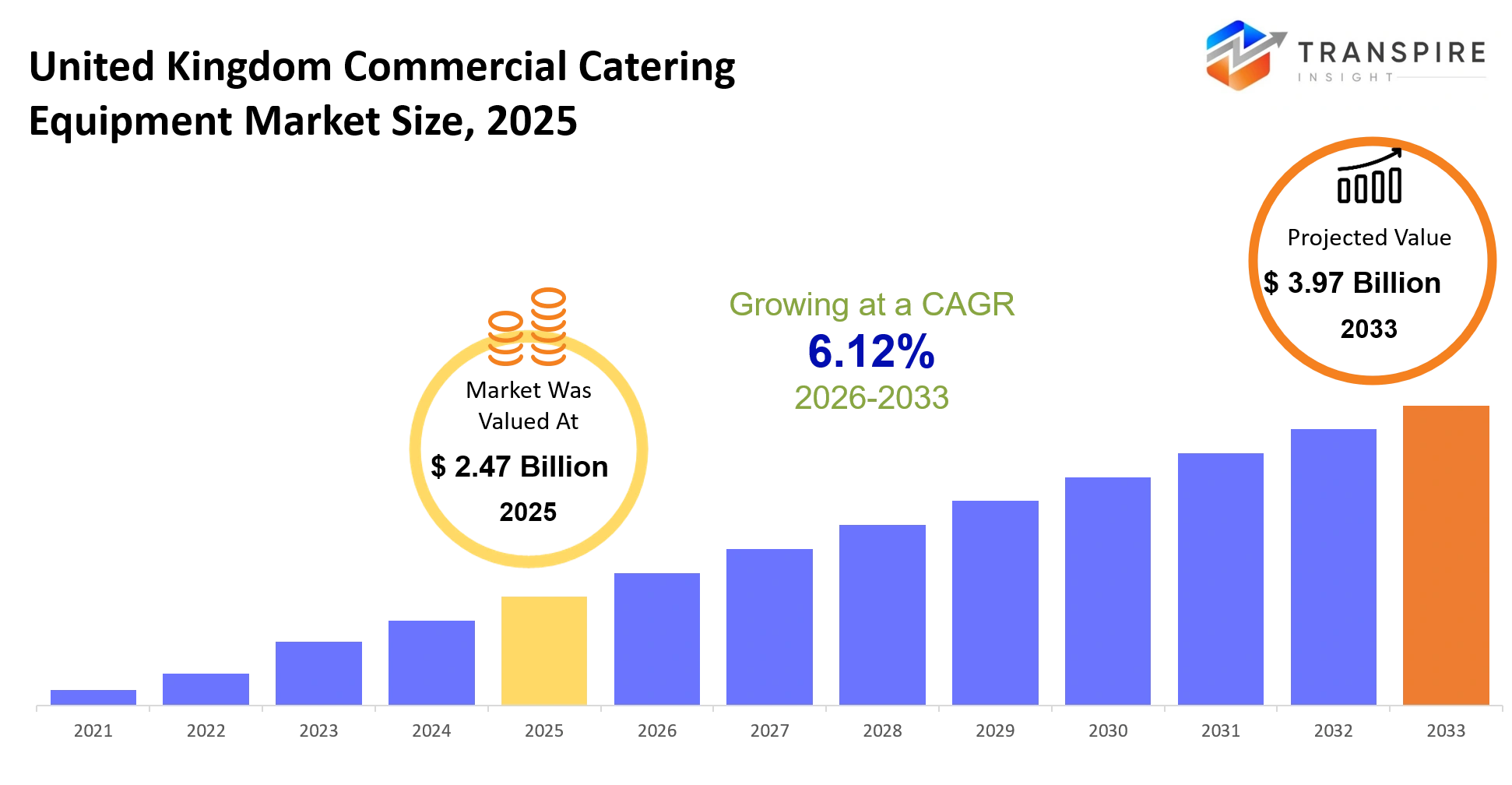
As per Transpire Insight Analysis the United Kingdom Commercial Catering Equipment Market size is estimated at USD 2.47 Billion in 2025 and is anticipated to reach USD 3.97 Billion by 2033, growing at a CAGR of 6.12% from 2026 to 2033.
In the United Kingdom , the commercial catering equipment market sort of backs up restaurants, hotels, hospitals, schools, corporate kitchens, and all those foodservice operators, by basically handing them the right kind of cooking units, refrigeration systems, food prep setups and warewashing tools they need. That way meal production stays consistent , and it’s kept safe while staying high-volume. In practice, these options help companies stick to hygiene rules, protect food quality, and raise kitchen output , all while still controlling those day to day operating costs.
Over the last five years the whole market direction moved more toward connected, energy-efficient, and automated equipment. Operators seem to care about long-term cost control more than they do about low upfront investment. This change kinda picked up speed after the energy price surge, and the supply chain disruptions that showed up around the COVID-19 period. Those events also highlighted how expensive it can be to run inefficient or just outdated kitchen assets.
Since utility expenses are still one of the biggest ongoing costs, more businesses are swapping legacy machines for smart systems. The goal is to cut energy use, make maintenance a little simpler, and improve the kitchen workflow. So overall, this shift supports tighter equipment replacement cycles, higher-value menu and product sales, and wider adoption of digital kitchen technologies across the United Kingdom foodservice sector.
United Kingdom Commercial Catering Equipment Market Size & Forecast:
- United Kingdom Commercial Catering Equipment Market Size 2025: USD 2.47 Billion
- Expected Market Value 2033: USD 3.97 Billion
- Forecast CAGR: 6.12%
- Leading region in 2025: England
- Fastest Growing region: Scotland
- Key Profile: Welbilt, Middleby Corporation, Rational AG, Ali Group, Electrolux Professional, Hobart, Hoshizaki, Fujimak, Falcon Foodservice, Blue Seal, Manitowoc, True Manufacturing, Winterhalter, Mareno, Meiko
Key Market Insights
- England really dominated the United Kingdom Commercial Catering Equipment Market , sitting at roughly 82% share in 2025 , largely helped by tight hospitality, healthcare and institutional foodservice networks. It’s one of those situations where everything kind of feeds into everything else, you know.
- Meanwhile, Scotland is projected to be the fastest-growing regional market over 2025–2032, mainly due to more hospitality spending , wider tourism, and lots of commercial kitchen refurbishment works.
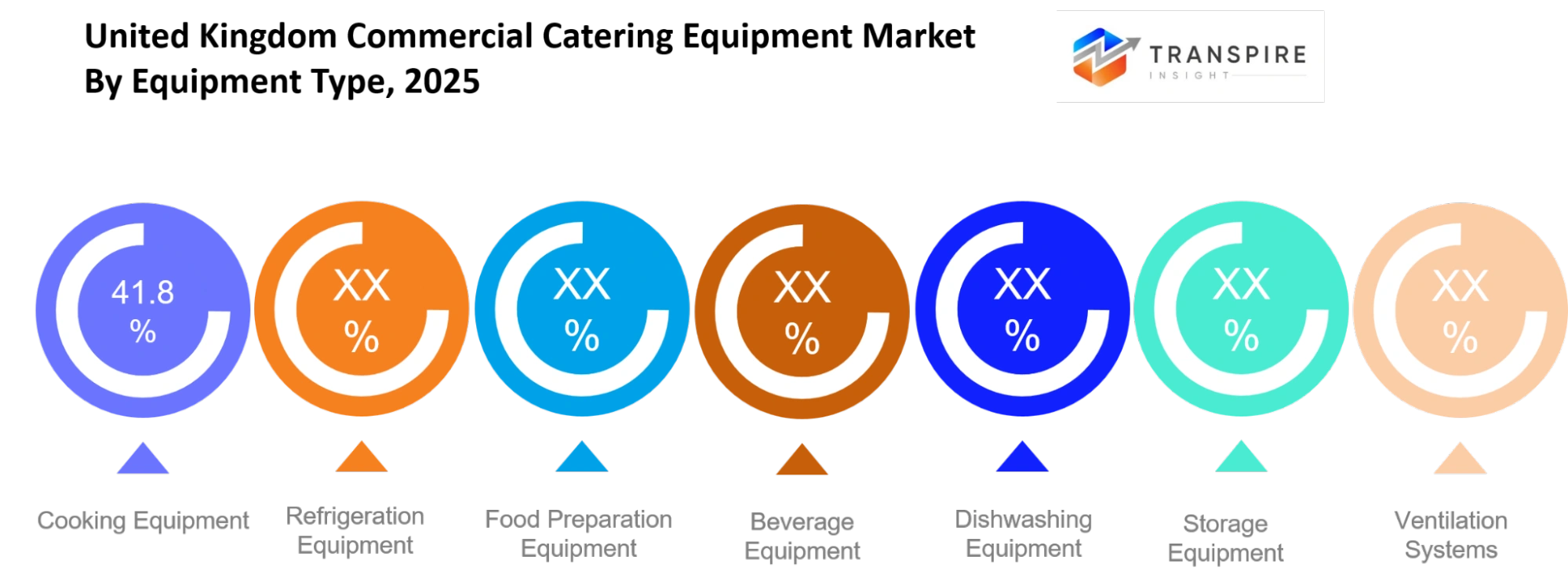
- On the product side, cooking equipment held the lead with nearly 38% market share in 2025, which makes sense considering ongoing replacement cycles and the steady appetite for energy efficient ovens plus combi systems.
- Refrigeration equipment came in as the second-largest segment too, backed by stronger food safety rules , and also growth in chilled food preparation facilities.
- Smart kitchen equipment is expected to post the fastest growth from 2025 to 2032, driven by connected monitoring , automation, and remote asset management.
- For applications, restaurants and hotels together accounted for about 46% market share in 2025 so hospitality stays the main use-case across the country , pretty clearly.
- Institutional catering is forecast to grow the quickest through 2032, supported by healthcare, education, and public-sector kitchen modernization programs that just keep rolling.
- Looking at end users, full-service restaurants represented around 41% of revenue in 2025, which keeps replacement demand steady for high capacity cooking and refrigeration equipment.
- And for what’s next, cloud kitchens together with delivery driven foodservice operators are projected to become the quickest-growing end user group during 2025–2032, they will need small , digitally guided kitchen systems.
What are the Key Drivers, Restraints, and Opportunities in the United Kingdom Commercial Catering Equipment Market?
Commercial kitchen modernization stays kind of the main growth driver. With higher energy costs, tougher food safety compliance, and this move toward connected kitchens, buyers are rethinking what matters. More and more businesses are not only looking at the acquisition price but also doing lifetime operating cost math, like, for real. That change nudges teams to spend on energy-saving ovens, refrigeration systems, and even intelligent warewashing equipment. The result usually shows up as lower utility bills, less routine maintenance, and better kitchen throughput… so there are financial gains you can actually point to. Those advantages then support faster equipment turnarounds and, in turn, steadier revenue performance in the commercial catering equipment industry.
Still, capex is the big structural wall. Smaller restaurants, cafés, and independent operators often delay replacement because financing charges are still high. On top of that, installation usually comes with electrical upgrades, ventilation changes, and some temporary disruption to normal operations. It’s not the kind of spend you recover overnight. And in a Transpire Insight review of regional procurement notices, plus launch timing, supply chain concentration seems to be the biggest execution problem. If procurement takes longer, deliveries get pushed, replacement revenue gets muted, and commercial product launches are postponed across several customer groups, not just one.
The biggest future opportunity seems to be in integrated digital kitchens, sort of a all-in approach. With AI-enabled equipment, cloud based monitoring platforms,and Internet of Things connectivity, operators can tune energy use while also lifting overall kitchen performance. You’re seeing large hospitality groups, healthcare providers, and contract catering firms ramp up spending on centralized kitchen management systems, because it makes things more coordinated. In general, vendors that bundle software with predictive maintenance plus energy optimization services alongside equipment sales will be the ones who lock in recurring revenue and also build longer term customer relationships more easily.
What Has the Impact of Artificial Intelligence Been on the United Kingdom Commercial Catering Equipment Market?
Artificial intelligence is kinda reshaping commercial kitchen operations by pushing equipment to be more intelligent, connected, and just more responsive to the day to day workloads. In today’s cooking, refrigeration, and warewashing setups, systems can automatically watch things like temperature , energy consumption , operating cycles, and hygiene compliance , using embedded sensors plus cloud linked control platforms. Then machine learning, it sort of sifts through past operating patterns to anticipate maintenance needs, notice weird equipment behavior, and suggest service actions before failures actually interrupt food prep. On top of that, AI can help with production planning by forecasting meal volumes, so operators can tweak cooking schedules, cut down on food waste , and keep energy use steadier, especially when the rush hits.
Overall, these features can really boost equipment uptime , cut down the cost of emergency repairs, and still back regulatory compliance without pushing utility expenses so high. Also the digital dashboards tend to give a more centralized view across several kitchen sites, which helps restaurant chains and institutional catering providers keep operational standards more consistent , uniformer even. In practice it’s like everything stays more aligned , even when things get busy.Still, broad rollout has some practical bumps. Bringing AI into legacy kitchen equipment requires a big investment, and uneven connectivity in older buildings makes real time analytics less reliable. A lot of independent operators, too, simply do not have enough operational data to train predictive models well, which slows adoption, even though the measurable benefits from these intelligent commercial catering technologies are pretty clear.
Key Market Trends
- Energy efficient combi ovens and induction cooking setups got a lot more traction between 2022 and 2025, mostly because operators tried to trim long term running costs.. And it seems like those savings really added up over time.
- At the same time connected commercial kitchens kept picking up cloud based monitoring platforms, so teams can do remote diagnostics and manage centralized equipment performance, especially for multi site restaurant groups, not just one location.
- Foodservice operators also moved faster to replace older refrigeration systems, after higher electricity prices showed how inefficient equipment can quietly bleed budgets during the last few years. You know, the usual surprise was how costly it was to keep everything running.
- From 2023 onward, AI enabled predictive maintenance solutions kept expanding, cutting down on unexpected failures and helping improve kitchen asset utilization. Less downtime, more steady throughput, kind of the idea.
- In hospitality renovation projects, modular kitchen layouts became a priority more and more. The reason was simple faster installation, plus more operational flexibility once facilities were being refurbished , and teams had to adapt quickly.
- Rational AG and Electrolux Professional also doubled down on intelligent cooking platforms. These include automated recipe control and energy optimization features that are meant to keep things consistent while reducing waste.
- Meanwhile, institutional catering providers kind of leaned into buying higher capacity automated warewashing equipment, mostly to meet hygiene compliance a bit better and cut down on labor dependency, especially after 2023.
- Manufacturers in general then started localizing their component sourcing approach between 2023 and 2025, and in a way that helped reduce procurement risk that was caused by international supply chain disruptions , too.
- Finally, sustainability targets pushed wider adoption of refrigerants with a lower environmental impact, and it also encouraged equipment designs meant to satisfy stricter energy performance standards, even when requirements got tougher.
United Kingdom Commercial Catering Equipment Market Segmentation
By Equipment Type :
Cooking Equipment still kinda took the lead, because commercial kitchens really need dependable cooking systems to keep meals flowing without interruptions across restaurants, hotels, hospitals, and other institutional sites. Combi ovens, fryers, grills, ranges and induction cooktops stayed among the top purchases, since many operators are aiming at better kitchen efficiency, more uniform food results, and also lower running costs. On top of that, regular replacement cycles help keep sales moving steady.
Refrigeration Equipment ended up in second place, largely due to food safety requirements that are non-negotiable, plus the ongoing increase in cold storage capacity. Food Preparation Equipment also picked up momentum, because automation cut down on manual labor and sped up prep work. Beverage Equipment, Dishwashing Equipment, Storage Equipment, Ventilation Systems, and other categories kept chipping in to make full kitchen operations work smoothly, by boosting workflow, hygiene, storage efficiency, air quality, and overall operational performance.
By Fuel Type :
Electric Equipment kind of took the lead as commercial kitchens more and more picked energy efficient appliances that give precise temperature control, and make installation simple. These modern electric systems also let operators do digital monitoring and they align with stricter efficiency rules that get adopted across hospitality plus institutional foodservice locations. With lower maintenance requirements in the picture, the long term purchasing decisions got a noticeable boost, in a way.
Gas Equipment stayed in the second place mainly because it’s already well established in high volume kitchens where quick heating still matters. Induction Equipment showed the quickest expansion, largely because energy savings and workplace safety became stronger drivers for buying teams. Meanwhile Hybrid Equipment, Steam Equipment, Solar-Assisted Equipment, Multi-Fuel Equipment, and Others kept getting picked for certain commercial applications where operational flexibility plus sustainability targets shaped the investment choices, overall.
By End User :
Restaurants were, kinda the biggest end-user segment, since day to day cooking never really stops and that means dependable high-capacity kitchen hardware is needed all through the daily grind. They also had a lot of menu revisions, lots of customers, plus ongoing replacement schemes for the machines, so restaurants kept putting money in across chains and separate independent foodservice operators. For most purchases, operational efficiency stayed front and center, not surprising though.
Hotels came in second, mainly because hospitality keeps growing and they need large scale food production setups. Catering Companies showed the fastest momentum as event catering, corporate meals, and contract foodservice work spread further around the country. Meanwhile Cafés, Hospitals, Educational Institutions, Corporate Canteens, and the Others group kept funding more current kitchen systems, partly to boost output and food standards , also to stay aligned with regulatory compliance, pretty much the usual goals.
By Distribution Channel :
Direct Sales pulled in the top revenue numbers because big commercial buyers leaned toward a customized equipment selection, plus installation help, maintenance agreements, and frankly better long-term supplier ties. This more direct engagement also made it easier for project planning in restaurants, hotels, healthcare facilities, and institutional kitchens; and the technical consultation made purchasers feel more secure about what they were actually buying.
Dealers came in as the second-largest channel, mainly by offering broad product availability, and local after-sales support too. Online retail kept climbing the fastest, since digital procurement platforms made it simpler to compare products, then place orders for smaller businesses. After that, Equipment Distributors, OEM Sales, Specialty Stores, Rental Services, and Others kept showing up for different needs with specialized solutions that matched varying day to day operations, and budget constraints.
By Application :
Cooking stayed the biggest application, pretty much because each commercial kitchen relies on dependable cooking systems to keep output steady, food consistency in check, and overall service quality good. Over time the ongoing equipment upgrades kept aiming to cut energy usage, while also boosting speed and day to day operational efficiency. Smart cooking technologies in particular helped with tighter process control, kind of like a quiet safety net for how things run.
Refrigeration ranked second, mainly because food safety and proper storage still require strict temperature management. Cleaning & Sanitation showed the fastest growth, since newer hygiene regulations nudged operators to invest in more capable warewashing and sanitation systems. At the same time Food Preparation, Bakery Operations, Beverage Preparation, Food Storage, and Others kept moving upward, with modernization rolling through commercial foodservice locations all around.
What are the Key Use Cases Driving the United Kingdom Commercial Catering Equipment Market?
Commercial kitchens in restaurants still end up being the biggest use case, mainly because steady food output depends on cooking equipment that actually holds up during those long, continuous service hours. A lot of restaurant chains, independent dining places, and quick-service operators keep putting money into new systems, mostly so they can push more volume, control energy expenses better, and keep food quality stable, while also staying on top of strict hygiene expectations.
Hospitals, and also educational institutions, are buying more equipment too, since large-scale meal programs need dependable refrigeration, dependable food preparation, and solid sanitation setups. Hotels are doing similar upgrades, they want kitchen facilities that can handle higher guest numbers, wider menu options, and smoother back-of-house work, all without messing up the day-to-day service that guests expect.
Then there are cloud kitchens and central production facilities which feel like an emerging direction with solid long-term promise. Delivery-first food businesses tend to look for compact, connected equipment that can drive high production even when the space is limited, while contract catering providers are starting to adopt intelligent kitchen technologies for tighter operational control, and to match shifting food safety rules as well as updated energy efficiency standards.
|
Report Metrics |
Details |
|
Market size value in 2025 |
USD 2.47 Billion |
|
Market size value in 2026 |
USD 2.62 Billion |
|
Revenue forecast in 2033 |
USD 3.97 Billion |
|
Growth rate |
CAGR of 6.12% from 2026 to 2033 |
|
Base year |
2025 |
|
Historical data |
2021 - 2024 |
|
Forecast period |
2026 - 2033 |
|
Report coverage |
Revenue forecast, competitive landscape, growth factors, and trends |
|
Regional scope |
United Kingdom (England, Scotland, Wales, Northern Ireland) |
|
Key company profiled |
Welbilt, Middleby Corporation, Rational AG, Ali Group, Electrolux Professional, Hobart, Hoshizaki, Fujimak, Falcon Foodservice, Blue Seal, Manitowoc, True Manufacturing, Winterhalter, Mareno, Meiko . |
|
Customization scope |
Free report customization (country, regional & segment scope). Avail customized purchase options to meet your exact research needs. |
|
Report Segmentation |
By Equipment Type (Cooking Equipment, Refrigeration Equipment, Food Preparation Equipment, Beverage Equipment, Dishwashing Equipment, Storage Equipment, Ventilation Systems, Others); By Fuel Type (Electric Equipment, Gas Equipment, Induction Equipment, Hybrid Equipment, Steam Equipment, Solar-Assisted Equipment, Multi-Fuel Equipment, Others); By End User (Hotels, Restaurants, Cafés, Hospitals, Educational Institutions, Corporate Canteens, Catering Companies, Others); By Distribution Channel (Direct Sales, Dealers, Online Retail, Equipment Distributors, OEM Sales, Specialty Stores, Rental Services, Others); By Application (Food Preparation, Cooking, Refrigeration, Bakery Operations, Beverage Preparation, Food Storage, Cleaning & Sanitation, Others) |
Which Regions are Driving the United Kingdom Commercial Catering Equipment Market Growth?
England makes up around 82% of the total revenue, and yeah it’s also the biggest regional piece of the market activity. The hospitality rules stay quite strict, there’s a broad healthcare framework, and companies keep investing in commercial foodservice spaces . Because of that equipment purchases can keep flowing across several sectors, not just one niche. Equipment makers, distributors, service providers, plus maintenance networks, all together form a pretty efficient supply chain, so large replacement and installation work can get done without too much friction. And as restaurants, hotels, hospitals, and institutional kitchens keep getting refurbished, England will likely keep its leading position across the whole forecast.
Scotland meanwhile gives a more steady stream of revenue, since hospitality, tourism, healthcare, and education keep showing up with reliable funding for commercial kitchen infrastructure. Local development policies tend to push renovation of hotels, public facilities, and catering sites, while also requiring compliance with energy requirements and food safety standards. You get this balanced mix, with independent operators alongside larger national hospitality groups, so purchasing stays consistent without leaning too hard on just one customer type. With relatively stable economic conditions and planned capital spending, equipment replacement should remain predictable over the next few years.
Wales is likely to see the quickest growth, as hospitality development, public sector infrastructure projects and commercial kitchen upgrades all speed up equipment purchasing. In the last while, money put into tourism amenities and institutional catering has pushed a broader shift toward energy efficiency, plus digitally connected kitchen setups. When modernization actually moves forward, it opens room for vendors who bring smart appliances, installation support, and year after year service agreements. New players, as well as investors, should get advantages from the fact that refurbishment work is expanding and the need for replacements keeps building during 2026 to 2033.
Who are the Key Players in the United Kingdom Commercial Catering Equipment Market and How Do They Compete?
Competition is still fairly fragmented, because international manufacturers sit right next to regional suppliers , distributors, and even those specialist kitchen solution providers. In other words, the thing that sways a buyer is not only price; it’s more like technology direction, energy efficiency, after sales support, and how well a vendor can handle customized project execution , step by step. Most of the established manufacturers keep pushing customer relationships forward via product innovation and service contracts. Meanwhile, specialist suppliers tend to win by pitching tailored options for hospitality, healthcare, and institutional foodservice projects, where requirements can get very specific.
Rational AG leans into intelligent cooking technology. It’s meant to boost consistency, cut energy usage, and make kitchen operations feel less complex thanks to automated cooking programs. Electrolux Professional differentiates with sustainable kitchen systems , connected equipment, and wide-ranging service support that commercial operators actually rely on. **Middleby Corporation** goes further on the digital side by expanding digital kitchen capabilities through connected cooking platforms and by investing in tools that increase operational visibility across multi-site foodservice groups.
Ali Group competes using a broad portfolio approach, so customers can source multiple equipment categories from one place, and still get support on large commercial kitchen projects. Hoshizaki keeps strengthening its market stance with premium refrigeration and ice-making technologies, which are often seen as reliable , strong on food safety performance, and built for long operating life. With continued investment in smart equipment, expanded service networks , and new product development, these companies can keep the edge in competitive positioning while also reacting to shifting customer needs as they come in.
Company List
- Welbilt
- Middleby Corporation
- Rational AG
- Ali Group
- Electrolux Professional
- Hobart
- Hoshizaki
- Fujimak
- Falcon Foodservice
- Blue Seal
- Manitowoc
- True Manufacturing
- Winterhalter
- Mareno
- Meiko
Recent Development News
In January 2026, Electrolux Professional Group completed the acquisition of the assets of Royal Range, a U.S. commercial cooking equipment manufacturer. The acquisition expanded the company's commercial cooking portfolio and strengthened its position in professional foodservice equipment, supporting innovation available to markets including the United Kingdom.Source https://www.electroluxprofessionalgroup.com/
In March 2026, RATIONAL AG launched the iCombi One combi oven exclusively for the Chinese market during the company's 50th anniversary year. The product launch expanded the company's intelligent cooking portfolio and reinforced continued investment in commercial kitchen technology that benefits global foodservice operators, including those in the United Kingdom. Sourcehttps://www.rational-online.com/
What Strategic Insights Define the Future of the United Kingdom Commercial Catering Equipment Market?
The United Kingdom Commercial Catering Equipment Market seems to be drifting toward a more service-led, and also digitally connected kind of business plan where the equipment sales aren’t really standalone anymore. Instead, what used to be just a purchase is now often backed by software, predictive maintenance, and longer term performance contracts. At the same time, higher operating costs and tighter efficiency rules will keep nudging buyers away from the “cheapest upfront” thinking, more and more toward total lifecycle value , which is a little harder to compare in the beginning but more compelling later.
There’s also a risk that is not as obvious, at least until it shows up. Supply chain concentration for key electronic parts and refrigeration systems can quietly become a real bottleneck, and that might stretch delivery timelines. Then project costs can climb too, even if overall investment levels look steady or healthy on paper.
Still, an interesting chance is showing up, especially with AI-enabled kitchen management platforms. These can link multiple commercial sites and steer energy use in real time, and it matters most in places like healthcare , education, and contract catering, where demand patterns are more complicated. The firms that manage to blend intelligent equipment with installation , financing, remote monitoring, and full lifecycle support are likely to keep customers longer. Overall, building localized service networks along with real digital capabilities should become the strongest competitive edge over the next five to seven years.
United Kingdom Commercial Catering Equipment Market Report Segmentation
By Equipment Type
- Cooking Equipment
- Refrigeration Equipment
- Food Preparation Equipment
- Beverage Equipment
- Dishwashing Equipment
- Storage Equipment
- Ventilation Systems
By Fuel Type
- Electric Equipment
- Gas Equipment
- Induction Equipment
- Hybrid Equipment
- Steam Equipment
- Solar-Assisted Equipment
- Multi-Fuel Equipment
By End User
- Hotels
- Restaurants
- Cafés
- Hospitals
- Educational Institutions
- Corporate Canteens
- Catering Companies
By Distribution Channel
- Direct Sales
- Dealers
- Online Retail
- Equipment Distributors
- OEM Sales
- Specialty Stores
- Rental Services
By Application
- Food Preparation
- Cooking
- Refrigeration
- Bakery Operations
- Beverage Preparation
- Food Storage
- Cleaning & Sanitation
Frequently Asked Questions
Find quick answers to common questions.
The expected United Kingdom Commercial Catering Equipment Market size for the market will be USD 3.97 Billion in 2033.
Key segments for the United Kingdom Commercial Catering Equipment Market are By Equipment Type (Cooking Equipment, Refrigeration Equipment, Food Preparation Equipment, Beverage Equipment, Dishwashing Equipment, Storage Equipment, Ventilation Systems, Others); By Fuel Type (Electric Equipment, Gas Equipment, Induction Equipment, Hybrid Equipment, Steam Equipment, Solar-Assisted Equipment, Multi-Fuel Equipment, Others); By End User (Hotels, Restaurants, Cafés, Hospitals, Educational Institutions, Corporate Canteens, Catering Companies, Others); By Distribution Channel (Direct Sales, Dealers, Online Retail, Equipment Distributors, OEM Sales, Specialty Stores, Rental Services, Others); By Application (Food Preparation, Cooking, Refrigeration, Bakery Operations, Beverage Preparation, Food Storage, Cleaning & Sanitation, Others).
Major United Kingdom Commercial Catering Equipment Market players are Welbilt, Middleby Corporation, Rational AG, Ali Group, Electrolux Professional, Hobart, Hoshizaki, Fujimak, Falcon Foodservice, Blue Seal, Manitowoc, True Manufacturing, Winterhalter, Mareno, Meiko.
The United Kingdom Commercial Catering Equipment Market size is USD 2.47 Billion in 2025.
The United Kingdom Commercial Catering Equipment Market CAGR is 6.12% from 2026 to 2033.
- Welbilt
- Middleby Corporation
- Rational AG
- Ali Group
- Electrolux Professional
- Hobart
- Hoshizaki
- Fujimak
- Falcon Foodservice
- Blue Seal
- Manitowoc
- True Manufacturing
- Winterhalter
- Mareno
- Meiko
About the Authors

Chetan Dhatrak
I’m Chetan Dhatrak, a Senior Research Analyst at Transpire Insight, specializing in the Consumer Goods, Foods and Beverages industry. I focus on analyzing market trends, consumer behavior, competitive landscapes, and industry developments to deliver accurate, data-driven insights. My research at Transpire Insight is built on credible sources and in-depth analysis, helping businesses and readers better understand market dynamics, emerging opportunities, and evolving consumer preferences. I’m committed to creating reliable, well-researched content that supports informed decision-making and reflects the latest developments in the consumer goods and food & beverage sectors.

Chakradhar Khansole
Chakradhar serves as the Research Director at Transpire Insight, bringing over 8 years of experience in technology, innovation, and strategic market intelligence. He specializes in transforming complex market data into actionable business insights that enable organizations to make informed, growth-oriented decisions. Recognized for his strategic vision and analytical expertise, Chakradhar leads high-impact research initiatives, delivering comprehensive market assessments, competitive intelligence, and forward-looking industry analysis.
Recently Published Reports
-
Apr 2026
Bottled Water Market
Bottled Water Market Size, Share & Analysis Report By Product Type (Still Bottled Water, Carbonated Bottled Water, Functional Bottled Water, and Others), By Packaging (PET, Cans, and Others), By Sales Channel (Supermarkets/Hypermarkets, Convenience Stores/Drug Stores, Grocery Stores/Club Stores, Foodservice, and Others) and Geography (North America, Europe, Asia-Pacific, Middle East and Africa, South and Central America), 2021 - 2032
-
Apr 2026
Color Cosmetic Packaging Market
Color Cosmetic Packaging Market Size, Share & Analysis Report By Application (Mascara Packaging, Liquid Packaging, and Liquid Face), By Type (Tubes & Bottles, Pens & Markers, Compacts & Containers, and Droppers & Pumps), and Geography (North America, Europe, Asia-Pacific, Middle East and Africa, South and Central America), 2021 - 2031
-
Apr 2026
External Microphone For Camera Market
External Microphone For Camera Market Size, Share & Analysis Report By Type (Shotgun Microphone, Lavalier Microphone, and Others), By Application (Digital Camera, Professional Video Camera, and Others), and Geography (North America, Europe, Asia-Pacific, Middle East and Africa, South and Central America), 2021 - 2031
-
Apr 2026
Foot Orthotic Insoles Market
Foot Orthotic Insoles Market Size, Share & Analysis Report By Type (Pre-fabricated, and Custom-made), By Material (Thermoplastic, Composite Carbon Fiber, and Others), By Distribution Channel (Drug Stores, Hospitals & Clinics, and Others), and Geography (North America, Europe, Asia-Pacific, Middle East and Africa, South and Central America), 2021 - 2031