

Europe Cloud Kitchen Market Size & Forecast:
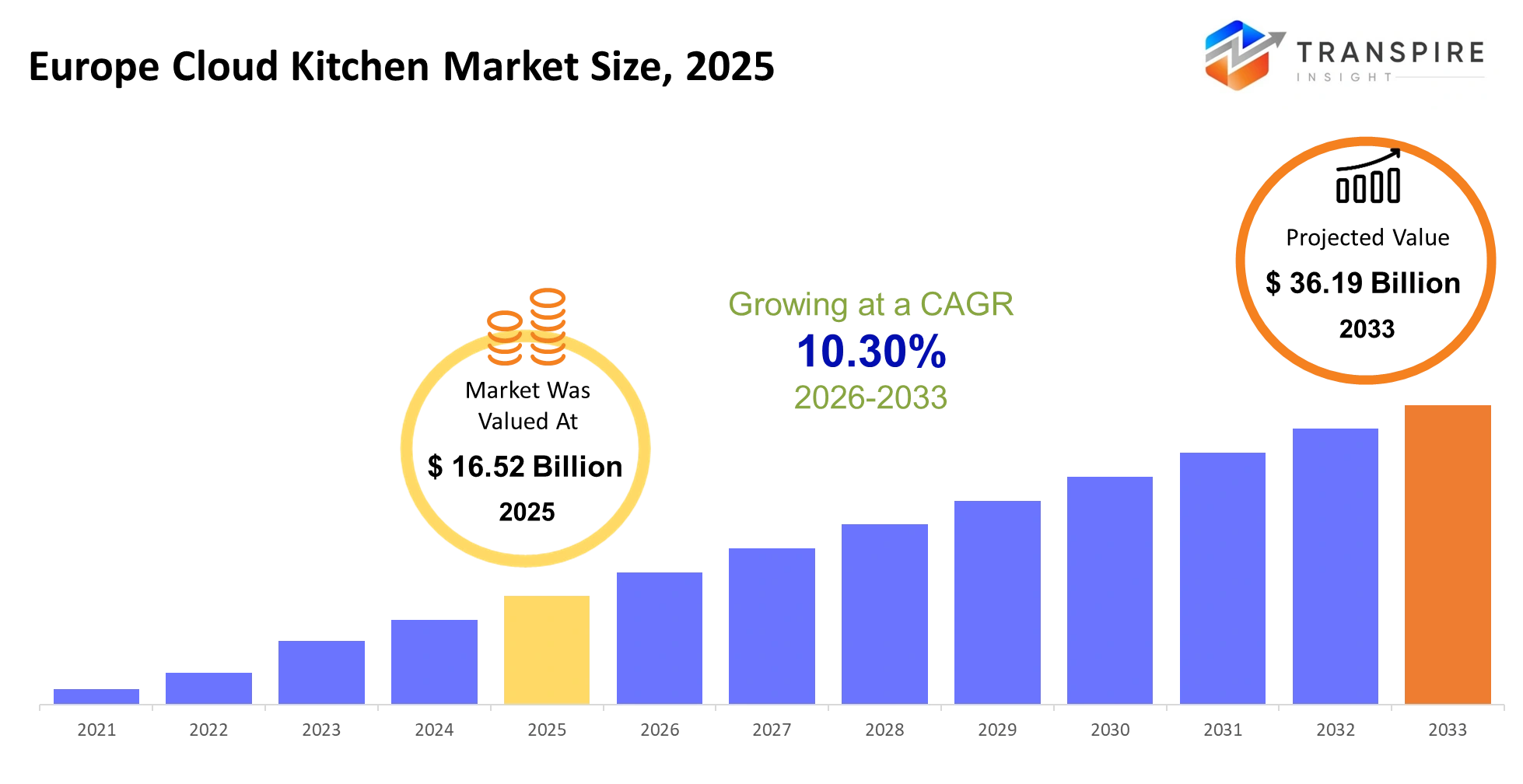
- Europe Cloud Kitchen Market Size 2025: USD 16.52 Billion
- Europe Cloud Kitchen Market Size 2033: USD 36.19 Billion
- Europe Cloud Kitchen Market CAGR: 10.30%
- Europe Cloud Kitchen Market Segments: By Type (Independent Cloud Kitchens, Commissary Kitchens, Kitchen Pods, Others), By Application (Food Delivery, Catering, Others), By End-User (Restaurants, Startups, Food Chains, Others), By Model (Aggregator-based, Standalone, Others).
To learn more about this report,  Download Free Sample Report
Europe Cloud Kitchen Market Summary:
The Europe Cloud Kitchen Market size is estimated at USD 16.52 Billion in 2025 and is anticipated to reach USD 36.19 Billion by 2033, growing at a CAGR of 10.30% from 2026 to 2033. The Europe cloud kitchen market lets food brands run delivery-only kitchens because it removes the need for expensive dine-in dining areas, which enables them to deliver food from multiple locations throughout the city while facing challenges of high urban real estate expenses and scattered last-mile food requirements. The system provides restaurants and virtual brands and aggregators with delivery-based kitchen facilities that enable them to expand their operations to multiple urban locations through shared or independent kitchen facilities.
The last 3 to 5 years saw a fundamental change in the market because companies started using data-based demand estimation methods together with kitchen networks that operate through centralized platforms and depend on location data and menu development instead of conventional methods for expanding their restaurant networks. The COVID-19 pandemic created delivery-first business models because it forced restaurants to stop their dine-in operations and switch to delivery services as their primary business model.
The new approach has transformed cost patterns because it creates easier access to multi-brand growth which businesses can achieve through their single location. The business now connects revenue growth directly to three factors which include order volume, platform relationships, and operational productivity instead of depending on location growth.
Key Market Insights
- Western Europe leads the Europe Cloud Kitchen Market because it has more than 55% market share which will continue until 2025. The United Kingdom, Germany, and France drive this market dominance.
- Southern Europe functions as the quickest developing area until 2030 because of both digital food delivery growth and increasing urban population numbers.
- Independent cloud kitchens hold a significant share of nearly 48% in 2025 because they require only minimal financial investment and their brand operations can be conducted freely.
- Commissary/shared kitchens account for the second-largest segment, which receives support because of aggregator-backed infrastructure together with the advantages of cost-sharing.
- Kitchen-as-a-Service (KaaS) functions as the quickest expanding segment, which will undergo rapid development until 2030 through its platform-based operational system.
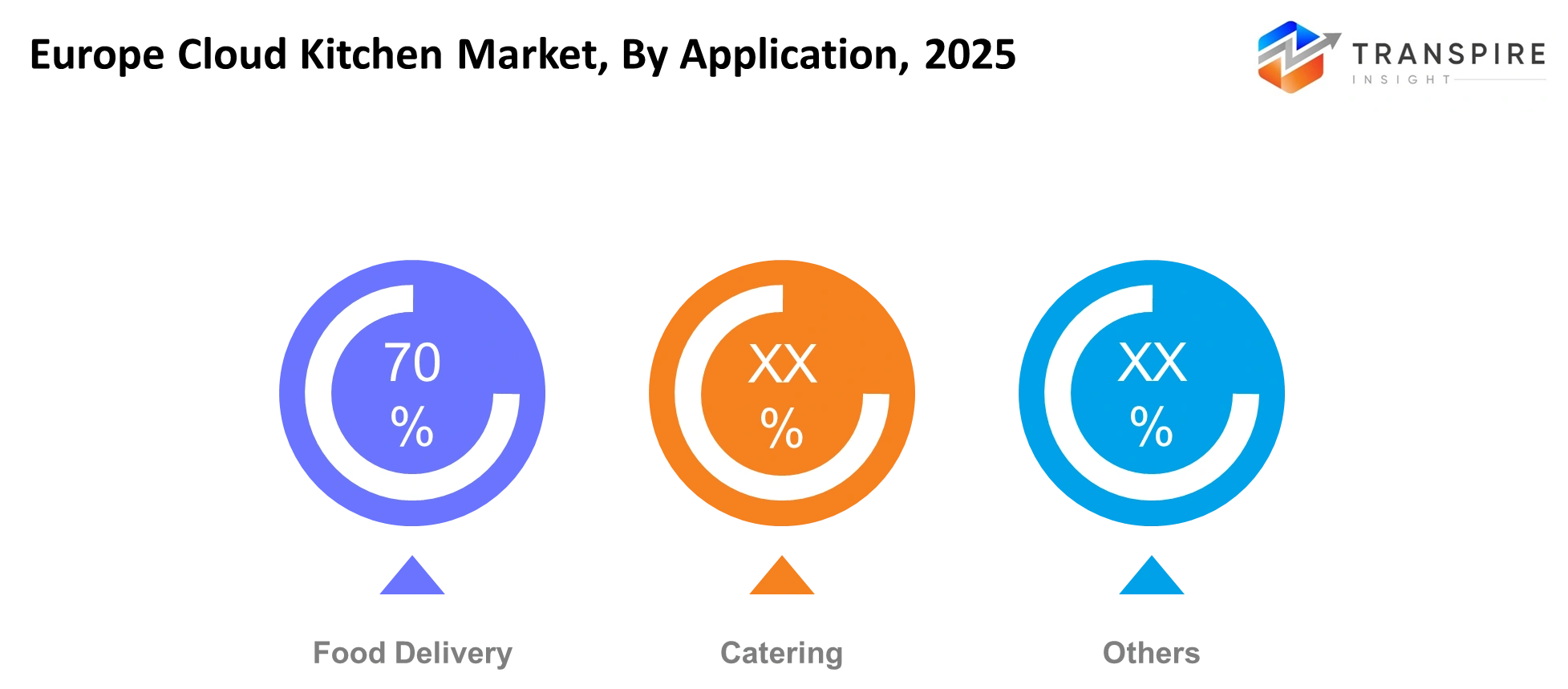
- Food delivery applications dominate with over 70% share in 2025, which shows that customers prefer to use apps for their ordering needs.
- Virtual restaurant brands represent the fastest-growing application, which expands quickly because of its low-risk testing approach together with its ability to develop menus.
- Quick Service Restaurants (QSRs) lead the Europe Cloud Kitchen Market with approximately 45% share because they use cloud kitchens to quickly enter new markets.
- Food startups and digital-first brands serve as the quickest developing end-user segment because they need fewer resources to operate and they can bring products to market more quickly.
What are the Key Drivers, Restraints, and Opportunities in the Europe Cloud Kitchen Market?
The Europe Cloud Kitchen Market accelerates because urban rental prices increase while third-party delivery platforms reach their operational peak. The shift started when food aggregators built their logistics networks throughout major European cities, which enabled delivery to reach customers within 20 to 30 minutes. The new situation permits restaurants to attract customers without needing expensive street-side restaurant spaces. A single kitchen enables operators to create several virtual brands, which results in higher earnings from each square foot of their space. The business model enables better financial results because it decreases time needed for investments to recover, which results in quicker market acceptance by traditional QSR chains and modern digital-first food companies.
The most significant barrier is the structural dependence on third-party delivery platforms that control customer access and pricing visibility. The margin compression problem arises because commission fees charge more than 20 to 30 percent of each order total. The issue becomes difficult to solve because platforms maintain ownership of customer information and delivery system capacity which kitchen operators need to achieve business expansion. The problem forces cloud kitchens to depend on indirect methods for customer engagement, which creates difficulties in developing brand loyalty and achieving sustainable business success.
A key opportunity exists because AI-driven kitchen optimization systems and predictive demand planning systems can work together to create operational efficiency. The operators allocate funds to systems which study regional order trends for creating flexible systems that regulate menu items and stock levels. The process leads to decreased food waste and faster order delivery. The technologies will create a major boost to profit margins which results in the ability to grow business activities, as they advance through their developmental stages in markets that use digital resources, such as the UK and Germany.
What Has the Impact of Artificial Intelligence Been on the Europe Cloud Kitchen Market?
Artificial intelligence is changing the operations of cloud kitchens through its ability to automate processes and create real-time decision-making systems. The system uses artificial intelligence to help operators handle order processing while it automatically dispatches tickets to different work areas and manages kitchen productivity during busy periods. The unified control system integrates point of sale information with inventory management systems and employee scheduling tools to decrease downtime while enhancing correct order fulfillment. The systems used by some platforms enable order processing to become 20 to 30 percent quicker while they also show actual decreases in food waste through their automated system for allocating stock.
Machine learning models use historical order data and weather patterns and local events as input to produce predictive models which forecast demand at specific geographic areas. The system enables kitchens to preplan their menu items and cooking requirements and employee schedules which enhances their operational capacity while decreasing emergency cancellations. The system uses predictive analytics to enhance performance because it detects low-performing menu items and updates pricing methods during ongoing operations.
The system faces a major obstacle because it requires complex integration methods to operate effectively. The majority of operators depend on their outdated separate systems which results in high expenses and extended time requirements for implementing unified AI systems that will improve their operations.
Key Market Trends
- The operators transformed their kitchen operations from single-brand kitchens to multi-brand facilities because they needed to operate five to ten virtual kitchens at some sites for better asset usage.
- Delivery aggregators like Deliveroo and Uber Eats developed Editions-style kitchen networks because they wanted to transition from their role as logistics providers into becoming infrastructure enablers.
- From 2021 to 2024 organizations adopted data analytics technology which enabled them to use instantaneous demand information for making real-time menu and pricing changes.
- The growing commission rates which reached above 25 percent per order in 2023 compelled brands to create their own direct ordering systems and hybrid delivery models.
- After 2022 mid-sized restaurant chains started using cloud kitchens for their business expansion because they wanted to explore new culinary options without committing to expensive permanent locations.
- Order management processes together with kitchen workflow automation brought about a 15 to 20 percent decrease in preparation time for high-density urban areas by 2024.
- Venture capital funding began supporting Kitchen-as-a-Service models which require minimal assets after 2021 while backing financial-intensive standalone facilities.
- Business expansion extended from London and Paris to tier-2 cities which included Manchester and Lyon because lower rents created better financial conditions for operational units.
- The operators implemented sustainability practices after 2022 through their adoption of centralized procurement systems and delivery batching optimization methods which lowered their packaging and logistics expenses.
Europe Cloud Kitchen Market Segmentation
By Type
By Type segmentation in the Europe Cloud Kitchen Market is led by independent cloud kitchens which dominate the market because their operational costs are low and they can expand their services to serve multiple customers in busy urban regions. Commissary kitchens hold a strong second position because shared infrastructure reduces overheads and supports multiple brands operating under one facility. Kitchen pods and modular units remain smaller but are gaining attention for their ability to be deployed quickly in suburban areas and during temporary demand surges.
The market growth in this segment results from increasing real estate expenses and the requirement for businesses to enter markets more quickly while spending less on assets. The future direction points toward hybrid kitchen networks which combine shared kitchen spaces with independent kitchen operations that enable operators to achieve operational cost savings while maintaining brand ownership and investors to concentrate on developing scalable business models that require minimal resources.
By Application
Food delivery stands as the largest market segment because digital ordering platforms have achieved widespread use and consumers increasingly prefer dining options that offer them convenience. Catering services sustain their current market position because they deliver services to corporate events and institutional clients and fulfill bulk order requests, but their business growth index remains lower than delivery services.
Niche markets which show growth potential are developing through ghost catering operations and subscription-based meal service offerings. Increased smartphone usage together with real-time logistics optimization has established a new standard for on-demand consumption which drives the growth pattern. The European Cloud Kitchen Market will see food delivery as its main demand driver while premium health-focused catering services will attract investment for specialized catering formats.
To learn more about this report, Download Free Sample Report
By End-User
The two main types of End-User customers who operate restaurants and quick-service chains because they can use cloud kitchens to expand their business reach. Food startups represent the fastest-adapting segment, leveraging low entry barriers to test new cuisines and virtual brands without physical storefronts. The other user group which includes institutional food providers shows consistent demand patterns that do not exceed certain limits.
The primary driver of operations for businesses exists in operational flexibility which enables established chains to decrease their need for physical locations while startups use digital-first methods to grow their operations. Future growth will favor hybrid operators that combine physical and virtual models, enabling stronger market penetration and improved unit economics across competitive urban clusters.
By Model
The kitchen structure of aggregator-based kitchens operates through their model which relies on platforms that deliver access to customer demand and their logistics capabilities and customer acquisition systems. Established restaurant groups operate standalone kitchens because they want to control their profit margins while connecting directly with their customers. The other hybrid models that exist today use aggregator networks together with their own ordering systems.
Aggregator-based models dominate the market because their strong last-mile networks provide them with built-in customer traffic although their dependence on commission systems creates difficulties for their profit margins. The following phase of the Europe Cloud Kitchen Market will enter its hybridization stage because operators will create their own distribution methods while maintaining their current relationship with aggregator platforms.
What are the Key Use Cases Driving the Europe Cloud Kitchen Market?
The European Cloud Kitchen Market needs food delivery services because digital ordering platforms serve urban customers who want to use delivery-only kitchens. The market needs this use case because it eliminates dine-in expenses which result in higher order numbers through app-based systems that operate most effectively in areas with high customer traffic.
The applications of this technology extend to virtual restaurant branding and corporate catering services which quick-service restaurant chains and food startups use for their operations. Corporate catering benefits from centralized production efficiency for bulk orders, while virtual brands use cloud kitchens to test multiple cuisines without physical storefront expansion, improving market reach and reducing financial risk.
The health-focused dietary kitchens which provide hyperlocal subscription meal services target fitness and medical nutrition segments as their emerging use cases. Digital consumers who want customized meal planning are increasingly adopting these models. The applications will become more effective because AI demand forecasting will enhance menu personalization and operational efficiency according to future predictions.
|
Report Metrics |
Details |
|
Market size value in 2025 |
USD 16.52 Billion |
|
Market size value in 2026 |
USD 18.22 Billion |
|
Revenue forecast in 2033 |
USD 36.19 Billion |
|
Growth rate |
CAGR of 10.30% from 2026 to 2033 |
|
Base year |
2025 |
|
Historical data |
2021 - 2024 |
|
Forecast period |
2026 - 2033 |
|
Report coverage |
Revenue forecast, competitive landscape, growth factors, and trends |
|
Regional scope |
Europe (Germany, United Kingdom, France, Italy, Spain and Rest of Europe) |
|
Key company profiled |
Rebel Foods, Kitopi, CloudKitchens, DoorDash Kitchens, Uber Eats, Deliveroo Editions, Just Eat, Zomato, Swiggy, Kitchen United, Zuul Kitchens, Karma Kitchen, FoodStars, Keatz, Dahmakan. |
|
Customization scope |
Free report customization (country, regional & segment scope). Avail customized purchase options to meet your exact research needs. |
|
Report Segmentation |
By Type (Independent Cloud Kitchens, Commissary Kitchens, Kitchen Pods, Others), By Application (Food Delivery, Catering, Others), By End-User (Restaurants, Startups, Food Chains, Others), By Model (Aggregator-based, Standalone, Others). |
Which Regions are Driving the Europe Cloud Kitchen Market Growth?
The Europe Cloud Kitchen Market is most active in Northern and Western Europe because these areas have developed urban delivery systems which enable their digital food services to operate effectively. The United Kingdom and Germany and France all enjoy advantages from their crowded city areas which provide them with modern delivery systems. The food safety regulations together with the licensing rules create strong investment opportunities for restaurant operators and technology-based food delivery services. The existing market presence together with high customer usage of mobile ordering systems and restaurant delivery services create a competitive advantage for the business. The region achieves operational excellence through its developed payment systems and cold chain delivery systems and kitchen equipment network.
Southern Europe offers stable growth which follows different patterns because its traditional hospitality industry develops together with its digital transformation efforts. The seasonal nature of consumer demand in Italy and Spain which depends on tourism creates regular business for cloud kitchen operators who serve the holiday period. The market has witnessed slower regulatory progress in digital payment systems and delivery platform growth compared to Northern Europe yet these changes have increased market participation. Business expansion in this region occurs through ongoing upgrades of current food service operations instead of through rapid expansion in business operations. The business generates steady income through domestic market sales and international visitor spending.
The Eastern European region experiences its fastest growth due to two factors which include urban logistics infrastructure expansion and digital food delivery system investment. The recent development of warehouse kitchen facilities together with reduced property expenses has motivated both domestic companies and international businesses to start their operations. The Polish and Romanian governments have launched digitalization programs which help restaurants to implement app-based food ordering services. The increasing middle-class income together with rising smartphone usage creates more demand for restaurants which provide quick dining options. The region presents investors and new businesses with substantial growth opportunities because of its developing markets and operational systems which can be expanded between 2026 and 2033.
Who are the Key Players in the Europe Cloud Kitchen Market and How Do They Compete?
The Europe Cloud Kitchen Market shows moderate market competition because platform-based systems bring about steady market development. Aggregators and independent kitchen operators compete to capture delivery demand, improve kitchen utilization, and reduce fulfillment time across dense urban areas. Companies now compete through three main factors which include their ability to integrate advanced technologies, their capacity to analyze customer demand in real time, and their expertise in geographic information systems. New companies disrupt traditional businesses by creating digital brands which require minimal equipment to operate in urban centers with high population density.
Deliveroo Editions operates central kitchen facilities which serve multiple urban areas through strategically located venues that enable faster delivery times and higher order volume. Uber Eats Kitchens uses platform data to match restaurant brands with optimized kitchen locations and improve forecasting accuracy, scaling through franchise-style deployments across key cities. Rebel Foods built a system which allows multiple digital restaurant brands to operate through its proprietary technology system across different European markets.
Kitopi operates a cloud kitchen system through its AI-powered kitchen management system and expands its operations through European hub acquisitions. Karma Kitchen operates shared kitchen facilities which make entry into the market easier for new companies while developing multiple kitchen networks that span across different urban centers. Zuul Kitchens develops small-scale delivery centers that provide extremely fast service and grows its business through adjacent neighborhood expansions in major urban centers.
Company List
- Rebel Foods
- Kitopi
- CloudKitchens
- DoorDash Kitchens
- Uber Eats
- Deliveroo Editions
- Just Eat
- Zomato
- Swiggy
- Kitchen United
- Zuul Kitchens
- Karma Kitchen
- FoodStars
- Keatz
- Dahmakan
Recent Development News
In April 2026, European sovereign cloud infrastructure expansion indirectly supporting digital-first food delivery ecosystems: A major €100M funding round in Europe’s cloud infrastructure sector highlights accelerating investment in sovereign cloud capacity, which supports data-heavy industries including delivery platforms and cloud kitchen ordering systems operating across Europe.
Source: https://sifted.eu
In February 2026, Paket Mutfak raises $3.8M to expand multi-brand cloud kitchen model: Turkish cloud kitchen startup Paket Mutfak secured $3.8 million in funding to scale its delivery-first multi-brand kitchen network. The company plans to expand operations, strengthen its ordering platform, and improve tech infrastructure for European delivery markets.
Source: https://tech.eu
What Strategic Insights Define the Future of the Europe Cloud Kitchen Market?
The Europe Cloud Kitchen Market is moving toward platform-integrated data-driven food production networks which use demand forecasting and logistics orchestration to create their market advantages. The next 5 to 7 years will see growth through digital management of order processing and kitchen operations and multi-brand expansion in shared infrastructure systems. The shift indicates that businesses have grown more dependent on delivery platforms and need real-time consumer data.
Delivery aggregators who control the market access major risk because their increased market power will force operators to pay higher prices while making them more reliant on outside demand sources. The current growth rate generates long-term margin pressure which remains hidden from current financial performance. Emerging markets in tier-2 and tier-3 European cities present an opportunity to develop low-cost cloud kitchen clusters through existing commercial real estate and local delivery networks.
Market participants should develop hybrid distribution models which connect aggregator platforms with their own direct ordering systems. This approach enables companies to minimize dependency risk while obtaining greater control over customers which results in steady revenue growth.
Europe Cloud Kitchen Market Report Segmentation
By Type
- Independent Cloud Kitchens
- Commissary Kitchens
- Kitchen Pods
- Others
By Application
- Food Delivery
- Catering
- Others
By End-User
- Restaurants
- Startups
- Food Chains
- Others
By Model
- Aggregator-based
- Standalone
- Others
Frequently Asked Questions
Find quick answers to common questions.
The approximate Europe Cloud Kitchen Market size for the market will be USD 36.19 Billion in 2033.
The key segments of the Europe Cloud Kitchen Market are By Type (Independent Cloud Kitchens, Commissary Kitchens, Kitchen Pods, Others), By Application (Food Delivery, Catering, Others), By End-User (Restaurants, Startups, Food Chains, Others), By Model (Aggregator-based, Standalone, Others).
Major players in the Europe Cloud Kitchen Market are Rebel Foods, Kitopi, CloudKitchens, DoorDash Kitchens, Uber Eats, Deliveroo Editions, Just Eat, Zomato, Swiggy, Kitchen United, Zuul Kitchens, Karma Kitchen, FoodStars, Keatz, Dahmakan.
The current market size of the Europe Cloud Kitchen Market is USD 16.52 Billion in 2025.
The Europe Cloud Kitchen Market CAGR is 10.30%.
- Rebel Foods
- Kitopi
- CloudKitchens
- DoorDash Kitchens
- Uber Eats
- Deliveroo Editions
- Just Eat
- Zomato
- Swiggy
- Kitchen United
- Zuul Kitchens
- Karma Kitchen
- FoodStars
- Keatz
- Dahmakan
Recently Published Reports
-
Apr 2026
Baby Infant Formula Market
Baby Infant Formula Market Size, Share & Analysis Report By ype (Infant Milk, Follow On Milk, Specialty Baby Milk, Growing-Up Milk), By Ingredient (Carbohydrate, Fat, Protein, Minerals, Vitamins, and Others), By Product Form (Powder, Liquid, and Ready-to-feed), By Distribution Channels (Supermarket/Hypermarket, Specialty Store, Pharmacies, Online Retail, and Others), and Geography (North America, Europe, Asia-Pacific, Middle East and Africa, South and Central America), 2021 - 2031
-
Apr 2026
Edible Insects for Animal Feed Market
Edible Insects for Animal Feed Market Size, Share & Analysis Report By Type (Insect Powder, Insect Meal, Insect Bar, Insect Paste, Insect Oil, and Others), By Insect Type (Beetles, Cricket, Caterpillar, Hymenoptera, Orthoptera, Tree Bugs, and Others), By Application (Livestock, Pet Food, and Aquaculture), By Livestock Type (Poultry, Swine, and Others), and Geography (North America, Europe, Asia-Pacific, Middle East and Africa, South and Central America), 2021 - 2031
-
Apr 2026
Food Industry Disinfection and Bacterial Control Market
Food Industry Disinfection and Bacterial Control Market Size, Share & Analysis Report By Type (Chemical Disinfectants, Physical Disinfectants, and Biocides and Antimicrobials), By Application (Food Processing Equipment Surface Disinfection, Food Preparation Areas Surface Disinfection, Storage Areas Surface Disinfection, Anti-microbial Coatings Food Preservation, and Preservative Solutions Food Preservation), By End User (Meat and Poultry Processing, Dairy Processing, Seafood Processing, Bakery and Confectionery, Restaurants and Commercial Kitchens, and Food Service Providers), By Sales Channel (Online, Offline), and Geography (North America, Europe, Asia-Pacific, Middle East and Africa, South and Central America), 2021 - 2031
-
Apr 2026
Freeze Dried Food Market
Freeze Dried Food Market Size, Share & Analysis Report By Product Type (Fruits, Vegetables, Freeze-Dried Dairy Products, Freeze-Dried Meat and Seafood, Freeze-Dried Pet Food, and Prepared Meal), By Nature (Organic, and Conventional), By Form (Powdered, Granules, and Diced), By End Use (Breakfast Cereals, Dairy Products, Bakery & Confectionery, Nutritional Bars & Supplements, Powdered Beverages, Snacks, and Retail (Household)), and Geography (North America, Europe, Asia-Pacific, Middle East and Africa, South and Central America), 2021 - 2031