

North America Full Service Restaurant Market Size & Forecast:
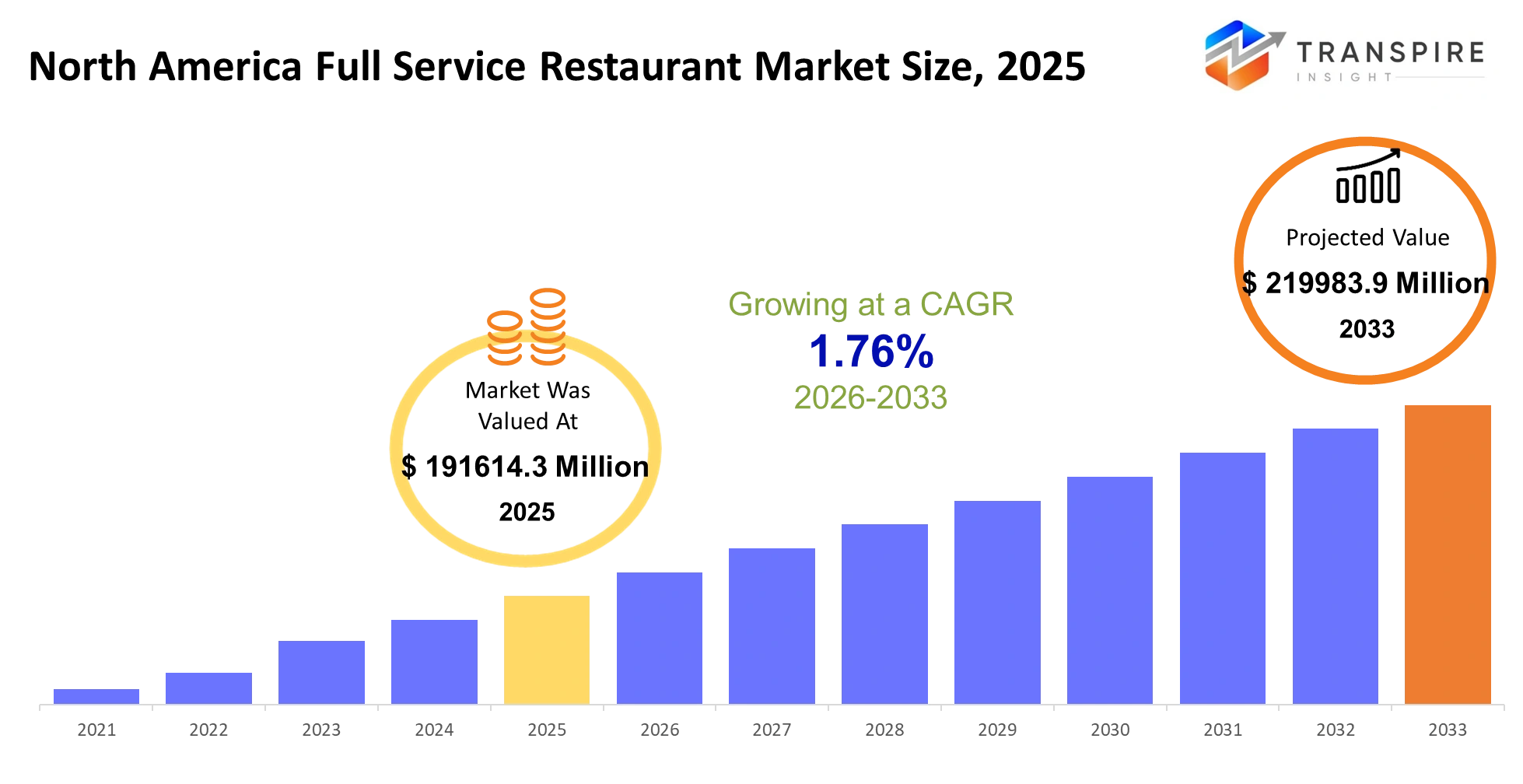
- North America Full Service Restaurant Market Size 2025: USD 191614.3 Million
- North America Full Service Restaurant Market Size 2033: USD 219983.9 Million
- North America Full Service Restaurant Market CAGR: 1.76%
- North America Full Service Restaurant Market Segments: By Type (Casual Dining, Fine Dining, Family Style, Ethnic Restaurants, Themed Restaurants, Others), By Application (Lunch, Dinner, Events, Parties, Catering, Others), By End-User (Individuals, Families, Corporates, Tourists, Groups, Others), By Service (Dine-in, Takeaway, Delivery, Catering, Online Orders, Others).
To learn more about this report,  Download Free Sample Report
North America Full Service Restaurant Market Summary:
The North America Full Service Restaurant Market size is estimated at USD 191614.3 Million in 2025 and is anticipated to reach USD 219983.9 Million by 2033, growing at a CAGR of 1.76% from 2026 to 2033. North America Full Service Restaurant Market shows consistent expansion because customers now prefer high-quality dining options which provide them with tailored dining experiences.
Full-service restaurants provide customers with high-quality meals which include multiple food options and a complete dining experience. The growth of experiential dining through themed restaurants and chef-driven restaurant concepts has increased demand for dining experiences in both urban and suburban locations.
Digital advancements and menu development lead restaurants to adopt online booking systems and contactless payment systems and customized menus which enable them to improve their customer service delivery. Health-conscious consumers make their purchasing decisions based on restaurants' health-oriented menu items and their use of fresh local produce along with eco-friendly methods. The market will continue its positive growth because people will have more money to spend and social dining habits will keep growing.
What Has the Impact of Artificial Intelligence Been on the North America Full Service Restaurant Market?
The North America Full Service Restaurant Market operates under fast-changing artificial intelligence systems which help businesses to analyze their data while gaining customer insights and tracking market changes. The North America Full Service Restaurant Market uses artificial intelligence to conduct advanced market research by using machine learning algorithms which process extensive datasets to find useful consumer behavior and dining pattern insights.
The North America Full Service Restaurant Market uses predictive analytics to assist operators with demand forecasting and menu optimization together with real-time pricing strategy alignment which improves market competitiveness. The North America Full Service Restaurant Market uses smart automation to boost production efficiency while simplifying its back-end operational systems.
Restaurants achieve better service speed and cost control through AI-powered inventory management and supply chain optimization which helps them minimize food waste. The North America Full Service Restaurant Market uses artificial intelligence to create personalized dining experiences through recommendation engines and targeted promotions which help businesses maintain customer loyalty while increasing their revenue. The North America Full Service Restaurant Market benefits from artificial intelligence because its adoption creates paths to innovation-based market differentiation and sustainable business growth.
Key Market Trends & Insights:
- The United States controls more than 75% of the North American full-service restaurant industry which will reach its market peak in 2025 because people spend more during their dining times at restaurants distributed throughout the area.
- The Canadian market grows at the highest rate because its urban centers expand and people seek various dining options until 2030 which will result in a compound annual growth rate exceeding 5%.
- The north america full service restaurant market gives casual dining restaurants more than 45% market share because their prices appeal to many customers.
- The second largest market segment for restaurants operates under fine dining because customers choose premium dining experiences and special events.
- The family-style restaurant market segment will grow at the highest rate between now and 2030 because more people want to dine together.
- Restaurants make 70% of their revenue from dine-in services because customers choose to experience dining in restaurants which provide good atmosphere and high-quality service.
- Testing digital platforms and hybrid dining systems has become the most popular method because users select dining options that offer the greatest comfort.
- Consumers who live in urban areas control more than 65% of the North American full service restaurant industry because their higher incomes match their lifestyle choices.
- Millennials and Gen Z represent the fastest-growing end-user segment, driven by preference for experiential and social dining environments.
North America Full Service Restaurant Market Segmentation
By Type
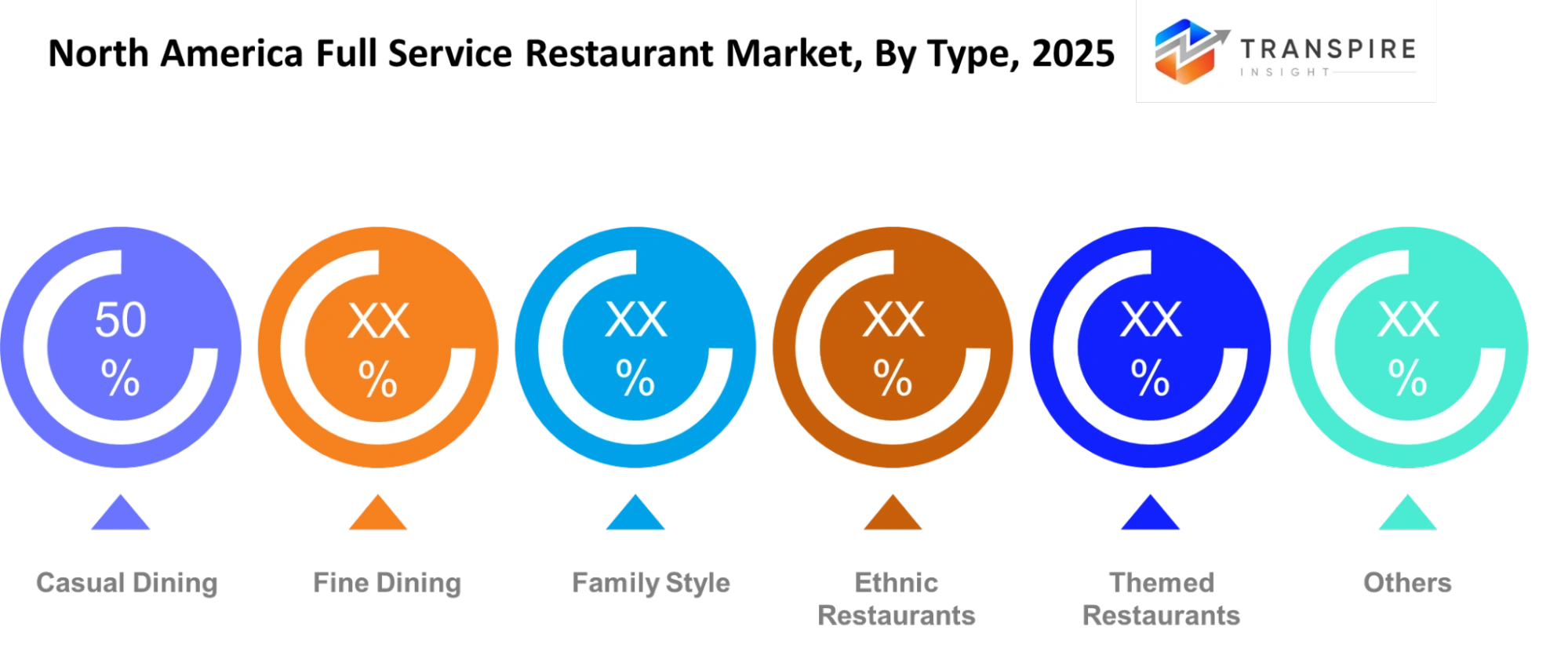
The affordable dining option attracts middle-income consumers because it offers budget-friendly meals and comfortable dining spaces which include a wide range of food options. Fine dining restaurants attract high-spending customers through their premium food ingredients and their formal dining service and their specially designed restaurant spaces. Family-style restaurants provide shared dining portions in a casual atmosphere which enables customers to dine together for social occasions.
Thematic restaurants achieve distinctive customer experiences through their interior design and restaurant concepts and their storytelling methods which boost customer interaction. Other formats include niche concepts that target specific tastes or dietary needs, adding diversity and flexibility to overall offerings.
To learn more about this report, Download Free Sample Report
By Application
The lunch service provides dining options which meet the needs of both working professionals and students who want quick access to high-quality meals during daytime hours. Social outings and family gatherings and premium dining experiences drive customers to choose dinner as their most important dining time. The business achieves consistent income through its event and party services which provide group reservations and custom menu options.
Catering services operate beyond restaurant boundaries to provide dining solutions for corporate functions and festive events and private gatherings. The business uses special promotional events and seasonal product launches to attract customers throughout the year. The business will establish dependable income streams while enhancing productivity through its strategy of distributing resources across various operational functions.
By End-User
People want to be able to pick their dishes from different options and receive their meals quickly. Families represent a major segment, seeking comfortable environments, value pricing, and diverse menu options for shared dining. Corporate clients contribute their needs through business meetings and team-building activities and formal dining events.
Tourists increase demand because they visit main locations to try local food and special dining options. Group customers drive higher order volumes through celebrations and social events. Other users include niche customer bases that prefer specific dining formats, adding stability and broader reach to customer segments.
By Service
Dine-in service offers its customers three main features which include atmospheric dining spaces and personalized dining service and complete dining experiences that lead to customer loyalty. Takeaway options support convenience for customers seeking quality meals without extended waiting time. The delivery market continues to expand because people now depend on digital platforms while their daily routines have changed.
Catering services provide bulk meal solutions for events and corporate needs, ensuring consistent demand. Online orders enable customers to order products more easily while tracking their order progress and getting better service because of technological upgrades. The organization uses hybrid service models which combine different service channels to create better customer access and operational flexibility.
What are the Main Challenges for the North America Full Service Restaurant Market Growth?
The north america full service restaurant market experiences multiple technical and operational issues that hinder its ability to maintain steady growth. Service quality and efficiency face challenges from complex kitchen operations and labor shortages and increasing input expenses. Supply chain disruptions which primarily impact fresh and imported ingredients lead to menu inconsistencies and pricing difficulties. The development obstacles within the north america full service restaurant market decrease business expansion capacity while they raise operational risks.
The north america full service restaurant market experiences manufacturing and commercialization obstacles because of high initial costs and ongoing operational expenses. The strict food safety regulations together with their compliance requirements create additional costs which hinder business expansion. The combination of rent costs and utility expenses and wage payments creates financial pressure that decreases profit margins for smaller operators, which makes it hard for them to grow their business. The market constraints of the industry create obstacles which delay innovation while blocking entry for new competitors.
The north american full service restaurant industry faces adoption obstacles which stem from its struggle to adopt advanced technology solutions and digital operational systems. The limited availability of trained workers together with training deficiencies prevents organizations from achieving effective implementation of their automation systems and data analysis tools. Modernization efforts face additional limitations through previous system upgrades and insufficient funding for current technologies. These factors create uneven growth across different regions and segments.
Regional Insights
The United States holds the largest share due to strong consumer spending, dense urban population, and wide presence of established restaurant chains. The demand for high-quality dining together with various dining options and digital dining solutions will create continuous growth in all major urban centers and their surrounding suburban regions.
Canada shows stable expansion supported by rising urbanization and demand for multicultural dining experiences. Mexico experiences steady growth because of its increasing tourism and bettering economic situation. The regional market performance depends on three factors: income levels, lifestyle patterns, and service quality investment, which will determine the future market equilibrium.
Recent Development News
In April 2026, Red Lobster Relaunches ‘Endless Shrimp’ After Financial Restructuring: Red Lobster reintroduced its popular promotion following past financial losses and bankruptcy restructuring efforts. The relaunch reflects a strategy to regain customer traffic while balancing pricing and profitability.
Source: https://people.com
In April 2026, Darden Expands Fine Dining Portfolio with New Capital Grille Opening: Darden Restaurants continues strategic expansion in the U.S. by opening a new Capital Grille location in Nashville. The move highlights ongoing investment in premium dining formats and portfolio diversification.
Source: https://www.the-sun.com
|
Report Metrics |
Details |
|
Market size value in 2025 |
USD 191614.3 Million |
|
Market size value in 2026 |
USD 194673.2 Million |
|
Revenue forecast in 2033 |
USD 219983.9 Million |
|
Growth rate |
CAGR of 1.76% from 2026 to 2033 |
|
Base year |
2025 |
|
Historical data |
2021 – 2024 |
|
Forecast period |
2026 – 2033 |
|
Report coverage |
Revenue forecast, competitive landscape, growth factors, and trends |
|
Country scope |
North America (Canada, The United States, and Mexico) |
|
Key company profiled |
McDonald's, Darden Restaurants, Yum! Brands, Restaurant Brands International, Chipotle, Starbucks, Domino’s, Wendy’s, Texas Roadhouse, Olive Garden, Cheesecake Factory, IHOP, Applebee’s, Panera Bread, Subway. |
|
Customization scope |
Free report customization (country, regional & segment scope). Avail customized purchase options to meet your exact research needs. |
|
Report Segmentation |
By Type (Casual Dining, Fine Dining, Family Style, Ethnic Restaurants, Themed Restaurants, Others), By Application (Lunch, Dinner, Events, Parties, Catering, Others), By End-User (Individuals, Families, Corporates, Tourists, Groups, Others), By Service (Dine-in, Takeaway, Delivery, Catering, Online Orders, Others). |
How Can New Companies Establish a Strong Foothold in the North America Full Service Restaurant Market?
The new companies that want to enter North America's full-service restaurant market must establish a specific market niche which requires both data analysis and a strong brand presence. Restaurants can create unique dining experiences by offering health-focused dining options and plant-based menu items and dishes from specific cultural backgrounds. The restaurant's market position will improve through sustainable product sourcing practices and high-quality customer experiences which create repeat business from dedicated customers.
The North American full-service restaurant market requires operators to adopt innovative technologies which will enable their businesses to develop. The new businesses in the market can use intelligent automation and artificial intelligence-based personalization and digital ordering systems to boost their operational performance and customer service. The delivery platforms and local suppliers and technology providers will help businesses grow by establishing operational systems that make it easier to enter new markets and reach business targets.
The restaurants that operate in North America need to solve three major industry problems which include labor shortages and cost management and supply chain breakdowns to gain market advantages. The restaurant management system developed by Toast and the cloud-based dining analytics startup demonstrate how innovative methods can transform operational processes for new business competitors. The new companies will create business resilience through these methods which will enable them to adjust their operations according to changing industry patterns.
Key North America Full Service Restaurant Market Company Insights
The established brands compete with new market entrants to deliver diverse menus while maintaining affordable prices and providing excellent service. Companies that lead their markets use brand awareness together with extensive service locations to deliver uniform experiences for their clients. The company will achieve long-term success through its ongoing investment in technology and digital ordering systems and loyalty initiatives.
The company will achieve revenue growth and market expansion through its planned operations in both urban and suburban regions. The company will achieve better operational performance through its partnerships with delivery platforms and suppliers which will also help it save costs. Menu design innovation together with sustainable practice development and effective customer engagement strategies will enable businesses to remain competitive while meeting new consumer market demands.
Company List
- McDonald's
- Darden Restaurants
- Yum! Brands
- Restaurant Brands International
- Chipotle
- Starbucks
- Domino’s
- Wendy’s
- Texas Roadhouse
- Olive Garden
- Cheesecake Factory
- IHOP
- Applebee’s
- Panera Bread
- Subway
What are the Key Use-Cases Driving the Growth of the North America Full Service Restaurant Market?
The north america full service restaurant market is expanding because customers want to dine with friends and conduct business meetings and experience high-end dining. Corporate dining stands as the main purpose where restaurants provide their spaces for client meetings and team activities and formal business events. The restaurant maintains its business through weekday customer visits which enable it to sell premium menu items that help the restaurant expand its overall market presence.
Family and group dining also play a major role in the north america full service restaurant market because consumers want to dine in restaurants that provide festive spaces for their special occasions and their Saturday dining experiences. Restaurants that provide different menu options together with bigger dining areas and special customer services succeed in bringing back their customers. The business model generates predictable income streams which result in establishing permanent relationships with customers.
The north america full service restaurant market experiences increased restaurant demand because of dining activities related to tourism and travel. Visitors prefer dining experiences that offer authentic local food and cultural dining experiences. Restaurants situated in important tourist destinations achieve revenue growth through seasonal demand increases which also enhance their brand recognition.
North America Full Service Restaurant Market Report Segmentation
By Type
- Casual Dining
- Fine Dining
- Family Style
- Ethnic Restaurants
- Themed Restaurants
- Others
By Application
- Lunch
- Dinner
- Events
- Parties
- Catering
- Others
By End-User
- Individuals
- Families
- Corporates
- Tourists
- Groups
- Others
By Service
- Dine-in
- Takeaway
- Delivery
- Catering
- Online Orders
- Others
Frequently Asked Questions
Find quick answers to common questions.
The approximate North America Full Service Restaurant Market size for the market will be USD 219983.9 Million in 2033.
The key segments of the North America Full Service Restaurant Market are By Type (Casual Dining, Fine Dining, Family Style, Ethnic Restaurants, Themed Restaurants, Others), By Application (Lunch, Dinner, Events, Parties, Catering, Others), By End-User (Individuals, Families, Corporates, Tourists, Groups, Others), By Service (Dine-in, Takeaway, Delivery, Catering, Online Orders, Others).
Major players in the North America Full Service Restaurant Market are McDonald's, Darden Restaurants, Yum! Brands, Restaurant Brands International, Chipotle, Starbucks, Domino’s, Wendy’s, Texas Roadhouse, Olive Garden, Cheesecake Factory, IHOP, Applebee’s, Panera Bread, Subway.
The current market size of the North America Full Service Restaurant Market is USD 191614.3 Million in 2025.
The North America Full Service Restaurant Market CAGR is 1.76%.
- McDonald's
- Darden Restaurants
- Yum! Brands
- Restaurant Brands International
- Chipotle
- Starbucks
- Domino’s
- Wendy’s
- Texas Roadhouse
- Olive Garden
- Cheesecake Factory
- IHOP
- Applebee’s
- Panera Bread
- Subway
Recently Published Reports
-
Apr 2026
Baby Infant Formula Market
Baby Infant Formula Market Size, Share & Analysis Report By ype (Infant Milk, Follow On Milk, Specialty Baby Milk, Growing-Up Milk), By Ingredient (Carbohydrate, Fat, Protein, Minerals, Vitamins, and Others), By Product Form (Powder, Liquid, and Ready-to-feed), By Distribution Channels (Supermarket/Hypermarket, Specialty Store, Pharmacies, Online Retail, and Others), and Geography (North America, Europe, Asia-Pacific, Middle East and Africa, South and Central America), 2021 - 2031
-
Apr 2026
Edible Insects for Animal Feed Market
Edible Insects for Animal Feed Market Size, Share & Analysis Report By Type (Insect Powder, Insect Meal, Insect Bar, Insect Paste, Insect Oil, and Others), By Insect Type (Beetles, Cricket, Caterpillar, Hymenoptera, Orthoptera, Tree Bugs, and Others), By Application (Livestock, Pet Food, and Aquaculture), By Livestock Type (Poultry, Swine, and Others), and Geography (North America, Europe, Asia-Pacific, Middle East and Africa, South and Central America), 2021 - 2031
-
Apr 2026
Food Industry Disinfection and Bacterial Control Market
Food Industry Disinfection and Bacterial Control Market Size, Share & Analysis Report By Type (Chemical Disinfectants, Physical Disinfectants, and Biocides and Antimicrobials), By Application (Food Processing Equipment Surface Disinfection, Food Preparation Areas Surface Disinfection, Storage Areas Surface Disinfection, Anti-microbial Coatings Food Preservation, and Preservative Solutions Food Preservation), By End User (Meat and Poultry Processing, Dairy Processing, Seafood Processing, Bakery and Confectionery, Restaurants and Commercial Kitchens, and Food Service Providers), By Sales Channel (Online, Offline), and Geography (North America, Europe, Asia-Pacific, Middle East and Africa, South and Central America), 2021 - 2031
-
Apr 2026
Freeze Dried Food Market
Freeze Dried Food Market Size, Share & Analysis Report By Product Type (Fruits, Vegetables, Freeze-Dried Dairy Products, Freeze-Dried Meat and Seafood, Freeze-Dried Pet Food, and Prepared Meal), By Nature (Organic, and Conventional), By Form (Powdered, Granules, and Diced), By End Use (Breakfast Cereals, Dairy Products, Bakery & Confectionery, Nutritional Bars & Supplements, Powdered Beverages, Snacks, and Retail (Household)), and Geography (North America, Europe, Asia-Pacific, Middle East and Africa, South and Central America), 2021 - 2031