

France Commercial Catering Equipment Market Size & Forecast:
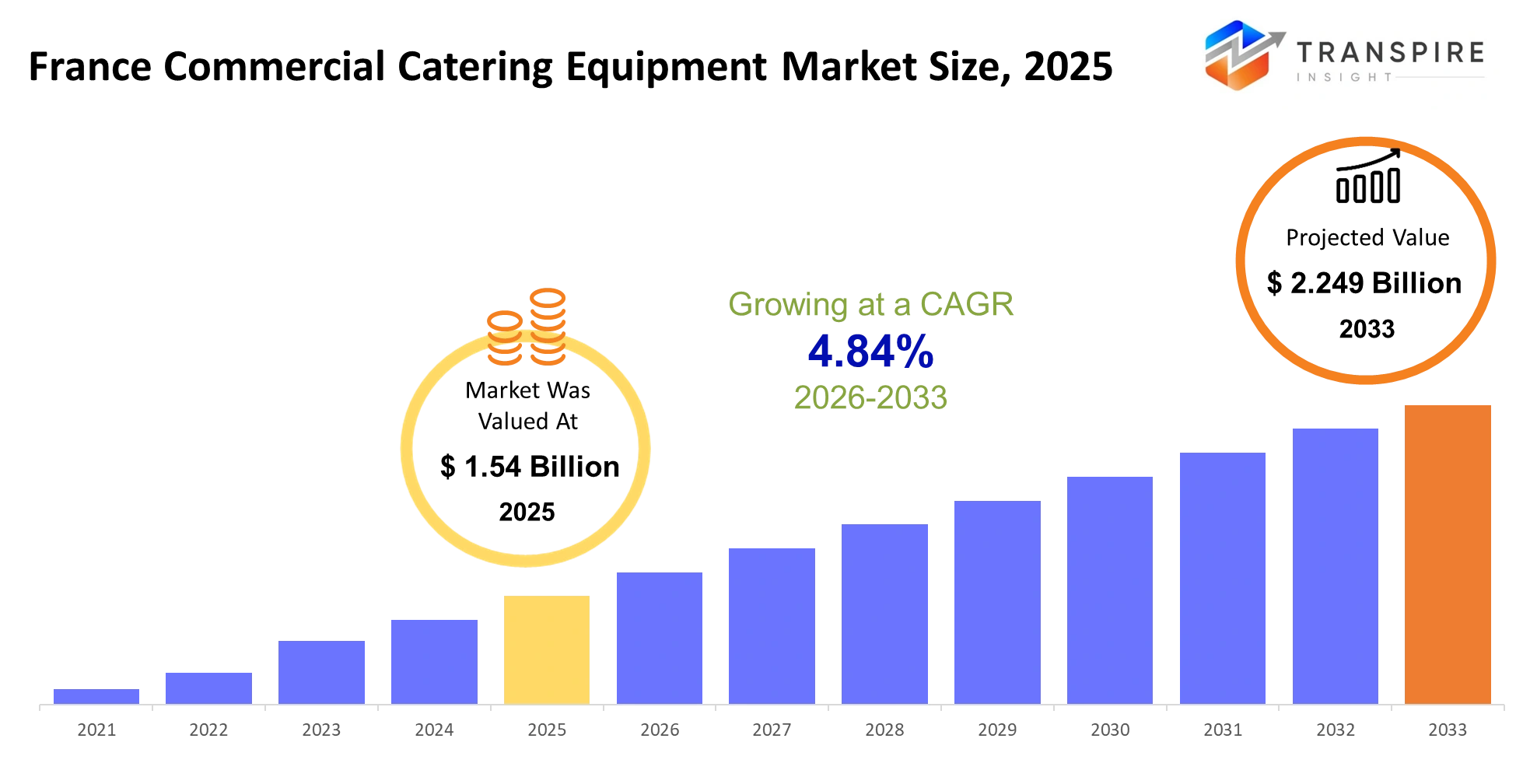
- France Commercial Catering Equipment Market Size 2025: USD 1.54 Billion
- France Commercial Catering Equipment Market Size 2033: USD 2.249 Billion
- France Commercial Catering Equipment Market CAGR: 4.84%
- France Commercial Catering Equipment Market Segments: By Type (Cooking, Refrigeration, Dishwashing, Preparation, Others); By Application (Restaurants, Hotels, Catering, Institutional, Others); By End-User (Hotels, Restaurants, Cafes, Catering, Hospitals, Others); By Distribution (Direct, Distributor, Online, Others).
To learn more about this report,  Download Free Sample Report
France Commercial Catering Equipment Market Summary
The France Commercial Catering Equipment Market was valued at USD 1.54 Billion in 2025. It is forecast to reach USD 2.249 Billion by 2033. That is a CAGR of 4.84% over the period.
The commercial catering equipment market in France functions as the essential infrastructure which enables restaurants, hotels, institutional kitchens, bakeries, and quick-service restaurants to perform their operations through its capacity to support large-scale food processing and storage needs and its sanitary services and its energy-saving cooking methods. The operational requirements of commercial kitchens depend on these systems which enable them to deliver their services with optimal speed while meeting hygiene standards and operating efficiency and maintaining food quality during their busiest times. The market evolved during the past five years from its previous use of standard stainless-steel equipment to its present adoption of energy-efficient connected systems which use Internet of Things technology for monitoring and automatic temperature regulation.
The hospitality and foodservice industries in France experienced increased replacement rates for their equipment following the implementation of stricter commercial energy rules and the new hygiene requirements which came after the pandemic. The period between 2021 and 2023 experienced supply chain interruptions which led buyers to shift their focus towards equipment that provided local service and modular components which helped decrease equipment downtime. The current market growth depends on three key factors which include restaurant infrastructure updates and cloud kitchen expansion and increasing labor expenses. Restaurant operators are making more investments in cooking and refrigeration systems that use automation because these systems decrease energy use while enhancing kitchen production and decreasing future operational costs.
Key Market Insights
- The commercial catering equipment market in France experienced its biggest revenue share from Northern France which established 36 percent of total sales in 2025 due to its extensive network of restaurants and hotels.
- The fastest growth in Southern France until 2033 will result from increased hospitality investments which drive the development of commercial kitchen facilities.
- The market in 2025 recorded its highest share from refrigeration equipment because restaurants and bakeries and institutional kitchens needed to comply with stricter food safety regulations.
- The quick-service restaurant segment used automated fryers and combi ovens and induction cooking systems to create its second biggest segment which included cooking equipment.
- Smart connected kitchen systems represent the fastest-growing segment through 2033 because they enable businesses to optimize labor and conduct predictive maintenance.
- The commercial catering equipment market in 2025 showed full-service restaurants as the biggest customer segment because restaurants upgraded their kitchens with new technology after the pandemic.
- The period from 2024 to 2033 saw cloud kitchens and delivery-focused foodservice operators become the fastest-growing application category in the market.
- The premium tourism recovery led hotels and hospitality groups to maintain substantial market share while they increased their investments in energy-efficient commercial kitchens.
- Institutional catering in hospitals and schools implemented automated dishwashing and food holding systems to achieve compliance with hygiene standards.
- Manufacturers use AI-powered cooking controls and remote diagnostic tools and energy tracking systems to create competitive benefits for both their operations and service delivery.
What are the Key Drivers, Restraints, and Opportunities in the France Commercial Catering Equipment Market?
The France commercial catering equipment market grows because professional kitchens undergo modern upgrades which result from both energy price fluctuations and labor shortages. French restaurant operators and institutional foodservice providers increasingly deploy automated cooking systems, programmable combi ovens, and smart refrigeration units because labor-intensive kitchen operations have become more expensive since 2021. The government development of energy efficiency programs together with improved HACCP food safety regulations has caused restaurants to replace their old equipment at an increased rate. The manufacturers who create equipment achieve greater profits through their sales of connected systems that optimize energy usage than through basic hardware replacement sales.
The high capital expenditure required for advanced commercial kitchen infrastructure remains the most important barrier. Smart catering systems need integrated ventilation systems together with electrical upgrades and software connectivity and trained operators which creates a structural barrier for small restaurants and independent cafés. Many businesses continue extending the life cycle of older equipment because financing costs and installation disruptions reduce short-term affordability. Businesses will experience delayed technology adoption while suppliers will lose out on potential revenue from aftersales maintenance contracts.
The rapid growth of cloud kitchens and centralized food preparation facilities throughout urban France creates a major opportunity for businesses. Delivery-focused operators increasingly invest in modular, high-throughput cooking equipment integrated with IoT monitoring and predictive maintenance tools. The cities of Paris Lyon and Marseille are experiencing increased financial backing for compact automated kitchen systems which enhance their ability to utilize space and process customer orders.
What Has the Impact of Artificial Intelligence Been on the France Commercial Catering Equipment Market?
The France commercial catering equipment market experiences transformation through artificial intelligence and digital technologies which enhance kitchen automation and operational standardization and equipment management through predictive analytics capabilities. Commercial kitchens increasingly adopt AI-powered combi ovens and refrigeration systems and dishwashing machines that use sensors to continuously track cooking temperatures and humidity levels and compressor performance and energy usage. The systems use their automated features to decrease food waste while providing continuous food output during peak service times.
Machine learning models are also being applied for predictive maintenance across refrigeration and cooking equipment fleets. Operators can identify compressor failures, abnormal energy consumption, or ventilation inefficiencies before equipment breakdown occurs. This method increases kitchen operation time while decreasing costs for unplanned repairs. Several premium manufacturers now integrate remote diagnostics platforms that help foodservice chains reduce energy consumption by double-digit percentages through automated optimization routines.
AI-driven analytics additionally support inventory synchronization and production planning within cloud kitchens and institutional catering facilities. Operators achieve faster preparation cycles while maintaining better compliance tracking and decreasing utility costs. The restaurant industry faces adoption challenges because independent restaurants must spend large amounts to connect their outdated systems. Many smaller operators still lack the digital connectivity and technical expertise required to deploy advanced smart kitchen ecosystems effectively.
Key Market Trends
- The period since 2022 has seen French restaurants replace their gas cooking systems with induction cooking systems which help them decrease their energy costs and their need for ventilation.
- After 2023 operators adopted smart refrigeration systems because they required automated temperature logging and food safety compliance tracking solutions.
- The cloud kitchen industry experienced rapid growth in Paris and Lyon which created a need for small cooking systems that could be monitored remotely. Between 2021 and 2025 hospitality chains adopted modular kitchen designs which enabled easier maintenance and shorter renovation times.
- The need for pandemic hygiene measures led to increased use of automated dishwashing systems because organizations required better cleaning standards for their food service areas.
- Rational AG developed AI-powered cooking systems which enable commercial kitchens to run cooking operations with less need for chef supervision.
- After 2022 manufacturing companies set up local service centers to handle post-sale equipment repairs because supply chain problems created delays with imported parts and equipment.
- The use of connected kitchen management systems increased after European countries experienced high energy costs during the years 2022 and 2023.
- Premium hotel operators increasingly adopted energy recovery ventilation systems to reduce utility costs and improve sustainability performance benchmarks.
- Foodservice operators shifted toward predictive maintenance contracts beginning in 2024 to minimize equipment failures during high-volume operating periods.
France Commercial Catering Equipment Market Segmentation
By Type
Cooking equipment holds the largest share of commercial kitchen investments because restaurants, hotels, and institutional foodservice facilities rely on ovens, fryers, grills, and induction systems for daily meal preparation. Programmable combi ovens and automated cooking stations emerged as the preferred solution for operators who sought to decrease manual work while achieving uniform product output because rising labor expenses and new energy efficiency regulations compelled them to adopt these technologies. Quick-service restaurants and delivery-focused kitchens choose to use multifunctional cooking systems because these systems enable them to deliver food more quickly while producing higher volumes of meals during their busiest times.
Refrigeration equipment remains a strong secondary segment because food safety regulations demand precise temperature management during both storage and food preparation activities. Hospitality operators are increasingly investing in automated dishwashing systems that lower water consumption and reduce dependence on manual labor. Bakeries and centralized catering facilities that want to boost their operational efficiency now increasingly adopt preparation equipment which includes mixers and slicers and food processors. Smart kitchen modernization projects currently underway benefit all kitchen functions which include ventilation and food holding systems. Connected cooking and refrigeration technologies will receive the most funding during the forecast period because operators prioritize both energy management and their capabilities to maintain equipment performance over extended periods.

To learn more about this report, Download Free Sample Report
By Application
The primary application area for restaurants exists because commercial dining establishments need to upgrade their equipment and modernize their kitchen systems in order to deliver efficient services. Independent restaurants and quick-service chains increasingly use automated cooking, refrigeration, and warewashing systems to improve food consistency while reducing staffing pressure. Delivery-focused dining models have created a greater need for kitchen equipment which combines multiple functions and enables restaurants to process orders quickly while using their space effectively.
Hotels maintain a major market presence because of their extensive banquet facilities and upscale dining operations and ongoing hospitality development projects which serve the tourism industry. The catering industry experiences steady growth because corporate events and transportation catering and institutional meal programs create a need for mobile kitchen systems and high-capacity kitchen systems. Institutional facilities such as schools and healthcare centers are also investing in hygienic and energy-efficient equipment designed to support standardized meal preparation and strict food safety requirements.Other application areas such as entertainment venues and food courts remain niche but benefit from rising urban commercial infrastructure development. Automated systems and centralized food preparation will drive catering and institutional foodservice segments to achieve stronger growth opportunities in upcoming years.
By End-User
Restaurants hold the dominant end-user share because commercial dining establishments constantly focus on improving kitchen productivity and food consistency and service speed. National restaurant chains are increasing their use of smart cooking systems together with connected refrigeration platforms to solve their labor shortages and rising energy costs. Urban foodservice markets create intense competition for restaurants which forces them to spend money on advanced kitchen equipment that provides superior performance.
Luxury hotels maintain a strong market position because premium hospitality operators require advanced kitchen systems to support large-scale dining services and banquet operations. Cafes are steadily increasing investments in compact refrigeration units and beverage preparation equipment and energy-efficient ovens which are designed for smaller urban spaces. Catering companies continue purchasing modular cooking and food holding systems to improve their mobility and operational efficiency when they serve large events. Hospitals are becoming a major growth area for healthcare foodservice providers who need automated sanitation and meal preparation systems to meet strict hygiene requirements. Over the forecast period hospitals and catering providers will increase their spending on connected equipment platforms which require low maintenance and are designed for continuous operation.
By Distribution
The hotel industry and institutional clients prefer direct distribution channels because they want custom purchasing contracts and equipment installation help and ongoing maintenance agreements. Equipment manufacturers build direct sales networks which provide technical support and equipment maintenance and digital tracking services to their customers. Direct distribution allows premium kitchen system providers to control their customer support operations and their equipment installation procedures.
Distributor networks maintain a strong secondary presence because regional dealers provide localized inventory access, installation capabilities, and faster replacement support for independent foodservice operators. The online distribution channels experience rapid growth because smaller restaurants and cafes use digital procurement platforms to purchase standardized kitchen appliances. Digital sales platforms enable budget-conscious customers to compare products and see price information. Startup foodservice operators show increasing interest in leasing and rental models which are currently limited but these models provide a way to reduce initial equipment costs. The hybrid sales approach which combines direct customer service with online procurement will create new competitive dynamics for commercial kitchen equipment distribution networks throughout the upcoming forecast period.
What are the Key Use Cases Driving the France Commercial Catering Equipment Market?
French commercial catering equipment usage develops through the primary need of restaurants and hotels and institutional kitchens. High-volume food preparation environments require combi ovens and refrigeration systems and dishwashers and automated cooking equipment to enable their operation in hygienic conditions while decreasing staff requirements and speeding up their service delivery. Restaurant chains that provide full services together with hospitality businesses create the highest equipment requirements because they constantly update their kitchen facilities to reduce energy expenses while preserving consistent business operations.
The secondary use cases establish their presence in hospitals and school canteens and corporate catering facilities. The operators use programmable cooking systems together with automated warewashing equipment to produce standardized meals which comply with food safety standards. Bakery chains and quick-service restaurants also accelerated their investments in compact high-throughput kitchen systems which their delivery-focused operations require.
Cloud kitchens and AI-connected smart kitchens developed into new applications which now use predictive maintenance software. Modular induction-based cooking environments which reduce kitchen footprint and energy consumption have been tested by luxury tourism venues and premium event catering operators.
|
Report Metrics |
Details |
|
Market size value in 2025 |
USD 1.54 Billion |
|
Market size value in 2026 |
USD 1.616 Billion |
|
Revenue forecast in 2033 |
USD 2.249 Billion |
|
Growth rate |
CAGR of 4.84% from 2026 to 2033 |
|
Base year |
2025 |
|
Historical data |
2021 - 2024 |
|
Forecast period |
2026 - 2033 |
|
Report coverage |
Revenue forecast, competitive landscape, growth factors, and trends |
|
Regional scope |
France |
|
Key company profiled |
Rational, Middleby, Electrolux, Ali Group, Hobart, Welbilt, ITW, Fujimak, Hoshizaki, Alto-Shaam, Manitowoc, True Mfg, Winterhalter, Dover, Duke. |
|
Customization scope |
Free report customization (country, regional & segment scope). Avail customized purchase options to meet your exact research needs. |
|
Report Segmentation |
By Type (Cooking, Refrigeration, Dishwashing, Preparation, Others); By Application (Restaurants, Hotels, Catering, Institutional, Others); By End-User (Hotels, Restaurants, Cafes, Catering, Hospitals, Others); By Distribution (Direct, Distributor, Online, Others). |
Which Regions are Driving the France Commercial Catering Equipment Market Growth?
Northern France maintains its market leadership in commercial catering equipment because the region holds a substantial portion of France's hospitality and tourism and institutional foodservice facilities. The urban areas of Paris and its neighboring cities maintain extensive restaurant and hotel and hospital and catering business networks which need ongoing kitchen upgrades. International equipment manufacturers and service providers find the area appealing because it offers strong transportation links and existing food distribution networks. High replacement needs for automated kitchen systems which use energy more efficiently arise from the presence of premium hospitality brands and corporate dining spaces.
Eastern France functions as an industrial and manufacturing center which produces commercial kitchen equipment. The region receives consistent financial backing for its food processing and institutional catering and equipment assembly operations which operate independently of tourist demand. The region experiences consistent technology adoption because of its strong cross-border trade connections with Germany and Switzerland. The region attracts manufacturers because it offers a skilled technical workforce and direct access to European supply chains which enhances their ability to provide service and support after sales.
Southern France experiences its highest growth rate because of increasing tourist numbers and higher funding for delivery-based dining operations. The cities of Marseille and Nice and Toulouse experienced an increase in restaurant openings and hotel renovations after the travel industry showed strong recovery between 2023 and 2025. Regional operators increasingly adopted compact, modular kitchen systems designed for space efficiency and high seasonal throughput.
Who are the Key Players in the France Commercial Catering Equipment Market and How Do They Compete?
The France commercial catering equipment market shows moderate consolidation because multinational manufacturers use technological innovations and service abilities and energy-efficient products to compete with their rivals without using price as a factor. Existing businesses maintain their market position through the development of connected kitchen ecosystems and predictive maintenance systems, while specialized manufacturers use their unique cooking technologies and custom installations to compete in the market. The market increasingly rewards companies capable of combining hardware, software, and after-sales servicing into integrated commercial kitchen solutions.
Rational AG competes through intelligent cooking automation and multifunctional combi oven systems that reduce labor dependency inside professional kitchens. The iCombi and iVario platforms present distinct market advantages through their AI-powered cooking controls and their ability to create custom operational procedures and their reduced energy requirements. The company established european manufacturing operations in 2026 through its Mulhouse production facility expansion which enables them to meet rising demand for multifunctional cooking systems.
Welbilt delivers connected kitchen ecosystems through its KitchenConnect digital platform and its equipment portfolio which operates through automation. The company distinguishes itself through its combination of cloud-based kitchen monitoring and remote diagnostic systems and its ability to connect different kitchen equipment from multiple brands which it provides to both restaurant and hospitality businesses. Electrolux Professional competes through sustainability-focused kitchen systems which achieve optimal energy and water efficiency in institutional catering environments.
Company List
- Rational
• Middleby
• Electrolux
• Ali Group
• Hobart
• Welbilt
• ITW
• Fujimak
• Hoshizaki
• Alto-Shaam
• Manitowoc
• True Mfg
• Winterhalter
• Dover
• Duke
Recent Development News
In January 2026, Rational AG launched the iHexagon accelerated cooking oven in France. The system combines steam, convection, and microwave technologies to improve cooking speed and operational efficiency in professional kitchens.
Source: https://www.restauration-collective.com
In February 2025, Welbilt announced construction of a new Experience Center in Texas focused on connected kitchen technologies and automation solutions. The investment enhances customer engagement and supports development of smart commercial kitchen ecosystems for global foodservice operators.
Source: https://www.welbilt.com/
What Strategic Insights Define the Future of the France Commercial Catering Equipment Market?
The France commercial catering equipment market is developing kitchen ecosystems through its current transition which will take five to seven years to complete. Foodservice operators must adopt integrated smart kitchen platforms because they face three challenges which include ongoing labor shortages and stricter energy regulations and increasing operational expenses. The industry will experience a competitive shift because companies will start to value their software integration capabilities and their lifecycle support and their operational analysis more than their hardware products.
One hidden risk involves growing dependence on electronic components and advanced semiconductors used in smart kitchen systems. Operators with narrow profit margins face higher capital expenses because supply disruptions and extended component shortages lead to longer equipment delivery cycles. The development of AI-enabled cloud kitchen infrastructure in urban France represents a significant business opportunity which combines compact automated systems with high-volume delivery operations that require less labor.
Market participants should prioritize partnerships with software providers and regional servicing networks because long-term competitive advantage will depend less on equipment sales alone and more on recurring digital support and operational optimization services.
France Commercial Catering Equipment Market Report Segmentation
By Type
- Cooking
- Refrigeration
- Dishwashing
- Preparation
- Others
By Application
- Restaurants
- Hotels
- Catering
- Institutional
- Others
By End-User
- Hotels
- Restaurants
- Cafes
- Catering
- Hospitals
- Others
By Distribution
- Direct
- Distributor
- Online
- Others
Frequently Asked Questions
Find quick answers to common questions.
The confirmed 2033 market size figure in USD 2.249 Billion.
Key segments for the France Commercial Catering Equipment Market are By Type (Cooking, Refrigeration, Dishwashing, Preparation, Others); By Application (Restaurants, Hotels, Catering, Institutional, Others); By End-User (Hotels, Restaurants, Cafes, Catering, Hospitals, Others); By Distribution (Direct, Distributor, Online, Others).
Major France Commercial Catering Equipment Market players are Rational, Middleby, Electrolux, Ali Group, Hobart, Welbilt, ITW, Fujimak, Hoshizaki, Alto-Shaam, Manitowoc, True Mfg, Winterhalter, Dover, Duke.
The France Commercial Catering Equipment Market size is USD 1.54 Billion in 2025.
The France Commercial Catering Equipment Market CAGR is 4.84% from 2026 to 2033.
• Rational
• Middleby
• Electrolux
• Ali Group
• Hobart
• Welbilt
• ITW
• Fujimak
• Hoshizaki
• Alto-Shaam
• Manitowoc
• True Mfg
• Winterhalter
• Dover
• Duke
Recently Published Reports
-
Apr 2026
Bottled Water Market
Bottled Water Market Size, Share & Analysis Report By Product Type (Still Bottled Water, Carbonated Bottled Water, Functional Bottled Water, and Others), By Packaging (PET, Cans, and Others), By Sales Channel (Supermarkets/Hypermarkets, Convenience Stores/Drug Stores, Grocery Stores/Club Stores, Foodservice, and Others) and Geography (North America, Europe, Asia-Pacific, Middle East and Africa, South and Central America), 2021 - 2032
-
Apr 2026
Color Cosmetic Packaging Market
Color Cosmetic Packaging Market Size, Share & Analysis Report By Application (Mascara Packaging, Liquid Packaging, and Liquid Face), By Type (Tubes & Bottles, Pens & Markers, Compacts & Containers, and Droppers & Pumps), and Geography (North America, Europe, Asia-Pacific, Middle East and Africa, South and Central America), 2021 - 2031
-
Apr 2026
External Microphone For Camera Market
External Microphone For Camera Market Size, Share & Analysis Report By Type (Shotgun Microphone, Lavalier Microphone, and Others), By Application (Digital Camera, Professional Video Camera, and Others), and Geography (North America, Europe, Asia-Pacific, Middle East and Africa, South and Central America), 2021 - 2031
-
Apr 2026
Foot Orthotic Insoles Market
Foot Orthotic Insoles Market Size, Share & Analysis Report By Type (Pre-fabricated, and Custom-made), By Material (Thermoplastic, Composite Carbon Fiber, and Others), By Distribution Channel (Drug Stores, Hospitals & Clinics, and Others), and Geography (North America, Europe, Asia-Pacific, Middle East and Africa, South and Central America), 2021 - 2031