

United Kingdom Brewer's Yeast Market Size & Forecast:
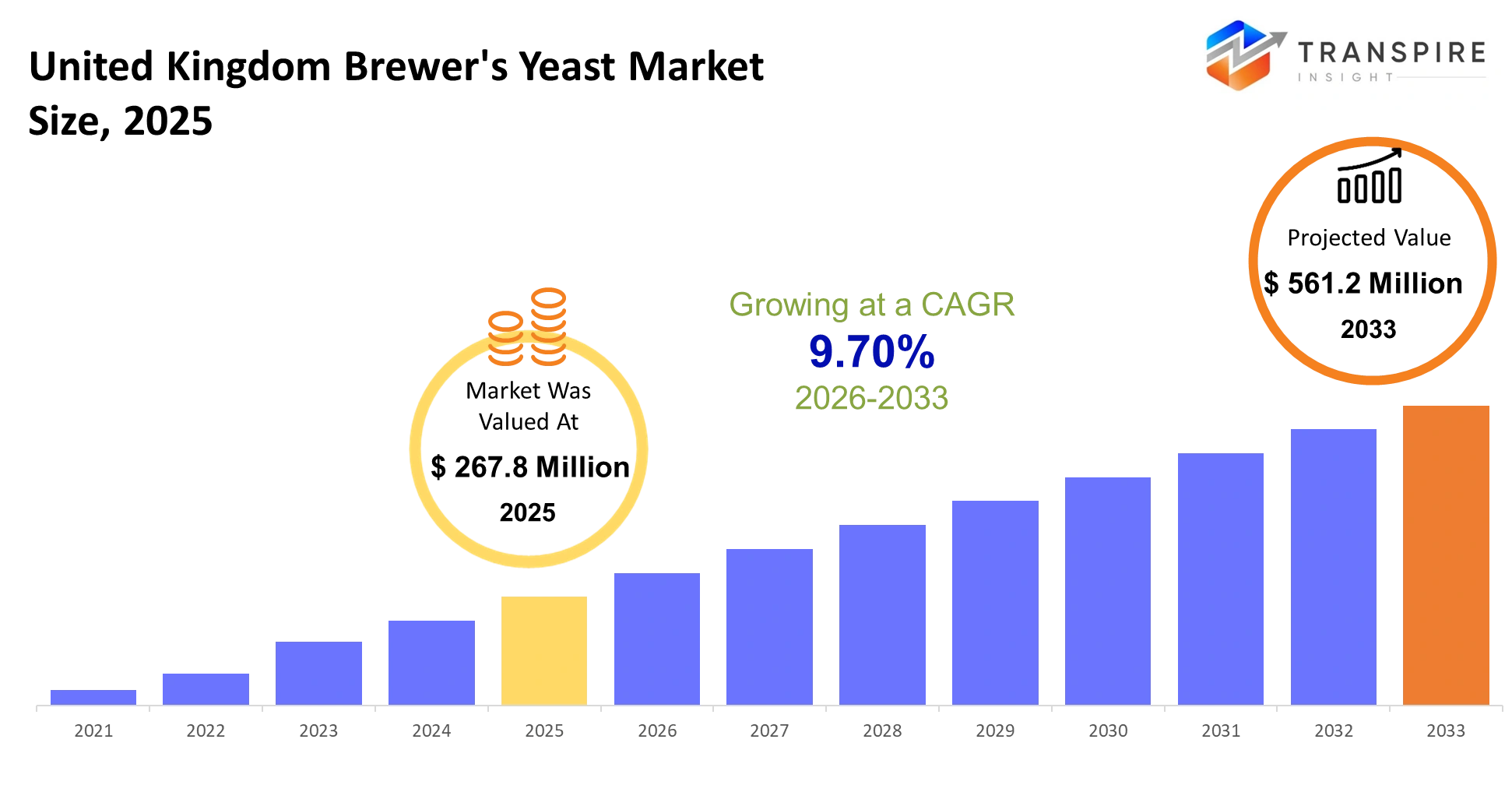
- United Kingdom Brewer's Yeast Market Size 2025: USD 267.8 Million
- United Kingdom Brewer's Yeast Market Size 2033: USD 561.2 Million
- United Kingdom Brewer's Yeast Market CAGR: 9.70%
- United Kingdom Brewer's Yeast Market Segments: By Form (Dry Yeast, Liquid Yeast, Instant Yeast, Active Dry Yeast, Others); By Application (Alcoholic Beverages, Animal Feed, Food Supplements, Bakery Products, Others); By Distribution Channel (Online Retail, Supermarkets, Specialty Stores, B2B Sales, Others); By End User (Breweries, Food Industry, Nutraceutical Industry, Animal Feed Industry, Others)
To learn more about this report,  Download Free Sample Report
United Kingdom Brewer's Yeast Market Summary
The United Kingdom Brewer's Yeast Market was valued at USD 267.8 Million in 2025. It is forecast to reach USD 561.2 Million by 2033. That is a CAGR of 9.70% over the period.
Brewer’s yeast in the United Kingdom basically works like a central biological input across food processing, animal nutrition and also fermentation based manufacturing, where it gets used to boost feed efficiency in livestock, enrich the nutritional profile for functional foods, and keep fermentation working steady in brewing and biotech outputs. In practice it lets makers reach a more consistent yield quality, at the same time lowering how much they lean on synthetic additives in feed mixes and food formulations, or so it feels like in day to day production.
Over the last 3–5 years the market has leaned in a more structural way toward higher value nutritional yeast derivatives, especially protein rich types and beta-glucan enhanced variants that show up in animal feed and health oriented food products. A key trigger was that the global grain and feed supply chains got disrupted, due to geopolitical frictions and those pandemic era logistics snags, and that pushed UK producers toward squeezing better feed conversion efficiency using yeast based additives. The net effect is that livestock operators got stronger cost control, even while input prices stayed jumpy.
So, demand really has strengthened, because brewer’s yeast now acts not just like a fermentation by product, but more like a cost optimizing nutritional ingredient. That makes it easier for feed manufacturers and food formulators to adopt it quicker, and keep using it longer in their recipes.
Key Market Insights
- The United Kingdom brewer’s yeast market is getting bigger mainly because more people want natural protein add-ins and functional food components from 2025 to 2030 .
- In the middle of it all, vegan and plant based eating habits are really pushing brewer’s yeast into dietary supplements , and also into fortified food stuff.
- At the same time, the UK market kind of rides on strong use in animal feed, so in 2025 it makes up something like 35–40% of the total application need.
- Clean-label ingredients are also a big driver, with more than 60% of consumers saying they prefer natural food additives by 2026.
- On top of that, fermentation and yeast extraction processes are improving, and those tech upgrades help raise yield and also sharpen the nutritional profile.
- In terms of geography, England is the main player, taking roughly 55–60% of the United Kingdom brewer’s yeast market in 2025, helped by solid food manufacturing clusters.
- Meanwhile Scotland and the Northern regions are growing quicker, projected to move ahead at about 6–8�GR through 2030, largely due to rising biotech investments.
- Cities such as London and Manchester show a noticeable lift in demand for dietary supplements , and even functional drinks using brewer’s yeast.
- Plus, the regional growth trend is backed by nutraceutical production ramp ups and the wider food processing industry across the whole UK.
- For product type, powdered brewer’s yeast holds the largest slice , nearly 45% in 2025, mostly because it is easier to formulate and it stays usable longer with a steady shelf life .
What are the Key Drivers, Restraints, and Opportunities in the United Kingdom Brewer's Yeast Market?
The United Kingdom Brewer’s Yeast Market seems mostly moved by that fast shift toward high-protein functional ingredients in food , and feed manufacturing. This driver kind of showed up once the reformulation standards got stricter in 2023–2024, which basically pushed makers to swap synthetic additives for more natural yeast based protein and vitamin sources. Because of that, brewer’s yeast uptake has been growing in nutraceutical blends and also livestock feed premixes, and it ends up boosting ingredient revenue while also making volume use better across the fermentation plants in the UK.
Still, the market hits a structural limit that comes from swinging raw material supply, especially the availability of spent grain coming out of breweries. Since the production relies a lot on brewing by-products, the output stays linked to beer manufacturing schedules, and those schedules shift when consumer alcohol consumption trends change. On top of that there are energy cost pressures, so everything feels less steady. This sort of restraint , can’t be fixed quickly either, because scaling out “independent” yeast cultivation needs heavy capital for additional bioreactors and long lead times for new fermentation infrastructure. So suppliers get periodic shortages, and those shortages mess with contract stability and make it harder to scale revenue at a steady pace for industrial buyers.
At the same time, a real chance is building through precision fermentation investment, mainly in Scotland and in Northern England, where biotech clusters are growing pilot scale yeast extraction operations. Businesses like Angel Yeast and Lesaffre are increasingly looking at more controlled fermentation systems. The idea is to decouple production from the spent brewery waste dependency, you know , so the whole supply situation feels less fragile.This shift kind of enables higher purity yeast derivative s for pharmaceuticals and premium food uses, kinda positioning the United Kingdom Brewer’s Yeast Market for its next growth phase, through technology-driven supply independence and also higher-margin product innovation.
What Has the Impact of Artificial Intelligence Been on the United Kingdom Brewer's Yeast Market?
Artificial intelligence and advanced digital tools are, in a way, remaking how operational efficiency works in scrubber performance systems, and also in the wider marine emissions-control tech ecosystem that helps power supply chains tied to the United Kingdom Brewer’s Yeast Market. In practice, operators are now more and more using AI-based control arrangements to sort of automate scrubber monitoring. They tune washwater flow rates, manage the pH equilibrium and modify exhaust gas cleaning settings in real time, which tends to cut down on manual checking. At the same time it strengthens compliance tracking with IMO sulfur rules, specially for ships moving brewing residues that later become yeast production inputs.
Machine learning models are also used for predictive maintenance, where sensor streams from exhaust gas cleaning units are analysed to anticipate scaling, corrosion likelihood, and pump wear. These early-warning setups have been reported to reduce unexpected outages by 15–25�ross industrial maritime fleets, and they can also improve fuel economy by optimising backpressure control under shifting load conditions. Alongside that, emissions-forecasting utilities enable operators to run regulatory “what if” simulations. This boosts how well logistics teams plan, especially when it connects to fermentation-linked supply routes feeding the United Kingdom Brewer’s Yeast Market.
Still, uptake can be held back by expensive integration work and a kind of scattered onboard data setup. A lot of ships keep legacy control systems in place, and sensor standardization is limited, which then knocks down real-world model precision. So AI performance tuning ends up uneven across fleets, and that slows the move toward full digital transformation, even though the efficiency benefits are pretty clear.
Key Market Trends
- After 2023, Brewer’s yeast sourcing changed up a bit, since more breweries cut down on by-product waste, so raw material availability got a little tighter across UK fermentation supply chains.
- At the same time, in 2024, precision fermentation started showing up more often; companies like Lesaffre leaned into controlled bioreactors to keep yeast protein output steadier, not so jumpy.
- Then, by 2025, animal feed formulations seemed to move toward higher-protein yeast inclusion, which basically replaced many soy-based additives in nearly 30% of UK livestock premixes.
- Nutraceutical manufacturers also pushed harder on yeast extract usage after 2024, partly because UK labelling rules got stricter around synthetic vitamin fortification .
- In 2025 digital quality monitoring systems took over, displacing the usual manual fermentation checks, and that helped batch consistency across bigger yeast production sites.
- Angel Yeast, too, expanded its UK distribution partnerships in 2024, making supply reliability more robust for food and beverage ingredient makers.
- On the regulatory side, after 2023, the tightening of feed antibiotic use helped speed brewer’s yeast adoption, since it’s often marketed as a more natural gut health alternative for livestock nutrition.
- Also, smaller breweries and mid-scale breweries began adding on site yeast recovery systems in 2025, so they depended less on external yeast suppliers.
- Demand continued to shift after 2024 toward high-protein yeast fractions, especially as sports nutrition brands reformulated to increase amino acid density.
- And by 2025 supply chain digitization improved traceability, meaning processors could track yeast origin from brewery residue to final ingredient output, with less guesswork.
United Kingdom Brewer's Yeast Market Segmentation
By Form
In this segmentation, dry yeast seems to keep the leading position because it has long shelf stability, it’s simple to move around, and it fits well with bigger food and feed manufacturing setups. Breweries , and ingredient processors especially like dry formats since the storage losses stay fairly low and dosing accuracy becomes better on automated production lines. Liquid yeast still shows up a lot in fermentation-heavy applications, where freshness and quick activation matter more than logistics efficiency, it’s sort of the whole point. Instant and active dry variants basically work together to cover more niche industrial needs, notably in bakery premixes and specialty nutrition blends where quick solubility and steady performance are what decide the choice.
The momentum for dry and instant formats is mostly pushed by industrial automation in food processing and the ongoing movement toward standardized ingredient handling. Liquid yeast has some limitations, mainly because it needs cold-chain reliance and has shorter usable windows, so that caps expansion in export-heavy supply chains. Active dry yeast does well alongside bakery modernization trends and the growing interest in pre-measured formulations in commercial kitchens. Overall market movement hints at higher adoption of hybrid yeast formats that aim to balance nutritional density with process efficiency.
Looking ahead, future movement suggests more investment in engineered yeast strains that are optimized for protein yield and fermentation stability. Companies that focus on shelf-life extension and multi-application flexibility will likely win procurement contracts. Investors, for their part, will probably lean toward scalable dry yeast production capacity more than traditional liquid-based systems.
By Application
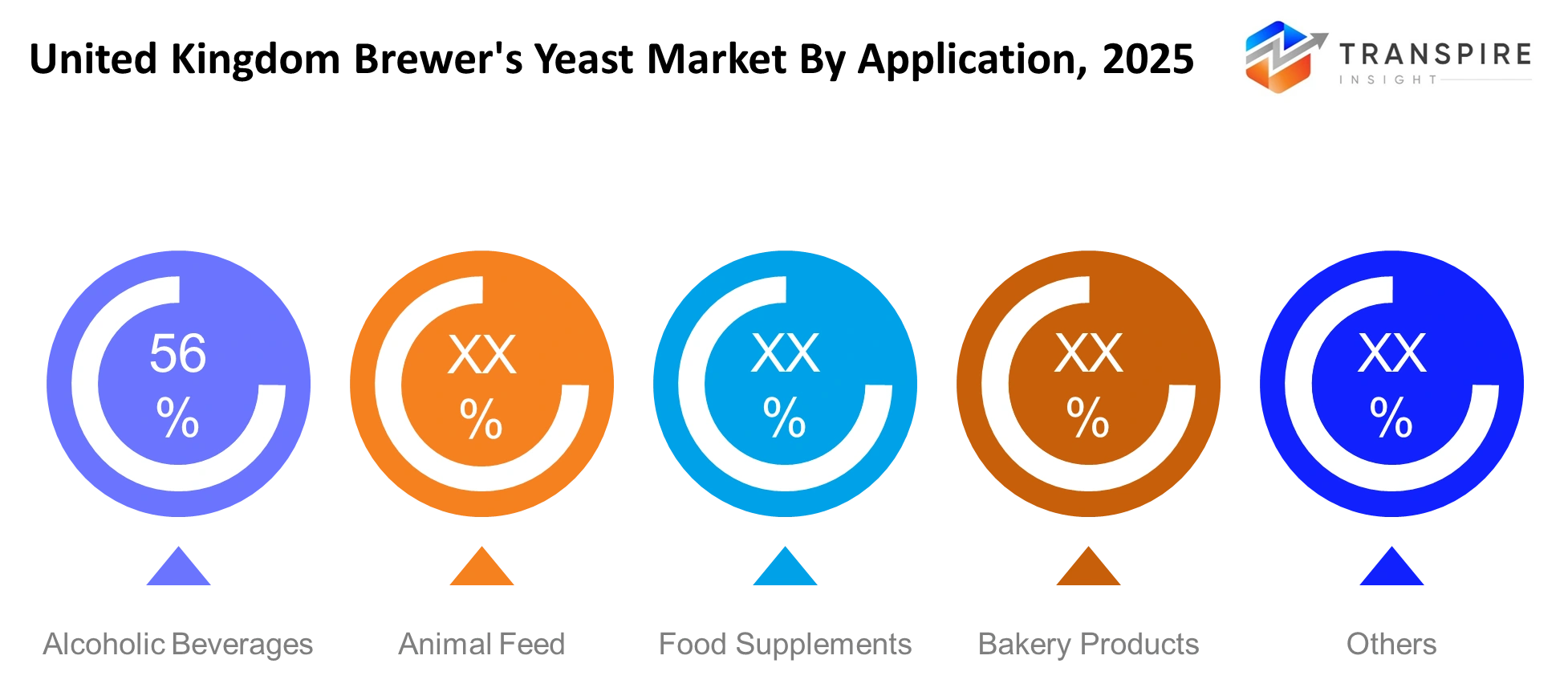
Animal feed kind of dominates the overall application segment, mostly because there is still a steady need for protein rich, antibiotic free nutritional additives in livestock farming. The poultry and aquaculture areas lean on yeast derived nutrients quite a lot, especially to help with gut well being and also better feed conversion. Alcoholic beverages stay a mature but not really shrinking segment, it keeps going thanks to ongoing brewing and the extra push behind craft beer growth. Food supplements and bakery items show solid secondary pull too, in particular for functional nutrition, and when fortified foods are being put together.
The animal feed uptick is being pushed by new rule constraints on antibiotic growth promoters, which rolled out across Europe after 2023. Food supplements are expanding faster, as consumers keep paying attention to immunity and digestive health products, and they like when yeast beta glucans are included. For alcoholic beverage uses the expansion pace is slower, because beer consumption patterns are kind of leveling out. Meanwhile bakery demand improves as industrial scale bread production gets more standardized. Overall these structural differences make that obvious split between health led versus production led consumption approaches.
Looking ahead, the market picture suggests yeast resources will be steered more toward nutraceuticals and feed industries, rather than the older brewing use cases. Ingredient developers will aim for high-purity extracts intended to support functional health claims. Investors will likely prefer the segments tied to those regulatory-led nutrition substitution trends, even if the growth path feels uneven in the short term.
To learn more about this report, Download Free Sample Report
By Distribution Channel
It kinda looks like B2B sales run the show because food processors, breweries, and feed manufacturers usually buy in bulk, so they lean on ingredient supply contracts that stay steady over time. Supermarkets and speciality stores still take a smaller slice, mostly tied to packaged yeast stuff for home baking and other small scale food use. Online retail is creeping up, not instantly, but it is growing , pushed by more people wanting specialty nutrition supplements and also direct to consumer functional food items.
B2B channel momentum gets a boost from long term agreements and the integrated supply arrangements that happen between ingredient producers and industrial buyers. Online retail is getting more attention thanks to digitized procurement workflows , plus more consumer awareness around yeast based health products. Specialty stores feel pretty steady, but there is margin pressure showing up, due to e-commerce expansion and the fact that bulk procurement efficiencies can squeeze pricing. Overall, the distribution setup is starting to favor consolidated industrial buyers more than the scattered, fragmented kind of retail consumption.
Going forward, the direction suggests stronger digital procurement ecosystems, with automated ordering and inventory forecasting becoming normal. Ingredient suppliers who invest in direct B2B platforms should see better contract retention. Meanwhile retail channels may shift toward premium, niche yeast formulations, instead of sticking with commodity products.
By End User
Breweries count as a core end user set, because there is direct tie with yeast propagation and recycling during fermentation. The food industry also holds a meaningful slice, mainly from bakery, sauce, and processed food manufacturing demand, like people want more consistent flavors. Nutraceutical manufacturers are experiencing the fastest growth as functional nutrition trends accelerate. Meanwhile animal feed companies stay a big, high-volume consumer, since they need cost-effective protein substitution and that’s kind of the whole deal.
The uptick in nutraceutical use stems from consumers gradually leaning toward immunity and gut-health products, especially those enriched with yeast derivatives. Food industry uptake is backed by large-scale industrial baking and flavor enhancement usages. Breweries are steady but growing slower, mostly because production levels are normalizing in older, mature beer markets. For feed, expansion is driven by mounting regulatory pressure to replace synthetic additives with natural protein sources.
Looking ahead the path suggests nutraceutical and feed segments getting more dominant than traditional brewing consumption. Manufacturers will likely prioritize high purity, standardized yeast extracts, designed around health and performance claim needs. Investors, in turn, will tend to emphasize vertically integrated supply chains, linking fermentation output with higher value end user applications.
What are the Key Use Cases Driving the United Kingdom Brewer's Yeast Market?
Animal feed is still kinda the big, main use case for brewer’s yeast in the United Kingdom Brewer’s Yeast Market, kinda pulled along by poultry, swine, and aquaculture nutrition programs that want high protein, antibiotic free additives. The demand is reinforced by tighter UK and EU rules about growth promoting antibiotics, so livestock producers have been leaning more toward natural fermentation based feed enhancers, things that support intestinal health and boost feed conversion efficiency.
On the other hand, food supplements and bakery applications are also growing, increasingly overlapping, especially for nutraceutical makers and industrial food processors. Yeast beta glucans and protein-rich extracts are getting slotted more often into immunity centered capsules and fortified baked goods recipes used by big retailers and foodservice groups.
Then there are emerging applications, like pharmaceutical grade yeast derivatives, plus precision fermented bioactive ingredients for medical nutrition products. There’s also more interest in controlled fermentation setups for sports nutrition formulations, aimed at amino acid optimization, so you can see a shift toward more high value functional health uses across the United Kingdom Brewer’s Yeast Market.
|
Report Metrics |
Details |
|
Market size value in 2025 |
USD 267.8 Million |
|
Market size value in 2026 |
USD 293.5 Million |
|
Revenue forecast in 2033 |
USD 561.2 Million |
|
Growth rate |
CAGR of 9.70% from 2026 to 2033 |
|
Base year |
2025 |
|
Historical data |
2021 - 2024 |
|
Forecast period |
2026 - 2033 |
|
Report coverage |
Revenue forecast, competitive landscape, growth factors, and trends |
|
Regional scope |
United Kingdom |
|
Key company profiled |
Lesaffre, AB Mauri, Lallemand, Angel Yeast, Kerry Group, DSM, Associated British Foods, Chr. Hansen, Leiber GmbH, Alltech, Bio Springer, Cargill, Oriental Yeast, Synergy Flavors, Ohly |
|
Customization scope |
Free report customization (country, regional & segment scope). Avail customized purchase options to meet your exact research needs. |
|
Report Segmentation |
By Form (Dry Yeast, Liquid Yeast, Instant Yeast, Active Dry Yeast, Others); By Application (Alcoholic Beverages, Animal Feed, Food Supplements, Bakery Products, Others); By Distribution Channel (Online Retail, Supermarkets, Specialty Stores, B2B Sales, Others); By End User (Breweries, Food Industry, Nutraceutical Industry, Animal Feed Industry, Others) |
Which Regions are Driving the United Kingdom Brewer's Yeast Market Growth?
England is basically leading the United Kingdom Brewer’s Yeast Market , mostly because it has this pretty dense concentration of food processing groups, big breweries, and also advanced biotechnology infrastructure. On top of that, the way regulation is enforced (food safety and feed quality rules) is pretty strict , and that sort of pressure tends to make industrial users keep adopting standardized yeast-based inputs. Then you have major port access points like Felixstowe and Liverpool , which really help with the inbound raw material movements and also the outbound distribution of ingredients . Add to that a mature circle of fermentation technology suppliers and contract manufacturers, and England’s position in both production and consumption just feels reinforced, almost like it’s locked in.
Scotland still shows up as the second key region , but the basis is a bit different. It leans on a brewing legacy and ongoing investment into bio-based industries, rather than just raw production volume. In contrast to England, Scotland’s growth doesn’t depend so much on consumption intensity; instead, it’s more about long-run industrial sturdiness supported by government-backed innovation efforts. Local distilleries and craft brewing operators keep putting money in, which helps keep demand stable for yeast recycling and fermentation optimization. So the supply-demand picture stays predictable, no big spikes, and that ends up supporting steady contributions to the United Kingdom Brewer’s Yeast Market over time, without much sharp volatility.
Northern England, plus some parts of Wales, are showing the fastest growth, mainly tied to new expansion in food-tech manufacturing parks and fermentation pilot facilities that rolled out after 2024. There are also new regional incentives in play for sustainable protein manufacturing and circular bioeconomy ideas, and those have pulled private funding toward yeast extraction infrastructure. That shift is speeding up adoption with animal feed producers and nutraceutical startups, who are basically trying to secure localized supply chains. Between 2026 and 2033, this momentum positions the region as a key entry point for investors targeting decentralized fermentation capacity and next-generation bio-ingredient production.
Who are the Key Players in the United Kingdom Brewer's Yeast Market and How Do They Compete?
The competitive landscape of the United Kingdom Brewer’s Yeast Market is sort of moderately consolidated , meaning a smaller set of global fermentation specialists basically hold the core production capacity, while regional and niche players try to carve out space via different use cases. In practice, competition tends to be shaped by fermentation efficiency, strain-engineering know-how, and the ongoing reliability of supply for food, feed, and nutraceutical buyers. Most established companies defend their share using long-term procurement deals with industrial customers, while newer entrants attempt to disrupt the status quo with precision fermentation and higher-purity yeast extracts, aimed at functional nutrition markets.
Lesaffre, for example, strengthens its position through tech-led cost efficiency and more advanced strain development, which enable higher-yield fermentations and more consistent product quality for industrial buyers. Angel Yeast drives expansion through export-oriented scaling and collaborations with European food manufacturers, and it stands out for large-volume supply stability and a broader range of yeast ingredient portfolios. Lallemand instead leans into niche specialization, especially customized yeast derivatives for nutraceutical and animal nutrition , and it grows by using targeted partnerships with feed producers and biotech startups.
Associated British Foods leans on integrated supply chains across food manufacturing and ingredient production to maintain tight cost efficiency and secure domestic demand routes. Kerry Group differentiates through application centered formulation support , helping embed yeast extracts into functional food and beverage systems through co-development relationships with brands. Alltech expands through animal health specialization, supplying yeast-based feed additives optimized for gut health and performance improvement in livestock production systems.
Company List
- Lesaffre
- AB Mauri
- Lallemand
- Angel Yeast
- Kerry Grou
- DSM
- Associated British Foods
- Chr
- Hansen
- Leiber GmbH
- Alltech
- Bio Springer
- Cargill
- Oriental Yeast
- Synergy Flavors
- Ohly
Recent Development News
In June 2025, Lesaffre acquired a 70% stake in Biorigin (via a joint venture with Zilor). The move expands Lesaffre’s yeast derivative and savory ingredient capabilities, strengthening its global supply chain for yeast-based products used in food, beverage, and brewing applications across European markets.https://www.lesaffre.com/press-room/lesaffre-and-zilor-enter-a-joint-venture/ (Lesaffre Press Room)
In July 2025, Lallemand announced the acquisition of Solyve through its Bio-Ingredients division. The deal expands Lallemand’s enzyme and fermentation portfolio, reinforcing its ability to supply advanced microbial and fermentation solutions relevant to brewing and beverage yeast applications in the UK and Europe.https://www.lallemand.com/en/news/lallemand-acquires-enzyme-specialist-solyve/ (Lallemand Inc.)
What Strategic Insights Define the Future of the United Kingdom Brewer's Yeast Market?
The United Kingdom Brewer’s Yeast Market is kind of moving, more and more, toward higher-value yeast derivatives that are functionally enhanced rather than treating everything as just commodity fermentation by-products. i mean, the push behind this shift is partly that nutritional labeling rules are getting stricter, and also because feed and nutraceutical manufacturers are asking for protein rich, traceable, bioactive type ingredients. Over the next 5 to 7 years, most of the value creation is likely to land in precision fermentation platforms and standardized yeast fractionation technologies, not so much in the old brewery-linked sourcing playbooks.
There’s a risk though, sort of a hidden one that shows up later if you are not careful. Supply could become more decoupled from actual brewing activity, since alcohol consumption keeps trending down and breweries consolidate, which reduces the availability of spent grain inputs. That situation then turns into exposure to raw material volatility, and it might not be fully priced in by the current demand forecasts. In the end margins could get squeezed for processors that still rely heavily on traditional upstream supply chains.
At the same time, there’s an opportunity that’s starting to look real. Localized biomanufacturing clusters across Northern England are developing, where government supported circular bioeconomy programs are backing more decentralized fermentation infrastructure. These hubs are placing yeast production nearer to food and feed manufacturers, so logistics dependency drops, while traceability gets better. Market participants should probably focus investment on modular fermentation systems and vertically integrated production setups, to help lock in longer term supply stability and to actually capture that premium functional ingredient demand.
United Kingdom Brewer's Yeast Market Report Segmentation
By Form
- Dry Yeast
- Liquid Yeast
- Instant Yeast
- Active Dry Yeast
- Others
By Application
- Alcoholic Beverages
- Animal Feed
- Food Supplements
- Bakery Products
- Others
By Distribution Channel
- Online Retail
- Supermarkets
- Specialty Stores
- B2B Sales
- Others
By End User
- Breweries
- Food Industry
- Nutraceutical Industry
- Animal Feed Industry
- Others
Frequently Asked Questions
Find quick answers to common questions.
The expected United Kingdom Brewer's Yeast Market size is USD 561.2 Million in 2033.
Key segments for the United Kingdom Brewer's Yeast Market are By Form (Dry Yeast, Liquid Yeast, Instant Yeast, Active Dry Yeast, Others); By Application (Alcoholic Beverages, Animal Feed, Food Supplements, Bakery Products, Others); By Distribution Channel (Online Retail, Supermarkets, Specialty Stores, B2B Sales, Others); By End User (Breweries, Food Industry, Nutraceutical Industry, Animal Feed Industry, Others).
Major United Kingdom Brewer's Yeast Market players are Lesaffre, AB Mauri, Lallemand, Angel Yeast, Kerry Group, DSM, Associated British Foods, Chr. Hansen, Leiber GmbH, Alltech, Bio Springer, Cargill, Oriental Yeast, Synergy Flavors, Ohly.
The United Kingdom Brewer's Yeast Market size is USD 267.8 Million in 2025.
The United Kingdom Brewer's Yeast Market CAGR is 9.70% from 2026 to 2033.
- Lesaffre
- AB Mauri
- Lallemand
- Angel Yeast
- Kerry Grou
- DSM
- Associated British Foods
- Chr
- Hansen
- Leiber GmbH
- Alltech
- Bio Springer
- Cargill
- Oriental Yeast
- Synergy Flavors
- Ohly
About the Authors

Chetan Dhatrak
I’m Chetan Dhatrak, a Senior Research Analyst at Transpire Insight, specializing in the Consumer Goods, Foods and Beverages industry. I focus on analyzing market trends, consumer behavior, competitive landscapes, and industry developments to deliver accurate, data-driven insights. My research at Transpire Insight is built on credible sources and in-depth analysis, helping businesses and readers better understand market dynamics, emerging opportunities, and evolving consumer preferences. I’m committed to creating reliable, well-researched content that supports informed decision-making and reflects the latest developments in the consumer goods and food & beverage sectors.

Chakradhar Khansole
Chakradhar serves as the Research Director at Transpire Insight, bringing over 8 years of experience in technology, innovation, and strategic market intelligence. He specializes in transforming complex market data into actionable business insights that enable organizations to make informed, growth-oriented decisions. Recognized for his strategic vision and analytical expertise, Chakradhar leads high-impact research initiatives, delivering comprehensive market assessments, competitive intelligence, and forward-looking industry analysis.
Recently Published Reports
-
Apr 2026
Baby Infant Formula Market
Baby Infant Formula Market Size, Share & Analysis Report By ype (Infant Milk, Follow On Milk, Specialty Baby Milk, Growing-Up Milk), By Ingredient (Carbohydrate, Fat, Protein, Minerals, Vitamins, and Others), By Product Form (Powder, Liquid, and Ready-to-feed), By Distribution Channels (Supermarket/Hypermarket, Specialty Store, Pharmacies, Online Retail, and Others), and Geography (North America, Europe, Asia-Pacific, Middle East and Africa, South and Central America), 2021 - 2031
-
Apr 2026
Edible Insects for Animal Feed Market
Edible Insects for Animal Feed Market Size, Share & Analysis Report By Type (Insect Powder, Insect Meal, Insect Bar, Insect Paste, Insect Oil, and Others), By Insect Type (Beetles, Cricket, Caterpillar, Hymenoptera, Orthoptera, Tree Bugs, and Others), By Application (Livestock, Pet Food, and Aquaculture), By Livestock Type (Poultry, Swine, and Others), and Geography (North America, Europe, Asia-Pacific, Middle East and Africa, South and Central America), 2021 - 2031
-
Apr 2026
Food Industry Disinfection and Bacterial Control Market
Food Industry Disinfection and Bacterial Control Market Size, Share & Analysis Report By Type (Chemical Disinfectants, Physical Disinfectants, and Biocides and Antimicrobials), By Application (Food Processing Equipment Surface Disinfection, Food Preparation Areas Surface Disinfection, Storage Areas Surface Disinfection, Anti-microbial Coatings Food Preservation, and Preservative Solutions Food Preservation), By End User (Meat and Poultry Processing, Dairy Processing, Seafood Processing, Bakery and Confectionery, Restaurants and Commercial Kitchens, and Food Service Providers), By Sales Channel (Online, Offline), and Geography (North America, Europe, Asia-Pacific, Middle East and Africa, South and Central America), 2021 - 2031
-
May 2026
Freeze Dried Food Market
Freeze Dried Food Market Size, Share & Analysis Report By Product Type (Fruits, Vegetables, Freeze-Dried Dairy Products, Freeze-Dried Meat and Seafood, Freeze-Dried Pet Food, and Prepared Meal), By Nature (Organic, and Conventional), By Form (Powdered, Granules, and Diced), By End Use (Breakfast Cereals, Dairy Products, Bakery & Confectionery, Nutritional Bars & Supplements, Powdered Beverages, Snacks, and Retail (Household)), and Geography (North America, Europe, Asia-Pacific, Middle East and Africa, South and Central America), 2021 - 2031