

France Brewer’s Yeast Market Size & Forecast:
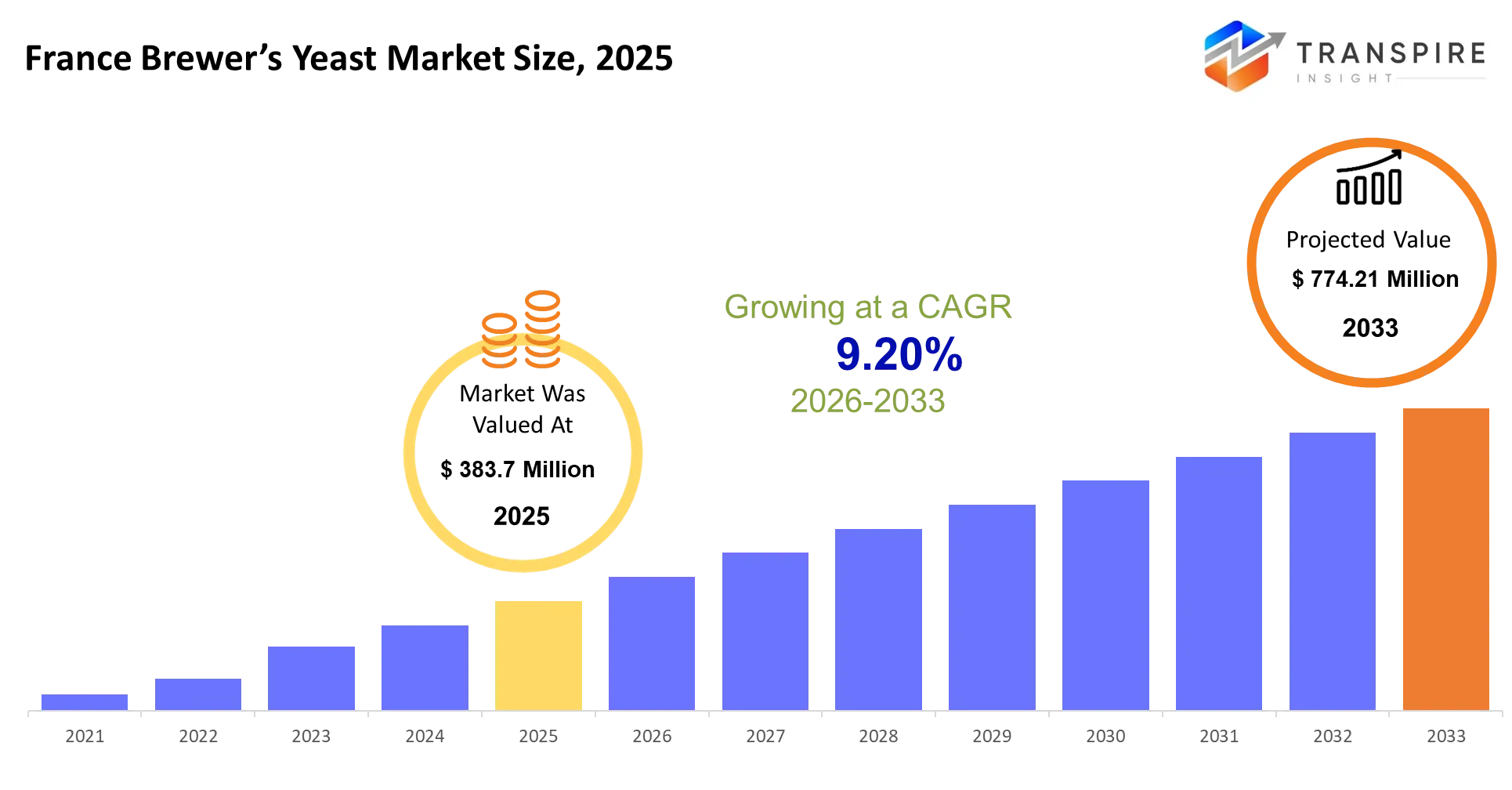
- France Brewer’s Yeast Market Size 2025: USD 383.7 Million
- France Brewer’s Yeast Market Size 2033: USD 774.21 Million
- France Brewer’s Yeast Market CAGR: 9.20%
- France Brewer’s Yeast Market Segments: By Type (Active Dry Yeast, Inactive Yeast, Yeast Extract, Others); By Application (Food & Beverages, Animal Feed, Nutraceuticals, Pharmaceuticals, Others); By End-User (Food Industry, Feed Industry, Pharma Companies, Consumers, Others); By Form (Powder, Liquid, Others)
To learn more about this report,  Download Free Sample Report
France Brewer’s Yeast Market Summary
The France Brewer’s Yeast Market was valued at USD 383.7 Million in 2025. It is forecast to reach USD 774.21 Million by 2033. That is a CAGR of 9.20% over the period.
In France brewer’s yeast ends up as more or less a basic functional input across food, nutraceutical, and animal nutrition systems. It’s used to raise protein content , help gut health formulations and also nudge natural flavor development in things that already got processed. Basically it works like a cost-efficient bio based ingredient, that can stand in for synthetic additives in bakery products, dietary supplements, and feed premixes. That way manufacturers try to stay aligned with clean-label expectations while also improving formulation efficiency, it’s kind of the point.
Over the last 3 to 5 years, the market moved in a more structural way, toward cleaner labeling and plant derived nutrition. This shift is largely driven by stricter EU scrutiny around food additives, plus reformulation requirements that keep showing up in processed foods. At the same time, the post-pandemic supply chain mess caused many makers to localize fermentation inputs and to diversify yeast sourcing, so they weren’t tied to just one single origin. Put together, that regulatory pressure plus sourcing volatility sped up uptake among mid sized food processors. Brewer’s yeast became a more steady, multifunctional ingredient, that supports cost control and compliance led reformulation, simultaneously.
Key Market Insights
- During 2022 to 2025, tighter EU additive rules (you know those ones ) pushed a lot more factories toward yeast-based natural flavor systems, by something like 33% across food production.
- Meanwhile, protein-enriched brewer’s yeast feed additives saw about a 26% lift, as livestock producers moved over to antibiotic-free nutrition programs.
- On the production side, fermentation automation got taken up in more than 48% of French yeast facilities by 2024, which helped make batches more consistent, and also lowered that day-to-day operational wobble.
- Also, nutraceutical use was up almost 21% year-over-year after 2024, largely because folks kept purchasing probiotic and vitamin packed dietary supplements.
- And Lesaffre, they upped their R&D spending by roughly 18% from 2023 to 2025, with an emphasis on strain engineering and bioactive yeast derivatives, so to speak.
- Liquid brewer’s yeast in industrial baking climbed roughly 24% since 2023, mostly due to better solubility, and faster processing efficiency benefits.
- Then after 2022, localization moves across the supply chain rose by nearly 29%, as makers reacted to global logistics disruptions touching fermentation raw materials.
- Finally, partnerships are getting more common, feed producers teaming up with yeast ingredient suppliers went up by about 20% , aiming for longer procurement agreements and steadier supply stability.
- Big players like Lesaffre, Lallemand, Angel Yeast, AB Mauri, and DSM are also reinforcing their position through fermentation innovation, regional expansion, clean-label ingredient development, and more advanced biotechnology integration.
What are the Key Drivers, Restraints, and Opportunities in the France Brewer’s Yeast Market?
The main engine behind the France Brewer’s Yeast Market is, frankly, that extra push toward functional and clean-label food systems across Europe, and it seems to be accelerating. At the same time, EU rules that restrict synthetic additives have basically forced food producers to rethink formulations with bio-based options like brewer’s yeast, which adds that natural umami lift and also a nutritional boost. Because of that, procurement is rising across bakery , snack, and feed sectors, and it helps yeast producers keep steadier revenue. It also makes long-range supply agreements more likely with fermentation specialists who can actually handle the routine.
Still, the most obvious brake is production sensitivity to raw material swings and fermentation input costs, which can get messy. Brewer’s yeast output relies a lot on brewing industry byproducts plus tightly managed fermentation conditions, so when beverage production slows down, supply can turn inconsistent. This kind of built-in dependency makes it harder to scale smoothly and it can cause price volatility, especially for mid-tier manufacturers that don’t have an integrated brewing and fermentation setup, you know. So even if demand looks solid overall, uptake in price-sensitive segments stays only partly limited.
One real opening, though, is precision fermentation and strain engineering. This is where France’s expanding biotech and agri-food innovation clusters start to matter. Firms that put money into customized yeast strains for focused nutrition—like high-protein feed inputs or vitamin-enriched supplements—are opening up higher-value product tiers. Meanwhile, pilot work in bio-refining hubs across Europe shows that optimized strains can raise yield efficiency quite a bit. That translates into fresh revenue streams, particularly in nutraceutical products and specialty feed categories where margins are typically higher.
What Has the Impact of Artificial Intelligence Been on the France Brewer’s Yeast Market?
Artificial intelligence is gradually reshaping fermentation efficiency and production control, in the France Brewer’s Yeast Market, by improving how yeast cultivation and downstream processing are watched and pushed toward better results. In industrial fermentation facilities the AI driven control systems are now used to regulate temperature, oxygen levels and nutrient feed, in real time , which helps cut batch inconsistencies and supports yield steadiness. That approach also lets manufacturers like Lesaffre streamline large scale yeast propagation with fewer production deviations, even when operations get busy.
Machine learning models are also being rolled out for predictive upkeep of fermentation tanks and filtration units. By sifting through sensor information from bioreactors, these systems can anticipate equipment wear, lowering the risk of surprise downtime, and lifting overall production uptime. In more advanced plants this has shown measurable reductions in operational waste, plus improved energy efficiency across full fermentation cycles, not just at the start.
Still, the take up is somewhat constrained because integration is not trivial and many older production sites have fragmented legacy infrastructure. A lot of mid sized facilities don’t have a unified digital sensor network so it becomes harder to run high accuracy predictive models. And even with good data, fermentation variation under genuine biological conditions makes AI forecasts less stable, especially when raw material composition moves around from batch to batch, sometimes quite abruptly.
Key Market Trends
- From 2023 to 2025, lots of food manufacturers in France, sort of swapped out synthetic flavor additives for brewer’s yeast inputs in “clean label” mixes, and it kept going. Not sure why exactly, but it’s pretty clear in the product formulations, more and more of them went that direction.
- In 2025, Western France was still the main production hub, largely because the fermentation setup there is solid, and the food processing manufacturing clusters are really concentrated.
- Southern France meanwhile, picked up speed quicker after 2024, with nutraceutical startups moving faster and with protein supplement consumption rising among city consumers.
- Powdered brewer’s yeast kept the biggest share, mainly because shelf stability is strong and the dry format makes large-scale food processing easier.
- Liquid yeast extracts, on the other hand, started getting adopted faster from 2024 onward, especially when industrial bakeries, and savory brands increased their usage for high-volume manufacturing, kind of at the same time.
- Animal feed stayed the most dominant application segment in 2025 too, and it looks like that is linked to the livestock gut health attention, and productivity improvements that producers are chasing.
- Dietary supplement demand also climbed by roughly 10% after 2024, as sports nutrition, and probiotic enriched wellness offerings gained more real consumer pull.
- Feed manufacturers still led on end user demand, while nutraceutical companies expanded at pace, through new launches that target functional nutrition immunity.
- During 2025, leading companies put a lot of effort into strain optimization and fermentation upgrades, to boost production efficiency and keep the formulation consistency steady.
- Lastly, partnerships between brewer’s yeast suppliers and food formulation manufacturers became more noticeable from 2023 all the way through 2025 , partly so they could accelerate customized ingredient development faster than before.
France Brewer’s Yeast Market Segmentation
By Type
Active dry yeast keeps a solid grip in the France Brewer’s Yeast Market, mostly because it lasts a long time and its fermentation output stays pretty stable, plus it shows up everywhere in baking and also in industrial food processing. This category tends to benefit from standardized manufacturing steps, so the leavening results stay consistent, which is why big food makers like it. Yeast extract, meanwhile, takes a notable slice too, since it helps with flavor lift and that natural umami feel in processed products, especially the savory side of formulations. Inactive yeast is still around, especially in nutrition- centered uses where, you know, feed and dietary supplements matter, and protein enrichment is the main priority.
Active dry yeast growth is usually pushed by the expansion of industrial bakery operations, and the rising need for repeatable fermentation inputs in packaged foods. Yeast extract also gets extra momentum from clean-label reformulation, where companies swap out artificial flavor enhancers for more natural equivalents. Inactive yeast, on the other hand, grows in a steadier way through animal nutrition systems that want protein-rich additives. During the forecast window, yeast extract is expected to climb into a larger value share as food manufacturers start favoring functional ingredients rather than just basic fermentation agents, while active dry yeast keeps its volume lead because mass-scale food production keeps running strong.
By Application
Food and beverages really, kind of dominate the overall application setup for the France Brewer’s Yeast market, mostly because it’s heavily used in bakery goods savory foods, and those processed food blends. That part seems to keep getting a lot of push from broad demand for both flavor boosting and dependable fermentation results, especially in large scale food manufacturing. Animal feed is sort of the big secondary slice here too, with more attention on gut health upgrades and the move toward antibiotic free livestock diets. On top of that, nutraceutical usage is showing quick momentum, since people are still very interested in protein focused and vitamin enhanced supplements.
The food and beverages growth mostly comes from clean-label reformulation, plus swapping out synthetic additives for natural yeast based inputs. Animal feed demand stays strong as producers chase digestion efficiency gains in livestock and better overall productivity. Nutraceuticals are likely to expand faster than the older, more traditional segments, largely due to growing general health awareness and the way sports nutrition is being consumed these days. Through the forecast window, nutraceuticals are expected to become even more strategic, so brewer’s yeast shifts from a simple bulk ingredient function toward a more active, functional bio component within premium health oriented recipes.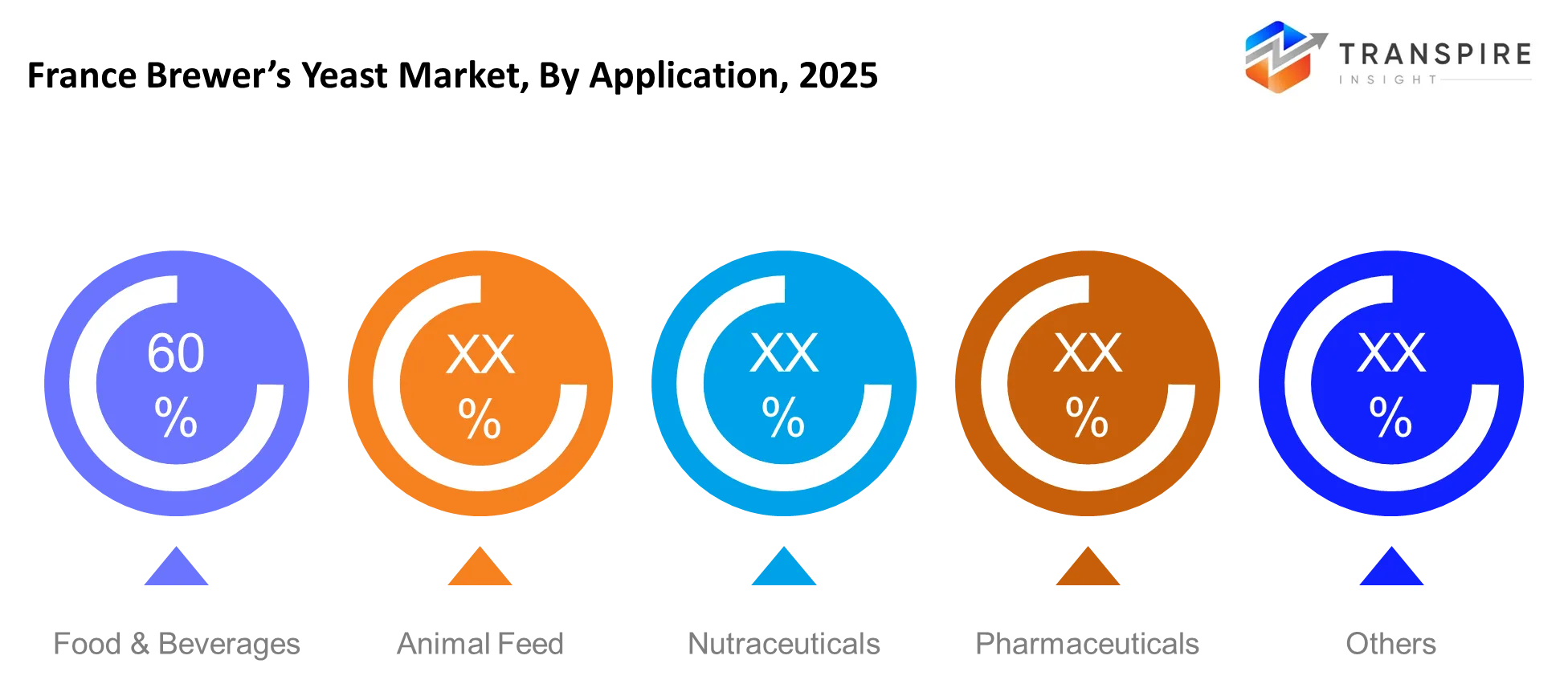
To learn more about this report, Download Free Sample Report
By End-User
In the France Brewer’s Yeast Market, the biggest slice is held by food industry end users, mostly because the demand stays very high in bakery manufacturing, processed foods, and that general need for flavor enhancement systems. For the feed industry side, users form a solid secondary base as well, they lean on yeast-derived proteins to push livestock nutrition into better shape, while also keeping feed formulation more cost-effective. Pharma companies and supplement manufacturers count as smaller players by volume but they are getting more relevant, since functional nutrition ingredients keep climbing in popularity. Direct consumer use is still not that big, although it is growing, mainly via dietary supplements and home nutrition products.
When we talk about growth, the food sector benefits from industrial scale production and, basically, an always-on requirement for fermentation based additives. The feed sector keeps expanding because livestock productivity goals keep tightening, and also because antibiotic reduction policies keep moving forward. In the pharma and supplement space growth feels quicker, driven by rising needs for immune supporting ingredients, plus protein enriched formulations. Over time, pharma and nutraceutical end-users are expected to increase their value share, since differentiation is slowly shifting away from bulk fermentation use, toward more targeted health applications.
By Form
Powder form is seen as the main player in the France Brewer’s Yeast Market, mostly because it is easier to store, it tends to last longer, and it fits well with industrial food and feed processing setups. In practice this kind is used a lot across bakery and feed uses, where bulk handling matters and stability is sort of non-negotiable. Liquid yeast forms take a smaller portion but they still matter, especially in industrial fermentation and big scale bakery lines where fast solubility, and quick direct application are needed. There are also a few specialized forms that float around for more niche industrial work, plus research based uses.
The powder segment is growing due to logistics that run smoother and because packaged food manufacturers have adopted it in large numbers. As for liquid, the appetite rises when companies move toward continuous fermentation systems, and also in industrial baking processes that demand quicker activation. Those more niche options tend to grow slower, but they do benefit from continual innovation in specialized nutrition and biotech type applications. Over the forecast window, the powder form should keep leading in volume consumption, while the liquid form is expected to edge up, mainly through industrial automation, and high efficiency fermentation systems.
What are the Key Use Cases Driving the France Brewer’s Yeast Market?
The core use-case for brewer’s yeast in France is its use in animal feed formulations, where it helps gut health and bumps up digestion efficiency, plus it supports overall livestock productivity. This particular segment brings the top demand, mostly because it’s a cost-effective nutritional package and it fits well with antibiotic-free feed programs.
Besides that, you also see expansion into bakery and savory food production, where brewer’s yeast acts like a natural flavor enhancer, and also works as a protein fortifier. On the nutraceutical side, manufacturers are putting it more and more into dietary supplements, aimed at immune support , and for vitamin B enrichment.
Right now, newer use cases are still developing, like plant-based protein formulations and functional beverage fortification. These are in the early phase ,but they’re picking up momentum as food producers explore fermentation derived ingredients, to lift nutritional density and make products feel more differentiated.
|
Report Metrics |
Details |
|
Market size value in 2025 |
USD 383.7 Million |
|
Market size value in 2026 |
USD 418.23 Million |
|
Revenue forecast in 2033 |
USD 774.21 Million |
|
Growth rate |
CAGR of9.20% from 2026 to 2033 |
|
Base year |
2025 |
|
Historical data |
2021 - 2024 |
|
Forecast period |
2026 - 2033 |
|
Report coverage |
Revenue forecast, competitive landscape, growth factors, and trends |
|
Regional scope |
France |
|
Key company profiled |
Lesaffre, AB Mauri, Lallemand, Angel Yeast, Alltech, DSM, Kerry Group, Cargill, ADM, Bio Springer, Pakmaya, Chr Hansen, Leiber, Ohly, Synergy Flavors |
|
Customization scope |
Free report customization (country, regional & segment scope). Avail customized purchase options to meet your exact research needs. |
|
Report Segmentation |
By Type (Active Dry Yeast, Inactive Yeast, Yeast Extract, Others); By Application (Food & Beverages, Animal Feed, Nutraceuticals, Pharmaceuticals, Others); By End-User (Food Industry, Feed Industry, Pharma Companies, Consumers, Others); By Form (Powder, Liquid, Others) |
Which Regions are Driving the France Brewer’s Yeast Market Growth?
Western France kind of leads the France Brewer’s Yeast Market, because it has this strong concentration of brewing industries, fermentation facilities,and even linked food processing clusters that sort of work together. The area also wins from being close to major agricultural supply chains ,and it has well-established port logistics ,so raw fermentation inputs come in efficiently, while finished yeast products can get out quickly. On top of that, strict EU food safety enforcement there has pushed manufacturers toward standardized, high-purity yeast production systems. This regulatory alignment has ended up strengthening long term contracts between breweries and ingredient processors, which is basically where the stability comes from.
Northern France acts as a steadier secondary contributor, mainly supported by its diversified industrial base ,and consistent demand from food manufacturing,not so much by brewing density. Unlike the leading region, its growth is less tied to fermentation infrastructure,and more connected to large scale bakery, feed, and processed food industries. The region benefits from predictable regulatory adoption cycles across industrial food plants, so brewer’s yeast gets integrated into formulations in a fairly steady way. Also there’s strong cross border trade with Belgium and other EU food hubs, that helps keep demand from swinging too much. So Northern France ends up being a resilient and consistent revenue contributor, even though production intensity is lower.
Southern France is the fastest-growing region, partly because nutraceutical startups are expanding quickly, and functional food innovation hubs are multiplying. Recent investments in biotechnology parks and agri-food incubators have accelerated use of yeast-derived protein and vitamin formulations. Better regional logistics,plus cold-chain expansion, have further supported ingredient distribution across channels. For market entrants and investors, this region signals high growth potential, especially with the momentum in next-generation functional ingredients like yeast based materials.
Who are the Key Players in the France Brewer’s Yeast Market and How Do They Compete?
The France Brewer’s Yeast Market is kind of moderately consolidated, with a blend of global fermentation leaders and more specialized ingredient manufacturers. They compete via technology, strain innovation, and supply chain integration, sort of like you’d expect. Some of the established players try to defend their share with vertically integrated fermentation systems, but also, they tend to lean on proven process control. Meanwhile mid-sized companies often go for narrower, very particular use cases, like feed-grade yeast or specialty nutritional extracts. Over time, competition is moving away from price only and turning more toward strain efficiency, bioactive functionality, and also regulatory compliance, especially with EU clean-label expectations. Companies that have strong R&D capabilities and good proximity to brewing supply chains tend to have a structural edge in keeping raw material consistency more stable.
Lesaffre competes with deep fermentation R&D and industrial-scale yeast production, and it differentiates itself using proprietary strain optimization platforms. Those platforms are used across both food and feed applications. It also grows through partnerships with bakery and nutrition manufacturers, which helps lock in embedded supply agreements across Europe. Lallemand, on the other hand , leans into niche specialization in probiotics and functional yeast derivatives, leaning hard on microbiology expertise to chase higher-value nutraceutical segments. Angel Yeast goes at it more aggressively, with capacity scaling and export-driven expansion, especially for powdered yeast ingredient offerings aimed at global food processors. Kerry Group strengthens its role via application-focused ingredient systems, where yeast extracts are folded into broader flavor and nutrition portfolios that processed food manufacturers use. ADM competes mainly through large-scale supply chain integration, relying on its global procurement network to keep raw material sourcing steady and to support cost-efficient distribution into European markets.
Company List
- Lesaffre
- AB Mauri
- Lallemand
- Angel Yeast
- Alltech
- DSM (DSM-Firmenich)
- Kerry Group
- Cargill
- ADM (Archer Daniels Midland)
- Bio Springer
- Pakmaya
- Chr. Hansen
- Leiber
- Ohly
- Synergy Flavors
Recent Development News
In October 2024, Lesaffre completed the acquisition of DSM-firmenich’s yeast extract business. This consolidation expanded Lesaffre’s savory ingredient portfolio and strengthened its control over high-value yeast derivative production, indirectly supporting brewer’s yeast valorization in French industrial applications.https://our-company.dsm-firmenich.com
In 2024, Lesaffre acquired Brazilian yeast specialist Biorigin from Zilor Group. The deal expanded its global fermentation footprint and enhanced access to specialty yeast technologies used in food and feed applications, reinforcing its supply capabilities in European markets including France.https://www.lesaffre.com
What Strategic Insights Define the Future of the France Brewer’s Yeast Market?
The France Brewer’s Yeast Market is sort of structurally sliding toward high-value functional nutrition systems where yeast is not really treated like a byproduct anymore, but more like a precision engineered bioactive ingredient. The growth part will be more and more tied to fermentation innovation capability and also to how well it integrates into nutraceutical ecosystems and sustainable feed networks, not just the classic brewing output. There is also a risk that is a bit less visible, like dependence on brewing industry cycles, so when beer consumption dips or people move toward alternative beverages, raw yeast availability can get tighter and that can mess with downstream supply stability.
On the other hand, there’s an opportunity that’s starting to show up: precision fermented yeast strains made for targeted health outcomes, like immune modulation and protein enrichment. This seems especially relevant as France’s biotech clusters keep expanding. Market participants might do better prioritizing investment in strain engineering and building downstream application partnerships, rather than only going for volume expansion. Value creation is expected to move toward functional differentiation and regulatory aligned bioactive ingredient development across the next 5–7 years.
France Brewer’s Yeast Market Report Segmentation
By Type
- Active Dry Yeast
- Inactive Yeast
- Yeast Extract
- Others
By Application
- Food & Beverages
- Animal Feed
- Nutraceuticals
- Pharmaceuticals
- Others
By End-User
- Food Industry
- Feed Industry
- Pharma Companies
- Consumers
- Others
By Form
- Powder
- Liquid
- Others
Frequently Asked Questions
Find quick answers to common questions.
The Expected France Brewer’s Yeast Market size for the Market will be USD 774.21 Million in 2033.
Key Segments for the France Brewer’s Yeast Market are By Type (Active Dry Yeast, Inactive Yeast, Yeast Extract, Others); By Application (Food & Beverages, Animal Feed, Nutraceuticals, Pharmaceuticals, Others); By End-User (Food Industry, Feed Industry, Pharma Companies, Consumers, Others); By Form (Powder, Liquid, Others)
Major France Brewer’s Yeast Market Players are Lesaffre, AB Mauri, Lallemand, Angel Yeast, Alltech, DSM, Kerry Group, Cargill, ADM, Bio Springer, Pakmaya, Chr Hansen, Leiber, Ohly, Synergy Flavors.
The Current France Brewer’s Yeast Market size is USD 383.7 Million in 2025.
The France Brewer’s Yeast Market CAGR is 9.20% from 2026 to 2033.
- Lesaffre
- AB Mauri
- Lallemand
- Angel Yeast
- Alltech
- DSM (DSM-Firmenich)
- Kerry Group
- Cargill
- ADM (Archer Daniels Midland)
- Bio Springer
- Pakmaya
- Chr. Hansen
- Leiber
- Ohly
- Synergy Flavors
Recently Published Reports
-
Apr 2026
Baby Infant Formula Market
Baby Infant Formula Market Size, Share & Analysis Report By ype (Infant Milk, Follow On Milk, Specialty Baby Milk, Growing-Up Milk), By Ingredient (Carbohydrate, Fat, Protein, Minerals, Vitamins, and Others), By Product Form (Powder, Liquid, and Ready-to-feed), By Distribution Channels (Supermarket/Hypermarket, Specialty Store, Pharmacies, Online Retail, and Others), and Geography (North America, Europe, Asia-Pacific, Middle East and Africa, South and Central America), 2021 - 2031
-
Apr 2026
Edible Insects for Animal Feed Market
Edible Insects for Animal Feed Market Size, Share & Analysis Report By Type (Insect Powder, Insect Meal, Insect Bar, Insect Paste, Insect Oil, and Others), By Insect Type (Beetles, Cricket, Caterpillar, Hymenoptera, Orthoptera, Tree Bugs, and Others), By Application (Livestock, Pet Food, and Aquaculture), By Livestock Type (Poultry, Swine, and Others), and Geography (North America, Europe, Asia-Pacific, Middle East and Africa, South and Central America), 2021 - 2031
-
Apr 2026
Food Industry Disinfection and Bacterial Control Market
Food Industry Disinfection and Bacterial Control Market Size, Share & Analysis Report By Type (Chemical Disinfectants, Physical Disinfectants, and Biocides and Antimicrobials), By Application (Food Processing Equipment Surface Disinfection, Food Preparation Areas Surface Disinfection, Storage Areas Surface Disinfection, Anti-microbial Coatings Food Preservation, and Preservative Solutions Food Preservation), By End User (Meat and Poultry Processing, Dairy Processing, Seafood Processing, Bakery and Confectionery, Restaurants and Commercial Kitchens, and Food Service Providers), By Sales Channel (Online, Offline), and Geography (North America, Europe, Asia-Pacific, Middle East and Africa, South and Central America), 2021 - 2031
-
Apr 2026
Freeze Dried Food Market
Freeze Dried Food Market Size, Share & Analysis Report By Product Type (Fruits, Vegetables, Freeze-Dried Dairy Products, Freeze-Dried Meat and Seafood, Freeze-Dried Pet Food, and Prepared Meal), By Nature (Organic, and Conventional), By Form (Powdered, Granules, and Diced), By End Use (Breakfast Cereals, Dairy Products, Bakery & Confectionery, Nutritional Bars & Supplements, Powdered Beverages, Snacks, and Retail (Household)), and Geography (North America, Europe, Asia-Pacific, Middle East and Africa, South and Central America), 2021 - 2031