

France Sensory And Functional Food Ingredients Market Size & Forecast:
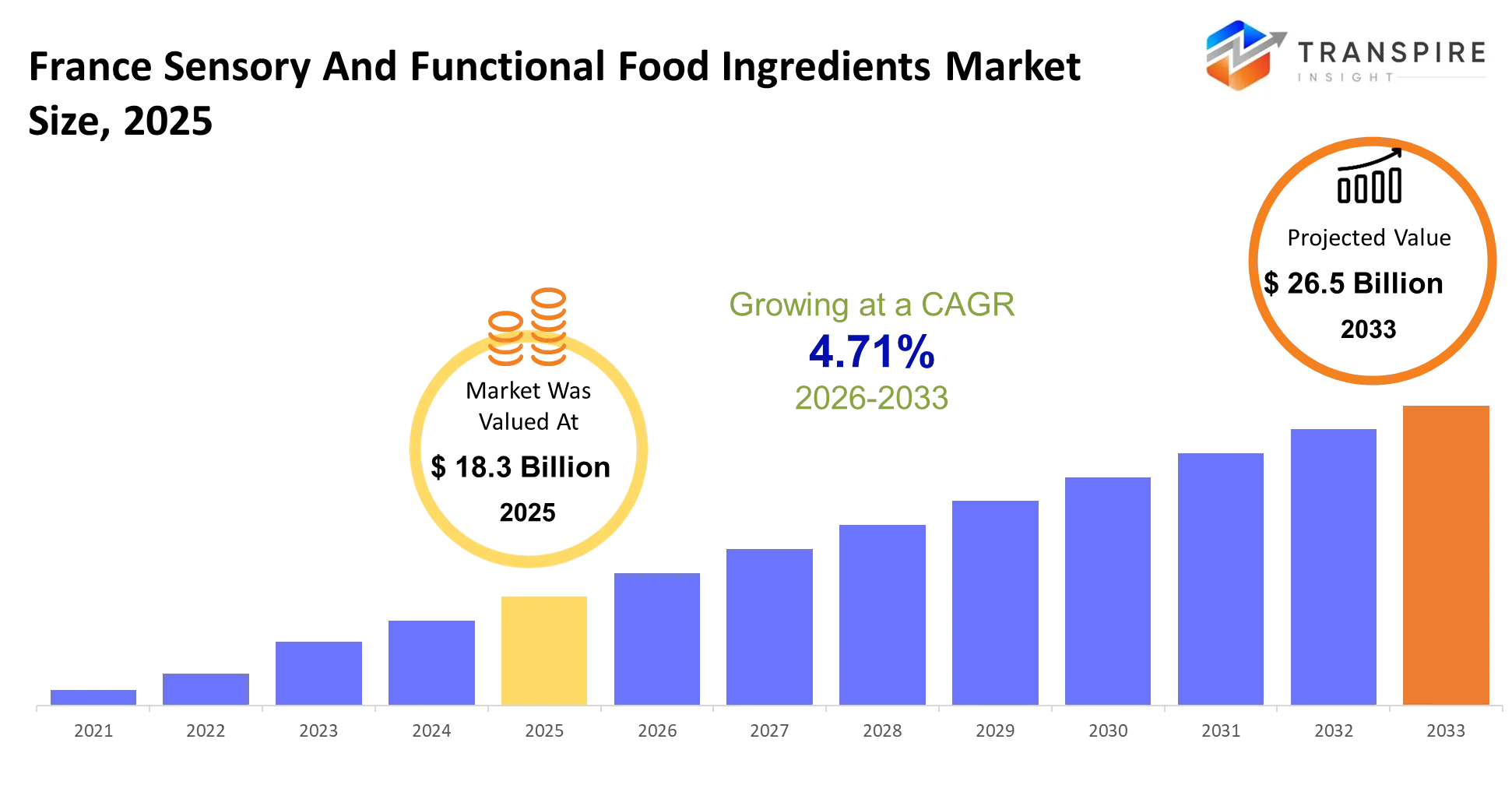
- France Sensory And Functional Food Ingredients Market Size 2025: USD 18.3 Billion
- France Sensory And Functional Food Ingredients Market Size 2033: USD 26.5 Billion
- France Sensory And Functional Food Ingredients Market CAGR: 4.71%
- France Sensory And Functional Food Ingredients Market Segments: By Type (Flavors, Colors, Sweeteners, Functional Ingredients, Others); By Application (Bakery, Beverages, Dairy, Confectionery, Processed Food, Others); By End-User (Food Manufacturers, Beverage Companies, Nutraceutical Firms, Retail, Others); By Form (Powder, Liquid, Others)
To learn more about this report,  Download Free Sample Report
France Sensory And Functional Food Ingredients Market Summary
The France Sensory And Functional Food Ingredients Market was valued at USD 18.3 Billion in 2025. It is forecast to reach USD 26.5 Billion by 2033. That is a CAGR of 4.71% over the period.
In France, the Sensory and Functional Food Ingredients Market kinda has a big role in supporting food makers, so they can improve taste and texture, keep shelf life steady, raise nutritional value, and even boost digestive performance , all while not really hurting product consistency or running into regulatory compliance issues. With these types of ingredients, producers can tinker with reformulations in processed foods , dairy goods, drinks, and also plant-based alternatives, so they better match what consumers now want—especially around clean label claims, protein enrichment, less sugar, and gut health support.
In the last five years, the market has moved away from synthetic additives , more toward naturally sourced bioactive compounds. This is mostly because of tighter European labeling rules , plus retailers pushing for ingredient sourcing that feels more transparent. Also during the COVID-19 period, supply chain disruptions made many companies lean more on home grown sources. Enzymes , probiotics, and flavor enhancers became a major focus, because shortages of imported goods messed with production timetables across France .
So as a result, firms have been channeling more investment into fermentation technologies, along with tighter formulation systems. That shift lets ingredient suppliers earn better margins, by offering customized solutions for functional beverages, sports nutrition, and fortified convenience foods, which in practice helps everyone stay aligned with those changing demand signals.
Key Market Insights
- Northern France was at almost 38% market share in 2025, mostly because food processing clusters are concentrated there and there are ingredient manufacturing facilities nearby, kind of everything co-located.
- Western France, meanwhile, is expected to grow the fastest regional hub through 2033, backed by dairy innovation scaling up and probiotic ingredient production, in a steady way.
- In the France Sensory And Functional Food Ingredients Market, functional proteins took the lead with around 31% share in 2025, and that happened largely due to the adoption of sports nutrition.
- Probiotics together with prebiotic fibers showed up as the second-largest segment, since digestive wellness products started getting broader retail shelf placement after 2021, not just niche channels.
- Natural flavor modulators also became the quickest-moving ingredient category from 2024 to 2033, because manufacturers sped up sugar-reduction reformulations, that part really drives it.
- Beverage applications held more than 27% market share in 2025, as fortified drinks and functional hydration items spread across retail chains.
- Clinical nutrition and elderly wellness products became the fastest-growing application segment after France’s population aged further, plus healthcare nutrition investments continued to rise.
- On the end-user side, large food manufacturers dominated demand with nearly 45% share, mostly from large reformulation programs across packaged food portfolios.
- Mid-sized clean-label food startups were the ones with the quickest adoption rates after 2022, since retailers increased their shelf allocation for functional packaged products.
- Ingredient suppliers are also partnering more and more with French food processors, to build bespoke protein blends, texture systems, and microbiome-centric formulations, specifically for premium packaged foods.
What are the Key Drivers, Restraints, and Opportunities in the France Sensory And Functional Food Ingredients Market?
The main thing speeding up the France Sensory And Functional Food Ingredients Market is basically the fast reworking of processed foods, under Europe’s nutritional rules and labeling requirements, so manufacturers have to pivot. France’s producers are feeling the push to cut down sugar, artificial preservatives and synthetic additives, yet still keep flavor steady plus hold texture quality. This whole shift got stronger after Nutri-Score rolled out across many big retail chains and a wide range of packaged food types. Because of that, ingredient vendors who focus on natural emulsifiers , plant proteins, enzymes, and those flavor masking systems have managed to land more valuable agreements with multinational food brands. Reformulation work now isn’t only “meet the rules”, it also impacts where products sit on shelves, how premium pricing is decided, and how competitive exports become.
The biggest slowdown is the sheer structural complexity behind ingredient verification and formulation compatibility. Functional ingredients can behave in weird ways when they meet heat processing, changes in acidity, shelf-life targets, and the overall sensory expectations. Making stable blends often turns into long testing periods, regulatory reviews, and costly pilot-scale experimentation. Smaller manufacturers also tend to postpone adoption, because reformulation expenses can raise manufacturing costs quite a lot, and also create operational exposure tied to taste consistency and consumer approval.
At the same time a real opportunity is taking shape, through precision fermentation and nutrition approaches aimed at the microbiome. French and wider European backers are putting more capital into biotech firms building next-generation proteins, bioactive peptides, and gut-supporting ingredients, with fermentation-based production methods.
What Has the Impact of Artificial Intelligence Been on the France Sensory And Functional Food Ingredients Market?
Artificial intelligence and newer digital tools are kind of rewriting how ingredient formulation works, how quality is checked, and how production gets done across the France Sensory And Functional Food Ingredients Market. More and more food ingredient makers lean on AI-driven formulation platforms that can mimic flavor relationships, tune texture profiles, and shrink the usual trial-and-error loops during product design. In practice, machine learning models look through sensory evaluation results , consumer preference signals, and ingredient compatibility clues, so reformulation can move faster for reduced-sugar drinks, protein-forward dairy, and plant based substitutions.
At the same time, manufacturers are rolling out predictive analytics in fermentation and processing sites to keep temperature steadier, protect moisture stability, and manage enzyme activity. These systems tend to boost batch uniformity while also cutting down raw material waste and lowering energy usage. Then there are monitoring tools that connect to industrial IoT sensors, helping ingredient producers spot contamination risks earlier , and keep meeting European food safety rules. Several bigger suppliers have said that once they added AI-supported quality assurance into day to day manufacturing, they saw better directionally—like improved production uptime and stronger formulation accuracy.
Demand forecasting is also being improved by predictive tools, which helps suppliers keep procurement schedules steadier after the ingredient supply disruptions that recently hit different parts of Europe. Still, AI uptake hits a real ceiling: lots of sensory properties, including mouthfeel, aroma depth, and the way flavor is actually perceived, don’t get modeled well enough with current datasets. On top of that, integration expenses and fragmented production setups slow adoption among mid-sized French ingredient manufacturers.
Key Market Trends
- Since 2021 , French drink producers have been pushing more aggressive sugar-reduction efforts, through natural flavor modulators and this botanical masking type of tech, kinda to keep taste, sounding familiar but not exactly the same.
- Between 2022 and 2025, dairy manufacturers started swapping out synthetic stabilizers for fermentation-derived texturizers— mostly because some retailer labeling rules got stricter, and they had to comply fast, not later.
- Plant-based protein blends got noticeably broader adoption after Europe pea and fava bean processing capabilities expanded across France and nearby countries.
- After the pandemic-era import disruptions, ingredient suppliers reworked their sourcing plans , moving toward regional production because dependency on Asian raw material suppliers was suddenly too obvious.
- AI-assisted formulation tools have shortened product development windows for functional beverages and nutritional snacks across many big French food companies.
- Partnerships for probiotic ingredients grew very fast once pharmacy and wellness retail channels increased digestive-health allocations, starting in 2023, and it kept going.
- Firms such as Roquette and Kerry Group put more money into precision fermentation and plant-protein innovation facilities.
- Clean-label bakery reformulations picked up speed, when French retailers introduced tougher ingredient transparency expectations for private-label, packaged foods.
- Functional nutrition products aimed at elderly consumers expanded sharply, driven by demographic aging and the rise in clinical nutrition spending across France.
- Food processors have also leaned more into encapsulation technologies, so nutrients stay steadier and shelf performance improves in fortified packaged items.
France Sensory And Functional Food Ingredients Market Segmentation
By Type
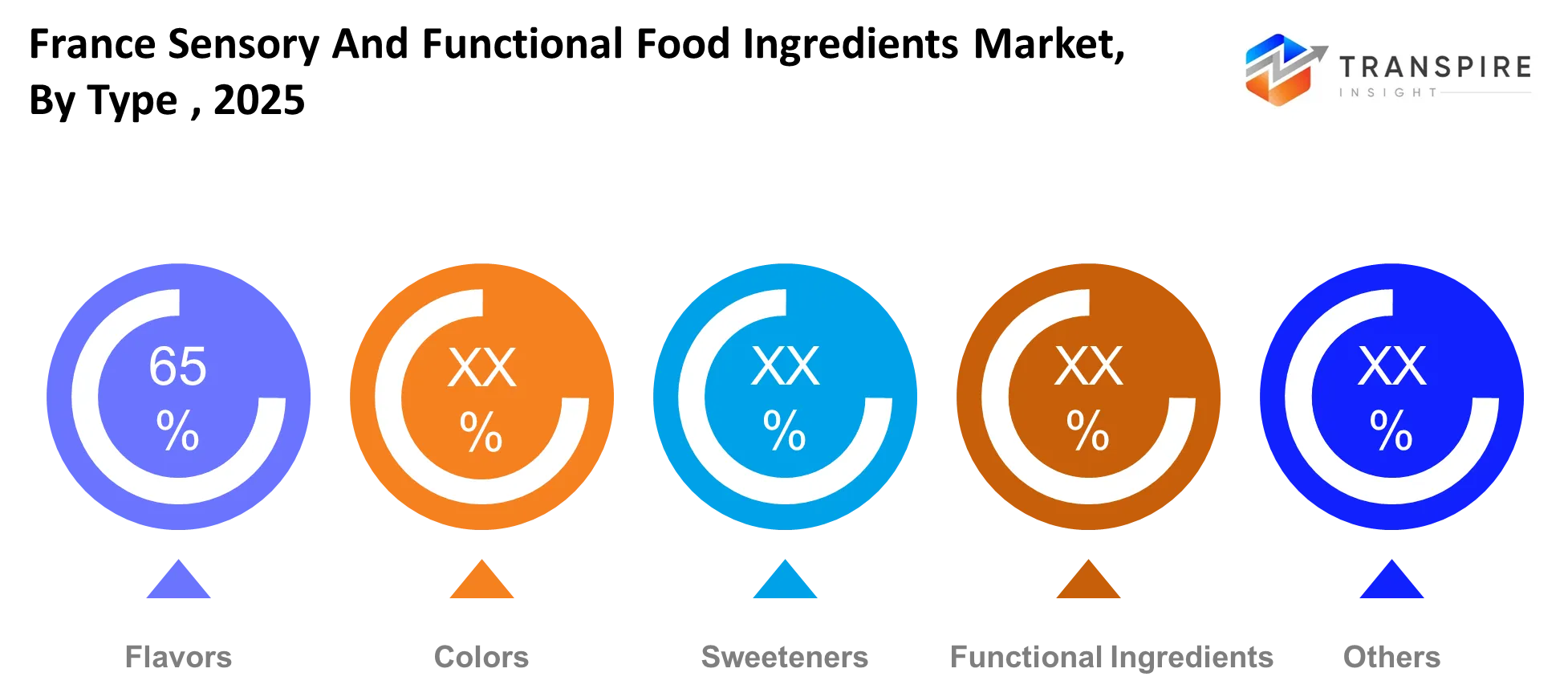
Flavors keep the dominant position , mainly because food manufacturers lean on taste optimization , so consumers still approve the products when sugar is reduced and when clean-label reformulation programs roll out. Beverage producers , dairy processors, and packaged food companies are still putting money into natural flavor modulators, botanical extracts, and fermentation-derived flavor systems, kind of like a way to keep the product stable, even as stricter ingredient transparency standards show up. There’s also strong demand for tailored sensory profiles, which backs premium pricing opportunities for suppliers that have more advanced formulation skills. Product developers are expected to speed up investments in AI-assisted flavor design and regional taste customization throughout the forecast period.
Colors maintain a notable market share because natural visual appeal is increasingly shaping purchasing behavior across confectionery, beverages, and dairy. Regulatory scrutiny around synthetic additives has nudged manufacturers toward plant-derived pigments , carotenoids, and anthocyanin-based formulations even though production costs run higher and stability can be tricky. Sweeteners keep expanding fairly steadily, as reduced-sugar launches alter the way packaged food is developed across France. Functional Ingredients are showing the fastest growth since probiotics, proteins, fibers , and bioactive compounds are getting adopted quickly across digestive wellness, sports nutrition, and clinical nutrition products. Meanwhile, other specialty ingredients are expected to open selective opportunities in personalized nutrition and microbiome-focused uses.
To learn more about this report, Download Free Sample Report
By Application
Beverages is kind of the front-running application segment because those functional hydration items, fortified drinks, and lower sugar recipes keep sparking ongoing invention activity all throughout France’s food and nutrition industry. In practice, producers lean more and more on sensory amplifiers, stabilizers, probiotic blends, and natural sweetening approaches , just to lift taste performance while still backing health-focused brand messaging. There’s also this quick rotation of new items in beverage categories, which means suppliers see repeated needs for ingredient setups that are tailored, plus quicker formulation turns. So ingredient suppliers are basically pushed to emphasize advanced flavor modulation and nutrient encapsulation platforms to stay competitive in beverage uses.
Dairy, meanwhile, holds a solid market stance thanks to people continuing to buy probiotic yogurts, fortified milk products, and protein-boosted dairy snacks both through retail and clinical nutrition pathways. Bakery keeps moving forward too, since producers are adopting natural emulsifiers, enzyme systems , and fiber mixes to help texture stay stable in clean-label and reduced-sugar goods. For Confectionery, manufacturers are raising the adoption of natural colors along with alternative sweeteners to match shifting nutrition expectations without dulling visual appeal or flavor punch. Processed Food and the remaining application segments should grow at a steady pace, driven by the need for better shelf-life management, functional fortification, and more premium convenience meal formulations over the forecast period.
By End-User
Food Manufacturers kinda dominate the end-user slice because big packaged food producers, well, represent the highest volume when it comes to ingredient sourcing and reformulation work across France. There are also heavy investments in clean-label switching, nutritional improvement, and product differentiation. This still keeps demand steady for customized flavor systems, proteins, fibers, plus fermentation based inputs. On top of that, long-term supply agreements between manufacturers and ingredient suppliers help lock in recurring income across the production cycle. Looking ahead, expansion is expected to revolve around AI supported formulation platforms and a quicker go-to-market for health oriented packaged food.\
Beverage Companies hold a big chunk of the market, mainly because competition in functional drinks and reduced sugar beverages keeps pushing ongoing novelty. That pressure leads to sensory upgrades and nutrient stabilization solutions, over and over. Nutraceutical Firms are also picking up steam because preventive healthcare habits are rising, so bioactive compounds, probiotics, and performance focused nutritional ingredients are requested more often across supplements and wellness lines. Meanwhile, Retail operators are widening their private-label functional food catalogs, which creates fresh sourcing angles for ingredient providers who can deliver cost efficient clean-label formulations. Other end users, like food service operators, and niche wellness brands are also expected to lift their demand for focused sensory plus nutritional tailoring during the forecast period
By Form
Powder holds the dominant position , because these powdered ingredients are often able to keep stability longer, they travel more easily, and they allow more formulation flexibility when people work across bakery , dairy, and nutritional products. Manufacturers really seem to prefer powdered probiotics, protein blends, enzymes, and sweetening systems because these formats basically make large storage and blending a lot simpler , while also lowering the spoilage risk. Industrial food processors gain too , in the sense of reduced logistics expenses and more reliable dosage precision during high volume production cycles. Ingredient suppliers are putting more money into new drying technologies along with encapsulation systems to raise powder solubility , and to help nutrients stay in better shape.
Liquid formulations keep a sizable market presence because beverage makers and flavor developers need rapid dispersion, a steady texture integration, and smoother processing compatibility once production scales up. Liquid flavor systems and sweetening blends continue to pick up momentum in ready-to-drink beverages, dairy drinks, and premium confectionery, more or less as a steady trend. Beyond that, other formats—like gels , pastes, and semi-solid concentrates—are moving forward slowly within niche nutrition programs and high performance food processing settings. And as demand keeps growing for customized ingredient delivery, it is expected to push innovation toward hybrid formulation technologies during the forecast period.
What are the Key Use Cases Driving the France Sensory And Functional Food Ingredients Market?
In the France Sensory And Functional Food Ingredients Market , the biggest use case comes from fortified dairy products , functional beverages and also protein-enriched packaged foods. French food manufacturers lean on probiotics, stabilizers, enzymes and flavor systems to boost nutritional performance while keeping taste consistency and shelf stability intact. This particular application generates the most demand because large retail chains and branded food producers continuously rework products to fit Nutri-Score standards and those clean-label positioning strategies.
The secondary side is moving fast too, especially in sports nutrition and clinical nutrition products. Functional proteins, amino acids, and texture-enhancing ingredients are being pulled into ready-to-drink shakes, elderly nutrition supplements and digestive wellness items that are sold through pharmacies and specialized retail channels. Even bakery manufacturers are shifting toward natural emulsifiers and fiber blends, mainly to support texture retention in reduced-sugar formulations , which is a pretty practical thing right now.
For emerging use cases, microbiome-targeted nutrition and precision-fermented bioactive ingredients are showing up more. French biotechnology firms are experimenting with customized gut-health formulations and plant-derived peptide systems for personalized wellness products. Today these are still niche however they’re expected to gather commercial traction as AI-assisted nutrition platforms and preventive healthcare models mature through 2033.
|
Report Metrics |
Details |
|
Market size value in 2025 |
USD 18.3 Billion |
|
Market size value in 2026 |
USD 19.2 Billion |
|
Revenue forecast in 2033 |
USD 26.5 Billion |
|
Growth rate |
CAGR of 4.71% from 2026 to 2033 |
|
Base year |
2025 |
|
Historical data |
2021 - 2024 |
|
Forecast period |
2026 - 2033 |
|
Report coverage |
Revenue forecast, competitive landscape, growth factors, and trends |
|
Regional scope |
France |
|
Key company profiled |
Givaudan, Firmenich, IFF, Symrise, Kerry Group, DSM, BASF, Cargill, ADM, Tate & Lyle, Sensient, Corbion, Ajinomoto, Chr Hansen, Roquette |
|
Customization scope |
Free report customization (country, regional & segment scope). Avail customized purchase options to meet your exact research needs. |
|
Report Segmentation |
By Type (Flavors, Colors, Sweeteners, Functional Ingredients, Others); By Application (Bakery, Beverages, Dairy, Confectionery, Processed Food, Others); By End-User (Food Manufacturers, Beverage Companies, Nutraceutical Firms, Retail, Others); By Form (Powder, Liquid, Others) |
Which Regions are Driving the France Sensory And Functional Food Ingredients Market Growth?
Northern France stays the main player sort of, because there is a dense mix of food processing sites, ingredient laboratories, and multinational production operations. The area also gains from solid logistics networks tied into major European trade corridors, so it stays easier to grab and move specialty ingredients without too much delay. On top of that, the government supported food innovation efforts, plus the already built dairy processing environment, kept encouraging spending in probiotics, enzyme systems and clean-label formulas. Big ingredient suppliers meanwhile keep regional R&D hubs near the packaged food manufacturers, which helps speed up joint product development, even when timelines get tight.
Western France comes next as the second-largest regional contributor , but its momentum looks different compared with the north’s more industrial rhythm. In practice the region runs on steady dairy output, agricultural processing know-how, and cooperative investments that keep moving nutrition improvements forward year after year. Here, food manufacturers lean more toward steady product reliability, fermentation know-how, and export minded dairy ingredients, rather than pushing pure high-volume industrial processing. That steadiness has made Western France a dependable revenue source for suppliers focusing on proteins, cultures, and digestive-health ingredient lines.
Auvergne-Rhône-Alpes is starting to show up as the quickest growing market, mainly due to rising biotechnology investment and more active food innovation work. In the last three years, local startup communities and research organizations have pushed ahead with precision fermentation, microbiome science, and plant based functional compounds. New funding tracks for food-tech manufacturing and sustainable protein work have drawn ingredient companies that want higher-value innovation, not just incremental upgrades
Who are the Key Players in the France Sensory And Functional Food Ingredients Market and How Do They Compete?
Competition in the France Sensory And Functional Food Ingredients Market stays moderately consolidated , even if it looks like a “few big names” sort of setup. Large global flavor and nutrition companies control a meaningful portion of premium ingredient supply, and they tend to hold on to it. What is really pushing the competitive landscape now is less the raw production scale , more the formulation technology , the regulatory know-how and the ability to customize for specific product goals. Multinational players defend their market share using proprietary fermentation systems, AI assisted formulation tools , and long running partnerships with French food manufacturers. Meanwhile, smaller biotech outfits and regional ingredient specialists are trying to break in, especially in clean-label and microbiome oriented categories .
Givaudan stands out with advanced sensory science and customized flavor modulation systems, which help manufacturers lower sugar and salt while keeping consumer acceptance steady. It keeps building out its formulation through digital flavor design platforms and high value ingredient innovation programs. DSM-Firmenich fights back using integrated nutrition and health solutions , bringing probiotics , taste frameworks, and bioactive compounds together under a single development platform. In practice , its merger led scale lets it support multinational packaged food clients with regulatory, sensory, and nutritional expertise all at once.
IFF leans strongly into biotechnology led ingredient development and fermentation based solutions for functional beverages and digestive wellness products. Roquette leans into its position in plant proteins and pea derived ingredients , supplying European clean-label and sports nutrition manufacturers. Kerry Group, on the other hand , competes via application specific texture systems and collaborative product development
Company List
- Givaudan
- Firmenich
- IFF
- Symrise
- Kerry Group
- DSM
- BASF
- Cargill
- ADM
- Tate & Lyle
- Sensient
- Corbion
- Ajinomoto
- Chr. Hansen
- Roquette
Recent Development News
In March 2025, DSM-Firmenich launched a new portfolio of taste solutions for pharmaceutical and nutrition formulations. The launch strengthened the company’s position in advanced flavor masking and functional ingredient applications for health-focused products.http://www.dsm-firmenich.com/en/businesses/health-nutrition-care/news/press-releases/2025-03-13-dsm-firmenich-launches-novel-taste-solutions-portfolio-for-pharmaceutical-applications.html (DSM-Firmenich).”
In April 2026, Givaudan reported stronger-than-expected first-quarter sales growth supported by continued demand across flavor and wellbeing applications. The performance reinforced ongoing investment in premium sensory ingredient innovation and pricing strategies across European food markets.http://www.reuters.com
In July 2025, DSM-Firmenich completed the divestment of its food enzymes business for EUR 1.5 billion as part of its strategic portfolio restructuring. The move allowed the company to focus capital allocation toward higher-margin nutrition, taste, and functional ingredient segments.http://our-company.dsm-firmenich.com
What Strategic Insights Define the Future of the France Sensory And Functional Food Ingredients Market?
The France Sensory and Functional Food Ingredients Market seems like it is going in a messy sort of way toward precision nutrition, fermentation based ingredient production, and AI assisted formulation systems. The main push behind this shift is basically the coming together of regulatory pressure, a stronger appetite for personalized wellness, and retailer expectations that call for clear, readable ingredient sourcing. Over the next five to seven years, suppliers that can connect nutritional functionality with sensory fine tuning will likely grab more than their share of value in premium packaged food categories
One risk that is a bit “quiet” is the growing reliance on narrow raw material flows like specialty plant proteins, microbial cultures, and bioactive extracts. If supply gets more concentrated and agriculture stays volatile, formulation costs may rise and that could squeeze pricing flexibility for mid sized manufacturers. Meanwhile, microbiome targeted nutrition plus precision fermentation platforms look like a real opening, especially for firms working on clinically validated functional ingredients.
Market players should probably focus on alliances with biotechnology companies, regional food tech accelerators, and AI driven formulation providers. The firms that blend scientific validation, scalable fermentation capacity, and quick customization will be in a better position to secure durable agreements with large multinational food and wellness brands
France Sensory And Functional Food Ingredients Market Report Segmentation
By Type
- Flavors
- Colors
- Sweeteners
- Functional Ingredients
- Others
By Application
- Bakery
- Beverages
- Dairy
- Confectionery
- Processed Food
- Others
By End-User
- Food Manufacturers
- Beverage Companies
- Nutraceutical Firms
- Retail
- Others
By Form
- Powder
- Liquid
- Others
Frequently Asked Questions
Find quick answers to common questions.
The approximate France Sensory And Functional Food Ingredients Market size for the market will be USD 26.5 Billion in 2033.
Key segments for the France Sensory And Functional Food Ingredients Market are By Type (Flavors, Colors, Sweeteners, Functional Ingredients, Others); By Application (Bakery, Beverages, Dairy, Confectionery, Processed Food, Others); By End-User (Food Manufacturers, Beverage Companies, Nutraceutical Firms, Retail, Others); By Form (Powder, Liquid, Others).
Major France Sensory And Functional Food Ingredients Market players are Givaudan, Firmenich, IFF, Symrise, Kerry Group, DSM, BASF, Cargill, ADM, Tate & Lyle, Sensient, Corbion, Ajinomoto, Chr Hansen, Roquette.
The France Sensory And Functional Food Ingredients Market size is USD 18.3 Billion in 2025.
The France Sensory And Functional Food Ingredients Market CAGR is 4.71% from 2026 to 2033.
- Givaudan
- Firmenich
- IFF
- Symrise
- Kerry Group
- DSM
- BASF
- Cargill
- ADM
- Tate & Lyle
- Sensient
- Corbion
- Ajinomoto
- Chr. Hansen
- Roquette
Recently Published Reports
-
Apr 2026
Baby Infant Formula Market
Baby Infant Formula Market Size, Share & Analysis Report By ype (Infant Milk, Follow On Milk, Specialty Baby Milk, Growing-Up Milk), By Ingredient (Carbohydrate, Fat, Protein, Minerals, Vitamins, and Others), By Product Form (Powder, Liquid, and Ready-to-feed), By Distribution Channels (Supermarket/Hypermarket, Specialty Store, Pharmacies, Online Retail, and Others), and Geography (North America, Europe, Asia-Pacific, Middle East and Africa, South and Central America), 2021 - 2031
-
Apr 2026
Edible Insects for Animal Feed Market
Edible Insects for Animal Feed Market Size, Share & Analysis Report By Type (Insect Powder, Insect Meal, Insect Bar, Insect Paste, Insect Oil, and Others), By Insect Type (Beetles, Cricket, Caterpillar, Hymenoptera, Orthoptera, Tree Bugs, and Others), By Application (Livestock, Pet Food, and Aquaculture), By Livestock Type (Poultry, Swine, and Others), and Geography (North America, Europe, Asia-Pacific, Middle East and Africa, South and Central America), 2021 - 2031
-
Apr 2026
Food Industry Disinfection and Bacterial Control Market
Food Industry Disinfection and Bacterial Control Market Size, Share & Analysis Report By Type (Chemical Disinfectants, Physical Disinfectants, and Biocides and Antimicrobials), By Application (Food Processing Equipment Surface Disinfection, Food Preparation Areas Surface Disinfection, Storage Areas Surface Disinfection, Anti-microbial Coatings Food Preservation, and Preservative Solutions Food Preservation), By End User (Meat and Poultry Processing, Dairy Processing, Seafood Processing, Bakery and Confectionery, Restaurants and Commercial Kitchens, and Food Service Providers), By Sales Channel (Online, Offline), and Geography (North America, Europe, Asia-Pacific, Middle East and Africa, South and Central America), 2021 - 2031
-
Apr 2026
Freeze Dried Food Market
Freeze Dried Food Market Size, Share & Analysis Report By Product Type (Fruits, Vegetables, Freeze-Dried Dairy Products, Freeze-Dried Meat and Seafood, Freeze-Dried Pet Food, and Prepared Meal), By Nature (Organic, and Conventional), By Form (Powdered, Granules, and Diced), By End Use (Breakfast Cereals, Dairy Products, Bakery & Confectionery, Nutritional Bars & Supplements, Powdered Beverages, Snacks, and Retail (Household)), and Geography (North America, Europe, Asia-Pacific, Middle East and Africa, South and Central America), 2021 - 2031