

France Liquid Handling System Market Size & Forecast:
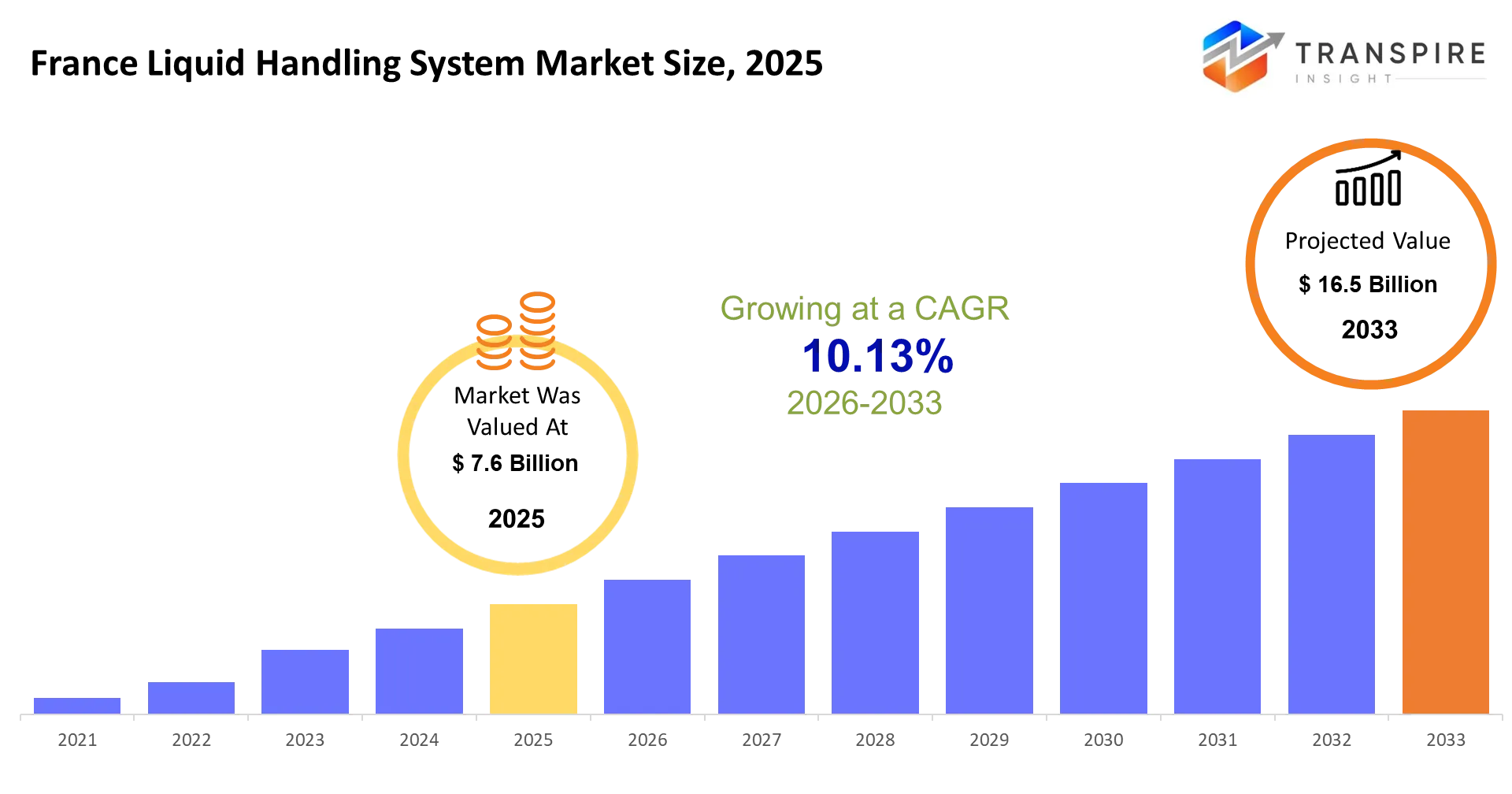
- France Liquid Handling System Market Size 2025: USD 7.6 Billion
- France Liquid Handling System Market Size 2033: USD 16.5 Billion
- France Liquid Handling System Market CAGR: 10.13%
- France Liquid Handling System Market Segments: By Type (Automated Systems, Semi-automated Systems, Manual Systems, Others); By Application (Drug Discovery, Diagnostics, Genomics, Proteomics, Others); By End-User (Pharma Companies, Biotech Firms, Research Institutes, Hospitals, Others); By Technology (Robotic Pipetting, Microfluidics, Others)
To learn more about this report,  Download Free Sample Report
France Liquid Handling System Market Summary
The France Liquid Handling System Market was valued at USD 7.6 Billion in 2025. It is forecast to reach USD 16.5 Billion by 2033. That is a CAGR of 10.13%over the period.
The France liquid handling system market serves vital functions in laboratories and pharmaceutical production and biotechnology research and clinical diagnostic testing because it enables accurate liquid transfer and metering and mixing and dispensing operations throughout extensive operational processes. The systems help reduce human mistakes while they enhance testing consistency and speed up testing procedures in settings which require precise control of every detail to maintain research and manufacturing standards. The market has evolved from using semi-automated bench systems to establishing integrated robotic platforms which operate with laboratory information management systems and AI-based analysis tools during the past five years.
The COVID-19 pandemic created operational delays in manual laboratory work which led to increased funding for developing scalable testing facilities and this resulted in a faster shift toward automated testing systems. The expanding biologics and cell therapy development pipeline in France has created a higher demand for automated liquid handling systems which can handle complex test procedures and perform multiple tests at once. The pharmaceutical industry and research institutions require faster validation processes and accurate compliance measurement which leads to vendors receiving more stable income through their software and consumables and maintenance deals.
Key Market Insights
- The pharmaceutical manufacturing and biotechnology research clusters of Northern France enabled the region to achieve 38% market share during 2025.
- The Western French region will develop into its most rapidly expanding hub during the period until 2033 through its growing investments in contract research and diagnostic facilities.
- The France Liquid Handling System Market reached its highest share through automated liquid handling workstations which achieved more than 44% market share because of high-throughput screening needs.
- Electronic pipetting systems remained the second-largest segment as clinical laboratories replaced manual systems to improve testing consistency and throughput.
- The market for robotic liquid handling platforms will experience its highest growth rate until 2033 because laboratories now implement AI-based automation systems.
- Drug discovery applications held the leading market share in 2025 because pharmaceutical companies accelerated biologics and genomic research programs.
- The molecular diagnostics market experienced its fastest growth because laboratories developed their PCR and next-generation sequencing capabilities after the pandemic. Pharmaceutical and biotechnology companies represented the largest end-user segment, contributing more than 46% of industry revenue in 2025.
- The public funding increases for precision medicine research caused academic research institutes to adopt compact automated dispensing systems at a fast pace.
- The laboratory automation providers and pharmaceutical manufacturers established more strategic collaborations after 2023 to help both parties develop their assays and standardize their workflows.
What are the Key Drivers, Restraints, and Opportunities in the France Liquid Handling System Market?
The rapid growth of biologics and genomics and precision medicine programs in pharmaceutical and clinical research laboratories drives the France liquid handling system market development. Drug developers increasingly rely on automated liquid handling platforms to process thousands of samples with consistent accuracy during high-throughput screening and molecular analysis. The shift happened because laboratories used pandemic funding of laboratory infrastructure upgrades which showed how manual processes created operational problems. Laboratories that need to develop products faster while meeting stricter compliance standards can benefit from automated dispensing systems which increase throughput and decrease reagent waste and testing costs and thereby enhance both purchasing activities and ongoing service sales.
The most significant restraint remains the high capital and integration cost associated with advanced robotic liquid handling systems. Large pharmaceutical firms can absorb these investments but smaller laboratories and regional diagnostic centers often struggle with upfront acquisition costs, software integration and workflow redesign and technician training requirements. The structural barrier prevents laboratories from modernizing their systems which results in limited use of fully automated platforms that mid-sized laboratories need to operate their facilities.
A major opportunity exists through the creation of AI-based laboratory orchestration systems that connect to cloud-based liquid handling systems. France is witnessing increased investment in smart laboratories capable of linking robotic dispensing digital sample tracking and predictive analytics into unified research environments. Companies that create modular automation systems for genomic sequencing and cell therapy applications will achieve benefits through upcoming market opportunities.
What Has the Impact of Artificial Intelligence Been on the France Liquid Handling System Market?
The France liquid handling system market experiences transformation through artificial intelligence and advanced digital technologies which modify laboratory operations for precise workflow execution and instrument calibration and work efficiency. AI-driven automated systems currently optimize liquid dispensing settings through live monitoring which decreases variations during high-throughput screening and PCR preparation and genomic sequencing activities. Pharmaceutical manufacturers and research laboratories increasingly integrate machine learning algorithms with robotic liquid handling systems to monitor workflow accuracy, detect anomalies, and automatically adjust dispensing volumes during complex assays.
The field of laboratory automation now uses predictive maintenance as the most effective AI application. Machine learning models analyze equipment usage patterns, pressure fluctuations, and calibration drift to create predictions about component failures which will happen before operational disruptions occur. The approach results in better system uptime together with reduced maintenance expenses and decreased dangers of sample contamination. Advanced analytics systems enhance workflow efficiency by predicting reagent usage and optimizing scheduling processes in laboratories that operate multiple instruments.
AI-powered laboratory management systems have transformed compliance documentation processes and digital record keeping methods according to pharmaceutical quality control standards which require audit preparation. However, adoption still faces limitations because organizations encounter difficulties when they try to incorporate AI software with their existing laboratory systems. Many laboratories also lack sufficiently standardized operational datasets required to train highly accurate predictive models across diverse testing environments.
Key Market Trends
- Pharmaceutical laboratories have stopped using standalone pipetting machines since 2022 to adopt complete robotic systems that come with unified software for managing their operational processes.
- French biotechnology firms increasingly adopted AI-assisted liquid handling platforms after pandemic-era laboratory modernization accelerated automation investment cycles.
- The need for high-throughput genomic research systems increased dramatically when cancer sequencing and cell therapy programs required advanced low-volume dispensing technologies with exact precision.
- Tecan Group and Hamilton Company have developed software that laboratory users find easier to operate because users encountered difficulties when they tried to connect multiple systems and write new software programs.
- Laboratories that process PCR and next-generation sequencing operations have started to select modular automation systems that can handle both 96-well and 384-well plate formats since 2023.
- Research laboratories experienced increased operational demands because staffing shortages and stricter reproducibility standards forced buyers to reduce their use of manual processes.
- Acoustic dispensing and nano-volume liquid handling technologies gained traction between 2024 and 2026 because laboratories sought lower reagent waste and contamination risks.
- Vendors began to chase ongoing money streams which extended beyond their main product offerings after they pivoted their business model toward developing robotics-compatible products and software platforms.
- Academic and mid-sized laboratories increasingly evaluated compact automation platforms with simplified interfaces instead of large enterprise-grade robotic installations.
- Laboratories identified two vital elements for their purchasing decisions which served as their chief criteria for selecting predictive maintenance and workflow optimization systems.
France Liquid Handling System Market Segmentation
By Type
Automation systems maintain their market leadership because pharmaceutical companies and genomic testing facilities and clinical research organizations need high-throughput systems which deliver both accurate results and consistent performance. The advanced robotic dispensing platforms enable laboratories to achieve better accuracy while maintaining testing standardization and faster throughput times across their entire operational capacity. The market segment benefits from strong AI-enabled workflow management adoption which creates premium pricing and generates ongoing software service revenue through cloud-based laboratory systems.
Mid-sized laboratories and academic institutes require affordable automation solutions which do not need complete robotic systems thus semi-automated systems maintain their market share. The systems attract laboratories which need to move from manual work to automated processes because they offer flexible deployment methods and require less hardware infrastructure. Budget-constrained laboratories and facilities that conduct minimal testing use manual systems because they find it hard to invest in automation technologies. The “others” category which includes specialized nano-dispensing and acoustic liquid handling platforms will experience steady growth during the forecast period because advanced biologics research and precision diagnostics require more sophisticated sample handling methods.
By Application
The primary distribution of drug discovery development occurs because pharmaceutical companies develop biologics while conducting compound screening and precision medicine research throughout France. High-throughput screening workflows need automated liquid handling systems that can deliver tiny amounts of liquid correctly to multiple test samples throughout their operations. The contract research organizations and pharmaceutical laboratories use automation because it enables them to complete validation processes faster while their laboratories work more effectively during preclinical testing.
The diagnostics market holds its current position because automated sample preparation systems have become essential for PCR testing and molecular diagnostics and infectious disease screening workflows. Next-generation sequencing laboratories now demand scalable dispensing technologies which enables them to grow their genomics applications through their DNA extraction and sequencing preparation procedures. The field of proteomics has grown because researchers use biomarkers to develop personalized healthcare solutions which need specialized systems for complex assay development. The forecast period shows environmental testing and food safety analysis work in the other category will gain from laboratory modernization efforts and testing compliance regulations that will be enforced throughout the period.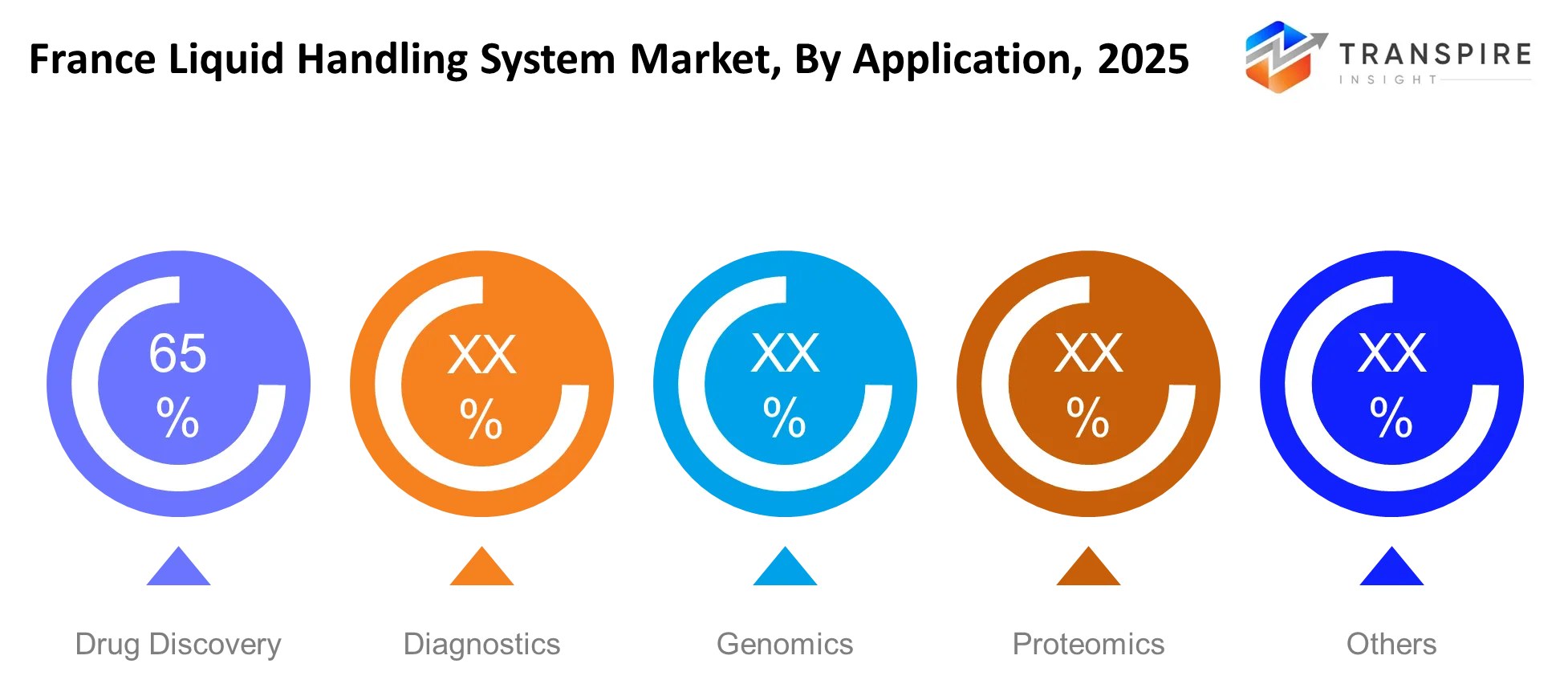
To learn more about this report, Download Free Sample Report
By End-User
The primary user group for pharmaceutical companies exists because their drug development processes need advanced liquid handling systems which can perform automated tasks to achieve consistent results while meeting legal requirements. Pharmaceutical laboratories show increased procurement activity because they invest in biologics production and cell therapy research and precision medicine development. The segment generates continuous revenue through its combination of extended equipment lifespan and ongoing maintenance contracts.
Biotech companies hold a strong market presence because genomic and molecular biology and therapeutic research institutes which focus on developing new startups need automated systems that provide flexibility. Research institutes continue to generate stable demand through their government-supported precision medicine and biomedical research programs which require advanced laboratory systems. The testing facilities of hospitals gradually implement automated dispensing systems which handle molecular diagnostics and pathology laboratory work because testing procedures have become more complex. The category "others," which includes forensic laboratories and industrial testing facilities, is projected to expand steadily because automated laboratory workflows become increasingly available in nontraditional testing environments.
By Technology
The technology segment of robotic pipetting operates as the dominant force because automated pipetting systems serve as vital tools which laboratories use to perform their high-throughput operations with precise sample handling methods. Robotic dispensing systems undergo growing adoption by pharmaceutical laboratories and sequencing centers because these systems work together with digital workflow management systems to enhance operational efficiency while decreasing reagent waste. Advanced robotic systems enable organizations to achieve scalable automation capabilities which span genomics and diagnostics and biologics manufacturing processes that face manual variability challenges which create operational risks.
Microfluidics technology is gaining traction because laboratories increasingly seek ultra-low volume sample processing solutions capable of reducing reagent consumption and contamination risk. Compact chip-based workflows enable laboratories to develop assays more quickly while achieving greater efficiency in genomics and point-of-care diagnostic testing. The "others" category which includes both acoustic dispensing and nano-volume liquid handling technologies will expand gradually because research laboratories need to conduct precise work which requires them to dispense liquids at microscopic levels. The upcoming period will see AI-enabled analytics systems and advanced dispensing technologies work together to transform laboratory automation purchasing methods which laboratories in France use.
What are the Key Use Cases Driving the France Liquid Handling System Market?
The primary application of liquid handling systems in France is applied through drug discovery processes together with high-throughput screening methods. The pharmaceutical and biotechnology industry depends on automatic dispensing systems, which enable them to handle extensive sample quantities, while maintaining accurate results throughout their biologics studies, compound testing, and genomic research activities. The highest workload demand occurs through these processes, which need manual work because it extends the time required for assays and creates greater results uncertainty within controlled testing facilities.
The market for clinical diagnostics and molecular testing solutions is undergoing fast growth in both hospital laboratories and private diagnostic networks. Robotic pipetting systems, which operate through robotic systems, have become essential for PCR preparation, next-generation sequencing, and infectious disease testing because they can perform low-volume sample handling without causing contamination problems. Academic research institutions are starting to implement small-scale automation systems, which will enable them to conduct multiomics research and precision medicine initiatives.
The healthcare industry is adopting two new technologies, which are automated cell therapy production and AI-driven laboratory management systems. French laboratories start implementing cloud-based robotic systems, which enable them to minimize reagent usage, track operational efficiency, and conduct decentralized genomic assessments throughout the upcoming period.
|
Report Metrics |
Details |
|
Market size value in 2025 |
USD 7.6 Billion |
|
Market size value in 2026 |
USD 8.4 Billion |
|
Revenue forecast in 2033 |
USD 16.5 Billion |
|
Growth rate |
CAGR of 10.13% from 2026 to 2033 |
|
Base year |
2025 |
|
Historical data |
2021 - 2024 |
|
Forecast period |
2026 - 2033 |
|
Report coverage |
Revenue forecast, competitive landscape, growth factors, and trends |
|
Regional scope |
France |
|
Key company profiled |
Thermo Fisher, Agilent, PerkinElmer, Danaher, Eppendorf, Tecan, Hamilton, Sartorius, Bio-Rad, Beckman Coulter, Gilson, Mettler Toledo, Hudson Robotics, Aurora Biomed, Analytik Jena |
|
Customization scope |
Free report customization (country, regional & segment scope). Avail customized purchase options to meet your exact research needs. |
|
Report Segmentation |
By Type (Automated Systems, Semi-automated Systems, Manual Systems, Others); By Application (Drug Discovery, Diagnostics, Genomics, Proteomics, Others); By End-User (Pharma Companies, Biotech Firms, Research Institutes, Hospitals, Others); By Technology (Robotic Pipetting, Microfluidics, Others) |
Which Regions are Driving the France Liquid Handling System Market Growth?
Northern France remains the leading regional market because it combines strong pharmaceutical manufacturing capacity with advanced biomedical research infrastructure. The Paris region and its biotechnology corridors serve as operational bases for major pharmaceutical companies and contract research organizations and clinical diagnostics laboratories that depend on automated liquid handling systems. The region benefits from government-sponsored life sciences innovation initiatives while academic institutions work together with private laboratories. This ecosystem enables ongoing funding for robotic laboratory automation and genomic sequencing and high-throughput screening technology development.
Eastern France serves as the second-largest contributor to industrial growth in the region which follows different growth paths than the northern region because its economic development stems from industrial stability and cross-border healthcare partnerships. The laboratories located near the German border and Swiss border maintain their investment schedules because of the strong medical device production facilities and established pharmaceutical distribution networks. The equipment buyers in this area select products based on three main factors which include their ability to handle work processes and meet regulatory standards and their equipment systems which provide long-term operational functionality. Vendors who provide service contracts and calibration services and modular automation systems create a revenue stream that remains constant throughout the business cycle.
The Western French market has become the fastest-growing regional market since 2024 because multiple biotechnology startups and decentralized testing laboratories expanded their operations. The public sector and private sector both enhanced their investments into precision diagnostics and agricultural biotechnology and genomics research which increased the need for automated dispensing systems.
Who are the Key Players in the France Liquid Handling System Market and How Do They Compete?
The French liquid handling system market shows moderate consolidation because established laboratory automation companies control the majority of high-value pharmaceutical and clinical laboratory contracts. The competition now focuses on workflow automation and software usability and ultra-low volume precision and post-installation service capabilities instead of instrument pricing. Large companies sustain their market presence through AI-based automation systems and comprehensive digital solutions, while small automation companies target specific markets with their adaptable products.
Thermo Fisher Scientific develops automated systems that pharmaceutical companies can use to produce products and manage cell therapy processes. The company launched the Gibco CTS Compleo system to boost its automated fill-and-finish capabilities, which require strict control of sterility and reproducibility standards. Tecan Group uses its modular robotic systems and OEM partnerships to enable laboratories to create tailored workflows for diagnostic testing and genomic research. The company increased its automated software-based operations by acquiring Wako Automation assets in 2025.
Hamilton Company provides liquid handling systems that deliver accurate results for high-throughput genomic testing and molecular biology research, especially in challenging situations that require precise control of small liquid volumes. Agilent Technologies combines its analytical instruments with liquid handling systems to create integrated systems that link chromatography and mass spectrometry methods. Beckman Coulter expands its business through automation software, which simplifies workflows and enables beginners to use the system, thereby attracting mid-sized clinical and academic laboratories that want quick system implementation.
Company List
Thermo Fisher, Agilent, PerkinElmer, Danaher, Eppendorf, Tecan, Hamilton, Sartorius, Bio-Rad, Beckman Coulter, Gilson, Mettler Toledo, Hudson Robotics, Aurora Biomed, Analytik Jena
Recent Development News
In April 2026, Thermo Fisher Scientific launched the Gibco CTS Compleo Fill and Finish System. The automated platform supports consistent cell therapy manufacturing outcomes by reducing manual intervention in formulation and filling workflows.http://www.pharmiweb.com
In March 2026, Thermo Fisher Scientific launched the Fluid Ease Pro ClipTip electronic pipette. The touchscreen-enabled liquid handling system improved reproducibility, workflow standardization, and ergonomic performance across high-throughput laboratory environments.http://www.pharmiweb.com
What Strategic Insights Define the Future of the France Liquid Handling System Market?
The France liquid handling system market is developing toward laboratory ecosystems which will use robotic dispensing and AI workflow management and predictive analytics through digital platforms which will connect all laboratory systems. The research field of biologics and genomics and precision medicine has developed complex requirements which force laboratories to use increasing automation solutions that maintain precise results during advanced operational procedures. Software integration and recurring digital service revenue will surpass hardware sales as the primary revenue source for the next five to seven years.
The first hidden risk involves increasing reliance on a small group of automation software platforms. Laboratories which create customized workflow systems based on exclusive platforms will encounter expensive switching expenses and security risks and permanent vendor dependence. Research into decentralized genomic testing and compact modular automation systems has created new business possibilities for mid-sized laboratories which want affordable deployment solutions. The market needs to develop systems which use software architectures that support interoperability and automation platforms which can work with all existing laboratory systems instead of using proprietary systems which restrict access.
France Liquid Handling System Market Report Segmentation
By Type
Automated Systems
Semi-automated Systems
Manual Systems
Others
By Application
Drug Discovery
Diagnostics
Genomics
Proteomics
Others
By End-User
Pharma Companies
Biotech Firms
Research Institutes
Hospitals
Others
By Technology
Robotic Pipetting
Microfluidics
Others
Frequently Asked Questions
Find quick answers to common questions.
The confirmed 2033 Market size figure in USD 16.5 Billion.
Key Segments for the France Liquid Handling System Market are By Type (Automated Systems, Semi-automated Systems, Manual Systems, Others); By Application (Drug Discovery, Diagnostics, Genomics, Proteomics, Others); By End-User (Pharma Companies, Biotech Firms, Research Institutes, Hospitals, Others); By Technology (Robotic Pipetting, Microfluidics, Others).
Major France Liquid Handling System Market Players are Thermo Fisher, Agilent, PerkinElmer, Danaher, Eppendorf, Tecan, Hamilton, Sartorius, Bio-Rad, Beckman Coulter, Gilson, Mettler Toledo, Hudson Robotics, Aurora Biomed, Analytik Jena.
The France Liquid Handling System Market size is USD 7.6 Billion in 2025.
The France Liquid Handling System Market CAGR is 10.13% from 2026 to 2033.
Recently Published Reports
-
Apr 2026
Cord Blood Banking Services Market
Cord Blood Banking Services Market Size, Share & Analysis Report By Type of Service (Collection, Processing, Storage), By Bank Type (Private Banks, Public Banks, and Hybrid Banks), By Component (Cord Blood, and Cord Tissue), By End User (Hospitals, Research Institutions, Biotechnology Companies, and Others) and Geography (North America, Europe, Asia-Pacific, Middle East and Africa, South and Central America), 2021 - 2031
-
Apr 2026
ELISA Processors Market
ELISA Processors Market Size, Share & Analysis Report By Type (Optical Filter ELISA Analyzer, and Optical Grating ELISA Analyzers), By Mode (Automated ELISA Analyzers, and Semi-Automated ELISA Analyzers), By Applications (Immunology, Vaccine development, Drug Monitoring, and Others), By End Users (Biotechnology Companies, Pharmaceutical Companies, Contract Research Organization, and Diagnostic Laboratories) and Geography (North America, Europe, Asia-Pacific, Middle East and Africa, South and Central America), 2021 - 2031
-
Apr 2026
Microscope Slide Scanner Market
Microscope Slide Scanner Market Size, Share & Analysis Report By Type (Portable Microscope Slide Scanner, and Desktop Microscope Slide Scanner), By Application (Biological Research, Medicine, Veterinary, and Other) and Geography (North America, Europe, Asia-Pacific, Middle East and Africa, South and Central America), 2021 - 2031
-
Apr 2026
Microwave Cookware Market
Microwave Cookware Market Size, Share & Analysis Report By Material Type (Plastic, Glass, Ceramic, Silicone, and Metal), By Application (Cooking, Reheating, and Defrosting), By End User (Household, Commercial (Restaurants, Hotels, and Cafes), and Food Service Industry), By Sales Channel (Online Retail, Offline Retail (Supermarkets, Hypermarkets, Specialty Stores), and Direct Sales (Company Outlets)) and Geography (North America, Europe, Asia-Pacific, Middle East and Africa, South and Central America), 2021 - 2031