
United States Baker's Yeast Market Size & Forecast
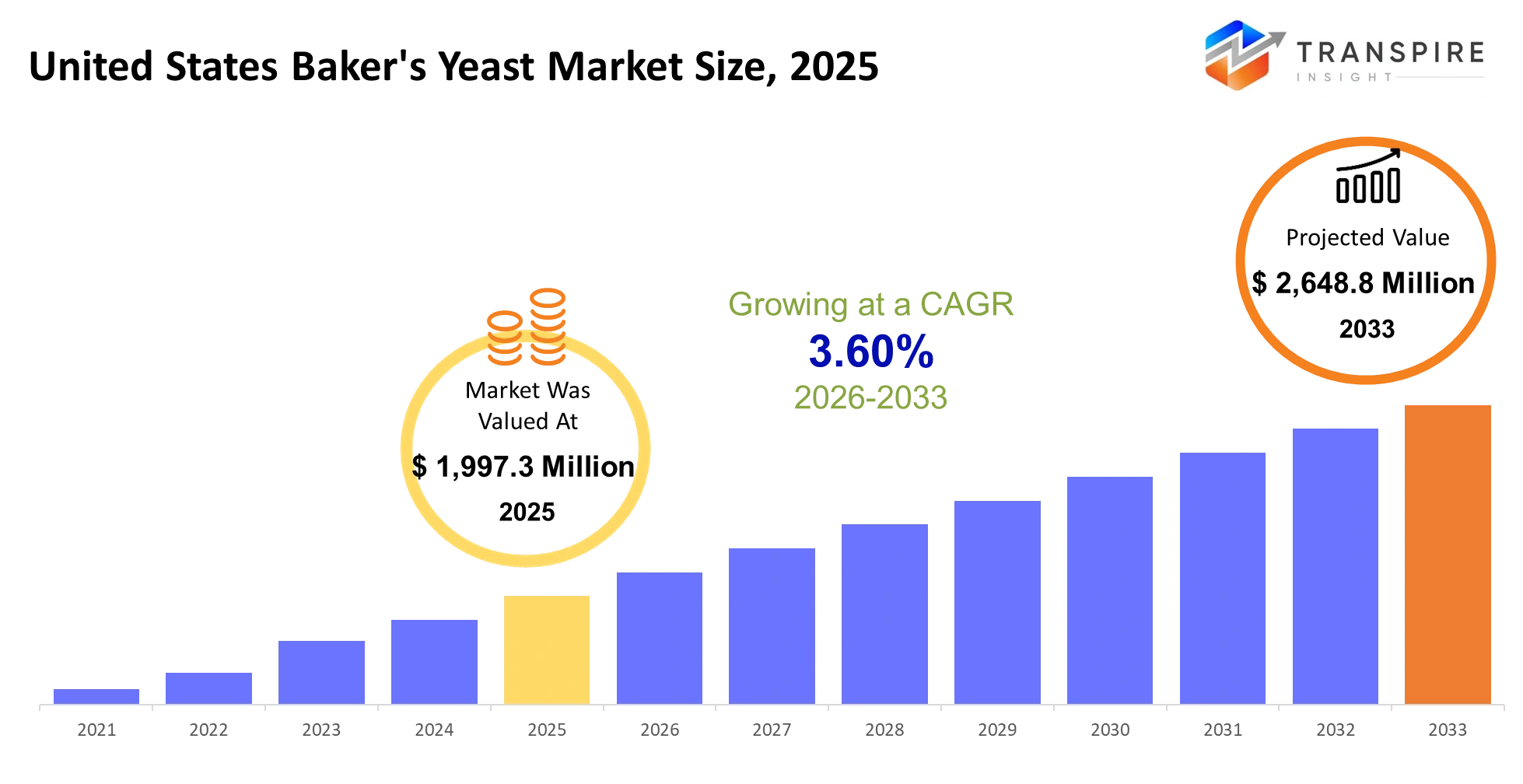
- United States Baker's Yeast Market Size 2025: USD 1,997.3 Million
- United States Baker's Yeast Market Size 2033: USD 2,648.8 Million
- United States Baker's Yeast Market CAGR: 3.60%
- United States Baker's Yeast Market Segments: By Type (Fresh Yeast, Active Dry Yeast, Instant Yeast), By Application (Bread, Pastries, Pizza Dough, Other Bakery Products).
To learn more about this report,  Download Free Sample Report
United States Baker's Yeast Market Summary
Baker's yeast is a single-celled organism that ferments sugars to produce carbon dioxide and alcohol, enabling dough to rise and develop flavor. The United States baker's yeast market encompasses fresh compressed yeast, active dry yeast granules, and instant yeast products sold to commercial bakeries, in-store bakery departments, quick-service restaurants, and home bakers. At USD 1,997.3 Million in 2025, the market is growing at 3.60% CAGR toward USD 2,648.8 Million by 2033.
Demand is anchored by bread consumption in American diets and the continued expansion of artisanal bakery segments that require premium yeast quality and reliability. Commercial bakeries have standardized on instant yeast for operational efficiency because instant yeast requires no rehydration, mixes directly into dough, and delivers consistent fermentation performance across batch volumes. The shift from fresh yeast toward instant and active dry yeast has been steady over the past two decades as commercial producers optimize for labor cost reduction.
Market growth is constrained by relatively flat commodity bread consumption but sustained by demand for specialty and premium bakery products. Bagel consumption, ciabatta rolls, sourdough breads, and artisanal pizza operations all require yeast products with specific fermentation characteristics. At the household level, home baking participation increased sharply during the 2020 to 2022 pandemic period and has stabilized at a higher baseline than pre-pandemic levels, creating persistent demand through retail channels.
Key United States Baker's Yeast Market Insights
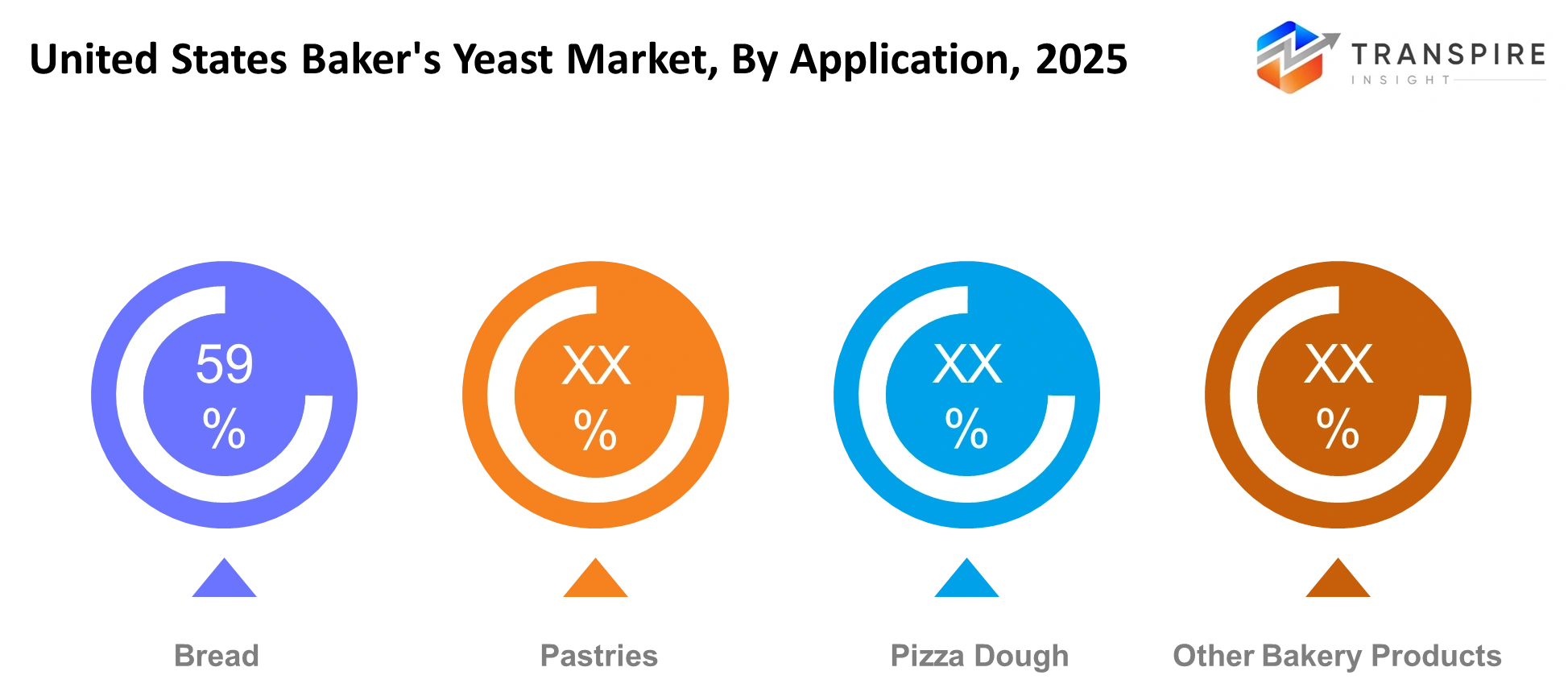
- Bread applications generate 59% of total United States baker's yeast market revenue in 2025, driven by consumption of sandwich loaves, sub rolls, bagels, and artisanal bread varieties across commercial bakeries and QSR chains.
- Active Dry Yeast and Instant Yeast together account for approximately 72% of the total baker's yeast market by volume in 2025, with commercial bakeries overwhelming preferring these formats over fresh yeast for shelf stability and operational consistency.
- Fresh Yeast remains essential for artisanal bakeries and premium bakery segments despite lower market share, as fresh yeast delivers superior fermentation control and complex flavor development that instant yeast cannot fully replicate.
- The commercial bakery segment represents approximately 78% of total market revenue in 2025, with large-scale producers accounting for the majority of volume through procurement contracts with regional and national yeast suppliers.
- Lesaffre Group and AB Mauri collectively hold over 55% of the United States baker's yeast market through their respective product portfolios and established distribution relationships with major food service operators and in-store bakery chains.
- Private label yeast products sold through retail grocery chains capture approximately 18% of the retail baker's yeast market by volume, competing on price with branded offerings like Fleischmann's and Red Star.
- Specialty yeast products formulated for specific applications such as sourdough, whole grain fermentation, and rapid-dough production are growing above 8% annually, outpacing commodity white bread yeast growth by a factor of two.
- Foodservice channels including QSR chains, pizza restaurants, and institutional food operators account for approximately 41% of commercial baker's yeast purchases, with McDonald's, Subway, and Domino's among the largest individual customers.
- Supply chain disruptions from 2020 to 2022 accelerated consolidation among small regional yeast manufacturers, with acquisitions and facility closures reducing the number of active yeast producers in the United States from 23 to 16 major operations.
- Clean label and non-GMO yeast products are growing at approximately 6.5% annually, outpacing the market average by a factor of 1.8, as bakeries respond to consumer demand for transparency in ingredient sourcing.
What are the Key Drivers, Restraints, and Opportunities in the United States Baker's Yeast Market?
The primary driver is the structural shift in American bread consumption toward specialty and premium bakery products. Commodity white sandwich bread consumption has declined approximately 1.2% annually over the past decade, but consumption of artisanal, sourdough, whole grain, and ethnic bread varieties has grown steadily. Bagel consumption alone has remained stable at 300 to 350 million bagels annually across the United States, supporting dedicated bagel bakeries and QSR operations. Specialty breads command premium prices and require yeast products with specific fermentation characteristics that commodity yeast suppliers struggle to provide, creating demand for premium and customized yeast products that drive margin expansion across the yeast industry.
The primary restraint is the consolidation of the commercial bakery industry into a small number of massive national producers who use their procurement scale to demand price concessions from yeast suppliers. Bimbo Bakeries, Flowers Foods, and a small number of other mega-producers control approximately 42% of commercial bread production in the United States and use that scale to negotiate yeast contracts at prices that compress supplier margins below 15% in many product categories. This consolidation dynamic restrains revenue growth even when volume demand is stable, because per-unit prices decline faster than volume increases as customers concentrate their purchasing power.
Integration of yeast with other ingredient technologies including enzymes, dough conditioners, and emulsifiers to provide one-stop formulation solutions for bakery customers is the clearest forward opportunity. Instead of selling yeast as an isolated ingredient, suppliers can offer comprehensive fermentation solutions that optimize bake time, crust quality, crumb structure, and shelf life in a single procurement package. Lesaffre and DSM-Firmenich have both begun marketing bundled yeast and enzyme solutions to large commercial bakeries, enabling customer switching costs that protect against aggressive competitor pricing and create opportunities for premium pricing on integrated solutions.
What Has the Impact of Artificial Intelligence Been on the United States Baker's Yeast Market?
Artificial intelligence applications in the baker's yeast market remain nascent but are beginning to emerge in fermentation process optimization and quality control. Computer vision systems deployed at yeast manufacturing facilities monitor foam density, cell viability indicators, and fermentation tank conditions in real time, generating alerts when production parameters drift outside optimal ranges. These systems reduce the number of batch failures caused by suboptimal fermentation conditions, typically improving manufacturing yield by 2 to 3 percentage points annually in facilities where the technology is deployed.
Predictive analytics applied to historical fermentation data enable manufacturers to forecast optimal fermentation times based on input substrate composition, ambient temperature, and target cell viability specifications. Rather than relying on technician judgment and experience to determine when fermentation is complete, machine learning models trained on thousands of historical batches predict optimal harvest timing with greater consistency, reducing batch-to-batch variability in finished product characteristics. This consistency improvement is particularly valuable for industrial customers where yeast performance consistency directly impacts their production costs.
The emerging application generating the most industry interest is microbial community profiling using DNA sequencing and machine learning to identify and quantify contaminating microorganisms in yeast cultures and fermentation tanks before they compromise product quality. Early detection of contamination enables targeted intervention, reducing the likelihood of complete batch loss and extending the economic viability of fermentation campaigns that would otherwise be abandoned. Current implementation costs approximately USD 50,000 to USD 120,000 per facility installation, limiting deployment to large yeast manufacturers with volumes sufficient to justify the investment.
Key Market Trends
- Bread applications represent 59% of total market revenue in 2025 and are growing at the market average rate of 3.60% CAGR through 2033, supported by artisanal bread demand and specialty bread category expansion in QSR and retail bakery channels.
- Pastries and pizza dough applications combined account for approximately 32% of market revenue and are growing at 5.2% CAGR through 2033, driven by expansion of fast-casual pizza concepts and premium pastry consumption in affluent urban markets.
- Instant Yeast holds approximately 48% of the type segment revenue in 2025 and is growing at 4.1% CAGR, driven by continued adoption among commercial bakeries optimizing for labor efficiency and operational consistency.
- Fresh Yeast comprises approximately 28% of the type segment revenue in 2025 and is declining at 0.8% CAGR through 2033, as artisanal bakeries represent a shrinking proportion of total commercial bakery output nationally.
- Active Dry Yeast holds approximately 24% of the type segment revenue in 2025 and is growing at 3.2% CAGR, supported by retail home baking demand and adoption by small regional bakeries seeking shelf-stable yeast products.
- Clean label yeast products are growing at 6.5% CAGR through 2033, outpacing the market average by a factor of 1.8 as bakeries respond to consumer demand for transparency and naturally derived ingredients.
- Specialty yeast formulated for specific applications including sourdough, rapid-dough production, and whole grain fermentation are growing above 8% annually, driven by restaurant and bakery interest in differentiated flavor profiles.
- Foodservice channels are growing slightly above the market average at 4.1% CAGR, supported by QSR expansion and the continued growth of fast-casual pizza and sandwich concepts.
- Retail grocery channels are growing at 2.8% CAGR through 2033, below the market average, as household baking participation stabilizes after the pandemic-driven surge in home baking activity from 2020 to 2022.
- Yeast supplier consolidation accelerated during 2020 to 2022 as smaller regional manufacturers closed or were acquired, with the number of active major yeast producers declining from 23 to 16 operations.
United States Baker's Yeast Market Segmentation
By Type
Instant Yeast holds 48% of the type segment revenue in 2025 and is the dominant format in commercial bakery applications. Instant yeast contains live yeast cells and yeast metabolites without added soy lecithin, allowing direct addition to dough without rehydration. Commercial bakeries prefer instant yeast because it reduces handling time, requires no temperature control between addition and mixing, and delivers consistent fermentation performance across batch volumes. This format commands a premium price relative to active dry yeast despite requiring no additional processing, because commercial customers value the labor cost savings and operational simplicity.
Fresh Yeast comprises 28% of segment revenue and remains essential for artisanal bakeries and premium bakery segments. Fresh yeast delivers superior fermentation control and complex flavor development because bakers can manage fermentation temperature and duration with precision, extracting desirable compounds including organic acids and esters that contribute to bread flavor and aroma. However, fresh yeast requires continuous refrigeration, must be used within four to six weeks of production, and demands careful handling to maintain cell viability. The shrinking proportion of artisanal bakeries in the total US bakery industry is gradually reducing fresh yeast demand.
Active Dry Yeast accounts for 24% of segment revenue and is growing at 3.2% CAGR. This format contains larger yeast granules with a protective coating of inert material, extending shelf life to 18 to 24 months without refrigeration. Small regional bakeries and retail home bakers prefer active dry yeast because it eliminates the need for cold chain management and is widely available in retail supermarkets at lower price points than instant yeast. The retail grocery channel is the primary distribution path for active dry yeast.
By Application
Bread applications generate 59% of total market revenue in 2025 and include sandwich loaves, sub rolls, bagels, English muffins, and specialty artisanal varieties. Commercial bakeries use yeast products tailored to the specific bread type they produce. Sandwich bread manufacturers require yeast that drives rapid fermentation and uniform crumb structure. Bagel producers use yeast formulated to deliver the dense crumb structure and specific flavor characteristics that distinguish bagels from other bread formats. Artisanal bread producers require yeast with properties enabling complex fermentation profiles.
Pastries and pizza dough account for 32% of total market revenue. Pastry fermentation differs from bread fermentation because pastries require shorter fermentation times and lighter gas production to maintain lamination structure in croissants, Danish pastries, and enriched doughs. Pizza dough requires fermentation that develops flavor complexity while maintaining dough extensibility and skin crisp in the final product. Fast-casual pizza concepts and premium pastry segments are both growing above 5% annually, supporting stable demand for application-specific yeast products.
Other bakery products including muffins, donuts, biscuits, and specialty items account for approximately 9% of market revenue. These applications often use yeast in combination with chemical leavening agents or require rapid fermentation times incompatible with traditional bakery yeast. Growth in this category remains below the market average as it represents a fragmentary collection of niche applications without consistent performance requirements.
To learn more about this report, Download Free Sample Report
By Distribution Channel
Commercial bakery procurement accounts for approximately 78% of total market revenue, with large-scale producers purchasing yeast through volume contracts negotiated directly with major suppliers. Consolidation of commercial bakery production into a small number of mega-producers has shifted negotiating power toward customers, compressing supplier margins below 15% in many commodity yeast categories.
Foodservice channels including QSR chains, pizza restaurants, and institutional food service operators represent approximately 41% of commercial bakery purchases. These customers specify yeast products through procurement departments and value supply chain reliability and consistency above all other factors.
Retail grocery channels account for approximately 18% of total market revenue. Private label yeast products sold through supermarket brands compete directly with branded offerings like Fleischmann's and Red Star on price, creating margin pressure in the retail segment.
What are the Key Use Cases Driving the United States Baker's Yeast Market?
The dominant use case is commercial bread production for sandwich loaves sold through retail grocery chains and quick-service restaurants. Sandwich bread represents approximately 35% of total yeast market revenue. Large commercial bakeries producing 500 to 2,000 loaves per hour require yeast products that drive rapid fermentation on a 3 to 4-hour cycle, deliver consistent crumb structure, and maintain product shelf life through the entire retail distribution period. These applications reward yeast suppliers that offer consistent performance, reliable supply, and volume pricing that reflects the customer's enormous purchasing scale.
Fast-casual pizza restaurant expansion is the second-largest use case, generating approximately 12% of total yeast market revenue and growing faster than the market average. Pizza operations require yeast formulated to develop flavor in extended cold fermentation periods followed by rapid rise in the oven. Brands including Domino's, Pizza Hut, and independent fast-casual concepts standardize on specific yeast products to maintain consistent pizza characteristics across all locations. Supplier switching costs in this channel are high once a brand standardizes on a yeast product because changing suppliers introduces the risk of flavor and texture variation that damages customer perception.
Artisanal and specialty bakery operations generate approximately 8% of total yeast market revenue and are growing above 6% annually. These bakeries use small quantities of premium fresh yeast or specialty yeast formulations to create breads with distinct flavor and texture characteristics that command premium retail prices. The profitability of artisanal bakery operations depends directly on the quality and consistency of their yeast supply, making brand loyalty strong but purchase volumes too small to achieve the scale discounts available in commodity bread segments. This channel remains profitable for yeast suppliers despite small absolute volumes because of higher per-unit margins and lower price sensitivity among customers.
|
Report Metrics |
Details |
|
Market size value in 2025 |
USD 1,997.3 Million |
|
Market size value in 2026 |
USD 2,068.1 Million |
|
Revenue forecast in 2033 |
USD 2,648.8 Million |
|
Growth rate |
CAGR of 3.60% from 2026 to 2033 |
|
Base year |
2025 |
|
Historical data |
2021 - 2024 |
|
Forecast period |
2026 - 2033 |
|
Report coverage |
Revenue forecast, competitive landscape, growth factors, and trends |
|
Geographic scope |
United States of America |
|
Key companies profiled |
Lesaffre Group, AB Mauri (Associated British Foods), Lallemand Inc., Angel Yeast Co. Ltd., Kerry Group PLC, DSM-Firmenich, Alltech Inc., Pakmaya, Oriental Yeast Co. Ltd., Leiber GmbH, Biorigin, Fleischmann's Yeast, SAF-Instant Yeast, Red Star Yeast Company, Chr. Hansen Holding A/S. |
|
Customization scope |
Free report customization (segment scope). Avail customized purchase options to meet your exact research needs. |
|
Report Segmentation |
By Type (Fresh Yeast, Active Dry Yeast, Instant Yeast), By Application (Bread, Pastries, Pizza Dough, Other Bakery Products). |
Who are the Key Players in the United States Baker's Yeast Market and How Do They Compete?
The United States baker's yeast market is dominated by two global suppliers: Lesaffre Group and AB Mauri, which together control approximately 55% of total market revenue. Lesaffre operates yeast production facilities in the United States and serves major commercial bakery customers through both branded products and private label contracts. AB Mauri, owned by Associated British Foods, maintains strong relationships with QSR chains and international bakery concepts, leveraging its parent company's extensive global distribution network to secure large volume contracts at competitive prices.
Mid-tier suppliers including Lallemand Inc., DSM-Firmenich, and Kerry Group PLC compete by offering specialized yeast products and integrated fermentation solutions that address specific customer applications. Lallemand operates yeast facilities across North America and markets specialty yeast products for sourdough, rapid fermentation, and clean label applications. DSM-Firmenich differentiates through enzyme and yeast combinations that address customer formulation needs beyond simple yeast fermentation.
Consumer-facing brands including Fleischmann's Yeast, Red Star, and SAF-Instant Yeast compete in the retail grocery channel through brand recognition and extensive supermarket shelf presence. Fleischmann's, owned by AB Mauri, leverages brand equity built over a century of retail presence to command premium pricing relative to private label alternatives. These branded products generate lower absolute revenue than foodservice sales but deliver higher per-unit margins and access to household bakers willing to pay brand premiums.
Company List
- Lesaffre Group
- AB Mauri (part of Associated British Foods)
- Lallemand Inc.
- Angel Yeast Co., Ltd.
- Kerry Group plc
- DSM-Firmenich
- Alltech Inc.
- Pakmaya
- Oriental Yeast Co., Ltd.
- Leiber GmbH
- Biorigin
- Fleischmann's Yeast
- SAF-Instant Yeast
- Red Star Yeast Company
- Chr. Hansen Holding A/S
Recent Developments
In January 2026, DSM-Firmenich launched a bundled yeast and enzyme solution for sourdough bread production, enabling bakers to optimize fermentation and enzymatic activity through a single procurement specification. The product entered pilot testing with five major regional bakeries in California and the Pacific Northwest.
Source: https://www.dsm-firmenich.com
In February 2026, Kerry Group PLC announced a strategic partnership with a leading fast-casual pizza chain to develop a custom yeast formula optimized for cold fermentation periods exceeding 48 hours. The partnership includes technical support, on-site yeast management consulting, and guaranteed supply contracts extending through 2028.
Source: https://www.kerrygroup.com
What Strategic Insights Define the Future of the United States Baker's Yeast Market?
Over the next five to seven years, the United States baker's yeast market will continue to be shaped by consolidation of commercial bakery production into a small number of mega-producers who use their purchasing power to suppress yeast pricing. However, this dynamic will be partially offset by the expansion of specialty bakery segments including artisanal breads, fast-casual pizza, and premium pastries, all of which support premium yeast pricing and reward suppliers that offer application-specific products rather than commodity formulations.
The clearest strategic opportunity for yeast suppliers is vertical integration into adjacent ingredients and services including enzymes, dough conditioners, and fermentation consulting. Instead of competing primarily on yeast price and performance, suppliers can capture higher margin by bundling yeast with complementary ingredients and technical services that address customer formulation needs comprehensively. Lesaffre, DSM-Firmenich, and Kerry Group are all pursuing this strategy through acquisitions and partnership development.
Market consolidation among yeast manufacturers is expected to continue, with the number of significant US-based yeast producers likely to stabilize at 12 to 14 major operations by 2028. Smaller regional manufacturers unable to invest in specialized production equipment and quality assurance systems will continue to exit the market through closure or acquisition by larger competitors. The remaining competitors will focus on geographic specialization, application specialization, or service differentiation rather than attempting to compete on price and scale against global leaders.
United States Baker's Yeast Market Report Segmentation
By Type
- Fresh Yeast
- Active Dry Yeast
- Instant Yeast
By Application
- Bread
- Pastries
- Pizza Dough
- Other Bakery Products
By Distribution Channel
- Commercial Bakeries
- Foodservice Channels
- Retail Grocery Channels
Frequently Asked Questions
Find quick answers to common questions.
The United States Baker's Yeast Market size is expected to reach USD 2,648.8 Million by 2033.
The key segments are By Type (Fresh Yeast, Active Dry Yeast, Instant Yeast) and By Application (Bread, Pastries, Pizza Dough, Other Bakery Products).
Major players include Lesaffre Group, AB Mauri (Associated British Foods), Lallemand Inc., Angel Yeast Co. Ltd., Kerry Group PLC, DSM-Firmenich, Alltech Inc., Pakmaya, Oriental Yeast Co. Ltd., Leiber GmbH, Biorigin, Fleischmann's Yeast, SAF-Instant Yeast, Red Star Yeast Company, and Chr. Hansen Holding A/S.
The United States Baker's Yeast Market size is USD 1,997.3 Million in 2025.
The United States Baker's Yeast Market CAGR is 3.60% from 2026 to 2033.
- Lesaffre Group
- AB Mauri (part of Associated British Foods)
- Lallemand Inc.
- Angel Yeast Co., Ltd.
- Kerry Group plc
- DSM-Firmenich
- Alltech Inc.
- Pakmaya
- Oriental Yeast Co., Ltd.
- Leiber GmbH
- Biorigin
- Fleischmann's Yeast
- SAF-Instant Yeast
- Red Star Yeast Company
- Chr. Hansen Holding A/S
Recently Published Reports
-
Apr 2026
Baby Infant Formula Market
Baby Infant Formula Market Size, Share & Analysis Report By ype (Infant Milk, Follow On Milk, Specialty Baby Milk, Growing-Up Milk), By Ingredient (Carbohydrate, Fat, Protein, Minerals, Vitamins, and Others), By Product Form (Powder, Liquid, and Ready-to-feed), By Distribution Channels (Supermarket/Hypermarket, Specialty Store, Pharmacies, Online Retail, and Others), and Geography (North America, Europe, Asia-Pacific, Middle East and Africa, South and Central America), 2021 - 2031
-
Apr 2026
Edible Insects for Animal Feed Market
Edible Insects for Animal Feed Market Size, Share & Analysis Report By Type (Insect Powder, Insect Meal, Insect Bar, Insect Paste, Insect Oil, and Others), By Insect Type (Beetles, Cricket, Caterpillar, Hymenoptera, Orthoptera, Tree Bugs, and Others), By Application (Livestock, Pet Food, and Aquaculture), By Livestock Type (Poultry, Swine, and Others), and Geography (North America, Europe, Asia-Pacific, Middle East and Africa, South and Central America), 2021 - 2031
-
Apr 2026
Food Industry Disinfection and Bacterial Control Market
Food Industry Disinfection and Bacterial Control Market Size, Share & Analysis Report By Type (Chemical Disinfectants, Physical Disinfectants, and Biocides and Antimicrobials), By Application (Food Processing Equipment Surface Disinfection, Food Preparation Areas Surface Disinfection, Storage Areas Surface Disinfection, Anti-microbial Coatings Food Preservation, and Preservative Solutions Food Preservation), By End User (Meat and Poultry Processing, Dairy Processing, Seafood Processing, Bakery and Confectionery, Restaurants and Commercial Kitchens, and Food Service Providers), By Sales Channel (Online, Offline), and Geography (North America, Europe, Asia-Pacific, Middle East and Africa, South and Central America), 2021 - 2031
-
Apr 2026
Freeze Dried Food Market
Freeze Dried Food Market Size, Share & Analysis Report By Product Type (Fruits, Vegetables, Freeze-Dried Dairy Products, Freeze-Dried Meat and Seafood, Freeze-Dried Pet Food, and Prepared Meal), By Nature (Organic, and Conventional), By Form (Powdered, Granules, and Diced), By End Use (Breakfast Cereals, Dairy Products, Bakery & Confectionery, Nutritional Bars & Supplements, Powdered Beverages, Snacks, and Retail (Household)), and Geography (North America, Europe, Asia-Pacific, Middle East and Africa, South and Central America), 2021 - 2031