

United Kingdom Autonomous Mobile Robots Market Size & Forecast:
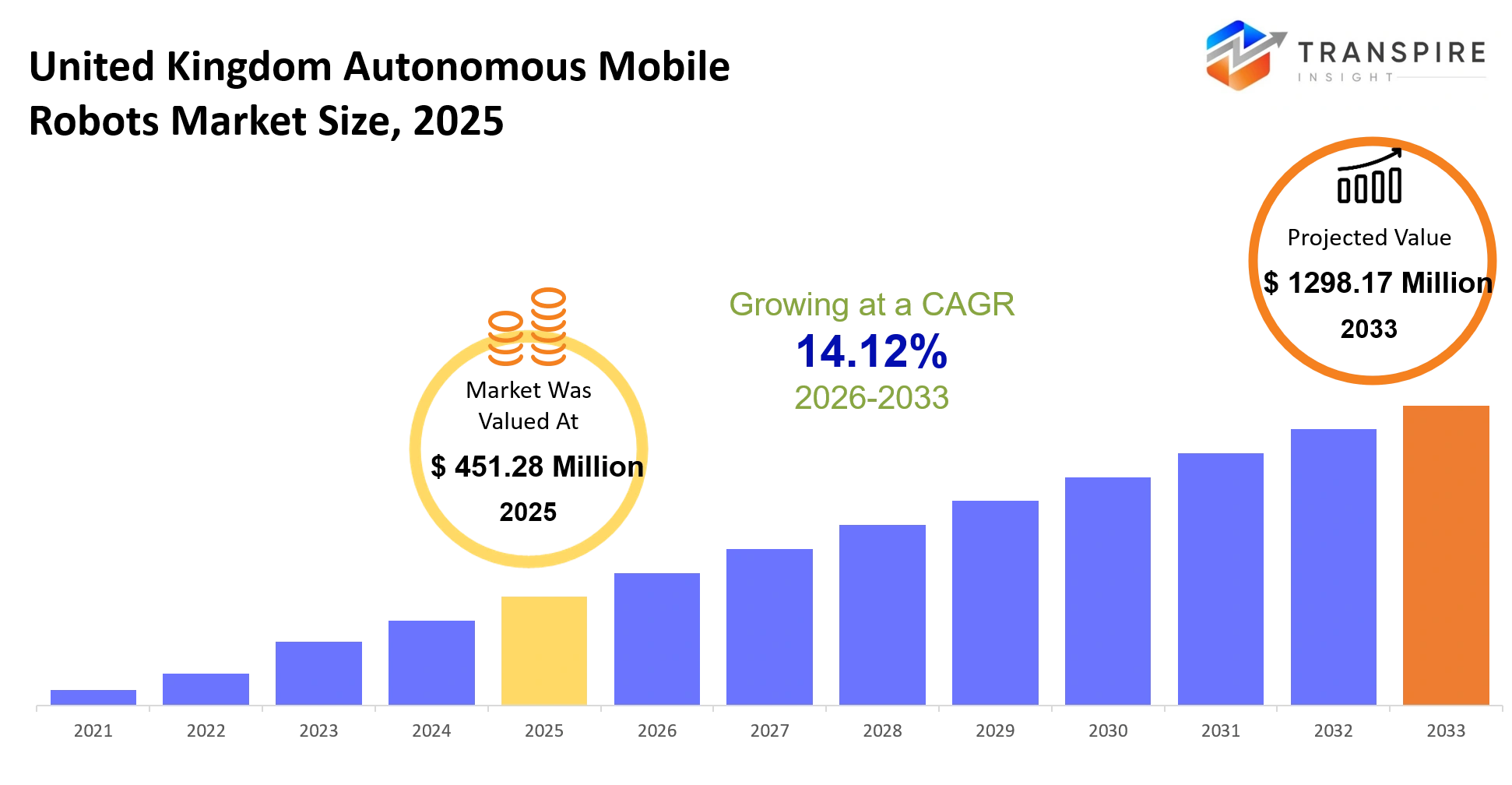
- United Kingdom Autonomous Mobile Robots Market Size 2025: USD 451.28 Million
- United Kingdom Autonomous Mobile Robots Market Size 2033: USD 1298.17 Million
- United Kingdom Autonomous Mobile Robots Market CAGR: 14.12%
- United Kingdom Autonomous Mobile Robots Market Segments: By Robot Type (Goods-to-person Robots, Self-driving Forklifts, Delivery Robots, Cleaning Robots, Inspection Robots, Security Robots, Collaborative Mobile Robots, Others); By Navigation Technology (LiDAR Navigation, Vision-based Navigation, SLAM Navigation, AI-based Navigation, Magnetic Guidance, Others); By Application (Warehouse Automation, Manufacturing Automation, Healthcare Logistics, Retail Automation, Hospitality Automation, Others); By End User (E-commerce Companies, Logistics Providers, Manufacturers, Hospitals, Retailers, Others)
To learn more about this report,  Download Free Sample Report
United Kingdom Autonomous Mobile Robots Market Summary
The United Kingdom Autonomous Mobile Robots Market was valued at USD 451.28 Million in 2025. It is forecast to reach USD 1298.17 Million by 2033. That is a CAGR of 14.12% over the period. In the United Kingdom, autonomous mobile robots are often used to move materials, parcels, and parts across warehouses, manufacturing sites and, more and more, ports and even hospital logistics networks. In real life, they tend to replace manual carts plus those fixed conveyor extensions, by moving through ever changing indoor spaces while coordinating with warehouse management systems, so goods keep moving with little or no human hands on the process, or at least that is the idea.
Over the last three to five years, the market kind of shifted from separate trial rollouts toward fleet scale orchestration, where several robots are managed through cloud control platforms and route decisions are constantly refined. At the same time, there has been a stubborn trigger in the real world, persistent labor shortages in UK logistics and warehouse operations , made sharper by post Brexit workforce constraints and also the pandemic driven spike in e commerce fulfillment pressure. That mix made many operators lean toward throughput stability, more than cost optimization only. So adoption is accelerating, since AMRs reduce reliance on hard to find labor while boosting order precision and turnaround velocity in settings with highly variable demand, which you know, is pretty common.
Key Market Insights
- Southern England, especially London and Midlands, basically keeps about 42% share in 2025, mainly because logistics and retail distribution infrastructure is so dense and well stitched together, kind of a network effect.
- Northern England is the quickest grower between 2025–2030, mostly as manufacturing reshoring keeps moving forward and industrial automation investments keep stacking up.
- In the United Kingdom Autonomous Mobile Robots market you’ll see regional clustering around the big port and warehouse corridors, like the activity sort of gathers there naturally.
- Goods-to-person AMRs take the lead with roughly 48% share in 2025, which is pinned on adoption in e-commerce fulfillment centers, where volumes are relentless.
- Autonomous forklifts end up ranking second, they help with heavy-load warehouse automation, and they also lower manual handling risks in a practical way.
- Collaborative mobile robots are the fastest-growing slice through 2030, because they can be deployed flexibly in mixed operations environments, where things don’t stay the same.
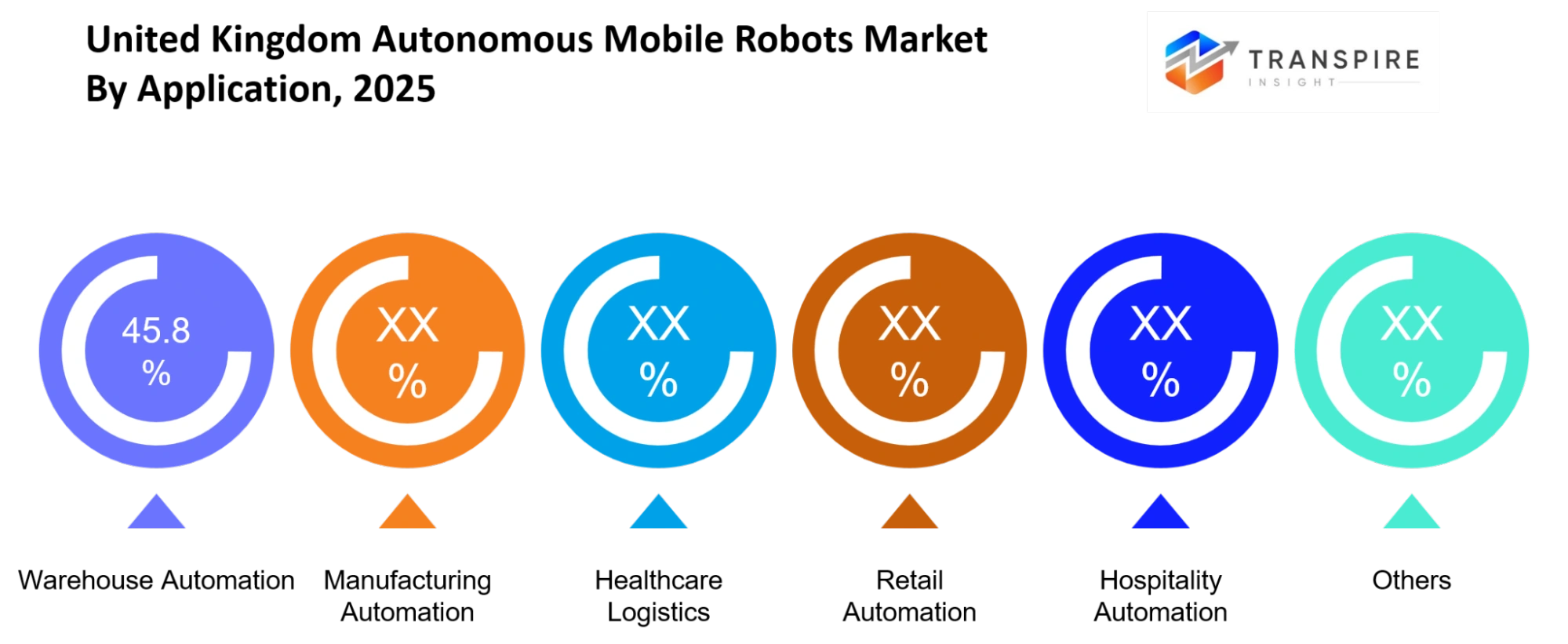
- On the application side, warehouse logistics leads at around 55% share in the United Kingdom Autonomous Mobile Robots market, powered by e-commerce scaling pressure and the need to move faster.
- Hospital logistics is the fastest-growing application, growing quickly since sterile transport matters and medical supply chains are being automated.
- Manufacturing intralogistics is still expanding as companies optimize just-in-time production workflows, and at the same time they reduce downtime.
- Finally, e-commerce and retail distribution dominate overall, with close to 50% share because the UK demand keeps requiring high-volume order fulfillment.
What are the Key Drivers, Restraints, and Opportunities in the United Kingdom Autonomous Mobile Robots Market?
The main driver is persistent labor scarcity across warehouse and distribution environments, it got worse after Brexit and then got even more obvious during the pandemic era supply chain turbulence. Because of this gap, UK retailers and 3PL operators leaned into automation for intralogistics work like picking, sorting, and moving pallets, in a more serious way rather than just testing. So, autonomous mobile robots kind of moved from experimental gadgets into core operating assets. That shift helps keep throughput steadier, and it also boosts vendor revenue via big fleet deployments, not just the usual one off installs.
The biggest restraint is the high integration complexity that sits inside legacy warehouse setups. A lot of UK sites still run semi-automated systems, or they depend on manually coordinated processes, which then forces expensive retrofitting if they want real time robot coordination. In practice this structural issue slows down deployment cycles because companies have to redo floor layouts, upgrade WMS software, and retrain staff before a full rollout. All of that pushes revenue timing further out for the solution providers.
A major opportunity is AI driven fleet orchestration platforms together with 5G enabled smart logistics hubs, especially in the Midlands and the Southeast areas of UK. Early launches in advanced fulfillment centers, like the next generation grocery automation networks spearheaded by Ocado Technology, show that scalable cloud robotics can improve higher density robot coordination. It can also expand the available addressable capacity across the United Kingdom Autonomous Mobile Robots Market, fairly quickly once the foundations are in place.
What Has the Impact of Artificial Intelligence Been on the United Kingdom Autonomous Mobile Robots Market?
Artificial intelligence is getting more and more put inside UK autonomous mobile robotics rollouts and nearby industrial automation setups, especially in places where scrubber performance systems , exhaust gas cleaning technology and marine emission control routines need constant checking and tight control. In real terms, AI-enabled control layers are now used to basically run system diagnostics on their own, watch operational compliance in real time, and tune the cleaning cycles using sensor feedback, not some rigid timetable. This tends to lessen the manual inspection burden a bit and makes performance reporting feel more steady across different, spread out assets.
Also, machine learning models are showing up for predictive maintenance, where vibration, pressure, and flow-rate readings are examined to foresee how components in scrubber units and mobile robotic systems might start degrading. That helps operators set up maintenance before things actually break, so uptime tends to hold up better and there are fewer surprises that interrupt operations. In logistics-linked robotics settings, AI-driven fleet optimization has shown kind of directional improvements for energy efficiency and for how tasks get assigned, which in turn can cut down idle time and raise system utilization rates, especially in those crowded high-density plants.
Still, there’s a major snag, the lack of high-quality, real-world maritime and industrial training data, mainly when conditions change in messy ways like higher humidity , corrosion exposure, and uneven load cycles. This kind of missing data reduces model accuracy and makes it slower to roll out truly fully autonomous decision-making, so operators end up keeping human-in-the-loop oversight for key compliance and safety tasks, across the United Kingdom Autonomous Mobile Robots Market ecosystem.
Key Market Trends
- Between 2020 and 2025 , UK warehouses kind of moved away from stand alone AMR trials to full fleet-scale installs across more than 50% of the bigger facilities.
- After 2021, labor shortages in UK logistics pushed automation procurement into longer and more careful cycles, and in operational planning it cut hiring dependence across fulfillment centers by about 30% .
- Later on, AI driven fleet orchestration ended up replacing the old rule based routing systems, and in the advanced sites Ocado Technology plus Amazon Robotics scaled autonomous coordination platforms , not just a demo.
- The older warehouse setups also got swapped more often for retrofit automation models, but the catch is integration costs went up 25–40% for mid-sized UK distribution operators from 2022 .
- Then machine learning based predictive maintenance started lowering the chances of unplanned AMR downtime, by as much as 35% in high throughput UK fulfillment environments starting in 2023 .
- On top of that, 5G enabled logistics hubs in Southeast England improved real time robot coordination latency by nearly 40% versus Wi‑Fi only systems, which is kind of a big difference.
- Zebra Technologies and ABB also expanded UK AMR deployments through partnerships with third party logistics firms during 2023 to 2025 .
- And by 2025 , the average robot density per warehouse rose from under 10 units back in 2020 to more than 25 units in UK facilities.
United Kingdom Autonomous Mobile Robots Market Segmentation
By Robot Type:
Goods-to-person robots, self-driving forklifts, delivery robots, cleaning robots, inspection robots, security robots, collaborative mobile robots and others will support material handling and facility movement across industries, kind of seamlessly. Goods-to-person systems will cut down manual picking time in warehouses, it feels like less effort overall. Self-driving forklifts will boost load handling safety and reduce human dependency in high traffic storage environments, especially when there’s a lot going on at once.
Cleaning robots and inspection robots will back up routine facility maintenance and monitoring tasks, with steady accuracy. Security robots will also help with surveillance in large industrial spaces. Collaborative mobile robots will work alongside human workers, which helps with task balance and reduces delays. Delivery robots, and other variants will cover internal transport needs in hospitals, factories, and retail distribution hubs
By Navigation Technology:
For navigation, LiDAR navigation, vision-based navigation, SLAM navigation, AI-based navigation, magnetic guidance, and other approaches will drive movement accuracy and route planning. SLAM navigation will enable real-time mapping in changing warehouse layouts. LiDAR systems will sharpen obstacle detection and cut collision risks in busy operational spaces across logistics and industrial sites.
AI-based navigation will help with adaptive routing based on traffic and workload shifts, not just “one way forever”. Vision-based systems will strengthen object recognition in mixed environments. Magnetic guidance will stick to controlled settings with fixed paths. Using combined navigation methods will improve reliability and reduce operational interruptions across automated warehouse and manufacturing workflows, all around the United Kingdom.
By Application:
Warehouse automation, manufacturing automation, healthcare logistics, retail automation, hospitality automation, and others will kind of define usage patterns. Warehouse automation will stay the core application, supporting fast order handling and inventory movement, which is kinda the main thing. Manufacturing automation will help internal material flow and reduce production delays in structured industrial environments.
Healthcare logistics will back safe movement of medicines and supplies inside hospitals. Retail automation will upgrade stock handling and in-store distribution efficiency. Hospitality automation will take care of internal service movement tasks. In general, these applications cut down manual workload, boost accuracy, and help faster operational cycles across many service and industrial settings.
To learn more about this report, Download Free Sample Report
By End User:
E-commerce companies, logistics providers, manufacturers, hospitals, retailers, and others will push adoption across the United Kingdom Autonomous Mobile Robots Market. E-commerce companies will lean on automation for quick order fulfillment and less pressure around delivery speed. Logistics providers will plug robots in to manage high-volume distribution workflows.
Manufacturers will use autonomous systems to streamline production support and internal transportation, generally speaking. Hospitals will adopt robotics for controlled movement of medical supplies. Retailers will improve inventory handling and store operations, day to day.Other users include smaller industrial units that aim for cost reduction, better efficiency, and less dependency on manual labor systems.
What are the Key Use Cases Driving the United Kingdom Autonomous Mobile Robots Market?
Warehouse logistics is kind of the main use case pushing the United Kingdom Autonomous Mobile Robots Market, where these robots do picking, sorting, and internal transport inside big, high-volume distribution centers. The pull is strongest in e-commerce and retail fulfillment hubs because order frequency stays high, workforce availability is messy and not always stable, and customers keep expecting fast delivery so goods need to stay in motion all the time , with no real delays.
Past the warehouse walls, adoption is widening into manufacturing and healthcare logistics. In factories, autonomous robots move parts between production lines, cutting down idle time and keeping the workflow more consistent. In hospitals and with pharmaceutical distributors, they are also bringing in autonomous robots to carry medicines and lab samples, mainly when controlled handling is needed, and when delivery timing really affects patient care and regulatory compliance.
Newer patterns are showing up too, like retail in-store automation and last-mile internal delivery inside large commercial complexes. A few logistics companies are even running trials with autonomous robots in semi-outdoor yard operations, mostly for container movement coordination. These applications are still early though, but they hint at solid potential as navigation systems get better and the operational environment becomes more organized, and a bit more predictable.
|
Report Metrics |
Details |
|
Market size value in 2025 |
USD 451.28 Million |
|
Market size value in 2026 |
USD 514.98 Million |
|
Revenue forecast in 2033 |
USD 1298.17 Million |
|
Growth rate |
CAGR of 14.12% from 2026 to 2033 |
|
Base year |
2025 |
|
Historical data |
2021 - 2024 |
|
Forecast period |
2026 - 2033 |
|
Report coverage |
Revenue forecast, competitive landscape, growth factors, and trends |
|
Regional scope |
Middle East and Africa (Saudi Arabia, United Arab Emirates, South Africa, Rest of Middle East and Africa) |
|
Key company profiled |
ABB, KUKA, Omron, Geek+, Zebra Technologies, Locus Robotics, Fetch Robotics, Mobile Industrial Robots, Amazon Robotics, Siemens, Clearpath Robotics, OTTO Motors, FANUC, Bosch Rexroth, Yaskawa |
|
Customization scope |
Free report customization (country, regional & segment scope). Avail customized purchase options to meet your exact research needs. |
|
Report Segmentation |
By Robot Type (Goods-to-person Robots, Self-driving Forklifts, Delivery Robots, Cleaning Robots, Inspection Robots, Security Robots, Collaborative Mobile Robots, Others); By Navigation Technology (LiDAR Navigation, Vision-based Navigation, SLAM Navigation, AI-based Navigation, Magnetic Guidance, Others); By Application (Warehouse Automation, Manufacturing Automation, Healthcare Logistics, Retail Automation, Hospitality Automation, Others); By End User (E-commerce Companies, Logistics Providers, Manufacturers, Hospitals, Retailers, Others) |
Which Regions are Driving the United Kingdom Autonomous Mobile Robots Market Growth?
Southern England still comes out on top in the United Kingdom Autonomous Mobile Robots Market, mainly because the logistics web is so dense, and e-commerce fulfillment centers are really packed in there. London , and the Southeast, also get a lot of leverage from port connectivity through Southampton and Felixstowe which helps keep import export rhythms moving quickly. Big 3PL players, plus retail distribution hubs, have already built up mature automation ecosystems, and they tend to plug AMRs in at scale. Because of this, the setup keeps letting teams roll out ongoing improvements, add more units, and lean on software driven warehouse optimization, almost like it’s becoming routine.
The Midlands acts more like a stable but still very meaningful engine , with its strength coming from manufacturing and automotive rather than the port led style of logistics. Here, expansion is less about shipping lanes and more about factory automation and internal material movement inside production areas. Places like Birmingham and Coventry have long running industrial operations, and they keep adopting robotics in a steady way to lift assembly line output. Steady capital spending from manufacturers then turns into gradual but dependable growth for autonomous mobile robot deployments.
Northern England is growing the quickest, pushed by recent reshoring of manufacturing plus focused infrastructure investments along logistics corridors. Industrial upgrades in and around Manchester, Leeds, and Teesside have made it easier for new warehouse and distribution builds to happen. On top of that, government backed regional development initiatives and port modernization efforts are improving how “ready” the region is for automation. Between 2026 and 2033, this momentum should open up strong entry routes for robotics vendors that want greenfield facilities, or to support supply chain networks that are expanding fast.
Who are the Key Players in the United Kingdom Autonomous Mobile Robots Market and How Do They Compete?
The United Kingdom Autonomous Mobile Robots Market shows kinda moderately fragmented competition, where big global robotics firms, warehouse automation specialists and logistics tech providers compete on software intelligence and integration skills, not just the hardware. The usual players defend their share through established enterprise contracts, while newer entrants try to win with aggressive pricing and quicker deployment styles. Honestly, the main basis of competition has moved toward fleet orchestration software, plus interoperability with warehouse systems, and long-term service reliability, instead of focusing only on how well a single robot performs.
Amazon Robotics leans on deep integration with high-volume fulfillment networks. It uses proprietary software that syncs robotic fleets with real-time order allocation systems, and that’s where their edge comes from. They basically operate at scale inside Amazon’s logistics ecosystem, which lets them keep refining navigation algorithms and workflow optimization. Their growth usually happens via incremental deployment upgrades across European fulfillment centers, not by chasing external, sales-first expansion.
Ocado Technology differentiates via highly automated grocery fulfillment grids, and these rely on dense robot coordination along with AI-guided picking systems. ABB keeps strengthening its position by concentrating on industrial-grade automation integration for manufacturing clients, often bundling robotics alongside wider electrification solutions. Geek+ expands through competitive pricing and fast deployment models in third-party logistics sites. Meanwhile, Zebra Technologies builds advantage through warehouse visibility software, plus tracking integration, so partners can steer inventory flow better and reduce operational delays across multiple, distributed facilities.
Company List
- ABB
- KUKA
- Omron
- Geek+
- Zebra Technologies
- Locus Robotics
- Fetch Robotics
- Mobile Industrial Robots
- Amazon Robotics
- Siemens
- Clearpath Robotics
- OTTO Motors
- FANUC
- Bosch Rexroth
- Yaskawa
Recent Development News
In February 2026, Siemens, Expert Technologies Group, and RMGroup announced the launch of the UK’s first fully customisable autonomous mobile robot manufacturing capability. The collaboration establishes an end-to-end domestic AMR production ecosystem aimed at improving industrial logistics efficiency and enabling flexible, infrastructure-light automation for UK manufacturers. Source https://news.siemens.co.uk/
In May 2026, JFB Construction Holdings and XTEND announced the launch of a UK-based XFAB sovereign AI robotics facility in Swindon. The expansion includes deployment of autonomous systems for defense applications and represents a significant investment in localized robotic manufacturing capabilities in the UK. Source https://www.nasdaq.com/
What Strategic Insights Define the Future of the United Kingdom Autonomous Mobile Robots Market?
The United Kingdom Autonomous Mobile Robots Market is kind of moving, structurally, toward fully orchestrated AI-managed intralogistics ecosystems where robots run as coordinated fleets, not really as standalone units. This change is pushed by shorter fulfillment deadlines, ongoing labor bottlenecks, and wider use of cloud based warehouse control systems that effectively connect robotics straight into demand forecasting. Over the next 5 to 7 years, most of the value creation will likely sit in software intelligence, system integration and predictive optimization layers, instead of hardware sales just on their own.
A less visible kind of risk is the growing dependency on proprietary platform ecosystems that are governed by a small number of large global vendors. That level of concentration can restrict interoperability, and can also create switching costs which reduce end user flexibility competitively. In the long run this might even slow innovation cycles, a bit.
There is also a new opportunity forming around combining autonomous mobile robots with 5G enabled smart logistics corridors that are being built in important UK industrial areas, like the Midlands and the Southeast. This setup can allow near real time fleet coordination across broader operating sites. Market players should focus on open architecture platforms and on partnerships with logistics operators so they can lock in long term deployment agreements, not just isolated project based installations.
United Kingdom Autonomous Mobile Robots Market Report Segmentation
By Robot Type
- Goods-to-person Robots
- Self-driving Forklifts
- Delivery Robots
- Cleaning Robots
- Inspection Robots
- Security Robots
- Collaborative Mobile Robots
By Navigation Technology
- LiDAR Navigation
- Vision-based Navigation
- SLAM Navigation
- AI-based Navigation
- Magnetic Guidance
By Application
- Warehouse Automation
- Manufacturing Automation
- Healthcare Logistics
- Retail Automation
- Hospitality Automation
By End User
- E-commerce Companies
- Logistics Providers
- Manufacturers
- Hospitals
- Retailers
Frequently Asked Questions
Find quick answers to common questions.
The United Kingdom Autonomous Mobile Robots Market size is USD 1298.17 Million in 2033.
Key segments for the United Kingdom Autonomous Mobile Robots Market are By Robot Type (Goods-to-person Robots, Self-driving Forklifts, Delivery Robots, Cleaning Robots, Inspection Robots, Security Robots, Collaborative Mobile Robots, Others); By Navigation Technology (LiDAR Navigation, Vision-based Navigation, SLAM Navigation, AI-based Navigation, Magnetic Guidance, Others); By Application (Warehouse Automation, Manufacturing Automation, Healthcare Logistics, Retail Automation, Hospitality Automation, Others); By End User (E-commerce Companies, Logistics Providers, Manufacturers, Hospitals, Retailers, Others).
Major United Kingdom Autonomous Mobile Robots Market players are ABB, KUKA, Omron, Geek+, Zebra Technologies, Locus Robotics, Fetch Robotics, Mobile Industrial Robots, Amazon Robotics, Siemens, Clearpath Robotics, OTTO Motors, FANUC, Bosch Rexroth, Yaskawa.
The United Kingdom Autonomous Mobile Robots Market size is USD 451.28 Million in 2025.
The United Kingdom Autonomous Mobile Robots Market CAGR is 14.12% from 2026 to 2033.
- ABB
- KUKA
- Omron
- Geek+
- Zebra Technologies
- Locus Robotics
- Fetch Robotics
- Mobile Industrial Robots
- Amazon Robotics
- Siemens
- Clearpath Robotics
- OTTO Motors
- FANUC
- Bosch Rexroth
- Yaskawa
About the Authors

Mayur Shinde
I am Mayur Shinde, a Senior Research Analyst at Transpire Insight, specializing in the Automotive & Transportation and Information & Communication Technology (ICT) Industry. My work focuses on analyzing emerging market trends, technological advancements, competitive landscapes, and industry developments to deliver accurate, data-driven insights. I am passionate about transforming complex market information into clear, actionable content that helps businesses, professionals, and decision-makers stay informed and make confident strategic decisions.

Chakradhar Khansole
Chakradhar serves as the Research Director at Transpire Insight, bringing over 8 years of experience in technology, innovation, and strategic market intelligence. He specializes in transforming complex market data into actionable business insights that enable organizations to make informed, growth-oriented decisions. Recognized for his strategic vision and analytical expertise, Chakradhar leads high-impact research initiatives, delivering comprehensive market assessments, competitive intelligence, and forward-looking industry analysis.
Recently Published Reports
-
Apr 2026
ATV & UTV Market
ATV & UTV Market Size, Share & Analysis Report By Type (ATV, and UTV), By Variants (Less Than 400 CC, 400 CC To 800 CC, and More Than 800 CC), and Geography (North America, Europe, Asia-Pacific, Middle East and Africa, South and Central America), 2021 - 2031
-
Apr 2026
Automotive Central Gateway Module Market
Automotive Central Gateway Module Market Size, Share & Analysis Report By Type (Ethernet Central Gateway Module, CAN Central Gateway Module, LIN Central Gateway Module, and FlexRay), By Application (Powertrain Control, Body Control, Infotainment System, Advanced Driver Assistance Systems (ADAS), and Others), By End User (Passenger Vehicles, and Commercial Vehicles), and Geography (North America, Europe, Asia-Pacific, Middle East and Africa, South and Central America), 2021 - 2031
-
Apr 2026
Automotive Engine Oil Filter Market
Automotive Engine Oil Filter Market Size, Share & Analysis Report By Filter Type (Fuel Filter, Engine Oil Filter, Hydraulic Oil Filter, and Others), By Filter Media (Cellulose, Synthetic, and Micro), By Sales Channel (OEMs, and Aftermarket), By Vehicle Type (Passenger Cars, Light Commercial Vehicles, Heavy Duty Trucks, Buses and Coaches, and Off-road Vehicles), and Geography (North America, Europe, Asia-Pacific, Middle East and Africa, South and Central America), 2021 - 2031
-
Apr 2026
Automotive Parts Aluminium Die Casting Market
Automotive Parts Aluminium Die Casting Market Size, Share & Analysis Report By Production Process (Pressure Die Casting, Vacuum Die Casting, Squeeze Die Casting, Gravity Die Casting), By Application (Body Parts, Engine Parts, Transmission Parts, Battery And Related Components, Other Application Types), and Geography (North America, Europe, Asia-Pacific, Middle East and Africa, South and Central America), 2021 - 2031
Our Clients



