
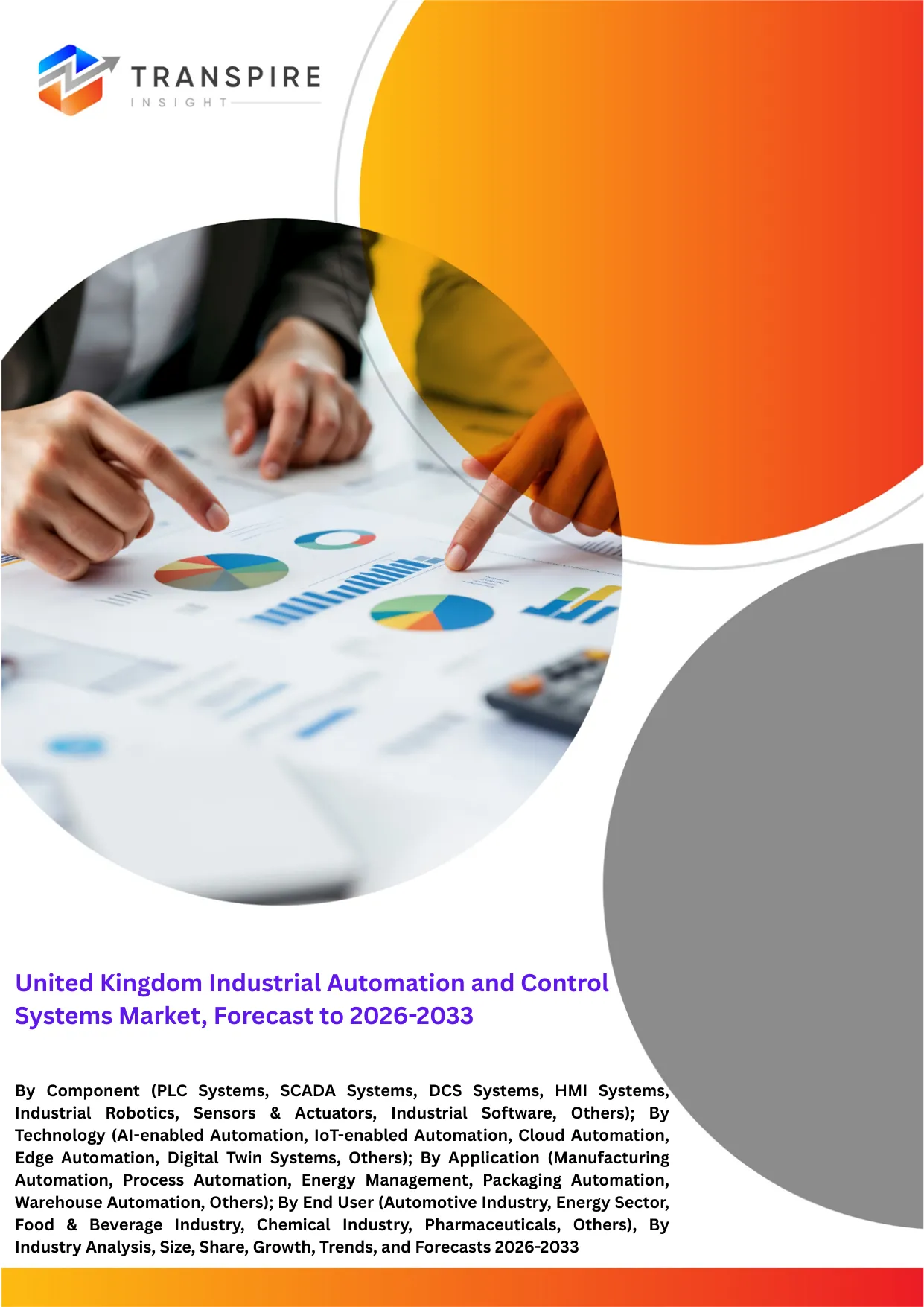
United Kingdom Industrial Automation and Control Systems Market Size & Forecast:
- United Kingdom Industrial Automation and Control Systems Market Size 2025: USD 15.19 Billion
- United Kingdom Industrial Automation and Control Systems Market Size 2033: USD 25.17 Billion
- United Kingdom Industrial Automation and Control Systems Market CAGR: 6.52%
- United Kingdom Industrial Automation and Control Systems Market Segments: By Component (PLC Systems, SCADA Systems, DCS Systems, HMI Systems, Industrial Robotics, Sensors & Actuators, Industrial Software, Others); By Technology (AI-enabled Automation, IoT-enabled Automation, Cloud Automation, Edge Automation, Digital Twin Systems, Others); By Application (Manufacturing Automation, Process Automation, Energy Management, Packaging Automation, Warehouse Automation, Others); By End User (Automotive Industry, Energy Sector, Food & Beverage Industry, Chemical Industry, Pharmaceuticals, Others)
To learn more about this report,  Download Free Sample Report
United Kingdom Industrial Automation and Control Systems Market Summary
The United Kingdom Industrial Automation and Control Systems Market was valued at USD 15.19 Billion in 2025. It is forecast to reach USD 25.17 Billion by 2033. That is a CAGR of 6.52% over the period.
In the United Kingdom Industrial Automation and Control Systems market, factories , energy facilities , and maritime operations can coordinate machines, watch processes closely, and keep safety stable in real time. It kind of swaps manual supervision with sensor-driven control systems, which handle production pace, product consistency, and downtime issues across really complex industrial spaces.
In the last five years , the market moved away from separate legacy PLC setups and is now leaning toward connected industrial IoT designs with edge computing and security that is built in. One of the main things speeding this up was energy price volatility , plus supply chain interruptions after the Russia-Ukraine conflict , and it basically revealed how expensive operational inefficiency can be, especially when there is sudden unplanned downtime. So now manufacturers and operators are putting more money into predictive maintenance, remote monitoring, and control platforms that can work together more smoothly, for stronger resilience and less energy usage. All this is feeding into greater automation adoption across UK manufacturing, utilities, and maritime logistics networks.
Key Market Insights
- England pretty much dominates the United Kingdom Industrial Automation and Control Systems Market, with close to 60% share, mostly because there is a dense manufacturing base, plus energy infrastructure that keeps expanding.
- Scotland ends up being the fastest-growing area through 2030, and it is pushed by offshore energy automation and the whole renewable grid modernization drive, in a pretty relentless way.
- In the “ontrol systems” segment, it actually leads the market with more than 40% share, tied to PLC and DCS deployments that companies rely on for stable operations.
- Industrial robotics is still the second-largest segment, kind of backed by automotive needs and precision manufacturing automation demand.
- Industrial IoT and edge platforms are the fastest-growing segment from 2026–2032 because real-time analytics adoption keeps rising, and teams want quicker insights.
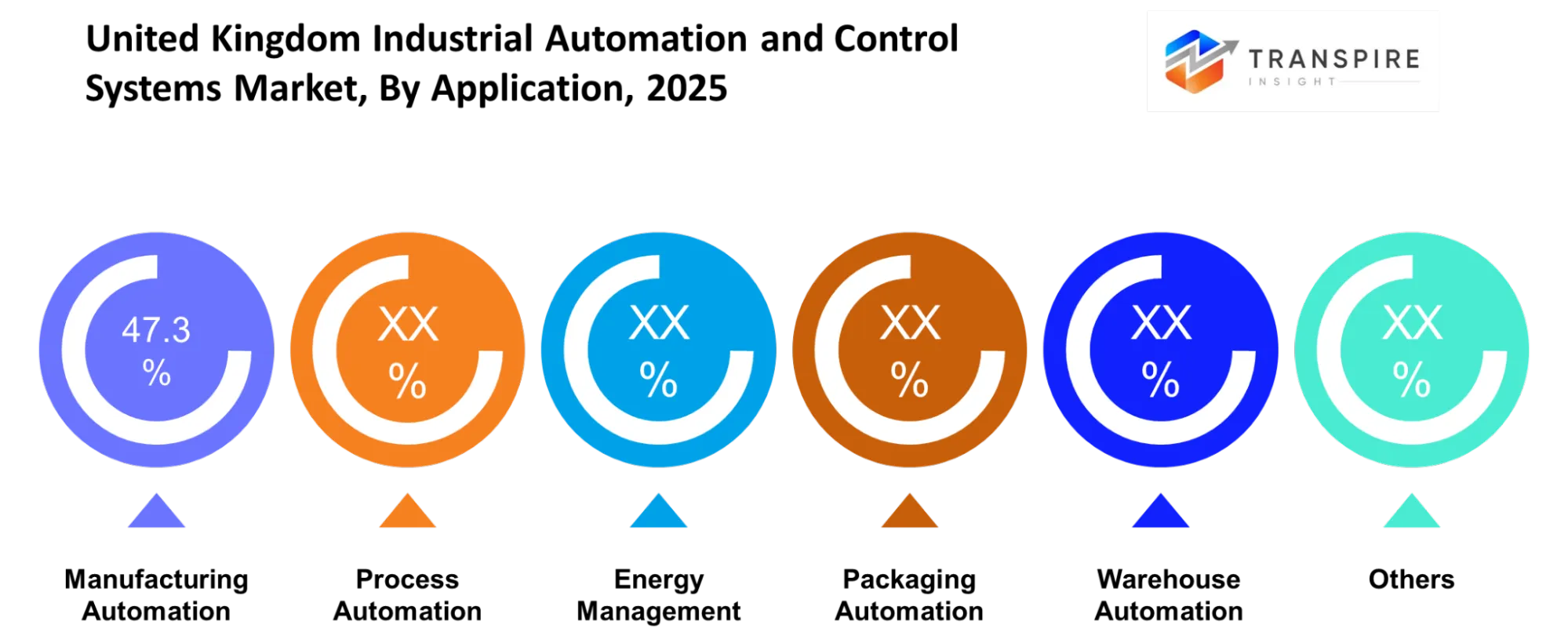
- Manufacturing automation takes the lead overall with nearly 45% share, which lines up with the strong appetite for process optimization, and predictive maintenance systems.
- Smart utilities and energy management is the fastest-growing application, fueled by decarbonization targets and grid efficiency mandates.
- For end users, manufacturing industries stay on top, bringing in more than 50% share across the United Kingdom Industrial Automation and Control Systems Market.
- Meanwhile, oil, gas, and maritime logistics are growing quickly too, mainly due to resilience concerns, and safety modernization requirements that can’t really wait.
What are the Key Drivers, Restraints, and Opportunities in the United Kingdom Industrial Automation and Control Systems Market?
The United Kingdom Industrial Automation and Control Systems Market is mostly pushed by the quick move toward Industry 4.0 take up across manufacturing, energy, and maritime work. This change really started after 2022 when UK industries were dealing with climbing energy costs and tighter efficiency expectations, so operators were kinda forced to cut back on manual involvement and to sharpen their process optimization a bit more. Because of that, businesses end up putting money into PLC upgrades, SCADA modernization, and IIoT control platforms that help with throughput and lower downtime in a pretty direct way. At the same time, this trend is also growing steady revenue for providers, via software linking, ongoing maintenance deals , and cloud based monitoring offerings.
Still, there’s a big restraint tied to the steep cost of connecting new systems, especially when companies want to swap legacy industrial infrastructure. This is most noticeable in mid-sized manufacturing facilities, where older , fragmented control setups are still common. It becomes a structural hurdle since retrofitting usually needs shutdown windows, skilled technicians, and careful compatibility tweaks across multiple vendor ecosystems. A lot of firms, end up postponing full automation upgrades because the upfront capital load is heavy, and that then dampens near-term adoption pace and slows the wide rollout of advanced control systems across the United Kingdom Industrial Automation and Control Systems Market.
A major opportunity is in edge computing -enabled autonomous production systems, especially around UK offshore energy and smart manufacturing clusters. There’s also this thing about putting money into digital twin deployments, like at ports such as Teesside and Felixstowe , where real-time simulation and predictive governance can help fine tune logistics and energy usage. As 5G private networks keep expanding across industrial zones, vendors that blend edge AI with control systems are in a good position to help release the next growth phase for the United Kingdom Industrial Automation and Control Systems Market.
What Has the Impact of Artificial Intelligence Been on the United Kingdom Industrial Automation and Control Systems Market?
Artificial intelligence and advanced digital technologies are, kind of, reshaping the United Kingdom Industrial Automation and Control Systems market by pushing real time decision making into industrial and maritime operations. In scrubber performance systems, and exhaust gas cleaning technology applied on vessels that move through UK ports like Southampton and Felixstowe, AI enabled monitoring tools take in sensor data and then tweak sulfur emission compliance parameters on a continuous basis. That in turn cuts down on manual calibration, while also strengthening regulatory adherence as maritime emissions standards keep tightening.
On the predictive side, machine learning models are more and more being placed into SCADA and PLC based environments, where they can forecast equipment degradation, spot anomalies, and help tune maintenance cycles. In manufacturing and energy facilities, these models support the reduction of unplanned downtime by catching early warning signs in motors, compressors and control valves, which helps improve uptime by an estimated double digit percentage in plants that are already digitally mature. There are also AI driven emissions forecasting tools that help energy operators optimize fuel consumption and keep operations aligned with decarbonization goals.
In day to day operations, these technologies boost efficiency by bringing maintenance costs down, improving asset utilization, and making compliance reporting steadier across distributed industrial networks. Still, adoption is held back by a shortage of high quality training data coming from real world maritime environments. Variable weather, plus occasional connectivity gaps, can reduce model accuracy, and that slows full scale deployment of AI systems in offshore and remote industrial settings, even when demand for automation upgrades stays strong.
Key Market Trends
- Between 2021 and 2025, UK manufacturers sort of transitioned away from legacy PLC systems and into IIoT enabled architectures, and well the upside was better real time production visibility plus more efficient operational control.
- After the 2022 ransomware incidents that hit European manufacturing networks, cybersecurity was pushed into industrial control systems much more quickly than before , and it really reshaped what buyers wanted in automation vendors.
- The energy price volatility in 2022 to 2023 basically nudged UK factories toward automation driven efficiency systems, so they cut down on processed energy waste and helped keep operating margins more stable.
- On the maritime side, compliance automation started expanding after stricter IMO emissions enforcement, which then encouraged more scrubber monitoring systems across vessels calling at UK ports from 2023.
- Siemens, ABB, and Schneider Electric accelerated the use of digital twins in UK manufacturing plants, and this changed maintenance models toward simulation based predictive optimization workflows.
- Edge computing in industrial facilities also grew , moving from pilot projects in 2020 to scaled deployments by 2025, lowering latency in mission critical control systems.
- And then post Brexit supply chain restructuring, from 2021 through 2024, made many firms lean into localized automation investments, to reduce import dependency. and improve production resilience across UK industries.
United Kingdom Industrial Automation and Control Systems Market Segmentation
By Component :
PLC systems keep acting as the backbone of industrial control in UK factories, steering machine operations while getting steady upgrades toward more connected formats. SCADA systems are being used a lot more now, for live monitoring across plants, kind of replacing older manual checks that people had to do, by hand. At the same time, industrial software is rising in use since companies want data-led control and smoother coordination, across production lines, not just locally.
DCS systems still fit best for big process industries, and they are moving toward tighter integration with digital tools for better control accuracy, which matters in practice. HMI systems are getting better at operator interaction with machines, so monitoring ends up simpler and quicker. Sensors and actuators are also becoming more advanced, meaning they capture real-time data more cleanly that supports better decisions and cuts operational delays across facilities.
By Technology :
AI-enabled automation is being adopted more across UK industries to support predictive decisions and shrink machine failure risks. IoT-enabled automation has moved from limited trials into broader industrial usage, tying equipment together and improving real-time visibility across operations. Cloud automation is also gaining space as companies shift data management away from on site setups, and toward remote storage.
Edge automation is growing too because firms want faster processing right close to the machines, lowering delays during critical operations. Digital twin systems are now used more often in planning and maintenance, letting companies try changes first before applying them in real settings. Altogether these technologies are nudging industries into a new way of managing efficiency, safety and system reliability, even if it’s still messy in day to day implementations.
By Application :
Manufacturing automation still gets used a lot across UK industries, with more firms switching from manual systems to automated production lines, to gain better output control— or something like that. Process automation is growing in chemical and energy areas too, and it supports steady operations while reducing human intervention in complex setups that really need continuous observation or consistent monitoring, yes.
Energy management apps are becoming more important because cost pressure is everywhere, plus efficiency targets at industrial sites. Packaging automation is speeding things up and improving accuracy in production chains, and warehouse automation is also rising along with digital logistics systems. In general, these shifts help keep operations smoother and cut down delays in supply movement, more or less.
To learn more about this report, Download Free Sample Report
By End User :
The automotive sector keeps leaning on automation systems to boost assembly precision and lower production mistakes. Energy users are adopting more automation to handle fluctuating demand, and to strengthen grid performance across generation, transmission and distribution networks. Meanwhile, chemical industries rely on control systems to keep safety levels high and production conditions stable.
Food and beverage companies are taking on automation to improve uniformity and hygiene across their production methods, while pharmaceutical firms use it for strict quality control and regulatory compliance. A bunch of other industries are slowly increasing adoption as operational efficiency and cost governance become more central in competitive markets, it seems.
What are the Key Use Cases Driving the United Kingdom Industrial Automation and Control Systems Market?
Manufacturing automation is kind of the main use case that’s pushing the United Kingdom Industrial Automation and Control Systems market forward, because more and more factories are picking PLC, SCADA, and robotics to push up production speed, keep consistency steadier, and tighten quality control . The strongest pull shows up in automotive, plus precision engineering plants where any downtime really hits output and cost efficiency, pretty directly. Firms often try to favor automated control setups so there’s less manual interference, and so production stays stable even when energy prices shift or labor availability gets wobbly.
Energy management, along with process optimization, is also growing fast as a new set of use cases, especially in chemical facilities and across utility operations. In these places, automation systems are used to track energy consumption, smooth out complicated processes, and meet safety compliance expectations more reliably. On top of that, warehouse automation is picking up attention in logistics and retail supply chains , since operators want quicker inventory handling, and fewer operational delays that slow everything down.
Looking ahead, the emerging use cases start to sound a bit more futuristic—like AI-driven predictive maintenance for offshore energy assets, and autonomous monitoring systems used for maritime scrubber activities. At ports and across shipping operations, teams are experimenting with real-time emissions tracking and vessel performance optimization tools. These efforts should help with tighter environmental compliance requirements and also improve fuel efficiency , across the forecast period.
|
Report Metrics |
Details |
|
Market size value in 2025 |
USD 15.19 Billion |
|
Market size value in 2026 |
USD 16.18 Billion |
|
Revenue forecast in 2033 |
USD 25.17 Billion |
|
Growth rate |
CAGR of 6.52% from 2026 to 2033 |
|
Base year |
2025 |
|
Historical data |
2021 - 2024 |
|
Forecast period |
2026 - 2033 |
|
Report coverage |
Revenue forecast, competitive landscape, growth factors, and trends |
|
Regional scope |
Middle East and Africa (Saudi Arabia, United Arab Emirates, South Africa, Rest of Middle East and Africa) |
|
Key company profiled |
Siemens, ABB, Schneider Electric, Rockwell Automation, Emerson Electric, Honeywell, Mitsubishi Electric, Yokogawa Electric, Omron Corporation, Bosch Rexroth, FANUC, Hitachi, General Electric, Danfoss, Beckhoff Automation |
|
Customization scope |
Free report customization (country, regional & segment scope). Avail customized purchase options to meet your exact research needs. |
|
Report Segmentation |
By Component (PLC Systems, SCADA Systems, DCS Systems, HMI Systems, Industrial Robotics, Sensors & Actuators, Industrial Software, Others); By Technology (AI-enabled Automation, IoT-enabled Automation, Cloud Automation, Edge Automation, Digital Twin Systems, Others); By Application (Manufacturing Automation, Process Automation, Energy Management, Packaging Automation, Warehouse Automation, Others); By End User (Automotive Industry, Energy Sector, Food & Beverage Industry, Chemical Industry, Pharmaceuticals, Others) |
Which Regions are Driving the United Kingdom Industrial Automation and Control Systems Market Growth?
England kind of leads the United Kingdom Industrial Automation and Control Systems market because it has a dense cluster of manufacturing hubs, plus really advanced energy infrastructure and then strict rule enforcement across how industry runs. There has also been strong policy support for Industry 4.0 take-up, so factories are basically being nudged to upgrade their control systems and link them with real-time monitoring tools, like all of that. Even major ports such as Felixstowe and Southampton add to the automation pull too, mostly from high cargo throughput and those digital logistics expectations that come with it. And there’s this mature ecosystem of technology providers, system integrators, and skilled industrial engineers which keeps things moving, so continuous upgrade cycles keep happening across production facilities.
Scotland contributes pretty steadily, and that’s tied to its established energy sector and the offshore industrial base. But, unlike England’s manufacturing-driven demand, Scotland’s automation expansion is more anchored in oil and gas, alongside renewable energy operations, where operators need steady and safety-first control systems. Long-term funding from energy operators and then slower regulatory alignment, with UK-wide digitalization norms, helps adoption stay steady, not like it jumps around too much. As a result, there’s a dependable demand foundation where operators tend to focus on reliability, protection of assets, and carefully managed modernization, instead of doing rapid large-scale system replacement.
Wales is kinda coming up as the fastest growing region right now, mostly because of some recent industrial modernization programs,and because there are targeted investments in advanced manufacturing infrastructure. In 2024 and 2025 new initiatives were rolled out to upgrade older production facilities, but also to make digital connectivity better across industrial zones. On top of that, government backed incentives for clean energy transition projects have nudged automation in smaller manufacturing clusters, like it’s not only big factories anymore. So this whole momentum, means there may be increasing opportunities for automation vendors since Wales is expected to pull in stronger technology integration,and more investment activity through the 2026–2033 period.
Who are the Key Players in the United Kingdom Industrial Automation and Control Systems Market and How Do They Compete?
Competition in the United Kingdom Industrial Automation and Control Systems market is, kind of moderately consolidated, and it’s mostly led by global incumbents. They have a strong installed base across manufacturing, energy, and maritime operations, so it’s not exactly easy to dislodge them. What drives competition here isn’t only price , it’s more about how well vendors can do system integration, how solid their cybersecurity posture is, how well the software plays together across environments, and then the long term service contracts. New entrants usually try to carve out something smaller, like niche IIoT solutions, but the established players still keep the edge. They do that via legacy system upgrades and long standing customer ties that were built over multi decade deployments, not overnight.
Siemens is pushing harder using digital twin platforms and industrial software integration through Siemens Xcelerator, aiming at UK manufacturing modernization and energy efficiency initiatives. ABB meanwhile leans into robotics ,plus electrification systems, and they keep expanding predictive maintenance offerings across UK utilities. Schneider Electric differentiates with EcoStruxure energy management systems that are aligned with the UK decarbonization agenda. Rockwell Automation leans on Allen-Bradley PLC influence, and then MES integration partnerships with UK manufacturers to keep momentum.
Honeywell competes through advanced process control systems and cybersecurity enabled industrial platforms, those are rolled out in chemical and refining sites across the UK, with a focus on secure connected operations. Emerson stands out with DeltaV distributed control, and it has a pretty strong footprint in process industries, and from there it expands lifecycle services. They also make targeted acquisitions which help reinforce automation capabilities across energy and industrial production settings.
Company List
- Siemens
- ABB
- Schneider Electric
- Rockwell Automation
- Emerson Electric
- Honeywell
- Mitsubishi Electric
- Yokogawa Electric
- Omron Corporation
- Bosch Rexroth
- FANUC
- Hitachi
- General Electric
- Danfoss
- Beckhoff Automation
Recent Development News
In March 2026, RS Group PLC announced the acquisition of BPX Group. The deal expands RS Group’s industrial automation and control portfolio in the UK and Ireland by strengthening its technical distribution capabilities and supplier network, reinforcing its position in the UK automation supply chain. Source https://www.sharecompare.co.uk/
In February 2026, Siemens entered a strategic partnership with Expert Technologies Group and RMGroup. The collaboration established the UK’s first fully customisable autonomous mobile robot manufacturing capability, advancing flexible robotics and intralogistics automation for UK manufacturers. Sourcehttps://news.siemens.co.uk/
What Strategic Insights Define the Future of the United Kingdom Industrial Automation and Control Systems Market?
The United Kingdom Industrial Automation and Control Systems Market is slowly moving, toward fully connected software-defined industrial surroundings where control systems increasingly run through AI-enabled platforms, and also edge computing integration. This change is mainly pushed by a steady pressure on UK industries to cut energy use, boost operational resilience, and hit the tighter emissions commitments across both manufacturing and maritime work. In the next five to seven years, value creation will likely lean less on hardware deployment, and more on data orchestration, predictive control, and lifecycle software services
There is also a quieter danger that doesn’t always get noticed, namely the growing reliance on a small set of global platform providers, which can build concentration risk around software updates, cybersecurity governance, and even pricing power across essential industrial infrastructure. At the same time, offshore and remote industrial sites might see slower AI uptake because connectivity issues remain stubborn. That can delay a consistent digital transformation across the market
One important new opening is AI-enabled autonomous maintenance systems for distributed energy assets and for port-side industrial clusters, especially since UK ports keep expanding smart logistics infrastructure. Market actors should put attention on interoperable, cybersecurity-first architectures and they should also invest in collaborations with UK-based industrial operators. The idea is to insert these systems early in modernization cycles, not just show up at the replacement stage, like it’s the only time that matters
United Kingdom Industrial Automation and Control Systems Market Report Segmentation
By Component
- PLC Systems
- SCADA Systems
- DCS Systems
- HMI Systems
- Industrial Robotics
- Sensors & Actuators
- Industrial Software
By Technology
- AI-enabled Automation
- IoT-enabled Automation
- Cloud Automation
- Edge Automation
- Digital Twin Systems
By Application
- Manufacturing Automation
- Process Automation
- Energy Management
- Packaging Automation
- Warehouse Automation
By End User
- Automotive Industry
- Energy Sector
- Food & Beverage Industry
- Chemical Industry
- Pharmaceuticals
Frequently Asked Questions
Find quick answers to common questions.
The United Kingdom Industrial Automation and Control Systems Market size is USD 25.17 Billion in 2033.
Key segments for the United Kingdom Industrial Automation and Control Systems Market are By Component (PLC Systems, SCADA Systems, DCS Systems, HMI Systems, Industrial Robotics, Sensors & Actuators, Industrial Software, Others); By Technology (AI-enabled Automation, IoT-enabled Automation, Cloud Automation, Edge Automation, Digital Twin Systems, Others); By Application (Manufacturing Automation, Process Automation, Energy Management, Packaging Automation, Warehouse Automation, Others); By End User (Automotive Industry, Energy Sector, Food & Beverage Industry, Chemical Industry, Pharmaceuticals, Others).
Major United Kingdom Industrial Automation and Control Systems Market players are Siemens, ABB, Schneider Electric, Rockwell Automation, Emerson Electric, Honeywell, Mitsubishi Electric, Yokogawa Electric, Omron Corporation, Bosch Rexroth, FANUC, Hitachi, General Electric, Danfoss, Beckhoff Automation.
The United Kingdom Industrial Automation and Control Systems Market size is USD 15.19 Billion in 2025.
The United Kingdom Industrial Automation and Control Systems Market CAGR is 6.52% from 2026 to 2033.
- Siemens
- ABB
- Schneider Electric
- Rockwell Automation
- Emerson Electric
- Honeywell
- Mitsubishi Electric
- Yokogawa Electric
- Omron Corporation
- Bosch Rexroth
- FANUC
- Hitachi
- General Electric
- Danfoss
- Beckhoff Automation
About the Authors

Avinash Kumar
I’m Avinash Kumar, a Senior Research Analyst at Transpire Insight, with expertise in the Electronics and Semiconductor and Energy & Power industry. My work focuses on analyzing emerging technologies, market trends, industry developments, and innovation across these sectors. I specialize in transforming complex technical and market insights into clear, research-backed content that helps professionals, businesses, and decision-makers stay informed. Through continuous industry research and data-driven analysis, I strive to deliver accurate, reliable, and practical perspectives on the latest advancements shaping the semiconductor and energy landscape.

Chakradhar Khansole
Chakradhar serves as the Research Director at Transpire Insight, bringing over 8 years of experience in technology, innovation, and strategic market intelligence. He specializes in transforming complex market data into actionable business insights that enable organizations to make informed, growth-oriented decisions. Recognized for his strategic vision and analytical expertise, Chakradhar leads high-impact research initiatives, delivering comprehensive market assessments, competitive intelligence, and forward-looking industry analysis.
Recently Published Reports
-
Apr 2026
Fiber Optic Faceplates Market
Fiber Optic Faceplates Market Size, Share & Analysis Report By Type (< 300 mm2, 300-350 mm2, and > 350 mm2, By Application (Night Vision, Holographic Imaging, Medical, and Others), and Geography (North America, Europe, Asia-Pacific, Middle East and Africa, South and Central America), 2021 - 2031
-
Apr 2026
High Temperature Superconductors Market
High Temperature Superconductors Market Size, Share & Analysis Report By Type (1G HTS, and 2G HTS), By Application (Power Cable, Fault Current Limiter, and Transformer), and Geography (North America, Europe, Asia-Pacific, Middle East and Africa, South and Central America), 2021 - 2031
-
Apr 2026
Industrial Plugs and Socket Market
Industrial Plugs and Socket Market Size, Share & Analysis Report By Type (Industrial Plugs, Industrial Sockets), By Current (Up to 32 A, 32 to 125 A, Above 125 A), By Protection (Dustproof and Splash Proof, Waterproof, Explosion Proof), By End User (Heavy Industries, Oil and Gas, Chemicals and Pharmaceuticals, Power Generation, Others), and Geography (North America, Europe, Asia-Pacific, Middle East and Africa, South and Central America), 2021 - 2031
-
Apr 2026
InGaAs Avalanche Photodiodes Market
InGaAs Avalanche Photodiodes Market Size, Share & Analysis Report By Type (1100 - 1700 nm, and 1000 - 1600 nm), By Application (Missile Warning System, Muzzle Flash Detection, Wafer Defect Inspection, Laser Rangefinders, and Others), and Geography (North America, Europe, Asia-Pacific, Middle East and Africa, South and Central America), 2021 - 2031