

Europe Digital Twin Market Size & Forecast:
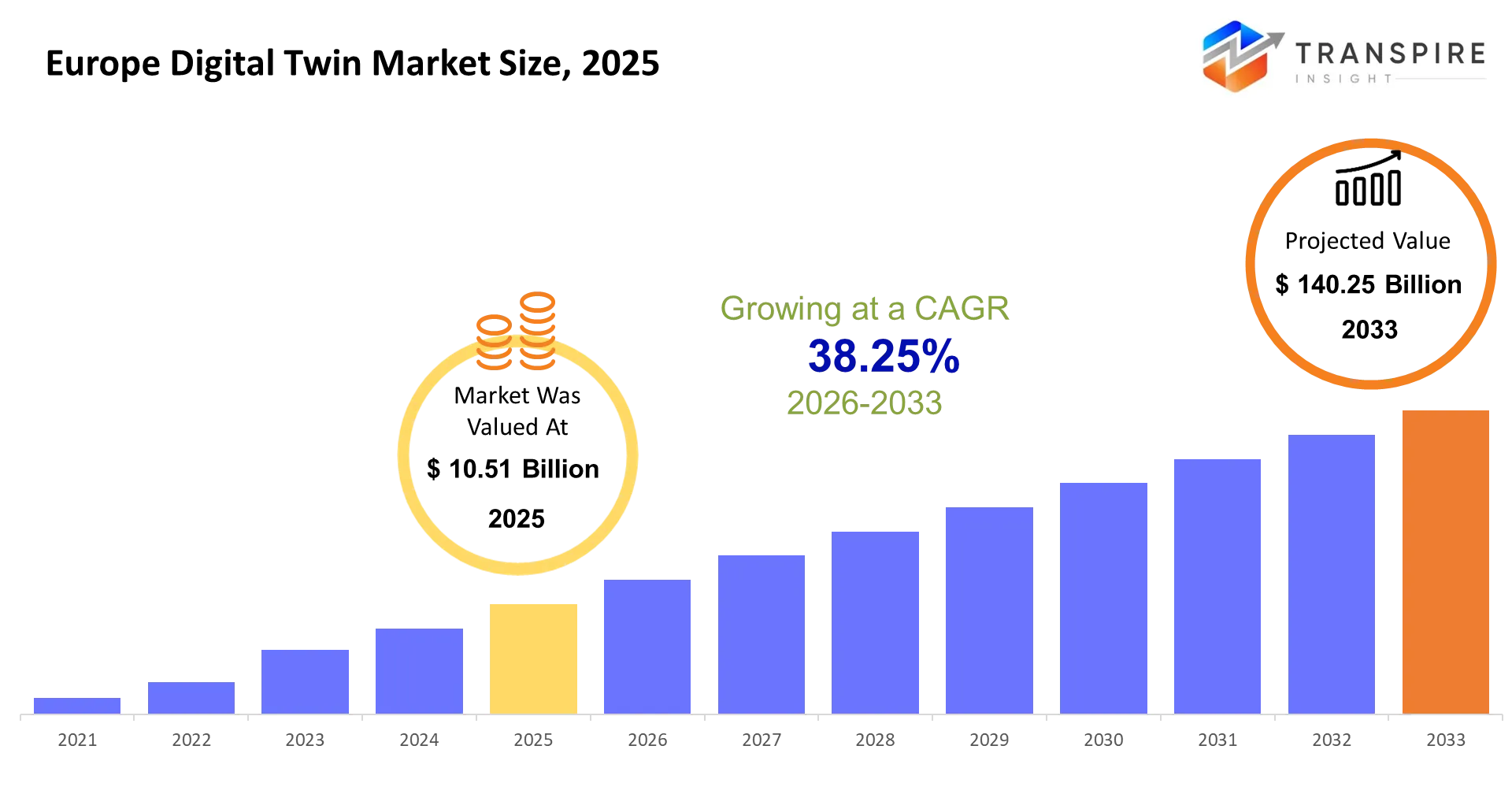
- Europe Digital Twin Market Size 2025: USD 10.51 Billion
- Europe Digital Twin Market Size 2033: USD 140.25 Billion
- Europe Digital Twin Market CAGR: 38.25%
- Europe Digital Twin Market Segments: By Type (Product Twin, Process Twin, System Twin, Others), By Application (Manufacturing, Healthcare, Automotive, Smart Cities, Others), By End-User (Enterprises, SMEs, Government, Others), By Deployment (Cloud, On-premise, Hybrid, Others).
To learn more about this report,  Download Free Sample Report
Europe Digital Twin Market Summary:
The Europe Digital Twin Market size is estimated at USD 10.51 Billion in 2025 and is anticipated to reach USD 140.25 Billion by 2033, growing at a CAGR of 38.25% from 2026 to 2033. Digital Twin technology in Europe has advanced from pilot visualization projects to become essential operational systems which factories and utilities and transport systems and offshore infrastructure now use. The operators use digital twins to create equipment simulations which enable them to forecast maintenance needs and achieve energy efficiency until production and equipment availability are interrupted. The aerospace and automotive and maritime logistics and industrial manufacturing sectors have found this solution to be extremely useful because operational shutdowns generate direct financial losses which disrupt their ability to meet delivery timelines.
The market transformed during the previous three to five years from using independent monitoring applications to adopting AI-powered systems that provide real-time operational data through industrial IoT and edge computing technologies. European manufacturers encountered unstable power prices together with operational efficiency improvements because the Russia-Ukraine conflict energy crisis pushed organizations to implement energy-efficient digital twin technologies. Organizations implemented digital twins to create energy consumption models which helped them achieve equipment life extension and operational efficiency through waste reduction. Companies now shift from traditional software licensing methods to subscription-based revenue systems which connect platforms and analytics services with ongoing industrial transformation initiatives.
Key Market Insights
- Germany achieved market leadership in the European Digital Twin Market through its possession of 28% of the market share which resulted from its advanced automotive and industrial manufacturing systems.
- The United Kingdom represents the fastest-growing regional market through 2030 because of its rapid development of smart infrastructure and aerospace digitalization initiatives.
- The French industrial simulation platforms market received substantial growth through government Industry 4.0 modernization and digital manufacturing initiatives.
- The Nordic countries have become emerging demand centers for digital twin technology which they use to enhance renewable energy grid systems and smart port operations and sustainable industrial processes.
- The Europe Digital Twin Market generated its revenue through software platforms which provided more than 52% of total revenues in 2025 because companies used predictive analytics for their entire organizations.
- The second largest segment in the market provided financial support to companies which needed help with system integration and cloud migration and lifecycle optimization consulting.
- From 2025 until 2030 AI-powered digital twin solutions represent the industry with the highest expansion rates because they provide real-time operational intelligence together with autonomous decision-making functions.
- Manufacturers adopted cloud-based deployment models because they needed solutions which could handle growing industrial data operations while enabling them to monitor equipment from remote locations.
- Manufacturers showed a strong preference for predictive maintenance applications which created 34% of market share in 2025 because they wanted to decrease equipment downtime and their maintenance expenses.
- The fastest-growing application segment of smart manufacturing emerged through the increasing use of connected factories together with industrial Internet of Things systems.
- Operational efficiency modeling received strong demand from energy management applications because of Europe's rising energy price volatility.
What are the Key Drivers, Restraints, and Opportunities in the Europe Digital Twin Market?
The Europe Digital Twin Market experiences its strongest growth because industries now prioritize predictive operations and energy-saving practices. The transition reached its highest point when Russia-Ukraine conflict caused European energy markets to collapse while manufacturers experienced sudden electricity and fuel price hikes. Industrial operators had to abandon their previous maintenance strategies because unplanned equipment failures now resulted in higher operational costs. Factories utilities and transport operators can now use digital twin platforms to create real-time simulations of asset performance which leads to lower maintenance expenses and decreased energy consumption. The operational margin improvements lead to business growth because automotive aerospace and industrial manufacturing companies now use digital twin technology across their entire organizations.
The market’s biggest structural barrier remains fragmented industrial infrastructure and legacy operational technology systems across Europe. Many factories still operate on decades-old machinery that lacks interoperability with cloud-based digital twin platforms. Organizations need to spend large amounts of money for system integration work because it requires extended time frames and specialized engineering skills. The need for customized integration instead of easily scalable solutions creates delays in software revenue generation for vendors while mid-sized manufacturers face challenges with system adoption.
Europe's renewable energy market together with its smart grid system present a significant opportunity for growth. Germany and Denmark are making substantial investments in their offshore wind development projects and their grid system upgrade initiatives. The use of digital twins for grid load simulation and turbine performance tracking and energy distribution optimization creates ongoing market demand for AI-based operational intelligence systems.
What Has the Impact of Artificial Intelligence Been on the Europe Digital Twin Market?
The Europe Digital Twin Market now uses artificial intelligence to transform its visualization tool into a self-operating intelligence system. Industrial operators use AI-powered digital twins to control production systems and track equipment performance and manage energy use across their factories. Machine learning models in manufacturing and utilities continuously assess sensor data from turbines and compressors and robotic systems to forecast when equipment will fail before it needs to be taken offline. The ability to predict equipment failure times enables organizations to decrease unexpected downtime while extending equipment lifespan and enhancing their maintenance scheduling processes.
Advanced simulation models create better operational efficiency improvements for all transport and logistics systems. Digital replicas of industrial assets provide three essential functions which include energy load forecasting and workflow sequencing optimization and production bottleneck detection. European manufacturers who implemented AI-powered predictive maintenance systems at their industrial facilities achieved two benefits which include increased equipment availability and reduced operational expenses. The energy-intensive sectors use digital twins to help their businesses decrease electricity usage while their systems maintain stable performance during grid reliability issues.
The current state of AI adoption encounters a significant challenge because industrial organizations maintain separate data systems which lack connection with each other. The majority of European legacy facilities continue to operate using operational technology systems which do not permit their systems to share real-time data with other systems. The absence of standardized processes results in decreased model precision and hinders organizations from implementing their solutions across historical industrial facilities.
Key Market Trends
- European manufacturers entered their full-scale digital twin implementation phase which began in 2021 after they completed their initial pilot testing.
- The automotive industry in Germany experienced a faster rate of technology adoption during 2022 because rising energy costs required factories to improve their machine performance while decreasing their operational interruptions.
- The period between 2023 and 2025 saw mid-sized industrial organizations transition from costly on-premise digital twin platforms to cloud-native digital twin platforms.
- Siemens and Dassault Systèmes developed their simulation capabilities through artificial intelligence technology which enables companies to make industrial decisions and maintain equipment through predictive maintenance.
- European electricity utilities started to implement digital twin systems for their entire power grid operations because renewable energy sources made their electricity distribution networks more difficult to manage since 2022.
- Industrial buyers changed their purchasing behavior from hardware-based automation systems to software subscriptions which include analytics tools and ongoing product maintenance and performance enhancement.
- Smart factories experienced lower unexpected machine stoppages because they used machine learning technology to analyze data from their real-time industrial sensor systems.
- The need for regulatory compliance which targets industrial emissions control and energy usage improvement drove heavy manufacturing and chemical and transportation infrastructure sectors to adopt digital twin technology.
- Nordic countries became centers of innovation for offshore wind digital twins which use predictive simulation technology to enhance turbine efficiency and maintenance planning.
- Technology companies established new competitive strategies by developing ecosystem partnerships that enabled them to work with cloud service providers and industrial original equipment manufacturers and edge computing companies throughout Europe.
Europe Digital Twin Market Segmentation
By Type
Product twin solutions exceed all other solution types because manufacturers require product simulation that delivers real-time information updates during their design testing and product lifetime. Automotive companies and aerospace firms and industrial equipment manufacturers now use product twins to reduce their prototype expenses while they speed up their product development process. Factories create predictive production models which enable them to achieve better operational performance through process twins. System twins have become more common in industrial settings which include smart grids and transportation infrastructure and large infrastructure projects because these systems need to track all their connected components.
The market demand now prefers vendors to develop complete digital platforms instead of providing standalone simulation solutions which leads to software providers to improve their multiple modeling features. The market will develop to support AI-driven autonomous twins who have the ability to modify their operational settings according to system requirements. Technology vendors will use this change to create analytics systems which can grow without limits while manufacturing customers will concentrate on obtaining long-term operational insights instead of utilizing short-term monitoring tools.
By Application
The manufacturing sector functions as the primary application area because industrial enterprises demand continuous improvements through asset optimization and predictive maintenance and production efficiency enhancements. Automotive manufacturers use digital simulation technology to enhance their assembly line operations because it helps them decrease downtime and enhance supply chain management. The healthcare sector experiences steady growth as hospitals and medical device companies implement virtual operational models for their equipment management and workflow optimization needs.
Western Europe experiences rapid growth of smart city projects because of its investments in connected infrastructure and energy-efficient transportation systems and urban utility management. The industrial sector requires more energy since skyrocketing energy prices force manufacturers to find better ways to manage operational costs. Organizations need to establish their competitive edge by merging operational technology with industrial Internet of Things systems and cloud-based analytics through a unified digital ecosystem. Future growth will likely concentrate in infrastructure-intensive sectors where operational continuity and sustainability targets require advanced simulation capabilities across large interconnected asset networks.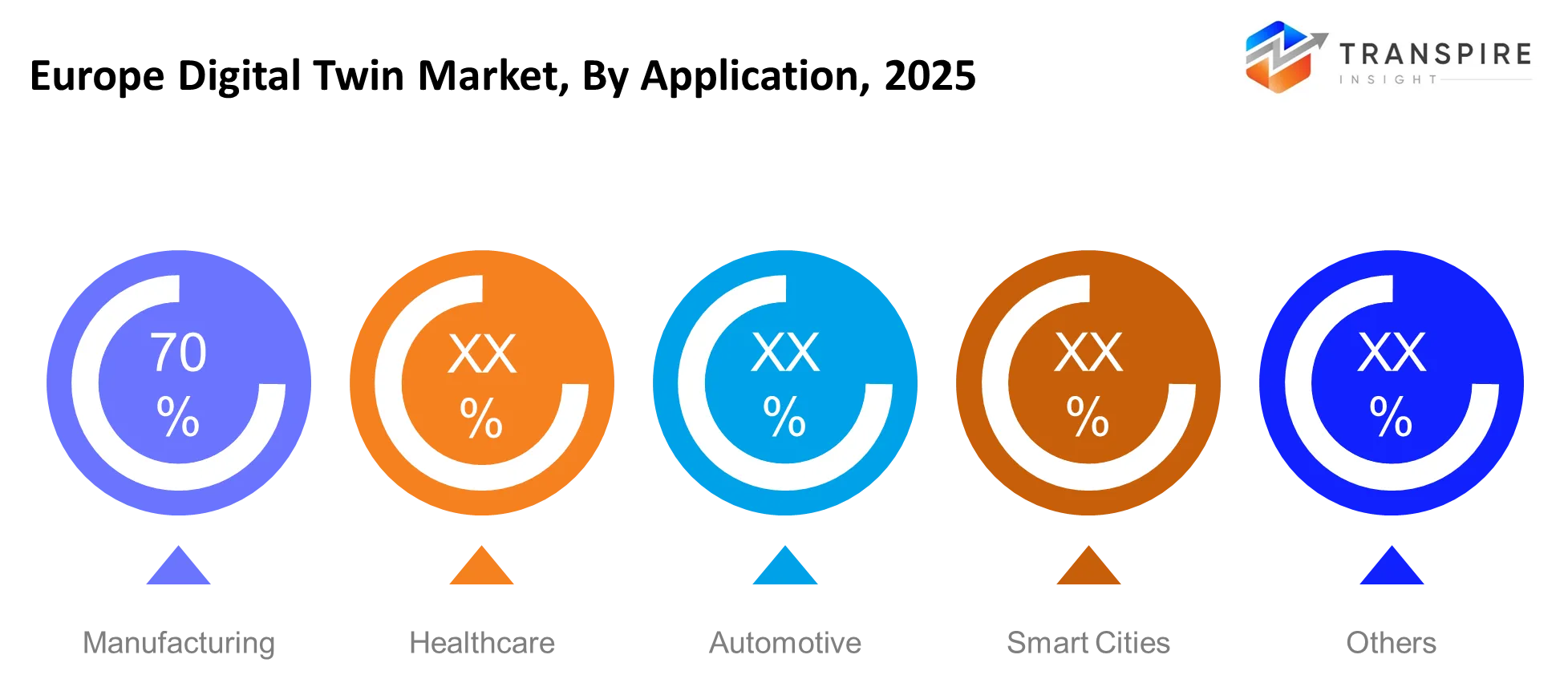
To learn more about this report, Download Free Sample Report
By End-User
Large enterprises account for the majority of market revenue because multinational manufacturers, utilities, and transportation operators possess the financial resources and technical expertise required for enterprise-scale deployment. Industrial corporations increasingly invest in predictive analytics and operational intelligence platforms to improve productivity and reduce maintenance-related losses across geographically distributed facilities. The implementation of digital solutions within small and medium-sized enterprises experiences delays because organizations struggle with integration costs and they lack sufficient digital capabilities while they also fear the difficulties that implementation will create.
Government adoption is strengthening gradually, particularly in smart infrastructure, transportation modernization, and energy transition projects supported by European digitalization initiatives. Demand behavior now reflects a broader shift from experimental pilot programs toward measurable operational return on investment. The future market expansion will depend on whether vendors can simplify the deployment models that mid-sized industrial customers need and the vendors will need to reduce integration barriers. Technology providers that deliver modular, subscription-based solutions will likely secure stronger long-term penetration across cost-sensitive buyer groups.
By Deployment
The market currently sees cloud deployment as the top choice because industrial organizations now seek data processing solutions that can expand their operations while providing remote access and designed cost-effective infrastructure management. Cloud-based platforms enable operators to transmit extensive sensor data across different facilities without the need to establish complete on-site data processing systems. The defense and aerospace and critical infrastructure industries continue to use on-premise deployment because these fields require strict data sovereignty and cybersecurity measures.
Organizations are increasingly adopting hybrid deployment systems which permit them to operate their businesses while safeguarding their digital assets and their traditional system components in complex industrial settings. The growing use of edge computing technology drives organizations to develop deployment methods which enable immediate processing at industrial sites. The future investment trends show that businesses will require hybrid systems which can interact with each other and support AI-powered analytics while following European industrial data protection standards. The upcoming decade will see vendors with secure and fast integration solutions achieve better market presence.
What are the Key Use Cases Driving the Europe Digital Twin Market?
The industrial manufacturing sector uses predictive maintenance because it serves as the main use case which drives technology adoption throughout Europe. Digital twin technology helps automotive plants aerospace facilities and heavy machinery operators to track equipment health and decrease unexpected equipment failures while they work to boost production output and reduce energy and labor expenses.
Utilities and transportation infrastructure systems experience rapid growth in their development of adjacent applications. Energy providers increasingly use digital replicas to balance renewable power loads and optimize grid performance, while logistics operators apply simulation models to improve warehouse automation and fleet coordination across regional supply chains.
Smart cities and healthcare infrastructure now see active development of new emerging applications. Municipal authorities are testing urban digital twins for traffic flow optimization and energy-efficient building management, while hospitals are exploring virtual asset monitoring systems to improve medical equipment utilization and operational planning efficiency.
|
Report Metrics |
Details |
|
Market size value in 2025 |
USD 10.51 Billion |
|
Market size value in 2026 |
USD 14.53 Billion |
|
Revenue forecast in 2033 |
USD 140.25 Billion |
|
Growth rate |
CAGR of 38.25% from 2026 to 2033 |
|
Base year |
2025 |
|
Historical data |
2021 - 2024 |
|
Forecast period |
2026 - 2033 |
|
Report coverage |
Revenue forecast, competitive landscape, growth factors, and trends |
|
Regional scope |
Europe (Germany, United Kingdom, France, Italy, Spain and Rest of Europe) |
|
Key company profiled |
Siemens, IBM, Microsoft, Oracle, SAP, GE Digital, Dassault Systèmes, PTC, ANSYS, Autodesk, Schneider Electric, ABB, Honeywell, Cisco, Hitachi |
|
Customization scope |
Free report customization (country, regional & segment scope). Avail customized purchase options to meet your exact research needs. |
|
Report Segmentation |
By Type (Product Twin, Process Twin, System Twin, Others), By Application (Manufacturing, Healthcare, Automotive, Smart Cities, Others), By End-User (Enterprises, SMEs, Government, Others), By Deployment (Cloud, On-premise, Hybrid, Others) |
Which Regions are Driving the Europe Digital Twin Market Growth?
Western Europe dominates the market because it possesses an advanced industrial automation system and complete digital network infrastructure and implements Industry 4.0 adoption methods. Germany and France and the Netherlands continue to make substantial investments in intelligent manufacturing systems and interconnected energy networks and artificial intelligence-powered industrial processes. The European Union established stringent energy efficiency standards which manufacturing and utilities companies needed to follow for implementing predictive operational technologies. The region maintains an established network of software developers and industrial original equipment manufacturers and cloud service providers and research institutions which enables enterprises to adopt their solutions at enterprise scale.
Northern Europe ranks as the second largest market while its stability depends on sustainable energy solutions and modernized power distribution systems. The Nordic countries maintain continuous funding for their offshore wind management systems and smart grid technologies and eco-friendly industrial practices through their public and private partnerships. Industrial operators across Sweden, Denmark, and Finland prioritize operational resilience and energy optimization rather than rapid production expansion. The technology vendors achieve reliable income streams through this method which enables them to maintain financial stability and digital infrastructure development in utilities and transportation networks.
The fastest-growing market in Eastern Europe now develops because industrial modernization efforts and foreign manufacturing investments proceed at an accelerated rate. Poland the Czech Republic and Romania have recently increased their investment in automated production facilities and logistics hubs and energy infrastructure modernization programs.
Who are the Key Players in the Europe Digital Twin Market and How Do They Compete?
The competitive landscape of the Europe Digital Twin Market remains moderately consolidated, but large industrial software providers control enterprise-scale deployments while specialized firms operate in specific market segments. The core of competition now focuses on AI integration and system compatibility with existing industrial equipment and the development of long-term analytics services instead of assessing software licensing fees. Established industrial automation companies use their integrated ecosystems which combine cloud services with industrial Internet of Things technology and predictive analytics and operational engineering skills to maintain their market position. Smaller technology companies are establishing market presence through their development of modular platforms which enable flexible implementation of renewable energy solutions and logistics systems and intelligent infrastructure systems.
Siemens establishes its unique market position through its complete system integration which enables manufacturers to link their production equipment with their predictive operational models. The company expands its operations in smart manufacturing and energy infrastructure through partnerships which develop industrial AI and edge computing technologies. Dassault Systèmes establishes its strength in engineering-intensive fields through its dedication to creating high-fidelity virtual models which serve the aerospace automotive and life sciences sectors because simulation accuracy directly impacts both production efficiency and compliance needs.
Schneider Electric competes through energy optimization and sustainability-focused operational platforms which utilities and buildings and industrial infrastructure use.
Company List
- Siemens
- IBM
- Microsoft
- Oracle
- SAP
- GE Digital
- Dassault Systèmes
- PTC
- ANSYS
- Autodesk
- Schneider Electric
- ABB
- Honeywell
- Cisco
- Hitachi
Recent Development News
In May 2026, Siemens Expands Rail Digital Twin Capabilities Through MERMEC Acquisition: Siemens announced the acquisition of key businesses from Italian rail technology company MERMEC to strengthen its rail software and digital infrastructure portfolio. The deal enhances Siemens’ digital twin and analytics capabilities for smart rail systems across Europe, particularly in predictive maintenance and signaling technologies.
Source: https://www.reuters.com
In January 2026, Siemens Launches “Digital Twin Composer” for Industrial Metaverse Applications: Siemens introduced Digital Twin Composer, a new software platform designed to build large-scale industrial metaverse environments using real-time operational and simulation data. The platform is aimed at European manufacturers seeking AI-powered factory optimization and lifecycle modeling solutions
Source: https://news.siemens.com
What Strategic Insights Define the Future of the Europe Digital Twin Market?
The Europe Digital Twin Market develops into autonomous industrial operations that use AI-driven simulation systems to optimize production and energy usage and maintenance scheduling and infrastructure functions without requiring human involvement. The economic pressure of the moment brings about the current digital transformation shift. European manufacturers and utilities face sustained energy volatility, aging industrial infrastructure, and tighter carbon accountability requirements, making operational efficiency a financial necessity rather than a technology upgrade.
The risk of increasing market concentration around a small number of cloud and industrial software providers remains a significant threat that people do not recognize. Enterprise customers who commit to integrated ecosystems will experience higher switching costs which will prevent them from using different systems and will hinder smaller technology companies from creating new products. Eastern Europe currently presents an emerging opportunity because supply chains are becoming regionalized and new industrial projects require scalable digital infrastructure for logistics and manufacturing and energy systems.
Market participants should prioritize interoperable, modular platforms that integrate easily with legacy industrial equipment because deployment flexibility will become a stronger competitive advantage than standalone software capability over the next decade.
Europe Digital Twin Market Report Segmentation
By Type
- Product Twin
- Process Twin
- System Twin
- Others
By Application
- Manufacturing
- Healthcare
- Automotive
- Smart Cities
- Others
By End-User
- Enterprises
- SMEs
- Government
- Others
By Deployment
- Cloud
- On-premise
- Hybrid
- Others
Frequently Asked Questions
Find quick answers to common questions.
The Approximate Europe Digital Twin Market size for the Market will be USD 140.25 Billion in 2033.
The key Segments of the Europe Digital Twin Market are By Type (Product Twin, Process Twin, System Twin, Others), By Application (Manufacturing, Healthcare, Automotive, Smart Cities, Others), By End-User (Enterprises, SMEs, Government, Others), By Deployment (Cloud, On-premise, Hybrid, Others).
Major Players in the Europe Digital Twin Market are Siemens, IBM, Microsoft, Oracle, SAP, GE Digital, Dassault Systèmes, PTC, ANSYS, Autodesk, Schneider Electric, ABB, Honeywell, Cisco, Hitachi.
The Current Market size of the Europe Digital Twin Market is USD 10.51 Billion in 2025.
The Europe Digital Twin Market CAGR is 38.25%.
- Siemens
- IBM
- Microsoft
- Oracle
- SAP
- GE Digital
- Dassault Systèmes
- PTC
- ANSYS
- Autodesk
- Schneider Electric
- ABB
- Honeywell
- Cisco
- Hitachi
Recently Published Reports
-
Apr 2026
3D Optical Profiler Market
3D Optical Profiler Market Size, Share & Analysis Report By Type (Desktop 3D Optical Profiler, and Portable 3D Optical Profiler), By Technology (Confocal Technology, and White Light Interference), By End-Use Industry (Manufacturing, Research Institutions, Automotive, Aerospace and Defense, Medical Devices, and Other), and Geography (North America, Europe, Asia-Pacific, Middle East and Africa, South and Central America), 2021 - 2031
-
Apr 2026
Depth Sensor Market
Depth Sensor Market Size, Share & Analysis Report By Type (Infrared Depth Sensors, Time-of-Flight (ToF) Sensors, Stereo Vision Sensors, Structured Light Sensors, Ultrasonic Depth Sensors), By Application (Automotive, Robotics, Gaming, Consumer Electronics, Industrial Automation, Healthcare, Security & Surveillance, Others), By End Users (Automotive Manufacturers, Consumer Electronics Companies, Healthcare Providers, Industrial Companies, Security Agencies, Gaming Companies, Robotics Companies, Others), and Geography (North America, Europe, Asia-Pacific, Middle East and Africa, South and Central America), 2021 – 2031
-
Apr 2026
Digital Manufacturing Market
Digital Manufacturing Market Size, Share & Analysis Report By Component (Hardware, Software, and Services), By Technology (Robotics, 3D Printing, Internet of Things (IoT), and Others), By Application (Automotive and Transportation, Aerospace and Defense, Consumer Electronics, Industrial Machinery, and Others), By Process Type (Computer-Based Designing, Computer-Based Simulation, Computer 3D Visualization, Analytics, and Others), and Geography (North America, Europe, Asia-Pacific, Middle East and Africa, South and Central America), 2021 – 2031
-
Apr 2026
Digital Visa Services Market
Digital Visa Services Market Size, Share & Analysis Report By Type (Individual Travelers, Group Travelers), By Application (Tourism, Business Travel, Others), and Geography (North America, Europe, Asia-Pacific, Middle East and Africa, South and Central America), 2021 – 2031