
Europe Cloud Database and DBaaS Market Size & Forecast:
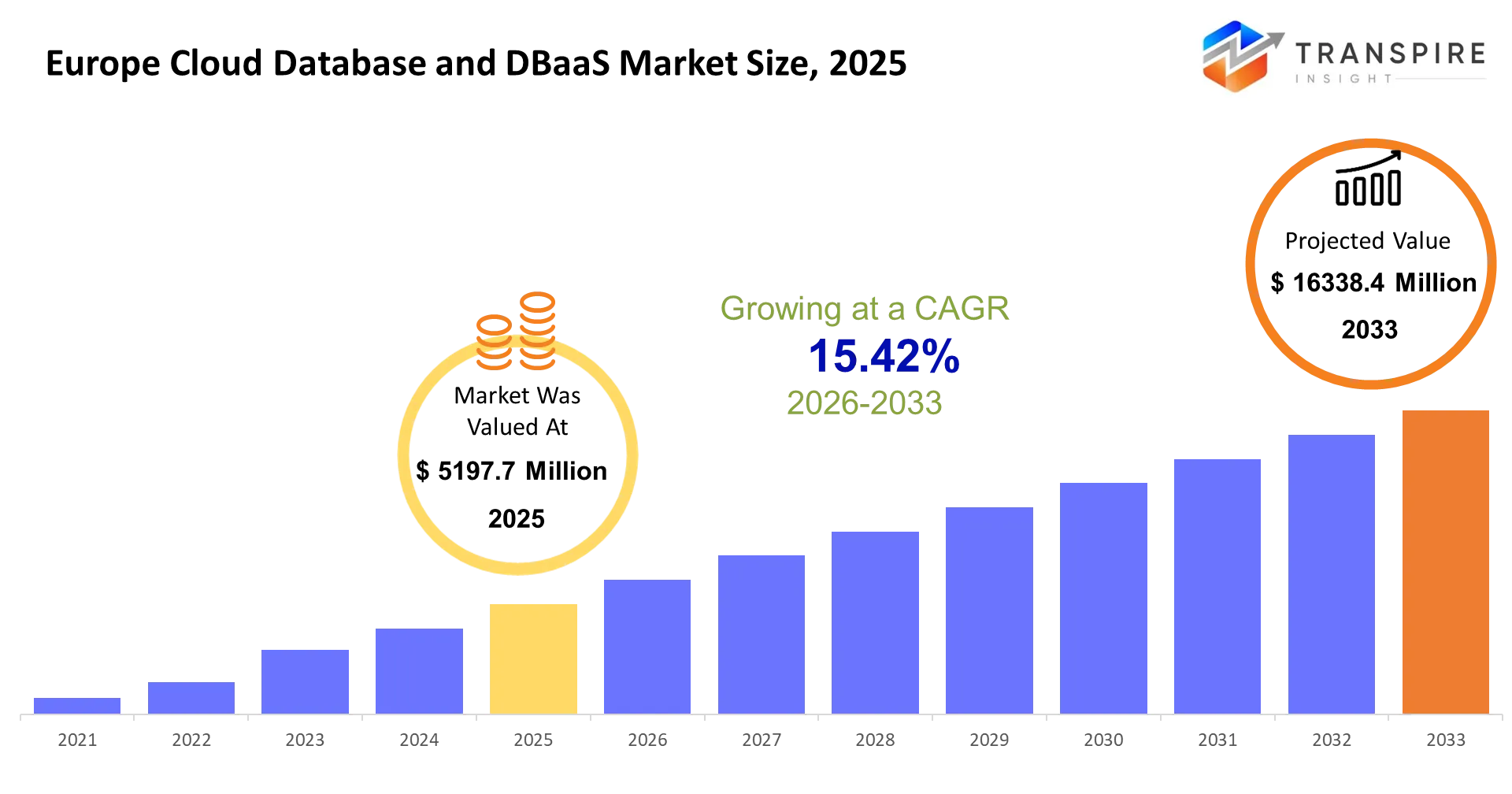
- Europe Cloud Database and DBaaS Market Size 2025: USD 5197.7 Million
- Europe Cloud Database and DBaaS Market Size 2033: USD 16338.4 Million
- Europe Cloud Database and DBaaS Market CAGR: 15.42%
- Europe Cloud Database and DBaaS Market Segments: By Type (Relational Databases, NoSQL Databases, NewSQL Databases, Distributed Databases, In-memory Databases, Others); By Application (Data Storage, Analytics, Transaction Processing, Cloud Applications, AI Workloads, Others); By End-User (Enterprises, SMEs, IT Companies, BFSI, Others); By Deployment (Public Cloud, Private Cloud, Hybrid Cloud, Multi-cloud, Others)
To learn more about this report,  Download Free Sample Report
Europe Cloud Database and DBaaS Market Summary
The Europe Cloud Database and DBaaS Market was valued at USD 5197.7 Million 2025. It is forecast to reach USD 16338.4 Million by 2033. That is a CAGR of 15.42% over the period.
The Europe cloud database and DBaaS market enables enterprises to store, process, and govern mission-critical data through managed, scalable cloud platforms instead of maintaining complex on-premise database infrastructure. The system provides banks, retailers, governments, and industrial operators with its capability to handle real-time financial transactions and regulatory reporting and AI analytics and cross-border digital services. Organizations require this function because they need to manage their rapidly increasing structured and unstructured data while meeting their compliance obligations.
Over the past 3–5 years organizations have moved away from traditional enterprise databases to work with distributed systems that operate on cloud-native and multi-cloud environments. The organization started to implement changes because organizations needed to change their data storage and processing methods after European Union data sovereignty requirements became more strict through improved GDPR enforcement. The outbreak of digital services during worldwide supply chain breakdowns from the pandemic created a demand that exposed the inability of outdated systems to handle operational needs at actual time.
DBaaS platforms that offer both compliance automation and elastic performance capabilities have become the main focus for enterprises today. The market for managed services has grown while companies have decreased their need for infrastructure ownership because they now prefer to use subscription-based cloud database services that operate in Europe.
Key Market Insights
- The European Cloud Database and DBaaS Market will reach its peak Western Europe market share of 45% in 2026 because of its extensive enterprise and financial services infrastructure.
- The Nordic region functions as the most reliable growing center which holds 18% market share because of its data centers powered by renewable energy and its strict environmental protection laws.
- The European regions of Southern Europe and Eastern Europe will experience their most rapid development until 2033 because the EU digital funding program operates and countries implement cloud-first policies.
- Businesses depend on structured data systems which require compliance to create more than 50 percent of relational database usage.
- The second-largest market share of NoSQL databases exists because digital-native applications have expanded into retail and e-commerce markets.
- The market for distributed and NewSQL databases will experience rapid growth until 2033 because of increasing AI workload requirements and the need for real-time analytics.
- The data storage solution maintains its leading position with 40 percent market share which enables businesses to shift from outdated systems to managed cloud services.
- Analytics applications are the fastest-growing segment, driven by AI integration and real-time business intelligence adoption.
- The BFSI sector experiences ongoing growth in transaction processing because its financial operations require high-volume processing and its need for regulatory reporting.
- The market is controlled by enterprises which hold above 55 percent market share because they implement cloud migration strategies for compliance reasons and to modernize their operations.
What are the Key Drivers, Restraints, and Opportunities in the Europe Cloud Database and DBaaS Market?
The Europe cloud database and DBaaS market develops mainly because enterprises modernize their systems through regulatory requirements while they migrate artificial intelligence tasks to cloud infrastructure. Organizations replaced their unconnected on-premise systems with managed database technologies which included built-in audit functions and encryption capabilities and geographical control features because of GDPR requirements and industry-specific data residency regulations. The trend towards digital services accelerated after 2024 because companies experienced increased costs for their existing systems while they needed to expand digital operations. Financial institutions and public agencies and large retailers adopted DBaaS services which helped them meet compliance requirements and conduct real-time analytics which resulted in increased monthly subscription revenues for cloud service providers.
European countries present a major obstacle because their different data sovereignty laws create complicated legal rules which impede the process of implementing data sovereignty requirements. The GDPR establishes minimum data protection standards, but each country within the European Union develops its own rules for data protection which creates different requirements for companies operating cross-border database systems. Multinational companies face higher integration expenses because their international operations require extensive software connection work, which results in delays for all worldwide company implementations. Companies in the hyperscale sector experience challenges because their systems require local adaptation instead of standard global platforms which stops them from achieving better profit margins while they focus on transferring all business operations to cloud-based systems.
The development of sovereign AI database platforms that meet regulatory requirements for various industries creates new business prospects for organizations which operate between Germany and France.Vendors like Snowflake and EnterpriseDB are beginning to align vector-enabled databases with sovereign cloud frameworks to support generative AI applications in banking and healthcare. The development of these ecosystems will create new adoption patterns which will begin to focus on database systems that use artificial intelligence and prioritize compliance as their primary design principle.
What Has the Impact of Artificial Intelligence Been on the Europe Cloud Database and DBaaS Market?
The systems for scrubber performance and marine emission control platforms now use artificial intelligence for their operations because cloud databases process real-time sensor data from exhaust gas cleaning units that serve multiple ships. The system uses AI to control washwater flow and fuel switching and pressure settings, which results in automatic operations that help the company meet IMO sulfur regulations. The DBaaS platforms operate by unifying vessel telemetry data to allow operators to monitor emissions across their entire fleet while generating automated reports needed for port-state inspections, which decreases operational tasks and speeds up regulatory assessments
Machine learning models analyze vibration and temperature and corrosion patterns to predict maintenance needs because they show scrubber fouling and pump degradation for upcoming failures. The systems use their data to balance fuel consumption with emission control, which resulted in an early deployment that increased fuel efficiency by 5 to 12 percent while maintaining compliance with changing operational requirements. The cloud-based analytics system increases operational time because it detects system faults at multiple ship locations throughout the fleet
The lack of real-time connectivity at sea limits adoption because it prevents continuous data synchronization, which results in reduced model accuracy during extended ocean travel. The integration costs for sensor-rich monitoring systems and secure cloud database connections to older vessels remain high, which delays the deployment process although operational advantages are obvious.
Key Market Trends
- European enterprises increasingly adopted managed DBaaS platforms instead of on-premise databases after GDPR enforcement became stricter in 2024-2026.
- The EU hyperscalers expanded their regional data centers during 2025 because financial and public sector customers started demanding more control over their data.
- The adoption of vector databases reached new heights during 2025 because companies began using generative AI workloads together with their existing enterprise data systems.
- The use of multi-cloud strategies increased dramatically during 2026 because businesses started to minimize their reliance on specific vendors after they became worried about vendor lock-in.
- Organizations adopted PostgreSQL-based managed services because they wanted to switch from proprietary systems to open-source database systems.
- Financial institutions accelerated their DBaaS migration activities during 2025 to establish systems for real-time fraud detection and automated regulatory reporting.
- AI-driven analytics workloads required databases to switch from storage-based systems to real-time processing systems that needed high computing capabilities.
- European regulators increased their examination of cross-border data transfers during 2026 which compelled vendors to develop products that fulfilled sovereignty requirements through localized operations.
- EnterpriseDB and other specialist vendors increased their enterprise market share by providing regulated industries with PostgreSQL deployments that met compliance standards and hybrid cloud functionality.
Europe Cloud Database and DBaaS Market Segmentation
By Type:
The European cloud database market operates with relational databases as the leading database technology because enterprises have used structured data models for a long time and because those models work effectively with regulatory reporting requirements. Financial institutions and public sector organizations continue to prefer SQL-based systems because of their maturity, consistency guarantees, and auditability. The migration activities of this segment create better results than greenfield adoption which leads to continuous demand for legacy modernization projects.
The demand for NoSQL and distributed databases is increasing because high-volume digital services require organizations to manage semi-structured data generated by customer interactions and IoT devices and e-commerce platforms. The combination of scalability and transactional consistency in NewSQL systems enables organizations to use them for their real-time financial and operational workload requirements. In-memory databases support latency-sensitive applications such as fraud detection and trading systems, while niche database types address specialized analytics needs.
The distributed systems and NewSQL systems will experience growth during the forecast period because organizations need to implement hybrid systems which combine AI processing with real-time processing capabilities. Developers will focus on interoperability across database types rather than isolated optimization. The investment interest of investors will focus on platforms which provide unified relational stability together with elastic scalability for smooth workload transitions between different operational environments.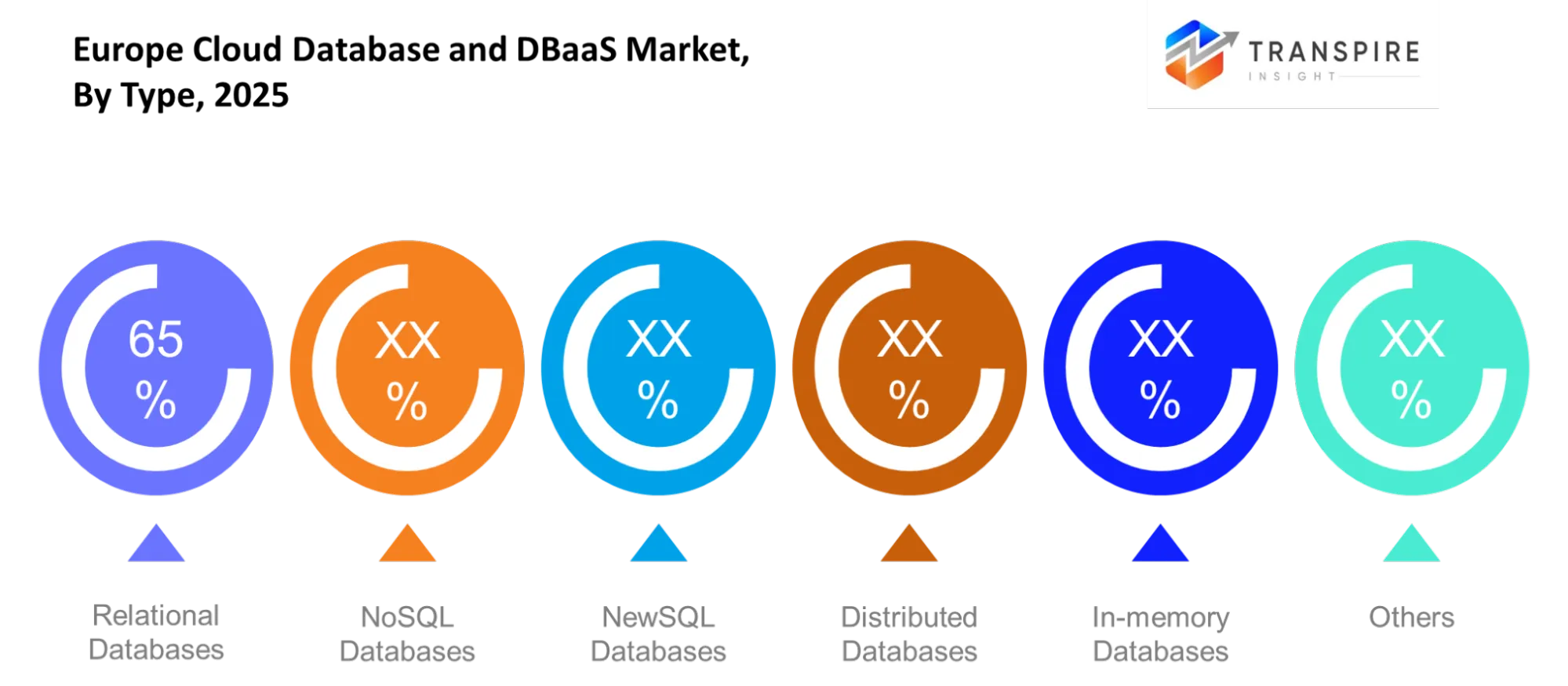
To learn more about this report, Download Free Sample Report
By Application:
Data storage functions as the most extensive application domain because businesses are transferring their historical records and active data into cloud storage systems. The demand for data retention and auditability control which exists in banking and government sectors creates a strong need for this service. This segment serves as the primary operational base which enables cloud database systems to be used throughout the organization.
Organizations are advancing their analytics capabilities together with cloud applications because they need immediate insights to deliver digital services. The BFSI industry and retail sector depend on transaction processing because it enables continuous operation which preserves their income. High-performance database systems become essential for AI workloads which include vector search operations and model training datasets.
The upcoming expansion will focus on applications that use artificial intelligence and systems which combine transaction processing with analytics. Vendors will need to create platforms which enable users to handle both structured and unstructured data within a single system. Database platform evaluation will shift towards assessing how well systems handle multiple workloads instead of measuring individual performance capabilities.
By End-User:
The high demand from enterprises results from their implementation of extensive modernization projects which impact finance and telecom and public administration sectors. Organizations select their IT systems because they need compliant systems which can expand their operations and work with current technology. The companies establish enduring agreements with database management services because of their consistent spending habits.
The most innovative users in technology work together with BFSI organizations to create advanced database systems which enable digital operations and meet regulatory requirements. SMEs show rising participation which is limited by cost sensitivity to standard DBaaS solutions that have lower complexity than other options. The healthcare and manufacturing sectors deliver ongoing demand through their unique digitization processes.
SMEs will experience increased demand because managed services become more accessible through their simplified operational processes. Enterprises will begin using multiple database systems for management instead of relying on single vendor solutions. Businesses that develop customized pricing solutions and automated compliance processes will achieve greater success across different market segments.
By Deployment:
Public cloud deployment maintains its dominant status because European businesses shift to cloud services and hyperscaler networks provide extensive coverage throughout the continent. Organizations choose this deployment model because it enables them to expand their operations while getting support from managed services and saving costs on equipment purchases. The development of regulatory frameworks has reached a stage where organizations can implement controlled adoption practices in high-security sectors.
Enterprises adopt hybrid cloud solutions because it enables them to maintain required data sovereignty while they seek better system performance. The private cloud model serves as a vital resource for defense and banking industries which need to maintain response control over their sensitive information. Organizations implement multi-cloud solutions because they want to prevent vendor lock-in while building systems that can withstand disruptions.
The future adoption of cloud computing solutions will increasingly prefer hybrid and multi-cloud models instead of complete public cloud solutions. Vendors will establish their market position through three key factors which include their ability to connect systems, move workloads between different platforms, and streamline compliance processes. The growing distribution of AI workloads across different jurisdictions together with regulatory fragmentation will lead buyers to prioritize flexible deployment options.
What are the Key Use Cases Driving the Europe Cloud Database and DBaaS Market?
European Cloud Database and DBaaS demand originates from enterprise application modernization which specifically impacts banking and insurance and public administration sectors. Organizations use managed relational databases to replace their outdated on-premise systems because it helps them achieve GDPR compliance and decrease operational costs. The database shift requires organizations to maintain database services which are scalable and controlled and designed for high uptime throughout their compliant operational activities.
Retail and healthcare sectors are expanding customer analytics and electronic health record management adoption. Retailers use DBaaS to support real-time personalization across omnichannel platforms while healthcare providers use secure cloud databases to share patient data according to strict EU privacy requirements. Manufacturing firms are using supply chain tracking systems and predictive maintenance systems more frequently for their operations.
The development of AI-native vector databases for generative AI applications exists as a new application area at legal and financial and research organizations. Cross-border fraud detection systems are increasing in popularity because EU regulators desire a standardized financial monitoring system. The applications exist in their initial stage but they will experience rapid growth because organizations will implement AI workloads throughout their regulated business operations.
|
Report Metrics |
Details |
|
Market size value in 2025 |
USD 5197.7 Million |
|
Market size value in 2026 |
USD 5987.6 Million |
|
Revenue forecast in 2033 |
USD 16338.4 Million |
|
Growth rate |
CAGR of 15.42% from 2026 to 2033 |
|
Base year |
2025 |
|
Historical data |
2021 - 2024 |
|
Forecast period |
2026 - 2033 |
|
Report coverage |
Revenue forecast, competitive landscape, growth factors, and trends |
|
Regional scope |
Europe (Germany, United Kingdom, France, Italy, Spain, Rest of Europe) |
|
Key company profiled |
Amazon Web Services, Microsoft Azure, Google Cloud, Oracle, IBM, SAP, MongoDB, Snowflake, Databricks, Alibaba Cloud, Huawei Cloud, Teradata, Redis Labs, Couchbase, Cloudera |
|
Customization scope |
Free report customization (country, regional & segment scope). Avail customized purchase options to meet your exact research needs. |
|
Report Segmentation |
By Type (Relational Databases, NoSQL Databases, NewSQL Databases, Distributed Databases, In-memory Databases, Others); By Application (Data Storage, Analytics, Transaction Processing, Cloud Applications, AI Workloads, Others); By End-User (Enterprises, SMEs, IT Companies, BFSI, Others); By Deployment (Public Cloud, Private Cloud, Hybrid Cloud, Multi-cloud, Others) |
Which Regions are Driving the Europe Cloud Database and DBaaS Market Growth?
Western Europe leads the Cloud Database and DBaaS market in Europe through its strong enterprise presence across Germany, France, and the United Kingdom. The region enjoys advantages from its established digital infrastructure, developed enterprise IT budgets, and highest number of hyperscaler availability zones throughout Europe. Organizations have chosen advanced managed database solutions because of GDPR enforcement and sector-specific compliance rules which require strict data protection. The existing system of cloud integrators and enterprise software vendors establishes this organization as an industry leader through its ability to complete large scale system transfers.
The Nordic countries establish the most dependable secondary center through their core Swedish Finnish and Danish territories which follow stable government regulations and develop energy-efficient data centers to extend their cloud database service usage. The area competes differently than Western Europe because its business environment depends on public sector digitalization plans and sustainability requirements. Providers benefit from low-cost renewable energy access, which makes high-intensity database workloads economically viable at scale. The existing state of the market has led to global cloud vendors making continual investments which focus on developing dependable capacity in the area instead of pursuing fast market growth.
Southern and Eastern Europe represent the fastest-growing region because accelerated EU digital funding together with recent investments in cross-border fiber and data center infrastructure development. The three countries of Poland, Spain, and Italy are increasing their cloud-first policies which require businesses to update their old database systems at a faster rate than what is seen in developed markets. The main development which has occurred involves public funding now supporting private cloud migration programs which has made DBaaS platform adoption easier for users. The period between 2026 and 2033 presents the best growth opportunities for new market players in this area which benefits companies that can establish local compliance systems while providing affordable managed database solutions.
Who are the Key Players in the Europe Cloud Database and DBaaS Market and How Do They Compete?
The Europe Cloud Database and DBaaS market now operates through a three-tiered market structure which creates an oligopolistic system that prevents both market fragmentation and full market consolidation. The core infrastructure hyperscalers maintain complete access control while database specialists create service-based AI-ready platforms that enable data management through their product offerings. The market now uses multiple factors apart from price to establish competitive advantages between providers. The providers use three elements to create their unique market positions which include EU data sovereignty compliance and multi-cloud portability and AI workload optimization for vector search and real-time analytics. The market has entered an architectural competition period because data governance control and integration capabilities have become more important than processing power costs.
Amazon Web Services uses its extensive European regional presence and its wide range of database offerings which include Aurora for automatic scaling and simple operation. Microsoft Azure uses its enterprise integration capabilities to connect Azure SQL with Arc-enabled hybrid deployments which enable controlled distributed workload management for businesses in regulated sectors. Google Cloud provides unique system capabilities through its advanced distributed systems which include Spanner and AlloyDB which are designed for applications that require global consistency and low latency. Snowflake creates an elastic analytics framework which enables organizations to process AI workloads through its separate storage and compute systems which operate in multiple countries. EnterpriseDB helps European regulated industries by providing PostgreSQL services which comply with sovereignty requirements and has built partnerships with financial institutions and public organizations to expand its operations.
Company List
- Amazon Web Services
- Microsoft Azure
- Google Cloud
- Oracle, IBM
- SAP
- MongoDB
- Snowflake
- Databricks
- Alibaba Cloud
- Huawei Cloud
- Teradata
- Redis Labs
- Couchbase
- Cloudera
Recent Development News
In February 2026, Snowflake announced the expansion of its European sovereign cloud database capabilities through new regional deployments in Germany and France. The rollout is designed to support regulated industries requiring strict EU data residency and is expected to accelerate adoption of AI-ready cloud data platforms in Europe.https://www.skyquestt.com
What Strategic Insights Define the Future of the Europe Cloud Database and DBaaS Market?
The Europe Cloud Database and DBaaS market will undergo a major transition from hyperscaler-led consolidation toward a federated sovereignty-aware architectural model during the next 5 to 7 years because of increasingly strict data residency regulations and the rapid growth of artificial intelligence workloads and the need for enterprises to maintain multi-cloud operational capabilities. The structural changes will benefit providers who build database systems with native compliance and portability features instead of viewing those functions as separate elements. European Union member states are developing different regulatory systems which create a hidden danger because they will increase costs for interoperability while hindering the ability to optimize data transfer between countries, even though overall system adoption is rising. The development of vector-enabled databases which meet sovereign compliance requirements and operate as managed databases presents an important opportunity for organizations that want to use generative AI within controlled industries. To establish open DBaaS platforms that maintain operational flexibility and fulfill upcoming demands for AI-native database solutions, market participants must develop interoperable DBaaS systems which include automated compliance checking capabilities.
Europe Cloud Database and DBaaS Market Report Segmentation
By Type
- Relational Databases
- NoSQL Databases
- NewSQL Databases
- Distributed Databases
- In-memory Databases
- Others
By Application
- Data Storage
- Analytics
- Transaction Processing
- Cloud Applications
- AI Workloads
- Others
By End-User
- Enterprises
- SMEs
- IT Companies
- BFSI
- Others
By Deployment
- Public Cloud
- Private Cloud
- Hybrid Cloud
- Multi-cloud
- Others
Frequently Asked Questions
Find quick answers to common questions.
The Europe Cloud Database and DBaaS Market size is USD 16338.4 Million in 2033.
Key Segments for the Europe Cloud Database and DBaaS Market are By Type (Relational Databases, NoSQL Databases, NewSQL Databases, Distributed Databases, In-memory Databases, Others); By Application (Data Storage, Analytics, Transaction Processing, Cloud Applications, AI Workloads, Others); By End-User (Enterprises, SMEs, IT Companies, BFSI, Others); By Deployment (Public Cloud, Private Cloud, Hybrid Cloud, Multi-cloud, Others).
Major Europe Cloud Database and DBaaS Market players are Amazon Web Services, Microsoft Azure, Google Cloud, Oracle, IBM, SAP, MongoDB, Snowflake, Databricks, Alibaba Cloud, Huawei Cloud, Teradata, Redis Labs, Couchbase, Cloudera.
The Current Europe Cloud Database and DBaaS Market size is USD 5197.7 Million in 2025.
The Europe Cloud Database and DBaaS Market CAGR is 15.42% from 2026 to 2033.
- Amazon Web Services
- Microsoft Azure
- Google Cloud
- Oracle, IBM
- SAP
- MongoDB
- Snowflake
- Databricks
- Alibaba Cloud
- Huawei Cloud
- Teradata
- Redis Labs
- Couchbase
- Cloudera
Recently Published Reports
-
Apr 2026
3D Optical Profiler Market
3D Optical Profiler Market Size, Share & Analysis Report By Type (Desktop 3D Optical Profiler, and Portable 3D Optical Profiler), By Technology (Confocal Technology, and White Light Interference), By End-Use Industry (Manufacturing, Research Institutions, Automotive, Aerospace and Defense, Medical Devices, and Other), and Geography (North America, Europe, Asia-Pacific, Middle East and Africa, South and Central America), 2021 - 2031
-
Apr 2026
Depth Sensor Market
Depth Sensor Market Size, Share & Analysis Report By Type (Infrared Depth Sensors, Time-of-Flight (ToF) Sensors, Stereo Vision Sensors, Structured Light Sensors, Ultrasonic Depth Sensors), By Application (Automotive, Robotics, Gaming, Consumer Electronics, Industrial Automation, Healthcare, Security & Surveillance, Others), By End Users (Automotive Manufacturers, Consumer Electronics Companies, Healthcare Providers, Industrial Companies, Security Agencies, Gaming Companies, Robotics Companies, Others), and Geography (North America, Europe, Asia-Pacific, Middle East and Africa, South and Central America), 2021 – 2031
-
Apr 2026
Digital Manufacturing Market
Digital Manufacturing Market Size, Share & Analysis Report By Component (Hardware, Software, and Services), By Technology (Robotics, 3D Printing, Internet of Things (IoT), and Others), By Application (Automotive and Transportation, Aerospace and Defense, Consumer Electronics, Industrial Machinery, and Others), By Process Type (Computer-Based Designing, Computer-Based Simulation, Computer 3D Visualization, Analytics, and Others), and Geography (North America, Europe, Asia-Pacific, Middle East and Africa, South and Central America), 2021 – 2031
-
Apr 2026
Digital Visa Services Market
Digital Visa Services Market Size, Share & Analysis Report By Type (Individual Travelers, Group Travelers), By Application (Tourism, Business Travel, Others), and Geography (North America, Europe, Asia-Pacific, Middle East and Africa, South and Central America), 2021 – 2031