
Europe Quantum-Safe Cloud Storage Market Size & Forecast:
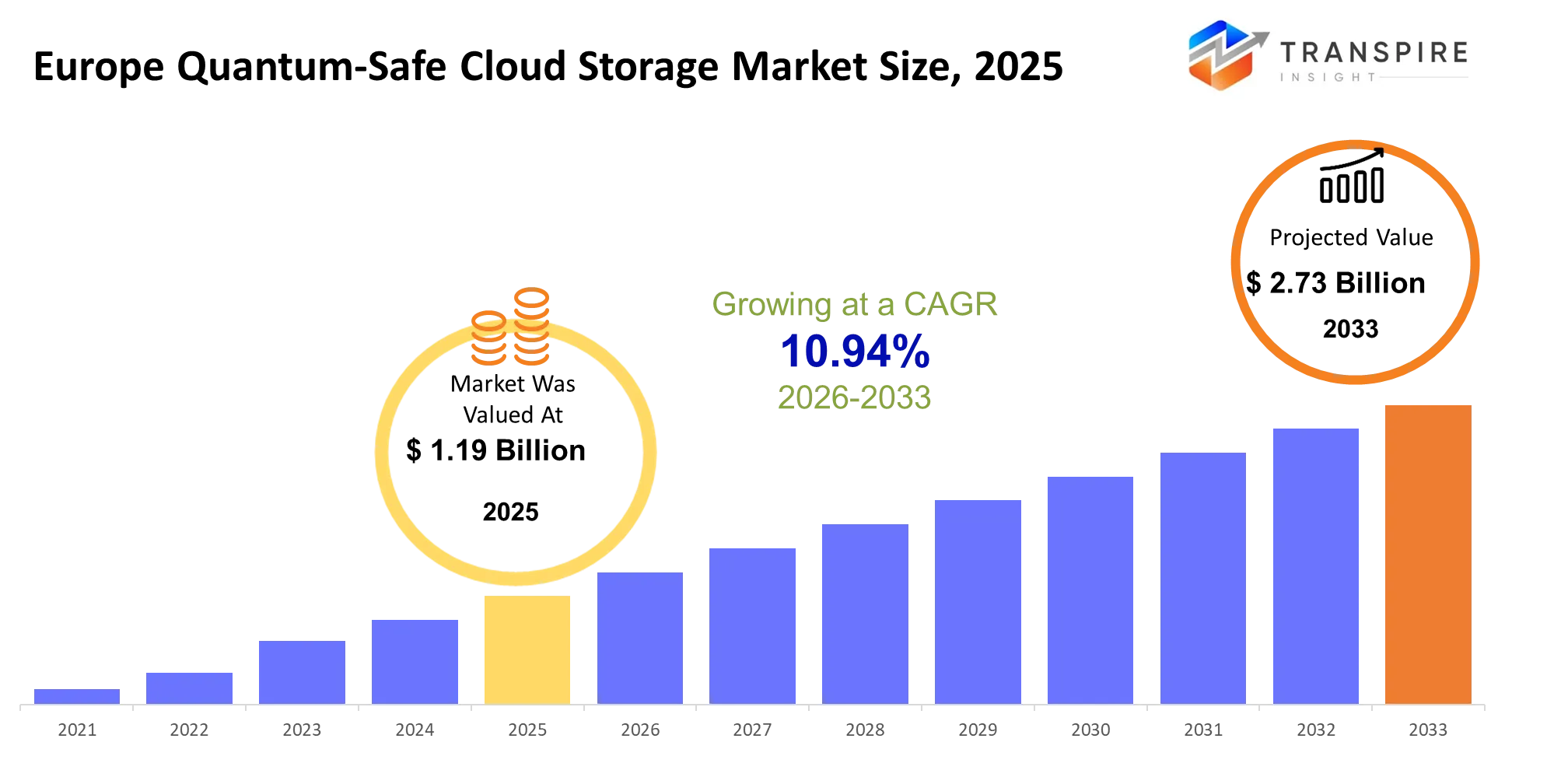
- Europe Quantum-Safe Cloud Storage Market Size 2025: USD 1.19 Billion
- Europe Quantum-Safe Cloud Storage Market Size 2033: USD 2.73 Billion
- Europe Quantum-Safe Cloud Storage Market CAGR: 10.94%
- Europe Quantum-Safe Cloud Storage Market Segments: By Type (Post-Quantum Cryptography, Quantum Key Distribution, Hybrid Security, Others); By Application (Data Security, Secure Communications, Financial Services, Government Security, Others); By End-User (BFSI, Government, Enterprises, Healthcare, Defense, Others); By Deployment (Cloud, Hybrid, Private Cloud, Others)
To learn more about this report,  Download Free Sample Report
Europe Quantum-Safe Cloud Storage Market Summary
The Europe Quantum-Safe Cloud Storage Market was valued at USD 1.19 Billion in 2025. It is forecast to reach USD 2.73 Billion by 2033. That is a CAGR of 10.94% over the period.
The quantum-safe cloud storage market of Europe assists organizations which require secure storage and transfer of sensitive industrial and maritime data because quantum computing future decryption threats must be avoided. The system today protects ship navigation logs and port operations and energy infrastructure files and enterprise records from unauthorized access which attackers will attempt to decode using advanced quantum technology. The market has experienced a structural change in recent years because vendors have started to implement quantum-resistant encryption into their standard cloud systems after first testing post-quantum technologies. The rise of cyber risk awareness in Europe which followed geopolitical conflicts acts as a crucial force that drives the change while NIS2 and other EU cybersecurity laws create additional regulatory pressure. Enterprises need to adopt modern security solutions which use quantum-safe features because this security requirement has increased their product acquisition process and pushed cloud vendors to develop these features for their upcoming products, which helps organizations buy and maintain long-term contracts.
Key Market Insights
- Western Europe establishes itself as the primary force that controls the European quantum-safe cloud storage market which it operates in because of its 45% market share which it commands in 2025 through its early business adoption of cloud computing services.
- The Nordic countries experience their fastest growth during the period from 2025 to 2030 because they possess strong digital infrastructure and their governments implement programs to secure quantum technologies.
- The Central and Eastern European region shows increased technology adoption because EU funding for cybersecurity programs and cloud technology implementation projects support their digital transition.
- In 2025, quantum-safe encryption software will dominate the market with 40% of total market share because it enables enterprises to secure their cloud-based systems.
- The second largest market segment consists of cloud storage services which continue to grow because businesses transfer their data to cloud systems.
- The segment that experiences the most rapid growth between 2025 and 2030 includes managed quantum-security services because small and medium enterprises choose to delegate their complex encryption requirements to external providers.
- The Europe Quantum-Safe Cloud Storage Market shows two primary trends which drive the market forward because data protection and secure archival systems together account for almost 50% of market share.
- The secure exchange of maritime and logistics data through digital networks becomes the most rapidly growing application because EU ports increase their supply chain operations through digital technologies.
- The BFSI sector establishes itself as the leading industry with approximately 35% market share because it needs to comply with strict regulations while protecting its sensitive financial data.
- The healthcare and life sciences field shows the fastest growth among end-user groups because healthcare providers increasingly use cloud systems to store their patient information.
What are the Key Drivers, Restraints, and Opportunities in the Europe Quantum-Safe Cloud Storage Market?
The development of the Europe Quantum-Safe Cloud Storage Market occurs because cybersecurity regulations become stricter at a quick pace while people increasingly worry about future quantum computing security risks. The EU NIS2 Directive together with national critical infrastructure regulations has forced companies to evaluate their encryption methods which now require them to implement post-quantum cryptography solutions in their cloud storage systems. The regulatory requirements shorten the time that enterprises need for security improvements while they prompt organizations to adopt quantum-safe cloud solutions which financial institutions and public sector organizations use because they must protect sensitive data from long-term security threats.
The Europe Quantum-Safe Cloud Storage Market has one main obstacle because organizations find it difficult to implement quantum-resistant encryption in their existing cloud systems. Organizations continue to operate with established cryptographic systems which have become an integral part of their business operations thus making any changes to these systems highly disruptive and expensive. The operational dependencies of the system create a barrier to complete implementation which particularly affects mid-sized companies that need cybersecurity expertise but lack it thus resulting in delayed revenue growth for vendors who have received significant customer interest.
An emerging opportunity exists through the incorporation of quantum-safe encryption into sovereign cloud projects which European countries France and Germany develop. Government-supported initiatives that develop secure localized cloud systems are establishing optimal conditions for the initial implementation of post-quantum technologies.The expansion of sovereign cloud partnerships by Microsoft and Thales Group has resulted in these providers choosing quantum-safe storage as an essential compliance component for their services.
What Has the Impact of Artificial Intelligence Been on the Europe Quantum-Safe Cloud Storage Market?
Artificial intelligence has become a fundamental part of the Europe Quantum-Safe Cloud Storage Market because maritime and industrial operators depend on post-quantum protected cloud systems to secure their confidential operational information. The AI systems monitor scrubber performance systems and exhaust gas cleaning technology by analyzing sensor streams which scientists store in quantum-safe cloud repositories. The system decreases the need for manual inspections and better tracks compliance throughout the entire fleet because European maritime emissions regulations are becoming stricter.
Machine learning models improve predictive abilities by estimating equipment deterioration times and emissions peak periods and voyage efficiency variances. The models applied to marine emission control systems use past performance data and current operational data to project future maintenance requirements which help operators decrease unexpected operational interruptions and prolong equipment operational lifespans. The operators observe bodyweight improvements for fuel efficiency together with better accuracy in following regulations because AI-based optimization modifies their routing and engine load methods using predictive knowledge.
The system faces a fundamental issue which prevents open-ocean operations from achieving dependable connection, thus hindering ships from synchronizing their data with cloud-based AI systems in real time. The system experiences two problems because of its long distance shipping routes which introduce latency and affect accuracy while creating delays in feedback loops.
Organizations in the Europe Quantum-Safe Cloud Storage Market adopt AI technology for their quantum-secure cloud infrastructure because they desire automated systems which can scale their operations while maintaining effective data protection against new cybersecurity threats.
Key Market Trends
- The Europe Quantum-Safe Cloud Storage Market started its first project with quantum encryption tests during 2021 and completed its first commercial deployment to banks and telecommunications companies by 2025.
- The EU cybersecurity regulations required organizations to follow mandatory compliance regulations which began with NIS2 implementation in 2024, in order to enforce encryption upgrades for their cloud storage systems.
- Financial institutions reduced their need for outdated encryption methods after 2023 cyber threat escalations, which led them to adopt quantum-safe storage solutions throughout their international transaction networks.
- Cloud providers moved from offering post-quantum modules as optional features in 2022 to making these modules standard components of enterprise cloud systems by 2025.
- Western European enterprises increased their quantum-safe investments by more than 40 percent during the period from 2023 to 2025 because geopolitical cyber threats became more serious.
- The maritime logistics industry, which digitizes its supply chain, now needs secure data storage solutions that offer real-time quantum-secure cloud capabilities because of the 2024 port automation system upgrades.
- IBM and Microsoft expanded their hybrid encryption services after 2023 to support the new EU quantum-resilience standards which began to take effect.
- Enterprises adopted cloud-native zero-trust security systems which use quantum-safe encryption, instead of perimeter-based cybersecurity systems, during 2022.
- The government-sponsored sovereign cloud initiatives in Germany and France, which began after 2024, created a greater need for local quantum-secure data storage systems.
- The adoption of managed security services increased significantly from 2023 onward because small and medium-sized enterprises needed to outsource their complex quantum-safe migration projects, which became more expensive to implement.
Europe Quantum-Safe Cloud Storage Market Segmentation
By Type:
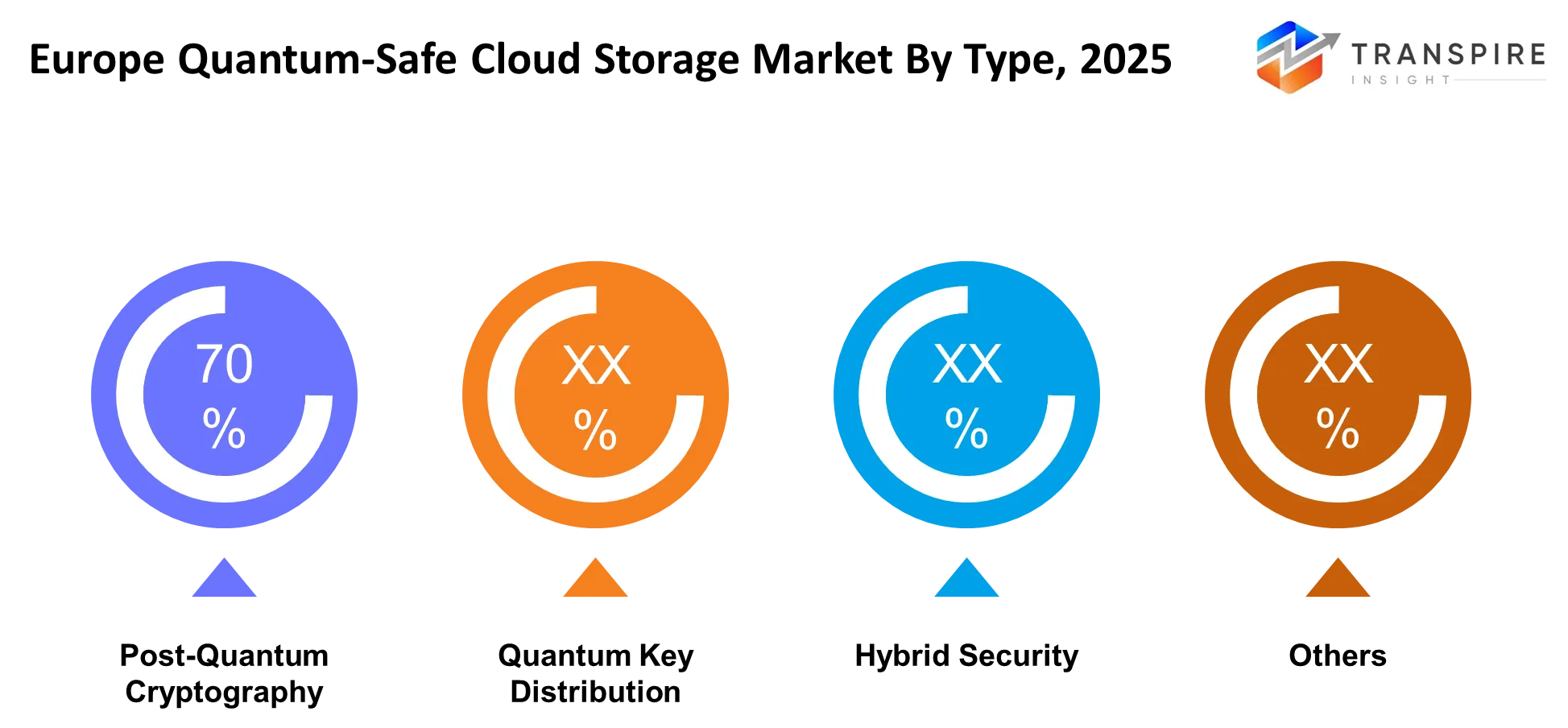
The Europe Quantum-Safe Cloud Storage Market considers Post-Quantum Cryptography to be the most secure solution because enterprises rapidly adopt it for their cloud security systems. The enterprise customers prefer this solution because it enables them to enhance their current encryption systems without needing to implement a complete system overhaul which results in diminished operational costs and faster implementation times. The implementation of Quantum Key Distribution remains restricted to government and defense applications because of its high deployment costs and the operational needs of secure networks. Organizations are implementing Hybrid Security models which combine traditional security methods with post-quantum techniques to achieve both performance and security objectives. The forecast period will show post-quantum solutions establishing their presence in commercial cloud platforms while hybrid systems become the standard which directs investment towards scalable cryptographic systems and API-based security solutions.
To learn more about this report, Download Free Sample Report
By Application:
Data Security leads the Europe Quantum-Safe Cloud Storage Market because organizations need to protect their sensitive financial industrial and healthcare datasets for extended periods. Secure Communications experiences fast growth because businesses need encryption-proof data transmission systems for their international digital transactions and maritime shipping operations. Financial Services maintain a strong position due to regulatory pressure and high-value transaction protection requirements, while Government Security applications continue steady adoption driven by national cybersecurity mandates. Secure communications experiences its strongest growth in secure communications because real-time data transmission through cloud networks needs quantum-resistant security measures.We accept that increased mechanization will see a -ute defect on cryptography in the development of software nominalization mechanisms especially for latency-sensitive communication systems.
By End-User:
The European Quantum-Safe Cloud Storage Market sees BFSI sector as its main adopter because of its need to meet strict compliance standards while facing dangerous cyber threats. Government agencies in Europe adopt national security systems together with sovereign cloud programs which drive their operational needs. Enterprises expand their presence in the market because digital transformation processes require them to use cloud-based data systems. The healthcare industry shows increasing adoption of digital patient record systems which enable medical data sharing between different countries. Defense applications exist as specific security solutions that protect secret communication systems and intelligence storage facilities. The BFSI and healthcare sectors will experience growth because businesses need to invest in quantum-secure systems due to increased regulatory requirements and data protection needs.
By Deployment:
The Europe Quantum-Safe Cloud Storage Market sees cloud deployment as its leading solution because enterprises adopt centralized security systems which provide total control over their cloud-based data storage. Organizations choose hybrid deployment because they want to update their quantum-safe systems while keeping their existing systems through partial system changes. Private cloud solutions maintain relevance in highly regulated sectors such as government and defense, where data sovereignty remains critical. Cloud-native architectures gain preference due to their ability to lower operational expenses and provide quicker deployment processes. Enterprises will invest in cloud-native quantum-safe platforms while using hybrid models as their cloud transitional systems because they need to achieve operational flexibility together with compliance requirements and ongoing security enhancements.
What are the Key Use Cases Driving the Europe Quantum-Safe Cloud Storage Market?
The Europe Quantum-Safe Cloud Storage Market experiences its highest market demand because organizations need to establish secure storage solutions for their long-term sensitive data. Financial institutions and healthcare systems together with critical infrastructure operators need to use quantum-resistant encryption which protects their essential records that need security during extended time periods. The European Union cybersecurity frameworks establish regulatory requirements which increase the need for protection of data that needs to be stored and audited across international borders.
The implementation of secure communication systems for maritime logistics and enterprise cloud networks has emerged as a new secondary use case, which is currently experiencing growth. Shipping operators together with energy companies depend on encrypted cloud platforms to transfer operational data which exists between their vessels and ports and control centers. Government agencies also expand adoption for classified communication channels linked to national security and defense coordination.
The market for real-time quantum-secure IoT data streaming from autonomous vessels and industrial sensors has emerged as an emerging application. Smart port ecosystems in Rotterdam and Hamburg are beginning to test secure edge-cloud integration for operational analytics. Cross-border digital identity verification in trade finance shows early traction, which indicates that broader adoption will occur during the forecast period.
|
Report Metrics |
Details |
|
Market size value in 2025 |
USD 1.19 Billion |
|
Market size value in 2026 |
USD 1.32 Billion |
|
Revenue forecast in 2033 |
USD 2.73 Billion |
|
Growth rate |
CAGR of 10.94% from 2026 to 2033 |
|
Base year |
2025 |
|
Historical data |
2021 - 2024 |
|
Forecast period |
2026 - 2033 |
|
Report coverage |
Revenue forecast, competitive landscape, growth factors, and trends |
|
Regional scope |
Europe (Germany, United Kingdom, France, Italy, Spain, Rest of Europe) |
|
Key company profiled |
IBM, Microsoft, Google, Amazon Web Services, Oracle, Cisco, Huawei, Thales, Atos, Toshiba, ID Quantique, QuintessenceLabs, PQShield, Crypta Labs, KETS Quantum Security |
|
Customization scope |
Free report customization (country, regional & segment scope). Avail customized purchase options to meet your exact research needs. |
|
Report Segmentation |
By Type (Post-Quantum Cryptography, Quantum Key Distribution, Hybrid Security, Others); By Application (Data Security, Secure Communications, Financial Services, Government Security, Others); By End-User (BFSI, Government, Enterprises, Healthcare, Defense, Others); By Deployment (Cloud, Hybrid, Private Cloud, Others) |
Which Regions are Driving the Europe Quantum-Safe Cloud Storage Market Growth?
The Quantum-Safe Cloud Storage Market in Europe is dominated by Western Europe because the region has effective regulatory systems and its digital infrastructure capabilities. The European Union frameworks require German and French and Dutch security regulations which compel businesses to use post-quantum encryption before other territories. The deployment of quantum-safe storage systems progresses quickly because of the region's extensive cloud infrastructure and developed data center networks and high levels of business digital transformation. The operators of maritime and industrial activities in this area process extensive quantities of protected international data which leads them to depend more on secure cloud technologies. The system creates a permanent leadership structure which maintains simultaneous contact between regulation and technology providers and enterprise requirements.
The secondary regions of Northern and Southern Europe provide market stability but their growth patterns differ from the leading market. The Nordic countries achieve steady cybersecurity adoption because their digital economy development works with their public sector commitments to cybersecurity. Southern Europe, particularly Italy and Spain, shows gradual uptake driven by modernization of port infrastructure and energy sector digitization. Western European countries proceed with their regulatory systems while these regions depend on their business capacity to generate revenue and implement incremental business improvements. The system establishes an unchanging revenue pattern which generates slow income for vendors who focus on developing long-term business relationships and upgrading their systems.
The Europe Quantum-Safe Cloud Storage Market experiences its fastest growth in Eastern Europe because of increased EU integration and funding for cybersecurity initiatives.The new investments in digital public infrastructure and cloud migration programs have increased enterprise capabilities to implement advanced encryption technologies. Poland and Romania are upgrading their data systems to meet the European Union security standards which create new requirements for quantum-safe solutions. The fast changes in the market provide good chances for cloud providers and cybersecurity companies to enter the market during the period from 2026 to 2033. The entry opportunities especially benefit companies which provide affordable deployment solutions that can grow with the emerging digital markets.
Who are the Key Players in the Europe Quantum-Safe Cloud Storage Market and How Do They Compete?
The Europe Quantum-Safe Cloud Storage Market experiences moderate competition, which results in hyperscale cloud providers maintaining control over primary infrastructure while cybersecurity firms maintain their operations through high-assurance security markets. The existing companies protect their market position by completely integrating post-quantum encryption into their cloud-native systems instead of using independent security products. The main factors which drive competition between businesses include their technological superiority and their ability to meet compliant requirements which include EU cybersecurity standards and sovereign data protection regulations. Service integration capability has become more essential than pricing because enterprises need to move to quantum-safe systems without causing any interruptions to their business operations.
Microsoft enhances its market position through the integration of post-quantum cryptography into its enterprise cloud services while constructing crypto-agile frameworks that enable businesses to implement quick algorithm transitions.IBM establishes itself as a unique player through its enterprise-grade hybrid cloud security offerings which it delivers through strategic partnerships with enterprises in regulated sectors such as financial services and government IT systems. Amazon Web Services enhances its security services by developing scalable cloud-native security solutions, which it implements throughout its worldwide infrastructure network. Google Cloud directs its efforts towards developing advanced encryption methods and implementing zero-trust security frameworks for data-intensive applications. Thales Group and Atos use their established defense connections and European sovereign cloud partnerships to obtain government contracts through public-private cybersecurity collaborations and region-specific compliance deployments.
Company List
- IBM
- Microsoft
- Amazon Web Services
- Oracle
- Cisco
- Huawei
- Thales
- Atos
- Toshiba
- ID Quantique
- QuintessenceLabs
- PQShield
- Crypta Labs
- KETS Quantum Security
Recent Development News
“In August 2025, Microsoft announced expanded post-quantum cryptography capabilities within its enterprise security ecosystem, accelerating integration of quantum-safe encryption across cloud services. The initiative focuses on crypto-agility and compliance readiness for European regulatory frameworks shaping cloud storage modernization.https://www.microsoft.com
What Strategic Insights Define the Future of the Europe Quantum-Safe Cloud Storage Market?
The Europe Quantum-Safe Cloud Storage Market requires cloud systems to implement complete cryptographic updates that become part of their core infrastructure instead of functioning as supplementary security protections. The upcoming 5–7 years will see adoption increase because of EU cybersecurity regulations and sovereign data protection regulations rather than actual quantum computing readiness. The industry will establish post-quantum encryption as a standard requirement for cloud procurement processes which will particularly affect businesses that operate under regulatory supervision.
The main danger comes from vendor concentration because hyperscale cloud providers control most of the market which results in decreased innovation and creates a dependency on few established quantum-safe standards. The existing interoperability problems between systems create switching costs that prevent enterprises from expanding their use of different systems.
The European Union sovereign cloud programs, which currently develop their public-private infrastructure systems, present an opportunity to integrate quantum-safe storage solutions into their operations, especially in Germany and France, which are expanding their programs. The market needs to focus on developing crypto-agile systems, which enable smooth transitions between classical, hybrid, and post-quantum technologies. Organizations will gain a critical advantage through this capability because they need to comply with regulations while moving their operations to cloud environments, which is happening at a rapid pace.
Europe Quantum-Safe Cloud Storage Market Report Segmentation
By Type
- Post-Quantum Cryptography
- Quantum Key Distribution
- Hybrid Security
- Others
By Application
- Data Security
- Secure Communications
- Financial Services
- Government Security
- Others
By End-User
- BFSI
- Government
- Enterprises
- Healthcare
- Defense
- Others
By Deployment
- Cloud
- Hybrid
- Private Cloud
- Others
Frequently Asked Questions
Find quick answers to common questions.
The Europe Quantum-Safe Cloud Storage Market size is USD 2.73 Billion in 2033.
Key segments for the Europe Quantum-Safe Cloud Storage Market are By Type (Post-Quantum Cryptography, Quantum Key Distribution, Hybrid Security, Others); By Application (Data Security, Secure Communications, Financial Services, Government Security, Others); By End-User (BFSI, Government, Enterprises, Healthcare, Defense, Others); By Deployment (Cloud, Hybrid, Private Cloud, Others)
Major Europe Quantum-Safe Cloud Storage Market players are IBM, Microsoft, Google, Amazon Web Services, Oracle, Cisco, Huawei, Thales, Atos, Toshiba, ID Quantique, QuintessenceLabs, PQShield, Crypta Labs, KETS Quantum Security.
The Europe Quantum-Safe Cloud Storage Market size is USD 1.19 Billion in 2025.
The Europe Quantum-Safe Cloud Storage Market CAGR is 10.94% from 2026 to 2033.
- IBM
- Microsoft
- Amazon Web Services
- Oracle
- Cisco
- Huawei
- Thales
- Atos
- Toshiba
- ID Quantique
- QuintessenceLabs
- PQShield
- Crypta Labs
- KETS Quantum Security
Recently Published Reports
-
Apr 2026
3D Optical Profiler Market
3D Optical Profiler Market Size, Share & Analysis Report By Type (Desktop 3D Optical Profiler, and Portable 3D Optical Profiler), By Technology (Confocal Technology, and White Light Interference), By End-Use Industry (Manufacturing, Research Institutions, Automotive, Aerospace and Defense, Medical Devices, and Other), and Geography (North America, Europe, Asia-Pacific, Middle East and Africa, South and Central America), 2021 - 2031
-
Apr 2026
Depth Sensor Market
Depth Sensor Market Size, Share & Analysis Report By Type (Infrared Depth Sensors, Time-of-Flight (ToF) Sensors, Stereo Vision Sensors, Structured Light Sensors, Ultrasonic Depth Sensors), By Application (Automotive, Robotics, Gaming, Consumer Electronics, Industrial Automation, Healthcare, Security & Surveillance, Others), By End Users (Automotive Manufacturers, Consumer Electronics Companies, Healthcare Providers, Industrial Companies, Security Agencies, Gaming Companies, Robotics Companies, Others), and Geography (North America, Europe, Asia-Pacific, Middle East and Africa, South and Central America), 2021 – 2031
-
Apr 2026
Digital Manufacturing Market
Digital Manufacturing Market Size, Share & Analysis Report By Component (Hardware, Software, and Services), By Technology (Robotics, 3D Printing, Internet of Things (IoT), and Others), By Application (Automotive and Transportation, Aerospace and Defense, Consumer Electronics, Industrial Machinery, and Others), By Process Type (Computer-Based Designing, Computer-Based Simulation, Computer 3D Visualization, Analytics, and Others), and Geography (North America, Europe, Asia-Pacific, Middle East and Africa, South and Central America), 2021 – 2031
-
Apr 2026
Digital Visa Services Market
Digital Visa Services Market Size, Share & Analysis Report By Type (Individual Travelers, Group Travelers), By Application (Tourism, Business Travel, Others), and Geography (North America, Europe, Asia-Pacific, Middle East and Africa, South and Central America), 2021 – 2031