
Europe Industrial Sensors Market Size & Forecast:
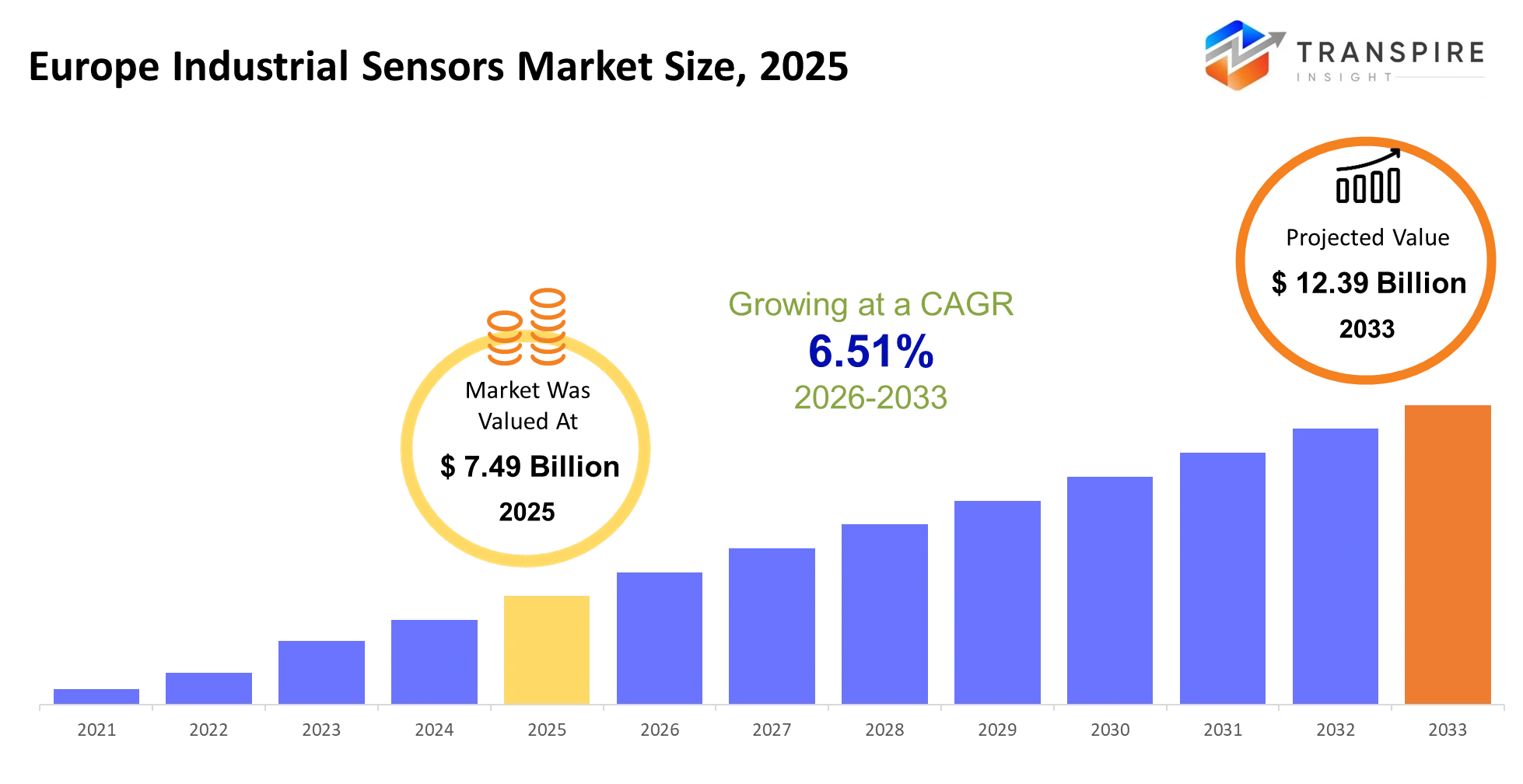
- Europe Industrial Sensors Market Size 2025: USD 7.49 Billion
- Europe Industrial Sensors Market Size 2033: USD 12.39 Billion
- Europe Industrial Sensors Market CAGR: 6.51%
- Europe Industrial Sensors Market Segments: By Type (Temperature Sensors, Pressure Sensors, Proximity Sensors, Motion Sensors, Others); By Application (Manufacturing, Automotive, Oil & Gas, Healthcare, Energy & Power, Others); By End-User (Industrial Firms, Automotive Companies, Energy Sector, Healthcare Sector, Manufacturing Units, Others); By Technology (IoT Sensors, Wireless Sensors, MEMS Sensors, Optical Sensors, Others).
To learn more about this report,  Download Free Sample Report
Europe Industrial Sensors Market Summary
The Europe Industrial Sensors Market was valued at USD 7.49 Billion in 2025. It is forecast to reach USD 12.39 Billion by 2033. That is a CAGR of 6.51% over the period.
Industrial sensors in Europe operate within factories and ports and processing plants to record temperature and pressure and vibration and emissions which enables operators to maintain safe and efficient machine operations that meet all regulatory requirements. The industry has developed from its previous state of using single-purpose analog equipment to using smart sensors with IIoT connectivity which transmit data to edge and cloud systems during the last 3 to 5 years. The transition gained speed after European energy prices rose in 2022 because of the Russia-Ukraine conflict which forced manufacturers to implement energy conservation measures and improve their process monitoring systems. EU emissions regulations and sustainability standards required companies to increase their monitoring of industrial production processes and environmental consequences. Companies are implementing automation systems with multiple sensors because these systems help them maintain equipment by predicting failures and enabling energy-efficient operations through machine-level energy monitoring which brings immediate cost benefits and helps them meet compliance requirements.
Key Market Insights
- Western Europe holds approximately 38 percent of the European Industrial Sensors Market because Germany and France operate advanced manufacturing facilities.
- Industrial modernization and foreign manufacturing investments drive Eastern Europe to become the fastest-growing region between 2024 and 2030.
- Northern Europe demonstrates significant technology adoption because its digital infrastructure supports both smart factory systems and advanced technology implementation.
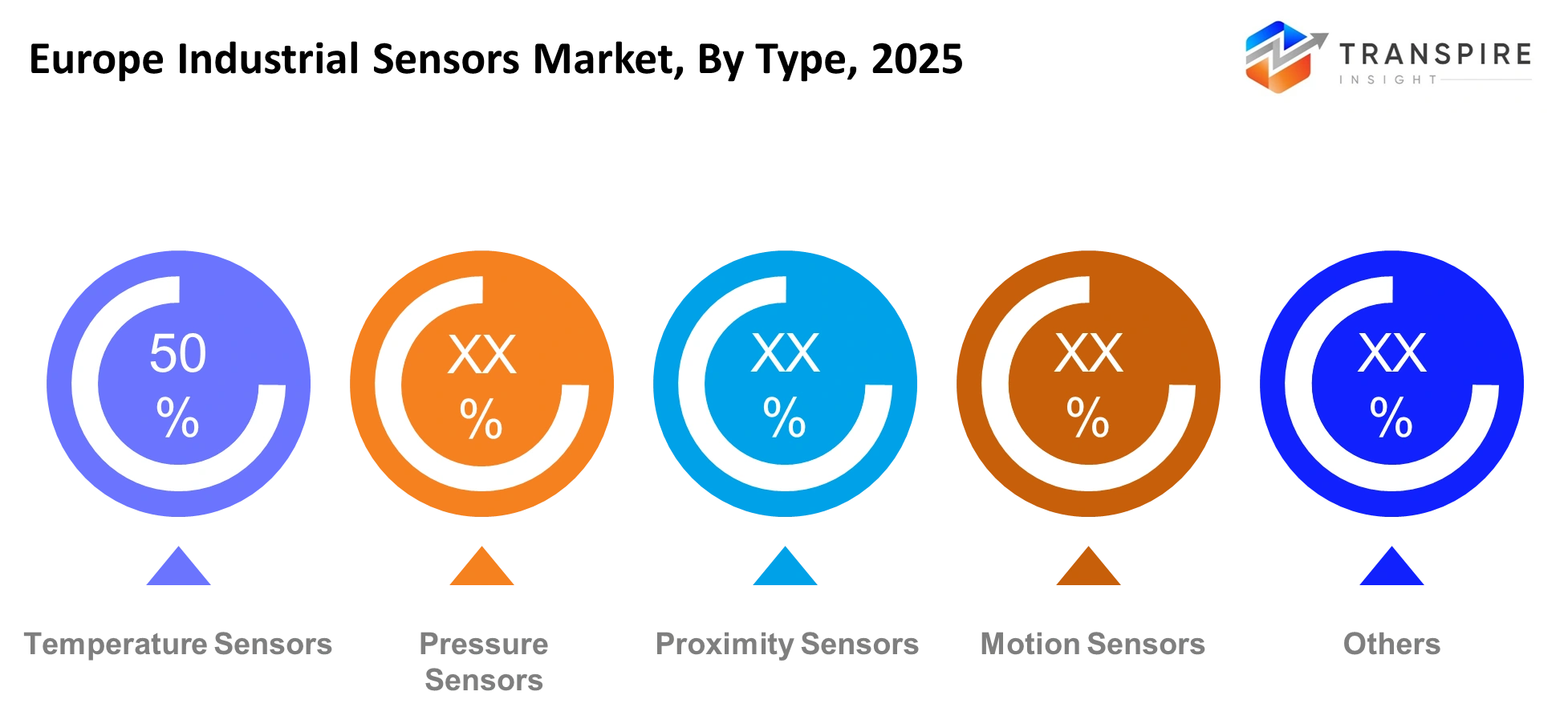
- The Europe Industrial Sensors Market distributes approximately 32 percent of its market share to pressure and temperature sensors which industrial facilities use for their monitoring needs.
- Proximity and position sensors represent the second-largest segment, which engineers widely use to create robotic systems and automated production facilities.
- The segment which is growing the fastest between 2024 and 2030 consists of optical and smart sensors, which companies use for their Industry 4.0 and AI-based monitoring solutions.
- The Europe Industrial Sensors Market identifies manufacturing applications as its leading segment, which maintains a 40 percent market share that industrial facilities use for their automated systems and quality management processes.
- Energy management applications represent the fastest-growing market segment, which operates under European Union sustainability regulations and industrial decarbonization programs.
- The European Industrial Sensors Market shows industrial manufacturing as its main end-user segment, which controls approximately 45 percent of market operations.
- The oil and gas and chemical processing industries experience rapid growth because they require safety compliance solutions and real-time hazard detection systems.
What are the Key Drivers, Restraints, and Opportunities in the Europe Industrial Sensors Market?
Driver:
The Industry 4.0 initiative implementation across Germany, France, and the Nordic countries drives manufacturing companies to combine their sensor networks with artificial intelligence automation systems which leads to the highest growth in the market. After the 2022 European energy crisis, which caused energy prices to rise, factories began to cut their operational costs by implementing operational efficiency measures. The need for industrial sensors has expanded because these devices now serve two purposes, which include production line monitoring and real-time production line optimization, leading to increased demand for advanced connected sensing technologies that generate ongoing software-based revenue streams.
Restraint:
The primary barrier exists because businesses face difficulties when they attempt to integrate their outdated industrial systems. Many European plants continue to function with outdated control systems which have been used for more than thirty years and these systems cannot directly operate with contemporary IIoT sensor systems. The existing architectural differences between systems lead to increased costs for retrofitting projects while they extend the period required to implement systems which results in sales delays that affect large manufacturing operations which lack funding for digital transformation initiatives.
Opportunity:
The most valuable business possibility exists in automotive production centers such as Bavaria and Lombardy which are adopting predictive maintenance solutions that operate on edge technology. The companies Siemens and Bosch are developing edge sensor systems that perform data analysis at the local level, which decreases delay times, and eliminates the need for cloud services. The process is expected to create new revenue opportunities through the implementation of maintenance agreements that deliver services and through the integration of high-value analytical solutions.
What Has the Impact of Artificial Intelligence Been on the Europe Industrial Sensors Market?
Artificial intelligence is increasingly embedded into Europe’s industrial sensor ecosystem, especially within scrubber performance systems, automated control infrastructure, and marine emission control technology used across ports and industrial fleets. The automated scrubber monitoring system uses AI algorithms to analyze continuous sensor data which includes sulfur oxide concentration and pressure differentials and exhaust flow rates to determine the appropriate cleaning intensity for operations that require less human involvement while achieving better compliance with EU maritime emission regulations. The researchers use machine learning models to predict equipment failures which will occur between days and weeks by analyzing vibration and thermal sensor data from industrial machines so they can enhance maintenance planning accuracy that will decrease unexpected downtime.
The digital systems boost operational efficiency because industrial operators experience decreased fuel consumption from their optimized engine systems and they achieve greater equipment availability through their ability to detect faults in exhaust gas cleaning systems. The AI-supported emissions forecasting system used in regulated environments helps organizations prepare for compliance by detecting emissions violations which start to exceed permitted levels, thus reducing their risk of penalties and interruptions to their business activities.
The maritime industry faces two challenges which limit the adoption of new technologies because of its need for precise training data and the restricted availability of high-quality training data that tracks sensor signal distortion during extreme environmental conditions. The need for complete data across all operational equipment limits the ability to use full-scale deployment which affects older fleet systems.
Key Market Trends
- Germany increased adoption of IIoT-enabled sensors by over 35% since 2022, driven by Industry 4.0 factory modernization programs.
- EU emissions regulations tightened in 2023, which required shipping operators to upgrade their scrubber monitoring systems through the addition of real-time sensor integration.
- Siemens and ABB expanded their edge-based industrial sensor portfolios during 2024 because companies now compete through their real-time analytics capabilities instead of their hardware products.
- Manufacturers started to adopt predictive maintenance after the 2022 energy crisis because they needed to decrease downtime more than they needed to stick with their existing repair systems.
- Automated production lines deployed optical and smart sensors between 2023 and 2025 to replace their existing mechanical sensing systems.
- Eastern European manufacturing hubs recorded a 28% rise in sensor deployment as multinational firms relocated production for cost optimization.
- Bosch Sensortec and Honeywell increased their research and development budget for AI-integrated sensors after 2023 to develop autonomous industrial monitoring systems.
- Supply chain localization efforts since 2022 reduced dependency on Asian semiconductor imports, which strengthened European sensor manufacturing resilience.
- Energy-intensive industries implemented sensor-driven efficiency programs during 2024, which enabled them to decrease operational waste through their continuous real-time monitoring systems.
Europe Industrial Sensors Market Segmentation
By Type:
The analysis breaks down into two main categories which include temperature sensors and pressure sensors and proximity sensors and motion sensors and all other sensors. The combined market share of temperature sensors and pressure sensors establishes their status as the leading technology because both systems function essential for maintaining operational stability throughout manufacturing and energy production and industrial automation processes. The existing infrastructure continues to use these sensors while new IoT-enabled upgrades maintain constant replacement patterns which occur at fixed intervals.
European factories experience rapid growth in proximity and motion sensor technologies because of increasing robotics usage and automated assembly line implementation. The production sector grows because of machine vision systems which are increasingly used and because safety compliance requirements exist in high-speed production environments.
Future demand will shift toward multi-functional smart sensor modules that integrate sensing, diagnostics, and connectivity. The product developers will focus on creating space-saving products which consume less power and enable both predictive analytics and real-time control system operations.
To learn more about this report, Download Free Sample Report
By Application:
The application segments include five fields which are Manufacturing and Automotive and Oil & Gas and Healthcare and Energy & Power and Others. The manufacturing sector stands as the top application segment because industries throughout Germany and France use sensors for their automation and quality control and process optimization needs.
The oil and gas sector experiences strong growth because refineries and offshore operations need to monitor safety and track emissions continuously. The automotive industry uses sensor-based diagnostics to monitor electric vehicle production processes.
The energy and power sector will expand rapidly because grid modernization needs continuous monitoring systems to support renewable energy integration. Organizations will use software-integrated sensor platforms as their primary tools for optimizing efficiency.
By End-User:
The two main types of users who require this technology include industrial firms and automotive companies and energy sector and healthcare sector and manufacturing units and all other organizations.
Energy sector users are expanding sensor deployment to manage distributed renewable systems and ensure grid stability under fluctuating load conditions. Automotive companies increasingly use sensor ecosystems for monitoring electric drivetrains and validating safety systems.
The use of diagnostic equipment and patient monitoring systems contributes to the ongoing increase of healthcare adoption. The upcoming growth period will focus on developing sensor platforms that enable different industries to share their operational data in various settings.
By Technology:
The text needs to be reconstructed with simpler language which maintains the same content and all HTML elements. The European manufacturing ecosystem adopts industrial automation technologies because IoT-enabled sensors have strong ties with both industrial automation systems and cloud-based analytics platforms. The automotive and energy sectors are adopting MEMS and wireless sensors because both technologies provide miniaturized components and enable remote monitoring capabilities.
The optical sensor technology is being used in both precise manufacturing processes and quality evaluation systems. The future development will concentrate on sensor systems which utilize edge computing to decrease latency and enhance decision-making processes. The technology providers will focus on developing secure connections which enable real-time data processing for autonomous industrial systems.
What are the Key Use Cases Driving the Europe Industrial Sensors Market?
The Europe Industrial Sensors Market shows manufacturing as its primary application which leads to market growth because sensors provide continuous temperature and pressure and machine vibration monitoring that ensures automated production lines operate without interruption. The industry requires high precision from automotive component assembly and electronics manufacturing which results in high demand because even small process deviations create expensive defects and production halts.
Energy and oil & gas operations currently extend their adoption to adjacent areas because sensors enable emissions monitoring and leak detection and equipment health assessment. The energy industry and industrial companies depend on these systems to achieve strict EU safety and environmental standards while enhancing their operational productivity across multiple sites.
Industrial ports now use smart grid monitoring and autonomous logistics systems as their emerging use cases. The applications face challenges with their current expansion but they demonstrate strong potential because European industrial modernization programs prioritize electrifying transport and managing infrastructure in real time.
|
Report Metrics |
Details |
|
Market size value in 2025 |
USD 7.49 Billion |
|
Market size value in 2026 |
USD 7.97 Billion |
|
Revenue forecast in 2033 |
USD 12.39 Billion |
|
Growth rate |
CAGR of 6.51% from 2026 to 2033 |
|
Base year |
2025 |
|
Historical data |
2021 - 2024 |
|
Forecast period |
2026 - 2033 |
|
Report coverage |
Revenue forecast, competitive landscape, growth factors, and trends |
|
Regional scope |
Europe (Germany, United Kingdom, France, Italy, Spain, Rest of Europe) |
|
Key company profiled |
Siemens, Honeywell, ABB, Schneider Electric, Bosch, Rockwell Automation, Emerson, GE, Omron, Panasonic, Keyence, STMicroelectronics, TE Connectivity, Sensata, Infineon. |
|
Customization scope |
Free report customization (country, regional & segment scope). Avail customized purchase options to meet your exact research needs. |
|
Report Segmentation |
By Type (Temperature Sensors, Pressure Sensors, Proximity Sensors, Motion Sensors, Others); By Application (Manufacturing, Automotive, Oil & Gas, Healthcare, Energy & Power, Others); By End-User (Industrial Firms, Automotive Companies, Energy Sector, Healthcare Sector, Manufacturing Units, Others); By Technology (IoT Sensors, Wireless Sensors, MEMS Sensors, Optical Sensors, Others). |
Which Regions are Driving the Europe Industrial Sensors Market Growth?
The Europe Industrial Sensors Market gets dominated by Western Europe because advanced manufacturing systems operate in Germany and France and the Netherlands. European Union industrial safety regulations together with emissions standards have caused factories and ports to install high-density sensor networks that provide continuous monitoring solutions. The automotive and industrial sectors of Germany create ongoing requirements for precise sensors which support both automated production and predictive maintenance operations. The digital infrastructure of the region operates at advanced levels while Siemens and Bosch provide strong supplier networks which enable quick adoption of new technologies. The combination of policy requirements together with industrial operations and established automation systems maintains Western Europe as the primary source of business revenue.
Northern Europe maintains its position because Norway and Sweden and Denmark contribute to its stable technological progress. The region shows growth through disciplined adoption in energy and maritime and clean technology sectors while the leading region expands through its large scale operations. Operators of ships and offshore platforms maintain steady investments in sensor systems which enable them to monitor extreme environmental conditions that exist in wind energy facilities and North Sea operations. Environmental governance and industrial planning create stable demand patterns which result in predictable growth instead of sudden industrial expansion. The stability of these systems guarantees businesses will receive continuous income especially through their energy efficiency and maritime safety product lines.
Eastern Europe has become the fastest-expanding area because industrial modernization and foreign manufacturing investments have increased since 2022. Poland and Czech Republic and Hungary are implementing factory upgrades to meet the production standards that Western Europe establishes.The EU-funded industrial digitalization programs and automotive supply chain relocation initiatives have caused most businesses to adopt sensors at an accelerated pace. The installation of sensors is increasing rapidly because new smart factory projects and affordable manufacturing facilities are being developed. Eastern Europe will become a primary growth area for sensor manufacturers who focus on high-volume industrial deployments between 2026 and 2033.
Who are the Key Players in the Europe Industrial Sensors Market and How Do They Compete?
The Europe Industrial Sensors Market shows a moderately consolidated competitive structure which allows multinational industrial automation corporations to control most market share while specialized sensor companies work in fast-developing market segments. The established companies maintain their market positions by offering complete hardware and software solutions which include data analytics and system interoperability and lifecycle service capabilities instead of selling individual sensors. The high-end industrial market maintains its price stability because companies choose to differentiate their products according to their ability to operate accurately and dependably in tough conditions and to work with Industry 4.0 systems.
Siemens establishes its industrial sensors business through complete integration of these sensors into its automation systems and digital twin technology which enables live factory system simulation and predictive factory system management. ABB develops its energy and robotics sensor solutions through partnerships with European energy companies while offering industrial equipment that withstands heavy-duty operations. Bosch Sensortec focuses on developing miniaturized MEMS sensors which it provides to customers in the automotive and consumer-industrial hybrid markets while expanding its business through partnerships with semiconductor manufacturers. Schneider Electric establishes its competitive edge by developing energy management and industrial efficiency systems which include sensors for smart grid and building automation solutions and by acquiring digital energy monitoring systems. Honeywell establishes its market position through industrial sensing solutions used in safety-sensitive sectors such as oil and gas and aerospace while expanding its European operations through service agreements and business partnerships in industrial digital transformation.
Company List
- Siemens
- Honeywell
- ABB
- Schneider Electric
- Bosch
- Rockwell Automation
- Emerson
- GE
- Omron
- Panasonic
- Keyence
- STMicroelectronics
- TE Connectivity
- Sensata
- Infineon
Recent Development News
In July 2025, STMicroelectronics announced the acquisition of NXP Semiconductors’ MEMS sensor business for up to US$950 million. The deal strengthens STMicroelectronics’ automotive and industrial sensing portfolio and expands its pressure and motion sensor capabilities used in European manufacturing systems.
Source: https://www.reuters.com
In March 2025, Siemens completed its acquisition of Altair Engineering for about US$10 billion, integrating advanced simulation software into its industrial automation ecosystem. The move enhances sensor-driven digital twin applications across smart factories, improving predictive monitoring and production optimization in European industrial environments.
Source: https://en.wikipedia.org
What Strategic Insights Define the Future of the Europe Industrial Sensors Market?
The Europe Industrial Sensors Market is moving toward deeply integrated software-defined sensor systems which use hardware to generate value through their ability to perform real-time analytics and connect with industrial AI systems. The European manufacturing sector experiences this structural transformation because of two factors which include rising Industry 4.0 adoption and the new EU regulations that require manufacturers to monitor their emissions and operational activities at all times. The next 5 to 7 years will shift sensor deployment from its current state of measuring individual elements toward its new function which supports independent decision-making throughout industrial plants and energy networks and maritime operations.
A less visible risk lies in semiconductor supply concentration especially because the industry depends on a few advanced chip manufacturing facilities which exist outside European borders. Any geopolitical disruption or export restriction could slow sensor innovation cycles and increase procurement volatility for industrial buyers. Edge-native sensor networks which enable decentralized energy systems present new business opportunities especially in Northern European offshore wind farms and smart grid corridors which benefit from its ability to process data locally and decrease both latency and bandwidth usage.
Market participants should build vertical integration systems which combine hardware components with AI industrial software while developing multiple semiconductor sourcing methods. The combination of these elements will create a system which enables businesses to maintain their operational capacity while staying competitive during periods of market consolidation.
Europe Industrial Sensors Market Report Segmentation
By Type
- Temperature Sensors
- Pressure Sensors
- Proximity Sensors
- Motion Sensors
- Others
By Application
- Manufacturing
- Automotive
- Oil & Gas
- Healthcare
- Energy & Power
- Others
By End-User
- Industrial Firms
- Automotive Companies
- Energy Sector
- Healthcare Sector
- Manufacturing Units
- Others
By Technology
- IoT Sensors
- Wireless Sensors
- MEMS Sensors
- Optical Sensors
- Others
Frequently Asked Questions
Find quick answers to common questions.
The Europe Industrial Sensors Market size is USD 12.39 Billion in 2033.
Key segments for the Europe Industrial Sensors Market are By Type (Temperature Sensors, Pressure Sensors, Proximity Sensors, Motion Sensors, Others); By Application (Manufacturing, Automotive, Oil & Gas, Healthcare, Energy & Power, Others); By End-User (Industrial Firms, Automotive Companies, Energy Sector, Healthcare Sector, Manufacturing Units, Others); By Technology (IoT Sensors, Wireless Sensors, MEMS Sensors, Optical Sensors, Others).
Major Europe Industrial Sensors Market players are Siemens, Honeywell, ABB, Schneider Electric, Bosch, Rockwell Automation, Emerson, GE, Omron, Panasonic, Keyence, STMicroelectronics, TE Connectivity, Sensata, Infineon.
The Europe Industrial Sensors Market size is USD 7.49 Billion in 2025.
The Europe Industrial Sensors Market CAGR is 6.51% from 2026 to 2033.
- Siemens
- Honeywell
- ABB
- Schneider Electric
- Bosch
- Rockwell Automation
- Emerson
- GE
- Omron
- Panasonic
- Keyence
- STMicroelectronics
- TE Connectivity
- Sensata
- Infineon
Recently Published Reports
-
Apr 2026
Fiber Optic Faceplates Market
Fiber Optic Faceplates Market Size, Share & Analysis Report By Type (< 300 mm2, 300-350 mm2, and > 350 mm2, By Application (Night Vision, Holographic Imaging, Medical, and Others), and Geography (North America, Europe, Asia-Pacific, Middle East and Africa, South and Central America), 2021 - 2031
-
Apr 2026
High Temperature Superconductors Market
High Temperature Superconductors Market Size, Share & Analysis Report By Type (1G HTS, and 2G HTS), By Application (Power Cable, Fault Current Limiter, and Transformer), and Geography (North America, Europe, Asia-Pacific, Middle East and Africa, South and Central America), 2021 - 2031
-
Apr 2026
Industrial Plugs and Socket Market
Industrial Plugs and Socket Market Size, Share & Analysis Report By Type (Industrial Plugs, Industrial Sockets), By Current (Up to 32 A, 32 to 125 A, Above 125 A), By Protection (Dustproof and Splash Proof, Waterproof, Explosion Proof), By End User (Heavy Industries, Oil and Gas, Chemicals and Pharmaceuticals, Power Generation, Others), and Geography (North America, Europe, Asia-Pacific, Middle East and Africa, South and Central America), 2021 - 2031
-
Apr 2026
InGaAs Avalanche Photodiodes Market
InGaAs Avalanche Photodiodes Market Size, Share & Analysis Report By Type (1100 - 1700 nm, and 1000 - 1600 nm), By Application (Missile Warning System, Muzzle Flash Detection, Wafer Defect Inspection, Laser Rangefinders, and Others), and Geography (North America, Europe, Asia-Pacific, Middle East and Africa, South and Central America), 2021 - 2031