
Europe Automotive LED Lighting Driver IC Market Size & Forecast:
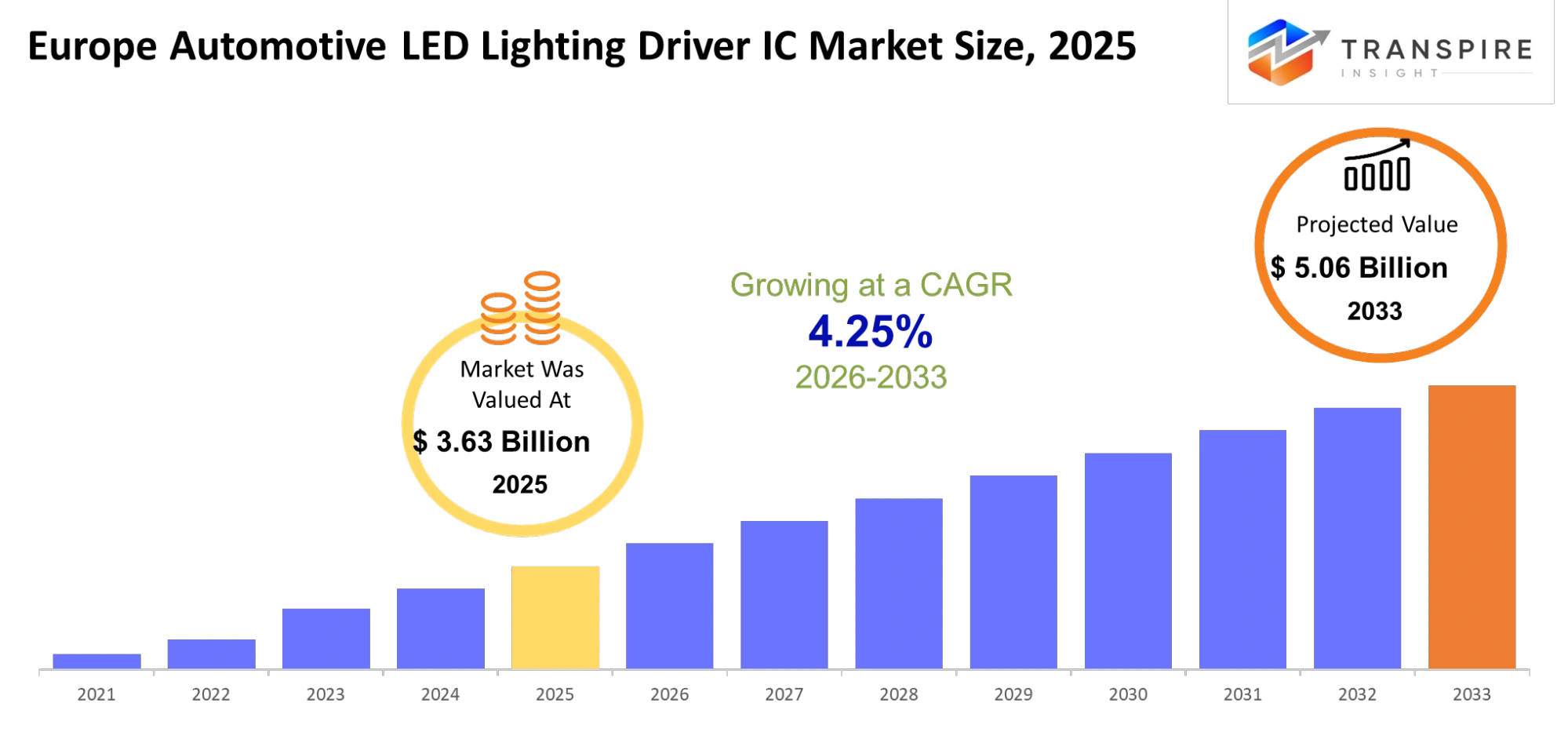
- Europe Automotive LED Lighting Driver IC Market Size 2025: USD 3.63 Billion
- Europe Automotive LED Lighting Driver IC Market Size 2033: USD 5.06 Billion
- Europe Automotive LED Lighting Driver IC Market CAGR: 4.25%
- Europe Automotive LED Lighting Driver IC Market Segments: By Type (Constant Current Drivers, Constant Voltage Drivers, Matrix Drivers, Others), By Application (Headlights, Interior Lighting, Signal Lights, DRLs, Others), By End-User (Automakers, Tier 1 Suppliers, Electronics Firms, Others), By Technology (Analog IC, Digital IC, Smart IC, Others).
To learn more about this report,  Download Free Sample Report
Europe Automotive LED Lighting Driver IC Market Summary:
The Europe Automotive LED Lighting Driver IC Market size is estimated at USD 3.63 Billion in 2025 and is anticipated to reach USD 5.06 Billion by 2033, growing at a CAGR of 4.25% from 2026 to 2033. The driver integrated circuits for automotive LED lighting systems maintain light control functions which extend throughout all areas of modern vehicular design. This system maintains effective performance for headlights and adaptive beams and ambient systems through its capacity to control multiple operational conditions which affect these components. The technology enables LED lights to function correctly with vehicle systems because it eliminates flickering and overheating while maintaining power efficiency.
The market has made a permanent shift to matrix and adaptive lighting systems because automotive safety requirements have become stricter and vehicle design needs unique elements. The global chip shortage created semiconductor supply disruptions that forced automakers to redesign their modules because they needed more robust driver IC solutions which combined multiple functions.
The relationship between two events now leads to growth because more intelligent lighting features enter vehicles, which forces OEMs to adopt ICs with higher performance standards, which results in higher vehicle content and drives suppliers to develop advanced designs that deliver additional features.
Key Market Insights
- The Europe Automotive LED Lighting Driver IC Market in 2025 will be dominated by Western Europe which controls more than 60% of the market because of Germany's robust automotive production capacity.
- The emergence of Eastern Europe as the fastest-growing region until 2030 results from its development of OEM production centers and its establishment of cost-effective electronics manufacturing facilities.
- The market for multi-channel LED driver ICs will exceed 45% share in 2025 because their use in adaptive and matrix lighting systems requires multiple lighting channels.
- The second-largest driver IC segment consists of single-channel driver ICs which find application in basic lighting systems and economical vehicle designs.
- The market for intelligent driver ICs with built-in control functionality will expand at its highest rate between 2025 and 2030 because users require more accurate lighting control systems.
- The market for exterior automotive lighting reaches 70% share in 2025 because regulations require improvements to road safety and visibility standards.
- Adaptive and matrix headlights represent the fastest-growing application which develops quickly because premium vehicles require safety innovations.
- The Europe Automotive LED Lighting Driver IC Market shows passenger vehicles as its primary segment since advanced lighting technologies receive high market acceptance.
- The period until 2030 sees electric vehicles becoming the most rapidly expanding end-user segment because OEMs use energy-saving LED solutions to improve battery operation.
What are the Key Drivers, Restraints, and Opportunities in the Europe Automotive LED Lighting Driver IC Market?
The European Automotive LED Lighting Driver IC Market now faces its most powerful driving force through new regulations which require advanced vehicle safety systems. The regulatory framework which permitted adaptive driving beam systems to operate in European nations after 2020 led to this policy change. The automotive industry adopted matrix LED headlights because they use multiple high-precision driver ICs which each vehicle needs to operate. The industry demands more semiconductor components for each lighting unit which results in higher revenue streams for each vehicle model. Manufacturers compete through their lighting systems which enable different visual effects, thus driving customer demand for advanced driver IC technologies.
The validation process for automotive-grade semiconductor components presents a major obstacle because it requires extensive testing time which extends the entire development period. Driver ICs must meet stringent reliability, thermal, and functional safety standards, often requiring multi-year qualification processes. New designs face delays because suppliers cannot keep up with changes that OEMs introduce to their products. The costs associated with redesigning products and requalifying them after modifications will result in platform upgrade delays, which will affect revenue growth even though there exists strong market demand for next-generation lighting solutions.
LED driver ICs present a major growth opportunity through their potential to connect with centralized electronic control systems which operate throughout electric vehicles. Zonal systems enable control units with higher processing capacity to handle various lighting operations. The German automotive industry now implements domain controllers which unify lighting controls for next-generation EV platforms, thus creating a market demand for driver ICs that offer full software-based design flexibility.
What Has the Impact of Artificial Intelligence Been on the Europe Automotive LED Lighting Driver IC Market?
The development of automotive LED lighting driver ICs now undergoes transformation through the combination of artificial intelligence with advanced digital technologies, which create new methods for designing and managing vehicle systems. AI-powered design tools complete their work through automated processes, which handle circuit design optimization and thermal management testing and failure assessment during product development, while also producing shorter design timelines with higher success rates in initial testing. The packaging inspection systems of machine vision systems operating in production areas examine integrated circuit packaging and soldering quality throughout their operational period, which results in decreased defect rates while maintaining automotive-grade reliability standards.
Vehicle electronics now utilize machine learning models to develop predictive capabilities through their embedded systems. The systems track current flow and temperature changes and voltage stability in LED drivers to forecast upcoming failures. The system enables maintenance to be performed ahead of time, which reduces the time needed for lighting systems to be inactive, thus enhancing vehicle safety while decreasing warranty expenses. AI-powered calibration optimizes adaptive lighting performance through its ability to adjust beam patterns in response to different driving conditions, which results in better energy savings and increased durability of components.
The technologies produce observable advantages through three specific outcomes, which include decreased failure rates, enhanced thermal performance, and improved safety standard adherence. The main obstacle persists because the implementation of AI capabilities in automotive electronics requires expensive integration, which proves challenging for mid-range vehicles that operate under tight budget constraints.
Key Market Trends
- The European safety standards introduced adaptive driving beams in 2020 which forced OEMs to implement matrix LED systems that need 2 to 3 times additional driver IC channels.
- The period between 2021 and 2024 saw automakers transition from using separate driver parts towards adopting complete IC solutions which decreased required board area while enhancing thermal performance and system dependability.
- The semiconductor shortages that occurred during 2021 to 2022 compelled companies such as Infineon Technologies and STMicroelectronics to establish domestic manufacturing facilities while they restructured their supply chain networks to create robust systems.
- The automotive industry began to implement software-based lighting systems which allowed remote updates of light patterns starting from 2022. This development increased the need for ICs which could be programmed to control lighting systems.
- Since 2021 electric vehicle platforms designated energy-efficient lighting systems as main design elements. This decision resulted in driver IC designs which achieved power savings of up to 15 percent.
- The first tier suppliers of automotive components began to jointly develop lighting electronics with semiconductor companies in 2023 to create custom integrated circuit solutions which engineers would use to build specialized vehicle systems.
- Manufacturing operations in Eastern Europe began to increase after 2022 because manufacturers started to move their electronics assembly work to lower-cost areas which helped them manage their escalating production expenses.
- Premium vehicle segments led early adoption of intelligent lighting, but mid-range models started to use basic adaptive systems by 2024 which increased total market demand.
- ISO 26262 functional safety standards established requirements which automotive lighting electronics needed to follow for their integrated diagnostics systems and backup mechanisms.
Europe Automotive LED Lighting Driver IC Market Segmentation
By Type
The primary market share for constant current drivers in this sector exists because their ability to regulate current precisely fulfills the brightness requirements of automotive LEDs which maintain their light output and thermal performance during different operating conditions. The market for matrix drivers operates as a fast-growing segment because the automotive industry moves toward adaptive headlight and pixelated headlight systems which require multi-channel control capabilities.
Constant voltage drivers maintain their market presence through basic lighting systems which need to achieve cost efficiency. The two sub-segments show different growth patterns because premium vehicle platforms drive the adoption of matrix drivers while entry-level models use basic system designs. Manufacturers need to develop small scalable products because future systems will use multi-channel drivers to handle control functions and diagnostic operations and thermal control within a single device.
By Application
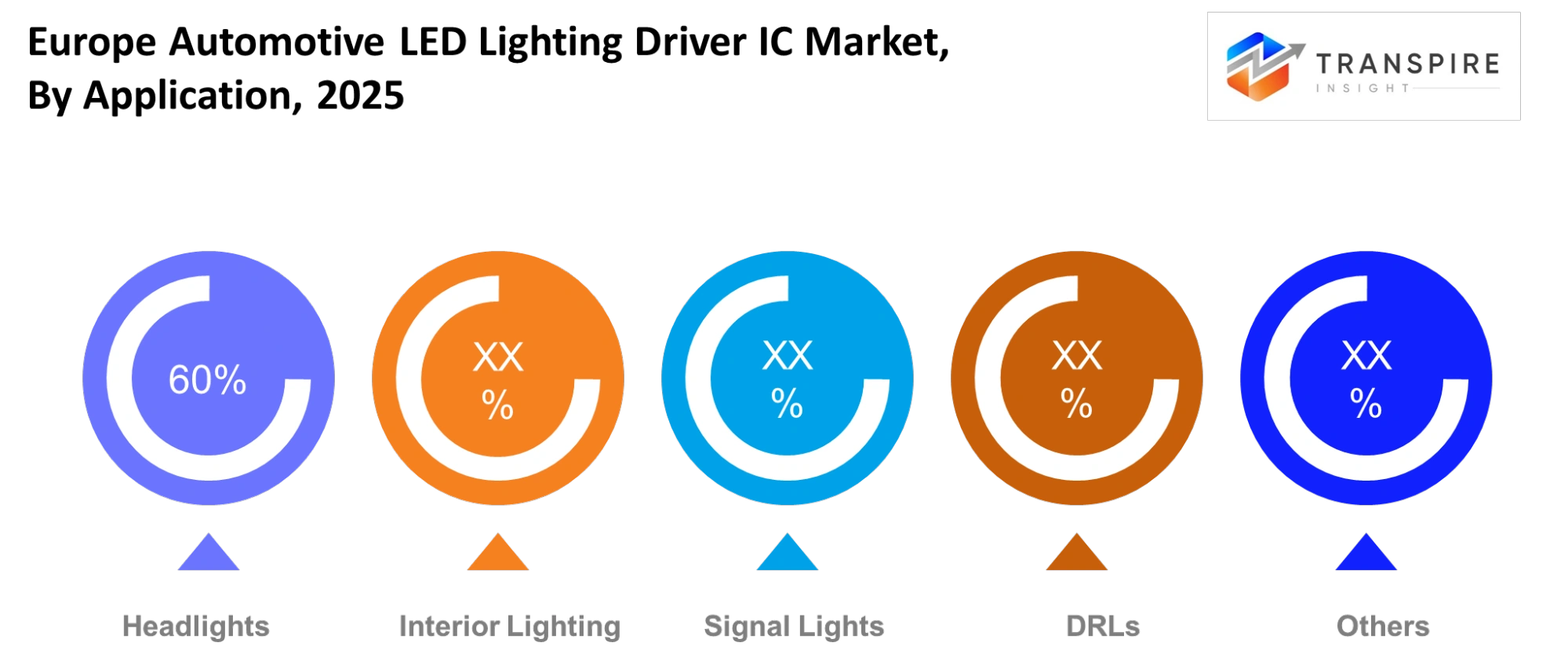
The strict safety standards for headlights together with the development of adaptive lighting systems which enhance visibility while decreasing glare make headlights the most important component for all applications. The market for signal lights and daytime running lights remains stable because these products are required by regulations which apply to all types of vehicles.
Automakers have started to use interior lighting because they want to create better cabin experiences while using ambient lighting systems to establish their brand identity. The different applications show different patterns of demand because exterior lighting needs to meet legal requirements while delivering performance value and modern design trends and user needs drive interior lighting usage. The upcoming market expansion will center around intelligent headlight systems and user-controlled interior lighting solutions which need driver integrated circuits that enable active power management and complete vehicle system compatibility.
To learn more about this report, Download Free Sample Report
By End-User
The automotive sector dominates the market because manufacturers control all aspects of vehicle design together with their control over platform-level lighting system specifications. The Driver Integrated Circuits Driver ICs Together with Driver Integrated Circuits Driver ICs Maintain Their Functioning. Electronics firms develop specialized integrated circuit designs which drive performance improvements while reducing product sizes through their innovation efforts.
The Demand behavior exhibits different patterns which show that automakers pursue unique product features together with regulatory compliance while Tier 1 suppliers concentrate on achieving cost savings and operational growth. The segment is moving toward deeper collaboration across the value chain, where co-development models and long-term supply agreements will shape procurement strategies and influence technology adoption.
By Technology
Through technology advancements, analog integrated circuits maintain their market share in fundamental lighting applications because they offer both dependable performance and lower operational costs. Digital integrated circuits now reach more markets because they provide users with the ability to design custom functions which work better with automobile control systems. The smart integrated circuit market is expanding at the highest rate because advanced vehicle systems require lighting systems which can adapt and perform diagnostics and transmit data.
The various technology levels of this system demonstrate different degrees of vehicle advancement, which use analog technology for basic vehicle functions and smart integrated circuits to improve premium and electric vehicle systems. The future will bring a gradual shift towards software-controlled lighting systems, which will use smart integrated circuits to provide users with both instantaneous system adjustments and advanced forecasting functions, driving manufacturers to invest in developing new control methods and system integration solutions.
What are the Key Use Cases Driving the Europe Automotive LED Lighting Driver IC Market?
The main application of the system operates with passenger vehicles through adaptive headlights, which use driver ICs to manage multiple LED channels for beam shaping and glare elimination. The need for this solution arises from European safety regulations and premium vehicle differentiation because precise light control enhances night visibility while enabling advanced driver assistance systems to function.
Automakers and Tier 1 suppliers increasingly adopt ambient interior lighting and dynamic signal systems to improve vehicle communication and cabin experience. The system enables electric vehicle platforms to manage energy consumption while providing flexible lighting solutions that help vehicles establish their unique brand identities.
The new use cases demonstrate software-defined lighting systems and projection-based systems, which project road surface warnings and navigation cues to users. The high-end vehicle market has started to adopt these systems, which will expand as regulatory frameworks progress and central programmable vehicle electronics systems become standard.
|
Report Metrics |
Details |
|
Market size value in 2025 |
USD 3.63 Billion |
|
Market size value in 2026 |
USD 3.78 Billion |
|
Revenue forecast in 2033 |
USD 5.06 Billion |
|
Growth rate |
CAGR of 4.25% from 2026 to 2033 |
|
Base year |
2025 |
|
Historical data |
2021 - 2024 |
|
Forecast period |
2026 - 2033 |
|
Report coverage |
Revenue forecast, competitive landscape, growth factors, and trends |
|
Regional scope |
Europe (Germany, United Kingdom, France, Italy, Spain and Rest of Europe) |
|
Key company profiled |
NXP, Infineon, STMicroelectronics, Texas Instruments, ON Semiconductor, Analog Devices, Renesas, Rohm, Microchip, Maxim Integrated, Broadcom, Qualcomm, Toshiba, Samsung, MediaTek |
|
Customization scope |
Free report customization (country, regional & segment scope). Avail customized purchase options to meet your exact research needs. |
|
Report Segmentation |
By Type (Constant Current Drivers, Constant Voltage Drivers, Matrix Drivers, Others), By Application (Headlights, Interior Lighting, Signal Lights, DRLs, Others), By End-User (Automakers, Tier 1 Suppliers, Electronics Firms, Others), By Technology (Analog IC, Digital IC, Smart IC, Others) |
Which Regions are Driving the Europe Automotive LED Lighting Driver IC Market Growth?
Western Europe dominates the automotive market because its robust vehicle manufacturing industry combined with its vehicle safety rules requires advanced lighting solutions. The high compliance standards in Germany and France compel car manufacturers to use adaptive LED systems in their vehicles. The existing ecosystem that includes original equipment manufacturers, Tier 1 suppliers, and semiconductor companies enables fast development and implementation of driver IC products. The integrated value chain enables continuous enhancements of lighting capabilities while the organization maintains its dominance in the regional market.
Central and Eastern Europe represent the second major region which offers cost-effective manufacturing operations together with continuous production expansion. The region attracts foreign investments because international car manufacturers establish assembly plants to decrease operational expenses. The development of contemporary lighting technologies occurs through regulatory practices that match European Union regulations, which permit uninterrupted implementation of new technologies without sudden alterations. The region functions as a dependable source of automotive components while providing manufacturing support for the entire European automotive market.
Southern Europe now stands as the fastest-growing area because electric vehicle production investments and government incentives create favorable conditions for development. The automotive modernization programs of Spain and Italy have gained momentum since 2022, which leads to the establishment of new vehicle development platforms. The increasing adoption of electric vehicles creates a greater demand for energy-efficient driver ICs which power interconnected lighting systems. The current growth leads to new market entry possibilities for vendors, while investors can expect substantial expansion between 2026 and 2033.
Who are the Key Players in the Europe Automotive LED Lighting Driver IC Market and How Do They Compete?
The Europe Automotive LED Lighting Driver IC Market features a competitive environment that displays moderate consolidation because multiple semiconductor companies dominate the market through their ownership of substantial automotive-approved product inventory. Automotive manufacturers and Tier 1 suppliers maintain deep relationships with incumbent companies, which helps these companies maintain their market positions while smaller companies struggle to achieve automotive certification and reliability requirements. Technology innovation forms the primary basis of competition because companies compete to achieve better integration and thermal performance and functional safety compliance. Buyers still consider cost as an important factor but they prefer to choose products which provide long-term reliability and system compatibility instead of products which offer short-term price benefits.
Infineon Technologies develops high-reliability automotive ICs which maintain functional safety features that meet ISO 26262 standards for premium vehicle platforms. The company distinguishes itself from competitors through its capability to provide complete system integration which enables its products to endure multiple years without needing design alterations that would impact original equipment manufacturers. STMicroelectronics creates energy-efficient products through its design methods which enable compact solutions, allowing car manufacturers to decrease energy use while achieving optimal lighting outcomes. The two companies establish growth through their collaboration with European automakers, which enables them to develop solutions during the initial stages of vehicle development.
NXP Semiconductors uses its expertise in vehicle networking and control systems to create driver ICs, which work together with complete electronic system designs. Texas Instruments uses its extensive analog product lineup and dependable manufacturing capabilities to compete in the automotive market, which demands high production output. onsemi develops advanced sensing and lighting solutions through its creation of driver ICs and imaging technologies, which enable adaptive and intelligent lighting systems to function. The different companies expand their operations through platform-level collaborations which take place at the business unit level.
Company List
- NXP
- Infineon
- STMicroelectronics
- Texas Instruments
- ON Semiconductor
- Analog Devices
- Renesas
- Rohm
- Microchip
- Maxim Integrate
- Broadcom
- Qualcomm
- Toshiba
- Samsung
- MediaTek
Recent Development News
In April 2026, Texas Instruments forecasts strong Q2 on rising chip demand: U.S.-based analog semiconductor leader Texas Instruments projected better-than-expected quarterly revenue, driven by rising demand for chips used in industrial and automotive applications, including LED driver ICs. This reflects strengthening supply conditions for automotive lighting electronics.
Source: https://www.reuters.com
In April 2026, STMicroelectronics beats Q1 expectations on automotive chip rebound: European semiconductor firm STMicroelectronics reported stronger-than-expected Q1 2026 results, driven by recovering automotive chip demand. The rebound directly supports growth in automotive LED driver ICs used in advanced lighting systems.
Source: https://www.reuters.com
What Strategic Insights Define the Future of the Europe Automotive LED Lighting Driver IC Market?
The Europe Automotive LED Lighting Driver IC Market is structurally moving toward software-defined lighting systems integrated within centralized vehicle architectures over the next 5–7 years. The transition occurs because electric and autonomous platforms make lighting function as part of a digital control system instead of operating as a separate feature. The demand for programmable driver integrated circuits will increase because original equipment manufacturers need to merge their electronic control units into single units which require real-time adaptability capabilities and over-their-air software updates.
A less visible risk lies in growing platform standardization by large automakers, which can reduce supplier diversity and concentrate purchasing power among a few semiconductor vendors. The market forces will make it difficult for smaller companies to compete because they have to navigate these challenges which will reduce their profits while demand for their products remains high.
The sector now has an emerging opportunity through vehicle-to-environment lighting communication which enables projection-based systems to connect with pedestrians and infrastructure elements throughout urban areas in Europe. Future market competitiveness depends on software development and system-level partnerships because companies must create integrated lighting systems that support ongoing product updates.
Europe Automotive LED Lighting Driver IC Market Report Segmentation
By Type
- Constant Current Drivers
- Constant Voltage Drivers
- Matrix Driver
- Others
By Application
- Headlights
- Interior Lighting
- Signal Lights
- DRLs
- Others
By End-User
- Automakers
- Tier 1 Suppliers
- Electronics Firms
- Others
By Technology
- Analog IC
- Digital IC
- Smart IC
- Others
Frequently Asked Questions
Find quick answers to common questions.
The approximate Europe Automotive LED Lighting Driver IC Market size for the market will be USD 5.06 Billion in 2033.
The key segments of the Europe Automotive LED Lighting Driver IC Market are By Type (Constant Current Drivers, Constant Voltage Drivers, Matrix Drivers, Others), By Application (Headlights, Interior Lighting, Signal Lights, DRLs, Others), By End-User (Automakers, Tier 1 Suppliers, Electronics Firms, Others), By Technology (Analog IC, Digital IC, Smart IC, Others).
Major players in the Europe Automotive LED Lighting Driver IC Market are NXP, Infineon, STMicroelectronics, Texas Instruments, ON Semiconductor, Analog Devices, Renesas, Rohm, Microchip, Maxim Integrated, Broadcom, Qualcomm, Toshiba, Samsung, MediaTek.
The current market size of the Europe Automotive LED Lighting Driver IC Market is USD 3.63 Billion in 2025.
The Europe Automotive LED Lighting Driver IC Market CAGR is 4.25%.
- NXP
- Infineon
- STMicroelectronics
- Texas Instruments
- ON Semiconductor
- Analog Devices
- Renesas
- Rohm
- Microchip
- Maxim Integrate
- Broadcom
- Qualcomm
- Toshiba
- Samsung
- MediaTek
Recently Published Reports
-
Apr 2026
Fiber Optic Faceplates Market
Fiber Optic Faceplates Market Size, Share & Analysis Report By Type (< 300 mm2, 300-350 mm2, and > 350 mm2, By Application (Night Vision, Holographic Imaging, Medical, and Others), and Geography (North America, Europe, Asia-Pacific, Middle East and Africa, South and Central America), 2021 - 2031
-
Apr 2026
High Temperature Superconductors Market
High Temperature Superconductors Market Size, Share & Analysis Report By Type (1G HTS, and 2G HTS), By Application (Power Cable, Fault Current Limiter, and Transformer), and Geography (North America, Europe, Asia-Pacific, Middle East and Africa, South and Central America), 2021 - 2031
-
Apr 2026
Industrial Plugs and Socket Market
Industrial Plugs and Socket Market Size, Share & Analysis Report By Type (Industrial Plugs, Industrial Sockets), By Current (Up to 32 A, 32 to 125 A, Above 125 A), By Protection (Dustproof and Splash Proof, Waterproof, Explosion Proof), By End User (Heavy Industries, Oil and Gas, Chemicals and Pharmaceuticals, Power Generation, Others), and Geography (North America, Europe, Asia-Pacific, Middle East and Africa, South and Central America), 2021 - 2031
-
Apr 2026
InGaAs Avalanche Photodiodes Market
InGaAs Avalanche Photodiodes Market Size, Share & Analysis Report By Type (1100 - 1700 nm, and 1000 - 1600 nm), By Application (Missile Warning System, Muzzle Flash Detection, Wafer Defect Inspection, Laser Rangefinders, and Others), and Geography (North America, Europe, Asia-Pacific, Middle East and Africa, South and Central America), 2021 - 2031