Market Summary
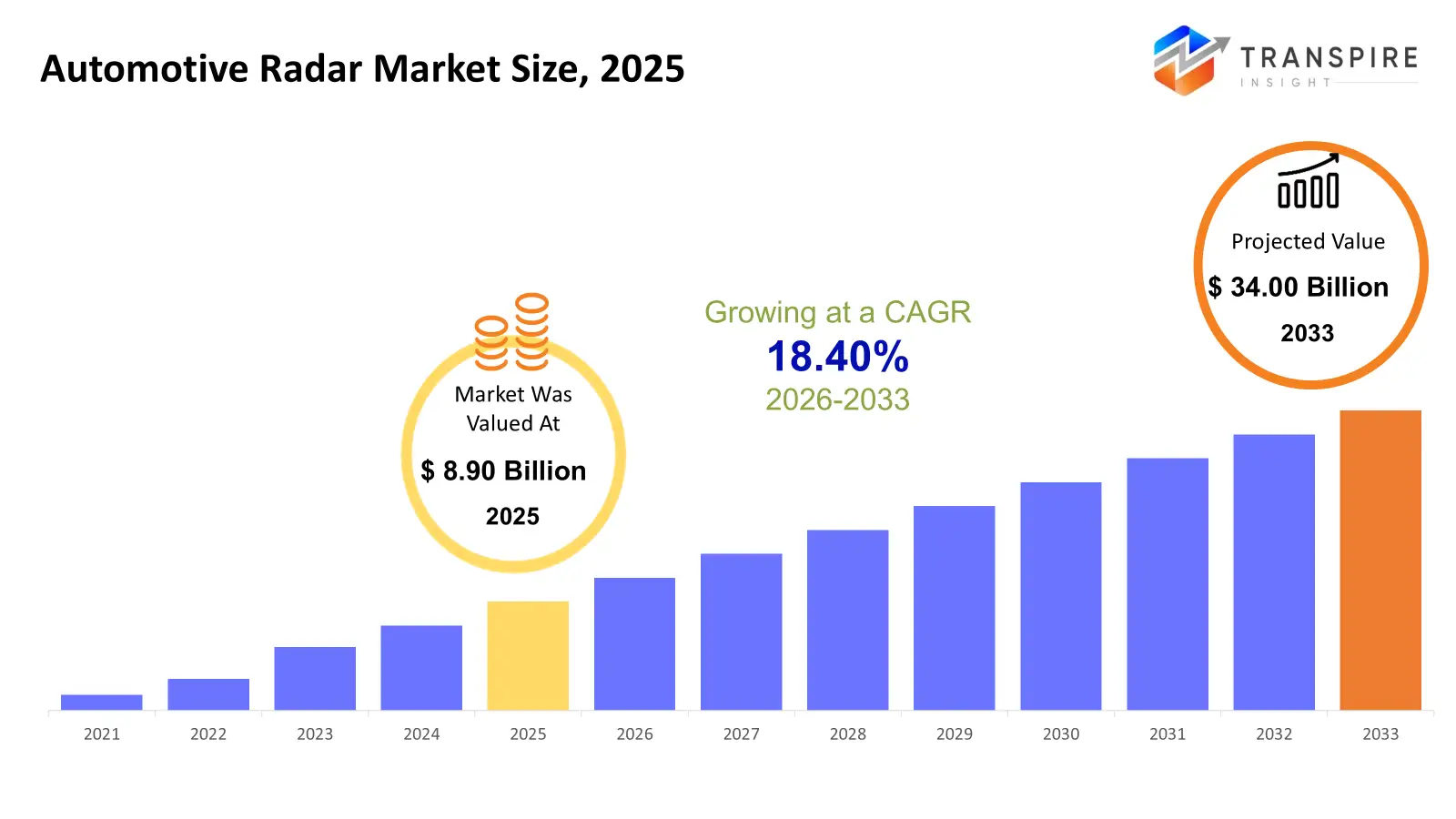
The global Automotive Radar market size was valued at USD 8.90 billion in 2025 and is projected to reach USD 34.00 billion by 2033, growing at a CAGR of 18.40% from 2026 to 2033. Fueled by a surge in high-tech driving aids, the car radar sector sees big expansion ahead. Because more drivers want protection on roads, tools like crash warnings are gaining popularity. Safety rules from authorities across nations now require gear, including smart speed adjustment, plus systems that stop crashes fast. These functions work mainly through radar tech built into vehicles.
Market Size & Forecast
- 2025 Market Size: USD 8.90 Billion
- 2033 Projected Market Size: USD 34.00 Billion
- CAGR (2026-2033): 18.40%
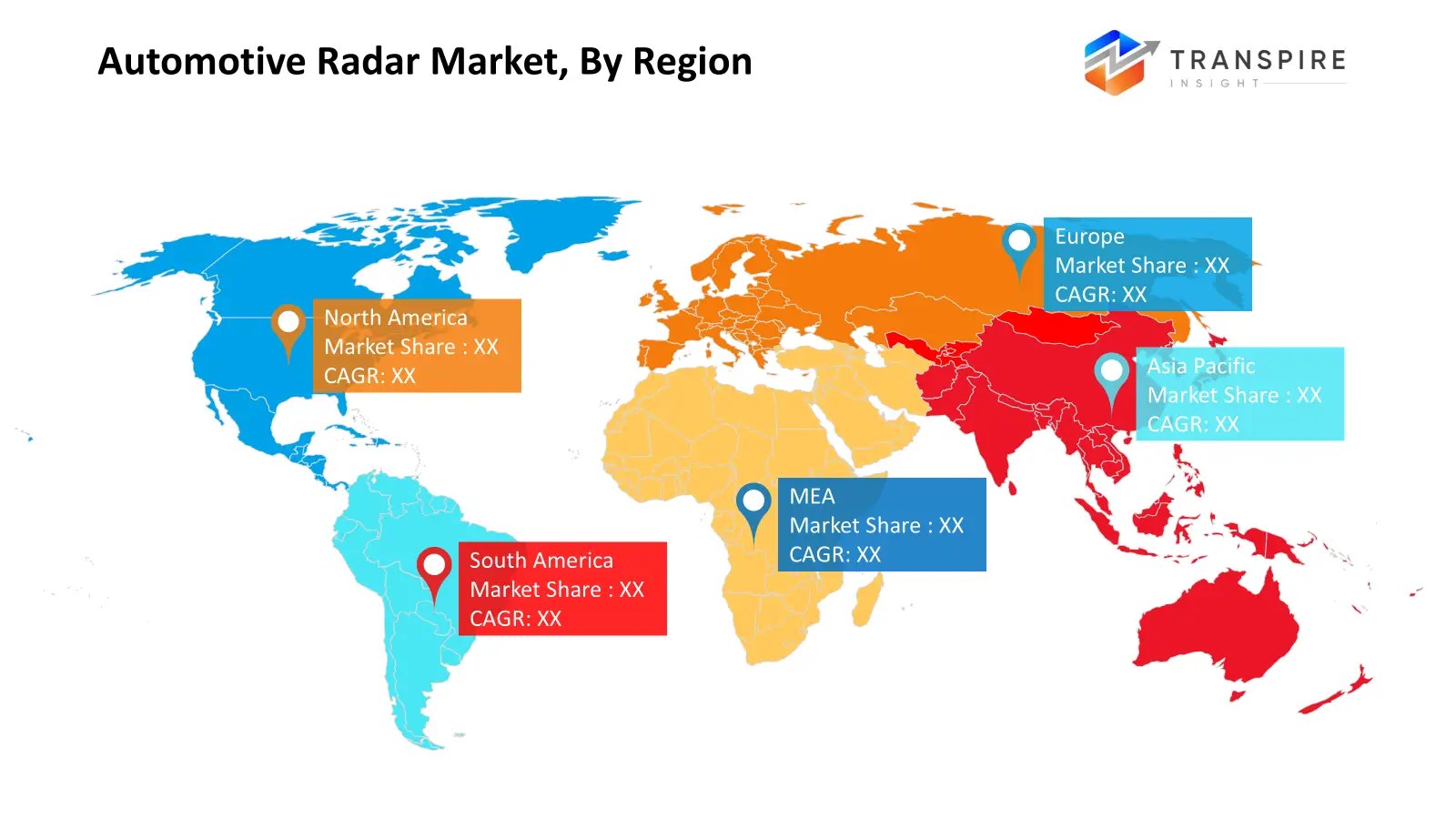
- North America: Largest Market in 2026
- Asia Pacific: Fastest Growing Market
To learn more about this report,  Download Free Sample Report
Key Market Trends Analysis
- The North American market share is estimated to be approximately 30% in 2026. Fueled by strict safety rules, North America sees more drivers using ADAS features every year. What pushes this shift is not just policy - carmakers are building smarter vehicles as standard. Behind the scenes, rising demand meets faster innovation. Still, progress ties closely to how quickly new models roll out across markets. Each step forward links to both consumer habits and industry movement.
- Fueled by advanced car tech, the United States drives regional expansion. Vehicle radar is common here because buyers want protection on roads. Innovation in autos moves fast, pushed by market needs.
- Fueled by surging car output, new demand for smarter and safer rides pops up across the Asia Pacific. Vehicle tech shifts gain ground here faster than elsewhere on Earth. Electrified models roll out at a pace few regions match.
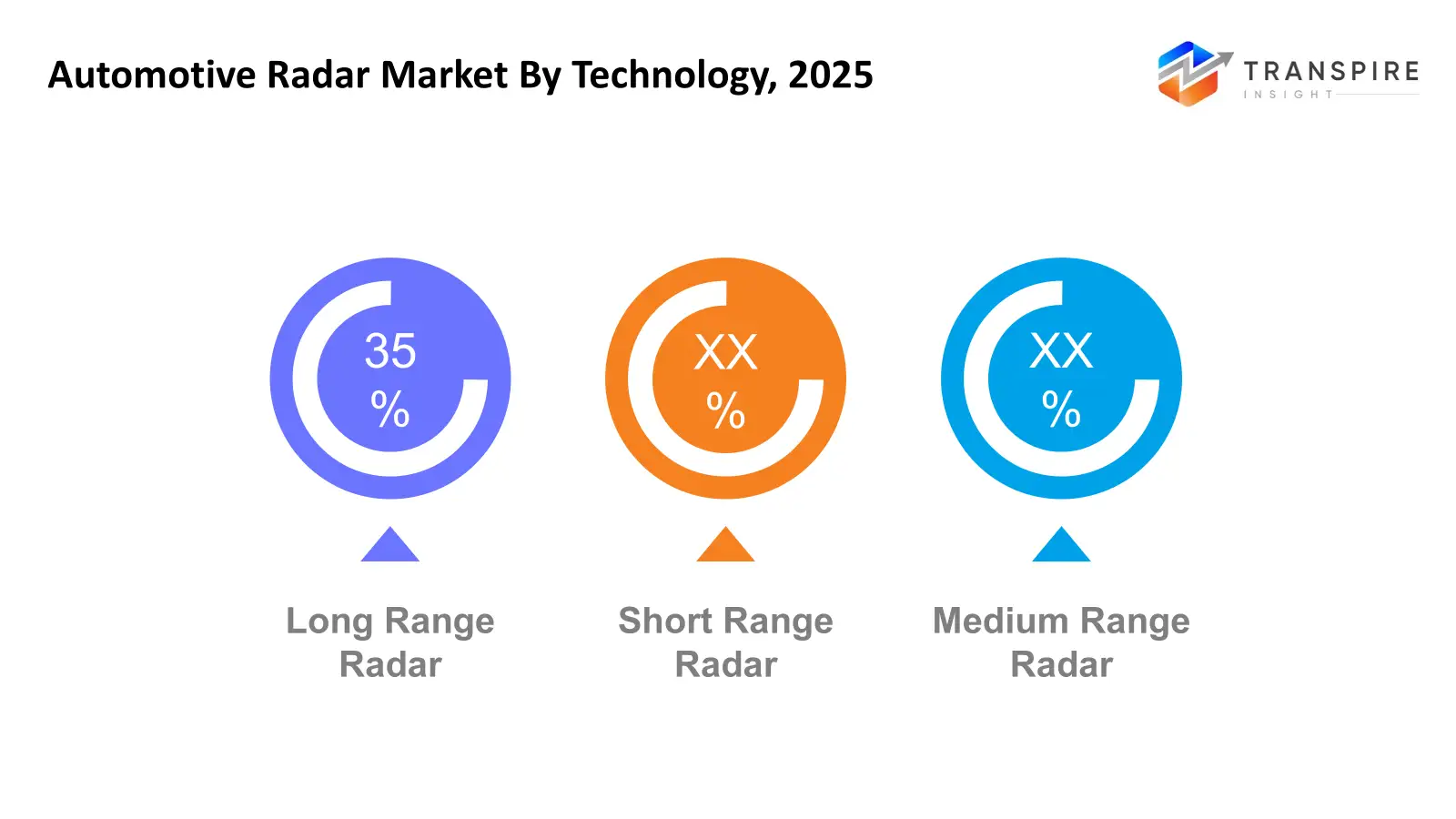
- Long-Range Radar shares approximately 35% in 2026. Fueled by rising need, long-range radar takes the lead - adaptive cruise control drives its expansion. Modern safety setups increasingly rely on it, especially where forward collision alerts matter most.
- Faster than most, 77 GHz radar stands out due to sharper detection and longer reach when used in high-level driver aids or self-driving systems. Though newer options exist, this frequency moves ahead because it sees farther and spots details better. While others struggle in tough conditions, here precision improves alongside distance covered. Because demands grow for reliable sensing, many now lean on this band for serious autonomy tasks.
- Most cars on the road now come with radar safety tech built in. Because these features are showing up even in basic models, more people are buying them. This shift pushes the overall need higher. Demand grows quietly through everyday choices at dealerships.
- Few things beat the ease of maintaining speed automatically, especially now that most cars come ready with this feature. What happens is simple: your car adjusts pace without you touching the pedal, just by reading traffic ahead. Still, it's not magic, merely smart sensors doing steady work behind the scenes. Over time, more drivers rely on it simply because stopping and starting feels less tiring. Even so, some remain unsure whether they trust machines to judge distance correctly. Yet automakers keep fitting them, knowing buyers expect help staying safe and relaxed.
From quiet highways to busy city streets, radar technology helps vehicles detect their surroundings without relying solely on cameras or human vision. Instead of simply reacting, modern vehicles anticipate movement by sending out signals that reflect off nearby objects. Because safety remains a top priority, these systems operate continuously throughout every journey, even when poor weather conditions limit visibility. With the rapid evolution of advanced driver assistance systems, radars have become central to crash-avoidance technologies—fueling strong growth in the automotive radar market. What once seemed like futuristic innovation now works quietly in the background, guiding drivers through increasingly complex driving environments.
Fewer people now accept risks on the road, so tools like smart speed adjustment have become common. Cars spot movement beside them using hidden signals that work even when it rains or gets dark. Instead of just one, machines inside keep track from several spots around the body. These helpers respond before a problem becomes serious, cutting stops suddenly without warning. Because drivers rely more on constant alerts, makers install extra units by default. Not every upgrade looks different, yet each improves how fast decisions happen. Safety once meant seatbelts only; today circuits predict trouble nearby. Even budget models carry gear that maps space all around. As habits shift further, radar parts move from rare to routine.
Nowhere else do sensors play such a critical role as they do when vehicles begin steering themselves. Instead of relying on just one type of detection, automakers combine radar with camera inputs for broader awareness. Even during heavy downpours or thick fog, these radio wave detectors keep performing without faltering. While light-based tools struggle in poor weather, radar pushes through unseen barriers. Through constant measurement of distance and speed, it sharpens how cars respond to nearby obstacles. Without this layer of perception, safe navigation would be far less reliable.
New strides in radar frequencies, how signals get handled, and then shrunk down, keep pushing the market forward. Instead of just bigger systems, companies now build sharper imaging radars that also take up less space, all without raising prices too much. With cars becoming more linked and able to drive themselves, radar sticks around as a key piece under the hood. Safety and smart movement on roads depend heavily on these quiet upgrades happening behind the scenes.
Automotive Radar Market Segmentation
By Range
- Short-Range Radar
Close by sensing happens with Short-Range Radar. This kind works inside vehicles when watching nearby zones. Parking help uses it often. So does checking areas drivers cannot easily see. Detection stays limited to small distances on purpose.
- Medium-Range Radar
Ahead of tight corners, medium-range radar keeps watch. It helps vehicles shift lanes safely while spotting traffic crossing nearby. Coverage reaches a fair stretch, not too far. Alerts come through when movement appears at the sides. This system works without needing long-distance vision.
- Long-Range Radar
High up ahead, a vehicle adjusts its speed automatically thanks to long-range radar. This system keeps watch far down the road, spotting cars ahead even at fast speeds. Instead of guessing, it uses precise signals to judge distance and movement. Alerts pop up if a possible crash looms into view. Cruise control turns smarter by reacting in real time.
To learn more about this report, Download Free Sample Report
By Frequency Band
- 24Ghz
Starting at 24 GHz, older radar setups rely on it because sensing stays affordable. Though limited in range, this band still appears where budget matters most.
- 77 GHz
Frequency at 77 gigahertz shows up often in modern driver assistance systems because it spots things better. Detection reaches farther when this band is used, making responses more precise. Systems rely on it since small details stay clear even at a distance.
- 79 GHz
With 79 GHz, details become clearer. Better separation of nearby objects happens here. Advanced safety setups rely on this precision. Clarity improves when signals operate at this frequency.
By Vehicle Type
- Passenger Vehicles
Cars are seeing wider use thanks to more built-in driver aids that help avoid crashes. New models now come with tools that watch the road constantly, reducing mistakes behind the wheel.
- Commercial Vehicles
Increasing deployment to enhance fleet safety and collision prevention.
By Application
- Adaptive Cruise Control
Starting down the road, a sensor up front keeps tabs on traffic moving ahead. Instead of needing constant driver adjustments, this system smoothly manages speed changes. When cars in front slow, it eases pressure on the throttle. If they pull away, acceleration resumes without input. Long-range detection allows early response before sudden shifts occur. Distance stays steady even when flow varies across lanes.
- Autonomous Emergency Braking
A sudden stop might save your day if something blocks the road ahead. Sensors watch nonstop, ready to react faster than a person can move. When danger shows up, brakes trigger without waiting for human hands. This system works silently, cutting risk before most notice a threat.
- Blind Spot Detection
A car's blind spot detection keeps watch beside it. When a vehicle enters that hidden zone, warnings appear. This system uses sensors instead of eyes. Alerts come if something moves nearby while changing lanes. It helps avoid collisions during lane shifts. Warnings stop once the path clears.
- Parking Assistance
Getting into snug spots becomes easier when sensors help guide the car. These small tools watch nearby obstacles during slow moves. They work best where space feels limited. Drivers gain extra awareness without reaching out. Close calls drop because alerts come early. Tech steps in right when the room runs low. Feedback appears just before contact might happen.
- Forward Collision Warning Systems
A sudden beep might sound if danger looms ahead on the road. When cars get too close, a warning appears to prompt attention. Sometimes, lights flash seconds before impact becomes likely. Sensors watch the distance, so reaction time improves slightly. A voice could say “slow down” when stopping is not fast enough. Danger zones up front trigger alerts without waiting. These signals help avoid crashes during busy commutes.
Regional Insights
A fresh wave of activity sweeps through the Asia Pacific when it comes to car radar tech, thanks largely to soaring output on factory floors. Safety matters more now to buyers, which pushes makers to add advanced driver aids into new models. Instead of trailing behind, nations such as China, Japan, South Korea, and India take bold steps forward, fueled by a surge in smart and electric cars rolling off assembly lines. Behind the scenes, funding flows into research while regulations tighten around crash prevention tools. With officials pushing harder for fewer accidents, automakers find themselves folding radar systems into designs faster than before.
Early embrace of smart safety tech helps North America take a big slice of the worldwide car radar scene. In the United States, drivers want features like self-adjusting speed controls, alerts for hidden lane traffic, and crash warning tools, fueling steady growth. Rules that back safer cars, paired with deep research efforts in auto innovation, keep pushing radar into both personal and work-use vehicles. Growth rolls on, driven by rules and know-how woven into how vehicles are built today.
Not far behind, Europe adds a steady push for tighter safety rules help, so do buyer choices leaning toward smarter car tech, especially in pricier models. Momentum shifts differently across Latin America and parts of the Middle East plus Africa; slow but clear movement follows higher car sales and more driver-assist systems showing up in everyday vehicles. Growth sneaks in where roads improve, and people start seeing value in staying safer on the move. Over time, these areas could shape a bigger piece of demand as conditions catch up.
To learn more about this report, Download Free Sample Report
Recent Development News
- May 28, 2025 – Mobileye Imaging Radar chosen by global automaker for eyes off driving.
- January 6, 2025 – Rogers Corporation launched new Thermoset Laminates for Automotive Radar Sensor Applications.
|
Report Metrics |
Details |
|
Market size value in 2025 |
USD 8.90 Billion |
|
Market size value in 2026 |
USD 10.40 Billion |
|
Revenue forecast in 2033 |
USD 34.00 Billion |
|
Growth rate |
CAGR of 18.40% from 2026 to 2033 |
|
Base year |
2025 |
|
Historical data |
2021 – 2024 |
|
Forecast period |
2026 – 2033 |
|
Report coverage |
Revenue forecast, competitive landscape, growth factors, and trends |
|
Regional scope |
North America; Europe; Asia Pacific; Latin America; Middle East & Africa |
|
Country scope |
United States; Canada; Mexico; United Kingdom; Germany; France; Italy; Spain; Denmark; Sweden; Norway; China; Japan; India; Australia; South Korea; Thailand; Brazil; Argentina; South Africa; Saudi Arabia; United Arab Emirates |
|
Key company profiled |
Bosch, Continental AG, Denso Corporation, ZF Friedrichshafen AG, Valeo, Autoliv, Hella, Aptiv, Panasonic, NXP Semiconductors, Analog Devices, Infineon Technologies, Texas Instruments, Robert Bosch LLC, Hyundai Mobis, Magna International, and Mobileye |
|
Customization scope |
Free report customization (country, regional & segment scope). Avail customized purchase options to meet your exact research needs. |
|
Report Segmentation |
By Range (Short-Range Radar, Medium Range Radar, Long-Range Radar), By Frequency Band (24GHz, 77GHz, 79GHz), By Vehicle Type (Passenger Vehicles, Commercial Vehicles), By Application (Adaptive Cruise Control, Autonomous Emergency Braking, Blind Spot Detection, Parking Assistance, Forward Collision Warning Systems) |
Key Automotive Radar Company Insights
Radar tech from Bosch powers many modern car safety features around the world. Their sensors drive functions like speed adjustment based on traffic, avoiding crashes, plus spotting vehicles outside your view. Precision matters here - so does dependability, along with keeping people safe. Across continents, teams work on refining these systems through constant research and testing. Innovation doesn’t stop; new versions aim to shape how cars move and respond in smart networks ahead.
Key Automotive Radar Companies:
- Bosch
- Continental AG
- Denso Corporation
- ZF Friedrichshafen AG
- Valeo
- Autoliv
- Hella
- Aptiv
- Panasonic
- NXP Semiconductors
- Analog Devices
- Infineon Technologies
- Texas Instruments
- Robert Bosch LLC
- Hyundai Mobis
- Magna International
- Mobileye
Global Automotive Radar Market Report Segmentation
By Range
- Short-Range Radar
- Medium Range Radar
- Long-Range Radar
By Frequency Band
- 24GHz
- 77GHz
- 79GHz
By Vehicle Type
- Passenger Vehicles
- Commercial Vehicles
By Application
- Adaptive Cruise Control
- Autonomous Emergency Braking
- Blind Spot Detection
- Parking Assistance
- Forward Collision Warning Systems
- Electronics & Semiconductors
Regional Outlook
- North America
- United States
- Canada
- Mexico
- Europe
- Germany
- United Kingdom
- France
- Spain
- Italy
- Rest of Europe
- Asia Pacific
- Japan
- China
- Australia & New Zealand
- South Korea
- India
- Rest of Asia Pacific
- South America
- Brazil
- Argentina
- Rest of South America
- Middle East & Africa
- Saudi Arabia
- United Arab Emirates
- South Africa
- Rest of the Middle East & Africa
Frequently Asked Questions
Find quick answers to common questions.
The approximate Automotive Radar Market size for the market will be USD 34.00 billion in 2033.
Key segments for the Automotive Radar Market are By Range (Short-Range Radar, Medium Range Radar, Long-Range Radar), By Frequency Band (24GHz, 77GHz, 79GHz), By Vehicle Type (Passenger Vehicles, Commercial Vehicles), By Application (Adaptive Cruise Control, Autonomous Emergency Braking, Blind Spot Detection, Parking Assistance, Forward Collision Warning Systems).
Major Automotive Radar Market players are Bosch, Continental AG, Denso Corporation, ZF Friedrichshafen AG, and Valeo.
The North America region is leading the Automotive Radar Market.
The Automotive Radar Market CAGR is 18.40%.
- Bosch
- Continental AG
- Denso Corporation
- ZF Friedrichshafen AG
- Valeo
- Autoliv
- Hella
- Aptiv
- Panasonic
- NXP Semiconductors
- Analog Devices
- Infineon Technologies
- Texas Instruments
- Robert Bosch LLC
- Hyundai Mobis
- Magna International
- Mobileye
Recently Published Reports
-
Apr 2026
ATV & UTV Market
ATV & UTV Market Size, Share & Analysis Report By Type (ATV, and UTV), By Variants (Less Than 400 CC, 400 CC To 800 CC, and More Than 800 CC), and Geography (North America, Europe, Asia-Pacific, Middle East and Africa, South and Central America), 2021 - 2031
-
Apr 2026
Automotive Central Gateway Module Market
Automotive Central Gateway Module Market Size, Share & Analysis Report By Type (Ethernet Central Gateway Module, CAN Central Gateway Module, LIN Central Gateway Module, and FlexRay), By Application (Powertrain Control, Body Control, Infotainment System, Advanced Driver Assistance Systems (ADAS), and Others), By End User (Passenger Vehicles, and Commercial Vehicles), and Geography (North America, Europe, Asia-Pacific, Middle East and Africa, South and Central America), 2021 - 2031
-
Apr 2026
Automotive Engine Oil Filter Market
Automotive Engine Oil Filter Market Size, Share & Analysis Report By Filter Type (Fuel Filter, Engine Oil Filter, Hydraulic Oil Filter, and Others), By Filter Media (Cellulose, Synthetic, and Micro), By Sales Channel (OEMs, and Aftermarket), By Vehicle Type (Passenger Cars, Light Commercial Vehicles, Heavy Duty Trucks, Buses and Coaches, and Off-road Vehicles), and Geography (North America, Europe, Asia-Pacific, Middle East and Africa, South and Central America), 2021 - 2031
-
Apr 2026
Automotive Parts Aluminium Die Casting Market
Automotive Parts Aluminium Die Casting Market Size, Share & Analysis Report By Production Process (Pressure Die Casting, Vacuum Die Casting, Squeeze Die Casting, Gravity Die Casting), By Application (Body Parts, Engine Parts, Transmission Parts, Battery And Related Components, Other Application Types), and Geography (North America, Europe, Asia-Pacific, Middle East and Africa, South and Central America), 2021 - 2031
Our Clients