
South Korea Variable Valve Timing Market Size & Forecast:
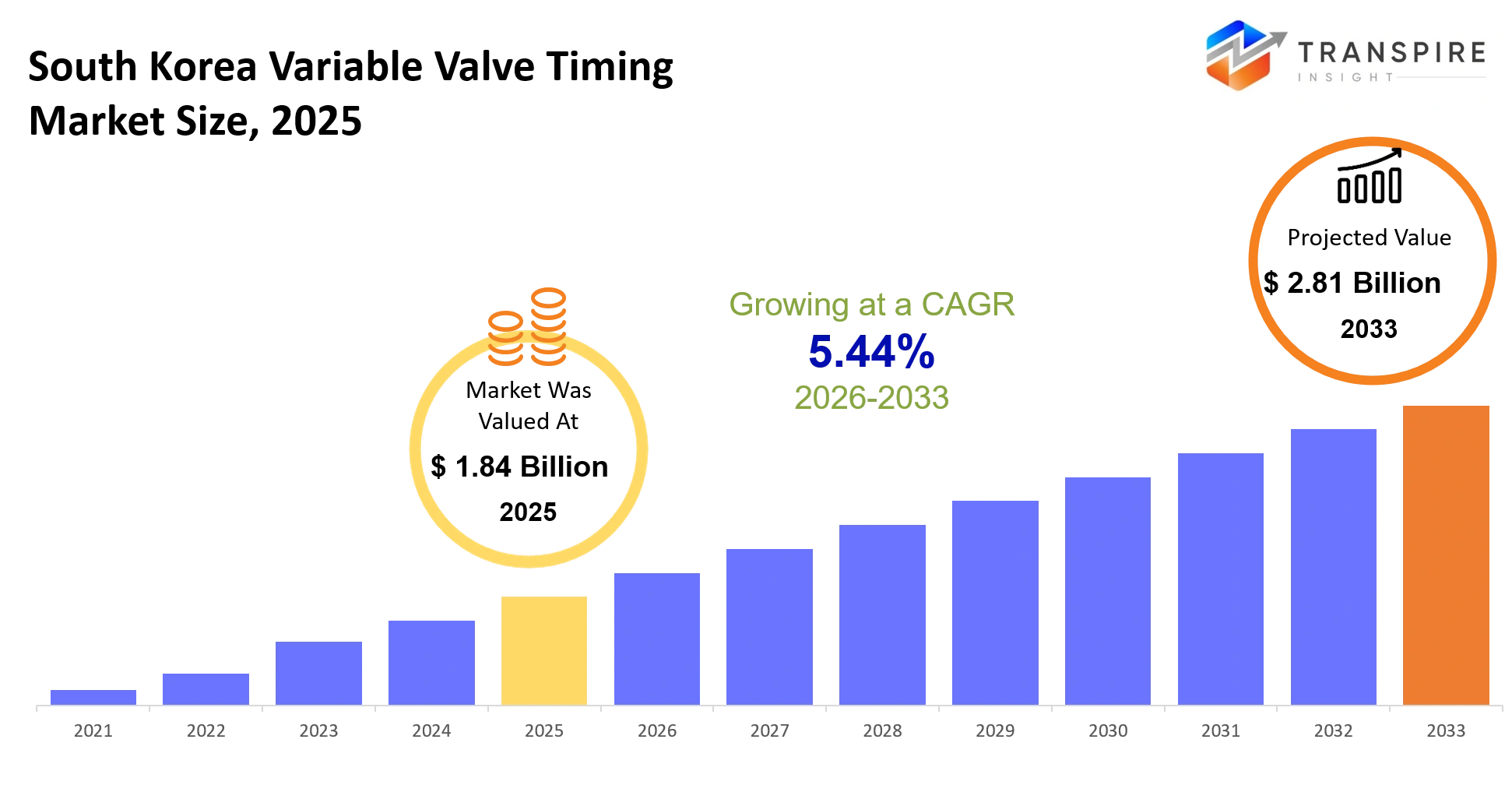
- South Korea Variable Valve Timing Market Size 2025: USD 1.84 Billion
- South Korea Variable Valve Timing Market Size 2033: USD 2.81 Billion
- South Korea Variable Valve Timing Market CAGR: 5.44%
- South Korea Variable Valve Timing Market Segments: By Technology (Cam Phasing Systems, Cam Changing Systems, Variable Valve Lift Systems, Electronic Valve Timing Systems, Others); By Vehicle Type (Passenger Vehicles, Commercial Vehicles, Hybrid Vehicles, Others); By Component (Hydraulic Actuators, Camshafts, Solenoids, Timing Controllers, Others); By Application (Fuel Efficiency Enhancement, Emission Reduction, Engine Performance Optimization, Others); By End User (Automotive OEMs, Aftermarket Suppliers, Fleet Operators, Others)
To learn more about this report,  Download Free Sample Report
South Korea Variable Valve Timing Market Summary
The South Korea Variable Valve Timing Market was valued at USD 1.84 billion in 2025. It is forecast to reach USD 2.81 billion by 2033. That is a CAGR of 5.44% over the period.
South Korea Variable Valve Timing, or VVT market, helps automakers improve how efficiently engines run, cut down on fuel use, and still satisfy tougher emissions rules without really taking away from vehicle performance. Basically, VVT systems change the valve timing depending on how the car is being driven. That lets manufacturers deliver stronger power output while staying aligned with regulatory standards. It feels like an even bigger deal now, because car buyers want both response and efficiency, not one or the other, from today’s vehicles.
In the last three to five years, there’s been a noticeable change in the way the market is structured , moving toward electronically managed and more tightly integrated valve timing approaches that also partner with hybrid powertrains. One of the main pushes behind this shift has been South Korea, and also major export regions, tightening both vehicle emission limits and fuel economy targets. So automakers are upgrading their engine base designs and extending service life of internal combustion, plus the hybrid segments. That means advanced VVT adoption keeps growing. As a result, the value of components per vehicle is moving up, and it opens fresh revenue lanes for technology suppliers as well as for automotive OEMs.
Key Market Insights
- The South Korea Variable Valve Timing Market is growing. Vehicle makers are focusing on fuel efficiency, lower emissions and improved engine performance in passenger and hybrid vehicles.
- Market growth will stay steady. This is because of electronic valve timing technologies and advanced powertrain solutions.
- The Seoul Capital Area leads the South Korea Variable Valve Timing Market. It has over 40% market share in 2025. Many automotive manufacturing and R&D facilities are there.
- The southeastern industrial region, including Ulsan and Busan is growing fast. Vehicle production is. Suppliers are investing.
- Demand for Variable Valve Timing Systems is linked to production. This helps component manufacturers.
- Cam Phasing Systems are leading with over 35% market share in 2025. Many modern vehicle engines use them.
- Variable Valve Lift Systems are the largest segment. They improve engine efficiency and driving performance.
- Electronic Valve Timing Systems will grow fastest from 2025 to 2030. Hybrid vehicle production is increasing.
- Fuel Efficiency Enhancement is the application. It has, over 45% of market demand in 2025.
- Emission Reduction is growing fast. Stricter environmental rules are pushing for engine technologies.
What are the Key Drivers, Restraints, and Opportunities in the South Korea Variable Valve Timing Market?
The strongest force pushing the South Korea Variable Valve Timing Market forward is basically the tightening of vehicle fuel economy and emissions regulations, across both local and export markets. South Korean automakers have to follow increasingly strict efficiency targets, but at the same time they still need to keep engine performance steady. Because of that kind of pressure, manufacturers have been more willing to move toward advanced variable valve timing arrangements that fine-tune combustion and make better use of fuel. This change seems even more important for hybrid vehicles, where engine efficiency stays a key consideration. And as automakers refresh their powertrain platforms to match the compliance demands, the amount of VVT parts installed per vehicle tends to rise, which feeds market revenue growth and also helps broader technology adoption.
The biggest stumbling block, though, is the longer term pivot toward battery electric vehicles, since BEVs do not really need conventional valve timing systems at all. This issue feels structural, not like a temporary mood of the market, because it comes from a real shift in vehicle design and not just short term buying patterns. Even if internal combustion and hybrid vehicles still represent most of today’s output, investments are increasingly being channeled into electrification efforts. So, some manufacturers might postpone major spending on next-generation VVT technologies, and that can slow down future market expansion, plus it can shrink the revenue prospects for component suppliers.
A major opportunity kinda lies in developing electronically controlled valve timing systems, for hybrid powertrains. South Korea has a really strong auto technology ecosystem and there is ongoing investment in intelligent vehicle platforms, so the conditions are pretty favorable for innovation. Like for example, advanced electronic valve control solutions can integrate with hybrid energy management systems, and in turn they can deliver better efficiency, and also lower emissions. Then as hybrid vehicle production keeps expanding over the coming years, the suppliers who provide these high-value technologies are likely to grab the next phase of market growth, before others.
What Has the Impact of Artificial Intelligence Been on the South Korea Variable Valve Timing Market?
Artificial intelligence along with advanced digital technologies are getting more and more important in the South Korea Variable Valve Timing Market, since automakers are pushing for higher engine efficiency, reduced emissions, and better powertrain reliability too. In practice, manufacturers are weaving AI-driven analytics into engine control units as well as calibration workflows, so valve timing can be nudged automatically according to driving conditions, engine load, and fuel use patterns. These systems keep on reading sensor signals, then they tweak valve behavior in real time, which lets engines chase stronger combustion efficiency and steadier performance overall.
On top of that, machine learning models are also being used for predictive maintenance across vehicle fleets and within manufacturing operations. When they examine information coming from actuators, solenoids, camshafts, and control modules, they can spot early cues of component wear. They may even anticipate likely failures before those issues show up in how the vehicle runs. This style of approach cuts down on surprise downtime, helps stretch the usable life of parts, and generally brings maintenance costs down. There are also AI-assisted simulation tools, those allow engineers to estimate emissions outcomes and refine engine designs before production starts, so development cycles get shorter, and it becomes easier to meet regulatory compliance requirements.
The operational upsides are pretty clear: better fuel economy, tighter emissions control, improved throttle response, and less money spent on warranty-related problems. Still, there is a big limitation that stays pretty stubborn, the integration cost is high when AI-enabled control systems have to fit with existing powertrain architectures. Plus, machine learning models tend to need huge amounts of solid operating data, so accuracy can drop when they are rolled out across different vehicle platforms, or under messy, real-world driving conditions.
Key Market Trends
- Korean car makers have been using more electronic systems to control the valves in their engines since 2020. This is because they have to meet rules about how much fuel their cars can use and how much bad stuff they can put into the air.
- Between 2021 and 2025 they started making a lot hybrid cars. This meant that the companies that supply them with parts had to make technologies to control the valves in the engines.
- Hyundai Mobis and other big companies like Denso and Bosch are spending money on new technologies to control the engines. They want to be better than their competitors at making cars that use fuel.
- Car makers are not just trying to make their engines as powerful as possible. Now they are trying to balance how powerful the engines are with how fuel they use and how much bad stuff they put into the air.
- After 2022 car makers started using computers to help them adjust the engines. This made it faster and more accurate to get the engines working right.
- There were some problems with getting parts in 2021 and 2022. So car makers are now trying to get more of their parts from companies.
- Car makers are putting the valve technologies into their hybrid cars. This makes the engines in these cars better than the engines in gasoline cars.
- The rules are not about making less bad stuff anymore. Now they are about making the car last longer and use less fuel over its lifetime. This means that car makers have to keep making their engines better.
- Since 2023 the companies that make the parts, for the cars have been working hard to make systems that can control the valves in the engines. These systems use software to make the valves work better.
- Now car makers are competing with each other to see who can make the best electronic systems to control their engines. They are not just trying to make the engines themselves but also the computers that control them.
South Korea Variable Valve Timing Market Segmentation
By Technology:
Cam Phasing Systems still hold a pretty strong position because engine manufacturers keep leaning into fuel efficiency, and also smoother engine operation, yeah. When they install them more widely across passenger vehicles, the adoption seems to stay steady. With better control over valve timing, manufacturers can line up with stricter emission targets more easily. Over time, the consistent use in modern engine platforms also helps the market presence, stay solid.
Cam Changing Systems are still a thing too, especially in uses that need flexible engine performance, across different operating conditions. Variable Valve Lift Systems get a lot of attention lately because they help improve combustion efficiency, and that can also boost power delivery. Electronic Valve Timing Systems keep expanding, since vehicle electronics keep getting more advanced. The Others category covers emerging and specialized technologies, built for specific engine needs, or at least tailored use cases.
There’s also a growing integration of electronic controls with engine management systems, which backs the move toward advanced valve timing solutions. Future technology upgrades will keep shaping purchasing choices among automotive manufacturers. Product development efforts keep focusing on better efficiency and regulatory compliance. And innovation, across every technology category, continues to support long term industry progress.
By Vehicle Type:
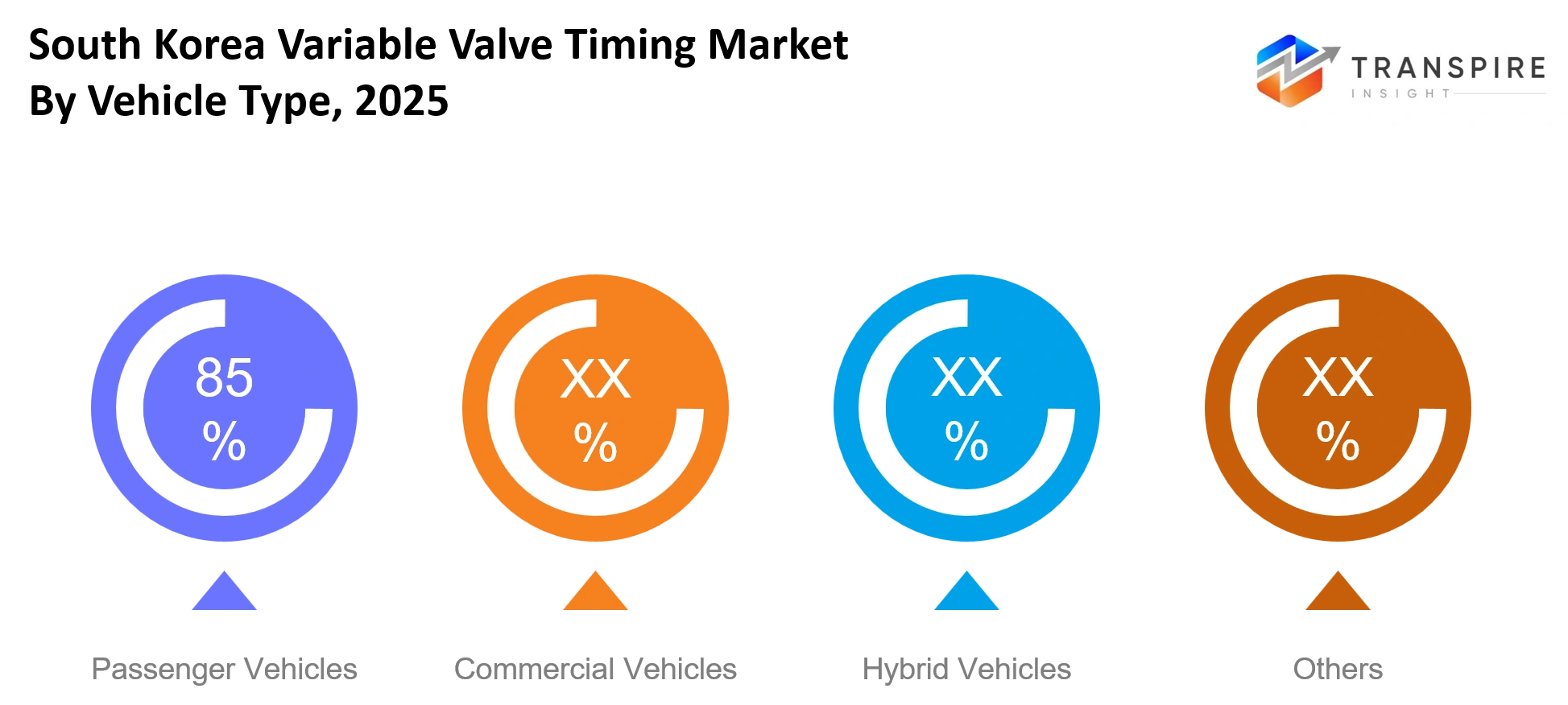
Passenger Vehicles make up a notable slice, mainly because production keeps running at scale and people are still buying fuel-efficient cars, so demand stays kind of constant. In response, manufacturers are installing advanced valve timing systems more often, as this helps nudge performance upward and also keep emissions lower, which sounds straightforward but it really matters. There’s also a consumer pull toward economical travel, that preference basically feeds the whole technology adoption cycle. Plus, every time there’s a new vehicle launch, this category gets a fresh boost, so the trend stays steady.
Commercial Vehicles also lean on valve timing solutions, not just for speed but for engine durability and everyday operational efficiency. Fleet operators tend to focus on trimming fuel costs, while still staying aligned with environmental compliance rules. Hybrid Vehicles are becoming a real growth thread too, since many automotive companies are broadening their electrified lineups. In these setups, advanced engine control technologies help the system run more efficiently inside hybrid powertrains, without the usual trade-offs.
For the Others category, it covers specialized vehicle applications, with more specific and sometimes very particular performance requirements. Vehicle manufacturers keep refining their engine systems to juggle efficiency and output in a balanced way. Regulatory expectations also nudge adoption across different classes of vehicles, not only the mainstream ones. And with continued investment in advanced mobility solutions, there are still future opportunities building up in the background.
To learn more about this report, Download Free Sample Report
By Component:
Hydraulic Actuators play a key role in helping adjust valve timing , and they support accurate engine operation overall. Reliable performance still matters a lot to manufacturers who want steady efficiency gains. Ongoing improvements in actuator design keep pushing faster responsiveness and smoother action. A strong pull for precise engineering also keeps boosting this segment.
Camshafts remain necessary components inside valve timing systems, and they directly shape overall engine performance. Solenoids assist with accurate control functions , and they also help valve operation stay efficient. Timing Controllers gain even more importance as electronic integration keeps spreading across modern vehicle platforms. With that, greater dependence on intelligent engine management systems helps fuel growth in advanced controller technologies.
The Others category basically covers supporting components that contribute to system functionality and durability. Manufacturers keep investing in higher-quality materials and refined designs . Better component reliability tends to lower maintenance needs. And across component categories, technological progress keeps backing long-term development.
By Application:
Fuel Efficiency Enhancement still counts as a major application area, mainly because vehicle manufacturers look for practical ways to trim fuel usage. Optimized valve timing, sort of helps steer combustion along better too, and that supports improved engine efficiency in general. There are also cost savings and regulatory compliance, and those two things make adoption keep going. Overall demand feels tightly tied to fuel economy targets.
Emission Reduction is another big application space as environmental rules get more strict over time. With advanced valve timing technologies, engines can reduce harmful exhaust outputs while staying effective. Engine Performance Optimization continues to grab attention from manufacturers who want to balance efficiency with power delivery. Better responsiveness and smoother operation, help adoption spread across several vehicle categories.
The Others category kind of covers more specialized applications, built around unusual operational requirements. Research and development keeps generating new performance opportunities and improvements. Manufacturers keep aiming for measurable operational benefits via technology upgrades. This kind of application diversity backs wider industry utilization.
By End User:
Automotive OEMs are really the biggest end user chunk, mostly because vehicle makers fold valve timing technologies straight into brand new vehicle builds. In other words, product quality, efficiency goals, and also regulatory requirements , all of that ends up shaping what gets purchased. Long term supply arrangements help keep demand patterns steady, not wild. And of course, ongoing innovation tends to push adoption of more advanced solutions, you know, bit by bit.
Aftermarket suppliers also matter a lot, since they handle replacement components plus maintenance support. Fleet operators are increasingly checking out approaches that help lower operating costs, and at the same time improve vehicle efficiency. For commercial transport work, solid engine performance is still a top priority. Then maintenance needs keep showing up, so it creates ongoing chances inside the aftermarket segment too.
The others group covers specialized users, people with particular operational expectations. Industry players keep leaning toward efficiency, durability, and compliance targets. When companies invest in advanced engine technologies it supports future growth chances. And strong teamwork across the automotive value chain will keep helping the market keep developing.
What are the Key Use Cases Driving the South Korea Variable Valve Timing Market?
The main reason people are buying into the South Korea Variable Valve Timing Market is basically to boost fuel efficiency in passenger vehicles. Automotive makers, you know, rely on advanced valve timing techniques to fine tune combustion and cut fuel use while still keeping engine output stable. In practice this is where demand is strongest, because fuel economy rules keep getting tighter in both the local market and overseas.
And yeah, it’s not only about fuel economy. Variable valve timing setups are being pushed more and more to lower tailpipe emissions and make the engine feel more responsive. Hybrid manufacturers are also moving fast here, combining these systems so the internal combustion unit can work smarter together with electric powertrains. On top of that, commercial operators gain from better engine control, which tends to reduce operating expenses and helps them stay on track with environmental compliance requirements.
Looking ahead, some newer angles are showing up. For example, advanced electronic valve timing systems are starting to be paired with intelligent engine management platforms. Automakers are testing software-driven control methods that change valve behavior in real time according to road and driving conditions. These efforts are still somewhat early, but they look promising as connected features and hybrid vehicle systems get more sophisticated over the forecast period.
|
Report Metrics |
Details |
|
Market size value in 2025 |
USD 1.84 Billion |
|
Market size value in 2026 |
USD 1.94Billion |
|
Revenue forecast in 2033 |
USD 2.81 Billion |
|
Growth rate |
CAGR of 5.44% from 2026 to 2033 |
|
Base year |
2025 |
|
Historical data |
2021 - 2024 |
|
Forecast period |
2026 - 2033 |
|
Report coverage |
Revenue forecast, competitive landscape, growth factors, and trends |
|
Regional scope |
South Korea |
|
Key company profiled |
Hyundai Mobis, Denso, Bosch, Continental AG, Aisin Corporation, BorgWarner, Hitachi Astemo, Valeo, Schaeffler, Mitsubishi Electric, Mahle, Delphi Technologies, Eaton Corporation, Tenneco, Rheinmetall Automotive |
|
Customization scope |
Free report customization (country, regional & segment scope). Avail customized purchase options to meet your exact research needs. |
|
Report Segmentation |
By Technology (Cam Phasing Systems, Cam Changing Systems, Variable Valve Lift Systems, Electronic Valve Timing Systems, Others); By Vehicle Type (Passenger Vehicles, Commercial Vehicles, Hybrid Vehicles, Others); By Component (Hydraulic Actuators, Camshafts, Solenoids, Timing Controllers, Others); By Application (Fuel Efficiency Enhancement, Emission Reduction, Engine Performance Optimization, Others); By End User (Automotive OEMs, Aftermarket Suppliers, Fleet Operators, Others) |
Which Regions are Driving the South Korea Variable Valve Timing Market Growth?
The Seoul Capital Area still stays the leading region in the South Korea Variable Valve Timing Market, mostly because automotive headquarters are concentrated there. You also have research centers plus advanced manufacturing facilities, so it feels like everything is kinda in one place. Big vehicle manufacturers and component suppliers keep solid engineering networks, and that basically helps continuous product development move along. In many cases, national emissions and fuel economy policies turn into real technology investments through these industrial clusters. There’s also a mature supplier ecosystem, a skilled workforce ,and strong testing capabilities, and that mix really helps keep the regional leadership going.
Meanwhile the southeastern industrial area, led by Ulsan and Busan, works as the second-largest contributor, even though the growth pattern is not the same. The strength there comes more from large-scale vehicle production and long-established manufacturing operations, rather than heavy research intensity. Automotive companies keep making consistent capital investments, and that supports stable demand for advanced engine technologies. On top of that, strong export activity and dependable industrial infrastructure make the region a steady source of market revenue, pretty reliably.
Then the central region is starting to look like the fastest-growing area, as automotive suppliers expand operations beyond the older manufacturing hubs. Lately, investments in smart manufacturing facilities and next-generation mobility projects have opened up new openings for advanced powertrain technologies. Also, more collaboration is forming between regional governments, universities, and automotive companies, which speeds up technology adoption. If this continues, it should generate interesting opportunities for suppliers, technology providers, and investors who are trying to expand between 2026 and 2033.
Who are the Key Players in the South Korea Variable Valve Timing Market and How Do They Compete?
Competition in the South Korea Variable Valve Timing Market is, kind of moderately consolidated, with global automotive tech suppliers going head to head alongside big domestic manufacturers. Most of the fight really happens on technology performance, especially the capability to boost fuel efficiency, cut emissions , and mesh well with hybrid powertrains. The older, established players tend to hold their ground using engineering know-how, long running OEM relationships and steady product enhancements. Meanwhile any new entrant runs into high barriers, because engine control systems need extensive testing, strict regulatory compliance and a very tight integration with the vehicle platform itself.
Hyundai Mobis leans hard on technology innovation , and it also benefits from very close collaboration with South Korean vehicle makers. That kind of link helps teams develop and validate advanced powertrain components at a faster pace, tuned for regional production expectations. Denso, on the other hand, differentiates itself with extremely accurate engine management technologies that help combustion stay efficient and emissions get better. Ongoing investment in electronic control systems keeps strengthening Denso’s position as automakers increase the adoption of intelligent powertrain solutions, more and more.
Bosch kinda competes by using advanced software integration, and electronic control stuff that boosts valve timing accuracy even when the driving conditions keep shifting. They keep expanding too, usually via partnerships and development programs that are aimed at connected as well as hybrid vehicle technologies. Then BorgWarner leans more into high efficiency powertrain solutions and they draw on know-how in engine optimization technologies, so automakers can handle tighter regulatory targets without losing too much ground. Hitachi Astemo differentiates itself with integrated vehicle control systems that merge engine control, electrification, and electronic technologies at the same time, and that basically opens up more opportunities as hybrid vehicle production grows across South Korea.
Company List
- Hyundai Mobis
- Denso
- Bosch
- Continental AG
- Aisin Corporation
- BorgWarner
- Hitachi Astemo
- Valeo
- Schaeffler
- Mitsubishi Electric
- Mahle
- Delphi Technologies
- Eaton Corporation
- Tenneco
- Rheinmetall Automotive
Recent Development News
In January 2026, Hyundai Mobis entered a partnership with Qualcomm Technologies. The companies signed a comprehensive agreement at CES 2026 to co-develop Software-Defined Vehicle (SDV) and Advanced Driver Assistance Systems (ADAS) solutions, strengthening advanced automotive electronics and control technologies for future vehicle platforms.
Source URL:https://www.mobis.com
In February 2025, Hitachi Astemo announced its corporate rebranding to Astemo, Ltd., effective April 2025. The move aligned the company’s electrification and intelligent mobility businesses under a unified identity, supporting future investment in advanced automotive technologies and powertrain systems.
Source URL:https://www.astemo.com
What Strategic Insights Define the Future of the South Korea Variable Valve Timing Market?
Over the next five to seven years, the South Korea Variable Valve Timing Market is likely to move toward more highly integrated electronic valve control architectures, that work smoothly with hybrid powertrains and also with intelligent engine management systems. The real driver behind this transition is basically the need to pull more efficiency out of internal combustion engines, while still backing electrification strategies. Instead of trying to mirror battery electric vehicle pathways directly, newer valve timing technologies will more and more show up as enabling parts inside hybrid platforms, and those platforms will remain relevant across many different vehicle segments.
There’s also a less obvious risk, the demand is getting more concentrated among a smaller group of major automotive manufacturers. If so, relying heavily on only a few OEMs could raise pricing pressure on suppliers, and it may reduce flexibility during production slowdowns or when platform changes happen. Still, there’s a counterbalancing opportunity taking shape around AI-assisted engine control systems, which can tune valve operation in real time to better efficiency and emissions outcomes.
For market participants, the practical priority should be to invest in software driven valve timing technologies, and to deepen partnerships with developers of hybrid vehicles. Firms that can blend mechanical know-how with advanced electronics and control software will generally have a stronger position, because powertrain technologies keep evolving year after year.
South Korea Variable Valve Timing Market Report Segmentation
By Technology
- Cam Phasing Systems
- Cam Changing Systems
- Variable Valve Lift Systems
- Electronic Valve Timing Systems
- Others
By Vehicle Type
- Passenger Vehicles
- Commercial Vehicles
- Hybrid Vehicles
- Others
By Component
- Hydraulic Actuators
- Camshafts
- Solenoids
- Timing Controllers
- Others
By Application
- Fuel Efficiency Enhancement
- Emission Reduction
- Engine Performance Optimization
- Others
By End User
- Automotive OEMs
- Aftermarket Suppliers
- Fleet Operators
- Others
Frequently Asked Questions
Find quick answers to common questions.
The expected South Korea Variable Valve Timing Market size for the market will be USD 2.81 Billion in 2033.
Key segments for the South Korea Variable Valve Timing Market are By Technology (Cam Phasing Systems, Cam Changing Systems, Variable Valve Lift Systems, Electronic Valve Timing Systems, Others); By Vehicle Type (Passenger Vehicles, Commercial Vehicles, Hybrid Vehicles, Others); By Component (Hydraulic Actuators, Camshafts, Solenoids, Timing Controllers, Others); By Application (Fuel Efficiency Enhancement, Emission Reduction, Engine Performance Optimization, Others); By End User (Automotive OEMs, Aftermarket Suppliers, Fleet Operators, Others).
Major South Korea Variable Valve Timing Market players are Hyundai Mobis, Denso, Bosch, Continental AG, Aisin Corporation, BorgWarner, Hitachi Astemo, Valeo, Schaeffler, Mitsubishi Electric, Mahle, Delphi Technologies, Eaton Corporation, Tenneco, Rheinmetall Automotive.
The South Korea Variable Valve Timing Market size is USD 1.84 Billion in 2025.
The South Korea Variable Valve Timing Market CAGR is 5.44% from 2026 to 2033.
- Hyundai Mobis
- Denso
- Bosch
- Continental AG
- Aisin Corporation
- BorgWarner
- Hitachi Astemo
- Valeo
- Schaeffler
- Mitsubishi Electric
- Mahle
- Delphi Technologies
- Eaton Corporation
- Tenneco
- Rheinmetall Automotive
About the Authors

Mayur Shinde
I am Mayur Shinde, a Senior Research Analyst at Transpire Insight, specializing in the Automotive & Transportation and Information & Communication Technology (ICT) Industry. My work focuses on analyzing emerging market trends, technological advancements, competitive landscapes, and industry developments to deliver accurate, data-driven insights. I am passionate about transforming complex market information into clear, actionable content that helps businesses, professionals, and decision-makers stay informed and make confident strategic decisions.

Chakradhar Khansole
Chakradhar serves as the Research Director at Transpire Insight, bringing over 8 years of experience in technology, innovation, and strategic market intelligence. He specializes in transforming complex market data into actionable business insights that enable organizations to make informed, growth-oriented decisions. Recognized for his strategic vision and analytical expertise, Chakradhar leads high-impact research initiatives, delivering comprehensive market assessments, competitive intelligence, and forward-looking industry analysis.
Recently Published Reports
-
Apr 2026
ATV & UTV Market
ATV & UTV Market Size, Share & Analysis Report By Type (ATV, and UTV), By Variants (Less Than 400 CC, 400 CC To 800 CC, and More Than 800 CC), and Geography (North America, Europe, Asia-Pacific, Middle East and Africa, South and Central America), 2021 - 2031
-
Apr 2026
Automotive Central Gateway Module Market
Automotive Central Gateway Module Market Size, Share & Analysis Report By Type (Ethernet Central Gateway Module, CAN Central Gateway Module, LIN Central Gateway Module, and FlexRay), By Application (Powertrain Control, Body Control, Infotainment System, Advanced Driver Assistance Systems (ADAS), and Others), By End User (Passenger Vehicles, and Commercial Vehicles), and Geography (North America, Europe, Asia-Pacific, Middle East and Africa, South and Central America), 2021 - 2031
-
Apr 2026
Automotive Engine Oil Filter Market
Automotive Engine Oil Filter Market Size, Share & Analysis Report By Filter Type (Fuel Filter, Engine Oil Filter, Hydraulic Oil Filter, and Others), By Filter Media (Cellulose, Synthetic, and Micro), By Sales Channel (OEMs, and Aftermarket), By Vehicle Type (Passenger Cars, Light Commercial Vehicles, Heavy Duty Trucks, Buses and Coaches, and Off-road Vehicles), and Geography (North America, Europe, Asia-Pacific, Middle East and Africa, South and Central America), 2021 - 2031
-
Apr 2026
Automotive Parts Aluminium Die Casting Market
Automotive Parts Aluminium Die Casting Market Size, Share & Analysis Report By Production Process (Pressure Die Casting, Vacuum Die Casting, Squeeze Die Casting, Gravity Die Casting), By Application (Body Parts, Engine Parts, Transmission Parts, Battery And Related Components, Other Application Types), and Geography (North America, Europe, Asia-Pacific, Middle East and Africa, South and Central America), 2021 - 2031
Our Clients



