

Global Hydraulic Motors Market Size & Forecast:
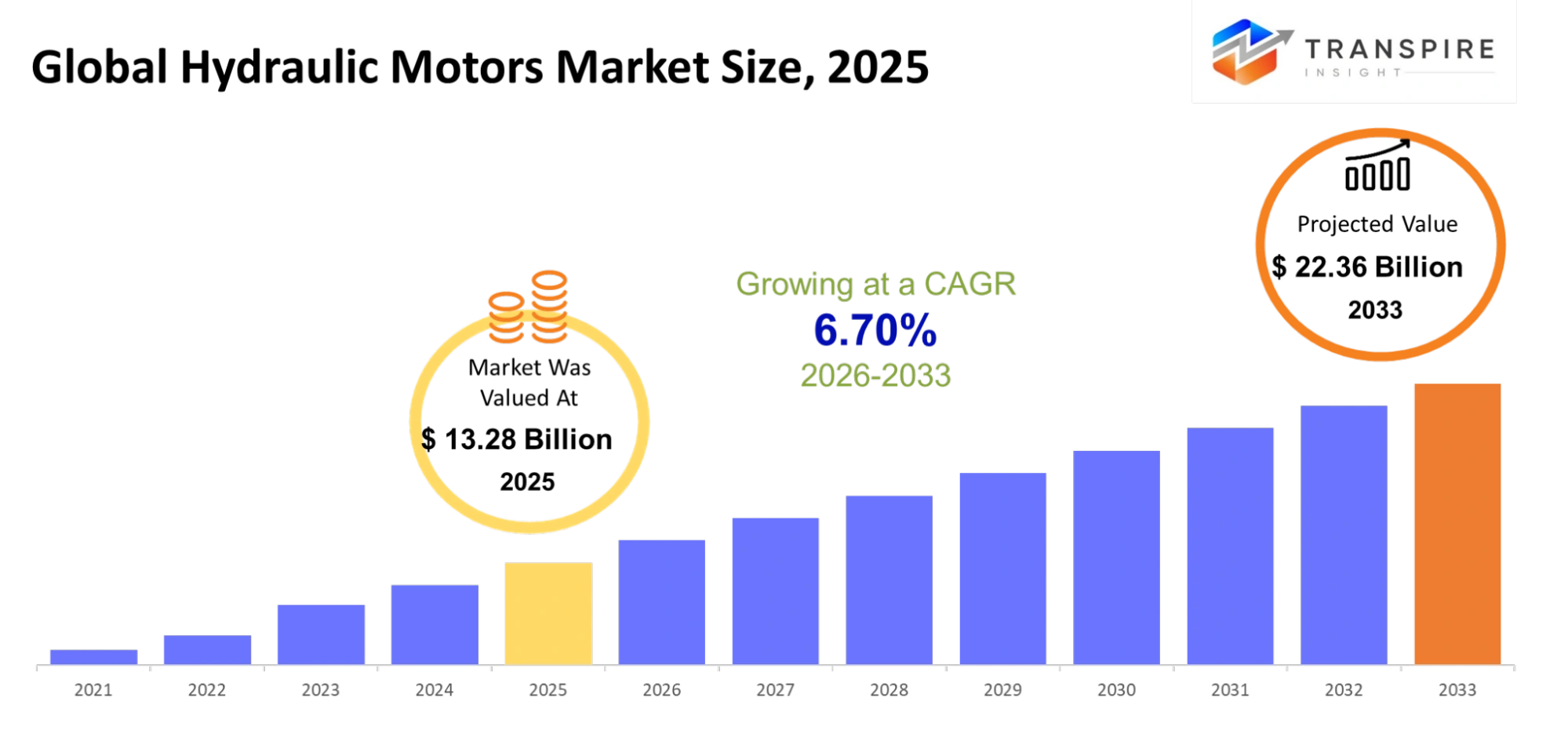
Global Hydraulic Motors Market Size 2025: USD 13.28 Billion
Global Hydraulic Motors Market Size 2033: USD 22.36 Billion
Global Hydraulic Motors Market CAGR: 6.70%
Global Hydraulic Motors Market Segments: By Motor Type (Gear Motor, Vane Motor, Piston Motor), By Application (Construction Equipment, Agricultural Machinery, Material Handling Equipment, Industrial Machinery), By End-User Industry (Construction, Agriculture, Mining, Manufacturing).
To learn more about this report,  Download Free Sample Report
Global Hydraulic Motors Market Summary:
The Global Hydraulic Motors Market was valued at USD 13.28 billion in 2025 and is forecast to reach USD 22.36 billion by 2033, expanding at a CAGR of 6.70% from 2026 to 2033. A hydraulic motor converts pressurized hydraulic fluid into rotational mechanical output. It's really the activation device at the working end of a hydraulic circuit: the pump generates both flow and pressure, the control valves direct it, and the motor converts that fluid energy into shaft torque and rotation. Without hydraulic motors, the very heavy machines that shift earth, cut crops, lift loads, and operate mining equipment couldn't function at the power densities those applications require - all within the size envelope of their frames and drivetrains.
The market share shows the motor's position in the market more so than any technical supremacy: gear motors are the easiest, most budget-friendly hydraulic motor design, and the applications where their specifications are suitable - a moderate amount of torque, moderate speed, tolerance for contamination, a pretty straightforward maintenance plan, cover quite a bit of the entire market volume. They're used in conveyors, fans, augers, winches, mixers, and low- to medium-duty drive applications all over construction, agriculture, and industrial equipment. That breadth of usage actually means they ship out in very high numbers even though their average selling price is lower than piston motors.
Piston motors really occupy the high-performance end of the market. Axial piston and radial piston designs deliver higher efficiency, wider speed ranges, and the capacity to handle much higher operating pressures than gear or vane options. They're specified for the applications where performance is way more important than unit cost: excavator swing drives, hydrostatic transmissions in combines and tractors, primary propulsion drives on compact track loaders, and mobile crane slewing drives. Their higher price per unit and the technical intricacy of maintaining them in the field really mean they're not a default choice for simpler drive functions.
Vane motors sit right in the middle between gear and piston in terms of performance and cost. They're smoother and quieter than gear motors at comparable speeds - which makes them useful in industrial applications where noise and output smoothness really matter. Their susceptibility to contamination and the wear characteristics of the vane-to-cam interface make them less suited to the tougher operating environments of mobile construction and agricultural equipment - which limits their share of those application areas.
Key Market Trends & Insights:
- Construction activity in Asia-Pacific - especially in China, India, and Southeast Asia - is really the main regional demand driver here, with excavator, loader, and crane production volumes actually pulling hydraulic motor sales at quite a scale.
- Agricultural machinery electrification is something hydraulic motor manufacturers are keeping very close eye on since some tractor and harvester functions - which currently rely on hydraulics - are good candidates for electro-hydraulic or even fully electric actuation in next-generation platform designs.
- Piston motor demand is actually growing much faster than gear motor demand in percentage terms, all thanks to the increased use of load-sensing and hydrostatic transmission systems in mid-size construction and agricultural equipment that previously just used simpler open-circuit hydraulics.
- Mining equipment - where large piston motors actually drive conveyor systems, drill rigs, and underground hauling machines - represents a rather stable, high-value segment that's less cyclical than construction and really does support consistent piston motor demand even during commodity price downturns.
Global Hydraulic Motors Market Segmentation
By Motor Type
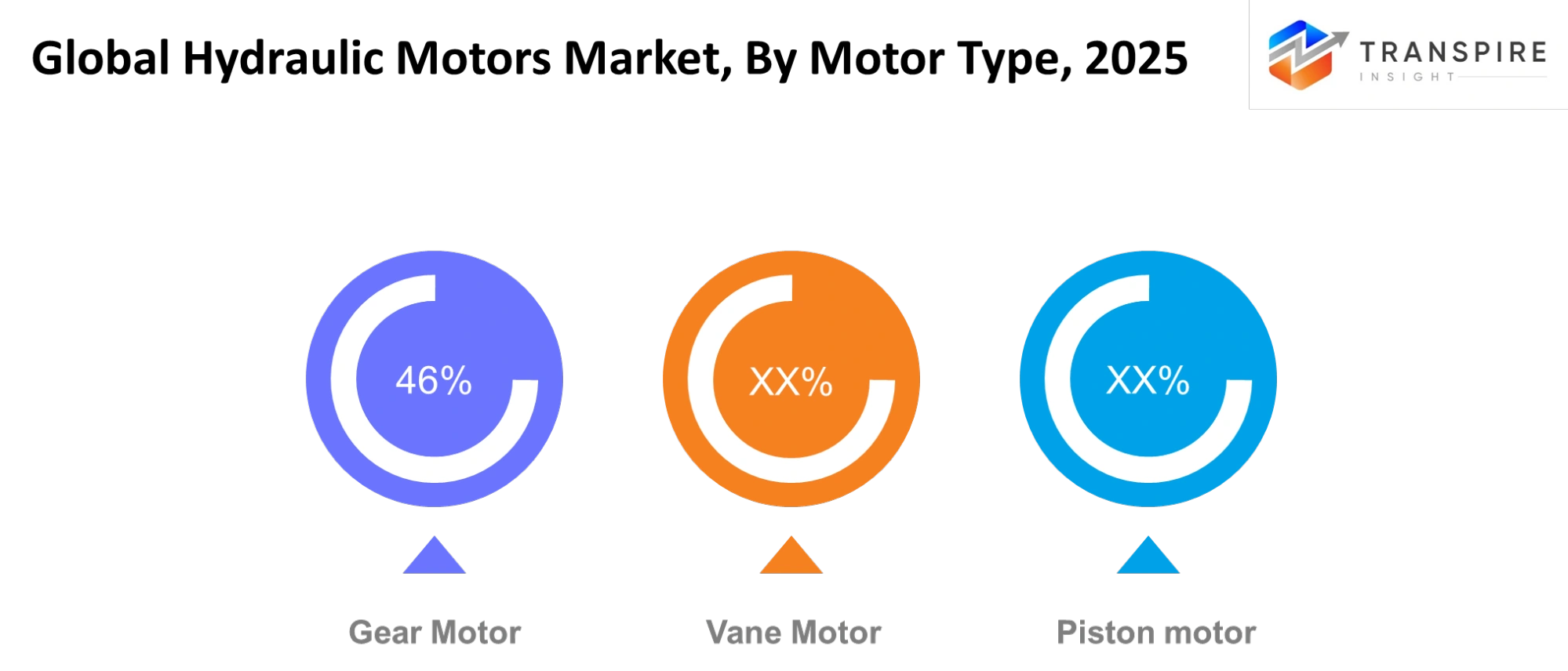
- Gear Motor: Gear motors represent the biggest motor type in the Global Hydraulic Motors Market - they account for approximately 46% of the entire market revenue. Inside a gear motor, highly pressurized fluid pushes against the teeth of meshing gears - this causes them to rotate and creates shaft output. Such a design features very few moving parts; it can tolerate a bit more fluid contamination than vane or piston motors and is also relatively easy to manufacture, service, and replace in the field itself. These properties really make gear motors your best option for many applications - especially when the drive function isn't really the main thing limiting a machine's performance. Agricultural auger drives, conveyor drives, fan drives, mixer drives, winches on light utility vehicles, and hydraulic tool drives are some of the main gear motor uses. Because of their relatively low efficiency compared to piston motors, that actually doesn't matter as much in these roles - since the drive function isn't always operating continuously at maximum load. The gear motor market is very high-volume - with often lower average selling prices compared to the other motor types.
- Vane Motor: Vane motors have spring-loaded or pressure-loaded vanes that slide back and forth in slots in a rotor - always touching the cam ring's surface. When pressurized fluid flows into the motor, the difference in pressure across the vanes really produces the torque. The very smooth cam ring contact - along with the continuous vane-to-ring seal - results in a lower output ripple than gear motors at similar speeds, making vane motors a popular choice for applications where smooth output and quiet operation are quite important indeed. Industrial machine tool drives, low-noise hydraulic fan drives, and even a few agricultural spray pump drives use vane motors because of those very reasons. However, the vanes do wear out with time - and contaminated fluid will speed up that process really noticeably, which greatly limits vane motor usage to clean, filtered hydraulic systems. Their part of the Global Hydraulic Motors Market is smaller compared to gear or piston motors - but concentrated in industrial rather than mobile applications.
- Piston motor: Piston motors offer much higher efficiency, a much wider operating speed range - and even the ability to withstand extremely high system pressures compared to gear or vane designs. In an axial piston motor, fluid acts on pistons arranged all around a rotating barrel, with a swashplate angle changing the linear piston motion into shaft rotation itself. Radial piston motors use a very different setup where pistons push outwards against a cam ring, producing very high torque at relatively low speeds indeed. Variable displacement axial piston motors can change their volume of fluid pumped in direct response to load or control signals - allowing a hydrostatic transmission to continually change its output speed and torque over a wide range without ever having to use a mechanical gearbox. This exceptional capability is the reason piston motors dominate in excavator swing and travel drives, combine harvester threshing and propulsion drives, and compact track loader drive systems themselves. Their high initial price and even greater maintenance complexity mean they're rarely used where a gear motor will suffice - but when performance really matters in mobile equipment applications, they are most definitely the standard requirement.
To learn more about this report, Download Free Sample Report
By Application
- Construction Equipment: Construction equipment is the largest application segment in the Global Hydraulic Motors Market. Excavators, wheel loaders, bulldozers, motor graders, compactors, and cranes all use hydraulic motors in their drive and work function circuits. Excavator travel drives use axial piston motors running in closed-loop hydrostatic circuits. Swing drives use piston motors with integrated braking functions. Attachment drives for augers, mulchers, and cold planers use gear motors at lower duty levels. The global construction equipment market, which follows infrastructure investment and residential construction cycles, is the primary demand driver for hydraulic motors in this segment. Asia-Pacific, led by China, generates the largest share of construction equipment production and therefore hydraulic motor demand.
- Agricultural Machinery: Agricultural machinery uses hydraulic motors across a range of drive and work functions. Modern combine harvesters use piston motors in hydrostatic propulsion drives that allow the operator to control ground speed continuously without a conventional gearbox. Header drives, threshing drum drives, and chopper drives use gear motors or fixed-displacement piston motors depending on the torque and speed requirements. Large tractors use hydraulic motors to power front-mounted implements, remote hydraulic tools, and some four-wheel drive assist systems. The agricultural segment is seasonal in its equipment purchase patterns but provides consistent hydraulic motor demand because harvesting equipment works at high utilization rates during short windows and replacement of worn components is a maintenance necessity rather than a discretionary purchase.
- Material Handling Equipment: Material handling equipment includes forklifts, reach trucks, order pickers, dock levelers, aerial work platforms, and conveyor systems. Hydraulic motors power the drive wheels on counterbalance forklifts and rough-terrain lift trucks, the lift and tilt functions on aerial platforms, and the conveyor belts on automated sorting systems. Gear motors are the dominant type in most material handling applications because the duty cycles and performance requirements are within gear motor capability and the lower unit cost matters in an application category where fleet sizes are large and replacement is frequent. Some rough-terrain aerial platforms and heavy-duty forklifts use piston motors where tractive effort and speed range justify the cost.
- Industrial Machinery: Industrial machinery covers the stationary and semi-stationary equipment that uses hydraulic motors as drive elements: metal forming presses, injection molding machines, rubber and plastic processing equipment, paper and board mill drives, steel mill auxiliary drives, and test rigs. Vane motors appear more frequently in industrial machinery than in mobile applications because industrial circuits are better filtered and the operating environments are more controlled. Piston motors are used in high-performance industrial drives where efficiency and speed range matter. The industrial machinery segment provides steadier demand than construction or agriculture because industrial maintenance replacement cycles are less tied to capital expenditure cycles in any one end market.
By End-User Industry
- Construction Equipment: Construction equipment is the largest application sector in the Global Hydraulic Motors Market. Excavators, wheel loaders, bulldozers, motor graders, rollers, and cranes all make use of hydraulic motors in both their drive and working function circuits. Excavator travel drives employ axial piston motors running within closed-loop hydrostatic circuits. Swing drives use piston motors fitted with built-in braking functions. Drive units for attachments such as augers, mulchers, and cold planers use gear motors at somewhat reduced duty levels. The worldwide construction equipment market - largely influenced by our infrastructure investments and residential construction patterns - represents the primary demand driver for hydraulic motors in this area. Asia-Pacific, especially China, generates the largest portion of construction equipment production - thus also creating quite a lot of hydraulic motor demand.
- Agricultural Machinery: Agricultural machinery makes use of hydraulic motors across various drive and working functions. Modern combine harvesters employ piston motors in hydrostatic propulsion drives that enable the operator to set ground speed very accurately continuously without even needing a traditional gearbox. Header drives, threshing drum drives, and chopper drives use gear motors or fixed-displacement piston motors based on the torque and speed needs. Large tractors use hydraulic motors to power front-mounted implements, some distant hydraulic tools, and certain four-wheel drive support systems. The agricultural area shows quite seasonal trends in its equipment purchases but nonetheless gives quite consistent hydraulic motor demand since harvesting equipment really gets used hard during short periods - and replacing worn parts is a necessary part of regular maintenance rather than an option for discretionary buying.
- Mining: Mining really relies on hydraulic motors - you can find them in a variety of equipment like rotary drill rigs, continuous miners, longwall mining systems, underground hauling vehicles, surface conveyor systems, and mineral processing equipment. Mining hydraulic motors tend to be quite large and very well specced out because duty cycles last so much longer, and the outcome of failure really would cost a lot more money. Piston motors are really quite common in mining propulsion and in high-torque drive applications. The mining sector actually experiences less cyclicality in its hydraulic motor demand compared with construction because even in times of commodity price drops, all the existing mines will continue to run and take care of their equipment - and replacing worn-out hydraulic motors is always a non-discretionary expense.
- Manufacturing: Manufacturing customers actually purchase hydraulic motors for production equipment, test rigs, and plant utility systems. This segment really includes makers of presses, builders of plastics machinery, suppliers of rubber processing equipment, and also the maintenance departments of manufacturing facilities that have to keep running their hydraulic-powered production lines. Demand from this segment is actually tied to industrial capital spending cycles - and to the overall level of manufacturing in each and every region. Europe, North America, China, Japan, and South Korea turn out to be the main manufacturing markets for hydraulic motors in this particular segment.
Country Insights
Asia-Pacific is the largest region in the Global Hydraulic Motors Market by a significant margin, with China the dominant contributor. Chinese construction equipment production, which includes the world's largest excavator manufacturing base, generates hydraulic motor demand at a scale that no other country matches. Chinese hydraulic motor manufacturers have grown their domestic market share over the past fifteen years, though European and Japanese manufacturers still hold strong positions in piston motors and premium gear motor applications where efficiency specifications are tight.
India is a growing market. Infrastructure investment, agricultural mechanization, and the expansion of domestic construction equipment production are all adding hydraulic motor demand. Indian equipment manufacturers have increasingly localized their supply chains, which has created opportunities for both domestic hydraulic component suppliers and established global brands that have set up local manufacturing.
North America, led by the United States, is a mature but technically demanding market. The US has a large installed base of agricultural equipment, construction machinery, and mining equipment that generates steady replacement demand. Piston motor demand in the US agricultural segment is strong because North American combines and large tractors use hydrostatic transmissions at higher rates than equivalent equipment in other markets. Parker Hannifin, Eaton, and Moog all have significant US operations that serve both OEM and aftermarket channels.
Europe is the home region of several leading manufacturers, including Bosch Rexroth, Danfoss, Linde Hydraulics, HAWE, and Bucher Hydraulics. European manufacturers compete on system engineering capability, product quality, and the depth of their application engineering support rather than price. The European market itself is a significant consumer of hydraulic motors in agricultural equipment, construction machinery, and industrial systems, with Germany, France, Italy, and Scandinavia being the main production centers.
Japan hosts Kawasaki Heavy Industries, KYB, and NACHI-Fujikoshi, which are major piston motor suppliers to construction equipment OEMs including Komatsu, Hitachi, and Kobelco. Japanese-designed motors are specified in equipment sold globally, giving Japanese manufacturers a reach beyond their domestic market that is disproportionate to Japan's share of end-market consumption.
To learn more about this report, Download Free Sample Report
Recent Development News
Several manufacturers in the Global Hydraulic Motors Market have released integrated electro-hydraulic motor units that combine a hydraulic motor with position and speed sensors and an onboard control interface, allowing the motor to be integrated directly into machine control systems without separate sensor installation. This reduces assembly complexity at OEM factories and makes the motor a more intelligent node in the machine's hydraulic circuit.
There is also ongoing development activity around higher-pressure rated piston motors for next-generation construction equipment that operates at system pressures above 450 bar. Running at higher pressure allows the same work output from smaller flow rates, which reduces the size and weight of the pump, hoses, and control valves in the circuit. For compact machines where package size is a significant design constraint, that reduction in system mass and envelope matters.
Report Metrics
|
Report Metrics |
Details |
|
Market size value in 2025 |
USD 13.28 Billion |
|
Market size value in 2026 |
USD 14.2 Billion |
|
Revenue forecast in 2033 |
USD 22.36 Billion |
|
Growth rate |
CAGR of 6.70% from 2026 to 2033 |
|
Base year |
2025 |
|
Historical data |
2021 - 2024 |
|
Forecast period |
2026 - 2033 |
|
Report coverage |
Revenue forecast, competitive landscape, growth factors, and trends |
|
Country scope |
Global |
|
Key company profiled |
Bosch Rexroth AG, Parker Hannifin Corporation, Eaton Corporation plc, Danfoss A/S, Kawasaki Heavy Industries Ltd., KYB Corporation, Linde Hydraulics GmbH, HAWE Hydraulik SE, Bucher Hydraulics GmbH, White Drive Products Inc., Casappa S.p.A., NACHI-Fujikoshi Corp., Yuken Kogyo Co. Ltd., Hydac International GmbH, Moog Inc. |
|
Customization scope |
Free report customization (country, regional & segment scope). Avail customized purchase options to meet your exact research needs. |
|
Report Segmentation |
By Motor Type (Gear Motor, Vane Motor, Piston Motor), By Application (Construction Equipment, Agricultural Machinery, Material Handling Equipment, Industrial Machinery), By End-User Industry (Construction, Agriculture, Mining, Manufacturing). |
Key Global Hydraulic Motors Company Insights
The Global Hydraulic Motors Market is led by a group of established European, American, and Japanese manufacturers that have built their positions over decades through investment in product engineering, manufacturing precision, and global service networks. Bosch Rexroth, Parker Hannifin, Eaton, and Danfoss compete across the full motor type range and serve both mobile and industrial markets. Their breadth means they can supply an OEM's complete hydraulic motor requirement across a machine platform rather than competing for individual motor positions against specialists.
Japanese manufacturers, including Kawasaki, KYB, and NACHI-Fujikoshi, have strong positions in piston motors supplied to Japanese construction equipment OEMs, and those motors travel with the equipment into export markets. This OEM-embedded position is difficult for competitors to displace on an existing platform, since hydraulic circuits are designed around specific motor characteristics and redesigning around a different motor requires engineering investment the OEM has already incurred once. Smaller specialists such as White Drive Products, Casappa, and Bucher Hydraulics hold defensible positions in specific motor types or application niches where their product depth or application engineering gives them an advantage over generalist competitors.
Company List
- Bosch Rexroth AG
- Parker Hannifin Corporation
- Eaton Corporation plc
- Danfoss A/S
- Kawasaki Heavy Industries Ltd.
- KYB Corporation
- Linde Hydraulics GmbH
- HAWE Hydraulik SE
- Bucher Hydraulics GmbH
- White Drive Products Inc.
- Casappa S.p.A.
- NACHI-Fujikoshi Corp.
- Yuken Kogyo Co. Ltd.
- Hydac International GmbH
- Moog Inc.
Global Hydraulic Motors Market Report Segmentation
By Motor Type
- Gear Motor
- Vane Motor
- Piston Motor
By Application
- Construction Equipment
- Agricultural Machinery
- Material Handling Equipment
- Industrial Machinery
By End-User Industry
- Construction
- Agriculture
- Mining
- Manufacturing
Frequently Asked Questions
Find quick answers to common questions.
The Global Hydraulic Motors Market is expected to reach approximately USD 22.36 billion by 2033.
Key segments include Motor Type (Gear Motor, Vane Motor, Piston Motor), Application (Construction Equipment, Agricultural Machinery, Material Handling Equipment, Industrial Machinery), and End-User Industry (Construction, Agriculture, Mining, Manufacturing).
Major players include Bosch Rexroth AG, Parker Hannifin Corporation, Eaton Corporation plc, Danfoss A/S, Kawasaki Heavy Industries Ltd., KYB Corporation, Linde Hydraulics GmbH, HAWE Hydraulik SE, Bucher Hydraulics GmbH, White Drive Products Inc., Casappa S.p.A., NACHI-Fujikoshi Corp., Yuken Kogyo Co. Ltd., Hydac International GmbH, and Moog Inc.
The Global Hydraulic Motors Market size is approximately USD 13.28 billion in 2025.
The Global Hydraulic Motors Market is expected to grow at a CAGR of 6.70% from 2026 to 2033.
- Bosch Rexroth AG
- Parker Hannifin Corporation
- Eaton Corporation plc
- Danfoss A/S
- Kawasaki Heavy Industries Ltd.
- KYB Corporation
- Linde Hydraulics GmbH
- HAWE Hydraulik SE
- Bucher Hydraulics GmbH
- White Drive Products Inc.
- Casappa S.p.A.
- NACHI-Fujikoshi Corp.
- Yuken Kogyo Co. Ltd.
- Hydac International GmbH
- Moog Inc.
Recently Published Reports
-
Apr 2026
Fiber Optic Faceplates Market
Fiber Optic Faceplates Market Size, Share & Analysis Report By Type (< 300 mm2, 300-350 mm2, and > 350 mm2, By Application (Night Vision, Holographic Imaging, Medical, and Others), and Geography (North America, Europe, Asia-Pacific, Middle East and Africa, South and Central America), 2021 - 2031
-
Apr 2026
High Temperature Superconductors Market
High Temperature Superconductors Market Size, Share & Analysis Report By Type (1G HTS, and 2G HTS), By Application (Power Cable, Fault Current Limiter, and Transformer), and Geography (North America, Europe, Asia-Pacific, Middle East and Africa, South and Central America), 2021 - 2031
-
Apr 2026
Industrial Plugs and Socket Market
Industrial Plugs and Socket Market Size, Share & Analysis Report By Type (Industrial Plugs, Industrial Sockets), By Current (Up to 32 A, 32 to 125 A, Above 125 A), By Protection (Dustproof and Splash Proof, Waterproof, Explosion Proof), By End User (Heavy Industries, Oil and Gas, Chemicals and Pharmaceuticals, Power Generation, Others), and Geography (North America, Europe, Asia-Pacific, Middle East and Africa, South and Central America), 2021 - 2031
-
Apr 2026
InGaAs Avalanche Photodiodes Market
InGaAs Avalanche Photodiodes Market Size, Share & Analysis Report By Type (1100 - 1700 nm, and 1000 - 1600 nm), By Application (Missile Warning System, Muzzle Flash Detection, Wafer Defect Inspection, Laser Rangefinders, and Others), and Geography (North America, Europe, Asia-Pacific, Middle East and Africa, South and Central America), 2021 - 2031