

Japan Construction Equipment Market Size & Forecast:
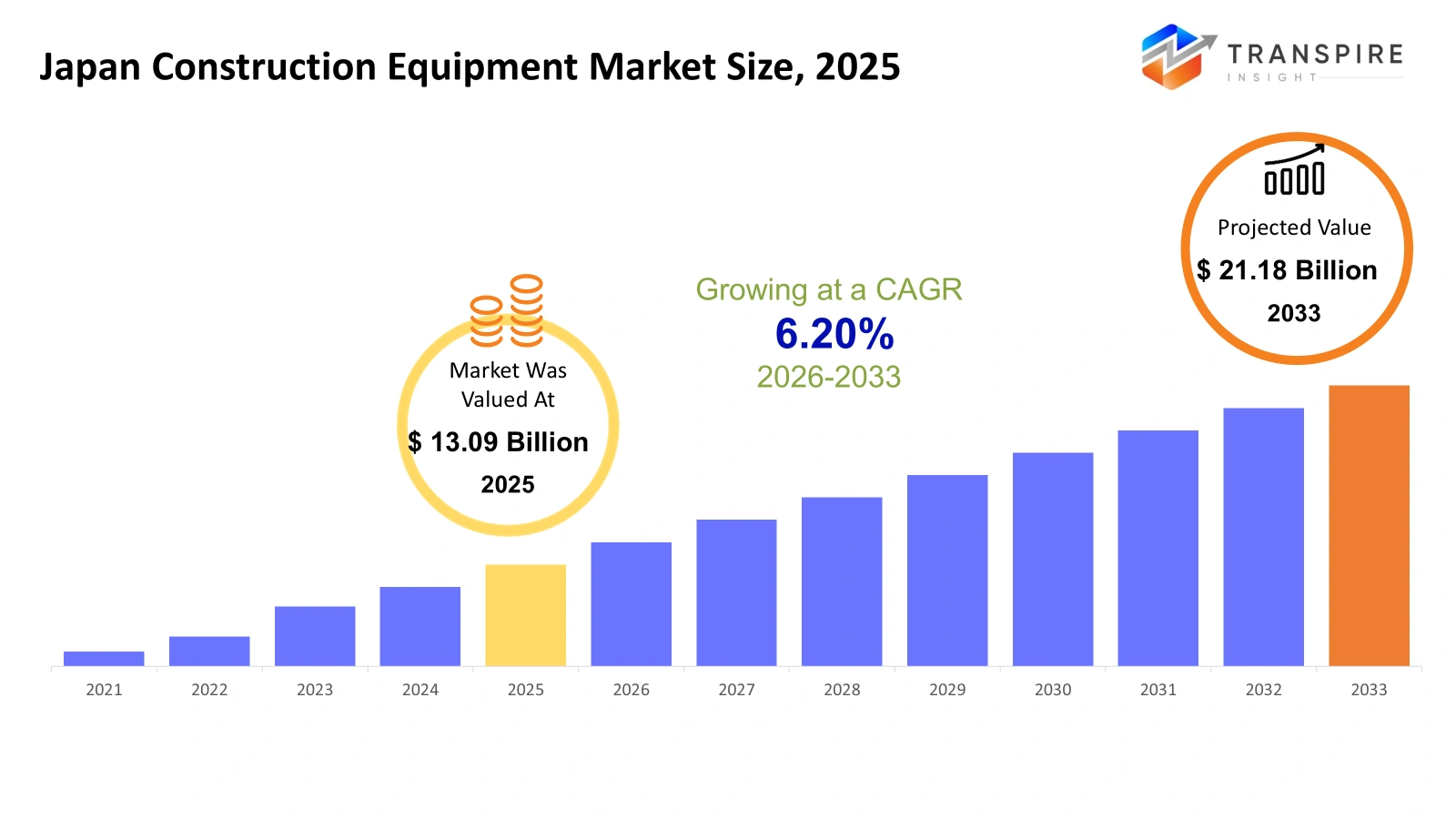
- Japan Construction Equipment Market Size 2025: USD 13.09 Billion
- Japan Construction Equipment Market Size 2033: USD 21.18 Billion
- Japan Construction Equipment Market CAGR: 6.20%
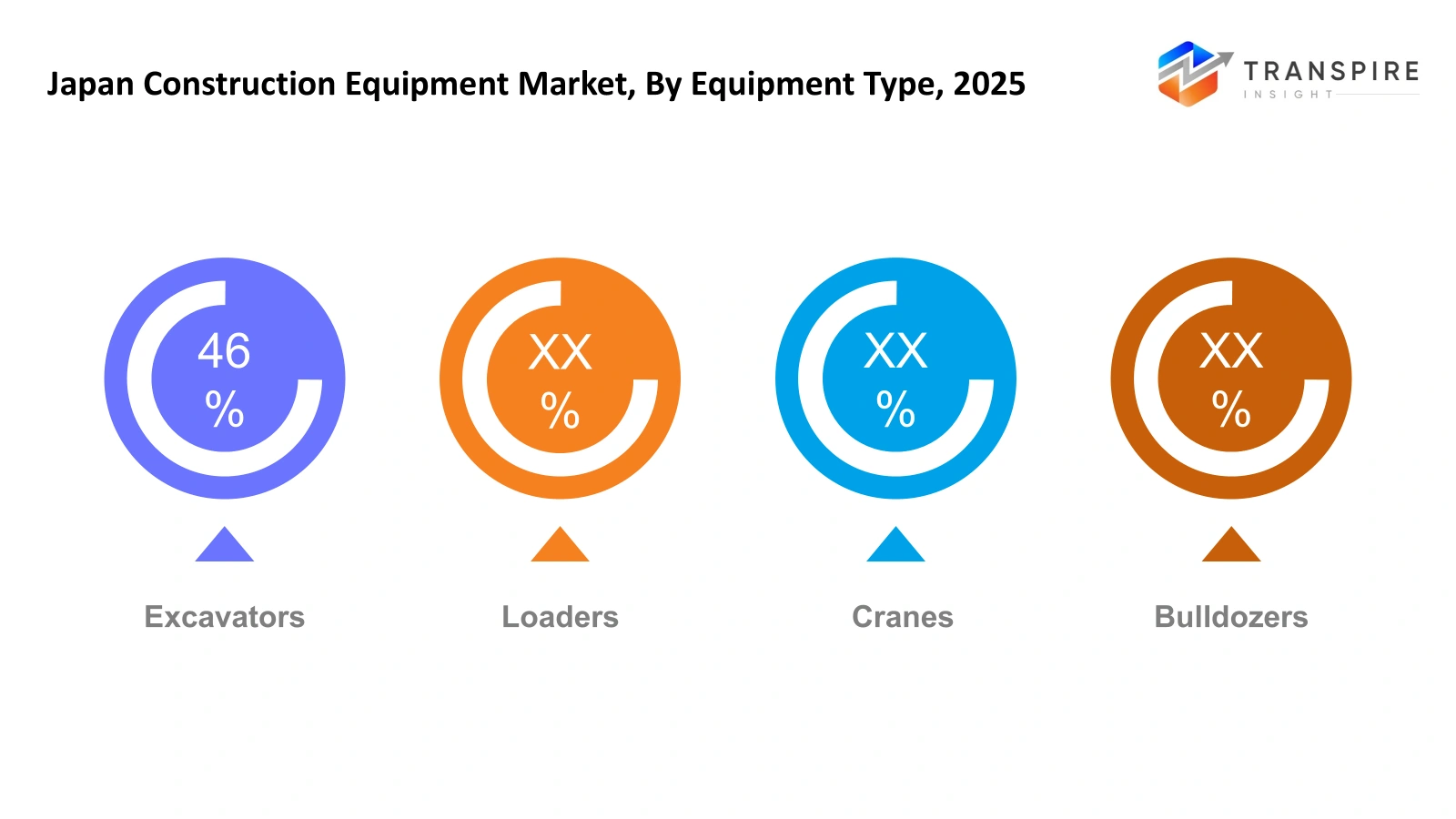
- Japan Construction Equipment Market Segments: By Equipment Type (Excavators, Loaders, Cranes, Bulldozers), By End User (Construction, Mining, Infrastructure Development).
To learn more about this report,  Download Free Sample Report
Japan Construction Equipment Market Summary:
The Japan Construction Equipment Market size is estimated at USD 13.09 Billion in 2025 and is anticipated to reach USD 21.18 Billion by 2033, growing at a CAGR of 6.20% from 2026 to 2033. Japan's construction equipment market maintains its steady evolution through three driving forces, which include infrastructure development, city redevelopment and technological advancements. The construction industry requires machinery which operates with high efficiency and low fuel consumption and has minimal environmental impact. Japanese manufacturers develop intelligent equipment which uses automated systems and telematics technology and artificial intelligence to enhance operational efficiency and workplace safety. The country's increasing workforce age is driving organisations to use advanced technologies alongside semi-autonomous equipment. Japan maintains its status as a leading force in modern construction equipment development through its domestic expertise and ongoing research and development investments.
Key Market Trends & Insights:
- The ongoing bridge and highway and public works projects which Japan conducts require construction machinery which construction companies can depend on for their work. The government-funded infrastructure development projects create continuous requirements which need advanced equipment throughout both cities and rural areas.
- Construction companies are increasingly adopting smart machines because these machines include GPS and telematics and automation capabilities. The technologies enable better accuracy, decreased need for manual work and improved performance of entire projects.
- The Japanese environmental regulations push manufacturers to create equipment which emits low emissions while consuming minimal energy. The construction industry is starting to adopt hybrid and electric machines because businesses want to decrease their carbon emissions.
- The construction industry in Japan experiences an increasing need for advanced machinery because of its ageing workforce and shortage of trained workers. The equipment which operates in semi-autonomous mode enables organisations to sustain their operational capacity during times of worker shortages.
- Contractors prefer to rent equipment because it provides them with flexible costs which match their specific project requirements. The equipment rental services across the construction industry experience growth because building companies show increasing interest in renting construction machines.
- Japanese companies maintain their strong reputation as leaders in construction technology through their ongoing dedication to innovative development. Companies invest in AI technology and robotic systems and digital monitoring technologies to enhance their competitive position both inside Japan and throughout international markets.
Japan Construction Equipment Market Segmentation
By Equipment Type
- Excavators: Excavators which perform multiple tasks of digging and trenching and moving materials have become the most important equipment used in construction projects throughout Japan. The equipment finds extensive application in both urban redevelopment projects and infrastructure repair operations. Japanese construction sites now use modern excavators which operate through automated systems and consume less fuel while their compact design enables operation in restricted construction areas.
- Loaders: Loaders serve as vital equipment which enables efficient transportation of soil and sand and construction materials throughout work sites. In Japan, compact and wheel loaders are popular for both large infrastructure projects and smaller urban construction work. Contractors prefer advanced loaders which deliver better lifting capacity together with fuel efficiency and user-friendly operational features.
- Cranes: Cranes serve as essential equipment for both high-rise building construction and major infrastructure projects throughout Japan. Tower cranes and mobile cranes are commonly used in urban areas where vertical construction is growing. Crane efficiency and reliability have improved through technological advancements which introduced safety monitoring systems and high-precision control mechanisms.
- Bulldozers: Bulldozers serve as essential equipment which enables land clearing and road construction and large-scale earthmoving operations. The Japanese government uses these machines to support both infrastructure development and disaster recovery operations. Manufacturers create bulldozers which provide better fuel efficiency and advanced navigation technology and enhanced durability to handle difficult construction conditions.
To learn more about this report, Download Free Sample Report
By End User
- Construction: The construction sector consumes more construction equipment than any other industry in Japan. The ongoing construction of urban areas together with residential developments and commercial building projects creates a need for construction equipment. Construction companies now prefer to use modern equipment which enhances their operational efficiency through better speed and accuracy and improved workplace safety.
- Mining: Japan needs heavy equipment for its mining operations, which include mineral extraction and site preparation, despite the sector being smaller than its other economic activities. Mining operations depend on construction equipment, including excavators, loaders and bulldozers, which help improve material handling and operational efficiency.
- Infrastructure Development: Construction equipment demand in Japan increases because of infrastructure development projects throughout the country. The construction of highways and rail networks and port facilities and public buildings requires advanced machinery through government funding. The use of advanced equipment allows contractors to complete projects within required timeframes while maintaining safety standards and environmental protection protocols.
Country Insights
Japan's construction equipment market demonstrates the nation's dedication to infrastructure development through its technological progress and its comprehensive urban planning efforts. Japan maintains its position as one of the most developed economies worldwide by investing in the restoration of its outdated bridges and highways and rail systems and public services. The present construction activities throughout the nation create a continuous requirement for contemporary building equipment.
The Japanese market gets defined through its primary element of innovation. The Japanese manufacturing process uses advanced technology because manufacturers create their products through automation and telematics and fuel-efficient system development. Construction companies can enhance their work efficiency through these innovations while meeting their safety requirements and environmental protection standards.
The equipment market experiences changes because Japan's elderly labour force needs specialised machinery. The construction sector faces a shortage of young workers, which leads companies to depend on advanced technology and partially automated systems for their operations. Government infrastructure initiatives and technological knowledge and domestic manufacturing capacity drive the market's continuous innovation while maintaining stability.
Recent Development News
Japan’s Big Construction Equipment Makers Face Demand and Tariff Challenges
Tariff Pressures Impact Overseas Sales for Japanese Machinery Firms
|
Report Metrics |
Details |
|
Market size value in 2025 |
USD 13.09 Billion |
|
Market size value in 2026 |
USD 13.9 Billion |
|
Revenue forecast in 2033 |
USD 21.18 Billion |
|
Growth rate |
CAGR of 6.20% from 2026 to 2033 |
|
Base year |
2025 |
|
Historical data |
2021 – 2024 |
|
Forecast period |
2026 – 2033 |
|
Report coverage |
Revenue forecast, competitive landscape, growth factors, and trends |
|
Country scope |
Japan |
|
Key company profiled |
Komatsu Ltd., Hitachi Construction Machinery Co. Ltd., Caterpillar Inc., Volvo Construction Equipment, Liebherr Group, Doosan Infracore, Hyundai Construction Equipment, Kobelco Construction Machinery, JCB Ltd., Sany Heavy Industry Co. Ltd., Zoomlion Heavy Industry Science & Technology, Terex Corporation, Sumitomo Construction Machinery, XCMG Group, Takeuchi Manufacturing Co. Ltd. |
|
Customization scope |
Free report customization (country, regional & segment scope). Avail customized purchase options to meet your exact research needs. |
|
Report Segmentation |
By Equipment Type (Excavators, Loaders, Cranes, Bulldozers), By End User (Construction, Mining, Infrastructure Development). |
Key Japan Construction Equipment Company Insights
The Japan construction equipment market is shaped by a mix of globally recognised manufacturers and specialized domestic suppliers. Companies use technological innovation together with product durability and operational efficiency to develop solutions that meet the changing requirements of construction and infrastructure development projects. Manufacturers allocate financial resources to develop automation systems together with telematics technology and eco-friendly equipment which enables them to boost operational efficiency while decreasing harmful emissions. Japanese companies use their strong research and development capabilities to create advanced equipment which provides both precise performance and dependable functioning. Companies use strategic partnerships together with export market growth and ongoing product development to maintain their competitive edge in both domestic and international construction equipment markets.
Company List
- Komatsu Ltd.
- Hitachi Construction Machinery Co. Ltd.
- Caterpillar Inc.
- Volvo Construction Equipment
- Liebherr Group
- Doosan Infracore
- Hyundai Construction Equipment
- Kobelco Construction Machinery
- JCB Ltd.
- Sany Heavy Industry Co. Ltd.
- Zoomlion Heavy Industry Science & Technology
- Terex Corporation
- Sumitomo Construction Machinery
- XCMG Group
- Takeuchi Manufacturing Co. Ltd.
Japan Construction Equipment Market Report Segmentation
By Equipment Type
- Excavators
- Loaders
- Cranes
- Bulldozers
By End User
- Construction
- Mining
- Infrastructure Development
Frequently Asked Questions
Find quick answers to common questions.
The approximate Japan Construction Equipment Market size for the market will be USD 21.18 Billion in 2033.
The key segments of the Japan Construction Equipment Market are By Equipment Type (Excavators, Loaders, Cranes, Bulldozers), By End User (Construction, Mining, Infrastructure Development).
Major players in the Japan Construction Equipment Market are Komatsu Ltd., Hitachi Construction Machinery Co. Ltd., Caterpillar Inc., Volvo Construction Equipment, Liebherr Group, Doosan Infracore, Hyundai Construction Equipment, Kobelco Construction Machinery, JCB Ltd., Sany Heavy Industry Co. Ltd., Zoomlion Heavy Industry Science & Technology, Terex Corporation, Sumitomo Construction Machinery, XCMG Group, Takeuchi Manufacturing Co. Ltd.
The current market size of the Japan Construction Equipment Market is USD 13.09 Billion in 2025.
The Japan Construction Equipment Market CAGR is 6.20%.
- Komatsu Ltd.
- Hitachi Construction Machinery Co. Ltd.
- Caterpillar Inc.
- Volvo Construction Equipment
- Liebherr Group
- Doosan Infracore
- Hyundai Construction Equipment
- Kobelco Construction Machinery
- JCB Ltd.
- Sany Heavy Industry Co. Ltd.
- Zoomlion Heavy Industry Science & Technology
- Terex Corporation
- Sumitomo Construction Machinery
- XCMG Group
- Takeuchi Manufacturing Co. Ltd.
Recently Published Reports
-
Apr 2026
Handling and Lifting Equipment Market
Handling and Lifting Equipment Market Size, Share & Analysis Report By Product (Cranes and Hoists, Forklifts, Conveyor Systems, Aerial Work Platforms, Others), By Application (E-Commerce, Automotive and Railway, Food and Beverages, Aviation, Others), and Geography (North America, Europe, Asia-Pacific, Middle East and Africa, South and Central America), 2021 - 2031
-
Apr 2026
HVAC Equipment Market
HVAC Equipment Market Size, Share & Analysis Report By Heating Equipment Type (Boilers and Furnaces, Heat Pumps, and Unitary Heaters), By Ventilation Equipment (Air Handling Units, Humidifiers and Dehumidifiers, Air Filters, and Fan Coiling Units), By Air Conditioning Equipment (Unitary Air Conditioners, Room Air Conditioners, Packaged Terminal Air Conditioners, and Chillers), By End User (Commercial, Residential, Industrial, and others), and Geography (North America, Europe, Asia-Pacific, Middle East and Africa, South and Central America), 2021 – 2031
-
Apr 2026
Refrigeration Valves Market
Refrigeration Valves Market Size, Share & Analysis Report By Type (Solenoid Valves, Expansion Valves, Check Valves, Service Valves, Others), By Application (Commercial Refrigeration, Industrial Refrigeration, Transport Refrigeration, Residential Refrigeration, Air Conditioning Systems), By End User (Food and Beverage Industry, Pharmaceutical Industry, HVAC Industry, Chemical Industry, Others), and Geography (North America, Europe, Asia-Pacific, Middle East and Africa, South and Central America), 2021 – 2031
-
Apr 2026
E-Commerce Packaging Materials Market
E-Commerce Packaging Materials Market By Material Type (Corrugated Boxes, Paper & Paperboard, Foam & Cushioning Materials, Plastic Packaging, Flexible Packaging, Protective Packaging, Others), By Product(Primary Packaging, Secondary Packaging, Tertiary Packaging), By Packaging Function (Protective Packaging, Branding & Presentation Packaging, Transit & Logistic Packaging, Sustainable Packaging, Tamper Evidence Packaging), By End-User (Retail & Consumer Goods, Electronic Appliances, Food & Beverages, Healthcare & Pharmaceutical, Fashion & Apparel, Home & Furnishing, Others); By Industry Analysis, Size, Share, Growth, Trends, and Forecasts 2021-2033