
Asia Pacific Molten Carbonate Fuel Cell Market Size & Forecast:
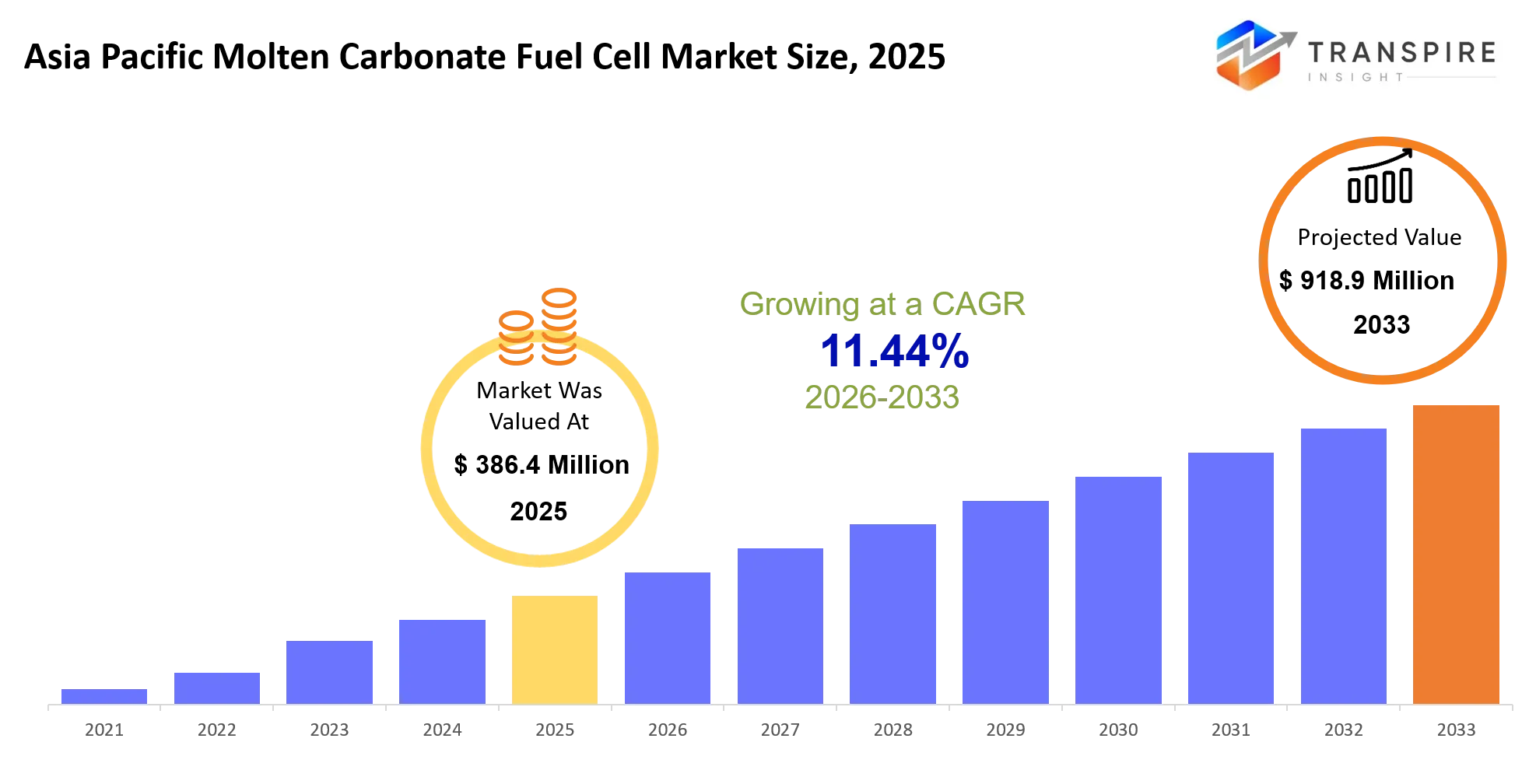
- Asia Pacific Molten Carbonate Fuel Cell Market Size 2025: USD 386.4 Million
- Asia Pacific Molten Carbonate Fuel Cell Market Size 2033: USD 918.9 Million
- Asia Pacific Molten Carbonate Fuel Cell Market CAGR: 11.44%
- Asia Pacific Molten Carbonate Fuel Cell Market Segments: By Product Type (Internal Reforming MCFC, External Reforming MCFC, Hybrid MCFC Systems, Others); By Application (Power Generation, Industrial CHP, Grid Stabilization, Renewable Energy Integration, Others); By End User (Utilities, Industrial Sector, Commercial Facilities, Others)
To learn more about this report,  Download Free Sample Report
Asia Pacific Molten Carbonate Fuel Cell Market Summary
The Asia Pacific Molten Carbonate Fuel Cell Market was valued at USD 386.4 Million in 2025. It is forecast to reach USD 918.9 Million by 2033. That is a CAGR of 11.44% over the period.
Asia Pacific’s molten carbonate fuel cell market, in a real way, tends to show up where industrial sites and bigger energy users need dependable low-emission power generation. At the same time they’re trying to cut back on how much they lean on grid electricity and fossil-fuel captive power systems. These units feel especially useful for industrial facilities, data centers, utilities, and even hydrogen-linked initiatives, since they can run continuously, deliver power with strong efficiency, and still line up with carbon-cutting targets.
In the last three to five years, the whole market vibe has changed. It went from being treated like a minor distributed power niche to something more connected with decarbonization plus hydrogen development plans. Net-zero commitments that governments back across major economies Japan, South Korea, China, and Australia included have made fuel cell projects easier to justify commercially. One big moment, honestly, was when industrial emission reduction rules started getting more strict and, in the same breath, energy security worries also climbed up after global fuel prices became a bit jumpy , and supply chains got disrupted.
It was kinda clear that the whole situation kinda showed how fragile it is to rely too much on imported fossil fuels. So a lot of organizations are now putting serious money into fuel cell systems, they promise steady power, lower life cycle emissions, and smoother day to day operations resilience , like better operational toughness.This shift is, in turn, building thicker project pipelines, increasing capital deployment, and encouraging more take-up across both industrial uses and utility-scale setups.
Key Market Insights
- East Asia kind of dominates the Asia Pacific Molten Carbonate Fuel Cell Market, it takes more than 60% share in 2025 which feels pretty huge.
- Stationary molten carbonate fuel cells hold the largest part, with over 75% of 2025 revenue contribution, yeah.
- For product segments , utility scale power generation lands as the second biggest slice, mostly because grid support, plus distributed generation requirements keep coming up.
- Combined heat and power , CHP systems are growing the quickest during the forecast period, since many industries want better energy efficiency, and they are looking for that.
- High capacity fuel cell systems above 1 MW are getting more attention too, especially for industrial and utility uses.
- Distributed power generation is the one that leads overall, with roughly 55% share, backed by the need for dependable baseload electricity.
- Industrial energy generation stays a major application area across manufacturing, petrochemicals, and those heavy processing plants.
- Carbon capture integrated fuel cell projects are basically the fastest-growing application segment all the way through 2032.
- Hydrogen production and energy storage integration are starting to appear as new demand drivers within the Asia Pacific fuel cell industry.
- And for end users, utilities are leading, contributing more than 40% of total market revenue in 2025, consistently.
What are the Key Drivers, Restraints, and Opportunities in the Asia Pacific Molten Carbonate Fuel Cell Market?
The most powerful driver pushing the Asia Pacific molten carbonate fuel cell market forward seems to be the region's shift toward more reliable, low carbon electricity. In South Korea, Japan, and China, Governments have tightened their decarbonization targets while also trying to handle grid reliability and energy security worries, at the same time. Because of that, utilities, plus industrial operators are leaning into solutions that can keep generating power on a steady basis, with emissions that are lower than conventional fossil fuel setups. So, molten carbonate fuel cells are being placed more often in distributed power schemes and combined heat and power projects, which in turn opens up fresh revenue paths for both technology vendors and project developers.
Still, high capital costs are basically the biggest structural obstacle in the market. Molten carbonate fuel cell systems depend on specialized materials, they involve intricate manufacturing steps and they also need broad balance-of-plant infrastructure.And unlike those short term supply chain hiccups, the cost pressure is already baked into how the technology is designed and then rolled out. so, because of this, quite a few prospective customers keep deferring decisions, or they pivot to cheaper alternatives, which then drags down commercial adoption and keeps the revenue growth kinda stuck especially in places where customers are very sensitive to pricing, and there is no way around it.
One standout growth chance is pairing molten carbonate fuel cells with hydrogen resources and carbon capture systems. A few countries in Asia Pacific are putting real weight behind hydrogen infrastructure, and that creates a decent runway for advanced fuel cell deployment. South Korea, in particular, is starting to look like a strong candidate market, where hydrogen development programs and industrial decarbonization efforts can help enable the next wave of large scale fuel cell projects.
What Has the Impact of Artificial Intelligence Been on the Asia Pacific Molten Carbonate Fuel Cell Market?
Artificial intelligence and newer digital technologies are becoming more and more important in the Asia Pacific molten carbonate fuel cell market, because plant operators want to boost system reliability, efficiency, and lifecycle economics, kind of overall. In today’s installations, AI-enabled control platforms help automate a bunch of operating inputs like temperature management, fuel utilization rates , and the balancing of power output. These setups sort through sensor readings on a constant basis , then they do quick tweaks in real time which keeps the system performing pretty steady, even when the load conditions start shifting.
At the same time machine learning is giving predictive maintenance a real push. Teams rely on data models to catch early indicators of things like component aging, changes in electrolyte behavior, and stack efficiency losses before they grow into something that causes an unplanned shutdown. With this sort of forward-looking method, maintenance downtime gets reduced and system availability can stay higher. In a number of bigger distributed power efforts, digital monitoring platforms have supported better operational uptime , while also bringing down maintenance expenses, mostly by using condition-based servicing instead of sticking to fixed maintenance calendars.
On top of that, AI-driven analytics are being used for performance forecasting and fuel optimization. These tools look at past operating trends along with local environmental conditions, then they try to spot chances to improve fuel efficiency and to push electricity generation output as much as possible.
Still, there is a notable limitation to AI adoption. A lot of molten carbonate fuel cell deployments don’t have long-term operational datasets. That makes it difficult to train predictive models that are highly accurate. Also the integration costs for advanced monitoring infrastructure are still a hurdle, particularly for smaller commercial and industrial projects.
Key Market Trends
- Since 2021, South Korea has been pushing forward with more commercial fuel cell rollout programs, and procurement has kinda slid away from just trial demonstration efforts toward bigger utility-scale energy investments.
- Between 2020 and 2025, industrial buyers started caring a lot more about continuous low carbon electricity, not the jumpy renewable-only setups, especially for operations that can’t really afford interruptions.
- The hydrogen economy roadmaps from Japan and South Korea then redirected the money flow, toward fuel cell technologies that can work with what people expect future hydrogen infrastructure will look like.
- Since 2022, energy security anxieties after global fuel market shocks have been speeding up distributed generation initiatives across many of the major Asia Pacific economies, sort of all at once.
- Manufacturers too, have gone past the “standalone” power setup idea, and more frequently add carbon capture capabilities into newer generation fuel cell platforms.
- Digital monitoring showed a big uptick after 2021, operators began using predictive analytics, to cut downtime and get better asset utilization overall.
- Partnerships between utilities, engineering companies , and fuel cell developers have also become more typical, mainly because project scales kept climbing beyond the multi megawatt range.
- Technology providers, like FuelCell Energy and Doosan Fuel Cell, keep talking more about long term service agreements rather than that old style one time equipment sales, so it feels kinda swapped.
- And since 2023, Southeast Asian markets have started showing up as new investment destinations, as governments keep pushing industrial decarbonization policies, which is a whole thing now.
Asia Pacific Molten Carbonate Fuel Cell Market Segmentation
By Product Type :
Internal Reforming MCFC systems make electricity by working the fuel right inside the fuel cell. In that way, you do not really need as much separate fuel processing gear. As a result, overall system performance tends to look better, and setup becomes less troublesome for a lot of industrial or utility environments. People keep adopting it in sites that want uninterrupted power generation while still getting efficient fuel use, basically.
External Reforming MCFC systems take a different route. They handle the fuel outside the fuel cell first, and only then start generating power. This arrangement gives more leeway for controlling how fuel conversion happens. It also fits a broader sweep of operating conditions, so it can stay flexible. Hybrid MCFC systems mix molten carbonate fuel cells with other supporting technologies, like gas turbines, with the goal of pushing efficiency and overall output upward. The Others group is basically for specialized setups. Those show up in niche energy work, in research efforts, and in customized industrial demands.
By Application :
Power Generation is a big deal for MCFC, as a major use case. Molten carbonate fuel cells provide dependable electricity to utilities, factories, and commercial operations. With stable output and strong efficiency, the systems work well where continuous energy availability matters most, like for constant operations.
For Industrial CHP, these fuel cell systems are used to deliver both electricity and heat. That dual supply helps facilities squeeze better energy utilization from their resources. For Grid Stabilization, the idea is to back electricity networks with dependable distributed power. Renewable Energy Integration projects pair fuel cells with renewable resources so energy reliability can be strengthened. And in the Others category, you will find newer types of deployments. They are tied to specialized energy management approaches, plus demonstration programs.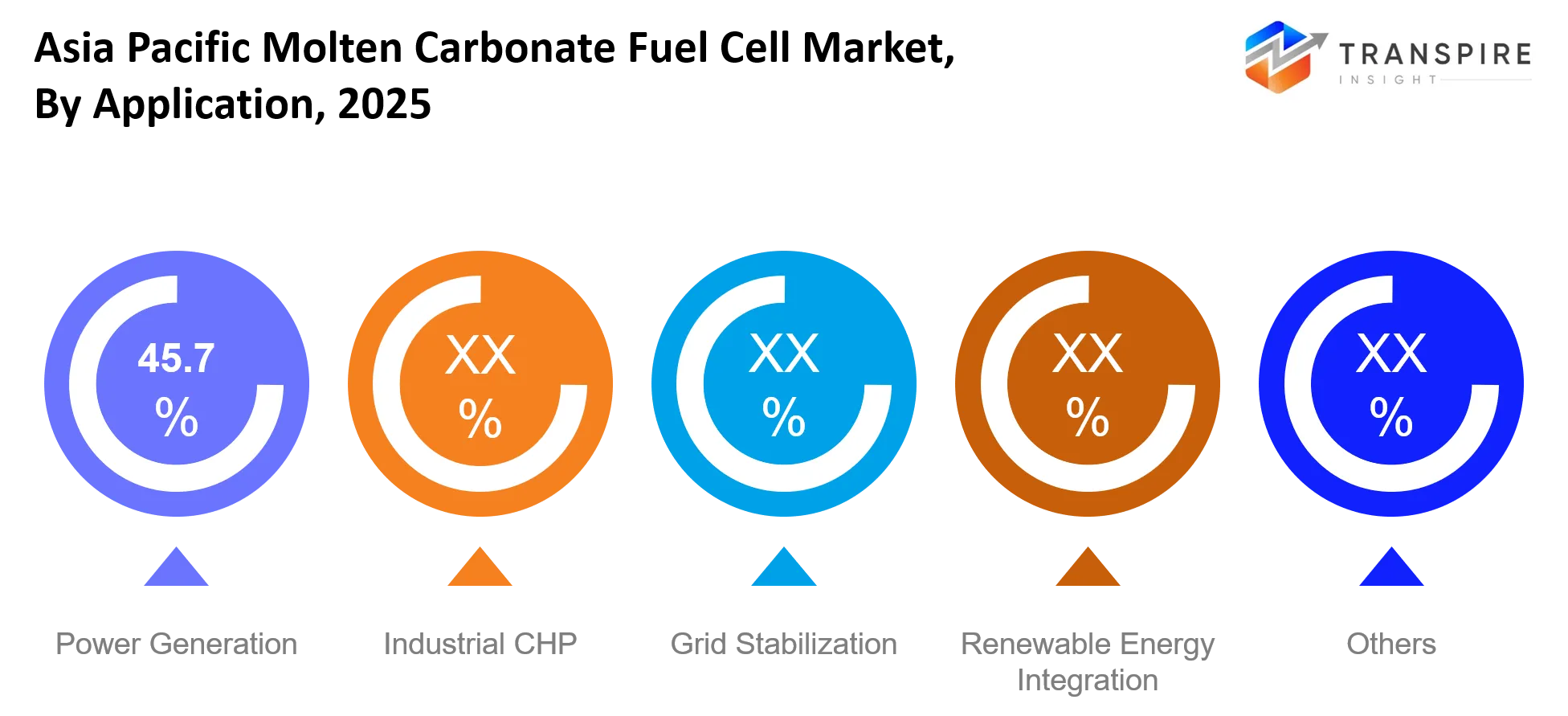
To learn more about this report, Download Free Sample Report
By End User :
Utilities are using molten carbonate fuel cells to sorta support distributed generation networks, and to back up long term decarbonization targets. When it comes to large scale deployment, the big emphasis is on grid dependability, while also cutting reliance on more traditional fossil fuel power sources, as much as possible.
In the Industrial Sector these setups get adopted for keeping stable electricity available, especially for manufacturing and processing work. Commercial Facilities also lean on fuel cells, mainly to control energy expenses and boost day to day operational resilience. The Others bucket covers institutional users, research groups, and niche facilities, these typically need dependable yet efficient power generation solutions for particular operational requirements, and it tends to be the dependable part that matters most in practice.
What are the Key Use Cases Driving the Asia Pacific Molten Carbonate Fuel Cell Market?
The main use case that’s driving adoption of molten carbonate fuel cells across Asia Pacific looks like distributed power generation, mainly for utilities and also for big industrial sites. In places like manufacturing plants, petrochemical complexes, and other energy-heavy operations, teams need electricity that doesn’t really stop, and fuel cell systems tend to deliver pretty stable power while at the same time helping operators hit tighter, more demanding carbon reduction targets.
But it’s not only about electricity. Industrial combined heat and power setups are also starting to gain real traction, especially across chemical processing, food manufacturing , and refinery operations. On the commercial side, locations like data centers and large business complexes are increasingly looking at fuel cell systems too, mostly to boost energy reliability and to cut back on the usual dependence on grid fluctuations.
At the moment, some emerging use cases are forming around hydrogen-driven energy arrangements and carbon capture tie-ins. Some projects in Japan and South Korea are currently looking at molten carbonate fuel cells for hydrogen use ,and also for carbon dioxide capture. It’s still early work ,not fully mature yet, but it might end up opening new opportunities ,especially if governments keep growing the backing for industrial decarbonization plus hydrogen infrastructure expansion.
|
Report Metrics |
Details |
|
Market size value in 2025 |
USD 386.4 Million |
|
Market size value in 2026 |
USD 430.6 Million |
|
Revenue forecast in 2033 |
USD 918.9 Million |
|
Growth rate |
CAGR of 11.44% from 2026 to 2033 |
|
Base year |
2025 |
|
Historical data |
2021 - 2024 |
|
Forecast period |
2026 - 2033 |
|
Report coverage |
Revenue forecast, competitive landscape, growth factors, and trends |
|
Regional scope |
Asia Pacific (India, China, Japan, Australia,South Korea, Rest of Asia Pacific) |
|
Key company profiled |
FuelCell Energy, POSCO Energy, Mitsubishi Power, Hitachi Zosen, Doosan Fuel Cell, Siemens Energy, Toshiba Energy Systems, Bloom Energy, Ansaldo Energia, Kawasaki Heavy Industries, Ballard Power Systems, Ceres Power, Panasonic, Cummins, ABB |
|
Customization scope |
Free report customization (country, regional & segment scope). Avail customized purchase options to meet your exact research needs. |
|
Report Segmentation |
By Product Type (Internal Reforming MCFC, External Reforming MCFC, Hybrid MCFC Systems, Others); By Application (Power Generation, Industrial CHP, Grid Stabilization, Renewable Energy Integration, Others); By End User (Utilities, Industrial Sector, Commercial Facilities, Others) |
Which Regions are Driving the Asia Pacific Molten Carbonate Fuel Cell Market Growth?
East Asia takes the lead in the Asia Pacific molten carbonate fuel cell market, with South Korea along with Japan acting as the key hubs for deployment, and tech progress. Heavy government backing for hydrogen economies, carbon neutrality goals, and distributed energy setups has basically pushed many companies to sink significant capital into fuel cell infrastructure. On top of that, the region is sitting on solid manufacturing foundations, well developed utility networks, and a pool of seasoned technology providers. With policy momentum, industrial pull, and hands on technical experience working together, market leadership keeps getting reinforced, even when conditions change.
Oceania is the next major regional contributor, though the market story looks a bit different than in East Asia. Its growth comes from longer horizon energy transition blueprints, relatively steady investment conditions and a very real appetite for low‑emission electricity solutions, mainly for industrial and commercial uses. Australia is especially notable, it has kept supporting clean energy initiatives through both public funding and private sector money. All of this ends up forming a dependable lane for project pipeline building and, in turn, supports a consistent inflow to regional revenue.
Southeast Asia is showing up as the fastest expanding region, mostly because governments are looking for dependable replacements to typical power generation. More recently, investments in industrial assets, grid modernization efforts and cleaner energy systems are making the adoption math look better for fuel cells. Places like Singapore, Thailand, and Malaysia are actively testing advanced energy options, aiming to boost energy security while also trimming emissions. That turn is opening up fresh space for technology suppliers, project developers, and investors who are watching for expansion opportunities between 2026 2033, yes roughly right in that window.
Who are the Key Players in the Asia Pacific Molten Carbonate Fuel Cell Market and How Do They Compete?
Competition in the Asia Pacific molten carbonate fuel cell market is still pretty concentrated, mainly because commercial roll-out needs specialized tech, long lead development cycles and a lot of cash upfront, not to mention patience. Most players tend to go at it based on how efficient the system is, how steady it runs over time, how well they execute projects, and how neatly it ties into hydrogen plus carbon management programs. The well established tech firms keep their footing with proprietary designs and long-term service agreements, but newer entrants usually lean more on partnerships, plus whatever demonstration work they can get underway, just to earn market access. Real success seems to come less from pure price rivalry and more from being able to prove performance that actually holds up, both in utility setups and in industrial environments.
FuelCell Energy stands out by bringing a broad track record with large-scale molten carbonate fuel cell systems, and by putting a strong emphasis on carbon capture integration. The company has been working on approaches that let fuel cells produce electricity, while also supporting carbon dioxide recovery efforts. That kind of capability gives it an edge in places where industrial decarbonization targets are tightening, sometimes quite quickly. Their expansion direction is increasingly about collaborations with utilities, industrial operators, and other organizations that are actively pursuing hydrogen and carbon management initiatives.
Doosan Fuel Cell kind of benefits from having a solid presence in South Korea, where government-backed clean energy programs keep pushing fuel cell deployment forward. The company tends to focus on localized manufacturing, service support, and a close, almost hands-on collaboration with utility customers in particular. Meanwhile, Mitsubishi Power and IHI Corporation keep putting energy fuel cell technologies into wider transition plans, which also cover hydrogen utilization and advanced power systems. In practice, they strengthen their market positions by leaning heavily on engineering know-how, technology development programs, and partnerships with industrial groups that are looking for long term, low-carbon energy solutions.
Company List
- FuelCell Energy
- POSCO Energy
- Mitsubishi Power
- Hitachi Zosen
- Doosan Fuel Cell
- Siemens Energy
- Toshiba Energy Systems
- Bloom Energy
- Ansaldo Energia
- Kawasaki Heavy Industries
- Ballard Power Systems
- Ceres Power
- Panasonic
- Cummins
- ABB
Recent Development News
In March 2025,FuelCell Energy entered a strategic partnership with Diversified Energy and TESIAC to form an acquisition and development company focused on off-grid power projects for data centers. The collaboration aims to deploy up to 360 MW of fuel-cell-based generation using coal mine methane and natural gas, reinforcing commercialization opportunities for carbonate fuel cell technology and expanding demand for stationary fuel cell systems.
Source https://investor.fce.com/
In March 2026,FuelCell Energy advanced deployment of its long-term service agreements in Asia by commissioning additional replacement carbonate fuel cell modules for both the Gyeonggi Green Energy (GGE) and CGN platforms in South Korea. The milestone supports continued investment in utility-scale molten carbonate fuel cell infrastructure and demonstrates sustained commercial activity in the Asia-Pacific MCFC market. Source https://investor.fce.com/
What Strategic Insights Define the Future of the Asia Pacific Molten Carbonate Fuel Cell Market?
The Asia Pacific molten carbonate fuel cell market is drifting toward a more integrated role inside the regional energy systems, instead of just sitting there as a stand alone power generation thing. Over the next five to seven years, growth will be pushed more and more by the coming together of industrial decarbonization, hydrogen infrastructure buildout, and the ongoing need for dependable distributed electricity. Plants that really need constant power plus usable heat will likely end up valuing solutions that juggle both energy security and emissions reduction targets, at the same time.
There is another risk, but it’s a bit less obvious. Technology substitution could quietly change the equation. Solid oxide fuel cells, advanced battery storage systems, and several other newly emerging low-carbon alternatives are getting better quickly. They might pull in funding that would have gone into molten carbonate fuel cell initiatives. On top of that, market concentration can cause its own trouble, since a small set of specialized suppliers could end up slowing rollouts, and making project execution harder to keep on track.
Still, there’s a fairly solid opportunity too. One idea is to link molten carbonate fuel cells with carbon capture use cases in heavy industries like cement, refining, and chemicals. Companies in this space should lean into partnerships with industrial operators, and also coordinate closely with hydrogen project developers. Early placement in those industries, even before the market fully matures, could produce longer runway revenue prospects than trying to compete only in the usual distributed power arenas.
Asia Pacific Molten Carbonate Fuel Cell Market Report Segmentation
By Product Type
- Internal Reforming MCFC
- External Reforming MCFC
- Hybrid MCFC Systems
By Application
- Power Generation
- Industrial CHP
- Grid Stabilization
- Renewable Energy Integration
By End User
- Utilities
- Industrial Sector
- Commercial Facilities
Frequently Asked Questions
Find quick answers to common questions.
The Asia Pacific Molten Carbonate Fuel Cell Market size is USD 918.9 Million in 2033.
Key Segments for the Asia Pacific Molten Carbonate Fuel Cell Market are By Product Type (Internal Reforming MCFC, External Reforming MCFC, Hybrid MCFC Systems, Others); By Application (Power Generation, Industrial CHP, Grid Stabilization, Renewable Energy Integration, Others); By End User (Utilities, Industrial Sector, Commercial Facilities, Others).
Major Asia Pacific Molten Carbonate Fuel Cell Market Players are FuelCell Energy, POSCO Energy, Mitsubishi Power, Hitachi Zosen, Doosan Fuel Cell, Siemens Energy, Toshiba Energy Systems, Bloom Energy, Ansaldo Energia, Kawasaki Heavy Industries, Ballard Power Systems, Ceres Power, Panasonic, Cummins, ABB.
The Current Asia Pacific Molten Carbonate Fuel Cell Market size is USD 386.4 Million in 2025.
The Asia Pacific Molten Carbonate Fuel Cell Market CAGR is 11.44% from 2026 to 2033.
- FuelCell Energy
- POSCO Energy
- Mitsubishi Power
- Hitachi Zosen
- Doosan Fuel Cell
- Siemens Energy
- Toshiba Energy Systems
- Bloom Energy
- Ansaldo Energia
- Kawasaki Heavy Industries
- Ballard Power Systems
- Ceres Power
- Panasonic
- Cummins
- ABB
About the Authors

Avinash Kumar
I’m Avinash Kumar, a Senior Research Analyst at Transpire Insight, with expertise in the Electronics and Semiconductor and Energy & Power industry. My work focuses on analyzing emerging technologies, market trends, industry developments, and innovation across these sectors. I specialize in transforming complex technical and market insights into clear, research-backed content that helps professionals, businesses, and decision-makers stay informed. Through continuous industry research and data-driven analysis, I strive to deliver accurate, reliable, and practical perspectives on the latest advancements shaping the semiconductor and energy landscape.

Chakradhar Khansole
Chakradhar serves as the Research Director at Transpire Insight, bringing over 8 years of experience in technology, innovation, and strategic market intelligence. He specializes in transforming complex market data into actionable business insights that enable organizations to make informed, growth-oriented decisions. Recognized for his strategic vision and analytical expertise, Chakradhar leads high-impact research initiatives, delivering comprehensive market assessments, competitive intelligence, and forward-looking industry analysis.
Recently Published Reports
-
Apr 2026
Active Power Filter Market
Active Power Filter Market Size, Share & Analysis Report By Type (Shunt Active Power Filters, Series Active Power Filter, Hybrid Active Power Filter), By Application (Harmonics Mitigation, Reactive Power Compensation, Voltage Regulation, Power Factor Correction), By Phase (Single Phase, Three Phase), By End-User Industry (Manufacturing, Healthcare, Commercial, Automotive, Oil and Gas, Others), and Geography (North America, Europe, Asia-Pacific, Middle East and Africa, South and Central America), 2021 - 2031
-
Apr 2026
Electrical Transformer Market
Electrical Transformer Market Size, Share & Analysis Report By Core (Closed, Shell, and Berry), By Insulation (Gas, Oil, Solid, Air, and Other), By Phase (Single, and Three), By Rating (100 MVA to 500 MVA, 501 MVA to 800 MVA, and 801 MVA to 1200 MVA), and Geography (North America, Europe, Asia-Pacific, Middle East and Africa, South and Central America), 2021 – 2031
-
Apr 2026
Hydraulic Piston Pumps Market
Hydraulic Piston Pumps Market Size, Share & Analysis Report By Type (Axial Piston Pumps, Radial Piston Pumps), By Operating Pressure (Low Pressure, Medium Pressure, High Pressure), By Application (Construction, Mining, Agriculture, Automotive, Oil & Gas, Industrial Machinery, Others), By End-User (OEMs, Aftermarket), and Geography (North America, Europe, Asia-Pacific, Middle East and Africa, South and Central America), 2021 – 2031
-
Apr 2026
Laboratory Gas Generators Market
Laboratory Gas Generators Market Size, Share & Analysis Report By Product (Nitrogen Gas Generator, Hydrogen Gas Generator, Zero Air Gas Generator, Purge Gas Generator, TOC Gas Generators, Others), By Application (Gas Chromatography, Liquid Chromatography-mass Spectrometry (LC-MS), Gas Analyzers, Others), By End-user (Life Science, Chemical & Petrochemical, Food & Beverage, Others), and Geography (North America, Europe, Asia-Pacific, Middle East and Africa, South and Central America), 2021 – 2031