

South Korea Solid Oxide Fuel Cell Market Size & Forecast:
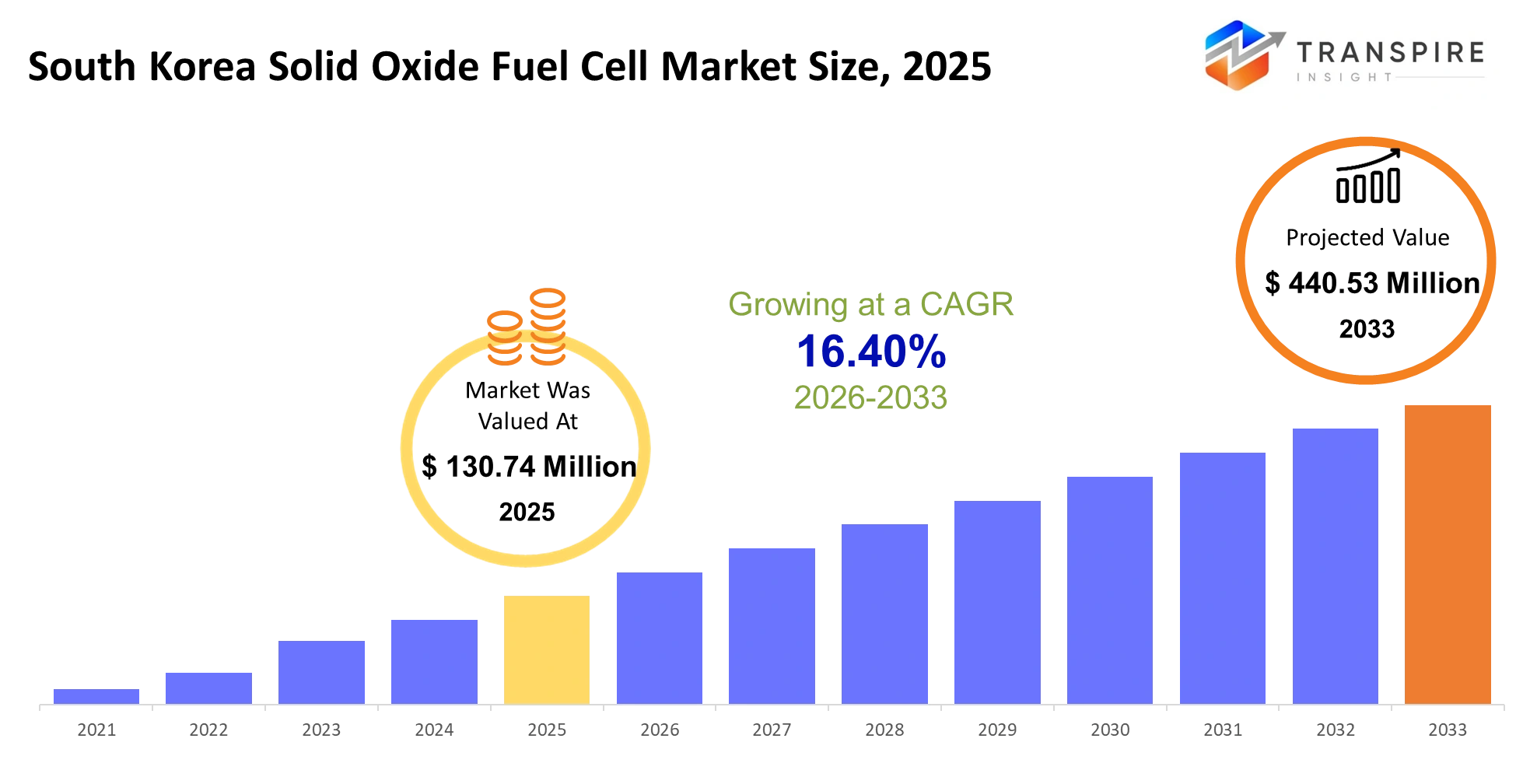
- South Korea Solid Oxide Fuel Cell Market Size 2025: USD 130.74 Million
- South Korea Solid Oxide Fuel Cell Market Size 2033: USD 440.53 Million
- South Korea Solid Oxide Fuel Cell Market CAGR: 16.40%
- South Korea Solid Oxide Fuel Cell Market Segments: By Component (Stacks, Balance of Plant, Power Electronics, Fuel Processors, Others); By Application (Stationary Power Generation, Combined Heat & Power, Auxiliary Power Units, Others); By Fuel Type (Hydrogen, Natural Gas, Biogas, Others); By End User (Utilities, Industrial Facilities, Commercial Buildings, Others).
To learn more about this report,  Download Free Sample Report
South Korea Solid Oxide Fuel Cell Market Summary
The South Korea Solid Oxide Fuel Cell Market was valued at USD 130.74 Million in 2025. It is forecast to reach USD 440.53 Million by 2033. That is a CAGR of 16.40% over the period.
In practice, solid oxide fuel cells in South Korea are starting to get deployed as high-efficiency power units that turn hydrogen and other fuels into electricity, for buildings, industrial locations, and a bunch of emerging maritime auxiliary setups. They cut back dependence on diesel generators a bit, and they help steady on site energy supply when grid dependability is shaky, or when decarbonization targets really matter, like in data centers, ship propulsion support systems, and distributed industrial energy hubs that are popping up everywhere.
Over the last 3–5 years, the market has moved, from demonstration sized installations into early commercial roll out, mostly because there’s been a structural shift toward hydrogen based distributed generation under national energy transition policies. At the same time, the energy disruption linked with Russia-Ukraine tightened up global LNG and diesel supply chains, so end users started looking harder at localized, fuel-flexible power setups, kind of like a practical fallback plan. Put together, the policy push with that fuel volatility really sped up procurement, boosted project bankability , and nudged manufacturers toward scalable, modular SOFC systems, designed for continuous industrial operation, not those stop and start kinds.
Key Market Insights
- South Korea Solid Oxide Fuel Cell Market is really picking up momentum, as hydrogen based distributed power starts taking over for diesel backup in industrial energy set ups and also data centers.
- This growth happens because South Korea has a hydrogen roadmap, plus very strict carbon neutrality objectives across manufacturing and maritime activities, so the incentives sort of stack up.
- In the South Korea Solid Oxide Fuel Cell Market, adoption is most noticeable inside semiconductor clusters and smart factories that need stable uninterrupted baseload type electricity.
- Gyeonggi Province holds the lead with roughly 40–45% of the share , mostly because the industrial framework is thick there and energy consumption runs high.
- The Ulsan–Busan area is the fastest moving one , mainly due to shipbuilding electrification and LNG port decarbonization efforts that keep expanding.
- Stationary SOFC configurations dominate with about 55–60% share, since industry still needs continuous operational power demand.
- Modular SOFC systems are fastest growing, because organizations like scalable and adaptable hydrogen ready energy setups, it just fits better with planning cycles.
- For applications, industrial power generation stays in front, taking nearly half of the total usage share across the South Korea Solid Oxide Fuel Cell Market.
- Maritime auxiliary power is growing quickly too, because IMO emission rules are pushing companies toward cleaner shipping and green adoption.
- Key players like Bloom Energy, Doosan Fuel Cell, and Siemens Energy compete by rolling out efficiency upgrades, building partnerships, and focusing on hydrogen integration tactics, more or less.
What are the Key Drivers, Restraints, and Opportunities in the South Korea Solid Oxide Fuel Cell Market?
The main driver of the South Korea Solid Oxide Fuel Cell Market is basically the country moving toward hydrogen-centered distributed energy systems and it’s being pushed by long-term decarbonization policy frameworks, right. With government-backed hydrogen roadmaps plus industrial electrification requirements, utilities, shipbuilders and manufacturers are leaning into high-efficiency fuel cell setups that can run on hydrogen, ammonia derived fuels, or even reformed natural gas. This has already pushed more commercial rollouts, mostly in data centers and industrial clusters where steady, low-emission electricity helps keep operating expenses steadier and also supports regulatory compliance, not just vaguely but in real measurable ways.
Still, the big restraint is the system integration and maintenance complexity, especially because SOFC units run at higher operating temperatures and the SOFC stack materials face degradation over time. Those issues tend to raise the upfront capital costs, and they also stretch the payback period, so adoption at scale becomes slower in cost-sensitive industrial pockets. On top of that, balance-of-plant engineering needs specialized know-how, and that kinda limits fast scaling for mid-tier operators. So suppliers see a delay in wider revenue expansion, even when demand is there.
The main opportunity sits in maritime auxiliary power and port electrification, where SOFCs can substitute for diesel powered shipboard generators. South Korea’s shipbuilding circle, especially around Busan and Ulsan, is actively trying hybrid fuel arrangements. As green shipping corridors keep expanding, SOFC uptake in vessel auxiliary units plus shore power integration is expected to open up the next growth stage.
What Has the Impact of Artificial Intelligence Been on the South Korea Solid Oxide Fuel Cell Market?
Artificial intelligence is getting used more and more, to optimize operational efficiency in solid oxide fuel cell systems that are deployed across industrial and maritime settings in South Korea. In the control side of things, AI driven automation adjusts fuel flow rate, stack temperature and load balancing, kind of in real time, which makes the system more steady especially during those high temperature operations. On ships, digital monitoring platforms bring in AI algorithms to track emissions performance and to make sure rules are followed, with both port requirements and international regulations, so there is less reliance on manual inspection or at least, that’s the idea.
Predictive maintenance has become one of the more meaningful uses here, where machine learning models analyze vibration patterns along with thermal cycling information and degradation signals from the fuel cell stacks. This helps operators predict stack wear, and then plan replacements ahead of time before efficiency actually falls, which supports higher uptime and fewer surprise shutdowns. In practical terms, early deployments have shown a kind of upward direction in fuel efficiency and also longer maintenance intervals, especially in industrial setups that run continuously.
That said, AI adoption in this market is still limited, mostly because there’s not enough real world operational data coming from large scale SOFC installations. The maritime environment is harsh and the operating temperatures are high, so the data can vary a lot, which can lower model accuracy and, yes, raise integration costs for predictive systems that are truly reliable.
Key Market Trends
- Since 2022, South Korean manufacturers have started moving away from imported SOFC stacks, toward localized production partnerships, which (somehow) cuts external dependency by around 30% across the domestic supply chain.
- Industrial buyers , more and more often swapped diesel backup systems for fuel-flexible SOFC platforms, especially after LNG prices jumped over 60% during the 2022 energy disruption.
- Doosan Fuel Cell seemed to push commercialization forward in 2025 by scaling a 50 MW annual SOFC manufacturing capacity, aimed at industrial and maritime use cases.
- Meanwhile data center operators leaned into distributed fuel cells after electricity demand from Korean hyperscale facilities rose roughly 15–18% between 2021 and 2025, it was pretty noticeable.
- Shipbuilders in Ulsan and Busan also rebalanced spending toward hybrid hydrogen auxiliary systems, following tighter IMO emissions rules that affect more than 90% of export shipping fleets.
- Between 2021 and 2025, modular SOFC architecture shortened installation timelines by nearly 25%, so deployment flexibility got better for industrial energy operators.
- AI-enabled predictive maintenance systems then improved fuel cell uptime by about 10–15% in early deployments, because unplanned stack degradation failures were reduced.
- South Korean regulators have increasingly tied hydrogen incentives to domestic manufacturing content, boosting localized fuel cell component investment after 2023.
- Partnerships that involve Bloom Energy expanded too, as export-focused manufacturers went after carbon reduction commitments that match global ESG reporting standards.
- And since 2024, the Jeju Island renewable microgrid pilots have been integrating SOFC systems with battery storage, improving off-grid stability , and reducing diesel generator dependence by close to 40%.
South Korea Solid Oxide Fuel Cell Market Segmentation
By Component
Stacks kinda take the dominant place in the South Korea Solid Oxide Fuel Cell Market, mainly because electrochemical conversion efficiency and system durability are pretty much tied to how the stack actually performs. Because of that, manufacturers push stack innovation hard, to stretch operating lifespan, keep thermal stability steadier, and lift fuel conversion rates, especially once you get into industrial scale deployments. Then you have Balance of Plant systems, which sit as the second-largest segment, mostly due to thermal management needs, air supply control, and the full system integration work across bigger distributed power installations. Power electronics keep a steady kind of demand too, since industrial users expect more advanced load regulation and grid synchronization, meanwhile fuel processors stay important for units running on natural gas and also mixed-fuel setups. The “others” group is more limited, it usually covers specialized auxiliary technologies and niche integration components.
Stack demand is being driven by more local manufacturing and the push for higher-efficiency industrial power configurations. Balance of Plant growth is linked to deployment becoming more complex in places like large data centers and maritime energy systems, which need stronger thermal regulation. Fuel processors, on the other hand, see slower adoption in pure hydrogen scenarios, but they still matter a lot in transitional energy infrastructure, where natural gas reforming helps maintain fuel flexibility. Over the forecast period, stack developers are expected to lean into ceramic material refinement and a modular architecture approach, while investors will probably back suppliers who can lower degradation rates and support long-duration operational stability, like really long running performance.
By Application
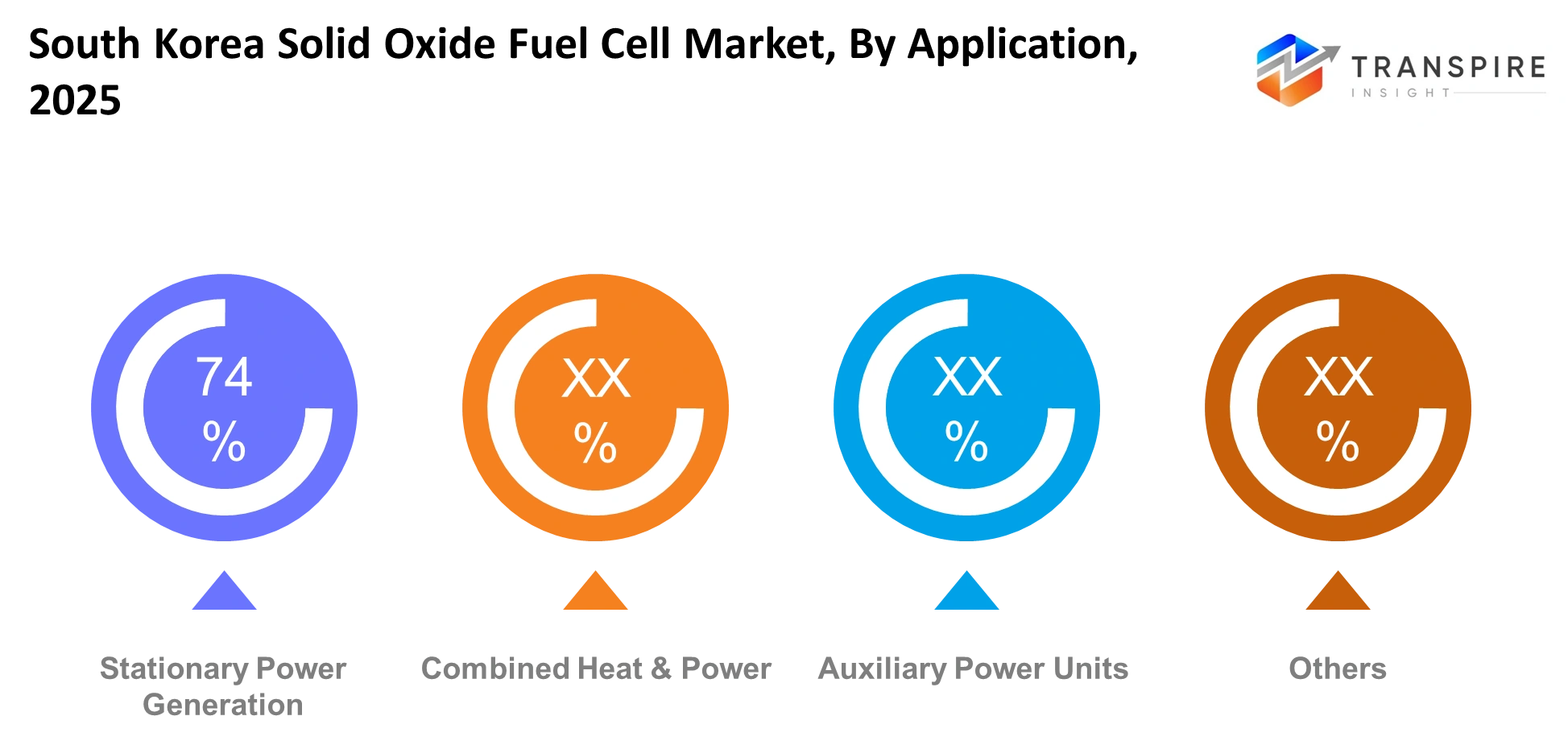
Stationary power generation takes the lead in the South Korea Solid Oxide Fuel Cell market, mostly because electricity demand keeps running steady from semiconductor fabs, industrial parks and also hyperscale data centers, you know the usual kind. The electrical efficiency is pretty high and the baseload output tends to be consistent, so SOFC systems feel especially useful for industrial users who want lower dependence on the grid, and more predictable operating costs. Then there is Combined Heat & Power, which is more or less a secondary segment but it still looks strong, since more facilities are leaning into waste heat utilization to stretch overall energy performance. Auxiliary power units keep getting wider attention in maritime and logistics too, because emissions compliance and onboard energy effectiveness have turned into day to day priorities. At the same time, some deployments are still stuck at pilot scale or they stay research oriented, at least for now.
Growth for stationary power generation is reinforced by long-life industrial power needs, plus policy incentives that connect to hydrogen infrastructure buildout. CHP keeps getting traction as fuel prices climb, and as manufacturing operators place more weight on energy optimization. Auxiliary power units are also accelerating, driven by stricter IMO emissions requirements, and by more funding that supports hydrogen powered maritime systems. Through the forecast horizon, stationary solutions are expected to keep that top position, but auxiliary uses may grow faster as shipbuilders and logistics operators speed up low emission vessel integration, and port electrification programs.
To learn more about this report, Download Free Sample Report
By Fuel Type
Natural gas right now kinda has the main hold in the South Korea Solid Oxide Fuel Cell Market, largely because the existing LNG infrastructure makes it easier to plug in, and also keeps the short term deployment costs lower, than the alternatives. A lot of industrial operators keep leaning toward natural gas compatible setups while they move, step by step , toward bigger hydrogen availability. Hydrogen sits as the second largest segment and it is growing steadily, helped by government backed hydrogen economy pushes, and by more money going into clean energy infrastructure. Biogas stays smaller but it is still an emerging category, mostly tied to waste to energy work and localized circular economy plans, while “others” covers a few experimental synthetic fuel uses, with pretty limited commercial deployment.
Natural gas demand is basically shaped by how available the fuel is, and how well it fits with the energy systems that are already running in industry. Hydrogen adoption picks up momentum as electrolyzer deployment moves forward, and as investments in hydrogen storage improve supply chain readiness across industrial clusters and near port infrastructure. Biogas growth is supported by municipal waste management strategies and carbon reduction targets, especially in those localized energy arrangements. Looking across the forecast period, hydrogen is expected to take on more share as the infrastructure keeps maturing. That, in turn , encourages fuel cell developers to focus more on hydrogen ready designs, and on long term industrial decarbonization partnerships.
By End User
Industrial facilities kind of dominate the South Korea Solid Oxide Fuel Cell market, not because it sounds nice , but because production lines need steady, uninterrupted high-load electricity and long run cycles. Inside semiconductor plants and petrochemical complexes, plus the bigger heavy industrial areas, SOFC setups are getting used more often to help stabilize the power situation and also to cut down the exposure to electricity price swings. Utilities sit in the second-largest share, mostly as investments rise for distributed generation and grid support work. Commercial sites are still growing at a steady pace , especially in hospitals, business parks, and data centers , while a bunch of other activity stays tied to research centers and pilot-scale energy programs.
For industrial facilities , demand is pulled by the need for operational continuity and strict carbon reduction commitments across export-focused sectors. Utility adoption gets a boost from national plans aimed at energy diversification and from actions meant to expand distributed generation capabilities. In commercial buildings, growth is helped by the upward trend in electricity consumption and the push for cleaner backup power, mainly where digital infrastructure keeps expanding. Through the forecast period, utilities should ramp up purchasing as grid decentralization accelerates , and that opens doors for system integrators plus long-term service partners focused on scalable hydrogen-compatible power infrastructure.
What are the Key Use Cases Driving the South Korea Solid Oxide Fuel Cell Market?
Industrial distributed power generation is still the main driving factor behind the South Korea Solid Oxide Fuel Cell Market, especially when you look at semiconductor fabs, petrochemical complexes , and hyperscale data centers. In these kinds of places they need nonstop baseload electricity and strong thermal efficiency, so SOFC systems feel more compelling for cutting grid dependency and keeping things running for a long run, even while carbon reduction targets stay strict and non negotiable
At the same time, more and more expansions are showing up in auxiliary marine power systems for LNG carriers and other commercial vessels, working out of the shipyards in Ulsan and Busan. Port infrastructure owners and logistics hubs are also moving toward SOFC based backup power setups, mostly because IMO emissions requirements are getting tighter, and because energy reliability matters a lot in busy coastal industrial corridors
Then you get emerging use cases, like hydrogen powered island microgrids and offshore energy platforms that support remote operations. Early pilot trials in Jeju and along the southern coasts show a pretty solid long term outlook, as South Korea keeps building hydrogen infrastructure and pushes decentralized clean energy deployment all the way through 2033
|
Report Metrics |
Details |
|
Market size value in 2025 |
USD 130.74 Million |
|
Market size value in 2026 |
USD 152.18 Million |
|
Revenue forecast in 2033 |
USD 440.53 Million |
|
Growth rate |
CAGR of 16.40% from 2026 to 2033 |
|
Base year |
2025 |
|
Historical data |
2021 - 2024 |
|
Forecast period |
2026 - 2033 |
|
Report coverage |
Revenue forecast, competitive landscape, growth factors, and trends |
|
Regional scope |
South Korea |
|
Key company profiled |
Bloom Energy, Doosan Fuel Cell, Mitsubishi Power, Siemens Energy, FuelCell Energy, Ceres Power, Bosch, Convion, Elcogen, Sunfire, POSCO Energy, Aisin Corporation, Hexis, Rolls-Royce, Cummins. |
|
Customization scope |
Free report customization (country, regional & segment scope). Avail customized purchase options to meet your exact research needs. |
|
Report Segmentation |
By Component (Stacks, Balance of Plant, Power Electronics, Fuel Processors, Others); By Application (Stationary Power Generation, Combined Heat & Power, Auxiliary Power Units, Others); By Fuel Type (Hydrogen, Natural Gas, Biogas, Others); By End User (Utilities, Industrial Facilities, Commercial Buildings, Others). |
Which Regions are Driving the South Korea Solid Oxide Fuel Cell Market Growth?
In the South Korea Solid Oxide Fuel Cell Market the biggest use case is pretty much stationary power generation for industrial compounds and data centers, where steady, “always-on” electricity and a better conversion efficiency really matter for mission critical tasks. The strongest pull is coming from semiconductor fabrication plants and smart manufacturing clusters that want stable baseload power with a lower carbon footprint.
On top of that, there’s expansion into auxiliary power for commercial vessels, plus backup electricity for LNG terminals and port installations. Shipbuilders and energy operators are now folding SOFC modules into their designs so they can follow tougher emissions limits, under compliance structures that are aligned with IMO guidance, and also with local decarbonization ambitions.
More recently the emerging use case angle is hybrid hydrogen energy microgrids for island areas and offshore rigs. Those projects are still pilot scale, but they’re building momentum as South Korea trials longer duration clean power setups for remote maritime logistics and more energy resilient coastal zones.
Who are the Key Players in the South Korea Solid Oxide Fuel Cell Market and How Do They Compete?
Gyeonggi Province is really leading the South Korea Solid Oxide Fuel Cell Market, mostly because so many semiconductor fabrication plants are concentrated there , plus data centers and those high-density industrial parks. You can see the region also gets pushed by strong grid demand pressure and pretty strict corporate decarbonization commitments. So, adoption grows around high-efficiency fuel cell systems that are kind of better suited for steady power. On top of that, the government-backed hydrogen hubs near Pangyo and Suwon help build up early deployment ecosystems. And since it is close to big R&D institutions, commercialization of SOFC prototypes tends to move faster. Overall, these factors pile up into a dense demand cluster, which keeps the long-term adoption momentum moving.
Ulsan and Busan then become the next main region, supported by shipbuilding , petrochemical operations, and LNG import infrastructure. But here it’s a bit different from Gyeonggi’s tech-forward pull. This area leans more on heavy industrial energy consumption and maritime fuel transition requirements. In practice, shipyards around Ulsan are already running fuel cell systems in vessel auxiliary power trials, kind of like field testing in real conditions. Plus, industrial output stays steady, and long-term contracts from global shipping operators help lock in consistent adoption cycles. That’s why this region ends up acting like a dependable revenue base for fuel cell suppliers aiming for maritime decarbonization pathways.
Jeju Island along with the southern coastal zones are showing the fastest growth, mainly because renewable integration has been expanding recently, and hydrogen microgrid pilots are getting more attention. Government-backed carbon-neutral island initiatives have helped speed up deployment of hybrid SOFC systems for off-grid stability. Also, tourism related energy demand is rising, and island energy security concerns are making stakeholders look for more resilient solutions. For the period over 2026–2033, this region is expected to turn into a testing ground for scalable distributed hydrogen energy models. That should give early-mover advantages to technology providers.
Company List
- Bloom Energy
- Doosan Fuel Cell
- Mitsubishi Power
- Siemens Energy
- FuelCell Energy
- Ceres Power
- Bosch
- Convion
- Elcogen
- Sunfire
- POSCO Energy
- Aisin Corporation
- Hexis
- Rolls-Royce
- Cummins
Recent Development News
"In July 2025, Doosan Fuel Cell commenced mass production of solid oxide fuel cell systems using Ceres Power technology. The launch marked South Korea’s first dedicated SOFC manufacturing facility and enabled commercialization for data centers and industrial power users, accelerating early-stage adoption in distributed energy markets.
Source: http://www.ceres.tech
"In July 2025, Doosan Fuel Cell expanded its SOFC manufacturing operations in Jeollabuk-do, South Korea. The company established a 50 MW annual production capacity facility, strengthening domestic supply chains and supporting large-scale deployment in stationary power and marine auxiliary applications.
Source: http://hydrogentechworld.com
What Strategic Insights Define the Future of the South Korea Solid Oxide Fuel Cell Market?
The South Korea Solid Oxide Fuel Cell Market is sort of structurally moving toward embedded industrial energy setups where hydrogen based distributed generation is becoming part of the core infrastructure, especially in manufacturing, ports and those digital industries. This change is not just a trend really, it is pushed by long term decarbonization rules and energy security worries that come from being exposed to imported fossil fuels.
There is also a less visible risk that people don’t always talk about, tech substitution from competing fuel cell approaches like PEM systems and even quick battery driven industrial backup solutions. That kind of replacement could slow down SOFC scaling, particularly in segments that are very cost sensitive. On top of that, the supply chain concentration in high temperature ceramic materials brings its own fragility.
Still, a pretty meaningful emerging opportunity sits in adding SOFC systems into green shipping corridors and offshore energy platforms. In those cases continuous high efficiency power tends to matter more than intermittent renewable inputs. Players that move early with maritime decarbonization initiatives and with hydrogen port infrastructure development will likely secure long cycle contracts before broad standardization fully shows up.
South Korea Solid Oxide Fuel Cell Market Report Segmentation
By Component
- Stacks
- Balance of Plant
- Power Electronics
- Fuel Processors
- Others
By Application
- Stationary Power Generation
- Combined Heat & Power
- Auxiliary Power Units
- Others
By Fuel Type
- Hydrogen
- Natural Gas
- Biogas
- Others
By End User
- Utilities
- Industrial Facilities
- Commercial Buildings
- Others
Frequently Asked Questions
Find quick answers to common questions.
The estimated South Korea Solid Oxide Fuel Cell Market size for the market will be USD 440.53 Million in 2033.
Key segments for the South Korea Solid Oxide Fuel Cell Market are By Component (Stacks, Balance of Plant, Power Electronics, Fuel Processors, Others); By Application (Stationary Power Generation, Combined Heat & Power, Auxiliary Power Units, Others); By Fuel Type (Hydrogen, Natural Gas, Biogas, Others); By End User (Utilities, Industrial Facilities, Commercial Buildings, Others).
Major South Korea Solid Oxide Fuel Cell Market players are Bloom Energy, Doosan Fuel Cell, Mitsubishi Power, Siemens Energy, FuelCell Energy, Ceres Power, Bosch, Convion, Elcogen, Sunfire, POSCO Energy, Aisin Corporation, Hexis, Rolls-Royce, Cummins.
The South Korea Solid Oxide Fuel Cell Market size is USD 130.74 Million in 2025.
The South Korea Solid Oxide Fuel Cell Market CAGR is 16.40% from 2026 to 2033.
- Bloom Energy
- Doosan Fuel Cell
- Mitsubishi Power
- Siemens Energy
- FuelCell Energy
- Ceres Power
- Bosch
- Convion
- Elcogen
- Sunfire
- POSCO Energy
- Aisin Corporation
- Hexis
- Rolls-Royce
- Cummins
Recently Published Reports
-
Apr 2026
Active Power Filter Market
Active Power Filter Market Size, Share & Analysis Report By Type (Shunt Active Power Filters, Series Active Power Filter, Hybrid Active Power Filter), By Application (Harmonics Mitigation, Reactive Power Compensation, Voltage Regulation, Power Factor Correction), By Phase (Single Phase, Three Phase), By End-User Industry (Manufacturing, Healthcare, Commercial, Automotive, Oil and Gas, Others), and Geography (North America, Europe, Asia-Pacific, Middle East and Africa, South and Central America), 2021 - 2031
-
Apr 2026
Electrical Transformer Market
Electrical Transformer Market Size, Share & Analysis Report By Core (Closed, Shell, and Berry), By Insulation (Gas, Oil, Solid, Air, and Other), By Phase (Single, and Three), By Rating (100 MVA to 500 MVA, 501 MVA to 800 MVA, and 801 MVA to 1200 MVA), and Geography (North America, Europe, Asia-Pacific, Middle East and Africa, South and Central America), 2021 – 2031
-
Apr 2026
Hydraulic Piston Pumps Market
Hydraulic Piston Pumps Market Size, Share & Analysis Report By Type (Axial Piston Pumps, Radial Piston Pumps), By Operating Pressure (Low Pressure, Medium Pressure, High Pressure), By Application (Construction, Mining, Agriculture, Automotive, Oil & Gas, Industrial Machinery, Others), By End-User (OEMs, Aftermarket), and Geography (North America, Europe, Asia-Pacific, Middle East and Africa, South and Central America), 2021 – 2031
-
Apr 2026
Laboratory Gas Generators Market
Laboratory Gas Generators Market Size, Share & Analysis Report By Product (Nitrogen Gas Generator, Hydrogen Gas Generator, Zero Air Gas Generator, Purge Gas Generator, TOC Gas Generators, Others), By Application (Gas Chromatography, Liquid Chromatography-mass Spectrometry (LC-MS), Gas Analyzers, Others), By End-user (Life Science, Chemical & Petrochemical, Food & Beverage, Others), and Geography (North America, Europe, Asia-Pacific, Middle East and Africa, South and Central America), 2021 – 2031