
South Korea Liquefied Natural Gas (LNG) Carrier Market Size & Forecast:
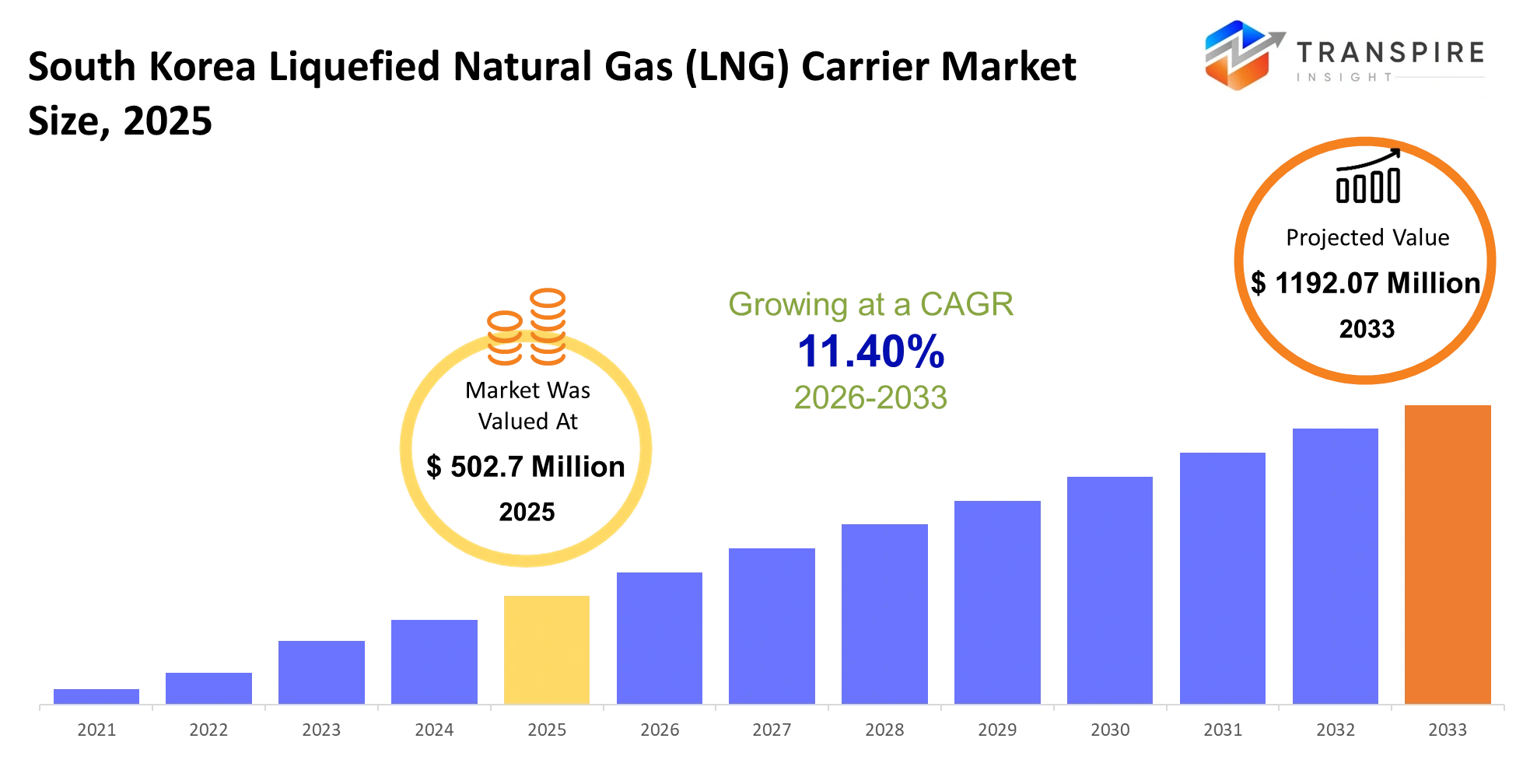
- South Korea Liquefied Natural Gas (LNG) Carrier Market Size 2025: USD 502.7 Million
- South Korea Liquefied Natural Gas (LNG) Carrier Market Size 2033: USD 1192.07 Million
- South Korea Liquefied Natural Gas (LNG) Carrier Market CAGR: 11.40%
- South Korea Liquefied Natural Gas (LNG) Carrier Market Segments: By Type (Moss Type, Membrane Type, Q-Flex, Q-Max), By Application (Transportation, Storage, Energy Trade), By End-User (Shipping Companies, Energy Firms, Governments).
To learn more about this report,  Download Free Sample Report
South Korea Liquefied Natural Gas (LNG) Carrier Market Summary:
South Korea Liquefied Natural Gas (LNG) Carrier Market size was estimated at USD 502.7 Million in 2025 and is anticipated to reach USD 1192.07 Million by 2033, growing at a CAGR of 11.40% from 2026 to 2033.
The South Korea liquefied natural gas carrier market has developed through three primary factors which include changes in fuel sourcing methods and ship design requirements and new environmental regulations that affect ship specifications.Shipbuilders will increasingly integrate cryogenic materials and digital monitoring systems and efficiency focused propulsion systems to meet new buyer demands from energy companies who need secure and dependable transportation solutions. Design certification processes will remain influenced by regulatory frameworks while operators will adopt new fuel and emissions control technologies that transform their approach to building and servicing carriers.
Key Market Trends & Insights:
- The South Korea Liquefied Natural Gas (LNG) Carrier Market experiences consistent expansion because the national energy planning system requires permanent gas imports. The shipbuilding industry keeps acquiring new contracts which are connected to their long-term supply contract commitments. The capacity expansion process of utilities and trading companies shows they need dependable LNG transportation systems.
- The South Korea Liquefied Natural Gas (LNG) Carrier Market depends on ongoing vessel engineering advancements. The new carriers provide better fuel performance through their new containment systems which create fewer emissions. Shipyards now use digital monitoring systems that enhance operational safety while reducing maintenance requirements to improve their global market position.
- The South Korea Liquefied Natural Gas (LNG) Carrier Market depends on its established shipbuilding partnerships with internationally recognized shipbuilders. The company can produce advanced ships because it possesses both extensive production facilities and specialized knowledge. The maritime manufacturing industry benefits from strong order volumes which create job opportunities and maintain steady income streams for its supply chain operations.
- The South Korea Liquefied Natural Gas (LNG) Carrier Market expands because Asian and European countries increase their LNG trading activities. The economies which depend on imports need transport services that create continuous demand. Fleet operators respond by securing newbuild contracts, ensuring alignment with expanding export terminals and long-distance shipping routes.
- The South Korea Liquefied Natural Gas (LNG) Carrier Market needs to meet environmental requirements which are becoming more demanding. The current ship designs aim to produce reduced carbon emissions while meeting international maritime regulations. Shipping networks across the world will achieve sustainability through the implementation of cleaner propulsion technologies which will operate efficiently.
South Korea Liquefied Natural Gas (LNG) Carrier Market Segmentation
By Type
- Moss Type: The operational performance of South Korea Liquefied Natural Gas (LNG) Carrier Market shows consistent utilization patterns for Moss Type ships which provide excellent safety features through their round tank design. The independent tank support system of this technology decreases the chances of leaks occurring while enhancing the system's ability to withstand extended ocean journeys. South Korean shipbuilders keep developing their insulation materials and structural design methods to achieve dependable LNG shipping operations.
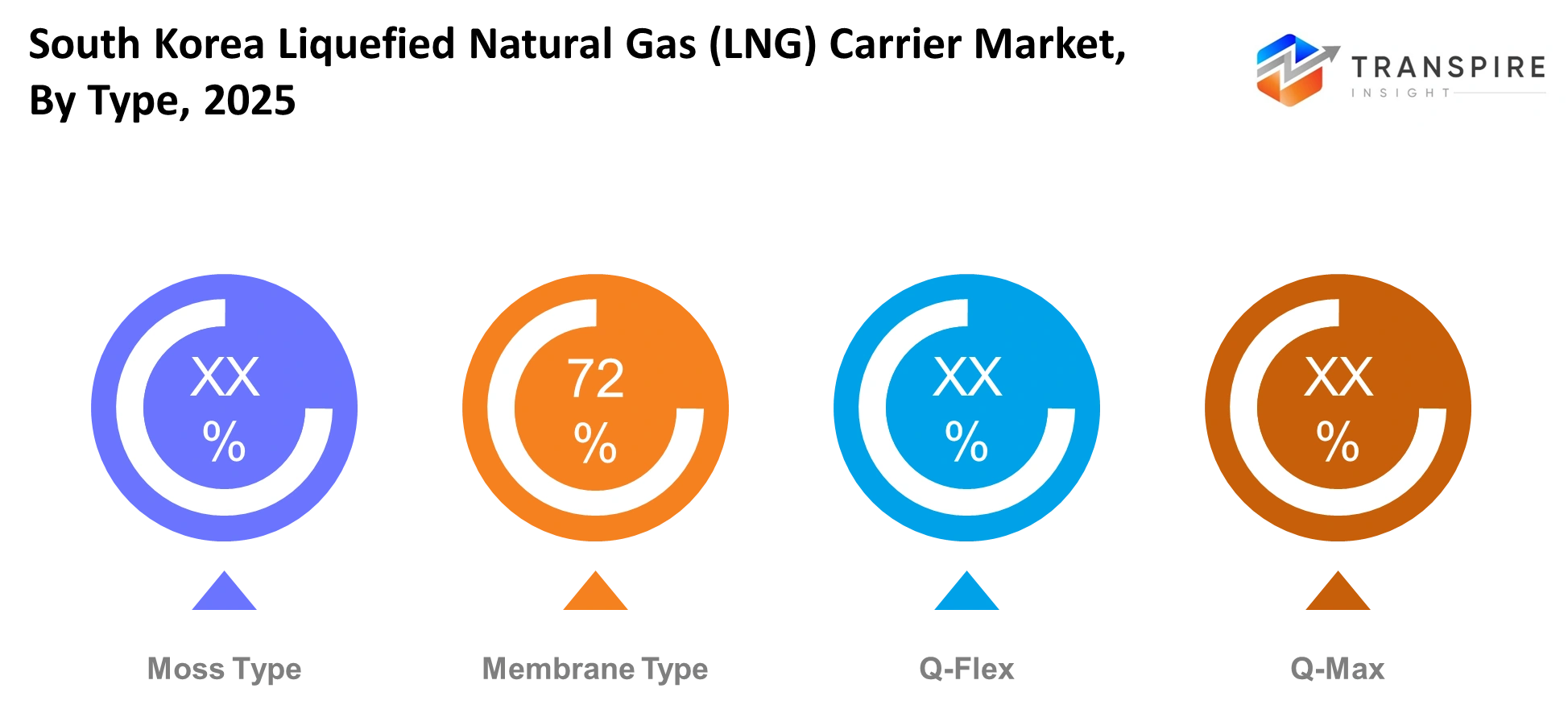
- Membrane Type: The South Korea Liquefied Natural Gas LNG Carrier Market depends primarily on Membrane Type carriers because they provide greater cargo capacity and better space efficiency. The thin membrane tanks of this system enable designated volume space through their hull dimensions. Ongoing system advancements enable organizations to achieve lower boil-off rates while enhancing fuel performance thus making this system the preferred choice.
- Q-Flex: The South Korea Liquefied Natural Gas LNG Carrier Market includes Q-Flex carriers which provide increased capacity and modern re-liquefaction technology for their onboard systems. These vessels enable cost-effective operations while minimizing cargo losses which occur during transit. The design enhancements enable Q-Flex to achieve an effective balance between fuel needs and operational performance which makes it ideal for long-distance LNG transportation.
- Q-Max: The South Korea Liquefied Natural Gas LNG Carrier Market features Q-Max carriers which stand as some of the most massive LNG carriers in existence today. The system can store high storage capacity which enables companies to transport large quantities while paying lower shipping costs per unit. The system maintains dependable operations through its advanced driving systems and improved containment technologies which function throughout lengthy international trade routes.
To learn more about this report, Download Free Sample Report
By Application
- Transportation: The South Korea Liquefied Natural Gas Carrier Market serves as the main link for transporting LNG between different continents. The design of the vessels provides protection for their cargoes while they travel through controlled temperature environments. The increasing demand for environmentally friendly fuel sources leads to higher dependency on LNG shipping which drives ongoing advancements in ship operating speed and storage capacity and fuel usage systems.
- Storage: The South Korea Liquefied Natural Gas Carrier Market enables floating storage operations at locations where onshore facilities do not exist. LNG carriers serve as temporary storage facilities which preserve cryogenic temperatures for long durations. The application establishes supply chain stability while providing capacity to manage demand changes across different importing regions.
- Energy Trade: The South Korea Liquefied Natural Gas Carrier Market supports global energy trade by enabling reliable LNG transportation between export and import nations. The shipping networks establish stability which benefits both long-term contract agreements and spot market operations. Efficient carriers enable timely delivery which helps to resolve supply shortfalls and maintains energy security across different areas.
By End-User
- Shipping Companies: The shipping companies which operate in South Korea drive their LNG carrier market through their investment in new LNG vessel technology. The company targets its operational activities to achieve better efficiency while reducing fuel consumption and meeting environmental protection requirements. The shipping companies expand their fleets because of increasing global demand for LNG and their need to provide reliable maritime transport services.
- Energy Firms: South Korea Liquefied Natural Gas (LNG) Carrier Market attracts strong participation from energy firms that require secure and consistent LNG supply chains. The companies maintain control of their logistics operations through their ability to own or lease carriers for extended periods. The unified shipping operations together with production and distribution activities create a system that boosts supply reliability.
- Governments: The South Korea Liquefied Natural Gas Carrier Market receives advantages from government activities which include their policy backing and financial support and their establishment of energy security measures. Public initiatives create incentives for both domestic shipbuilding and technological progress.Focus on stable LNG imports and exports ensures long-term energy balance and supports national economic priorities.
Country Insights
- The South Korea Liquefied Natural Gas Carrier Market demonstrates strong industrial capacity because it relies on its advanced shipbuilding facilities and its ongoing worldwide demand for energy transportation services. The main shipyards sustain their order book because they deliver dependable services through their technical knowledge. Production that focuses on exports creates economic stability, whereas energy companies' long-term agreements generate reliable income.
- The South Korean Liquefied Natural Gas Carrier Market maintains its ongoing development through the introduction of advanced ship designs and new efficiency standards. The development of fuel-efficient engines together with storage system technology enables organizations to achieve their environmental objectives while managing expenses. The government implements policies that support maritime development, while the availability of skilled workers enables companies to deliver production excellence and meet their international project delivery commitments.
- The South Korea Liquefied Natural Gas Carrier Market expands its operations because of its valuable international partnerships and its ongoing business relationships with important importing countries. The area offers its strategic location which provides direct shipping route access to essential shipping pathways that enable shorter shipment delivery periods. Leading shipbuilders use their financial resources to fund research projects and modernization efforts which enables them to stay competitive in an industry that faces increasing requirements for energy transport solutions.
Recent Development News
In April 2026, large LNG carrier delivery schedules tied to QatarEnergy projects. South Korea's leading shipbuilding companies plan to complete multiple LNG carriers which they will deliver in 2026. The country plays a key role in both global LNG transportation and shipbuilding industrial networks.
In March 2026, surge in LNG carrier demand amid Middle East tensions. Rising geopolitical risks, including disruptions near the Strait of Hormuz and Qatar’s LNG export issues, are expected to increase global demand for LNG carriers, directly benefiting South Korea.
|
Report Metrics |
Details |
|
Market size value in 2025 |
USD 502.7 Million |
|
Market size value in 2026 |
USD 560.01 Million |
|
Revenue forecast in 2033 |
USD 1192.07 Million |
|
Growth rate |
CAGR of 11.40% from 2026 to 2033 |
|
Base year |
2025 |
|
Historical data |
2021 - 2024 |
|
Forecast period |
2026 - 2033 |
|
Report coverage |
Revenue forecast, competitive landscape, growth factors, and trends |
|
Country scope |
South Korea |
|
Key company profiled |
Hyundai Heavy Industries, Samsung Heavy Industries, Daewoo Shipbuilding, Mitsubishi Heavy Industries, Kawasaki Heavy Industries, CSSC, DSME, MOL, NYK Line, Shell, TotalEnergies, ExxonMobil, Gazprom, QatarEnergy, BW LNG. |
|
Customization scope |
Free report customization (country, regional & segment scope). Avail customized purchase options to meet your exact research needs. |
|
Report Segmentation |
By Type (Moss Type, Membrane Type, Q-Flex, Q-Max), By Application (Transportation, Storage, Energy Trade), By End-User (Shipping Companies, Energy Firms, Governments). |
Key South Korea Liquefied Natural Gas (LNG) Carrier Company Insights
- The South Korea Liquefied Natural Gas (LNG) Carrier market shows strong industrial depth which gets backing from world-class shipbuilding companies like Hyundai Heavy Industries and Samsung Heavy Industries and Daewoo Shipbuilding and Marine Engineering. Each company will develop advanced containment systems and improve fuel efficiency while achieving environmental compliance with global standards. Research and engineering investment will enhance design capabilities which focus on membrane-type LNG carriers and dual-fuel propulsion systems. International energy firms demonstrate continuous demand through their strong order books while gas producers and shipping operators maintain long-term partnerships which will deliver project continuity and technical progress throughout vessel construction.
- The South Korea Liquefied Natural Gas (LNG) Carrier market will assess its competitive strength through its ability to deliver products within scheduled time frames and its success in managing costs and its capacity to comply with emerging fuel regulations. Shipbuilders will establish partnerships with classification societies and technology vendors to implement digital monitoring and safety solutions.Companies will develop their future strategies through the development of eco-friendly vessel designs which include ammonia-ready and hydrogen-compatible carriers. Companies that focus on export business will continue to drive economic development, since their upcoming contracts will originate from locations that are spending heavily on liquefied natural gas infrastructure development. Government support together with South Korea's skilled workforce and existing supply chain system will enable the country to continue its leadership position in liquefied natural gas carrier production.
South Korea Liquefied Natural Gas (LNG) Carrier Market Companies:
- Hyundai Heavy Industries
- Samsung Heavy Industries
- Daewoo Shipbuilding
- Mitsubishi Heavy Industries
- Kawasaki Heavy Industries
- CSSC
- DSME
- MOL
- NYK Line
- Shell
- TotalEnergies
- ExxonMobil
- Gazprom
- QatarEnergy
- BW LNG
South Korea Liquefied Natural Gas (LNG) Carrier Market Segmentation
By Type
- Moss Type
- Membrane Type
- Q-Flex
- Q-Max
By Application
- Transportation
- Storage
- Energy Trade
By End-User
- Shipping Companies
- Energy Firms
- Governments
Frequently Asked Questions
Find quick answers to common questions.
The approximate South Korea Liquefied Natural Gas (LNG) Carrier Market size for the market will be USD 1192.07 Million in 2033.
Key segments for the South Korea Liquefied Natural Gas (LNG) Carrier Market are By Type (Moss Type, Membrane Type, Q-Flex, Q-Max), By Application (Transportation, Storage, Energy Trade), By End-User (Shipping Companies, Energy Firms, Governments).
Major South Korea Liquefied Natural Gas (LNG) Carrier Market players are Hyundai Heavy Industries, Samsung Heavy Industries, Daewoo Shipbuilding, Mitsubishi Heavy Industries, Kawasaki Heavy Industries, CSSC, DSME, MOL, NYK Line, Shell, TotalEnergies, ExxonMobil, Gazprom, QatarEnergy, BW LNG.
The South Korea Liquefied Natural Gas (LNG) Carrier Market size is USD 502.7 Million in 2025.
The South Korea Liquefied Natural Gas (LNG) Carrier Market CAGR is 11.40%.
- Hyundai Heavy Industries
- Samsung Heavy Industries
- Daewoo Shipbuilding
- Mitsubishi Heavy Industries
- Kawasaki Heavy Industries
- CSSC
- DSME
- MOL
- NYK Line
- Shell
- TotalEnergies
- ExxonMobil
- Gazprom
- QatarEnergy
- BW LNG
Recently Published Reports
-
Apr 2026
Active Power Filter Market
Active Power Filter Market Size, Share & Analysis Report By Type (Shunt Active Power Filters, Series Active Power Filter, Hybrid Active Power Filter), By Application (Harmonics Mitigation, Reactive Power Compensation, Voltage Regulation, Power Factor Correction), By Phase (Single Phase, Three Phase), By End-User Industry (Manufacturing, Healthcare, Commercial, Automotive, Oil and Gas, Others), and Geography (North America, Europe, Asia-Pacific, Middle East and Africa, South and Central America), 2021 - 2031
-
Apr 2026
Electrical Transformer Market
Electrical Transformer Market Size, Share & Analysis Report By Core (Closed, Shell, and Berry), By Insulation (Gas, Oil, Solid, Air, and Other), By Phase (Single, and Three), By Rating (100 MVA to 500 MVA, 501 MVA to 800 MVA, and 801 MVA to 1200 MVA), and Geography (North America, Europe, Asia-Pacific, Middle East and Africa, South and Central America), 2021 – 2031
-
Apr 2026
Hydraulic Piston Pumps Market
Hydraulic Piston Pumps Market Size, Share & Analysis Report By Type (Axial Piston Pumps, Radial Piston Pumps), By Operating Pressure (Low Pressure, Medium Pressure, High Pressure), By Application (Construction, Mining, Agriculture, Automotive, Oil & Gas, Industrial Machinery, Others), By End-User (OEMs, Aftermarket), and Geography (North America, Europe, Asia-Pacific, Middle East and Africa, South and Central America), 2021 – 2031
-
Apr 2026
Laboratory Gas Generators Market
Laboratory Gas Generators Market Size, Share & Analysis Report By Product (Nitrogen Gas Generator, Hydrogen Gas Generator, Zero Air Gas Generator, Purge Gas Generator, TOC Gas Generators, Others), By Application (Gas Chromatography, Liquid Chromatography-mass Spectrometry (LC-MS), Gas Analyzers, Others), By End-user (Life Science, Chemical & Petrochemical, Food & Beverage, Others), and Geography (North America, Europe, Asia-Pacific, Middle East and Africa, South and Central America), 2021 – 2031