
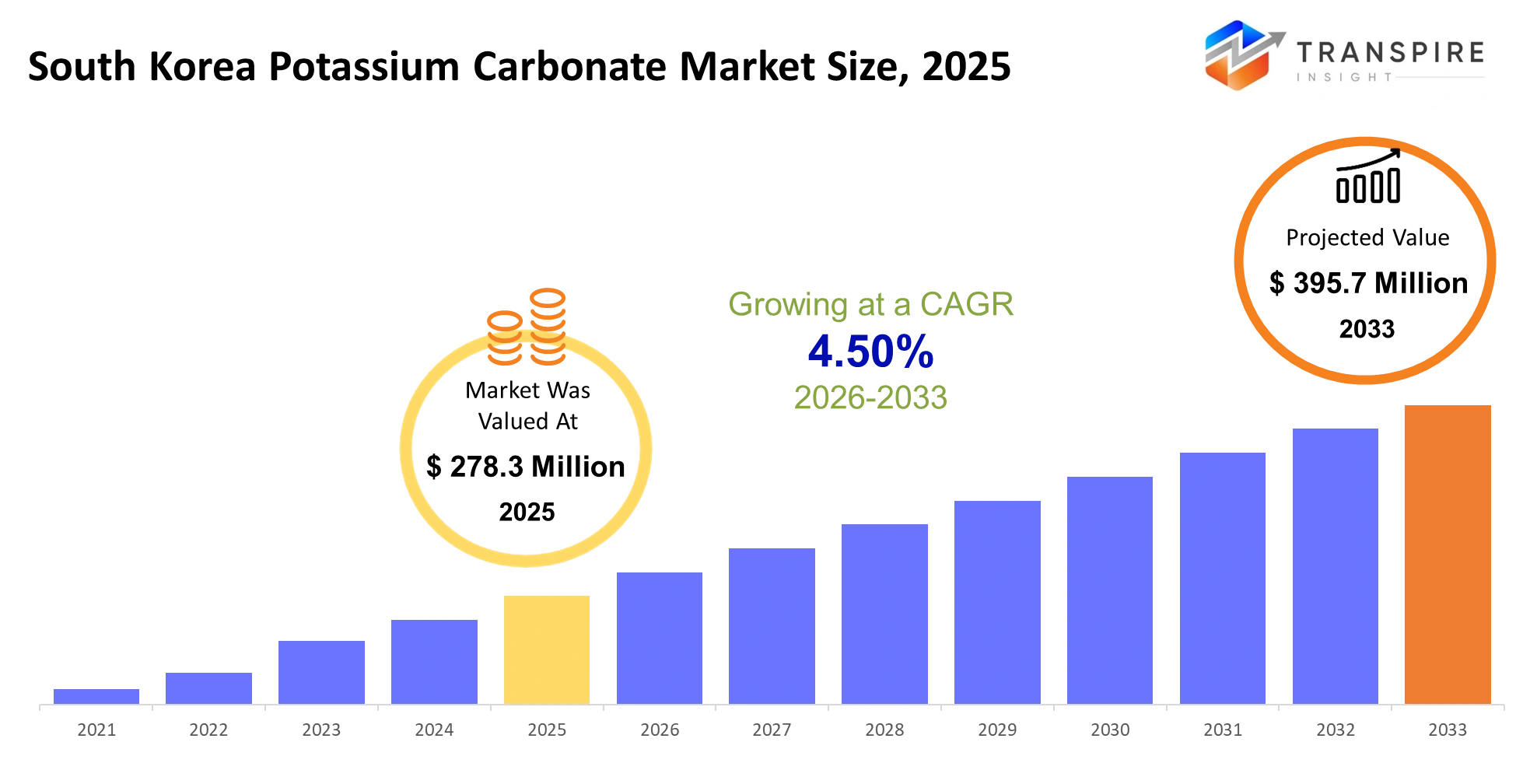
South Korea Potassium Carbonate Market Size & Forecast:
- South Korea Potassium Carbonate Market Size 2025: USD 278.3 Million
- South Korea Potassium Carbonate Market Size 2033: USD 395.7 Million
- South Korea Potassium Carbonate Market CAGR: 4.50%
- South Korea Potassium Carbonate Market Segments: By Application (Glass Manufacturing, Fertilizers, Pharmaceuticals, Chemicals), By End-User (Agriculture, Chemical Industry, Healthcare).
To learn more about this report,  Download Free Sample Report
South Korea Potassium Carbonate Market Summary:
South Korea Potassium Carbonate Market size was estimated at USD 278.3 Million in 2025 and is anticipated to reach USD 395.7 Million by 2033, growing at a CAGR of 4.50% from 2026 to 2033.
The potassium carbonate market of South Korea will operate as a specialized market within the chemicals and materials industry because of industrial operational needs and changing customer expectations. The market will depend on glass production and specialty chemical manufacturing and food processing operations which require suppliers to deliver products with consistent quality and total purity. Domestic buyers will increasingly choose high-grade products which help maintain cleaner production processes and consistent product quality. Export-oriented manufacturers will also push for tighter specifications which link their sourcing decisions to international compliance standards that change with trade policy developments.
The market will demonstrate continuous changes as it adapts to more stringent environmental regulations and improved process efficiency. Producers will implement energy-efficient synthesis methods together with recycling systems for their operations to reduce both emissions and waste production. Demand patterns will gradually shift as downstream industries explore alternatives or blends that improve performance while lowering environmental impact. Digital production and supply chain monitoring will transform pricing transparency and delivery reliability in the country which will establish a more structured and accountable operating framework.
Key Market Trends & Insights:
- The Potassium Carbonate Market in South Korea experiences constant industrial demand which originates from its use in glass manufacturing and specialty chemical production and food processing applications. The electronics manufacturing industry is expanding which leads to increased consumption patterns while stable supply chains help to maintain equilibrium in pricing. Domestic producers are implementing efficiency enhancements and expense management techniques to maintain their competitive edge in regional trade activities.
- The Potassium Carbonate Market in South Korea derives its main advantage from glass manufacturing requirements which specifically use specialty and optical glass products. The increased adoption of high-quality display panels and technical glass products drives consumption growth. Production facilities require consistent material quality, leading to preference for reliable suppliers with stable output and refined processing standards.
- The chemical synthesis and formulation processes drive the market growth for Potassium Carbonate in South Korea. The applications of this compound extend to fertilizers and detergents and buffering agents. The industrial buyers demand both high purity standards and reliable product delivery which leads them to sign long-term agreements. The growth of chemical production processes in downstream sectors leads to increased demand which results in stable purchasing patterns throughout the entire market.
- The Potassium Carbonate Market in South Korea operates within food-grade applications for both cocoa processing and pH regulation purposes. The production and distribution activities follow strict safety requirements which ensure that all operations meet established regulatory standards. The demand for these products remains steady at moderate levels because food manufacturing output stays consistent and established usage patterns exist for specific product types.
- The South Korean Potassium Carbonate Market demonstrates equal distribution between imported materials and products created through domestic manufacturing, which relies on international trade to support its operations. The supply chain operational performance directly affects market price consistency, while the enhancements in logistics systems lead to improved delivery speed. Manufacturers maintain their dedication to operational dependability, which enables them to sustain their market position while their industrial sector experiences slow growth.
South Korea Potassium Carbonate Market Segmentation
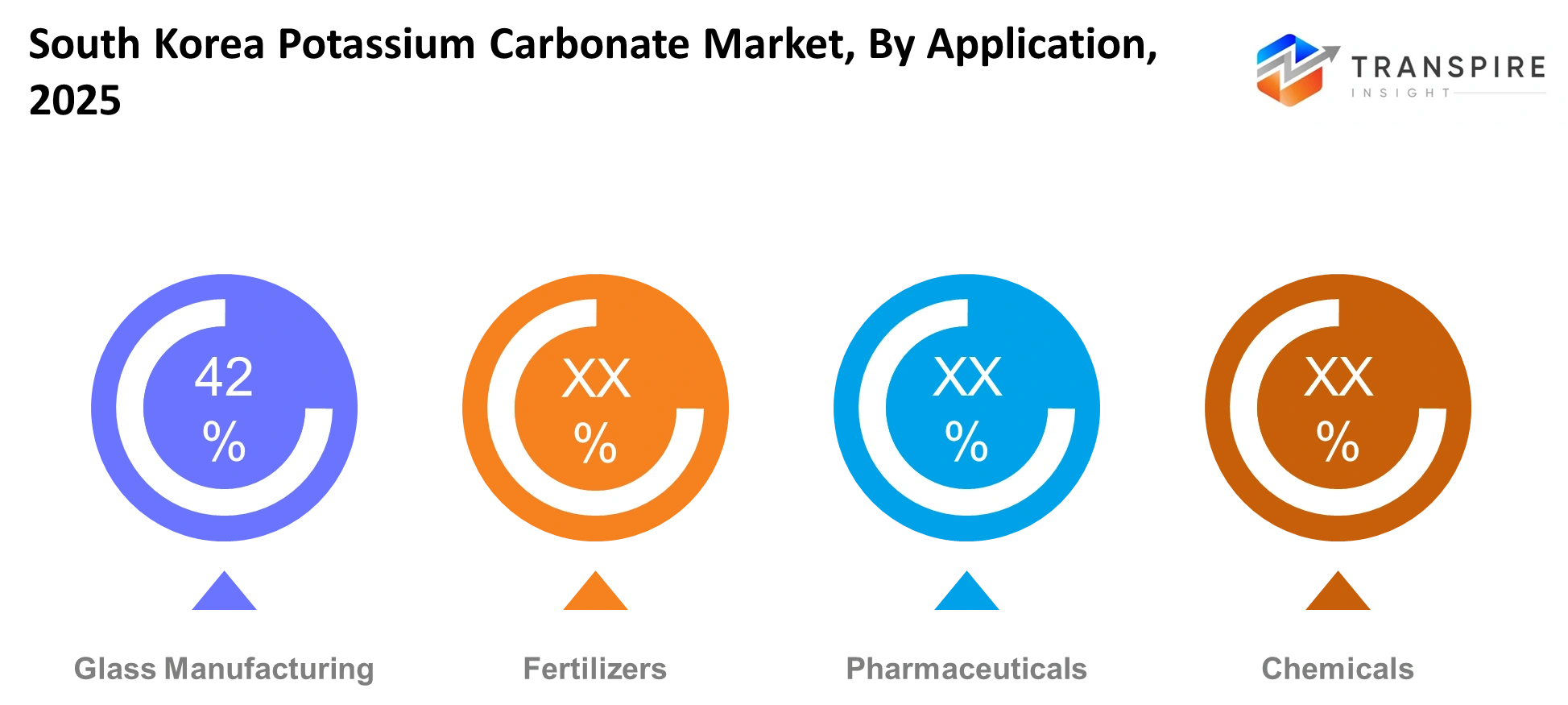
By Application
- Glass Manufacturing: The South Korean Potassium Carbonate Market experiences ongoing demand from glass production because manufacturers require exceptional optical and specialty glass. The melting point of potassium carbonate decreases but the substance still maintains its function as a high-quality optical material. The South Korean electronics sector which includes display panel production will keep driving demand for this specific application area.
- Fertilizers: The South Korean Potassium Carbonate Market demonstrates permanent demand because potassium functions as an essential element in fertilizer production. The use of potassium carbonate in agricultural practices enhances soil quality which results in higher agricultural output. Farmers will keep using agricultural fertilizers at a consistent rate because they need to practice efficient farming and provide proper nutrient distribution to their crops.
- Pharmaceuticals: The South Korean Potassium Carbonate Market serves a vital function in pharmaceutical operations because it provides stable substances for managing chemical processes which need precise control. In drug formulation potassium carbonate serves as both a buffering agent and an intermediate compound. The domestic pharmaceutical industry will steadily increase its demand for this application because it expands its manufacturing and research capabilities.
- Chemicals: The South Korean Potassium Carbonate Market operates as an essential component of the chemical industry because potassium carbonate functions as a fundamental material for various synthesis operations. The production process of soaps and detergents and specialty chemicals requires these materials. The industrial sector will keep expanding while companies prioritize developing chemical products that offer greater value.
To learn more about this report, Download Free Sample Report
By End-User
- Agriculture: The South Korean Potassium Carbonate Market establishes permanent ties to the agricultural sector because farmers need dependable potassium sources to enhance their soil quality. Potassium carbonate functions as a plant strengthener which enables plants to withstand various environmental pressures. The demand for agricultural products depends on three factors which include the agricultural productivity targets and the efficient land utilization and the pursuit of better crop production results.
- Chemical Industry: The chemical industry serves as the major customer for the South Korean Potassium Carbonate Market because potassium carbonate shows multiple uses throughout various manufacturing processes. The industry requires both intermediates and processing agents which creates consistent product requirements. The growth patterns of this segment will be determined by industrial modernization combined with specialized chemical production activities.
- Healthcare: The South Korean Potassium Carbonate Market experiences gradual demand growth from healthcare-related industries which use controlled chemical inputs. Potassium carbonate functions as a key component in laboratory environments and product formulation. The end-user category will experience constant growth because healthcare facilities and pharmaceutical production facilities will continue to expand.
Country Insights
- South Korea shows its industrial growth by sustaining development in its manufacturing and chemical processing industries. The demand for potassium carbonate will increase because it is needed for producing glass and manufacturing detergents and specialty chemicals. Domestic producers focus on consistent supply, while import dependence remains limited because established local production capacity and efficient distribution systems make it possible to meet demand.
- The industrial clusters in Ulsan and Yeosu cities enable chemical production which generates ongoing potassium carbonate demand across various uses. The consumption patterns receive additional input from electronics and display manufacturing. The regulatory standards establish production control requirements which create quality products while maintaining environmental sustainability and permitting market expansion.
- The South Korea Potassium Carbonate Market gains strength through export-oriented manufacturing which receives support from regional trade connections that enable goods to move continuously. The production volumes will increase because neighboring Asian countries will create demand for our products. Advanced processing technology creates efficiency improvements through investment while industrial segments maintain operational capacity because they have steady access to essential raw materials.
Recent Development News
Rising global feedstock costs impacting Korean producers (Q1 2026)
In March 2026,The global potassium carbonate market experienced a price rise because potassium chloride prices increased and energy disruptions occurred due to geopolitical conflicts. The cost pressures directly impact domestic production margins because South Korea relies on imported potash feedstock for its operations.
Expansion of Korean production capacity by UNID (April 2025)
In April 2025, UNID South Korean chemical manufacturer UNID progressed through its multi-phase expansion project which includes construction of facilities that will produce 52000 tons of potassium carbonate each year. The development shows Korea's efforts to build stronger domestic production and export capabilities.
|
Report Metrics |
Details |
|
Market size value in 2025 |
USD 278.3 Million |
|
Market size value in 2026 |
USD 290.8 Million |
|
Revenue forecast in 2033 |
USD 395.7 Million |
|
Growth rate |
CAGR of 4.50% from 2026 to 2033 |
|
Base year |
2025 |
|
Historical data |
2021 - 2024 |
|
Forecast period |
2026 - 2033 |
|
Report coverage |
Revenue forecast, competitive landscape, growth factors, and trends |
|
Country scope |
South Korea |
|
Key company profiled |
Armand Products Company, UNID Co. Ltd., Evonik Industries AG, BASF SE, OCI Company Ltd., Tata Chemicals Ltd., AGC Inc., Gujarat Alkalies and Chemicals Ltd., Hebei Xinji Chemical Group, Shandong Lubei Chemical Co. Ltd., Tokuyama Corporation, Nippon Chemical Industrial Co. Ltd., Asahi Glass Co. Ltd., Shanxi Leixin Chemical Co. Ltd., Wuxi Yangshan Biochemical Co. Ltd. Group Corporation, Indian Oil Corporation Ltd., Gerdau S.A. |
|
Customization scope |
Free report customization (country, regional & segment scope). Avail customized purchase options to meet your exact research needs. |
|
Report Segmentation |
By Application (Glass Manufacturing, Fertilizers, Pharmaceuticals, Chemicals), By End-User (Agriculture, Chemical Industry, Healthcare). |
Key South Korea Potassium Carbonate Company Insights
- The South Korean Potassium Carbonate market maintains continuous engagement from chemical companies which possess strong domestic distribution networks and dependable material supply systems. Industrial users require companies to deliver products with consistent quality standards and dependable delivery performance. The production facilities meet all environmental requirements, while the companies uphold their contractual obligations to supply glass, fertilizer, and food processing industries.
- The South Korea Potassium Carbonate market consists of both established manufacturers and regional suppliers who create its competitive environment. The company uses pricing strategies that maintain equilibrium between its raw material expenses and changes in customer demand. The companies dedicate resources to improve their operational processes and decrease energy consumption, which enables them to maintain budget control while serving industrial needs throughout various application fields in the nation.
South Korea Potassium Carbonate Market Companies:
- Armand Products Company
- UNID Co. Ltd.
- Evonik Industries AG
- BASF SE
- OCI Company Ltd.
- Tata Chemicals Ltd.
- AGC Inc.
- Gujarat Alkalies and Chemicals Ltd.
- Hebei Xinji Chemical Group
- Shandong Lubei Chemical Co. Ltd.
- Tokuyama Corporation
- Nippon Chemical Industrial Co. Ltd.
- Asahi Glass Co. Ltd.
- Shanxi Leixin Chemical Co. Ltd.
- Wuxi Yangshan Biochemical Co. Ltd.
South Korea Potassium Carbonate Market Segmentation
By Application
- Glass Manufacturing
- Fertilizers
- Pharmaceuticals
- Chemicals
By End-User
- Agriculture
- Chemical Industry
- Healthcare
Frequently Asked Questions
Find quick answers to common questions.
The approximate South Korea Potassium Carbonate Market size for the market will be USD 395.7 Million in 2033.
Key segments for the South Korea Potassium Carbonate Market are By Application (Glass Manufacturing, Fertilizers, Pharmaceuticals, Chemicals), By End-User (Agriculture, Chemical Industry, Healthcare).
Major South Korea Potassium Carbonate Market players are Armand Products Company, UNID Co. Ltd., Evonik Industries AG, BASF SE, OCI Company Ltd., Tata Chemicals Ltd., AGC Inc., Gujarat Alkalies and Chemicals Ltd., Hebei Xinji Chemical Group, Shandong Lubei Chemical Co. Ltd., Tokuyama Corporation, Nippon Chemical Industrial Co. Ltd., Asahi Glass Co. Ltd., Shanxi Leixin Chemical Co. Ltd., Wuxi Yangshan Biochemical Co. Ltd. Group Corporation, Indian Oil Corporation Ltd., Gerdau S.A.
The South Korea Potassium Carbonate Market size is USD 278.3 Million in 2025.
The South Korea Potassium Carbonate Market CAGR is 4.50%.
- Armand Products Company
- UNID Co. Ltd.
- Evonik Industries AG
- BASF SE
- OCI Company Ltd.
- Tata Chemicals Ltd.
- AGC Inc.
- Gujarat Alkalies and Chemicals Ltd.
- Hebei Xinji Chemical Group
- Shandong Lubei Chemical Co. Ltd.
- Tokuyama Corporation
- Nippon Chemical Industrial Co. Ltd.
- Asahi Glass Co. Ltd.
- Shanxi Leixin Chemical Co. Ltd.
- Wuxi Yangshan Biochemical Co. Ltd.
Recently Published Reports
-
May 2026
Healthcare Polymer Packaging Market
Healthcare Polymer Packaging Market Size, Share & Analysis Report By Packaging Type (Syringes, IV Bottles and Pouches, Clamshells, Blisters, Bottles & Jars, Containers, Tubes, IV Parental Packaging, Others), By Type (Regulated, Non-regulated), By Polymer Type (LDPE (Low-Density Polyethylene), HDPE (High-Density Polyethylene), Homo-polymer (Homo), Random Copolymer (Random), Block Copolymer (Block), PET, Polystyrene, Polyvinyl Chloride, Polyamide/EVOH, Others), and Geography (North America, Europe, Asia-Pacific, Middle East and Africa, South and Central America), 2021 - 2031
-
Apr 2026
Hydrophilic Tape (Waterstop) Market
Hydrophilic Tape (Waterstop) Market Size, Share & Analysis Report By Type (Bentonite-Based Hydrophilic Tape, Rubber-Based Hydrophilic Tape), By Application (Residential Buildings, Commercial Buildings, Infrastructure Projects), and Geography (North America, Europe, Asia-Pacific, Middle East and Africa, South and Central America), 2021 - 2031
-
Apr 2026
Metalens Market
Metalens Market Size, Share & Analysis Report By Type (Visible Light Metalens, and Infrared Metalens), By Application (Consumer Electronics, Automotive Electronics, Industrial, Medical, and Others), and Geography (North America, Europe, Asia-Pacific, Middle East and Africa, South and Central America), 2021 - 2031
-
Apr 2026
PBT Resin Market
PBT Resin Market Size, Share & Analysis Report By Type (Reinforced PBT Resin, Unreinforced PBT Resin), By Processing Method (Injection Molding, Extrusion, Blow Molding, Others), By End-User (Automotive, Electrical & Electronics, Consumer Appliances, Industrial Machinery, Medical Devices, Packaging, Others), and Geography (North America, Europe, Asia-Pacific, Middle East and Africa, South and Central America), 2021 - 2031