
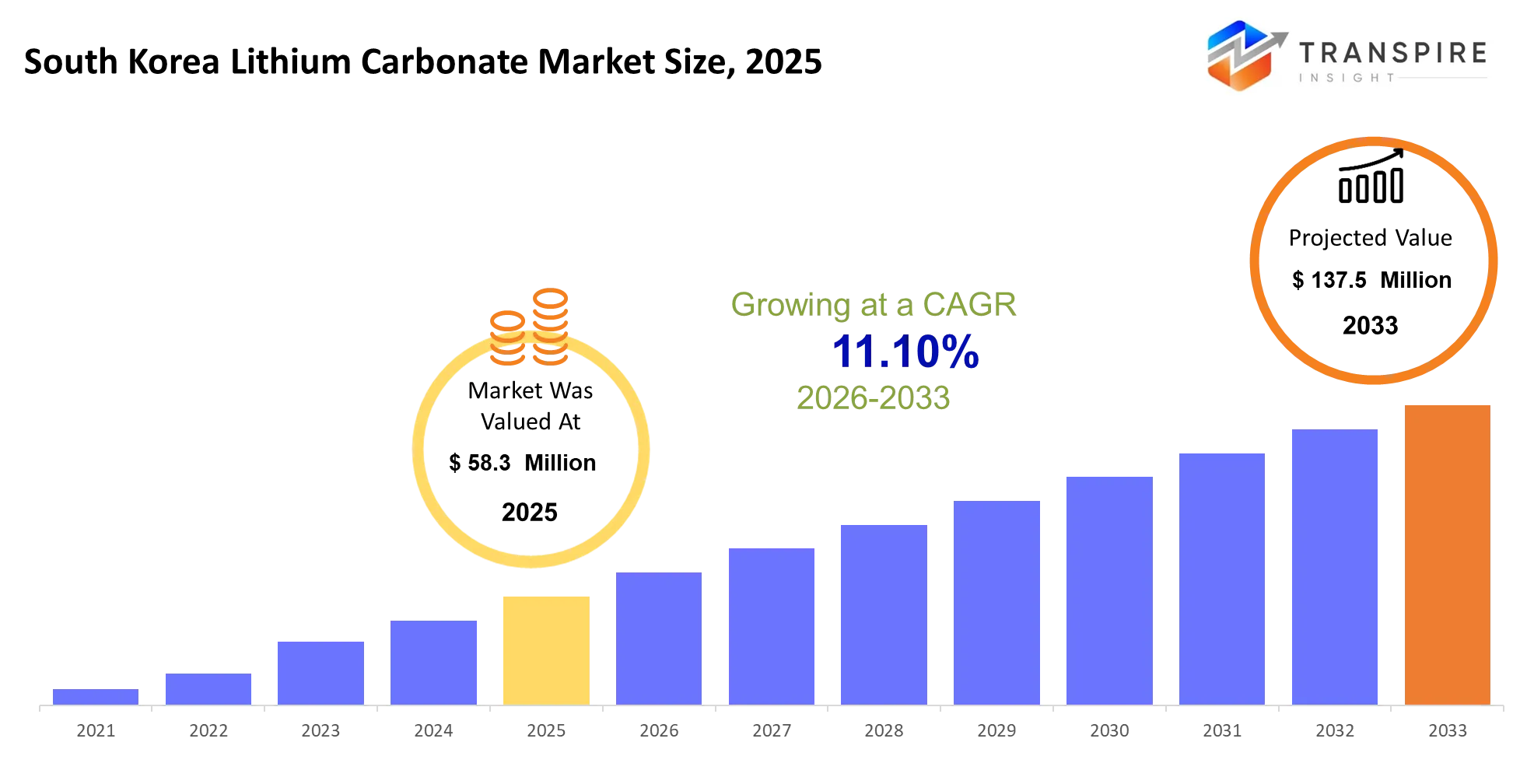
South Korea Lithium Carbonate Market Size & Forecast:
- South Korea Lithium Carbonate Market Size 2025: USD 58.3 Million
- South Korea Lithium Carbonate Market Size 2033: USD 137.5 Million
- South Korea Lithium Carbonate Market CAGR: 11.10%
- South Korea Lithium Carbonate Market Segments: By Grade (Battery Grade, Industrial Grade, Pharmaceutical Grade, Others); By Application (Lithium-ion Batteries, Glass & Ceramics, Lubricants, Pharmaceuticals, Others); By End User (Battery Manufacturers, Automotive OEMs, Chemical Industry, Electronics Companies, Others); By Form (Powder, Granules, Crystalline Form, Others)
To learn more about this report,  Download Free Sample Report
South Korea Lithium Carbonate Market Summary
The South Korea Lithium Carbonate Market was valued at USD 58.3 Million in 2025. It is forecast to reach USD 137.5 Million by 2033. That is a CAGR of 11.10% over the period.
In South Korea, lithium carbonate works like a sort of main refining ingredient , that keeps the battery manufacturing whole machine humming, and it gets fed into cathode production, which then ends up in electric cars, grid storage setups and also industrial backup power. so it basically supports mobility and the energy infrastructure at the same time. Over the last 3–5 years , things have changed in a more structural way, Korean battery producers started moving beyond just EV output and they went toward a wider mix of energy storage use cases , while also upgrading to higher-nickel battery formats to squeeze out better energy density.
One very practical trigger was the post-2021 lithium supply shock, when global mining output was constrained and supply was heavily concentrated in South America and China, which exposed procurement weak spots for Korean manufacturers. When that happened , companies were pushed into longer term contracting, and they also made equity style investments in upstream assets , plus they tightened day to day coordination with suppliers. So the market now leans more heavily toward vertically secured sourcing and more localized processing capacity , which boosts domestic value capture, and it also speeds up investment in recycling and refining facilities across South Korea’s battery supply chain.
Key Market Insights
- Gyeonggi and Chungcheong industrial corridors really dominate the South Korea Lithium Carbonate Market, with something like 42–45% share in 2025, mostly because battery factory clustering is so dense and close together.
- Ulsan plus Gyeongbuk are starting to look like the fastest-growing hubs, through 2024–2030… and that’s more or less tied to cathode material expansion, plus EV ecosystem scaling not just in theory but in practice.
- Battery-grade lithium carbonate basically takes the lead in the South Korea Lithium Carbonate Market, it keeps more than 70% share, and the reason is clear: high-purity EV cathode demand keeps pushing it forward.
- Industrial-grade lithium carbonate sits in the next spot, it grabs the second-largest share, and it’s mainly used for ceramics, glass, and those specialty chemical manufacturing needs.
- Recycled lithium carbonate is the speediest segment through 2025–2030, driven by circular economy thinking and supply security initiatives, so it grows faster than the others as recovery ramps up.
- Electric vehicle batteries kinda dominate the South Korea Lithium Carbonate Market with around 65% share, mainly because EV production is being scaled aggressively.
- Meanwhile, energy storage systems are the fastest-growing application, since grid stabilization and the smoother integration of renewable power keep moving faster across Korea’s energy sector.
- On the end-user side, battery manufacturers sit at the top, taking in more than 60% share, tied to big gigafactory operations.
- Also, energy utilities and industrial chemical firms are quickly expanding their own end-user roles, pulled by electrification plus deployment of storage, more and more these days.
What are the Key Drivers, Restraints, and Opportunities in the South Korea Lithium Carbonate Market?
South Korea’s Lithium Carbonate Market is, mostly, pushed forward by how fast domestic EV battery production capacity keeps growing, sort of because policy backed electrification goals and the automakers public promises to ditch internal combustion platforms. This whole pivot has basically compelled battery makers like LG Chem and Samsung SDI to lock in bigger lots of battery-grade lithium carbonate so they can keep up with higher nickel cathode output. Because of that, buying patterns are now much more contract led and often long term, and it ends up feeding more stable revenue streams into refiners, and also into upstream suppliers too.
There is also a major structural issue though, South Korea is basically relying almost entirely on imported lithium feedstock, and that supply is concentrated among a rather small set of global suppliers. That heavy dependence makes the South Korea Lithium Carbonate Market vulnerable to price swings plus shipping disruptions, things that you cannot really fix quickly with domestic mining alternatives. So even when downstream demand looks strong, the procurement uncertainty raises input costs and tightens margins for midstream processors, which then makes expansion plans more cautious and can delay capacity additions across the broader supply chain.
A notable chance is kind of unfolding via lithium recycling and that urban mining approach, especially since Korean battery scrap volumes are climbing along with gigafactory production cycles. There are players like POSCO Future M who are putting money into closed loop recovery systems, so they can pull lithium carbonate out of used EV batteries. That effectively builds up a second supply current , which then helps lessen dependence on imports and also steadies the pricing a bit. And as recycling performance keeps getting better, it should allow more scalable domestic sourcing, while also speeding up the next expansion stage of the South Korea Lithium Carbonate Market.
What Has the Impact of Artificial Intelligence Been on the South Korea Lithium Carbonate Market?
Artificial intelligence and advanced digital systems are, kind of, starting to reshape operational efficiency across South Korea’s lithium carbonate and battery materials value chain, especially inside refining plants and integrated cathode production facilities. When it comes to automation , AI-enabled control systems are being rolled out to help regulate chemical processing conditions like temperature stability, impurity filtration, and electrolyte balance. This reduces manual meddling , and helps keep the process more repeatable. Industrial monitoring platforms, similar in layout to scrubber performance systems in emission-heavy industries, are now used to follow real-time equipment condition and compliance signals across refining lines.
For the predictive side , machine learning models dig into old production records and sensor signals to estimate equipment wear, tune maintenance schedules, and spot potential quality shifts during lithium purification. The same models can also be used for emissions forecasting at chemical processing sites, so operators can nudge inputs in a way that stays inside regulatory boundaries. In practice, the operational impact looks fairly tangible: plant uptime has improved by an estimated 10–15% at more advanced facilities. At the same time, energy use is down, mainly due to better load balancing and fewer off-spec material batches that used to drive reprocessing costs, which were not exactly small. On top of that, supply chain analytics aid procurement timing decisions, lowering the risk tied to lithium price swings.
Even so, adoption is still held back by high integration expenses and a shortage of reliable, standardized training data for legacy processing setups. A lot of sites also run into interoperability issues when older equipment gets connected to AI-driven monitoring platforms, so the sector-wide rollout is slower than people would like, and everything takes more time than planned.
Key Market Trends
- After 2021 supply shocks, battery manufacturers started to ramp up their long-run lithium carbonate agreements, sort of moving away from short-term spot buying, across a lot of South Korea supply chains.
- The South Korea Lithium Carbonate Market then leaned more toward battery-grade refinement, because EV cathode producers kept pushing for higher purity feed, especially once 2022 nickel-rich chemistry got adopted.
- Recycling capacity really grew a lot after 2023. Companies began pulling lithium from gigafactory scrap, not just for the sake of recovery but to cut import dependency and keep input costs a bit steadier.
- LG Chem also widened upstream collaborations with global miners during 2022–2025, which made vertical integration in cathode material sourcing stronger, in practice.
- POSCO Future M went further too, boosting investment into lithium extraction from secondary sources, so it wasn’t only processing anymore, more like circular supply chain models.
- Then energy storage demand jumped after 2024 when grid stabilization policies kicked in, and this shifted lithium carbonate use beyond the classic EV battery role.
- AI-enabled monitoring tools helped a lot in lithium purification plants across South Korea, by improving impurity detection accuracy, which in turn reduced refining downtime.
- And overall procurement got more diversified, toward South America and Africa, so South Korea was less locked into China-centered supply routes after the disruptions in 2023.
South Korea Lithium Carbonate Market Segmentation
By Grade :
Battery grade lithium carbonate will probably stay the key format because it fits well with high-performance lithium-ion battery manufacturing, especially for electric vehicles and also for energy storage. People keep buying more, not only because of general usage, but because many manufacturers are moving toward high-nickel chemistries, which really need stable, high purity feedstocks. Industrial grade still matters for ceramics, glass, and a few specialty chemical activities, while pharmaceutical grade is more limited, but still steady, mainly because regulated or controlled uses demand strict quality. The other grades, meanwhile, take a small slice and they tend to show up in narrower chemical processing steps, where constraints are different.
As for the South Korea Lithium Carbonate Market , it has moved over time toward tighter purity requirements, since battery makers keep tightening their input rules. Battery oriented production is expected to keep expanding, while industrial applications might grow slower. Supply chain pressure has pushed firms to get better at refining efficiency, and to cut impurities earlier in the process. That is what, in practice, makes consistent grading standards across all suppliers feel even more important now.
By Application :
Lithium-ion batteries will pretty much run the application demand, as South Korea continues to ramp EV production along with energy storage deployment. There’s been very strong tie-up between cathode makers and battery producers, so lithium carbonate consumption keeps climbing. For glass and ceramics, the demand stays kind of steady because industrial manufacturing keeps going, ok. Lubricants and pharmaceuticals are there too, but they’re smaller nonetheless and the growth feels limited, compared with what battery applications bring in.
In the South Korea Lithium Carbonate market, the patterns have shifted, like a lot, toward energy storage systems, after EV adoption really took off and grid modernization efforts moved forward. Battery usage now basically sets the procurement playbook , while other, non-battery uses are growing slower, partly because of substitution and because efficiency improvements are doing their job. Manufacturers also seem to push most of their allocation into battery-grade output, and that has narrowed availability for the older industrial application lanes in recent years.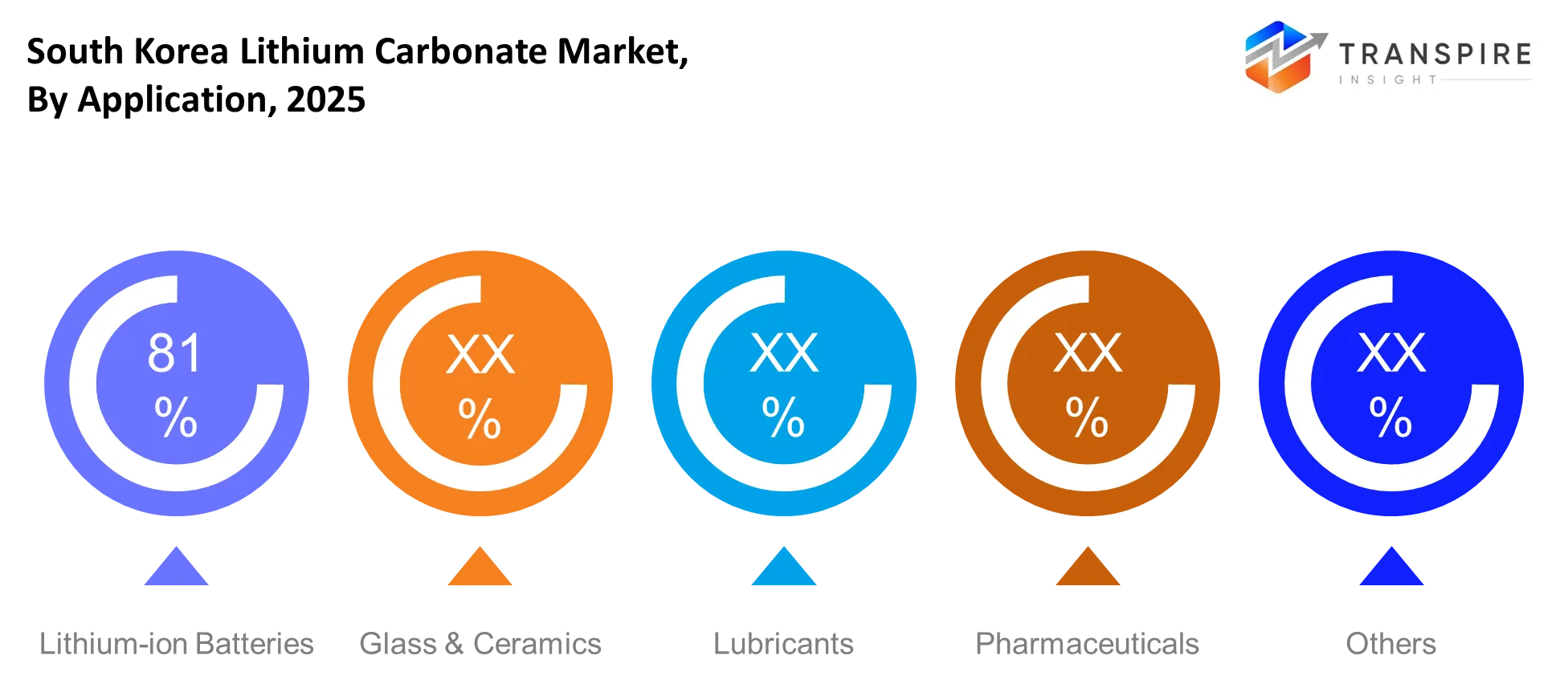
To learn more about this report, Download Free Sample Report
By End User :
Battery manufacturers will likely stay the biggest end users, even as firms like LG Chem, Samsung SDI, and SK On keep pushing bigger production capacity out. Automotive OEMs, sort of, indirectly drive demand, because EV production commitments keep coming up. Meanwhile chemical companies use lithium carbonate for intermediate processing type steps , and electronics firms rely on it in limited energy storage, and also in some component applications.
The South Korea Lithium Carbonate Market has shifted a bit toward tighter, more integrated ties between battery producers and the automotive supply chain, which then boosts long-term contracting behavior. In general, end users now lean toward secured supply agreements, not so much spot purchases, since there was that past price volatility. Chemical and electronics areas still show smaller demand overall, but it’s fairly stable. Still, battery manufacturers keep steering the procurement patterns and the investment direction across the broader value chain.
By Form :
In the end, powder form lithium carbonate will probably end up dominating, because it dissolves faster and fits well with battery cathode processing, where uniform mixing is kind of a big deal . Granules, on the other hand, tend to be picked for easier handling and transport efficiency, sort of smoother logistics. Meanwhile the crystalline form is usually kept for high-purity workflows, where reaction behavior has to be controlled very carefully, not just roughly managed .
So each material shape really serves slightly different processing requirements inside industrial lines and battery production systems. Also, preferences in the South Korea lithium carbonate market have leaned more toward finer , and more controlled particle structures lately, since battery makers want better consistency in cathode output. Powder adoption has gone up alongside more automation in the material handling setups , while crystalline variants stay relevant for the precision processing stages. Granule usage is still there and hasn’t collapsed , but it’s been secondary compared with higher-performance battery production needs.
What are the Key Use Cases Driving the South Korea Lithium Carbonate Market?
Electric vehicle battery production still looks like the main thing, the dominant use case for the South Korea Lithium Carbonate Market. Cathode makers tend to want very high-purity inputs, so they can keep energy density stable , and also push for a longer cycle life. Because domestic automakers and major battery companies keep announcing manufacturing plans, they effectively keep a steady procurement squeeze on suppliers. So yeah, EVs really are the main demand driver here.
After that, energy storage systems and consumer electronics are growing as secondary uses . Utility-scale grid stabilization efforts are helping, and at the same time there’s more appetite for compact rechargeable devices. Battery manufacturers, plus electronics businesses , are now syncing their sourcing approaches more often. The goal is to support multi-application production lines, especially since flexible battery formats are getting more attention.
Looking ahead, there are also emerging areas like advanced recycling based lithium recovery. And there’s specialty chemical synthesis aimed at next-generation solid-state battery research. These segments are still pretty small in comparison , but they’re getting noticed. Chemical firms and R&D-heavy battery producers are aiming to cut import dependence and improve material circularity during the forecast period.
|
Report Metrics |
Details |
|
Market size value in 2025 |
USD 58.3 Million |
|
Market size value in 2026 |
USD 65.8 Million |
|
Revenue forecast in 2033 |
USD 137.5 Million |
|
Growth rate |
CAGR of 11.10% from 2026 to 2033 |
|
Base year |
2025 |
|
Historical data |
2021 - 2024 |
|
Forecast period |
2026 - 2033 |
|
Report coverage |
Revenue forecast, competitive landscape, growth factors, and trends |
|
Country scope |
South Korea |
|
Key company profiled |
Albemarle Corporation, SQM, Ganfeng Lithium, Tianqi Lithium, Livent, POSCO Holdings, LG Chem, Samsung SDI, SK On, Arcadium Lithium, Mineral Resources, Pilbara Minerals, Allkem, Sichuan Yahua Industrial Group, Lithium Americas |
|
Customization scope |
Free report customization (country, regional & segment scope). Avail customized purchase options to meet your exact research needs. |
|
Report Segmentation |
By Grade (Battery Grade, Industrial Grade, Pharmaceutical Grade, Others); By Application (Lithium-ion Batteries, Glass & Ceramics, Lubricants, Pharmaceuticals, Others); By End User (Battery Manufacturers, Automotive OEMs, Chemical Industry, Electronics Companies, Others); By Form (Powder, Granules, Crystalline Form, Others) |
Which Regions are Driving the South Korea Lithium Carbonate Market Growth?
South Korea’s Gyeonggi and Chungcheong industrial corridor still looks like the dominant pocket in the Lithium Carbonate Market, mainly because there’s such a dense cluster of battery gigafactories and cathode material plants. There’s also strong policy backing for localizing the domestic battery supply chain ,so companies have been willing to commit serious, long-range capital spending there. Even the transport side helps a lot, with logistics connectivity around Incheon and Pyeongtaek ports giving a smoother flow of raw inputs coming in ,and exports leaving on time. On top of that, a pretty tightly connected ecosystem made up of chemical processors, refiners, and battery manufacturers keeps the demand for lithium carbonate running at scale, more or less continuously.
Ulsan and Gyeongbuk function as a steady secondary region, backed by a durable industrial base, built more on chemicals and heavy manufacturing rather than just battery concentration. Compared to the leading corridor, this area benefits from a broader set of end-use needs ,not only battery-grade supply but also petrochemicals, electronics materials, and industrial compounds. Investments from established industrial groups stay steady ,so consumption tends to follow predictable patterns even when global pricing is a bit jumpy. The regulatory changes have rolled out gradually but in a consistent way, which lets firms plan capacity expansions without getting too many surprises. Overall, this kind of stability makes the region a dependable contributor to South Korea Lithium Carbonate Market revenue.
The Jeolla region seems like it is emerging as the fastest growing area, mostly because of the latest spending on secondary battery complexes and the recycling infrastructure being expanded. On top of that, the government has also been pushing industrial relocation programs and green energy initiatives, so the pace of facility development picked up after 2023, kind of in a noticeable way. Also, new port connected logistics upgrades are making import work for raw lithium feedstock smoother, while export readiness for processed materials gets better. This whole shift is pulling in battery material producers who are looking for lower cost expansion zones, with steadier momentum. So for investors stepping into the 2026–2033 window, Jeolla looks like a place with real high growth potential, mainly tied to recycling led supply chains and the next generation battery production capacity.
Who are the Key Players in the South Korea Lithium Carbonate Market and How Do They Compete?
The South Korea Lithium Carbonate Market shows a kind of moderately consolidated competitive vibe, where a few big producers of battery materials along with major lithium suppliers kinda take the lead on procurement channels. Rivalry seems driven less by quick spot numbers and more by long term supply security, refining know-how, and whether a player is tightly tied into the battery manufacturing ecosystem. Usually, established firms hold their ground via contracted volumes with cathode and battery makers, but newer companies often try to slip in through recycling technologies and upstream collaborations. Also the ability to control purification steps and hit consistent battery grade specs, that part became the main “battlefield” not just price.
LG Chem leans hard into downstream integration, so it locks in lithium carbonate via long horizon supply deals that link directly into its cathode production activities. The edge is mainly how well material requirements and battery performance needs get coordinated, so quality swings between batches get minimized. The firm keeps pushing forward by forming joint ventures with upstream miners and setting up sourcing agreements in South America, aimed at making raw material inflows more stable, more “steady” if you will.
POSCO Future M builds its approach around vertical integration, and recycling led lithium sourcing really anchors it. It stands apart through investments in urban mining sites, where lithium is pulled from used EV batteries, which lowers dependence on imports. Their expansion also includes setting up new chemical processing plants, plus working with global battery manufacturers so that material flows stay close looped.
Samsung SDI and SK On sort of compete using advanced battery chemistry innovation, especially high nickel, and those next generation cell setups. Their edge seems to come from very tight control over the battery performance specifications, and that spills back into lithium carbonate quality standards upstream, like indirectly but clearly. They also keep expanding capacity via overseas gigafactory investments, plus strategic alliances with major global automotive OEMs. This overall helps their demand visibility and gives them stronger procurement leverage all the way through the South Korea Lithium Carbonate Market.
Company List
- Albemarle Corporation
- SQM
- Ganfeng Lithium
- Tianqi Lithium
- Livent
- POSCO Holdings
- LG Chem
- Samsung SDI
- SK On
- Arcadium Lithium
- Mineral Resources
- Pilbara Minerals
- Allkem
- Sichuan Yahua Industrial Group
- Lithium Americas
Recent Development News
In November 2025, POSCO Holdings announced acquisition of a 30% stake in a lithium joint venture operated by Mineral Resources and separately acquired Lithium South Development’s Argentine subsidiary. The $750 million investment secured long-term lithium concentrate supply from Australia and lithium mining rights in Argentina, strengthening South Korea’s battery-grade lithium carbonate supply chain. Source https://koreajoongangdaily.joins.com/
In May 2025, POSCO Holdings secured funding commitments of about 1 trillion won for three battery-material affiliates, including POSCO Pilbara Lithium Solution. The investment was aimed at expanding lithium and cathode material operations to strengthen South Korea’s rechargeable battery supply chain amid recovering EV demand. Source https://koreajoongangdaily.joins.com/
What Strategic Insights Define the Future of the South Korea Lithium Carbonate Market?
In South Korea the Lithium Carbonate Market is kind of drifting toward a more vertically integrated and recycling-backed supply setup, led by the steady expansion of EV batteries and the growing push to lock in reliable upstream materials . Over the next 5–7 years, procurement habits will keep moving away from spot dependency, because battery makers start pinning themselves to long-term contracts and also internalize chunks of the refining and recovery process, so they can cut down volatility exposure.
There’s another risk that’s a bit harder to spot, which is technology substitution, especially as alternative chemistries creep in, like sodium-ion systems, and that can lower the incremental lithium intensity in certain storage use cases. This probably won’t hit demand right away, but it may slowly tone down long-term growth assumptions, if adoption speeds up quicker than expected in stationary storage segments.
On the opportunity side, scaling closed-loop lithium recovery is getting real, tied to gigafactory scrap streams in industrial hubs such as Jeolla, where recycling infrastructure is growing next to new battery capacity . Companies that link recovery with cathode production should see structural cost advantages. Market players should start prioritizing recycling capability , and upstream collaboration, now, since control over secondary lithium supply will likely turn into a key competitive lever in the South Korea Lithium Carbonate Market.
South Korea Lithium Carbonate Market Report Segmentation
By Grade
- Battery Grade
- Industrial Grade
- Pharmaceutical Grade
By Application
- Lithium-ion Batteries
- Glass & Ceramics
- Lubricants
- Pharmaceuticals
By End User
- Battery Manufacturers
- Automotive OEMs
- Chemical Industry
- Electronics Companies
By Form
- Powder
- Granules
- Crystalline Form
Frequently Asked Questions
Find quick answers to common questions.
The South Korea Lithium Carbonate Market size is USD 137.5 Million in 2033.
Key Segments for the South Korea Lithium Carbonate Market are By Grade (Battery Grade, Industrial Grade, Pharmaceutical Grade, Others); By Application (Lithium-ion Batteries, Glass & Ceramics, Lubricants, Pharmaceuticals, Others); By End User (Battery Manufacturers, Automotive OEMs, Chemical Industry, Electronics Companies, Others); By Form (Powder, Granules, Crystalline Form, Others).
Major South Korea Lithium Carbonate Market Players are Albemarle Corporation, SQM, Ganfeng Lithium, Tianqi Lithium, Livent, POSCO Holdings, LG Chem, Samsung SDI, SK On, Arcadium Lithium, Mineral Resources, Pilbara Minerals, Allkem, Sichuan Yahua Industrial Group, Lithium Americas.
The Current South Korea Lithium Carbonate Market size is USD 58.3 Million in 2025.
The South Korea Lithium Carbonate Market CAGR is 11.10% from 2026 to 2033.
- Albemarle Corporation
- SQM
- Ganfeng Lithium
- Tianqi Lithium
- Livent
- POSCO Holdings
- LG Chem
- Samsung SDI
- SK On
- Arcadium Lithium
- Mineral Resources
- Pilbara Minerals
- Allkem
- Sichuan Yahua Industrial Group
- Lithium Americas
Recently Published Reports
-
May 2026
Healthcare Polymer Packaging Market
Healthcare Polymer Packaging Market Size, Share & Analysis Report By Packaging Type (Syringes, IV Bottles and Pouches, Clamshells, Blisters, Bottles & Jars, Containers, Tubes, IV Parental Packaging, Others), By Type (Regulated, Non-regulated), By Polymer Type (LDPE (Low-Density Polyethylene), HDPE (High-Density Polyethylene), Homo-polymer (Homo), Random Copolymer (Random), Block Copolymer (Block), PET, Polystyrene, Polyvinyl Chloride, Polyamide/EVOH, Others), and Geography (North America, Europe, Asia-Pacific, Middle East and Africa, South and Central America), 2021 - 2031
-
Apr 2026
Hydrophilic Tape (Waterstop) Market
Hydrophilic Tape (Waterstop) Market Size, Share & Analysis Report By Type (Bentonite-Based Hydrophilic Tape, Rubber-Based Hydrophilic Tape), By Application (Residential Buildings, Commercial Buildings, Infrastructure Projects), and Geography (North America, Europe, Asia-Pacific, Middle East and Africa, South and Central America), 2021 - 2031
-
Apr 2026
Metalens Market
Metalens Market Size, Share & Analysis Report By Type (Visible Light Metalens, and Infrared Metalens), By Application (Consumer Electronics, Automotive Electronics, Industrial, Medical, and Others), and Geography (North America, Europe, Asia-Pacific, Middle East and Africa, South and Central America), 2021 - 2031
-
Apr 2026
PBT Resin Market
PBT Resin Market Size, Share & Analysis Report By Type (Reinforced PBT Resin, Unreinforced PBT Resin), By Processing Method (Injection Molding, Extrusion, Blow Molding, Others), By End-User (Automotive, Electrical & Electronics, Consumer Appliances, Industrial Machinery, Medical Devices, Packaging, Others), and Geography (North America, Europe, Asia-Pacific, Middle East and Africa, South and Central America), 2021 - 2031