
Global Fuel Cell Electric Vehicle Market Size & Forecast:
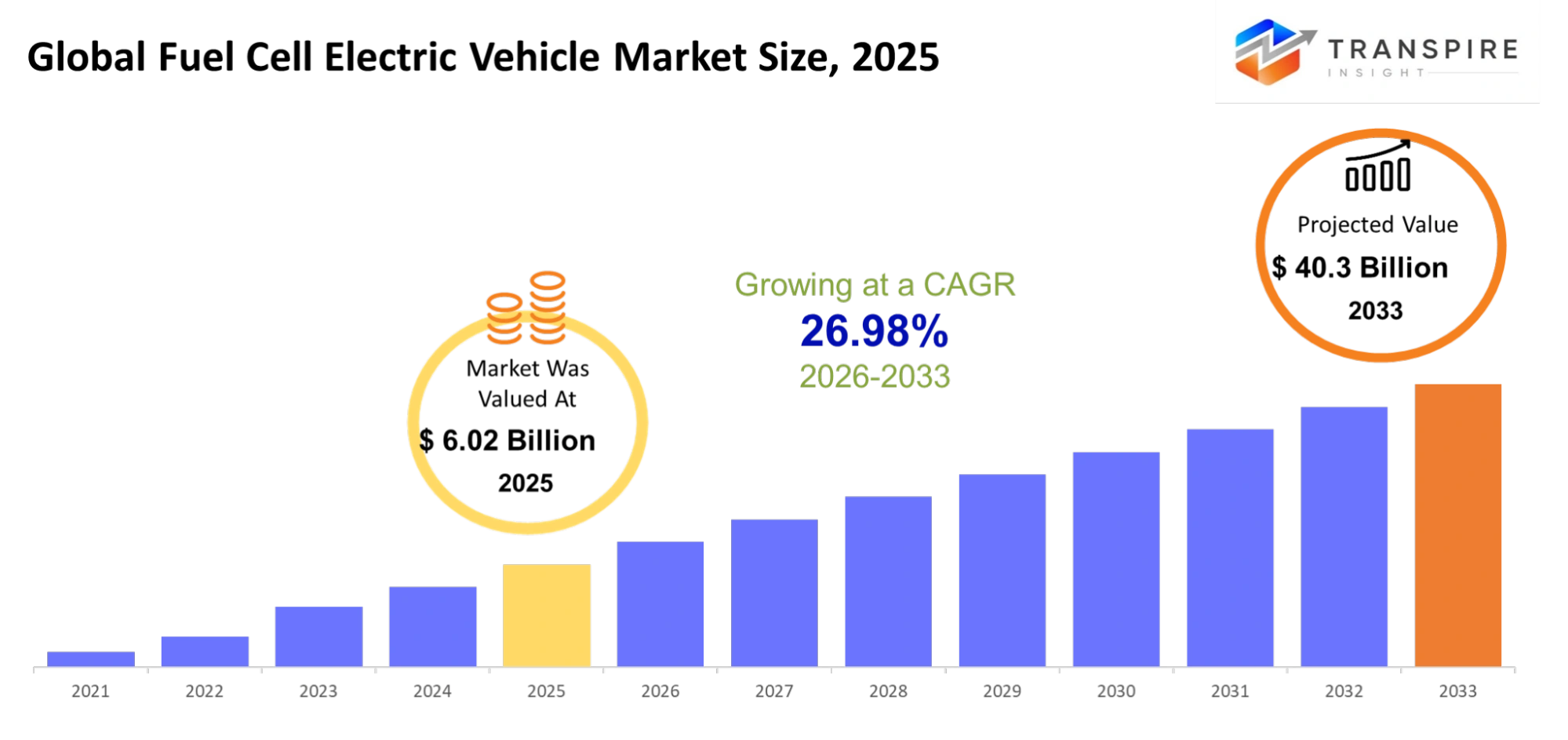
Global Fuel Cell Electric Vehicle Market Size 2025: USD 6.02 Billion
Global Fuel Cell Electric Vehicle Market Size 2033: USD 40.3 Billion
Global Fuel Cell Electric Vehicle Market CAGR: 26.98%
Global Fuel Cell Electric Vehicle Market Segments: By Vehicle Type (Passenger Cars, Buses, Trucks), By Component (Fuel Cell Stack, Battery, Hydrogen Tank, Power Electronics), By Power Output (Below 100 kW, 100-200 kW, Above 200 kW).
To learn more about this report,  Download Free Sample Report
Global Fuel Cell Electric Vehicle Market Summary:
The Global Fuel Cell Electric Vehicle Market was valued at USD 6.02 billion in 2025. It is projected to reach USD 40.3 billion by 2033. The CAGR over this period is 26.98%.
Fuel cell electric vehicles operate on hydrogen. The fuel cell stack turns hydrogen into electricity itself. That electricity powers the motor itself. The only emission is water vapor itself. There's no combustion going on here. This makes FCEVs a zero-emission choice, where battery EVs face challenges themselves. Toyota and Hyundai really stand out in the passenger space. The Mirai and NEXO are the very best known production FCEVs so far.
Refueling takes just under five minutes. Range actually exceeds 400 miles on a full tank itself. These features really suit drivers who simply cannot handle long charging stops. The 26. 98% CAGR is among the very fastest in the entire automotive industry itself. It begins with a relatively small starting point.
Growth really depends on our hydrogen infrastructure expanding right along with vehicle sales. South Korea, Japan, Germany, and California are the most active markets today itself. Policy support in each one has been quite direct and financially supported itself. Heavy vehicles are actually the stronger long-term opportunity itself.
Trucks and buses carry very heavy loads over extremely long distances indeed. Battery weight really becomes a significant penalty at that scale itself. Hydrogen doesn't have that problem itself. A Class 8 fuel cell truck can refuel itself and get back on the road in just minutes. This is why Daimler, Volvo, and Nikola are all really developing FCEV truck platforms itself.
Key Market Trends & Insights:
- Green hydrogen prices are decreasing yet still exceed $5 per kilogram in many markets. Achieving parity with diesel fuel is what really determines the timeline for the large-scale adoption of commercial vehicles.
- Fuel cell stack durability has now reached over 5,000 hours in automotive applications. Heavy-duty trucks are aiming for an impressive 25,000 hours. Closing this gap is the main area of focus for engineering experts at stack manufacturers right now.
- The EU has actually set a requirement for zero-emission heavy trucks by the year 2040. Hydrogen is largely expected to account for a very significant portion of that compliance. This is drawing the attention of fleet operators towards FCEV trucks even sooner.
- Hydrogen filling station networks are really holding back passenger car adoption. South Korea has over 200 stations. Germany has more than 90. The rest of the US has relatively few. The number of stations determines which markets really start growing first.
- Electrolyser capacity is expanding all over the world. Green hydrogen production is expected to drop below $2 per kilogram by the early 2030s. If that happens on schedule, FCEV economics would change quite significantly indeed.
Global Fuel Cell Electric Vehicle Market Segmentation
By Vehicle Type
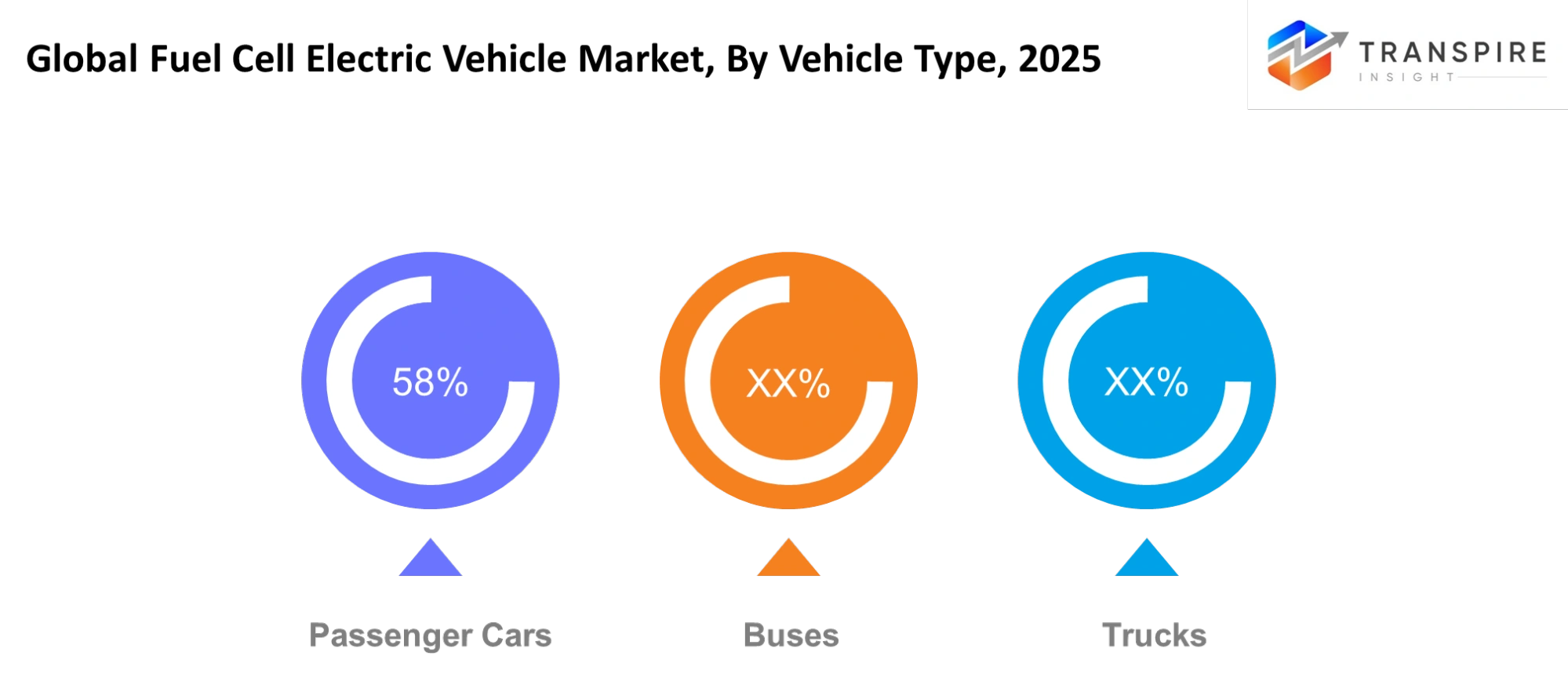
- Passenger Cars: Passenger cars constitute the biggest share of the market revenue - at 58%. Toyota's Mirai and Hyundai's NEXO hold the positions of the most widely distributed production vehicles. Both can be found in markets boasting effective hydrogen retail networks. Passenger FCEV adoption very much depends on the availability of stations. A driver won't purchase an FCEV if the nearest station is about 100 miles away. As such, progress in this segment is really driven by infrastructure investment, not by vehicle readiness itself. The vehicles themselves are quite technically advanced. The Mirai Gen 2 offers a WLTP range of more than 650 km. Refueling actually takes just three to five minutes.
- Buses: Fuel cell buses are operational in many cities across Europe, Asia, and North America. They are pretty well-suited to transit applications. A bus depot can easily install centralized hydrogen storage and fuelling equipment. This really solves the retail station problem that restricts passenger cars from expanding their market. Route distances are relatively predictable. Fuel cell buses drive for 400 to 500 km per fill. They refuel either overnight or between shifts. Several European cities have actually ordered FCEV bus fleets under the Clean Hydrogen Partnership funding programme.
- Trucks: Trucks represent the fastest-growing vehicle category in the Global Fuel Cell Electric Vehicle Market. The case is rather simple. A 40-tonne truck carrying freight over 1,000 km requires a powertrain that is quite light and fast to refuel. Battery trucks carry a weight penalty of several tonnes in battery packs. That would reduce payload capacity. FCEV trucks avoid this. Daimler Truck's GenH2 targets a 1,000 km range and 30-minute hydrogen refuelling. Volvo, Hyundai, and Nikola are also working on similar platforms. The commercial launch timeframes for Class 8 FCEV trucks cluster roughly around 2025 to 2028.
To learn more about this report, Download Free Sample Report
By Component
- Fuel Cell Stack: The fuel cell stack is the most technically complex and costliest component in an FCEV. It is the unit where hydrogen and oxygen react to produce electricity. The stack comprises many individual cells, each containing a membrane electrode assembly. The cost of the stack is closely linked to the platinum content in the catalyst layers. Reducing platinum content - without affecting performance - is the primary target for stack manufacturers looking to cut costs. Toyota, Hyundai, and Ballard have all made great strides in stack power density over the past decade. A 2025-generation automotive stack produces more than 100 kW from a package roughly the size of a small case. The durability of the stack in heavy-duty applications is another major problem area. Automotive stacks are rated for 5,000 to 8,000 hours. Commercial trucking demands 25,000 to 30,000 hours. Meeting that goal without increasing costs is the focus of most current heavy-duty stack development programs.
- Battery: FCEVs come equipped with a buffer battery beside the fuel cell stack. The battery manages peak power demands. Acceleration, regenerative braking capture, and cold-start assistance all require the battery. The fuel cell itself cannot respond fast enough to cover these transient demands. The battery in an FCEV is smaller than in a battery EV since it doesn't have to store the vehicle's complete driving range. It holds enough to cover dynamic power peaks. Lithium-ion is the standard chemistry today. Some manufacturers are exploring solid-state batteries for the buffer function in future platforms as well.
- Hydrogen Tank: Hydrogen is kept on board in high-pressure carbon fiber tanks. Passenger cars generally use 700-bar storage. This makes enough hydrogen density possible for a 400 to 650 km range - without a tank that's too big to fit in the vehicle. Heavy vehicles make use of several tanks placed in the chassis. Carbon fiber Type IV tanks are the norm. They are very light, extremely robust, and certified for automotive use under ECE R134 in Europe and corresponding regulations everywhere else.
- Power Electronics: Power electronics control the flow of electricity between the fuel cell stack, the buffer battery, and the drive motor. The DC-DC converter raises stack voltage to the necessary level required by the inverter. The inverter converts DC into AC for the motor. Efficiency losses in the power electronics decrease the entire system efficiency. Suppliers of semiconductors including Infineon, ON Semiconductor, and STMicroelectronics provide the SiC and GaN devices that enhance converter efficiency in FCEV drivetrains.
By Power Output
- Below 100 kW: The below 100 kW segment really covers small passenger cars and light commercial vehicles. It's your entry-level power tier for fuel cell vehicles. Most early-generation fuel cell passenger cars operated in this range itself. Current production vehicles from Toyota and Hyundai have really moved above 100 kW - which really limits the below-100 kW segment mainly to older platforms, light vans, and specialized low-speed applications. Fuel cell forklifts and material handling equipment also fall under this power range. The forklift application is one of the most commercially mature FCEV use cases out there. Companies such as Plug Power and Doosan have actually deployed thousands of fuel cell forklifts in warehouse operations all over the US and Asia.
- 100-200 kW: The 100 to 200 kW segment really covers current-generation passenger cars and city buses. Toyota's second-generation Mirai uses a 128 kW stack itself. The Hyundai NEXO uses a 95 kW stack - but with a peak system output above 100 kW when the battery kicks in. This is the most commercially active power tier in the passenger FCEV market right now. It's also the range used by most fuel cell city bus platforms running in Europe and China. Stack efficiency is highest in this output range for current-generation designs. Cost per kilowatt is also most competitive here compared to the below-100 kW and above-200 kW tiers itself.
- Above 200 kW: The above 200 kW segment really covers heavy trucks, long-haul buses, and rail applications. This is the fastest-growing power tier in the Global Fuel Cell Electric Vehicle Market itself. Daimler's GenH2 truck targets a combined system output above 300 kW. Hyundai's XCIENT Fuel Cell truck uses dual 90 kW stacks - for a combined output of 180 kW, with newer platforms targeting higher output itself. Stack systems for heavy-duty applications use multiple stacks in parallel to reach the required power level.
Regional Insights
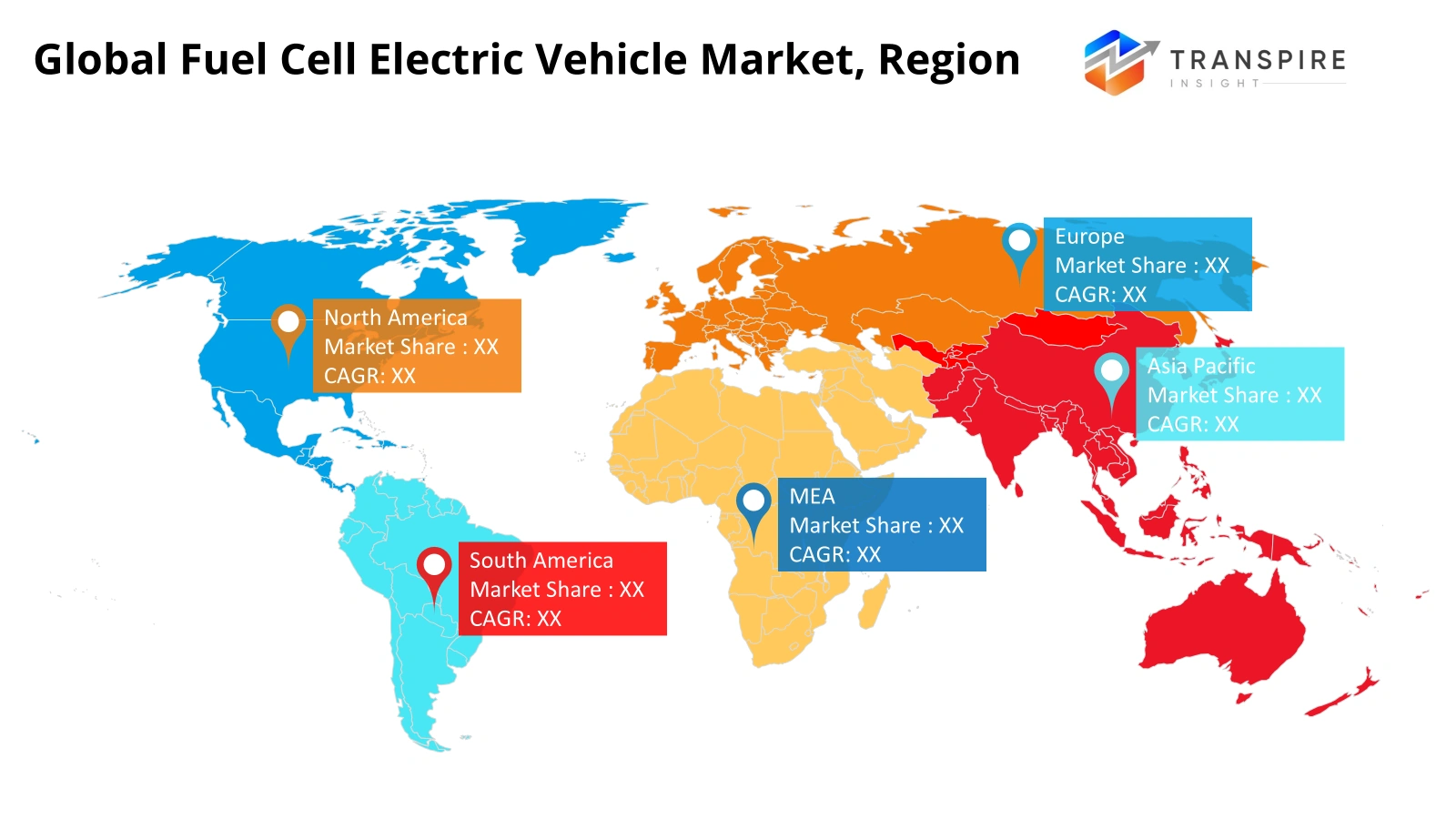
South Korea has the largest FCEV market per capita. Hyundai sells the NEXO there. The government really got into deploying hydrogen stations itself. Korea had more than 270 hydrogen stations by 2024. The national hydrogen roadmap sets a goal of 1,200 stations by 2030. Korea even exports its XCIENT fuel cell trucks to Europe and North America.
Japan really started thinking about the hydrogen society concept way before any other government did. Toyota introduced the Mirai back in 2014. Japan had over 160 operational hydrogen stations by 2024. The government helps fund station construction quite a bit so the retail network stays alive even when car sales are low. Honda really joined back in the passenger FCEV market with the CR-V e: FCEV in 2024.
Germany really puts in the most money in Europe for FCEV infrastructure. Over 90 hydrogen stations operate nationally. The H2 Mobility joint venture - Shell, TotalEnergies, and Air Liquide - built most of this network. Germany also hosts a bunch of FCEV bus pilot programs under some EU funding. Daimler and Bosch are also working on heavy-duty fuel cell systems there.
China has put out the largest number of fuel cell commercial vehicles all over the world. Most are buses and trucks in special pilot city areas. The government funded vehicles and refueling infrastructure themselves with direct subsidies. Chinese stack makers, like SAIC's subsidiary, are scaling up domestic production quite a bit. Our reliance on Japanese and Korean stacks is declining significantly.
The United States really lags behind everywhere except in California. California has over 60 hydrogen stations set up. The rest of the country doesn't have nearly that many. The Department of Energy's hydrogen hubs program - they put in $7 billion to build out our regional hydrogen infrastructure. Some target locations for these hubs are commercial trucking routes in the Midwest and Southeast.
To learn more about this report, Download Free Sample Report
Recent Development News
In 2023, Toyota and BMW announced a joint fuel cell system development program. BMW will use Toyota's fifth-generation fuel cell technology in a production vehicle. The launch is planned for 2028. This is the first time a European premium OEM has committed to a Toyota-sourced stack for a production car.
In 2025, Daimler Truck and Volvo completed the formation of cellcentric, their joint fuel cell development venture. The venture is targeting series production of heavy-duty fuel cell systems from 2027. It is one of the largest dedicated FCEV powertrain investments in the commercial vehicle sector.
Report Metrics
|
Report Metrics |
Details |
|
Market size value in 2025 |
USD 6.02 Billion |
|
Market size value in 2026 |
USD 7.57 Billion |
|
Revenue forecast in 2033 |
USD 40.3 Billion |
|
Growth rate |
CAGR of 26.98% from 2026 to 2033 |
|
Base year |
2025 |
|
Historical data |
2021 - 2024 |
|
Forecast period |
2026 - 2033 |
|
Report coverage |
Revenue forecast, competitive landscape, growth factors, and trends |
|
Country scope |
Global |
|
Key company profiled |
Toyota Motor Corporation, Hyundai Motor Company, Honda Motor Co. Ltd., Ballard Power Systems Inc., Plug Power Inc., Nikola Corporation, General Motors Company, Daimler Truck AG, Volvo Group, BMW Group, Audi AG, SAIC Motor Corporation, Doosan Fuel Cell Co. Ltd., Bloom Energy Corporation, Cummins Inc. |
|
Customization scope |
Free report customization (country, regional & segment scope). Avail customized purchase options to meet your exact research needs. |
|
Report Segmentation |
By Vehicle Type (Passenger Cars, Buses, Trucks), By Component (Fuel Cell Stack, Battery, Hydrogen Tank, Power Electronics), By Power Output (Below 100 kW, 100-200 kW, Above 200 kW). |
Key Global Fuel Cell Electric Vehicle Company Insights
Toyota really holds the deepest fuel cell patent portfolio of any automaker. It started working on FCEV technology way back in the 1990s. The Mirai is actually on its second generation now. Toyota licenses its stack technology to partners - including BMW. Rather than just sitting back, it very much works alongside partners on the application engineering aspect itself.
Hyundai runs the other long-established passenger FCEV program. The NEXO is its key product. Hyundai also builds the XCIENT fuel cell truck. That makes it the sole company actually producing FCEVs in both passenger cars and heavy trucks right now. Its fuel cell systems subsidiary handles stack development pretty much independently itself.
Ballard Power Systems doesn't build vehicles itself. Instead, it makes stacks. Its clients include bus OEMs all over Europe and China. Ballard has been the prime independent stack supplier for transit bus applications for ages. It boasts over 60 million hours of cumulative stack operation throughout its entire deployed fleet so far.
Plug Power concentrates primarily on the stationary and forklift market. It has actually set up over 60,000 fuel cell units in warehouse operations. This is the biggest deployed FCEV fleet of any sort worldwide. Plug Power is now expanding into hydrogen production and distribution so it can really control its fuel supply chain itself.
Nikola, Daimler Truck, and Volvo are all aiming at the Class 8 truck market. None have yet reached mass production levels though. Daimler and Volvo's cellcentric joint venture is actually the most dedicated investment in this space so far. Cummins is providing fuel cell modules to commercial vehicle OEMs that don't really develop their own stacks themselves.
Company List
- Toyota Motor Corporation
- Hyundai Motor Company
- Honda Motor Co. Ltd.
- Ballard Power Systems Inc.
- Plug Power Inc.
- Nikola Corporation
- General Motors Company
- Daimler Truck AG
- Volvo Group
- BMW Group
- Audi AG
- SAIC Motor Corporation
- Doosan Fuel Cell Co. Ltd.
- Bloom Energy Corporation
- Cummins Inc.
Global Fuel Cell Electric Vehicle Market Report Segmentation
By Vehicle Type
- Passenger Cars
- Buses
- Trucks
By Component
- Fuel Cell Stack
- Battery
- Hydrogen Tank
- Power Electronics
By Power Output
- Below 100 kW
- 100-200 kW
- Above 200 kW
Frequently Asked Questions
Find quick answers to common questions.
The Global Fuel Cell Electric Vehicle Market is expected to reach approximately USD 40.3 billion by 2033.
Key segments include Vehicle Type (Passenger Cars, Buses, Trucks), Component (Fuel Cell Stack, Battery, Hydrogen Tank, Power Electronics), and Power Output (Below 100 kW, 100-200 kW, Above 200 kW).
Major players include Toyota Motor Corporation, Hyundai Motor Company, Honda Motor Co. Ltd., Ballard Power Systems Inc., Plug Power Inc., Nikola Corporation, General Motors Company, Daimler Truck AG, Volvo Group, BMW Group, Audi AG, SAIC Motor Corporation, Doosan Fuel Cell Co. Ltd., Bloom Energy Corporation, and Cummins Inc.
The Global Fuel Cell Electric Vehicle Market size is approximately USD 6.02 billion in 2025.
The Global Fuel Cell Electric Vehicle Market is expected to grow at a CAGR of 26.98% from 2026 to 2033.
- Toyota Motor Corporation
- Hyundai Motor Company
- Honda Motor Co. Ltd.
- Ballard Power Systems Inc.
- Plug Power Inc.
- Nikola Corporation
- General Motors Company
- Daimler Truck AG
- Volvo Group
- BMW Group
- Audi AG
- SAIC Motor Corporation
- Doosan Fuel Cell Co. Ltd.
- Bloom Energy Corporation
- Cummins Inc.
Recently Published Reports
-
Apr 2026
ATV & UTV Market
ATV & UTV Market Size, Share & Analysis Report By Type (ATV, and UTV), By Variants (Less Than 400 CC, 400 CC To 800 CC, and More Than 800 CC), and Geography (North America, Europe, Asia-Pacific, Middle East and Africa, South and Central America), 2021 - 2031
-
Apr 2026
Automotive Central Gateway Module Market
Automotive Central Gateway Module Market Size, Share & Analysis Report By Type (Ethernet Central Gateway Module, CAN Central Gateway Module, LIN Central Gateway Module, and FlexRay), By Application (Powertrain Control, Body Control, Infotainment System, Advanced Driver Assistance Systems (ADAS), and Others), By End User (Passenger Vehicles, and Commercial Vehicles), and Geography (North America, Europe, Asia-Pacific, Middle East and Africa, South and Central America), 2021 - 2031
-
Apr 2026
Automotive Engine Oil Filter Market
Automotive Engine Oil Filter Market Size, Share & Analysis Report By Filter Type (Fuel Filter, Engine Oil Filter, Hydraulic Oil Filter, and Others), By Filter Media (Cellulose, Synthetic, and Micro), By Sales Channel (OEMs, and Aftermarket), By Vehicle Type (Passenger Cars, Light Commercial Vehicles, Heavy Duty Trucks, Buses and Coaches, and Off-road Vehicles), and Geography (North America, Europe, Asia-Pacific, Middle East and Africa, South and Central America), 2021 - 2031
-
Apr 2026
Automotive Parts Aluminium Die Casting Market
Automotive Parts Aluminium Die Casting Market Size, Share & Analysis Report By Production Process (Pressure Die Casting, Vacuum Die Casting, Squeeze Die Casting, Gravity Die Casting), By Application (Body Parts, Engine Parts, Transmission Parts, Battery And Related Components, Other Application Types), and Geography (North America, Europe, Asia-Pacific, Middle East and Africa, South and Central America), 2021 - 2031
Our Clients