
Japan Automotive Fuel Cell Market Size & Forecast:
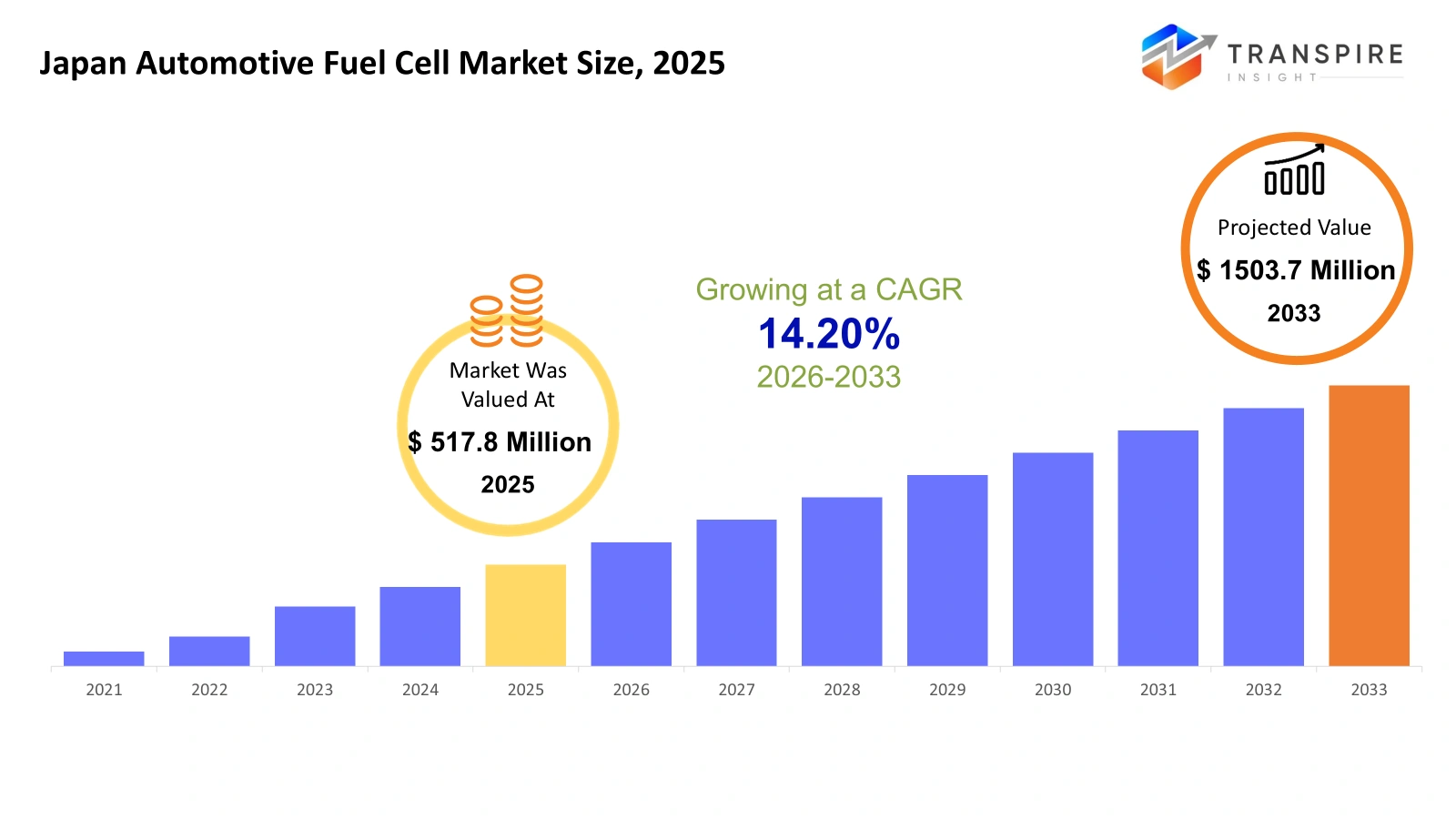
- Japan Automotive Fuel Cell Market Size 2025: USD 517.8 Million
- Japan Automotive Fuel Cell Market Size 2033: USD 1503.7 Million
- Japan Automotive Fuel Cell Market CAGR: 14.20%
- Japan Automotive Fuel Cell Market Segments:By Component (Fuel Cell Stack, Hydrogen Storage System, Power Electronics), By Vehicle Type (Passenger Cars, Commercial Vehicles, Buses), By Application (Transportation, Stationary Power).
To learn more about this report,  Download Free Sample Report
Japan Automotive Fuel Cell Market Summary:
The Japan Automotive Fuel Cell Market size is estimated at USD 517.8 Million in 2025 and is anticipated to reach USD 1503.7 Million by 2033, growing at a CAGR of 14.20% from 2026 to 2033. Japan's automotive fuel cell market is expanding because the nation is increasing its support for clean transportation systems together with its hydrogen-based economy development. The Japanese government and major car manufacturers are working together to establish fuel cell vehicles as a key element of the country's carbon reduction plan. The adoption of hydrogen technology is increasing due to three factors: expanding hydrogen infrastructure, technological progress, and growing public environmental knowledge. Japan is establishing itself as a worldwide authority in fuel cell vehicle research and eco-friendly vehicle solutions through its ongoing technological progress and development of refuelling stations.
Key Market Trends & Insights:
- The Japanese government uses its strong support of hydrogen technology to promote hydrogen as a sustainable energy solution. The authorities implement subsidies and policy frameworks and long-term hydrogen strategies to create an environment that encourages both automakers and consumers to adopt fuel cell vehicles, which creates stronger market foundations.
- The hydrogen refuelling infrastructure development project will expand its network of hydrogen refuelling stations to cover major urban areas and essential transportation routes. The expansion of the system enables drivers to operate their vehicles without fear of running out of fuel, which makes hydrogen fuel cell vehicles a viable choice for daily use.
- Japanese automotive manufacturers allocate substantial funding to research and development efforts which aim to enhance fuel cell technology performance through improved efficiency and durability and decreased production costs. The technology achieves higher commercial viability through ongoing advancements that enhance its dependable performance.
- The exploration of fuel cell technology now extends beyond passenger vehicles to include buses and trucks and logistics fleets. Hydrogen refueling stations provide these applications with fast refuelling capabilities and extended driving distance which enable their use in heavy-duty transport operations.
- Japanese consumers and businesses show increasing interest in low-emission transportation solutions because climate change issues are becoming more urgent. The public shows interest in fuel cell vehicles because those vehicles offer a clean transportation solution which generates only water vapour emissions.
- The hydrogen ecosystem development project depends on strategic partnerships that include automotive manufacturers and energy providers and technology companies. The partnerships work together to improve infrastructure development, reduce costs, and promote the expansion of fuel cell vehicle use.
Japan Automotive Fuel Cell Market Segmentation
By Component
- Fuel Cell Stack: A fuel cell vehicle relies on its fuel cell stack as the essential component which produces electricity through the combination of hydrogen and oxygen. Researchers in Japan conduct ongoing studies which lead to advancements in stack performance through increased efficiency and durability and smaller design elements. To make fuel cell vehicles more common in the market, automakers work to decrease production expenses while they boost vehicle performance.
- Hydrogen Storage System: Hydrogen storage systems play a crucial role in safely storing and supplying hydrogen to the fuel cell. Japanese manufacturers create high-pressure tanks which possess improved strength and efficiency and reduced weight. The development of new materials together with safety technology advancements allows hydrogen-powered vehicles to achieve better driving range and improved operational safety.
- Power Electronics: The power electronics system controls electrical movement between the fuel cell stack and battery and electric motor. Japanese researchers develop advanced power control systems for fuel cell vehicles which will enhance energy efficiency and driving performance. The technologies provide continuous energy distribution while they improve the management of vehicle power systems.
By Vehicle Type
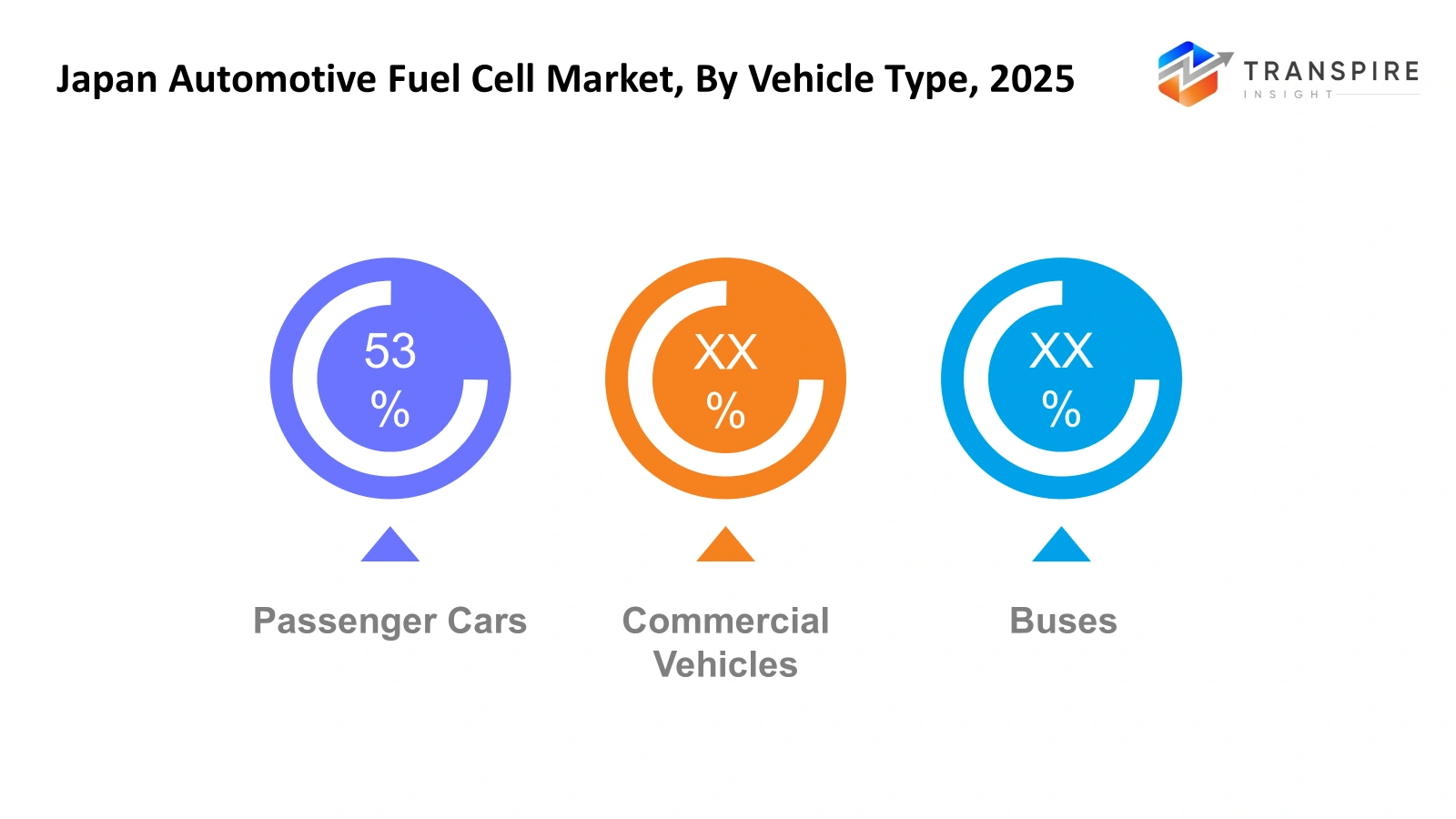
- Passenger Cars: The passenger fuel cell vehicles which run on hydrogen fuel are becoming popular in Japan because they provide environmentally sustainable transportation options. The vehicle delivers silent operation together with complete emission-free driving because both automotive manufacturers and government regulations provide their development support. The expansion of hydrogen refuelling stations leads to increased consumer interest in using fuel cell vehicles as their primary mode of daily travel.
- Commercial Vehicles: Fuel cell technology has become more appealing to commercial vehicles, which include both delivery vans and logistics trucks. Japanese companies are researching hydrogen vehicles because businesses need to operate their vehicles for extended distances, yet require quick charging times. The system supports operations with frequent vehicle use and long-distance driving requirements.
- Buses: Japanese cities have begun using hydrogen-powered buses in their clean public transportation programmes. The buses emit only water vapour into the atmosphere, making no noise, which helps enhance the quality of urban air. The governments, together with transit authorities, support their implementation to showcase environmentally friendly transportation methods.
To learn more about this report, Download Free Sample Report
By Application
- Transportation: The primary use of automotive fuel cells in Japan remains transportation. The mobility sector adopts hydrogen technology from passenger cars to heavy-duty vehicles to achieve carbon emissions reductions. The ongoing development of fuel cell systems together with refuelling networks will enhance their ability to support transportation systems in the future.
- Stationary Power: Japan uses fuel cell technology for both vehicle applications and stationary power generation systems. The systems deliver dependable electricity to buildings while functioning as backup power systems and providing energy to remote locations. Fuel cells present a sustainable energy solution because they use hydrogen to produce clean and reliable power.
Country Insights
The Japanese automotive fuel cell market shows the country's plan to develop a hydrogen-based transportation system through its fuel cell technology development activities. The Japanese government has established itself as a leader in fuel cell vehicle development through strong regulatory support and a comprehensive national hydrogen development framework. The government maintains its support for new inventions through financial assistance programmes, combined with efforts to develop facilities that enable energy companies to collaborate with automobile makers.
Japanese automotive manufacturers are developing fuel cell systems through research aimed at improving system efficiency, reducing operational expenses, and boosting vehicle capabilities. The expansion of hydrogen refuelling stations in important urban centres enables people to use fuel cell technology for their regular travel needs.
Japan is investigating other uses of fuel cells beyond passenger vehicles, including buses, trucks, and commercial vehicle fleets, to support its low-emission transportation system. The country develops its hydrogen industry through its advanced technological skills and its comprehensive hydrogen development plan, which helps it build its position as a leader in the global fuel cell automotive market while achieving environmentally friendly transportation solutions.
Recent Development News
Toyota Develops New Fuel Cell System as Part of Japan’s Hydrogen Society Vision.
Toyota Unveils Third-Generation Hydrogen Fuel Cell System to Boost Efficiency and Lower Costs.
|
Report Metrics |
Details |
|
Market size value in 2025 |
USD 517.8 Million |
|
Market size value in 2026 |
USD 593.6 Million |
|
Revenue forecast in 2033 |
USD 1503.7 Million |
|
Growth rate |
CAGR of 14.20% from 2026 to 2033 |
|
Base year |
2025 |
|
Historical data |
2021 – 2024 |
|
Forecast period |
2026 – 2033 |
|
Report coverage |
Revenue forecast, competitive landscape, growth factors, and trends |
|
Country scope |
Japan |
|
Key company profiled |
Toyota Motor Corporation, Honda Motor Co. Ltd., Hyundai Motor Company, BMW Group, Daimler AG, Ballard Power Systems, Plug Power Inc., Panasonic Corporation, Toshiba Energy Systems, Cummins Inc., Doosan Fuel Cell, Bloom Energy, Bosch Group, Nikola Corporation, PowerCell Sweden AB. |
|
Customization scope |
Free report customization (country, regional & segment scope). Avail customized purchase options to meet your exact research needs. |
|
Report Segmentation |
By Component (Fuel Cell Stack, Hydrogen Storage System, Power Electronics), By Vehicle Type (Passenger Cars, Commercial Vehicles, Buses), By Application (Transportation, Stationary Power). |
Key Japan Automotive Fuel Cell Company Insights
The Japan automotive fuel cell market exists because major automotive companies and hydrogen technology innovators operate their businesses in the country. Companies are investing substantial funds into research and development activities to achieve better fuel cell performance and extended service life and reduced production costs. Automakers and energy companies and technology organizations form strategic partnerships which drive forward the creation of hydrogen infrastructure and its accompanying technologies. The program works to develop fuel cell vehicles into dependable transportation solutions which people can use during their daily activities. Japanese companies develop clean automotive technologies through their ongoing product development work and commitment to environmental sustainability. The companies control the direction of future clean automotive technologies through their operations in Japan.
Company List
- Toyota Motor Corporation
- Honda Motor Co. Ltd.
- Hyundai Motor Company
- BMW Group
- Daimler AG
- Ballard Power Systems
- Plug Power Inc.
- Panasonic Corporation
- Toshiba Energy Systems
- Cummins Inc.
- Doosan Fuel Cell
- Bloom Energy
- Bosch Group
- Nikola Corporation
- PowerCell Sweden AB.
Japan Automotive Fuel Cell Market Report Segmentation
By Component
- Fuel Cell Stack
- Hydrogen Storage System
- Power Electronics
By Vehicle Type
- Passenger Cars
- Commercial Vehicles
- Buses
By Application
- Transportation
- Stationary Power
Frequently Asked Questions
Find quick answers to common questions.
The approximate Japan Automotive Fuel Cell Market size for the market will be USD 1503.7 Million in 2033.
The key segments of the Japan Automotive Fuel Cell Market are By Component (Fuel Cell Stack, Hydrogen Storage System, Power Electronics), By Vehicle Type (Passenger Cars, Commercial Vehicles, Buses), By Application (Transportation, Stationary Power).
Major players in the Japan Automotive Fuel Cell Market are Toyota Motor Corporation, Honda Motor Co. Ltd., Hyundai Motor Company, BMW Group, Daimler AG, Ballard Power Systems, Plug Power Inc., Panasonic Corporation, Toshiba Energy Systems, Cummins Inc., Doosan Fuel Cell, Bloom Energy, Bosch Group, Nikola Corporation, PowerCell Sweden AB.
The current market size of the Japan Automotive Fuel Cell Market is USD 517.8 Million in 2025.
The Japan Automotive Fuel Cell Market CAGR is 14.20%.
- Toyota Motor Corporation
- Honda Motor Co. Ltd.
- Hyundai Motor Company
- BMW Group
- Daimler AG
- Ballard Power Systems
- Plug Power Inc.
- Panasonic Corporation
- Toshiba Energy Systems
- Cummins Inc.
- Doosan Fuel Cell
- Bloom Energy
- Bosch Group
- Nikola Corporation
- PowerCell Sweden AB.
Recently Published Reports
-
Apr 2026
ATV & UTV Market
ATV & UTV Market Size, Share & Analysis Report By Type (ATV, and UTV), By Variants (Less Than 400 CC, 400 CC To 800 CC, and More Than 800 CC), and Geography (North America, Europe, Asia-Pacific, Middle East and Africa, South and Central America), 2021 - 2031
-
Apr 2026
Automotive Central Gateway Module Market
Automotive Central Gateway Module Market Size, Share & Analysis Report By Type (Ethernet Central Gateway Module, CAN Central Gateway Module, LIN Central Gateway Module, and FlexRay), By Application (Powertrain Control, Body Control, Infotainment System, Advanced Driver Assistance Systems (ADAS), and Others), By End User (Passenger Vehicles, and Commercial Vehicles), and Geography (North America, Europe, Asia-Pacific, Middle East and Africa, South and Central America), 2021 - 2031
-
Apr 2026
Automotive Engine Oil Filter Market
Automotive Engine Oil Filter Market Size, Share & Analysis Report By Filter Type (Fuel Filter, Engine Oil Filter, Hydraulic Oil Filter, and Others), By Filter Media (Cellulose, Synthetic, and Micro), By Sales Channel (OEMs, and Aftermarket), By Vehicle Type (Passenger Cars, Light Commercial Vehicles, Heavy Duty Trucks, Buses and Coaches, and Off-road Vehicles), and Geography (North America, Europe, Asia-Pacific, Middle East and Africa, South and Central America), 2021 - 2031
-
Apr 2026
Automotive Parts Aluminium Die Casting Market
Automotive Parts Aluminium Die Casting Market Size, Share & Analysis Report By Production Process (Pressure Die Casting, Vacuum Die Casting, Squeeze Die Casting, Gravity Die Casting), By Application (Body Parts, Engine Parts, Transmission Parts, Battery And Related Components, Other Application Types), and Geography (North America, Europe, Asia-Pacific, Middle East and Africa, South and Central America), 2021 - 2031
Our Clients