

South Korea Titanium Dioxide Market Summary
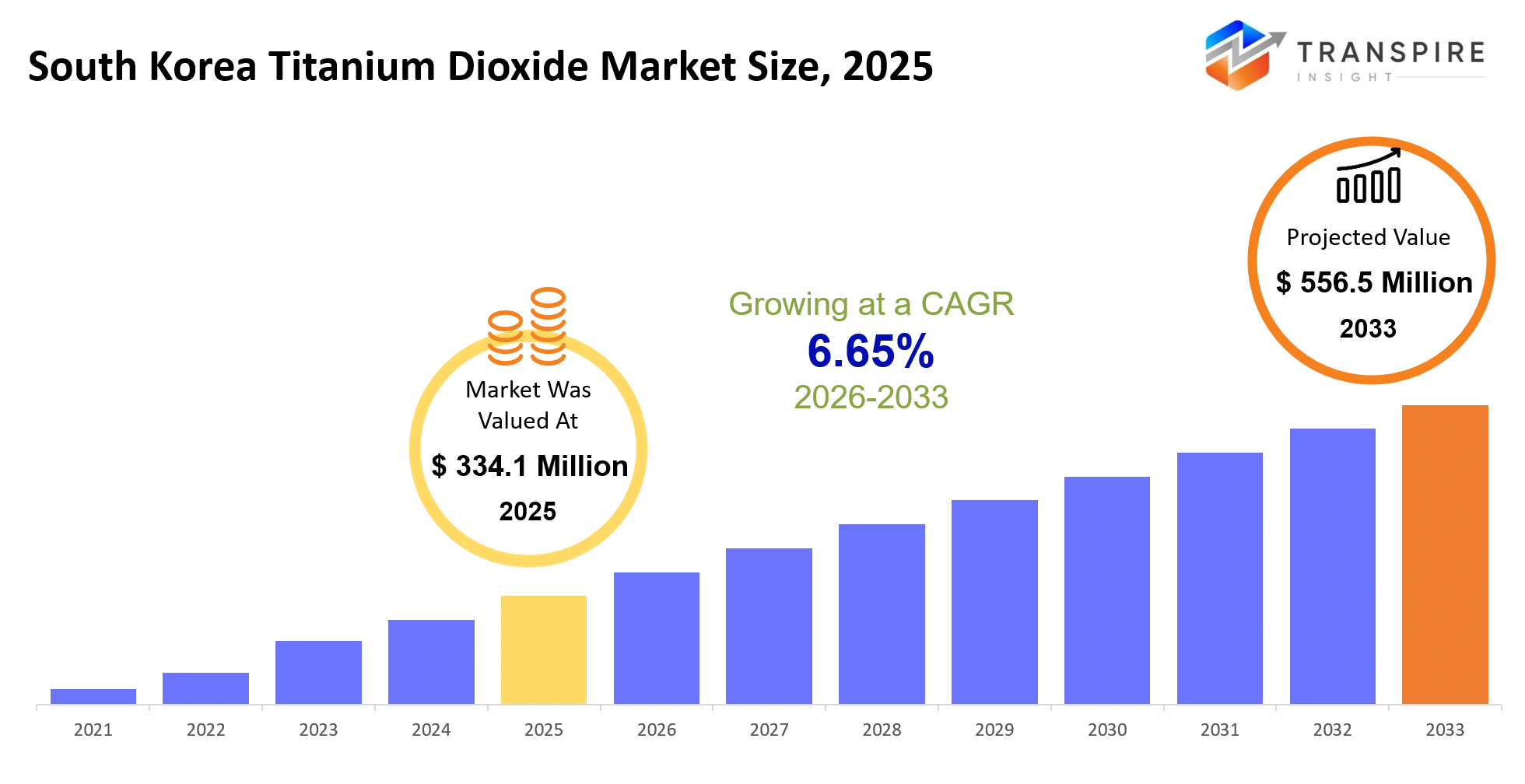
As per Transpire Insight Analysis the South Korea Titanium Dioxide Market size is estimated at USD 334.1 Million in 2025 and is anticipated to reach USD 556.5 Million by 2033, growing at a CAGR of 6.65% from 2026 to 2033.
The South Korea Titanium Dioxide Market kinda supports manufacturers that are after durable whiteness, nice opacity, strong UV resistance, and honestly a little extra surface guarding across paints, coatings, plastics, inks, and all the other industrial goods. In real life, titanium dioxide helps finished products keep their appearance and overall usefulness, while also reducing how much material they need to reach solid coverage. Over the last 3–5 years, the entire market has been leaning toward higher-performance grades, because Korean makers keep pushing formulation efficiency , stronger product staying power, and tougher environmental credentials.
One real world trigger was the disruption to global chemical supply chains after the Russia-Ukraine conflict, which kind of laid bare the fact that Korean buyers got hit by imported feedstock swings, messy transportation timing , and pigment pricing moves. So they began tightening sourcing plans, plus adding supplier diversification, not just one channel, and thats it.
Right now, the growth seems more about manufacturers upgrading their formulations and securing dependable pigment supplies, rather than it being only about making more volume. And because premium coatings, automotive related materials, and advanced plastics all want consistent optical and functional performance, these higher value titanium dioxide grades should bring better revenue potential across South Korean industrial supply chains.
South Korea Titanium Dioxide Market Size & Forecast:
- South Korea Titanium Dioxide Market Size 2025: USD 334.1 Million
- Expected Market Value 2033: USD 556.5 Million
- Forecast CAGR: 6.65%
- Leading region in 2025:
- Fastest Growing region:
- Key Profile: Chemours Company, Tronox Holdings, Venator Materials, Kronos Worldwide, LB Group, CNNC Huayuan Titanium Dioxide, Lomon Billions, Ishihara Sangyo Kaisha, Tayca Corporation, Cinkarna Celje, Evonik Industries, KRONOS International, Dongbu Fine Chemical, OCI Company Ltd., BASF SE.
Key Market Insights
- In 2025, Gyeonggi Province ends up taking over South Korea’s regional market , roughly a 30% share it seems , and that’s backed by automotive, electronics, coatings, and plastics manufacturing clusters that keep expanding, day by day.
- Busan meanwhile is moving the quickest too, and its marine coatings, shipbuilding suppliers, and port-linked manufacturing are lifting titanium dioxide consumption across the 2026–2033 forecast window.
- On the product side, rutile shows up as the big thing, with a 77.31% revenue share in 2025.
- That situation looks tied to better opacity, weather resistance, and durability across industrial formulations.
- After that, anatase holds second place, and specialty applications basically nudge producers toward higher purity grades, for fibers, electronics, cosmetics, and even customized formulations that are tuned for specific jobs.
- By 2033, anatase also becomes the fastest-growing segment, with specialty-grade development plus higher-value uses pushing demand forward. Those uses really lean on purity, dispersion, and particle characteristics that are matched to the target performance.
- As far as applications go, paints and coatings are still dominating, because construction, automotive, marine, and industrial coating recipes rely a lot on opacity and UV resistance in practice.
- Cosmetics and sunscreen are accelerating too, as ultrafine titanium dioxide gets more traction in formulas where UV absorption matters, and where controlled particle traits are needed.
- For end use, paints coatings and plastics are leading, and Korean automotive and construction manufacturers keep showing strong procurement needs for durable, high-performance pigment systems.
- Lastly, electronics and specialty materials come out as the fastest-growing end-user categories, supported by Korea’s semiconductor, consumer electronics, and advanced-material manufacturing base that keeps expanding.
What are the Key Drivers, Restraints, and Opportunities in the South Korea Titanium Dioxide Market?
The main growth driver is Korea’s shift toward high-performance coatings and specialty materials, like it’s not just coatings anymore right. Automotive, construction, marine, and electronics makers really need stronger opacity, UV resistance, and long-term color stability. So formulators get pushed toward higher-value rutile grades plus various specialty grades that behave more predictably and with less annoying variability. And yeah the effect is pretty direct: if pigment performance improves, coatings can be made thinner, or last longer, which supports premium formulations, and also higher-value procurement calls. On top of that Korea’s 2025 K-Chemistry Roadmap puts extra focus on high-value specialty chemicals, cleaner production methods, and AI-enabled process optimization, kind of pushing everyone to do things smarter.
The biggest restraint is supply-chain concentration, plus the fact that firms still lean on imported feedstocks and global pigment pricing shifts that are hard to forecast. Titanium-containing feedstock has limited supplier availability in many regions and TiO₂ pricing is mostly negotiated instead of exchange-traded. From the Transpire Insight review of regional procurement signals and product launch timing, supply chain concentration stays the main execution risk, even when demand looks steady. If disruptions happen they can delay replenishment, push companies to hold larger inventories, and even postpone customer qualification cycles, which then spills over into schedules. In the end these knock-on effects tend to suppress near-term revenue, especially when manufacturers can’t secure consistent material grades across shipments.
The strongest opportunity sits in specialty and ultrafine TiO₂ used for electronics, cosmetics, advanced plastics, and high-performance coatings. COSMO Chemical already runs roughly 30,000 tonnes of capacity, and it plans to expand its specialty-product mix quite a bit. Korea’s electronics ecosystem, together with advanced manufacturing, gives a fairly immediate customer pool for purified grades, not just bulk buyers.
What Has the Impact of Artificial Intelligence Been on the South Korea Titanium Dioxide Market?
AI and digital tech are starting to nudge titanium dioxide production away from reactive control into more predictive manufacturing, you know like, less guessing and more “seeing ahead” sort of idea. In pigment plants, sensor streams can support automatic supervision of things like temperature, pressure, particle traits, feedstock conditions, and even process chemistry, even while the line is already running. Machine-learning models can catch weird operating rhythms before they snowball into an off-spec batch. It really counts because pigment quality relies heavily on stable particle size, dispersion behavior, purity levels, and those process conditions people often underweight. At the same time, predictive demand modeling can connect customer orders, automotive production timing, construction momentum, plus inventory logs, so procurement schedules become calmer and emergency sourcing drops.
Korea is actively laying down the industrial base for this shift. In 2025, the government noticed interest from 519 companies in AI autonomous-manufacturing programs, that’s more than double the prior year’s 213-company interest. The national chemical roadmap also leans toward AI-enabled intelligent process control, starting at raw-material intake, flowing through separation steps, and finishing in post-processing work.
The practical payoff can appear as higher uptime, fewer quality disturbances, reduced energy draw, and quicker maintenance calls , more or less. Korean smart-factory efforts have already reported measurable productivity improvements and equipment upgrades in factories. Even so, TiO₂ producers still run into the familiar hurdles: integration costs, patchy or inconsistent historical datasets, and the difficulty of reusing a trained model across different pigment grades, not to mention shifting operating conditions.
Key Market Trends
- Rutile kind of kept that top 77.31% share in 2025, while specialty anatase applications started to get more commercial attention across Korea’s advanced manufacturing base.
- Anatase is expected to become the fastest growing grade by 2033 and that is helped along by purified ultrafine fiber , electronics , and cosmetic use cases.
- Specialty grade production picked up after 2024, when Korean producers went after purified plus application specific TiO₂, instead of mostly leaning on commodity pigment sales.
- COSMO Chemical is also moving its mix toward specialty products, aiming for more than 80% specialty product share after the high value product launches seemed to work, at least that’s the idea.
- In 2025 there was stronger AI manufacturing momentum too, with Korean authorities receiving 519 company requests which sped up digital process control across chemical and industrial output, somehow.
- Supply chain risk got worse after global capacity reshuffling , as bigger producers closed facilities and trimmed capacity. With weak pricing squeezing profitability across 2023–2025.
- Chemours rolled out a TMP/TME free Ti-Pure grade in February 2025, and it basically shows how regulatory and formulation requirements are reshaping the premium pigment story, right now.
- Tronox expanded the availability of Korea specific products in 2025, they published several TiONA grades and strengthened technical support for Korean customers.
- Ultrafine TiO₂ gained real traction in 2025–2026, mainly for cosmetics, sunscreens, coatings , and other needs where particle size control and UV performance matter.
- And in 2025 Korea’s chemical policy leaned more toward specialty materials, linking TiO₂ adjacent development with semiconductors , future mobility , environmental compliance , and AI enabled manufacturing.
South Korea Titanium Dioxide Market Segmentation
By Grade :
Rutile Grade it kind of keeps a pretty solid spot, because automotive coatings, architectural paints , plastics, and industrial finishes really do need solid hiding power, reasonable weather resistance, and color that just stays steady. Pigment Grade also keeps a wide industrial presence, like in paints, inks, plastics, and construction materials , the usual kind of space. Anatase Grade is more for cases where optical behavior and a particular formulation need extra attention, not simply generic coverage. Nano Titanium Dioxide is getting more buzz in cosmetics , UV protection goods, and certain specialty materials , mostly because if you manage the particle size you can support a more directed performance.
High-Purity Grade should grow in commercial value , especially as Korean electronics , advanced materials, pharmaceutical producers, and specialty chemical makers push for tighter material requirements. Cosmetic Grade and Pharmaceutical Grade will ride on formulation upgrades that depend on controlled purity and stable particle traits, so it’s not really casual stuff. Food Grade will stay tied to allowed food-related uses, along with the regulatory responsibilities that follow it. Industrial Grade will keep showing up in high-volume uses, while the specialty grades may bring better margin compared with plain commodity products.
By Process :
Chloride Process and Sulfate Process still stay as the main production routes, but the choice of which one to use kind of depends on feedstock availability, what the product specifications look like, operating costs, and also the environmental requirements. Sulfate Process is still pretty relevant, mainly because the existing production infrastructure helps support wide-ranging pigment manufacturing. Chloride Process meanwhile brings advantages for certain high-performance grades, mainly thanks to better control on pigment quality and overall process efficiency.
High-Purity Synthesis and Nano Production will likely get more important over time, especially since Korean manufacturers are aiming at electronics, cosmetics, advanced coatings, and specialty materials. Green Manufacturing will also see more emphasis, as producers try to lower waste generation, improve energy efficiency, and get stronger environmental performance. Recycled Production gives another angle too, namely to ease the pressure on raw materials. Continuous Production tends to support stable output and consistent process behavior, while Batch Production is still useful for customized grades and smaller specialty orders .
By Application :
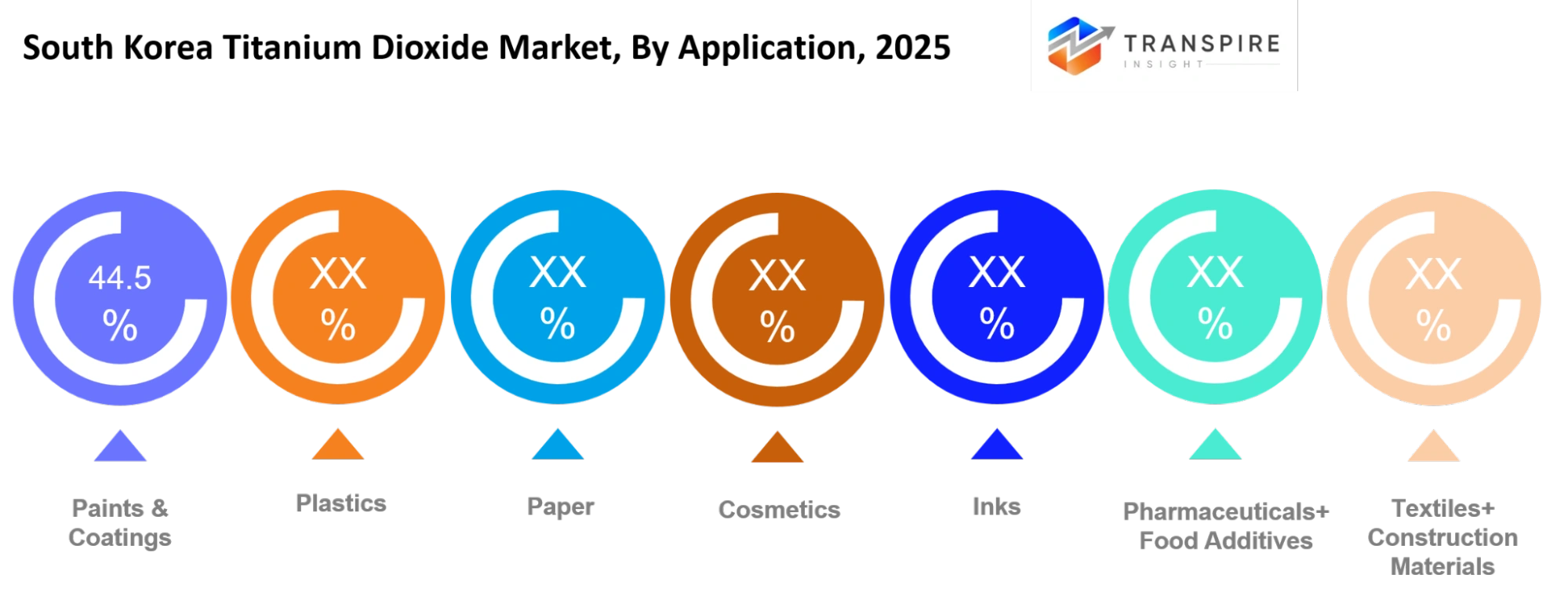
Paints & Coatings are a big deal, mostly because titanium dioxide gives strong opacity, that bright whiteness, UV resistance and decent surface durability. In the automotive coatings space, plus architectural finishes and industrial coatings, and even construction products, they will likely keep on supporting pigment use. Plastics also need titanium dioxide for color stability, opacity, and that extra shield against ultraviolet exposure, so there’s steady buying activity among Korean compounders, as well as manufacturers, year after year.
On the other hand cosmetics and specialty formulations should open up faster chances for Nano Titanium Dioxide and higher-purity grades. Sunscreen and personal-care products want controlled particle features, and they need consistent, reliable quality. Paper, inks, textiles, and construction materials should keep their usual consumption levels across both commercial and industrial output. Pharmaceutical and Food Additives are a bit more tightly managed, since regulatory requirements steer which grades are actually accepted, how high the purity should be, and how formulations are carried out, in practice.
By End User :
Construction is sort of a big end-user group, because paints, coatings, plastics, sealants, and general building materials really do need durable white pigments, you know, for day to day service. Automotive manufacturing also pulls a lot of value with coatings , interior plastic parts, outside elements, and protective finishes that have to last. Packaging manufacturers use titanium dioxide too, mainly because opacity, color consistency and overall look can change how a product shows up to customers, plus it affects material behavior during use.
Now for other areas, the Cosmetics Industry and Electronics sector should open up more solid opportunities for specialty grades. Cosmetic companies want controlled particle size and purity for certain mixtures, while electronics companies are asking more often for high-purity materials for advanced production steps. Pharmaceutical firms will stay in the mix for tightly defined grades, and they have to follow regulatory requirements. The Chemical Industry buyers will still matter a great deal, since pigment creation and downstream formulation depend on dependable supply, stable quality, and practical technical assistance.
By Distribution Channel :
Direct Sales still feel important for those big Korean manufacturers, since bulk purchasing really depends on steady supply, technical details that have to match, negotiated pricing, and those long term commercial agreements that people do not drop easily. Chemical Distributors kind of help the smaller manufacturers, and also niche buyers, because they keep local inventory around, give practical technical support, and they can handle more flexible order volumes. Industrial Suppliers, in turn, reach the customers who need regular pigment deliveries for coatings, plastics, inks, and even construction related materials.
The online B2B channels will grow more relevant too, mostly because buyers can compare grades, specifications, suppliers, and delivery options in a more digital way. Importers and Exporters will stay in the picture as well, since international titanium dioxide supply affects what is available in Korea and also how the prices shift. Specialty Dealers will keep supporting higher value grades where application guidance matters and customized service is basically expected. Wholesalers and Retail Suppliers will keep covering smaller volume customers, while direct supplier relationships will likely remain stronger for the large industrial contracts and those specialized material requirements.
What are the Key Use Cases Driving the South Korea Titanium Dioxide Market?
Paints and coatings stay pretty much the main use case , with construction, automotive and industrial coating makers making most of the bigger buys. It’s the strong opacity , UV resistance, crisp brightness and that long durability , that is why titanium dioxide is still so essential for protective , as well as decorative mixes, kind of a reliable baseline.
Plastics and cosmetics are also getting more space, it’s not only holding steady. For packaging and automotive plastic manufacturers the pigment supports whiteness and UV stability, while in Korea cosmetic producers lean on ultrafine grades for sunscreens, skincare, and makeup blends
Electronics coatings and newer nanoparticle formulations are starting to look more promising too. Semiconductor and capacitor uses can benefit from corrosion and wear resistance, and meanwhile, specialized cosmetic and coating recipes should keep pulling in the higher value ultrafine grades through the forecast period.
|
Report Metrics |
Details |
|
Market size value in 2025 |
USD 334.1 Million |
|
Market size value in 2026 |
USD 354.5 Million |
|
Revenue forecast in 2033 |
USD 556.5 Million |
|
Growth rate |
CAGR of 6.65% from 2026 to 2033 |
|
Base year |
2025 |
|
Historical data |
2021 - 2024 |
|
Forecast period |
2026 - 2033 |
|
Report coverage |
Revenue forecast, competitive landscape, growth factors, and trends |
|
Country scope |
South Korea |
|
Key company profiled |
Chemours Company, Tronox Holdings, Venator Materials, Kronos Worldwide, LB Group, CNNC Huayuan Titanium Dioxide, Lomon Billions, Ishihara Sangyo Kaisha, Tayca Corporation, Cinkarna Celje, Evonik Industries, KRONOS International, Dongbu Fine Chemical, OCI Company Ltd., BASF SE. |
|
Customization scope |
Free report customization (country, regional & segment scope). Avail customized purchase options to meet your exact research needs. |
|
Report Segmentation |
By Grade (Rutile Grade, Anatase Grade, Pigment Grade, Nano Titanium Dioxide, Food Grade, Cosmetic Grade, Pharmaceutical Grade, Industrial Grade, High-Purity Grade, Others); By Process (Chloride Process, Sulfate Process, Hybrid Process, Recycled Production, High-Purity Synthesis, Nano Production, Green Manufacturing, Continuous Production, Batch Production, Others); By Application (Paints & Coatings, Plastics, Paper, Cosmetics, Inks, Pharmaceuticals, Food Additives, Textiles, Construction Materials, Others); By End User (Construction, Automotive, Packaging, Cosmetics Industry, Pharmaceutical Companies, Paper Industry, Textile Industry, Chemical Industry, Electronics, Others); By Distribution Channel (Direct Sales, Chemical Distributors, Online B2B, Wholesalers, Industrial Suppliers, Importers, Exporters, Specialty Dealers, Retail Suppliers, Others). |
Which Regions are Driving the South Korea Titanium Dioxide Market Growth?
Gyeonggi shows up as the leading regional market, estimated around 30% in 2025 , but not only because of raw numbers. It’s propped up by a dense set of automotive, electronics, coatings, plastics, and chemical manufacturing infrastructure. The strong setup also comes through industrial foundations , wider supplier webs, and manufacturing investment that’s heavily concentrated in specific zones. Because of that it gives the province a kind of practical edge in downstream pigment consumption. Companies like Sukgyung AT bring specialty material know-how, and meanwhile industrial buyers can count on logistics that are already in place, plus chemical supply networks that are pretty mature. This kind of concentration should hold Gyeonggi’s position through 2033, especially as advanced materials keep moving, automotive output keeps going, and specialty formulations keep generating higher value pigment needs.
Ulsan, though, kind of grows on a different base, more structural, less “just demand”. The drivers here are large scale chemical processing, port infrastructure, and integrated industrial complexes. The region benefits from steadier industrial investment and a direct line to chemical feedstocks, so procurement is more predictable for big manufacturers. COSMO Chemical, for instance, runs a 30,000-tonne annual titanium dioxide facility at the Onsan industrial complex in Ulsan. That production footprint supports reliable regional revenue via domestic supply, export activity, and longer term relationships with industrial customers.
In Chungcheong it sits as the quickest , faster-growing zone for semiconductors and electronics, and also battery materials + advanced manufacturing spending keeps going up. Lately the industrial money has nudged up the want for higher purity materials for electronics and for specialized chemical processes , so it feels like a slightly different growth track than the usual construction or automotive clusters. COSMO Chemical said it brought in high-purity titanium dioxide for secondary battery use at its specialty materials operations, in 2025. Then for 2026–2033, firms that focus on high-purity grades , technical support services, and a more local distribution can pick up fresh contracts, as the advanced manufacturing footprint ramps.
Who are the Key Players in the South Korea Titanium Dioxide Market and How Do They Compete?
Pigment demand feels steady right now. Big foreign firms still hold a large share. At the same time, local makers keep pushing. Some of them have already built repeat buyers. Even so, smaller companies can still win business in a few specific niches.Most buyers begin by checking how the color behaves. They look at how the pigment stays stable over time. They also want tight repeatability from one shipment to the next. The shade and the performance targets have to match. Delivery timing matters too. Many buyers also ask for hands on help, like how to blend and how to run production, not just a product sticker.
Cost is part of the choice. In Korea, some buyers line up local supply against imported lots. If a supplier can ship on schedule and match the right pigment grade to each job, the order can move fast.COSMO Chemical works with a clear plan. The company does not only push bulk sales. It focuses on what it produces in Korea and keeps control over the grade of each pigment. COSMO also states it runs the only titanium dioxide production line in the country.
Its anatase grades go into rubber, paints, and coatings. They are used in paper, resins, and fibers as well. The same grades also show up in certain food related uses. The firm also serves needs in electronics. COSMO aims to move further into specialty materials that carry higher value.Management wants specialty products to grow from about 30% of revenue to over 80%.
Chemours competes through premium Ti-Pure pigment performance, technical consistency, and formulation support, while Tronox combines pigment production with mineral-resource integration. KRONOS differentiates through a broad grade portfolio and its commercial relationship with COSMO Chemical for Korean customers. COSMO Chemical’s distribution structure specifically covers KRONOS rutile products for domestic plastics and paint customers. Sukgyung AT takes a narrower technology-led position, producing ultrafine, high-purity titanium dioxide with approximately 20-nanometer particles, more than 99.9% purity, and customized surface treatments for cosmetics, toners, dental composites, and e-paper materials. These strategies allow international suppliers to defend premium pigment positions while Korean specialists target higher-margin applications.
Company List
- Chemours Company
- Tronox Holdings
- Venator Materials
- Kronos Worldwide
- LB Group
- CNNC Huayuan Titanium Dioxide
- Lomon Billions
- Ishihara Sangyo Kaisha
- Tayca Corporation
- Cinkarna Celje
- Evonik Industries
- KRONOS International
- Dongbu Fine Chemical
- OCI Company Ltd.
- BASF SE
Recent Development News
In February 2026, COSMO Chemical confirmed an OEM collaboration with KRONOS for high-purity titanium dioxide applications, creating a route into pharmaceutical-grade markets where strict purity requirements support higher-value sales.
Source: https://www.theworldfolio.com/
In March 2026, COSMO Chemical reported continued development of titanium dioxide products including anatase and rutile grades, supporting specialty-material expansion and broader supply options for Korean industrial customers.
Source: https://kind.krx.co.kr/
What Strategic Insights Define the Future of the South Korea Titanium Dioxide Market?
Korea’s titanium dioxide business may look different in the coming years. More buyers could ask for special forms and specific grades. They may do this because “regular” pigment volume is not the only thing that matters anymore.
Demand may rise in a few clear pockets. Some coatings need tighter specs for real performance. Electronics also rely on stable grades. Skin care and some specialty chemicals need consistent quality too. Local producers may see a chance to charge better by adjusting output to what each client actually uses.
Still, there is a risk side to watch. Supply might end up too集中 in too few hands. Korea does not have a large home production base. If a plant stops, or if shipments get delayed, or if raw feed becomes harder to obtain, problems can spread quickly. Prices could jump. Customers might also wait longer while they redo tests and approvals, even if sales for the whole sector still seem fine.
There is also a brighter path. High purity anatase can be a good fit for advanced materials. It can also be used for parts related to secondary batteries. COSMO Chemical is already moving in this direction, tying special titanium dioxide to a broader push for higher value lines. If that strategy holds, it may help the firm reach better margin areas later.
So what can companies do right away? They can lock in dependable raw supply terms with clear conditions. They can also invest in careful purification steps. Next, they should run more application trials and keep stricter quality checks. Using newer inspection tools can help. If firms do this, they may cut supply risk and stand a better chance of selling premium grades as the market shifts toward niche materials.
South Korea Titanium Dioxide Market Report Segmentation
By Grade
- Rutile Grade
- Anatase Grade
- Pigment Grade
- Nano Titanium Dioxide
- Food Grade
- Cosmetic Grade
- Pharmaceutical Grade
- Industrial Grade
- High-Purity Grade
By Process
- Chloride Process
- Sulfate Process
- Hybrid Process
- Recycled Production
- High-Purity Synthesis
- Nano Production
- Green Manufacturing
- Continuous Production
- Batch Production
By Application
- Paints & Coatings
- Plastics
- Paper
- Cosmetics
- Inks
- Pharmaceuticals
- Food Additives
- Textiles
- Construction Materials
By End User
- Construction
- Automotive
- Packaging
- Cosmetics Industry
- Pharmaceutical Companies
- Paper Industry
- Textile Industry
- Chemical Industry
- Electronics
By Distribution Channel
- Direct Sales
- Chemical Distributors
- Online B2B
- Wholesalers
- Industrial Suppliers
- Importers
- Exporters
- Specialty Dealers
- Retail Suppliers
Frequently Asked Questions
Find quick answers to common questions.
The expected South Korea Titanium Dioxide Market size for the market will be USD 556.5 Million in 2033.
Key segments for the South Korea Titanium Dioxide Market are By Grade (Rutile Grade, Anatase Grade, Pigment Grade, Nano Titanium Dioxide, Food Grade, Cosmetic Grade, Pharmaceutical Grade, Industrial Grade, High-Purity Grade, Others); By Process (Chloride Process, Sulfate Process, Hybrid Process, Recycled Production, High-Purity Synthesis, Nano Production, Green Manufacturing, Continuous Production, Batch Production, Others); By Application (Paints & Coatings, Plastics, Paper, Cosmetics, Inks, Pharmaceuticals, Food Additives, Textiles, Construction Materials, Others); By End User (Construction, Automotive, Packaging, Cosmetics Industry, Pharmaceutical Companies, Paper Industry, Textile Industry, Chemical Industry, Electronics, Others); By Distribution Channel (Direct Sales, Chemical Distributors, Online B2B, Wholesalers, Industrial Suppliers, Importers, Exporters, Specialty Dealers, Retail Suppliers, Others).
Major South Korea Titanium Dioxide Market players are Chemours Company, Tronox Holdings, Venator Materials, Kronos Worldwide, LB Group, CNNC Huayuan Titanium Dioxide, Lomon Billions, Ishihara Sangyo Kaisha, Tayca Corporation, Cinkarna Celje, Evonik Industries, KRONOS International, Dongbu Fine Chemical, OCI Company Ltd., BASF SE.
The South Korea Titanium Dioxide Market size is USD 334.1 Million in 2025.
The South Korea Titanium Dioxide Market CAGR is 6.65% from 2026 to 2033.
- Chemours Company
- Tronox Holdings
- Venator Materials
- Kronos Worldwide
- LB Group
- CNNC Huayuan Titanium Dioxide
- Lomon Billions
- Ishihara Sangyo Kaisha
- Tayca Corporation
- Cinkarna Celje
- Evonik Industries
- KRONOS International
- Dongbu Fine Chemical
- OCI Company Ltd.
- BASF SE
About the Authors

Pankaj Ghogare Patil
I am Pankaj Ghogare Patil, a Senior Research Analyst at Transpire Insight, specializing in the Pharmaceutical, Chemicals & Materials, Healthcare IT, and Biotechnology industry. My expertise lies in conducting comprehensive market research, analyzing industry trends, evaluating competitive landscapes, and translating complex data into actionable insights. At Transpire Insight, I closely follow emerging technologies, regulatory developments, and market innovations to create accurate, well-researched, and informative content that helps businesses and professionals make informed decisions. I am committed to producing credible, evidence-based articles that reflect industry best practices while making technical topics accessible and valuable for a broad audience.

Chakradhar Khansole
Chakradhar serves as the Research Director at Transpire Insight, bringing over 8 years of experience in technology, innovation, and strategic market intelligence. He specializes in transforming complex market data into actionable business insights that enable organizations to make informed, growth-oriented decisions. Recognized for his strategic vision and analytical expertise, Chakradhar leads high-impact research initiatives, delivering comprehensive market assessments, competitive intelligence, and forward-looking industry analysis.
Recently Published Reports
-
May 2026
Healthcare Polymer Packaging Market
Healthcare Polymer Packaging Market Size, Share & Analysis Report By Packaging Type (Syringes, IV Bottles and Pouches, Clamshells, Blisters, Bottles & Jars, Containers, Tubes, IV Parental Packaging, Others), By Type (Regulated, Non-regulated), By Polymer Type (LDPE (Low-Density Polyethylene), HDPE (High-Density Polyethylene), Homo-polymer (Homo), Random Copolymer (Random), Block Copolymer (Block), PET, Polystyrene, Polyvinyl Chloride, Polyamide/EVOH, Others), and Geography (North America, Europe, Asia-Pacific, Middle East and Africa, South and Central America), 2021 - 2031
-
Apr 2026
Hydrophilic Tape (Waterstop) Market
Hydrophilic Tape (Waterstop) Market Size, Share & Analysis Report By Type (Bentonite-Based Hydrophilic Tape, Rubber-Based Hydrophilic Tape), By Application (Residential Buildings, Commercial Buildings, Infrastructure Projects), and Geography (North America, Europe, Asia-Pacific, Middle East and Africa, South and Central America), 2021 - 2031
-
Apr 2026
Metalens Market
Metalens Market Size, Share & Analysis Report By Type (Visible Light Metalens, and Infrared Metalens), By Application (Consumer Electronics, Automotive Electronics, Industrial, Medical, and Others), and Geography (North America, Europe, Asia-Pacific, Middle East and Africa, South and Central America), 2021 - 2031
-
Apr 2026
PBT Resin Market
PBT Resin Market Size, Share & Analysis Report By Type (Reinforced PBT Resin, Unreinforced PBT Resin), By Processing Method (Injection Molding, Extrusion, Blow Molding, Others), By End-User (Automotive, Electrical & Electronics, Consumer Appliances, Industrial Machinery, Medical Devices, Packaging, Others), and Geography (North America, Europe, Asia-Pacific, Middle East and Africa, South and Central America), 2021 - 2031