
Middle East and Africa Building & Construction Materials Market Summary
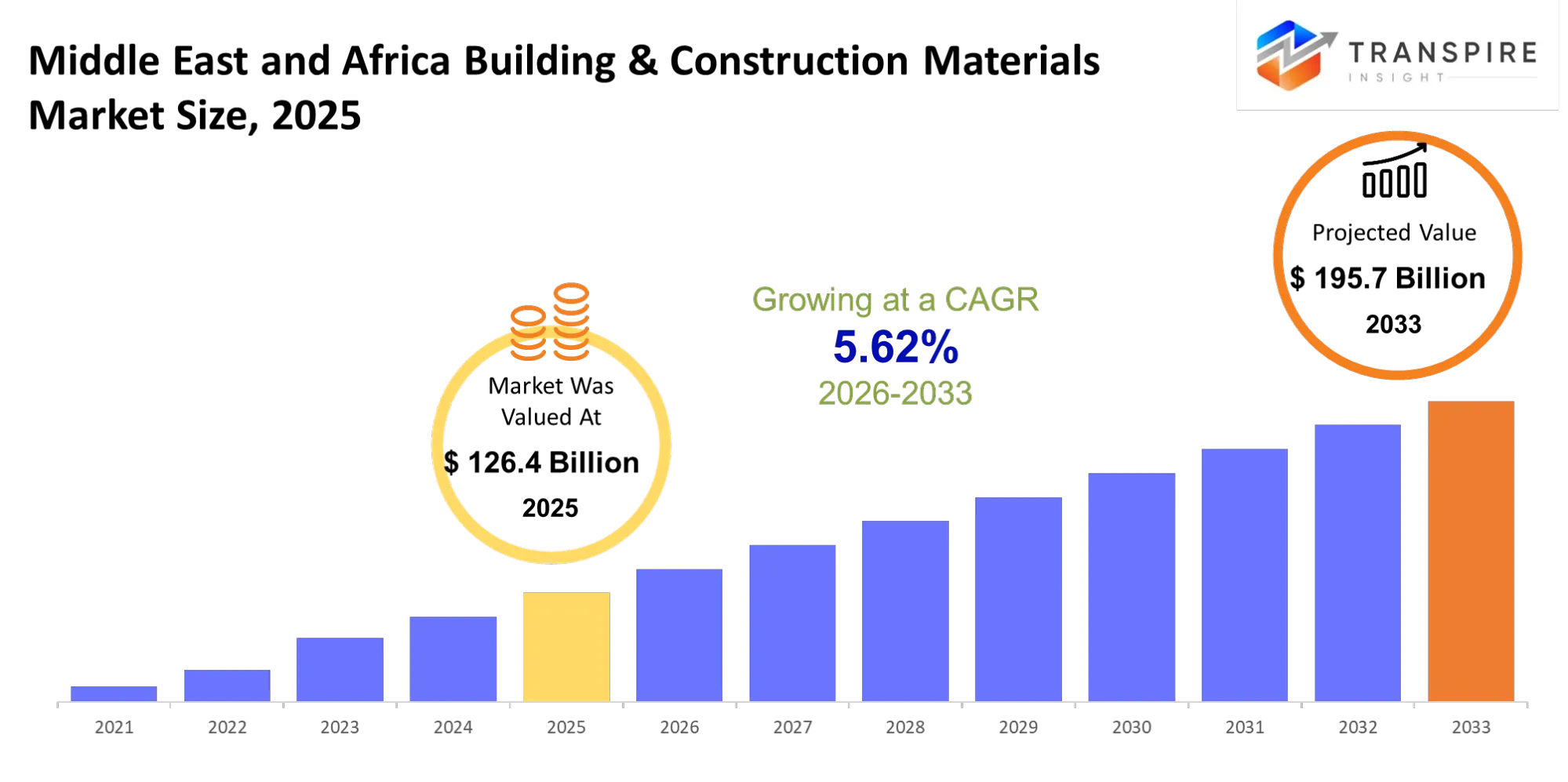
As per Transpire Insight Analysis the Middle East and Africa Building & Construction Materials Market size is estimated at USD 126.4 Billion in 2025 and is anticipated to reach USD 195.7 Billion by 2033, growing at a CAGR of 5.62% from 2026 to 2033.
The Middle East and Africa Building & Construction Materials Market provides the essential material supply that helps residential homes, commercial complexes, industrial sites, transport corridors, and energy infrastructure get built more efficiently, and at larger scale. In the last five years, things have started leaning toward higher-value products, the kind that help energy use, long-term resistance, and overall lifecycle outcomes. This happened as governments rolled out tighter green building rules and also pushed investment into areas beyond oil dependency.
Then COVID-19 arrived, along with the later global supply chain problems, which really showed how risky import dependence can be. So, multiple countries moved to grow regional manufacturing for cement, steel, and insulation, rather than leaning so heavily on imports. As a result, buying timelines have become shorter, materials can be sourced more easily, and domestic supply networks are, well, stronger now.
Big city expansion initiatives, logistics corridors, and renewable energy builds are still driving continuous procurement. That keeps manufacturers busy enough to broaden their production mix, while boosting revenue from premium construction solutions, not only plain commodity-type materials.
Middle East and Africa Building & Construction Materials Market Size & Forecast:
- Middle East and Africa Building & Construction Materials Market Size 2025: USD 126.4 Billion
- Expected Market Value 2033: USD 195.7 Billion
- Forecast CAGR: 5.62%
- Leading region in 2025:
- Fastest Growing region:
- Key Profile: Holcim, Heidelberg Materials, CEMEX, Saint-Gobain, CRH, UltraTech Cement, Sika, BASF Construction Chemicals, Knauf, ArcelorMittal, Lafarge, Emirates Steel, Etex Group, Kingspan, Boral
Key Market Insights
- The Middle East and Africa Building & Construction Materials Market is set to hit USD 195.7 billion by 2033, mainly driven by things like infrastructure modernization, plus that regional manufacturing expansion that just keeps going.
- In the GCC region, it’s leading hard, with an estimated 46% market share in 2025 , pushed forward by megaprojects, smart cities , and transport infrastructure spend.
- Africa is projected to be the fastest-growing regional market through 2033. That outlook is tied to urban housing shortages, along with public infrastructure financing, kind of a linked chain effect.
- For the product split , cement and concrete are still in the lead, holding roughly a 38% market share, supported by road works, housing builds, and commercial construction activity.
- Steel products come in as the second-largest segment, because industrial facilities, logistics hubs, and renewable energy projects keep demanding structural materials .
- On the insulation side, insulation materials are expected to post the fastest growth through 2033 , as building energy efficiency rules get stricter and stricter.
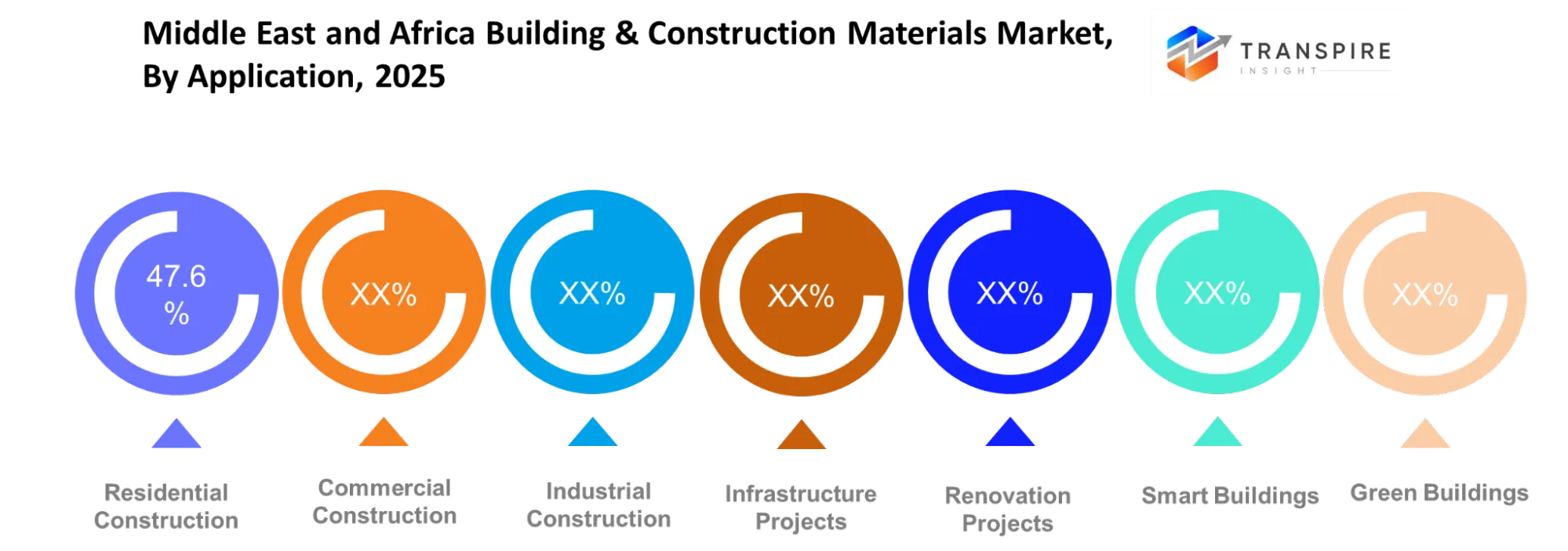
- If we look at application demand, residential construction makes up nearly 41% , while industrial construction is the one showing the quickest expansion across emerging economies.
- As for end users, construction companies remain the front-runner segment with more than 48% market share , and government infrastructure agencies are also expanding their procurement pipelines, without slowing down .
- Key players such as Holcim, Heidelberg Materials, Saint-Gobain, Sika, Knauf, and Emirates Steel are boosting competitiveness using product innovation , regional production, and strategic partnerships.
- Meanwhile, digital manufacturing, low-carbon cement technologies, recycled aggregates, and modular construction solutions continue reshaping how procurement strategies are done across the regional construction materials industry, overall.
What are the Key Drivers, Restraints, and Opportunities in the Middle East and Africa Building & Construction Materials Market?
Government-backed infrastructure diversification still feels like the strongest nudge for market growth, even if it is not the only thing at play. National development programs, like Saudi Arabia’s Vision 2030, the UAE industrial strategy , and the big transport pushes happening across Africa, have basically raised demand for cement, steel, insulation, glass, and those specialty construction chemicals. With public spending backing it, many manufacturers choose to set up regional production facilities. That cuts logistics cost a bit, but also makes delivery timing more dependable , so suppliers can actually plan. All these pieces together broaden material consumption across commercial, residential, industrial, and energy infrastructure projects, which then tends to lift supplier revenues overall.
But, you know, market performance still gets constrained by volatility in raw materials pricing and by energy costs. Cement and steel production involves energy heavy manufacturing , and imported clinker, iron ore, chemicals, plus transportation, can get thrown off by currency swings or geopolitical disruptions. And the tricky part is that these cost pressures are structural, so they cannot be fixed fast. They depend on long-run investments in domestic mining, renewable power, and expanded manufacturing capacity. Because of that, project budgets often get updated again and again, procurement choices get delayed, and construction activity ends up getting held back.
Green construction, though, looks like the clearest long-term opening. Governments are slowly rolling in tighter building efficiency requirements. That is pushing stronger demand for low-carbon cement, recycled aggregates , improved insulation, and high-performance glazing materials, especially in commercial projects.
What Has the Impact of Artificial Intelligence Been on the Middle East and Africa Building & Construction Materials Market?
Artificial intelligence is, kind of, re shaping the regional construction materials industry by nudging manufacturing efficiency a bit, tightening quality control, and making supply chain planning feel a lot more organized than before. Cement plants in particular are starting to use AI powered process optimization setups that keep tracking kiln temperatures , fuel usage, and the raw material make up on a steady basis, so output stays more uniform while energy demand goes down. On top of that, machine learning models read equipment vibration levels, pressure signals, and operational history to guess when maintenance is needed before a major breakdown happens . This helps manufacturers push plant availability higher and cut down on those annoying unplanned stops , too.
AI also ends up reinforcing logistics planning, because it can forecast material demand, tune inventory amounts, and even improve fleet routing across big construction projects. Then there are computer vision systems, they can automatically check finished items and spot defects in concrete blocks , steel parts, glass panels, and insulation materials with more steady attention than manual inspection. All these digital capabilities raise production yields, make delivery timelines shorter, and lower operating costs, while still keeping compliance with stricter quality standards in place.
Even so, AI adoption isn’t evenly spread across the region. A lot of manufacturers run into heavy integration costs when they try to upgrade older production equipment using intelligent monitoring platforms. Plus, limited digital infrastructure, inconsistent operational data, and a shortage of specialized AI engineering skills also slow things down. This shows up most clearly for medium sized producers, they often don’t have enough financial room for the large scale digital transformation that these tools usually require.
Key Market Trends
- After 2020 supply chain disruptions, regional manufacturers kinda shifted away from import dependence and leaned more into localized production, sure, it wasn’t instant but it did happen, overall.
- Low-carbon cement technologies started getting real commercial traction when governments rolled out tougher building sustainability rules across GCC nations.
- Steel producers are putting more money into electric arc furnace setups, partly to boost efficiency and also to cut production emissions, you know, the usual pressure.
- Modular construction picked up speed after labor shortages pushed developers to wrap up projects faster, sometimes with tighter sequencing and less downtime.
- Recycled aggregate production grew too, because circular economy policies started mattering more for urban infrastructure projects and that sort of pressure kept building.
- AI and machine vision based digital quality inspection has become much more routine in cement, glass, and steel plants, not just as pilots but as more ongoing practice.
- Bigger developers now often demand high-performance insulation materials to meet modern energy efficiency regulations that have been introduced since 2021.
- Global players like Holcim, Heidelberg Materials, Saint-Gobain, Knauf, and Sika kept expanding their regional manufacturing and distribution reach by making strategic investment moves, pretty consistently.
- At the same time, infrastructure spending is starting to lean more heavily toward locally sourced materials, this supports domestic producers and it also strengthens procurement resilience across the whole region.
- Meanwhile smart city initiatives keep showing up as one of the main drivers behind purchasing decisions for premium construction materials, usually tied to durability, lifecycle outcomes, and day to day operational efficiency, which is kind of the point, right.
Middle East and Africa Building & Construction Materials Market Segmentation
By Material Type
Cement sorta forms the base layer of residential, commercial, industrial, and infrastructure building through the region because it has dependable strength, and its cost efficiency stays pretty good. Concrete helps with bigger structural work by allowing ready placement and a long service life, meanwhile steel supplies structural stability for high rise buildings, bridges, factories, and transport facilities, too. Bricks and blocks are still used a lot for housing developments because they’re affordable, offer thermal performance ,and they’re pretty simple to install. Glass keeps gaining value in newer commercial buildings thanks to better natural lighting and nice exterior looks.
Wood shows up mostly in interior construction, decorative finishes, doors and selected structural uses where design flexibility matters. Insulation materials also keep expanding across new developments, since building regulations put more weight on energy efficiency and indoor comfort. Other things like ceramics , aggregates, gypsum products, roofing compounds, and construction chemicals back specialized needs in the build. Choosing materials depends on the project scale, the environment, the structural needs, and also the long term maintenance goals.
By Application
Residential construction is still the biggest share, mainly because population growth keeps rolling forward and urban expansion is still happening in lots of Middle Eastern and African countries. Commercial construction covers office spaces, shopping centers, hotels, healthcare facilities, and educational institutions, all of which need durable materials that work well in practice, not just on paper. Industrial construction, on the other hand supports factories, warehouses, logistics parks and manufacturing sites, so they rely on heavy structural materials with a long operating life. Infrastructure projects typically involve roads, railways, airports, ports, bridges, utilities, and energy facilities and these usually demand very large volumes of cement, steel, and concrete.
Renovation work keeps material use steady, since building improvements, structural fixes, and modernization efforts continue over time. Smart buildings bring digital systems, upgraded insulation, and energy management technology into the mix, which helps with daily performance and lower costs. Green buildings push for recycled products, energy-saving materials, and low‑carbon construction approaches in order to meet the changing building requirements. There are also other uses like public buildings, sports complexes, cultural venues, and mixed-use developments, made for growing urban communities, even when the planning is not exactly the same everywhere.
By Distribution Channel
Direct sales stay the preferred route for big infrastructure projects, mainly because manufacturers deal straight with major contractors, and also with developers, not through lots of middle steps. Building material distributors offer a wide assortment of products and in the same time they make ordering easier for medium-sized construction firms working across several locations. Retail stores still help smaller contractors, renovation specialists, and individual builders with quick product access plus flexible buying choices. Online sales keep growing too, as digital procurement platforms get better at showing prices clearly, displaying stock in a visible way, and speeding up the whole ordering process.
Wholesale suppliers keep product supply steady for regional distributors and larger commercial purchasers, helped by bulk purchasing arrangements. Contractors often source materials via long-term supplier ties, which in turn supports smoother project timelines and steadier cost handling. Other distribution paths include specialized construction supply firms, and procurement partnerships built around specific projects, these cover unusual material needs. Distribution plans continue moving toward integrated logistics networks, that improve delivery pace, and help with inventory management too.
By End User
Construction companies end up taking the largest share, mainly because big residential, commercial, industrial, and infrastructure projects mean they need to keep buying essential building materials, like without much pause. Real estate developers put money into housing neighborhoods , office complexes, retail sites, and mixed-use developments, and these really rely on dependable material access, plus steady product quality. On the other hand, government infrastructure agencies procure materials for transit corridors, water systems, public buildings, and also broader national development programs. Meanwhile industrial developers typically seek out specialized structural materials for manufacturing plants, logistics hubs, and energy installations.
For residential builders, the emphasis is on housing developments where construction costs, durability, and the pace of completing the job have to line up in a practical way. Commercial contractors handle office buildings, hotels, hospitals, schools, and retail centers, and they also choose materials that satisfy technical requirements and safety rules, pretty carefully. Other end users can be institutional organizations, utility providers, and engineering firms, working on more specialized construction tasks. Across all these end-user groups, purchasing choices hinge on project timelines, regulatory compliance , lifecycle performance, and budget planning.
By Product Form
Precast materials help speed up construction because they’re made in a factory with tight control, so you get consistent quality, and honestly less site work, too . Ready-mix concrete then steps in for homes, offices, factories, plus infrastructure projects, it keeps a fairly uniform strength and it also makes placement faster and more efficient. Structural steel is still kind of non negotiable for big buildings, bridges, industrial plants, and transportation builds, mainly due to its high load-bearing capacity.
Roofing materials keep changing as well, usually in the direction of stronger weather resistance, better thermal performance, and longer-lasting product life span. For flooring materials, people typically choose concrete surfaces, ceramic solutions, engineered top layers, and other durable choices depending on what the building is for, and what kind of upkeep is realistic. Wall materials , on the other hand support structural steadiness, insulation, and indoor finishing while still matching today’s architectural preferences.
Composite materials are also getting more attention lately, mostly for their lighter weight properties, corrosion resistance , and overall improved structural behavior across various construction uses. Other forms include finishing materials, prefabricated components, sealants, coatings, and specialty construction products that are developed for certain project needs, not just general use.
What are the Key Use Cases Driving the Middle East and Africa Building & Construction Materials Market?
Residential housing still stays as the main use case , mostly because the national housing programs, the push for wider urban expansion, and population growth are still fueling big construction work. Because of continuous development of apartments, villas and also affordable housing initiatives, the demand keeps moving for cement, concrete, steel, insulation products, and wall materials, in both older city areas and newer urban zones.
On the commercial and industrial side, activity keeps widening via logistics parks, manufacturing plants , office complexes, hospitals, schools and universities, plus retail centers. At the same time, government infrastructure agencies and industrial developers are putting significant money into transport corridors, airports bridges, renewable energy sites and utility networks. That translates into steady purchasing of structural steel, ready-mix concrete, and precast components.
Meanwhile smart city projects and low-carbon building efforts look like the newer use cases with real long-term upside. Energy-efficient buildings more and more rely on advanced insulation systems, composite materials, recycled construction products, and even digital construction methods, simply because building requirements are getting stricter across multiple Middle Eastern and African economies.
|
Report Metrics |
Details |
|
Market size value in 2025 |
USD 126.4 Billion |
|
Market size value in 2026 |
USD 133.5 Billion |
|
Revenue forecast in 2033 |
USD 195.7 Billion |
|
Growth rate |
CAGR of 5.62% from 2026 to 2033 |
|
Base year |
2025 |
|
Historical data |
2021 - 2024 |
|
Forecast period |
2026 - 2033 |
|
Report coverage |
Revenue forecast, competitive landscape, growth factors, and trends |
|
Regional scope |
Middle East and Africa (Saudi Arabia, United Arab Emirates, South Africa, Rest of Middle East and Africa) |
|
Key company profiled |
Holcim, Heidelberg Materials, CEMEX, Saint-Gobain, CRH, UltraTech Cement, Sika, BASF Construction Chemicals, Knauf, ArcelorMittal, Lafarge, Emirates Steel, Etex Group, Kingspan, Boral |
|
Customization scope |
Free report customization (country, regional & segment scope). Avail customized purchase options to meet your exact research needs. |
|
Report Segmentation |
By Material Type (Cement, Concrete, Steel, Bricks & Blocks, Glass, Wood, Insulation Materials, Others); By Application (Residential Construction, Commercial Construction, Industrial Construction, Infrastructure Projects, Renovation Projects, Smart Buildings, Green Buildings, Others); By Distribution Channel (Direct Sales, Building Material Distributors, Retail Stores, Online Sales, Wholesale Suppliers, Contractors, Others); By End User (Construction Companies, Real Estate Developers, Government Infrastructure Agencies, Industrial Developers, Residential Builders, Commercial Contractors, Others); By Product Form (Precast Materials, Ready-Mix Concrete, Structural Steel, Roofing Materials, Flooring Materials, Wall Materials, Composite Materials, Others) |
Which Regions are Driving the Middle East and Africa Building & Construction Materials Market Growth?
The Gulf Cooperation Council (GCC) is basically showing up as the largest regional market , mostly because of sustained investment into big infrastructure works, city growth, and industrial diversification programs that don’t really slow down. National plans like Saudi Vision 2030, the UAE’s pushes for industrial expansion , and those longer public investment pipelines keep backing demand for cement, steel , concrete, insulation and also those more specialized construction materials. In addition , modern port infrastructure at Jebel Ali, Khalifa Port, and Saudi logistics hubs helps make raw materials come in more efficiently while still allowing exports of finished construction products into different regional markets. With strong regulatory rules, established manufacturing capacity, plus contractor networks that are fairly integrated, the whole environment feels stable enough to keep regional leadership strong.
South Africa stays in the No.2 position though, and the reason feels a bit different since the market structure is built around mature industrial capacity, mining activity, and ongoing commercial construction, instead of relying on megaproject development. A diversified economy, a solid domestic production base, and comparatively steadier building standards help keep procurement more predictable across residential, industrial, and infrastructure projects. Public infrastructure upkeep, investments related to renewable energy , and logistics improvements also keep creating demand, even when economic conditions wobble here and there. So this sort of balanced demand profile gives material suppliers more dependable revenue , more long-term operational stability, rather than chasing short cycle project expansion.
For the Rest of Africa, the expectation is faster growth going toward 2033, since governments are accelerating urban housing programs, investing in transport corridors, and pushing broader industrial development.
Who are the Key Players in the Middle East and Africa Building & Construction Materials Market and How Do They Compete?
Competition brings together worldwide building material manufacturers with solid local producers, so you end up with a market that’s sort of moderately consolidated. In the end it’s scale, manufacturing efficiency, sustainability, and how well regional distribution works that decides who wins. Big players are still pushing harder to keep their positions, mostly via low-carbon product families, more digital manufacturing, and more local production sites. Meanwhile, regional suppliers usually fight back with logistics perks and sheer nearness to major construction projects. Price management stays relevant, but in procurement the product’s real performance, environmental certifications, and dependable supply are starting to matter even more.
Holcim stands out with low-carbon product lines like ECOPact and ECOPlanet, and they’re also broadening circular construction know-how. That means demolition materials get reused, then turned into new products, not just discarded. They also keep adding to their construction solutions portfolio through specific acquisitions and investments in sustainable manufacturing technologies. Heidelberg Materials leans into digital production, carbon-cutting methods, and strategic acquisitions meant to reinforce production strength and export reach. Their increased ownership in Akçansa also boosts manufacturing capacity and gives better logistics access across the Mediterranean area, which should help with upcoming demand moving toward the Middle East.
Saint-Gobain competes with high-performance insulation, glass, and interior building options that raise building energy efficiency and occupant comfort. Sika, in turn, expands through construction chemicals with advanced performance, waterproofing technologies, and on-the-ground technical support that improves durability for infrastructure as well as commercial developments.
Company List
- Holcim
- Heidelberg Materials
- CEMEX
- Saint-Gobain
- CRH
- UltraTech Cement
- Sika
- BASF Construction Chemicals
- Knauf
- ArcelorMittal
- Lafarge
- Emirates Steel
- Etex Group
- Kingspan
- Boral
Recent Development News
In April 2026, Heidelberg Materials announced the acquisition of Sabanci Holding's 39.72% stake in Akçansa. The transaction increased Heidelberg Materials' ownership to 79.44%, strengthening production capacity and export capabilities across Turkey and the wider Mediterranean region.https://www.heidelbergmaterials.com
In March 2026, Holcim announced the acquisition of CEMEX's building materials and solutions operations in Colombia. The acquisition expands Holcim's construction solutions portfolio and supports continued international growth in higher-value building materials.https://www.holcim.com
In June 2025, Holcim announced an investment in SaltX's plasma technology for near-zero cement production. The investment accelerates commercial development of low-carbon cement manufacturing technologies and supports long-term decarbonization objectives.https://www.holcim.com
What Strategic Insights Define the Future of the Middle East and Africa Building & Construction Materials Market?
The market is slowly leaning toward localized manufacturing, low-carbon materials and digitally integrated production systems, as governments want more supply chain resilience, plus tougher building performance standards. In other words, future competitive advantage will rely less on sheer production volume and more on how well firms can deliver certified sustainable materials, keep dependable regional distribution networks, and bring down lifecycle construction expenses. There is also a quieter kinda risk, raw material and energy cost volatility can quietly erode project margins even if construction pipelines still look strong, or very busy. Meanwhile, carbon-reduced cement, recycled aggregates, and AI-enabled manufacturing are real opportunities, especially as regulations get stricter and more demanding over time. Manufacturers and investors should consider expanding across high-growth African markets, while also putting money into digital production technologies and sustainability-focused product lines, these should match the direction of procurement expectations and the broader long-term infrastructure development plans.
Middle East and Africa Building & Construction Materials Market Report Segmentation
By Material Type
• Cement
• Concrete
• Steel
• Bricks & Blocks
• Glass
• Wood
• Insulation Materials
• Others
By Application
• Residential Construction
• Commercial Construction
• Industrial Construction
• Infrastructure Projects
• Renovation Projects
• Smart Buildings
• Green Buildings
• Others
By Distribution Channel
• Direct Sales
• Building Material Distributors
• Retail Stores
• Online Sales
• Wholesale Suppliers
• Contractors
• Others
By End User
• Construction Companies
• Real Estate Developers
• Government Infrastructure Agencies
• Industrial Developers
• Residential Builders
• Commercial Contractors
• Others
By Product Form
• Precast Materials
• Ready-Mix Concrete
• Structural Steel
• Roofing Materials
• Flooring Materials
• Wall Materials
• Composite Materials
• Others
Frequently Asked Questions
Find quick answers to common questions.
The expected Middle East and Africa Building & Construction Materials Market size for the market will be USD 195.7 Billion in 2033.
Key segments for the Middle East and Africa Building & Construction Materials Market are By Material Type (Cement, Concrete, Steel, Bricks & Blocks, Glass, Wood, Insulation Materials, Others); By Application (Residential Construction, Commercial Construction, Industrial Construction, Infrastructure Projects, Renovation Projects, Smart Buildings, Green Buildings, Others); By Distribution Channel (Direct Sales, Building Material Distributors, Retail Stores, Online Sales, Wholesale Suppliers, Contractors, Others); By End User (Construction Companies, Real Estate Developers, Government Infrastructure Agencies, Industrial Developers, Residential Builders, Commercial Contractors, Others); By Product Form (Precast Materials, Ready-Mix Concrete, Structural Steel, Roofing Materials, Flooring Materials, Wall Materials, Composite Materials, Others).
Major Middle East and Africa Building & Construction Materials Market players are Holcim, Heidelberg Materials, CEMEX, Saint-Gobain, CRH, UltraTech Cement, Sika, BASF Construction Chemicals, Knauf, ArcelorMittal, Lafarge, Emirates Steel, Etex Group, Kingspan, Boral.
The Middle East and Africa Building & Construction Materials Market size is USD 126.4 Billion in 2025.
The Middle East and Africa Building & Construction Materials Market CAGR is 5.62% from 2026 to 2033.
- Holcim
- Heidelberg Materials
- CEMEX
- Saint-Gobain
- CRH
- UltraTech Cement
- Sika
- BASF Construction Chemicals
- Knauf
- ArcelorMittal
- Lafarge
- Emirates Steel
- Etex Group
- Kingspan
- Boral
About the Authors

Kartik bhong
I am Kartik Bhong, a Senior Research Analyst at Transpire Insight, specializing in the Packaging, Manufacturing, and Construction industry. My work focuses on analyzing market trends, emerging technologies, industry regulations, and competitive landscapes to deliver accurate, data-driven insights. I am passionate about transforming complex industry information into clear, practical content that helps businesses, professionals, and decision-makers stay informed and make confident strategic decisions. Through continuous research and a strong commitment to accuracy, I strive to create reliable, well-researched content that reflects the latest developments across these dynamic industries and supports the vision of Transpire Insight in delivering valuable market intelligence.

Chakradhar Khansole
Chakradhar serves as the Research Director at Transpire Insight, bringing over 8 years of experience in technology, innovation, and strategic market intelligence. He specializes in transforming complex market data into actionable business insights that enable organizations to make informed, growth-oriented decisions. Recognized for his strategic vision and analytical expertise, Chakradhar leads high-impact research initiatives, delivering comprehensive market assessments, competitive intelligence, and forward-looking industry analysis.
Recently Published Reports
-
Apr 2026
Handling and Lifting Equipment Market
Handling and Lifting Equipment Market Size, Share & Analysis Report By Product (Cranes and Hoists, Forklifts, Conveyor Systems, Aerial Work Platforms, Others), By Application (E-Commerce, Automotive and Railway, Food and Beverages, Aviation, Others), and Geography (North America, Europe, Asia-Pacific, Middle East and Africa, South and Central America), 2021 - 2031
-
Apr 2026
HVAC Equipment Market
HVAC Equipment Market Size, Share & Analysis Report By Heating Equipment Type (Boilers and Furnaces, Heat Pumps, and Unitary Heaters), By Ventilation Equipment (Air Handling Units, Humidifiers and Dehumidifiers, Air Filters, and Fan Coiling Units), By Air Conditioning Equipment (Unitary Air Conditioners, Room Air Conditioners, Packaged Terminal Air Conditioners, and Chillers), By End User (Commercial, Residential, Industrial, and others), and Geography (North America, Europe, Asia-Pacific, Middle East and Africa, South and Central America), 2021 – 2031
-
Apr 2026
Refrigeration Valves Market
Refrigeration Valves Market Size, Share & Analysis Report By Type (Solenoid Valves, Expansion Valves, Check Valves, Service Valves, Others), By Application (Commercial Refrigeration, Industrial Refrigeration, Transport Refrigeration, Residential Refrigeration, Air Conditioning Systems), By End User (Food and Beverage Industry, Pharmaceutical Industry, HVAC Industry, Chemical Industry, Others), and Geography (North America, Europe, Asia-Pacific, Middle East and Africa, South and Central America), 2021 – 2031
-
Apr 2026
E-Commerce Packaging Materials Market
E-Commerce Packaging Materials Market By Material Type (Corrugated Boxes, Paper & Paperboard, Foam & Cushioning Materials, Plastic Packaging, Flexible Packaging, Protective Packaging, Others), By Product(Primary Packaging, Secondary Packaging, Tertiary Packaging), By Packaging Function (Protective Packaging, Branding & Presentation Packaging, Transit & Logistic Packaging, Sustainable Packaging, Tamper Evidence Packaging), By End-User (Retail & Consumer Goods, Electronic Appliances, Food & Beverages, Healthcare & Pharmaceutical, Fashion & Apparel, Home & Furnishing, Others); By Industry Analysis, Size, Share, Growth, Trends, and Forecasts 2021-2033