
Middle East and Africa Residential Modular Construction Market Size & Forecast:
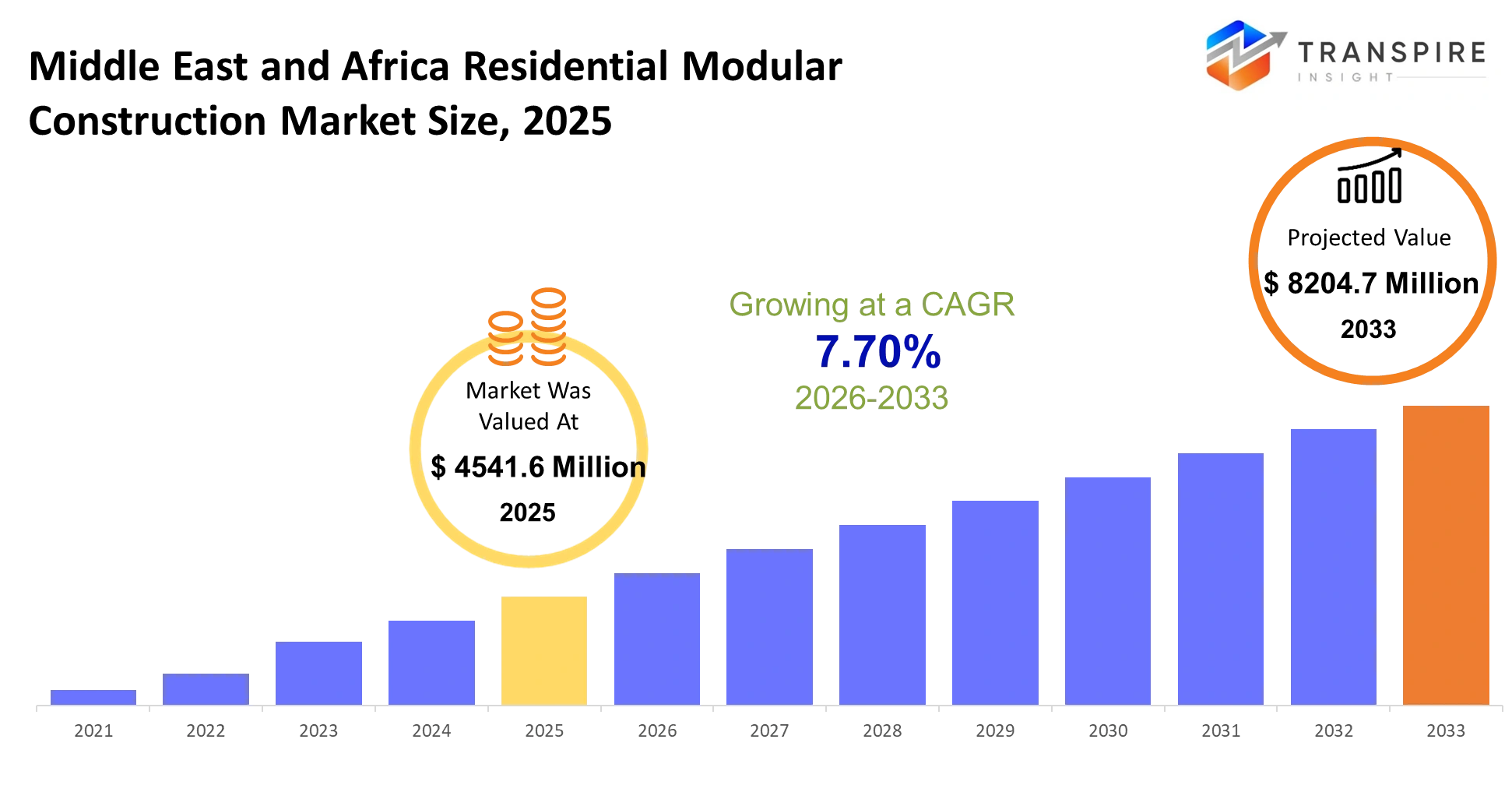
- Middle East and Africa Residential Modular Construction Market Size 2025: USD 4541.6 Million
- Middle East and Africa Residential Modular Construction Market Size 2033: USD 8204.7 Million
- Middle East and Africa Residential Modular Construction Market CAGR: 7.70%
- Middle East and Africa Residential Modular Construction Market Segments: By Type (Permanent, Relocatable, Hybrid), By Material (Wood, Steel, Concrete, Composite), By End-User (Homeowners, Developers, Construction Firms, Government Housing Bodies)
To learn more about this report,  Download Free Sample Report
Middle East and Africa Residential Modular Construction Market Summary:
The Middle East and Africa Residential Modular Construction Market size is estimated at USD 4541.6 Million in 2025 and is anticipated to reach USD 8204.7 Million by 2033, growing at a CAGR of 7.70% from 2026 to 2033. The construction sector in the Middle East and Africa which includes Saudi Arabia, United Arab Emirates, South Africa, and Rest of Middle East and Africa will implement new methods for constructing residential buildings in response to different environmental conditions and urban development challenges. The construction industry will increasingly adopt precision-built modules because buyers demand quicker property possession and constant product quality. Building codes and sustainability standards will become more stringent because governments will establish higher requirements for factory-based construction methods. The combination of digital design tools and off-site manufacturing will enable efficient customization processes while urban populations will demand adaptable building designs. The current system will evolve towards efficient operations and controlled expenditures while creating flexible housing solutions that meet both regional lifestyle needs and environmental protection requirements.
What Has the Impact of Artificial Intelligence Been on the Middle East and Africa Residential Modular Construction Market?
Artificial intelligence is transforming decision-making processes and operational efficiency throughout the Middle East and Africa residential modular construction industry because it establishes a new method which relies on data analysis instead of existing methods. AI in middle east and africa residential modular construction market activities will enhance market research by processing vast datasets, identifying buyer behavior patterns, and uncovering micro-level demand shifts across urban and semi-urban regions.
The residential modular construction market in the Middle East and Africa will experience operational changes through its implementation of artificial intelligence which will create automated systems for both production and supply chain work. The accuracy of factory-based module production will improve through AI systems which enable waste reduction and quality assessment and production process optimization.
AI will deliver more than efficiency improvements through its implementation in the Middle East and Africa residential modular construction market because it will bring about new innovations and customization. Developers will use intelligent design systems to develop housing models which can adapt to both regional climate conditions and consumer needs. The adoption of AI-powered insights and automation will help companies improve their competitive position because they will create housing solutions that are both affordable and tailored to specific customer needs while delivering faster results in response to market requirements.
Key Market Trends & Insights:
- Saudi Arabia controls the middle eastern and african residential modular construction industry because it holds almost 30% of the market share in 2025 which results from its extensive housing development projects.
- The United Arab Emirates maintains its position as the most rapidly growing area which will achieve growth above 8% compound annual growth rate until 2030 because of its smart city funding initiatives.
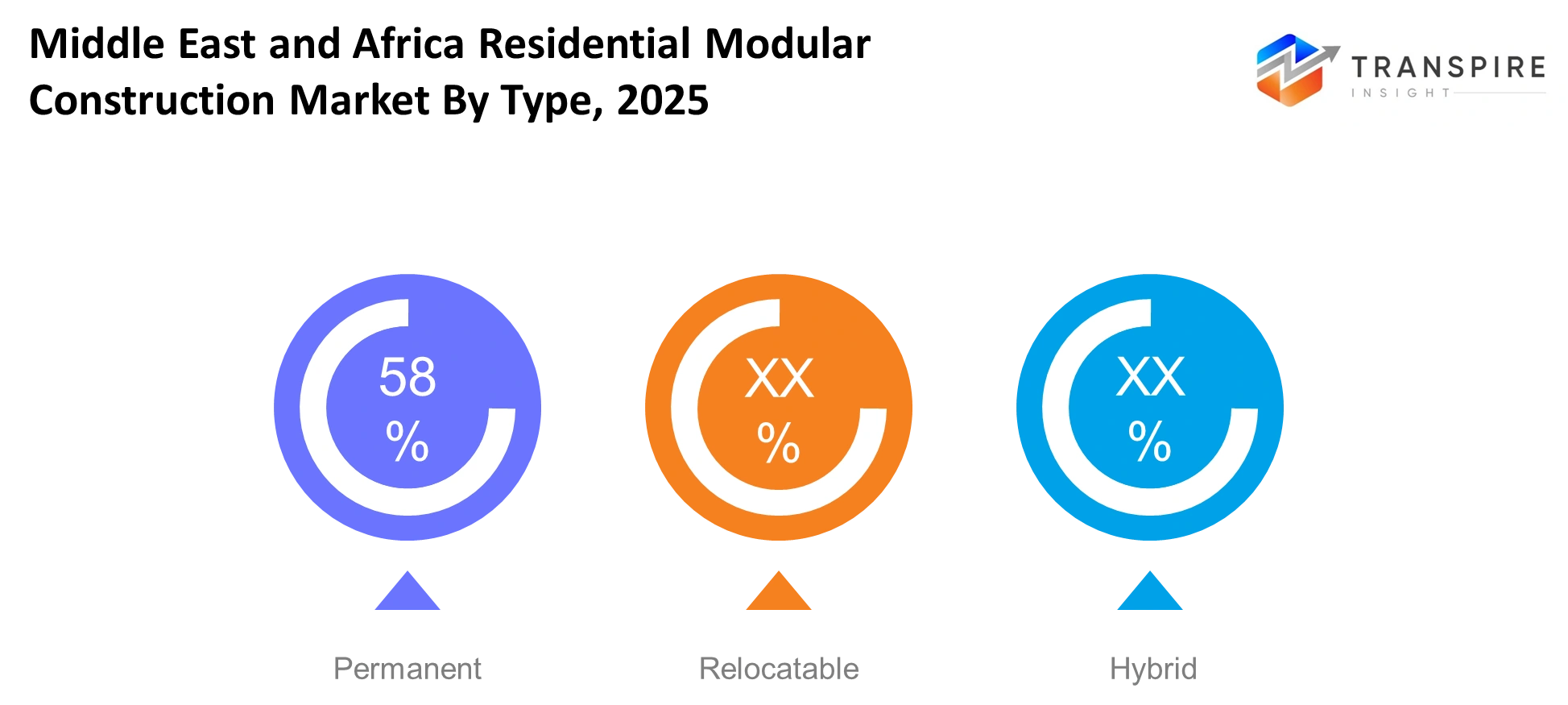
- Permanent modular construction achieves more than 55% market share in 2025 because its residential buildings provide long-lasting durability.
- The construction industry uses relocatable modular units for temporary housing purposes which brings them an approximate market share of 30%.
- The market shows hybrid modular systems as its fastest-expanding segment which will achieve a 9% compound annual growth rate during the upcoming period because of their adaptable design.
- The market of single-family houses remains at the top of the list, holding a market share of 60% in 2025 due to growing demand from middle-class residents of cities.
- The rapid growth of multi-family units is explained by the necessity for more affordable housing in the densest cities.
- Builders of real estate dominate on the market with over 50% of market share, utilizing the advantages of modular construction technology.
Middle East and Africa Residential Modular Construction Market Segmentation
By Type
The construction method of permanent modular systems will become the leading building method because it meets the long-term housing requirements and provides excellent durability. The construction materials of these buildings will become essential for urban residential developments which need to achieve both stability and extended structural lifetime. Relocatable units will support temporary housing needs, especially for workforce accommodation and remote locations. The need for these units will continue to exist in regions where people move to new areas.
The construction method of hybrid modular systems will become more popular because it allows builders to create projects with both traditional building methods and modular construction components. The system enables users to create tailor-made solutions while maintaining the benefits of rapid development. Developers will prefer hybrid models for complex housing layouts and mixed-use developments. The market will expand because people want housing options that offer both flexible design and innovative architectural solutions.
To learn more about this report, Download Free Sample Report
By Material
Wood will be used in specific regions where cost and availability support lightweight construction.Steel continues to be the preferred material for its superior strength and longevity and ability to perform well in harsh climatic conditions. Steel construction modules shall facilitate massive residential building projects and skyscrapers. Concrete will maintain its dominant status in areas that require strong and permanent housing solutions.
Composite materials will emerge as a modern alternative that provides optimal weight and strength and insulation characteristics. Energy efficiency will increase because these materials will decrease the need for maintenance work. The selection of materials will base itself on three factors which include regional climate patterns and cost factors and project specifications. Modular construction will achieve better performance and sustainability through material innovations which develop new materials.
By End-User
Homeowners will gradually adopt modular housing due to faster completion and predictable costs. People will show more interest because they will learn about the products which provide different quality levels together with customization possibilities. Developers will use modular methods as their primary construction method because it allows them to finish projects faster while maintaining budget control. The construction of large residential developments will depend on modular systems to achieve their delivery schedules.
Construction firms will use modular techniques to enhance their operational efficiency while decreasing their requirement for manual labor. Government housing bodies will play a key role by promoting affordable housing initiatives using modular construction. The public sector will provide support for extensive housing projects together with infrastructure development. The combination of these end-users will create a steady pattern of adoption which will spread across various regions and project categories.
What are the Main Challenges for the Middle East and Africa Residential Modular Construction Market Growth?
The Middle East and Africa residential modular construction market encounters multiple technical and operational obstacles which restrict its capacity to grow while operating at full capacity. The transportation of prefabricated modules will face challenges because different regions maintain varying infrastructure standards which will result in delivery delays and increased transportation expenses.
The process of operational development will face obstacles because modular production facilities require both substantial financial resources and specialized technical knowledge for their establishment. The process of building code compliance together with safety standard adherence will create more complex challenges because different countries have their own unique regulations. The market will experience increased costs because of two factors which include unstable raw material costs and the restricted availability of materials through domestic supply routes.
The construction industry will experience mounting challenges because its existing methods face competition and operators need to manage upcoming threats which force them to undergo operational changes. Modular providers will need to find a balance between their product costs and product quality because pricing competition in the market will reach higher levels. The residential modular construction market in the Middle east and Africa will encounter investment challenges because companies need to adjust to new regulations and technological advancements.
Regional Insights
The Middle East and Africa Residential Modular Construction Market will continue to shape housing delivery through structured and factory-based construction practices.Demand will rise as urban centers expand and require faster, cost-controlled residential solutions.Market direction will reflect a balance between speed, quality, and adaptability to local conditions.
Changing construction preferences will encourage wider adoption of modular systems, especially where traditional methods face delays and cost overruns.Technology integration will improve planning accuracy and reduce material waste.Regional diversity in climate and infrastructure will influence design and execution, ensuring solutions remain practical and efficient.
Saudi Arabia will implement its housing programs through government-backed projects which will address the needs of growing urban areas and rising population numbers. The demand for modular construction will remain constant because of large-scale developments while modern building methods will achieve permanent market presence through ongoing investment. The project execution process will benefit from better regulatory alignment which will enable smoother operations.
The United Arab Emirates will experience fast development because of its smart city projects and its dedication to advanced building technologies. The affordable housing needs of South Africa combined with its infrastructure development plans will create consistent market demand. The Middle East and Africa region will adopt modular construction methods at a slow pace because of economic factors and people started to learn about the advantages of modular construction.
Recent Development News
In April 2026, Hail, a city in northern Saudi Arabia, has made its debut in the prestigious IMD Smart City Index.Traditionally dominated by large cities such as London, Singapore and Beijing, it was Hail that this year stole the spotlight as the biggest riser among the 148 cities assessed. Making its first-ever appearance, the mid-sized Saudi city secured the 33rd position, just behind Berlin and Vienna, and ranked second from a Saudi perspective only behind capital city Riyadh, which rose three places to 24th.https://www.reuters.com/
In April 2026, Construction Week Middle East highlighted leading Saudi construction firms accelerating modular and off-site construction adoption across large-scale residential and infrastructure projects. The update emphasized increased investment and project execution capabilities aligned with regional housing demand.https://www.constructionweekonline.com/
|
Report Metrics |
Details |
|
Market size value in 2025 |
USD 4541.6 Million |
|
Market size value in 2026 |
USD 4882.2 Million |
|
Revenue forecast in 2033 |
USD 8204.7 Million |
|
Growth rate |
CAGR of 7.70% from 2026 to 2033 |
|
Base year |
2025 |
|
Historical data |
2021 - 2024 |
|
Forecast period |
2026 - 2033 |
|
Report coverage |
Revenue forecast, competitive landscape, growth factors, and trends |
|
Regional scope |
United States; Canada; Mexico; United Kingdom; Germany; France; Italy; Spain; Denmark; Sweden; Norway; China; Japan; India; Australia; South Korea; Thailand; Brazil; Argentina; South Africa; Saudi Arabia; United Arab Emirates |
|
Key company profiled |
Skanska, Laing O’Rourke, Bouygues, Vinci, Katerra, Red Sea Housing, Algeco, Guerdon, Clayton Homes, Sekisui House, Daiwa House, Lendlease, ATCO, Modulaire Group, WillScot |
|
Customization scope |
Free report customization (country, regional & segment scope). Avail customized purchase options to meet your exact research needs. |
|
Report Segmentation |
By Type (Permanent, Relocatable, Hybrid), By Material (Wood, Steel, Concrete, Composite), By End-User (Homeowners, Developers, Construction Firms, Government Housing Bodies) |
How Can New Companies Establish a Strong Foothold in the Middle East and Africa Residential Modular Construction Market?
New companies can build a strong position in the middle east and africa residential modular construction market by focusing on niche demand areas rather than competing across all market segments. The new entrants can meet regional requirements through their business operations which focus on affordable housing and workforce accommodation and smart city projects. The market will expand through urban cluster development which creates demand for specialized solutions that provide fast and cost-effective design methods to smaller companies.
The middle east and africa residential modular construction market will use innovation strategies to help new companies establish their unique market presence. Digital design tools together with AI-driven planning and advanced materials will help companies achieve better construction accuracy while minimizing environmental waste. The startups ModulusTech and Cuby Technologies have shown how their automated modular systems together with lightweight structures lead to faster delivery times without compromising quality which makes their methods highly applicable to current industry needs.
The establishment of strategic partnerships will enhance market entry efforts because they will link new businesses with local developers, government housing organizations and infrastructure planners. The team will achieve better project outcomes by working together to remove regulatory obstacles which impede their work. The residential modular construction market in the Middle East and Africa will benefit from joint ventures that connect construction companies with local distribution networks and project pipelines which will help them achieve operational stability at the beginning of their business activities.
Companies will use technology-based differentiation to address major industry problems, which include labour shortages, quality control problems and expensive construction expenses. New market entrants will create competitive advantages through their provision of housing solutions which can be customized and expanded and which use less energy. Emerging companies that adopt innovation, establish local partnerships and develop specific products will acquire a superior advantage to extract sustained value from the Middle East and Africa residential modular construction industry.
Key Middle East and Africa Residential Modular Construction Market Company Insights
The Middle East and Africa Residential Modular Construction Market will continue to expand because urban and semi-urban areas need faster housing solutions. Construction practices will shift toward factory-based production which will create better efficiency and shorter project delays. The market will follow three main factors which include cost control, scalability and ongoing structured project execution.
Modular housing will become more popular because buyers want to experience predictable project timelines and receive consistent quality. The integration of technology will enhance project planning while reducing problems that occur during construction. Construction methods will evolve in response to regional climate differences and infrastructure variations, yielding solutions that meet diverse housing requirements.
To achieve faster and more precise project completion major companies will concentrate on developing new products and implementing cutting-edge building solutions. The implementation of automated manufacturing systems will reduce material waste while producing more reliable outputs. The company will establish a market presence through strategic expansion into areas with high customer demand which will enhance its future market position.
Partnerships with local developers and government housing bodies will support faster project execution and access to new opportunities. The company will provide customers with multiple options which include cost-effective solutions and personalized products. A business can gain a competitive advantage through its capacity to manage three crucial elements, which include creating new products and providing affordable solutions and delivering products on a large scales.
Company List
- Skanska
- Laing O’Rourke
- Bouygues
- Vinci
- Katerra
- Red Sea Housing
- Algeco
- Guerdon
- Clayton Homes
- Sekisui House
- Daiwa House
- Lendlease
- ATCO
- Modulaire Group
- WillScot
What are the Key Use-Cases Driving the Growth of the Middle East and Africa Residential Modular Construction Market?
The residential modular construction market of the Middle East and Africa shows increasing progress because actual use cases demonstrate solutions which help solve existing problems of housing and infrastructure needs. The most effective use of modular construction exists in affordable housing projects because this method delivers projects more quickly while maintaining fixed project costs. The approach helps governments and developers to handle increased demands from urban population growth which results in faster project completion and earlier building occupancy.
The residential modular construction market of Middle East and Africa provides another important application for workforce housing which serves the oil and mining and major infrastructure development industries. Modular units provide flexible and relocatable housing for workers in remote areas, improving living standards while maintaining cost efficiency. The application will continue to drive industrial expansion throughout the area which supports its existing industrial projects.
Healthcare and emergency housing solutions also play an important role in driving demand. Modular construction allows rapid deployment of clinics, quarantine facilities, and temporary housing during crises. The Middle East and Africa residential modular construction market will use this capability to enhance its public health response and disaster management efforts, making modular systems an effective solution.
Smart city development is emerging as a long-term driver, where modular housing will integrate with digital infrastructure and sustainable design. Developers will use advanced materials and prefabrication techniques to build energy-efficient homes at scale. The market will experience growth because these use-cases match both current innovation patterns and upcoming urban development plans.
Middle East and Africa Residential Modular Construction Market Report Segmentation
By Type
- Permanent
- Relocatable
- Hybrid
By Material
- Wood
- Steel
- Concrete
- Composite
By End-User
- Homeowners
- Developers
- Construction Firms
- Government Housing Bodies
Frequently Asked Questions
Find quick answers to common questions.
The approximate Middle East and Africa Residential Modular Construction Market size for the market will be USD 8204.7 Million in 2033.
Key segments for the Middle East and Africa Residential Modular Construction Market are By Type (Permanent, Relocatable, Hybrid), By Material (Wood, Steel, Concrete, Composite), By End-User (Homeowners, Developers, Construction Firms, Government Housing Bodies).
Major Middle East and Africa Residential Modular Construction Market players are Skanska, Laing O’Rourke, Bouygues, Vinci, Katerra, Red Sea Housing, Algeco, Guerdon, Clayton Homes, Sekisui House, Daiwa House, Lendlease, ATCO, Modulaire Group, WillScot.
The Middle East and Africa Residential Modular Construction Market size is USD 4541.6 Million in 2025.
The Middle East and Africa Residential Modular Construction Market CAGR is 7.70%.
- Skanska
- Laing O’Rourke
- Bouygues
- Vinci
- Katerra
- Red Sea Housing
- Algeco
- Guerdon
- Clayton Homes
- Sekisui House
- Daiwa House
- Lendlease
- ATCO
- Modulaire Group
- WillScot
Recently Published Reports
-
Dec 2024
Handling and Lifting Equipment Market
Handling and Lifting Equipment Market Size, Share & Analysis Report By Product (Cranes and Hoists, Forklifts, Conveyor Systems, Aerial Work Platforms, Others), By Application (E-Commerce, Automotive and Railway, Food and Beverages, Aviation, Others), and Geography (North America, Europe, Asia-Pacific, Middle East and Africa, South and Central America), 2021 - 2031
-
Feb 2025
HVAC Equipment Market
HVAC Equipment Market Size, Share & Analysis Report By Heating Equipment Type (Boilers and Furnaces, Heat Pumps, and Unitary Heaters), By Ventilation Equipment (Air Handling Units, Humidifiers and Dehumidifiers, Air Filters, and Fan Coiling Units), By Air Conditioning Equipment (Unitary Air Conditioners, Room Air Conditioners, Packaged Terminal Air Conditioners, and Chillers), By End User (Commercial, Residential, Industrial, and others), and Geography (North America, Europe, Asia-Pacific, Middle East and Africa, South and Central America), 2021 – 2031
-
Feb 2025
Refrigeration Valves Market
Refrigeration Valves Market Size, Share & Analysis Report By Type (Solenoid Valves, Expansion Valves, Check Valves, Service Valves, Others), By Application (Commercial Refrigeration, Industrial Refrigeration, Transport Refrigeration, Residential Refrigeration, Air Conditioning Systems), By End User (Food and Beverage Industry, Pharmaceutical Industry, HVAC Industry, Chemical Industry, Others), and Geography (North America, Europe, Asia-Pacific, Middle East and Africa, South and Central America), 2021 – 2031
-
Dec 2025
E-Commerce Packaging Materials Market
E-Commerce Packaging Materials Market By Material Type (Corrugated Boxes, Paper & Paperboard, Foam & Cushioning Materials, Plastic Packaging, Flexible Packaging, Protective Packaging, Others), By Product(Primary Packaging, Secondary Packaging, Tertiary Packaging), By Packaging Function (Protective Packaging, Branding & Presentation Packaging, Transit & Logistic Packaging, Sustainable Packaging, Tamper Evidence Packaging), By End-User (Retail & Consumer Goods, Electronic Appliances, Food & Beverages, Healthcare & Pharmaceutical, Fashion & Apparel, Home & Furnishing, Others); By Industry Analysis, Size, Share, Growth, Trends, and Forecasts 2021-2033