

United States Industrial Coating Market Size & Forecast:
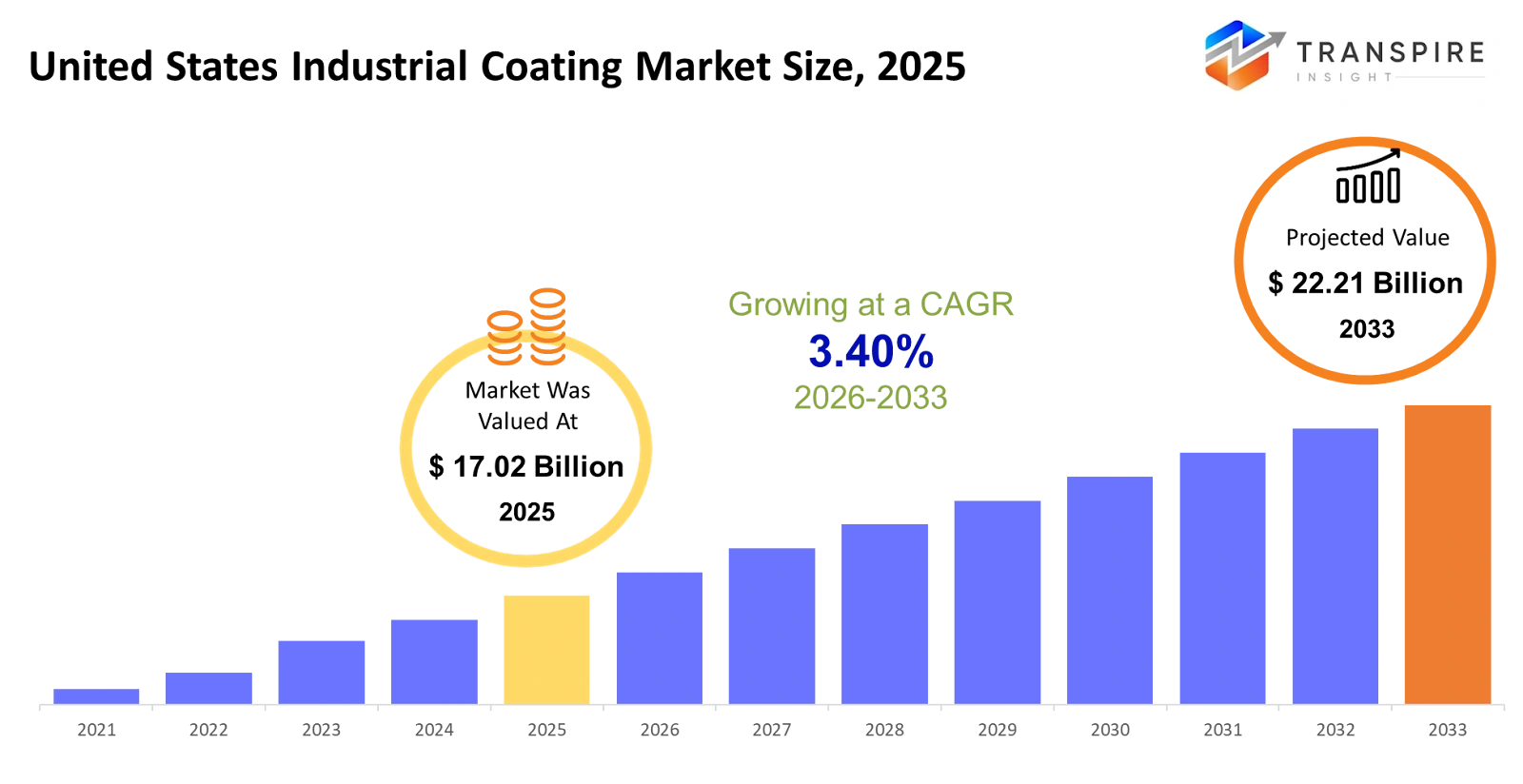
- United States Industrial Coating Market Size 2025: USD 17.02 Billion
- United States Industrial Coating Market Size 2033: USD 22.21 Billion
- United States Industrial Coating Market CAGR: 3.40%
- United States Industrial Coating Market Segments: By Type (Epoxy, Polyurethane, Acrylic, Alkyd, Zinc-rich, Fluoropolymer, Powder), By Application (Automotive, Marine, Aerospace, Oil & Gas, Construction, Machinery, Electronics), By Technology (Waterborne, Solvent, Powder, UV, High solids, Electrocoating, Thermal), By End-User (Industrial, OEM, Infrastructure, Energy, Manufacturing, Transport, Defense), By Distribution (Direct, Distributors, OEM, Contractors, Retail, Export, Online).
To learn more about this report,  Download Free Sample Report
United States Industrial Coating Market Summary:
The United States Industrial Coating Market size is estimated at USD 17.02 Billion in 2025 and is anticipated to reach USD 22.21 Billion by 2033, growing at a CAGR of 3.40% from 2026 to 2033. The United States industrial coating market is experiencing above base growth because construction and automotive and manufacturing industries require additional industrial coatings. The market for advanced coating technologies, which include water-based and powder coatings, is expanding because businesses prioritize developing products that provide improved durability and corrosion resistance and comply with environmental regulations. Manufacturers use product innovation together with sustainable practices to achieve their goals of meeting strict industry regulations.. The manufacturers use product innovation together with sustainable practices to achieve their goals of meeting strict industry regulations. The market sustains its active state because infrastructure development and industrial expansion create new business opportunities while customer demands and technological advancements drive market rivalry.
Key Market Trends & Insights:
- Industrial operations now use low-VOC water-based coatings because these materials help companies achieve environmental standards which have become more restrictive. The organisation shows its dedication to sustainable practices because it uses this environmentally friendly solution which maintains operational efficiency and product longevity.
- The demand for protective coatings is increasing because infrastructure development projects receive more funding. The construction of bridges and highways together with public utilities, need protective coatings which can endure extreme environmental conditions.
- The market for smart coatings and nano-coatings shows increasing demand for these innovative products. These advanced solutions provide advanced features which include self-healing capabilities and anti-corrosion protection together with improved operational performance.
- The market demand for powder coatings has increased because these coatings provide long-lasting performance and generate low environmental impact. Powder coatings present customers with an affordable and environmentally friendly solution which serves as an alternative to conventional liquid coatings.
- Manufacturers create new coating products which help extend maintenance periods because they want to achieve better operational results while keeping their costs low. The solution enables businesses to achieve higher operational efficiency while spending less money on maintenance.
- Customers want customised coatings which will meet their precise needs in industrial applications. This trend has resulted in more organisations creating solutions which match their particular operational settings and their specific business requirements.
United States Industrial Coating Market Segmentation
By Type
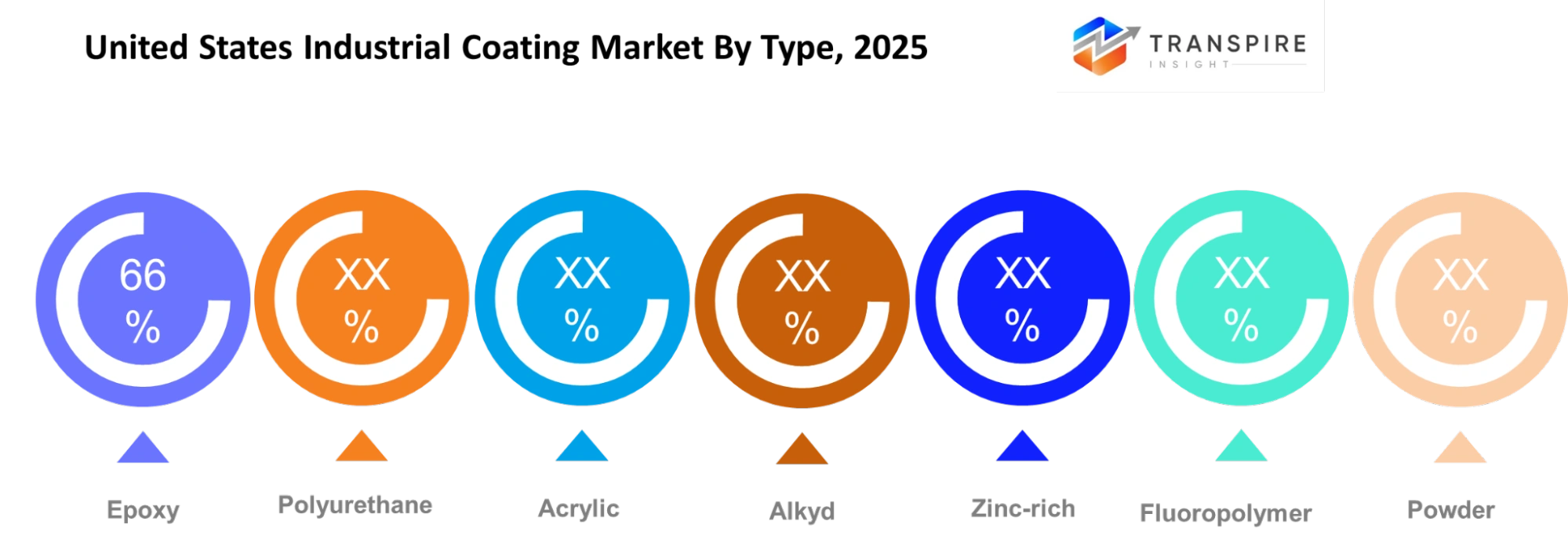
- Epoxy: Epoxy coatings maintain their strong popularity because they provide outstanding adhesion together with effective protection against corrosion. The industrial sector employs these coatings for heavy-duty applications which require protection from chemical exposure and moisture infiltration. Their operational durability enables them to function reliably over extended periods in extreme working conditions that various industries face.
- Polyurethane: Polyurethane coatings deliver two main advantages to users because they provide flexible protection together with high-quality finishing options. The materials demonstrate outstanding resistance against three different types of damage which include abrasion and weathering and UV exposure. The coatings serve two purposes because they maintain visual appeal while providing solid protection. This quality makes them ideal for use in the automotive industry and outdoor industrial settings which require enduring visual appeal.
- Acrylic: Acrylic coatings maintain their color for extended periods because they dry quickly. The product serves purposes in which visual appeal needs protection but users only require moderate defense. The material works well for outdoor applications because it withstands sunlight and environmental elements while delivering cost-effective performance and functionality.
- Alkyd: Alkyd coatings serve as traditional protective solutions which people frequently select for their general protection needs. Users can achieve a smooth finish through the product's easy application process, which makes it suitable for all work environments. The product continues to be the preferred option for light industrial work because it delivers affordable yet flexible protection that competes with advanced coating systems.
- Zinc-rich: Zinc-rich coatings deliver exceptional protection against corrosion, especially for steel structures. The system protects against rusting through its cathodic protection mechanism, which maintains effectiveness in extreme environmental conditions. The coatings function as standard protective solutions for infrastructure projects and marine operations which require long-lasting defence against metal deterioration.
- Fluoropolymer: Fluoropolymer coatings provide outstanding protection against chemical substances and ultraviolet radiation and high-temperature conditions. The coatings maintain their original colour and gloss for long periods, which makes them suitable for use in demanding performance situations. The coatings find applications in challenging conditions because they provide extended service life with little need for upkeep.
- Powder: The use of powder coatings has increased because they provide environmentally friendly solutions which maintain their durability. The coating process creates a robust and consistent surface finish which does not require any solvent usage. The product has gained preference among industrial facilities because it delivers operational efficiency while producing minimal waste in their sustainable production processes.
To learn more about this report, Download Free Sample Report
By Application
- Automotive: The automotive industry needs industrial coatings to increase both vehicle durability and vehicle appearance. The coatings create a protective shield that defends vehicles against three types of damage, which include corrosion and scratches and environmental harm. The demand for high-quality finishes has led to ongoing development of coatings which will satisfy both their practical needs and their visual needs.
- Marine: Marine applications require coatings which need to endure continuous contact with water and salt and severe weather conditions. The coatings deliver effective protection against corrosion while also stopping biofouling. Their function protects the operational lifespan of ships and offshore structures and all marine equipment.
- Aerospace: Aerospace coatings need to fulfil specific performance requirements, which include protection from extreme thermal conditions and high pressure and ultraviolet radiation. The materials help decrease weight while increasing fuel efficiency. The coatings provide safety for high-stress aviation environments while extending equipment durability.
- Oil & Gas: The oil and gas industry depends on protective coatings to defend its assets against three threats, which include corrosion and chemical exposure and extreme environmental conditions. The industry needs protective coatings which offer strong protection for pipelines and storage tanks and equipment in both onshore and offshore environments.
- Construction: Coatings serve as protective materials in construction to shield structures from damage caused by weather and moisture and physical contact. The materials extend the operational period of buildings and bridges and infrastructure systems. Urban areas need dependable coating materials which will sustain their performance over extended periods because of their increasing development.
- Machinery: Industrial machinery needs permanent coatings which can withstand extreme working conditions and contact with oils and chemicals and high-temperature environments. The coatings protect equipment against wear which extends its operational lifespan while improving performance and reducing repair needs.
- Electronics: The coatings which electronic devices use offer protection against three threats, which include moisture, dust and corrosion. The coatings protect sensitive components, which enables products to operate reliably for extended periods. The demand for specialised protective coatings has increased because advanced electronics continue to develop.
By Technology
- Waterborne: The popularity of waterborne coatings is growing because their environmental effects are minimal. The product complies with stringent regulations through its reduced emission of volatile organic compounds. The coatings provide industrial applications with a secure and sustainable solution which maintains full operational capacity.
- Solvent: The strong adhesion and durable characteristics of solvent-based coatings make them ideal for demanding applications. The product continues to be used in situations which demand optimal performance despite its environmental drawbacks because users require outstanding endurance in difficult circumstances.
- Powder: The implementation of powder coating technology requires no solvents which results in environmentally sustainable and efficient operations. The product delivers an intense solid coating which protects surfaces through its robust design. The method receives widespread acceptance from organizations which prioritize both environmental responsibility and financial efficiency.
- UV-cured: The fast drying technology of UV-cured coatings provides proof of their effective performance capabilities. The process enables production facilities to decrease their operating expenses through reduced energy usage. The coatings serve as an excellent solution for businesses that need quick production shifts while maintaining their product standards.
- High solids: High solids coatings contain a greater amount of solid material, which decreases emissions while maintaining their performance capabilities. The product enables superior environmental protection through its ecologically friendly features which provide both coverage and strength to industrial processes.
- Electrocoating: Electrocoating delivers consistent coverage across all surface conditions, including complex surface areas. The process improves protection against corrosion while maintaining production standards. The automotive and industrial manufacturing sectors widely adopt this technology because it delivers accurate results through its efficient operational methods.
- Thermal: Thermal spray coatings apply molten materials to surfaces which create protective coatings. The materials provide outstanding protection against heat and wear and corrosion. The technology finds applications in heavy industries which require maximum durability.
By End-User
- Industrial: Industrial operations depend on protective coatings because they protect equipment and increase operation efficiency. The coatings which protect equipment from corrosion enable machines to operate continuously in extreme industrial conditions.
- OEM: Original equipment manufacturers use coatings to enhance product quality and durability. Coatings are applied during manufacturing to create a uniform finish which also protects products, thus increasing their market value.
- Infrastructure: Infrastructure projects require coatings that provide long-term protection against environmental damage. Bridges and roads and public assets receive protection from coatings which decrease maintenance needs while extending their structural life.
- Energy: The energy sector uses coatings to protect assets from extreme conditions. Power plants and pipelines and renewable installations depend on coatings for safety and efficiency and durability.
- Manufacturing: Manufacturing industries need coatings to protect their products while they also use them to maintain their production equipment. The coatings function as essential elements which maintain operational effectiveness while they protect product quality.
- Transport: Rail and logistics businesses use coatings to create durable products which also attract customers through their visual design. The coatings can endure damage from use and exposure to weather conditions while they face regular operational demands.
- Defense: Defense applications require specialised coatings which provide protection and stealth capabilities. The coatings must maintain dependable performance when exposed to extreme conditions while they comply with rigorous safety regulations.
By Distribution
- Direct: The direct sales business model enables manufacturers to establish close customer connections through direct sales to customers. The business model proves most suitable for industrial customers because it enables better product customisation and accurate pricing management and effective post-purchase assistance.
- Distributors: Distributors exist to help businesses grow their sales territory through their distribution system. The system enables smaller businesses to access products while distributors create efficient delivery systems that operate in multiple regions.
- OEM Channels: OEM distribution delivers coating products directly to manufacturers who require these materials. The process guarantees uniform material quality while coating materials become part of manufacturing operations.
- Contractors: Contractors function as middlemen who apply protective coatings to construction sites and industrial facilities. Their expertise ensures proper application and performance.
- Retail: Retail channels provide small-scale buyers with access to maintenance products. The stores provide customers with straightforward access to various coating products.
- Export: Manufacturers use export distribution methods to enter international markets. The method facilitates international business operations while creating new commercial possibilities.
- Online: People find online platforms appealing because they provide both simple usage and easy online access. The platforms enable customers to assess different products before they choose which products to buy.
Country Insights
The existing manufacturing capacity and ongoing infrastructure development work in the country create continuous requirements for advanced coating materials. Manufacturers currently adopt sustainable solutions which include low-VOC and waterborne coatings because they need to meet increasing demands for product durability and energy efficiency and environmental regulations. The companies use innovation as their main driver by spending money on advanced technologies which will improve product performance while cutting down their maintenance expenses. The demand in different regions shows changes because industrial centres use more resources than areas with less manufacturing and building work. The market expands because of key industry companies who conduct ongoing research and development activities. The U.S. market maintains its stability while responding to new environmental regulations and industrial development needs.
Recent Development News
In March 2026, Innovation in High-Durability Coatings Gains Momentum: Companies are investing in advanced coating technologies focused on durability and environmental performance, particularly for industrial and automotive applications.
In March 2026, Global Coatings Industry Growth Supports U.S. Market: Rising global demand for coatings, especially in infrastructure and automotive sectors, is positively influencing U.S. industrial coating consumption.
|
Report Metrics |
Details |
|
Market size value in 2025 |
USD 17.02 Billion |
|
Market size value in 2026 |
USD 17.57 Billion |
|
Revenue forecast in 2033 |
USD 22.21 Billion |
|
Growth rate |
CAGR of 3.40% from 2026 to 2033 |
|
Base year |
2025 |
|
Historical data |
2021 – 2024 |
|
Forecast period |
2026 – 2033 |
|
Report coverage |
Revenue forecast, competitive landscape, growth factors, and trends |
|
Country scope |
United States |
|
Key company profiled |
PPG, Sherwin-Williams, AkzoNobel, BASF, Axalta, Jotun, Hempel, Nippon Paint, Kansai, RPM, Beckers, Tikkurila, Sika, Asian Paints, Berger. |
|
Customization scope |
Free report customization (country, regional & segment scope). Avail customized purchase options to meet your exact research needs. |
|
Report Segmentation |
By Type (Epoxy, Polyurethane, Acrylic, Alkyd, Zinc-rich, Fluoropolymer, Powder), By Application (Automotive, Marine, Aerospace, Oil & Gas, Construction, Machinery, Electronics), By Technology (Waterborne, Solvent, Powder, UV, High solids, Electrocoating, Thermal), By End-User (Industrial, OEM, Infrastructure, Energy, Manufacturing, Transport, Defense), By Distribution (Direct, Distributors, OEM, Contractors, Retail, Export, Online). |
Key United States Industrial Coating Company Insights
The United States industrial coating market is shaped by the strong presence of both global leaders and regional players who compete through their innovations and product quality and sustainable practices.Companies are focusing on developing advanced coatings that offer enhanced durability and corrosion resistance and environmental compliance.Companies use strategic partnerships and mergers together with their ongoing research and development investments as methods to improve their market standing.Companies are expanding their product lines to meet the various industrial requirements of their customers.Companies in this industry sector develop new products because they need to compete with other businesses while delivering their customers efficient products that perform at high levels.
Company List
- PPG
- Sherwin-Williams
- AkzoNobel
- BASF
- Axalta
- Jotun
- Hempel
- Nippon Paint
- Kansai
- RPM
- Beckers
- Tikkurila
- Sika
- Asian Paints
- Berger
United States Industrial Coating Market Report Segmentation
By Type
- Epoxy
- Polyurethane
- Acrylic
- Alky
- Zinc-rich
- Fluoropolymer
- Powder
By Application
- Automotive
- Marine
- Aerospace
- Oil & Gas
- Construction
- Machinery
- Electronics
By Technology
- Waterborne
- Solvent
- Powder
- UV
- High solids
- Electrocoating
- Thermal
By End-User
- Industrial
- OEM
- Infrastructure
- Energy
- Manufacturing
- Transport
- Defense
By Distribution
- Direct
- Distributors
- OEM
- Contractors
- Retail
- Export
- Online
Frequently Asked Questions
Find quick answers to common questions.
The approximate United States Industrial Coating Market size for the market will be USD 22.21 Billion in 2033.
The key segments of the United States Industrial Coating Market are By Type (Epoxy, Polyurethane, Acrylic, Alkyd, Zinc-rich, Fluoropolymer, Powder), By Application (Automotive, Marine, Aerospace, Oil & Gas, Construction, Machinery, Electronics), By Technology (Waterborne, Solvent, Powder, UV, High solids, Electrocoating, Thermal), By End-User (Industrial, OEM, Infrastructure, Energy, Manufacturing, Transport, Defense), By Distribution (Direct, Distributors, OEM, Contractors, Retail, Export, Online).
Major players in the United States Industrial Coating Market are PPG, Sherwin-Williams, AkzoNobel, BASF, Axalta, Jotun, Hempel, Nippon Paint, Kansai, RPM, Beckers, Tikkurila, Sika, Asian Paints, Berger.
The current market size of the United States Industrial Coating Market is USD 17.02 Billion in 2025.
The United States Industrial Coating Market CAGR is 3.40%.
- PPG
- Sherwin-Williams
- AkzoNobel
- BASF
- Axalta
- Jotun
- Hempel
- Nippon Paint
- Kansai
- RPM
- Beckers
- Tikkurila
- Sika
- Asian Paints
- Berger
Recently Published Reports
-
May 2026
Healthcare Polymer Packaging Market
Healthcare Polymer Packaging Market Size, Share & Analysis Report By Packaging Type (Syringes, IV Bottles and Pouches, Clamshells, Blisters, Bottles & Jars, Containers, Tubes, IV Parental Packaging, Others), By Type (Regulated, Non-regulated), By Polymer Type (LDPE (Low-Density Polyethylene), HDPE (High-Density Polyethylene), Homo-polymer (Homo), Random Copolymer (Random), Block Copolymer (Block), PET, Polystyrene, Polyvinyl Chloride, Polyamide/EVOH, Others), and Geography (North America, Europe, Asia-Pacific, Middle East and Africa, South and Central America), 2021 - 2031
-
Apr 2026
Hydrophilic Tape (Waterstop) Market
Hydrophilic Tape (Waterstop) Market Size, Share & Analysis Report By Type (Bentonite-Based Hydrophilic Tape, Rubber-Based Hydrophilic Tape), By Application (Residential Buildings, Commercial Buildings, Infrastructure Projects), and Geography (North America, Europe, Asia-Pacific, Middle East and Africa, South and Central America), 2021 - 2031
-
Apr 2026
Metalens Market
Metalens Market Size, Share & Analysis Report By Type (Visible Light Metalens, and Infrared Metalens), By Application (Consumer Electronics, Automotive Electronics, Industrial, Medical, and Others), and Geography (North America, Europe, Asia-Pacific, Middle East and Africa, South and Central America), 2021 - 2031
-
Apr 2026
PBT Resin Market
PBT Resin Market Size, Share & Analysis Report By Type (Reinforced PBT Resin, Unreinforced PBT Resin), By Processing Method (Injection Molding, Extrusion, Blow Molding, Others), By End-User (Automotive, Electrical & Electronics, Consumer Appliances, Industrial Machinery, Medical Devices, Packaging, Others), and Geography (North America, Europe, Asia-Pacific, Middle East and Africa, South and Central America), 2021 - 2031