
Market Summary
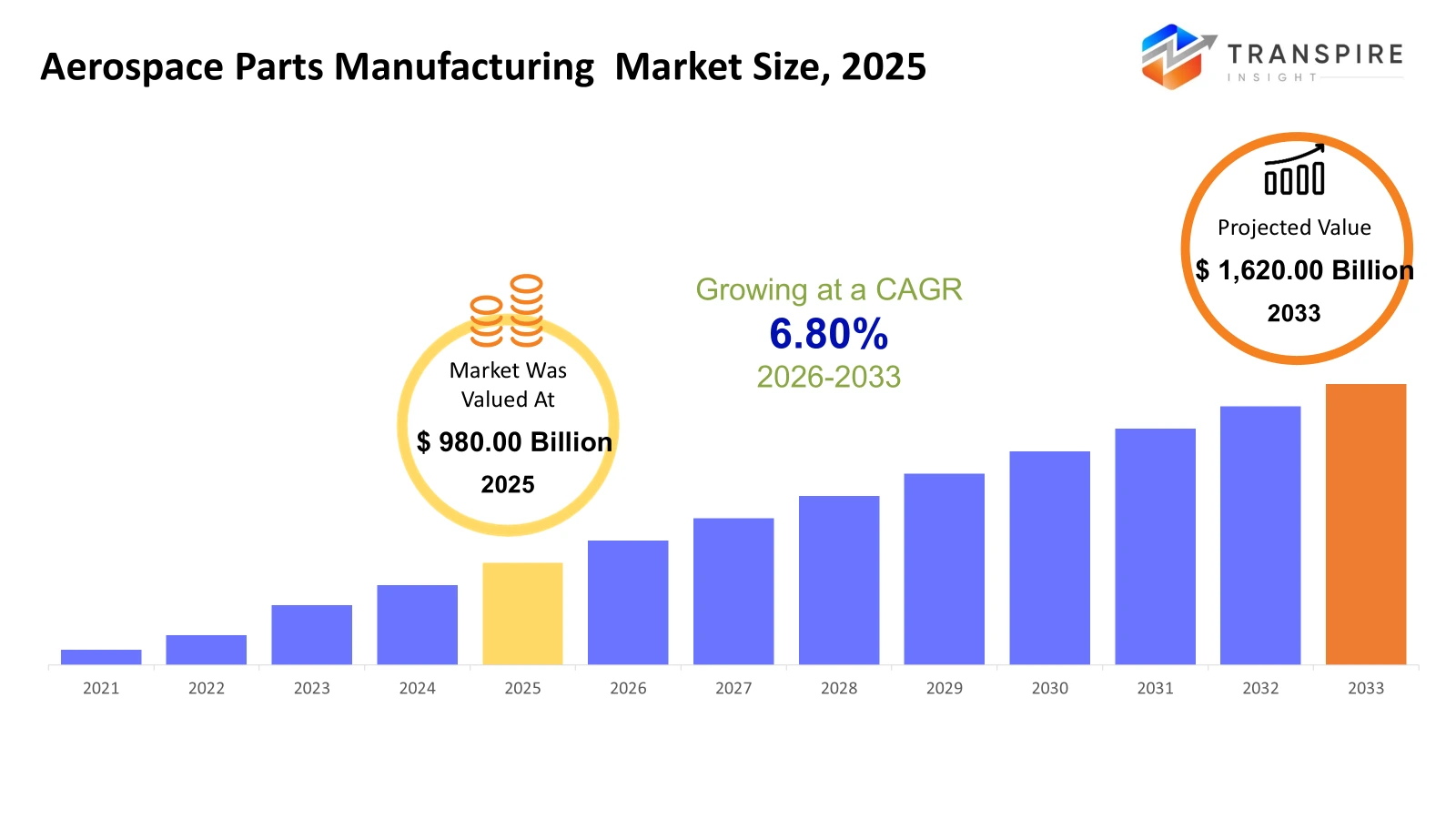
The global Aerospace Parts Manufacturing market size was valued at USD 980.00 billion in 2025 and is projected to reach USD 1,620.00 billion by 2033, growing at a CAGR of 6.80% from 2026 to 2033. The market CAGR is driven by the continued growth in global air passengers and the expansion programs of aircraft fleets, especially fuel-efficient narrow-body aircraft, thereby driving the demand for precision-engineered components and high-performance materials.
Market Size & Forecast
- 2025 Market Size: USD 980.00 Billion
- 2033 Projected Market Size: USD 1,620.00 Billion
- CAGR (2026-2033): 6.80%
- North America: Largest Market in 2026
- Asia Pacific: Fastest Growing Market
To learn more about this report,  Download Free Sample Report
Key Market Trends Analysis
- North America continues to be the leading aerospace manufacturing region, with established OEM ecosystems, robust defense spending, advanced R&D, and a comprehensive MRO infrastructure that fuels new production and aftermarket business in the commercial and military aircraft segments.
- The United States is the key driver of the region’s leadership position in aerospace manufacturing, with high production rates of aircraft, innovation in propulsion and avionics technologies, and regular defense procurement programs that fuel demand for precision components and advanced materials.
- The Asia Pacific region is a new high-growth manufacturing market driven by the growing commercial aircraft fleet, growing domestic aircraft manufacturing programs in China and India, and investments in aerospace infrastructure and supplier development programs.
- Engine components are the leading product segment, driven by the airline industry’s focus on fuel efficiency and performance enhancement, which fuels demand for high-temperature alloys, precision machining, and advanced turbine technologies that match next-generation aircraft platforms.
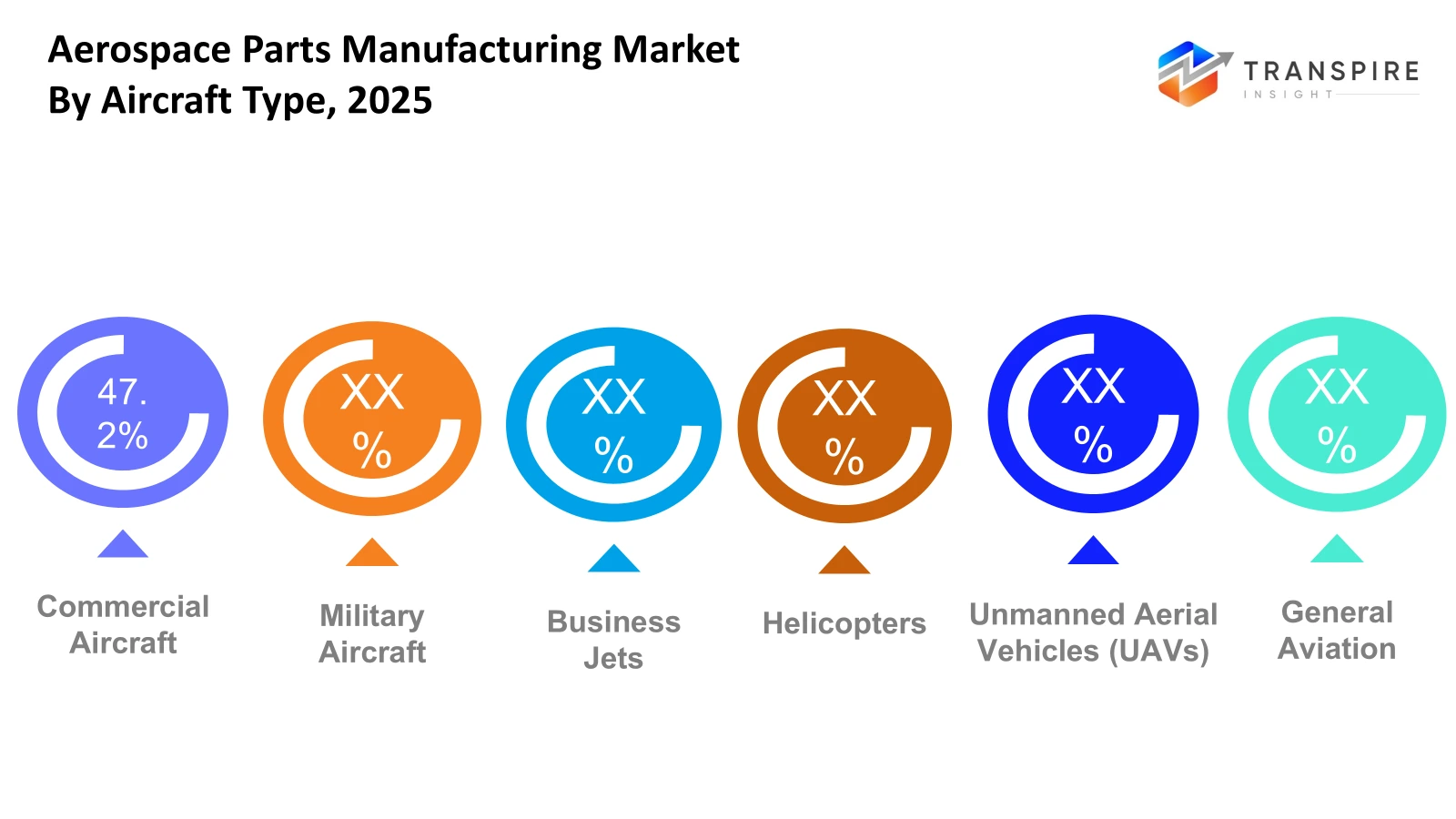
- Commercial aircraft account for the majority of aircraft type demand, driven by growing passenger traffic, the emergence of low-cost carriers, and a substantial order backlog for narrow-body aircraft.
- CNC machining is still the most prevalent manufacturing method due to the high tolerance and repeatability necessary for engine components, structural assemblies, and load-carrying systems in commercial and military aircraft.
- Aluminum alloys still account for the largest material demand due to their cost-effectiveness, well-established supply chains, and desirable strength-to-weight ratios, despite the gradual introduction of composites in aircraft structures.
So, The Aerospace Parts Manufacturing Market includes the production of structural, propulsion, electronic, and interior parts for commercial, military, and general aviation aircraft. The market combines high-tech materials, precision engineering, and regulatory requirements to ensure performance and safety criteria are satisfied. The companies involved in the industry face complex global supply chains from OEMs, Tier 1 suppliers, and niche machining shops. Market development is directly related to global aircraft production rates, airline fleets, and defense modernization initiatives. The trend toward light materials and fuel efficiency is revolutionizing product development, with increasing demand for composites, titanium alloys, and advanced manufacturing processes. The aftermarket service sector, including maintenance and replacement parts, further enhances revenue growth. The technological revolution is a hallmark of the market. Automation, digital twins, additive manufacturing, and advanced quality control systems are enhancing production efficiency and minimizing lead times. As aircraft development programs shift toward sustainability and electrification, component suppliers are responding to new material and system integration challenges, further solidifying the industry’s resilience.
Aerospace Parts Manufacturing Market Segmentation
By Product Type
- Engine Components
Engine components are a high-value category, driven by the need for high performance, safety, and fuel efficiency. The use of advanced materials like superalloys and titanium is on the rise, thanks to the need to withstand high temperatures and stresses.
- Aerostructures
Aerostructures, which include fuselage, wings, and structural components, are a major production category. The category is driven by the growing demand for commercial aircraft deliveries and the need for lightweight designs. The integration of composites is gaining momentum to improve structural integrity and lower the weight of aircraft.
- Avionics
Avionics systems are growing rapidly with the adoption of digital cockpits and advanced navigation systems. The need for safety and communication system enhancements is driving demand. The integration of AI-based monitoring systems is revolutionizing manufacturing challenges.
- Landing Gear Systems
Landing gear systems involve precise engineering and the use of high-strength materials. The replacement cycle and MRO services make a significant contribution to revenue. Technological improvements are focused on minimizing weight while ensuring robustness.
- Cabin Interiors
Cabin interiors are shaped by airline interest in passenger experience and customization. Light-weight seating, modular galleys, and advanced in-flight entertainment systems are driving innovation. Retrofit initiatives further accelerate the replacement cycle in manufacturing.
- Electrical Systems
Electrical systems are emerging as a result of the shift towards more electric aircraft (MEA). Higher electrification enables improved fuel economy and less reliance on hydraulic systems. Companies are working on advanced wiring and power distribution systems.
- Control Systems
Control systems include flight control actuators and electronic control units. Increased automation and fly-by-wire systems are increasing the complexity of system integration. The need for reliability and redundancy remains a fundamental driver of growth.
By Aircraft Type
- Commercial Aircraft
Commercial aircraft lead by volume, driven by the growing number of passengers worldwide. Narrow-body aircraft programs have a major impact on the output of parts manufacturing. Fleet upgrade and fuel-efficient aircraft platforms drive the demand.
- Military Aircraft
Military aircraft demand is driven by modernization programs in the defense sector and geopolitical events. High-performance components and advanced materials are required in this market. Long program lives guarantee stable and long-term manufacturing contracts.
- Business Jets
Business jets exhibit moderate growth, driven by the revival of business travel and demand from high-net-worth individuals. Customization and luxury interiors provide niche manufacturing opportunities. Lightweight materials are being increasingly incorporated for performance enhancement.
- Helicopters
The helicopter industry is fueled by the military, emergency services, and offshore industries. Rotor and transmission parts are a specialized sub-market. Spare parts and upgrades contribute to steady aftermarket sales.
- Unmanned Aerial Vehicles (UAVs)
The UAV industry is growing rapidly in the military and commercial sectors. Composites and miniaturized avionics are the key to this market. Shorter innovation cycles drive manufacturing adoption.
- General Aviation
The general aviation market encompasses training aircraft and general aviation planes with relatively stable demand. Spare parts and repairs are major contributors to production volume. Cost-effective materials and standardized components are the norm in this market.
To learn more about this report, Download Free Sample Report
By Manufacturing Process
- CNC Machining
CNC machining continues to be the driving force in aerospace component manufacturing. It is widely employed in engine and structural parts. Automation and multi-axis machining improve productivity and minimize tolerances.
- Additive Manufacturing (3D Printing)
Additive manufacturing is gradually gaining acceptance in complex shapes and weight-reducing components. It minimizes material waste and facilitates rapid prototyping. Certification issues continue, but acceptance is increasing for non-critical parts.
- Casting
Casting is widely employed in complex engine and structural parts. Superalloy casting is a major area of importance in turbine production. The market is relatively stable in high-temperature applications.
- Forging
Forging provides optimal mechanical properties for load-carrying parts. It is a major area of importance in landing gear and engine shafts. Rising demand for titanium forgings fuels market growth.
- Injection Molding
Injection molding is a popular process for cabin interior and non-structural plastic parts. The market has high efficiency and economy. Light-weight thermoplastics are gaining popularity.
- Composite Fabrication
Composite fabrication is growing rapidly due to aircraft lightweighting programs. Carbon fiber reinforced polymers (CFRP) are leading in new-generation aircraft. Investment in automated fiber placement equipment is rising.
By Material
- Aluminum Alloys
Aluminum alloys continue to be used extensively because of their cost-effectiveness and favorable strength-weight ratio. They lead the market in aerostructures and aircraft bodies. But a trend of substitution by composites is noticed in modern aircraft variants.
- Titanium Alloys
Titanium alloys are required in high-stress and high-temperature parts. Their corrosion resistance and strength properties make them the best choice for aircraft engines and landing gear. An increasing demand for fuel-efficient aircraft fuels the use of titanium.
- Steel Alloys
Steel alloys are mainly used in structural and landing gear parts. Their high strength ensures their reliability in weight-bearing applications. The demand is stable in both commercial and military aircraft markets.
- Composite Materials
Composite materials are experiencing robust growth because of weight reduction advantages. Carbon fiber composites are widely used in wing and fuselage parts. Their demand is high in next-generation aircraft platforms.
- Superalloys
Superalloys are essential in turbine engines, which work in extreme heat conditions. Nickel-based alloys are the leading superalloys. Improvements in engine performance create sustained demand.
Regional Insights
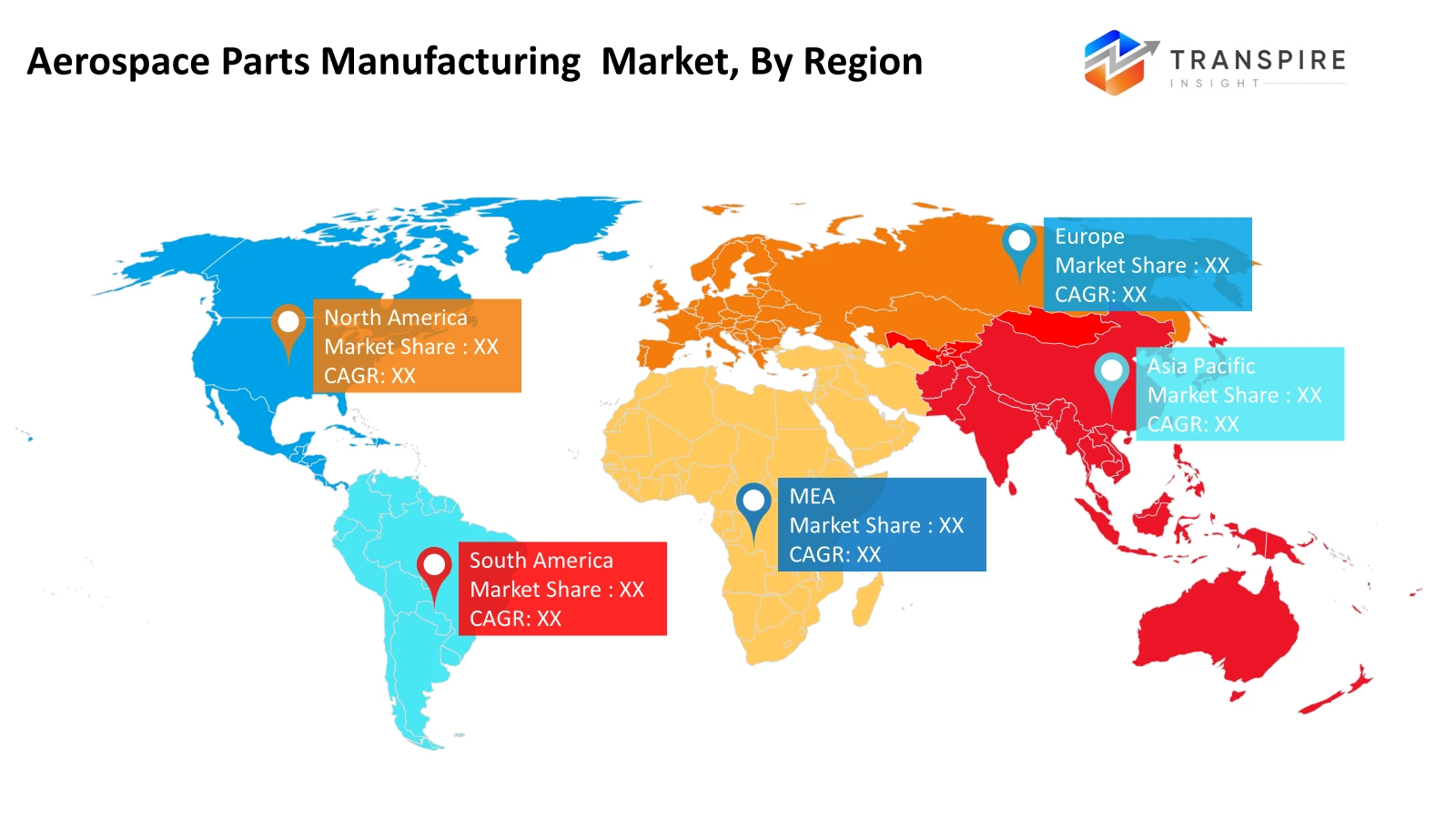
North America, consisting of the United States, Canada, and Mexico, is a mature and innovative aerospace market. The United States is the leader in Tier 1 manufacturing with large OEM and defense industry operations, while Canada is home to aerostructure and engine manufacturing. Mexico is a Tier 2 low-cost manufacturing hub for assemblies and wiring systems. Europe, consisting of Germany, the United Kingdom, France, Spain, Italy, and the Rest of Europe, has robust Tier 1 aircraft assembly and engine manufacturing. Germany and France are the hubs for aerostructure and propulsion manufacturing, while the United Kingdom is the leader in engine technology. Southern and Eastern European countries are emerging as Tier 2 suppliers.
Asia Pacific, consisting of Japan, China, Australia & New Zealand, South Korea, India, and the Rest of Asia Pacific, is a growing aerospace market. China and Japan are emerging as leaders in Tier 1 aircraft assembly and structural manufacturing, while India and South Korea are expanding Tier 2 component manufacturing. Australia & New Zealand offer niche engineering and MRO services. South America, driven by Brazil and Argentina, has a moderate but important role. Brazil is a Tier 1 regional aircraft production center, while Argentina and other countries are involved in Tier 2 component manufacturing and MRO. Middle East & Africa, comprising Saudi Arabia, United Arab Emirates, South Africa, and Rest of Middle East & Africa, are making efforts to develop localized aerospace capabilities. The UAE and Saudi Arabia have Tier 1 assembly plans, while South Africa is involved in Tier 2 manufacturing and regional MRO.
To learn more about this report, Download Free Sample Report
Recent Development News
- February 2026, GE Aerospace made an announcement about a strategic investment of up to US$300 million in the expansion of engine repair services in Singapore, with a focus on advanced automation, AI-driven inspection, and predictive maintenance to enhance turnaround times and service for aircraft engine parts between 2025 and 2029.
- In September 2025, GE Aerospace and BETA Technologies have formalized their partnership and equity investment of $300 million to co-develop hybrid electric propulsion systems for AAM, which indicates a move towards new propulsion systems that may change the future of aerospace parts manufacturing.
|
Report Metrics |
Details |
|
Market size value in 2025 |
USD 980.00 Billion |
|
Market size value in 2026 |
USD 1,020.00 Billion |
|
Revenue forecast in 2033 |
USD 1,620.00 Billion |
|
Growth rate |
CAGR of 6.80% from 2026 to 2033 |
|
Base year |
2025 |
|
Historical data |
2021 – 2024 |
|
Forecast period |
2026 – 2033 |
|
Report coverage |
Revenue forecast, competitive landscape, growth factors, and trends |
|
Regional scope |
North America; Europe; Asia Pacific; Latin America; Middle East & Africa |
|
Country scope |
United States; Canada; Mexico; United Kingdom; Germany; France; Italy; Spain; Denmark; Sweden; Norway; China; Japan; India; Australia; South Korea; Thailand; Brazil; Argentina; South Africa; Saudi Arabia; United Arab Emirates |
|
Key company profiled |
GE Aviation, Pratt & Whitney, Rolls-Royce plc, Honeywell International, Inc., Safran SA, Eaton Corporation plc, Woodward, Inc., JAMCO Corporation, Intrex Aerospace, CAMAR Aircraft Parts Company, MTU Aero Engines AG, Aequs Private Limited, Collins Aerospace, Kawasaki Heavy Industries, Ltd., and Ducommun Inc |
|
Customization scope |
Free report customization (country, regional & segment scope). Avail customized purchase options to meet your exact research needs. |
|
Report Segmentation |
By Product Type (Engine Components, Aerostructures, Avionics, Landing Gear Systems, Cabin Interiors, Electrical Systems, Control Systems), By Aircraft Type (Commercial Aircraft, Military Aircraft, Business Jets, Helicopters, Unmanned Aerial Vehicles (UAVs), General Aviation), By Manufacturing Process (CNC Machining, Additive Manufacturing (3D Printing), Casting, Forging, Injection Molding, Composite Fabrication) and By Material (Aluminum Alloys, Titanium Alloys, Steel Alloys, Composite Materials, Superalloys) |
Key Aerospace Parts Manufacturing Company Insights
GE Aviation is one of the most prominent participants in the aerospace parts manufacturing industry because of its broad engine and propulsion systems portfolio. The company has high-volume production capabilities along with advanced material and digital inspection capabilities, which are driving the market. The partnerships and supply agreements with the leading aircraft manufacturers ensure that the company has optimal revenue streams and geographic footprints, especially in North America and Europe. The focus on fuel-efficient engines and life cycle services ensures that the company maintains a leadership position in the market.
Key Aerospace Parts Manufacturing Companies:
- GE Aviation
- Pratt & Whitney
- Rolls-Royce plc
- Honeywell International, Inc.
- Safran SA
- Eaton Corporation plc
- Woodward, Inc.
- JAMCO Corporation
- Intrex Aerospace
- CAMAR Aircraft Parts Company
- MTU Aero Engines AG
- Aequs Private Limited
- Collins Aerospace
- Kawasaki Heavy Industries, Ltd.
- Ducommun Inc
Global Aerospace Parts Manufacturing Market Report Segmentation
By Product Type
- Engine Components
- Aerostructures
- Avionics
- Landing Gear Systems
- Cabin Interiors
- Electrical Systems
- Control Systems
By Aircraft Type
- Commercial Aircraft
- Military Aircraft
- Business Jets
- Helicopters
- Unmanned Aerial Vehicles (UAVs)
- General Aviation
By Manufacturing Process
- CNC Machining
- Additive Manufacturing (3D Printing)
- Casting
- Forging
- Injection Molding
- Composite Fabrication
By Material
- Aluminum Alloys
- Titanium Alloys
- Steel Alloys
- Composite Materials
- Superalloys
Regional Outlook
- North America
- United States
- Canada
- Mexico
- Europe
- Germany
- United Kingdom
- France
- Spain
- Italy
- Rest of Europe
- Asia Pacific
- Japan
- China
- Australia & New Zealand
- South Korea
- India
- Rest of Asia Pacific
- South America
- Brazil
- Argentina
- Rest of South America
- Middle East & Africa
- Saudi Arabia
- United Arab Emirates
- South Africa
- Rest of the Middle East & Africa
Frequently Asked Questions
Find quick answers to common questions.
The approximate Aerospace Parts Manufacturing Market size for the market will be USD 1,620.00 billion in 2033.
Key segments for the Aerospace Parts Manufacturing Market By Product Type (Engine Components, Aerostructures, Avionics, Landing Gear Systems, Cabin Interiors, Electrical Systems, Control Systems), By Aircraft Type (Commercial Aircraft, Military Aircraft, Business Jets, Helicopters, Unmanned Aerial Vehicles (UAVs), General Aviation), By Manufacturing Process (CNC Machining, Additive Manufacturing (3D Printing), Casting, Forging, Injection Molding, Composite Fabrication) and By Material (Aluminum Alloys, Titanium Alloys, Steel Alloys, Composite Materials, Superalloys).
Major Aerospace Parts Manufacturing Market players are GE Aviation, Pratt & Whitney, Rolls-Royce plc, Honeywell International, Inc., Safran SA.
The North America region is leading the Aerospace Parts Manufacturing Market.
The CAGR of the Aerospace Parts Manufacturing Market is 6.80%.
- GE Aviation
- Pratt & Whitney
- Rolls-Royce plc
- Honeywell International, Inc.
- Safran SA
- Eaton Corporation plc
- Woodward, Inc.
- JAMCO Corporation
- Intrex Aerospace
- CAMAR Aircraft Parts Company
- MTU Aero Engines AG
- Aequs Private Limited
- Collins Aerospace
- Kawasaki Heavy Industries, Ltd.
- Ducommun Inc
Recently Published Reports
-
Apr 2026
Aerospace Fluoropolymers Market
Aerospace Fluoropolymers Market Size, Share & Analysis Report By Type (PTFE, FEP, PFA, ETFE, and Others), By Application (Electrical Insulation, Seals & Gaskets, Coatings, and Others), By End User (Commercial Aviation, Military Aviation, General Aviation, and Others), and Geography (North America, Europe, Asia-Pacific, Middle East and Africa, South and Central America), 2021 - 2031
-
Apr 2026
Airborne SATCOM System Market
Airborne SATCOM System Market Size, Share & Analysis Report By Type (SATCOM Terminals, Transceivers, Airborne Radio, Modems and Routers, SATCOM Radomes, and Other), By Application (Government and Defense and Commercial), and Geography (North America, Europe, Asia-Pacific, Middle East and Africa, South and Central America), 2021 – 2031
-
Apr 2026
Ship Leasing Market
Ship Leasing Market Size, Share & Analysis Report By Vessel Type (Container Ships, Bulk Carriers, Tankers, and Specialized Vessels), By Lease Duration (Short-Term Lease (Less than 1 year), Medium-Term Lease (1-5 years), and Long-Term Lease (More than 5 years)), By Lease Type (Bareboat Charter, Time Charter, Financial Lease, and Others), By End-User Industry (Oil and Gas, Manufacturing and Industrial, Automotive, Agriculture and Food, Retail and Consumer Goods, and Others), and Geography (North America, Europe, Asia-Pacific, Middle East and Africa, South and Central America), 2021 – 2031
-
Apr 2026
Thread Rolling Dies Market
Thread Rolling Dies Market Size, Share & Analysis Report By Type (Flat Thread Rolling Dies, Circular (Cylindrical) Dies, Tangential Thread Rolling Dies, Planetary Thread Rolling Dies, and Other Types), By Material Type (High-Speed Steel (HSS), Carbide, Tool Steel, Alloy Steel, and Other Specialized Alloys), By Distribution Channel (Direct Sales, Distributors and Dealers, and Online Platforms), By Application (Automotive Industry, Aerospace and Defense, Construction and Infrastructure, Industrial Machinery, Electronics and Electrical Components, Medical Devices, and Fastener Production), and Geography (North America, Europe, Asia-Pacific, Middle East and Africa, South and Central America), 2021 – 2031
Our Clients