
North America Pharmaceutical Grade Sodium Chloride Market Size & Forecast:
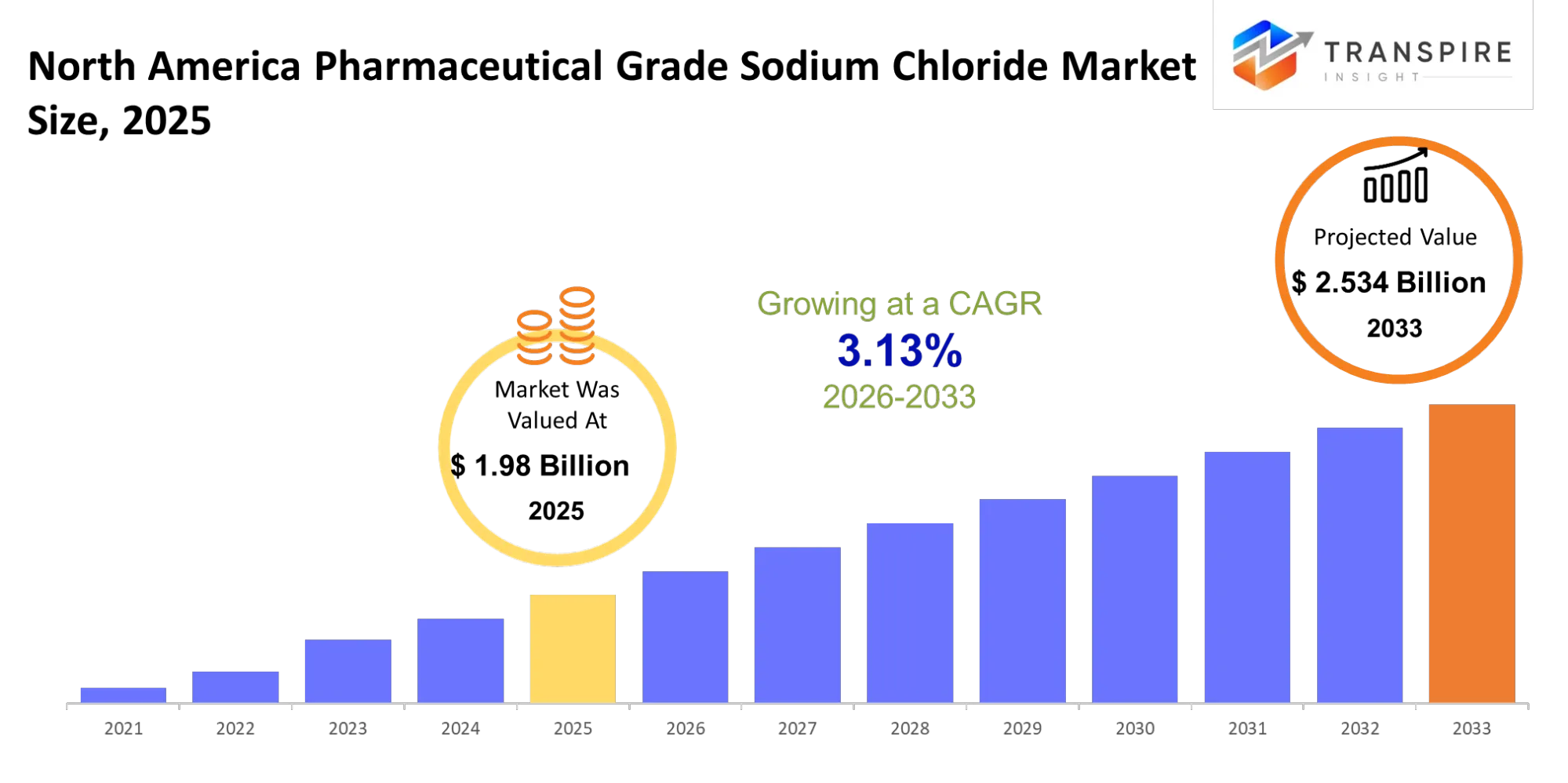
- North America Pharmaceutical Grade Sodium Chloride Market Size 2025: USD 1.98 Billion
- North America Pharmaceutical Grade Sodium Chloride Market Size 2033: USD 2.534 Billion
- North America Pharmaceutical Grade Sodium Chloride Market CAGR: 3.13%
- North America Pharmaceutical Grade Sodium Chloride Market Segments: By Form (Powder, Crystals, Solution, Granules, Others), By Application (IV Solutions, Hemodialysis, Drug Formulation, Nasal Sprays, Others), By End User (Pharmaceutical Companies, Hospitals, Biotechnology Companies, Research Institutes, Others), By Purity Level (USP Grade, EP Grade, BP Grade, Others).
To learn more about this report,  Download Free Sample Report
North America Pharmaceutical Grade Sodium Chloride Market Summary:
The North America Pharmaceutical Grade Sodium Chloride Market size is estimated at USD 1.98 Billion in 2025 and is anticipated to reach USD 2.534 Billion by 2033, growing at a CAGR of 3.13% from 2026 to 2033.The North America Pharmaceutical Grade Sodium Chloride Market kinda sits right in the middle of the healthcare manufacturing ecosystem, supplying ultra-high-purity salt for intravenous solutions , dialysis fluids , injectable drugs , and even biopharmaceutical production workflows. So yeah, its main role is really to keep formulation safety on track, make sure everything stays consistent , and stay within regulatory compliance. That matters because in many medical products even small impurity levels can end up affecting patient outcomes, not in a dramatic way always, but still in a real way.
In the last three to five years, the whole market has shifted, more like a structural tilt, toward stricter quality control and stronger traceability requirements. This shift is connected to biologics getting more complex, plus sterile injectables , and those newer advanced therapeutic products that don’t leave much room for error. Also, during the pandemic period, supply chain disruptions showed some weak points in how pharmaceutical raw materials were sourced. As a result, manufacturers started diversifying suppliers, and they tried to bolster domestic production capabilities, sort of as a hedge and also as a reliability move.
Now, market growth is being fueled by steady increases in injectable therapies, biologic drug manufacturing, and higher volumes tied to chronic disease treatments. When pharmaceutical companies keep expanding production capacity and they focus on supply security, then sourcing pharmaceutical grade sodium chloride becomes more strategic. That tends to turn into higher-value purchasing agreements, longer term relationships with suppliers, and better revenue opportunities across the regional supply chain.
Key Market Insights
- In 2025, the United States basically dominates the North America Pharmaceutical Grade Sodium Chloride Market, capturing something like 82% of the regional revenue , yes, it’s that high.
- A solid pharmaceutical manufacturing backbone, plus strong biologics production, backs up why the country keeps such a big portion of the business.
- Canada shows up as the fastest-moving regional market over the forecast window , largely because investments keep pouring into pharmaceutical manufacturing capacity, and also because domestic drug production is getting more attention.
- When it comes to product grades, pharmaceutical-grade sodium chloride for injectable formulations is leading, with close to 48% share in 2025, it’s the mainstay.
- Dialysis-grade sodium chloride kind of hangs around the runner-up spot since renal care treatment volumes are steadily getting bigger all across North America.
- Biopharmaceutical processing-grade sodium chloride is expected to grow the fastest by 2030, linked to the continual increase in biologics output plus cell therapy manufacturing.
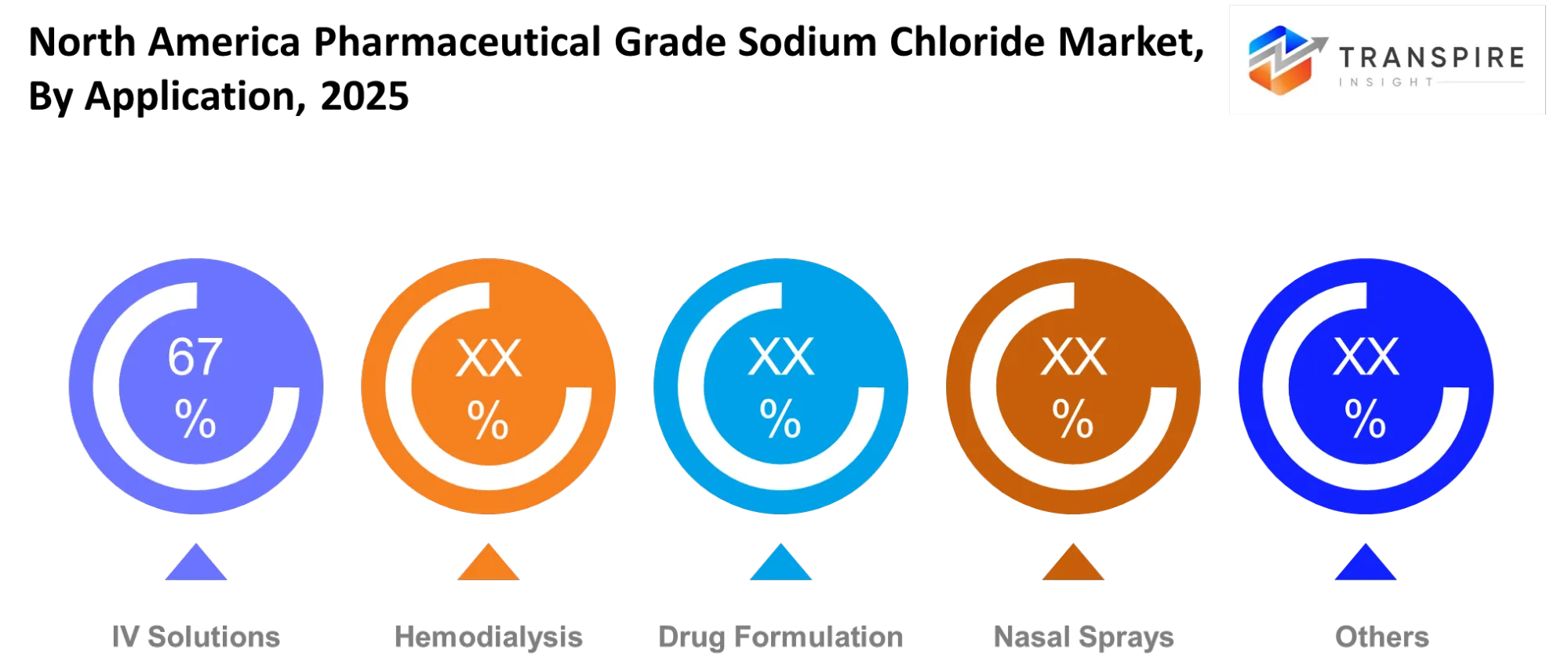
- For uses, intravenous solutions, IV take the top position and account for roughly 44% of total market revenue in 2025.
- Biopharmaceutical manufacturing is also the fastest-growing application space, pulled forward by commercial scale production of monoclonal antibodies and newer advanced therapies.
- Sterile injectable drug formulations are still gaining traction as pharmaceutical companies expand and upgrade manufacturing capacity.
- On the end-user side, pharmaceutical manufacturers hold the largest share, exceeding 58% of total demand in 2025.
- Meanwhile, Contract Development and Manufacturing Organizations (CDMOs) are expected to be the fastest-growing end-user category across the forecast period.
- And as more drug manufacturing gets outsourced, demand keeps emerging for high-purity pharmaceutical ingredients, kind of steadily, without much pause.
What are the Key Drivers, Restraints, and Opportunities in the North America Pharmaceutical Grade Sodium Chloride Market?
The strongest growth driver in the North America Pharmaceutical Grade Sodium Chloride Market is , kind of the rapid expansion of injectable drugs biologics, and sterile pharmaceutical manufacturing, even though it sounds simple. This whole shift was sped up by rising investment in biologic therapies, vaccine production capacity and advanced drug delivery systems over the last several years. Pharmaceutical grade sodium chloride basically acts as a key raw material in intravenous solutions, injectable formulations, and bioprocessing uses where purity standards are particularly strict and not negotiable. So as pharmaceutical manufacturers expand production lines and launch new therapies , procurement volumes of high-purity sodium chloride trend upward too. And that ripple effect turns into a direct revenue impact across the supply chain, from specialty salt producers to pharmaceutical ingredient suppliers.
The market’s main restraint is the complexity of regulatory compliance and qualification expectations for pharmaceutical-grade raw materials. Suppliers are expected to keep validated manufacturing processes, a lot of quality documentation, and consistent purity specifications, to match pharmaceutical standards. The barrier is structural , because regulatory approvals, facility certifications, and supplier qualification programs usually mean years of investment and repeated auditing. Because of that, new entrants deal with long commercialization timelines, while current manufacturers face high operating costs. These limits reduce supply flexibility and can slow capacity expansion, which then suppresses potential revenue growth when pharmaceutical production ramps up quickly.
A big opportunity shows up in the ongoing localization of pharmaceutical supply chains across North America, and i mean it in a pretty practical way. Governments as well as pharma companies are putting money into domestic manufacturing infrastructure, partly to lessen dependence on overseas sourcing, and also to strengthen supply security. For instance, new biologics and sterile injectable manufacturing facilities that are being developed in the United States and Canada will need qualified regional suppliers for pharmaceutical grade raw materials. Once those sites start running , the vendors who can deliver traceable, top-purity sodium chloride, under long-term contracts, should end up reaching a larger and more premium client base. That shift should help power the market’s next phase of expansion, even if it sounds a little gradual at first.
What Has the Impact of Artificial Intelligence Been on the North America Pharmaceutical Grade Sodium Chloride Market?
Artificial intelligence and more advanced digital technologies are, kinda, increasingly reshaping how pharmaceutical-grade sodium chloride is produced. The big idea is that they improve process control, quality assurance, and also help the whole supply chain run smoother. Manufacturers are rolling out AI-enabled monitoring setups across purification, crystallization, and even packaging steps to keep an eye on critical quality factors all the time. Things like impurity levels, particle consistency, moisture content, and batch uniformity are tracked continuously , not just occasionally. With automated control platforms they can tweak operating conditions in real time, which tends to cut down process swings and can minimize product rejection, kinda like you prevent the “bad batches” earlier.
On top of that, machine learning models are being put to work for predictive maintenance , especially for filtration units, evaporators, pumps, and other key production assets. These systems sift through sensor signals and surface signs of equipment wear before a full breakdown shows up. So facilities see less unplanned downtime and they keep production moving. There are also more advanced forecasting tools, used to fine tune inventory decisions by estimating pharmaceutical manufacturing demand ahead of time. That helps suppliers line up production timing with customer needs, and reduce excess stock that just sits around.
Overall, the outcomes look pretty measurable: higher equipment uptime , lower maintenance expenses, better batch yields, and stronger regulatory compliance thanks to improved traceability and digital recordkeeping. Still, AI adoption is not fully wide open because integration can be costly, and validating AI-driven controls is complex in tightly regulated pharmaceutical settings. A lot of places also struggle to connect older, legacy manufacturing infrastructure with modern data platforms. That mismatch, it slows the larger rollout across the industry, even when teams want to move faster.
Key Market Trends
- Since 2020 , pharmaceutical companies have kind of broadened their sourcing plans after supply chain interruptions showed weak spots from relying on just one region for raw materials, kind of exposed vulnerabilities in a really direct way.
- Between 2021 and 2025, spending on North American biologics manufacturing sped up , and that also pushed demand for ultra-high-purity sodium chloride used for cell culture workflows , it’s more than a niche input now.
- Regulatory audits lately keep leaning harder on supply chain traceability, so suppliers have been moving toward digital batch tracking and electronic quality records systems , even when the paperwork used to be “manual enough”.
- Contract Development and Manufacturing Organizations, or CDMOs , broadened procurement volumes as outsourcing activity increased across sterile injectable work and biologic drug production, without much pause.
- Manufacturers then started stepping away from spot purchasing and leaning into multi-year supply agreements, partly to dampen procurement risk and to keep production scheduling more stable, which feels a bit “boring” but useful.
- Big suppliers like Cargill and K+S Group increased attention on pharmaceutical-grade product lineups, with more strict purity limits , compared with earlier years.
- Automated process monitoring became more common after 2022, and it helped producers lower batch-to-batch variation while also supporting better regulatory compliance results.
- Quality requirements tightened as advanced therapies moved into commercial production, which basically required suppliers to invest in validation, testing, and contamination-control infrastructure, not only in equipment but also in routine practices.
- On top of that , domestic manufacturing expansion in the United States and Canada shifted buying habits toward qualified regional suppliers, especially those with dependable delivery capabilities.
- In the end, competitive differentiation is leaning more on traceability, regulatory readiness, and consistent purity results rather than just raw production size alone , which is interesting because it changes what “winning” looks like.
North America Pharmaceutical Grade Sodium Chloride Market Segmentation
By Form
In terms of form, powder is still the dominant sub-segment and it’s kind of obvious, pharmaceutical manufacturers like it for storage convenience, long shelf life, and the general flexibility it brings across several production processes. Powder products also help with large scale formulation work, and they enable more precise dosing during manufacturing, which in turn strengthens market share. Crystal forms keep a strong place too, mainly because high purity needs show up a lot in injectable and dialysis settings. Meanwhile, solution-based products are still picking up momentum in sites that care about operational efficiency and saving time on preparation, even when the workflow is a bit tight. Granules and other specialty forms usually land in niche use cases where handling traits, or processing constraints, are a little different from the usual production routine.
Overall, demand patterns are slowly drifting toward formats that somehow help manufacturing consistency, and at the same time lower contamination risks. And since pharmaceutical production keeps expanding and quality standards are getting more strict, suppliers are basically expected to invest in more advanced processing technologies plus stronger packaging systems. So yeah, this direction will probably end up creating sharper differentiation among producers, and it will also make space for premium products, the ones designed for highly regulated pharmaceutical environments.
By Application
In terms of application, intravenous solutions are taking up the largest chunk , because sodium chloride is basically used as a core ingredient in fluid replacement therapies and day to day hospital patient care. When healthcare systems keep using it consistently, there’s this steady demand base, and it also kind of locks in leadership within that application landscape. After that, hemodialysis comes next as a major segment, mainly tied to the rising overall treatment load linked with chronic kidney disease and older age demographics.
On the other side, drug formulation applications are still widening , since biologics, sterile injectables, and other specialty medicines need very high purity inputs to stay within regulatory expectations.Nasal sprays and similar uses take a smaller portion, though they often gain from continuous product improvement and broader consumer healthcare adoption. Looking forward , the biggest growth is going to hinge more and more on advanced therapeutic manufacturing, plus specialized drug delivery systems. Manufacturers that can match their production capabilities with shifting pharmaceutical needs should be positioned to capture value, especially from fast-growing therapeutic categories.
To learn more about this report, Download Free Sample Report
By End-User
By end user, pharmaceutical companies seem to hold the leading place, because massive drug manufacturing uses a lot of pharmaceutical-grade sodium chloride in formulation, processing, and also quality control. The old style manufacturing networks, plus the expanding injectable drug pipeline, keep this leadership going. Hospitals count as another key slice too, mainly from direct use in intravenous treatments, dialysis routines, and a range of clinical applications.On the other side, biotechnology companies are showing up as a fast-growing group, since money and effort for biologics, cell therapies, and gene based treatments are picking up across North America.
Research institutes also add demand, but more through lab work, process refinement, and clinical research programs. Even so, their overall consumption stays on the smaller side, compared with the bigger players.What’s interesting is how buying habits are shifting the market feel, pharmaceutical brands tend to focus on supply reliability, while biotech firms lean harder into purity and full traceability. Looking ahead, the investment signals point to more cooperation between suppliers and advanced therapy developers, which could open up space for customized products, and longer term supply agreements.
By Purity Level
On the basis of purity level USP Grade ends up taking the largest market share, mostly because of regulatory acceptance, broad compatibility across applications , and how widely it’s been adopted throughout pharmaceutical manufacturing. In practice it works like the industry benchmark, even when people talk fast about it. Strong demand from injectable formulations, intravenous solutions, and biologic production keeps it near the front. EP Grade and BP Grade still hold real ground, especially for manufacturers who serve international markets or work inside global supply chains where compliance with multiple pharmacopeial standards is basically nonnegotiable.
The other purity classifications, meanwhile , tend to get used for more specialized tasks and region specific regulatory expectations, but their sales volumes are comparatively modest. Market behavior seems to be shifting toward higher purity specifications. This is tied to tighter regulatory scrutiny and the fact that pharmaceutical products are getting more complex over time. Looking ahead , future development will likely orbit around improved quality verification, stronger traceability systems, and tighter contamination control measures. Suppliers who can reliably exceed minimum purity requirements should be in a better position, because they can pull in customers that want long term regulatory confidence , plus supply security.
What are the Key Use Cases Driving the North America Pharmaceutical Grade Sodium Chloride Market?
The primary, use case for pharmaceutical-grade sodium chloride is for making intravenous solutions for hospitals, outpatient centers,and emergency care settings. There’s really high consumption volumes and very strict purity requirements so this application becomes the biggest source of demand across the whole healthcare supply chain .
After IV therapies , the adoption is also widening for hemodialysis fluids, and for sterile drug formulation processes. Pharmaceutical manufacturers and biotechnology companies depend on high-purity sodium chloride to keep product consistency, stay aligned with regulatory rules, and improve manufacturing efficiency for injectable medicines and biologic therapies.
Newer uses are showing up in cell and gene therapy manufacturing, where production has to be ultra controlled and the environment is, well, highly managed so the materials used need to be ultra-pure. Growth is also starting to show up in more advanced bioprocessing platforms and in specialized research programs , that kind of focus on next-generation therapeutics. That’s creating fresh opportunities for suppliers who can manage increasingly stringent quality controls and stronger traceability expectations, as well.
|
Report Metrics |
Details |
|
Market size value in 2025 |
USD 1.98 Billion |
|
Market size value in 2026 |
USD 2.042 Billion |
|
Revenue forecast in 2033 |
USD 2.534 Billion |
|
Growth rate |
CAGR of 3.13% from 2026 to 2033 |
|
Base year |
2025 |
|
Historical data |
2021 - 2024 |
|
Forecast period |
2026 - 2033 |
|
Report coverage |
Revenue forecast, competitive landscape, growth factors, and trends |
|
Country scope |
North America (Canada, The United States, and Mexico) |
|
Key company profiled |
Akzo Nobel, K+S Group, Tata Chemicals, Cargill, Dominion Salt, Salins Group, Morton Salt, INEOS Enterprises, Swiss Saltworks, Cheetham Salt, Nouryon, Merck KGaA, Thermo Fisher Scientific, Spectrum Chemical, American Elements |
|
Customization scope |
Free report customization (country, regional & segment scope). Avail customized purchase options to meet your exact research needs. |
|
Report Segmentation |
By Form (Powder, Crystals, Solution, Granules, Others), By Application (IV Solutions, Hemodialysis, Drug Formulation, Nasal Sprays, Others), By End User (Pharmaceutical Companies, Hospitals, Biotechnology Companies, Research Institutes, Others), By Purity Level (USP Grade, EP Grade, BP Grade, Others) |
Which Regions are Driving the North America Pharmaceutical Grade Sodium Chloride Market Growth?
The United States still looks like the main regional market, mostly because it has this huge pharmaceutical manufacturing base , a lot of biologics production ability, and a fairly strong regulatory setup. The supervision from the U.S. Food and Drug Administration keeps demand high for raw materials that are very pure and that still match strict quality benchmarks . On top of that, bigger moves around sterile injectable facilities, contract manufacturing organizations, and advanced therapy production keep pushing consumption upward. There is also this mature ecosystem with ingredient suppliers, pharmaceutical firms, research institutions, and logistics networks, which is basically what sustains regional leadership.
Canada comes next as the second-largest market, but its rise is more about steadiness than sheer size. Strong public healthcare spending, ongoing investments in pharmaceutical production, and a predictable regulatory environment lead to dependable buying behavior. There is also this mature ecosystem with ingredient suppliers, pharmaceutical firms, research institutions and logistics networks, which is basically what keeps regional leadership going, kind of quietly. Canada comes next as the second-largest market but its growth feels more like steadiness than raw scale, you know. Strong public healthcare spending and continued investments in pharmaceutical production, plus a fairly predictable regulatory environment, they all translate into dependable purchasing behavior over time.
Newer actions aimed at strengthening home drug manufacturing, and cutting back on import reliance, have also lifted demand for pharmaceutical-grade raw materials. International manufacturers are jumping in as well, expanding operations so they can benefit from lower production costs and be closer to North American supply chains. Growth through 2026–2033 should generate solid opportunities for market entrants, contract manufacturers, and suppliers looking for long-term expansion .
Who are the Key Players in the North America Pharmaceutical Grade Sodium Chloride Market and How Do They Compete?
In the North America Pharmaceutical Grade Sodium Chloride Market the competition is, you know, moderately consolidated, so only a smaller set of qualified suppliers can really play there. They serve customers that are highly regulated, mainly pharmaceutical and biotechnology, and that makes things kind of tight. What usually wins is not so much price, but the whole purity consistency thing. Also regulatory compliance, reliable supply, and traceability matter a lot. The older, established suppliers tend to hold onto market share through long-term customer ties plus validated manufacturing processes . New entrants though have barriers that are not trivial, because certification requirements and the pharmaceutical supplier qualification timelines take time, and they require real resources. And as biologics and sterile injectable production keep expanding, the competition is shifting more toward quality assurance capabilities and, like, the ability to keep supply uninterrupted across North America.
Cargill competes by leaning on supply chain scale and integrated production capacity, so raw material availability stays dependable. They also differentiate through logistics infrastructure that is pretty extensive, and they can handle large pharmaceutical accounts while keeping quality specifications consistent. K+S Group instead leans into high-purity specialty salt products, and they lean on advanced processing know-how to satisfy the strict pharmaceutical requirements. Their expansion approach includes growing specialty product portfolios, and also boosting the support they offer to pharmaceutical manufacturers who are looking for secure regional sourcing options.
Morton Salt kind of benefits from having a solid North American production footprint, which in turn helps lessen supply chain risk and makes deliveries more reliable, or at least that’s how it feels. They also stress product consistency and those long-running distribution networks, and for regulated pharmaceutical use that becomes pretty valuable. Then there’s Compass Minerals, they set themselves apart with access to resources plus regional production assets, basically to back up supply security. While Nouryon, instead of going the same route, leans into a more technology-oriented approach, connecting specialty ingredient know-how with the shifting demands of pharmaceutical manufacturing. And all these companies keep moving ahead through customer partnerships, capacity optimization programs, and ongoing investments in quality systems that reinforce regulatory compliance, as well as longer-term contract chances.
Company List
- Akzo Nobel
- K+S Group
- Tata Chemicals
- Cargill
- Dominion Salt
- Salins Group
- Morton Salt
- INEOS Enterprises
- Swiss Saltworks
- Cheetham Salt
- Nouryo
- Merck KGaA
- Thermo Fisher Scientific
- Spectrum Chemical
- American Elements
Recent Development News
In May 2026, ICU Medical Company Growth, Stability & Outlook 2026: ICU Medical disclosed that reported revenue declined due in part to IV Solutions business portfolio actions. The company remains a significant participant in the North American IV fluids and sodium chloride solutions market, making this a notable financial development for the sector.
Source: https://builtin.com
In February 2026, Baxter annual profit forecast disappoints as key product troubles mount: Baxter, a major supplier of IV saline and sodium chloride solutions in North America, projected lower-than-expected 2026 earnings. The company cited continuing operational challenges and softer demand for IV solutions, highlighting ongoing changes in the North American infusion-products market.
Source: https://www.reuters.com
What Strategic Insights Define the Future of the North America Pharmaceutical Grade Sodium Chloride Market?
The North America Pharmaceutical Grade Sodium Chloride Market is kind of shifting, more toward a higher value quality driven model where traceability, purity verification, and supply assurance end up mattering more than sheer production volume alone. Under the surface, it seems driven by how biologics, cell therapies, and sterile injectable medicines are expanding so fast, and that whole situation pushes for stricter raw material requirements, plus more complex supplier vetting steps. so, even if consumption doesn’t jump as much, market value can still climb quicker.
There’s also a quieter risk, kinda hard to spot at first, tied to how concentrated qualified suppliers can be. Pharmaceutical manufacturers are leaning on a smaller pool of approved vendors, which may open supply vulnerabilities if there are production disruptions, regulatory issues, or capacity limits at a few crucial facilities. This could get sharper over time, because qualification timelines often make swapping to another supplier, not very easy.
On the opportunity side, there’s an emerging angle like ultra high purity sodium chloride grades, that are pretty much tailored for cell and gene therapy manufacturing. Some firms that start early with more advanced purification approaches, and also digital traceability frameworks, plus a durable partnership model with biotechnology manufacturers may end up in the best position to catch the coming demand, and then build longer term competitive strength through the next ten years.
North America Pharmaceutical Grade Sodium Chloride Market Report Segmentation
By Form
- Powder
- Crystals
- Solution
- Granules
- Others
By Application
- IV Solutions
- Hemodialysis
- Drug Formulation
- Nasal Sprays
- Others
By End User
- Pharmaceutical Companies
- Hospitals
- Biotechnology Companies
- Research Institutes
- Others
By Purity Level
- USP Grade
- EP Grade
- BP Grade
- Others
Frequently Asked Questions
Find quick answers to common questions.
The approximate North America Pharmaceutical Grade Sodium Chloride Market size for the market will be USD 2.534 Billion in 2033.
The key segments of the North America Pharmaceutical Grade Sodium Chloride Market are By Form (Powder, Crystals, Solution, Granules, Others), By Application (IV Solutions, Hemodialysis, Drug Formulation, Nasal Sprays, Others), By End User (Pharmaceutical Companies, Hospitals, Biotechnology Companies, Research Institutes, Others), By Purity Level (USP Grade, EP Grade, BP Grade, Others).
Major players in the North America Pharmaceutical Grade Sodium Chloride Market are Akzo Nobel, K+S Group, Tata Chemicals, Cargill, Dominion Salt, Salins Group, Morton Salt, INEOS Enterprises, Swiss Saltworks, Cheetham Salt, Nouryon, Merck KGaA, Thermo Fisher Scientific, Spectrum Chemical, American Elements.
The current market size of the North America Pharmaceutical Grade Sodium Chloride Market is USD 1.98 Billion in 2025.
The North America Pharmaceutical Grade Sodium Chloride Market CAGR is 3.13%.
- Akzo Nobel
- K+S Group
- Tata Chemicals
- Cargill
- Dominion Salt
- Salins Group
- Morton Salt
- INEOS Enterprises
- Swiss Saltworks
- Cheetham Salt
- Nouryo
- Merck KGaA
- Thermo Fisher Scientific
- Spectrum Chemical
- American Elements
About the Authors

Pankaj Ghogare Patil
I am Pankaj Ghogare Patil, a Senior Research Analyst at Transpire Insight, specializing in the Pharmaceutical, Chemicals & Materials, Healthcare IT, and Biotechnology industry. My expertise lies in conducting comprehensive market research, analyzing industry trends, evaluating competitive landscapes, and translating complex data into actionable insights. At Transpire Insight, I closely follow emerging technologies, regulatory developments, and market innovations to create accurate, well-researched, and informative content that helps businesses and professionals make informed decisions. I am committed to producing credible, evidence-based articles that reflect industry best practices while making technical topics accessible and valuable for a broad audience.

Chakradhar Khansole
Chakradhar serves as the Research Director at Transpire Insight, bringing over 8 years of experience in technology, innovation, and strategic market intelligence. He specializes in transforming complex market data into actionable business insights that enable organizations to make informed, growth-oriented decisions. Recognized for his strategic vision and analytical expertise, Chakradhar leads high-impact research initiatives, delivering comprehensive market assessments, competitive intelligence, and forward-looking industry analysis.
Recently Published Reports
-
May 2026
Healthcare Polymer Packaging Market
Healthcare Polymer Packaging Market Size, Share & Analysis Report By Packaging Type (Syringes, IV Bottles and Pouches, Clamshells, Blisters, Bottles & Jars, Containers, Tubes, IV Parental Packaging, Others), By Type (Regulated, Non-regulated), By Polymer Type (LDPE (Low-Density Polyethylene), HDPE (High-Density Polyethylene), Homo-polymer (Homo), Random Copolymer (Random), Block Copolymer (Block), PET, Polystyrene, Polyvinyl Chloride, Polyamide/EVOH, Others), and Geography (North America, Europe, Asia-Pacific, Middle East and Africa, South and Central America), 2021 - 2031
-
Apr 2026
Hydrophilic Tape (Waterstop) Market
Hydrophilic Tape (Waterstop) Market Size, Share & Analysis Report By Type (Bentonite-Based Hydrophilic Tape, Rubber-Based Hydrophilic Tape), By Application (Residential Buildings, Commercial Buildings, Infrastructure Projects), and Geography (North America, Europe, Asia-Pacific, Middle East and Africa, South and Central America), 2021 - 2031
-
Apr 2026
Metalens Market
Metalens Market Size, Share & Analysis Report By Type (Visible Light Metalens, and Infrared Metalens), By Application (Consumer Electronics, Automotive Electronics, Industrial, Medical, and Others), and Geography (North America, Europe, Asia-Pacific, Middle East and Africa, South and Central America), 2021 - 2031
-
Apr 2026
PBT Resin Market
PBT Resin Market Size, Share & Analysis Report By Type (Reinforced PBT Resin, Unreinforced PBT Resin), By Processing Method (Injection Molding, Extrusion, Blow Molding, Others), By End-User (Automotive, Electrical & Electronics, Consumer Appliances, Industrial Machinery, Medical Devices, Packaging, Others), and Geography (North America, Europe, Asia-Pacific, Middle East and Africa, South and Central America), 2021 - 2031