
South Korea Small Scale LNG Terminal Market Size & Forecast:
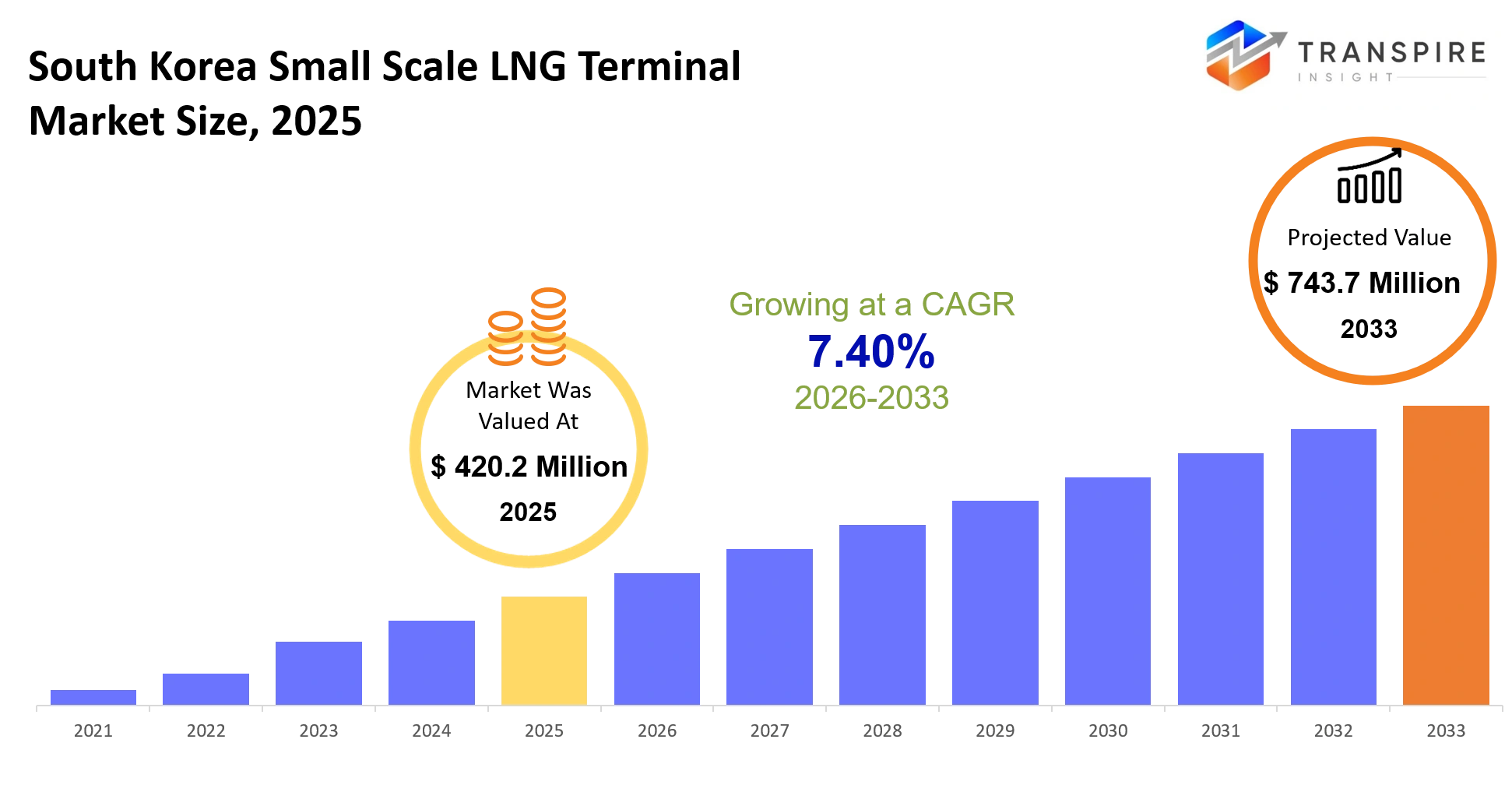
- South Korea Small Scale LNG Terminal Market Size 2025: USD 420.2 Million
- South Korea Small Scale LNG Terminal Market Size 2033: USD 743.7 Million
- South Korea Small Scale LNG Terminal Market CAGR: 7.40%
- South Korea Small Scale LNG Terminal Market Segments: By Terminal Type (Onshore Terminals, Floating Terminals, Satellite Terminals, Modular Terminals, Import Terminals, Bunkering Terminals, Distribution Hubs, Others); By Application (Industrial Supply, Power Generation, Marine Fueling, Commercial Supply, Transportation Fuel, Remote Energy Supply, LNG Trading, Others); By Capacity (Below 50 K m3, 50-100 K m3, 101-200 K m3, 201-300 K m3, Above 300 K m3, Expandable Terminals, Multi-user Terminals, Others); By End User (Utilities, Industrial Companies, Shipping Firms, Energy Traders, Government Agencies, Commercial Users, Logistics Providers, Others)
South Korea Small Scale LNG Terminal Market Summary
The South Korea Small Scale LNG Terminal Market was valued at USD 420.2 Million in 2025. It is forecast to reach USD 743.7 Million by 2033. That is a CAGR of 7.40% over the period.
South Korea’s market for small-scale LNG terminals helps coastal industries, island grids, and growing marine fuel chains, including bunkering, address the logistical challenge of importing, storing, and regasifying LNG regionally. They provide a ready solution for gas delivery to distributed industrial end-uses located away from major gas pipelines. In the past 5 years, the development and increasing adoption of barge-based and ship-linked LNG solutions has driven growth and facilitated South Korea’s ongoing decarbonisation efforts through both the adoption of LNG as an alternative industrial fuel and the maritime use of LNG as a bunkering fuel. The structural change from large, monolithic LNG import terminals towards modular and flexible small-scale terminals closely aligned with bunkering has been hastened by recent volatility and supply uncertainty following Russia’s gas supply disruption in early 2022 and recent strict new sulfur caps imposed by the International Maritime Organisation (IMO). Utilities and port operators are seeking smaller, quicker to build and deployLNG assets and these have the potential to generate significant revenue for a new bunkering value chain and supply remote industrial users.
Key Market Insights
- South Korea Small Scale LNG Terminal Market Shifting from CentralizedLNG to Barge-Based, Satellite Model Centralized LNG infrastructure hubs are gradually shifting towards distributed, satellite terminal systems and barge-based models.
- The high growth rate of LNG bunkering at Busan & Ulsan is contributing to shifts in demand within the Small Scale LNG Terminal Market ecosystem in the region.
- The deployment of integrated digital monitoring solutions are leading to gains in operational efficiency; recent systems have achieved nearly 15% reductions in downtime for newly operational facilities.
- Significant presence and active involvement by the Korea Gas Corporation have stabilized the supply chain integration process of small scale LNG across distributed networks.
- Port-linked terminals facilitating the marine fuel shift are anticipated to record the fastest growth from 2024-2028.
- More than 55% of total small-scale LNG demand volume emanates from clusters in industrial areas in southern coastal regions.
- Hyundai Heavy Industries is engaged in research & development to further enhance integration technologies of LNG carriers and terminals.
- An increase in collaboration initiatives between major shipbuilders and energy utilities are expediting the commercialization processes of hybrid systems combining LNG storage and LNG regasification units.
What are the Key Drivers, Restraints, and Opportunities in the South Korea Small Scale LNG Terminal Market?
The key driver is the policy focus on natural gas as a transitional fuel for industrial decarbonization in Korea and bunkering demand driven by IMO 2020 regulation which prompted the rise of small scale LNG terminal construction around major ports to provide local supply independent of major import terminals. Increased uptake of LNG infrastructure by the industrial and maritime sectors increases the utilization of small scale LNG terminals which generates higher revenues through storage, regasification, and bunkering fees, alongside lower fuel costs by localized bunkering.
Major restraint, high Capex and regulatory hurdles involved in the set-up of a small-scale LNG infrastructure. Small scale LNG terminals need cryogenic storage systems and require safety approval from regulators, coupled with port authority consent; these requirements impose long development lead times for such infrastructure, including modular plants, restricting the expansion capability for privately funded small scale LNG players.
Opportunity is the LNG-powered Maritime Bunkering Hub in conjunction with the development of smart ports like the one in Busan and Ulsan, attracting partnerships with players like SK E&S, Hyundai Oilbank, or Hanwha Ocean to leverage the development of port infrastructure. Small scale LNG can also be used to integrate various multi-fuel bunkering solutions with smart port capabilities.
What Has the Impact of Artificial Intelligence Been on the South Korea Small Scale LNG Terminal Market?
In terms of operational control and maintenance systems in the South Korea Small Scale LNG Terminal Market, artificial intelligence has been enabling monitoring of LNG storage levels, transfer efficiency, and emissions monitoring. We observe the deployment of AI-powered automated solutions for the terminal control system to ensure regasification rates and minimise personnel input during periods of high demand.
The application of machine learning models for predicting the remaining useful life of cryogenic pumps and valves to avoid unplanned outages has led to increased operational uptime of an estimated 10-18% at terminals operating advanced machinery. Marine operations: AI-powered analytics has shown considerable promise in refining fuel consumption prediction for LNG bunkering vessels and to enhance emissions management.
Samsung Heavy Industries is using digital twins to simulate interactions between terminals and bunkering vessels, helping to guarantee operational reliability and safety during periods of high demand. Limitations include the scarcity of high quality operational data, particularly at offshore facilities with irregular connectivity, and high deployment costs that often render it unaffordable for smaller facilities. Nonetheless, we expect to see AI evolve from peripheral optimising tool to intrinsic efficiency enabler.
Key Market Trends
- Modular LNG terminal installations saw a growth rate of over 30% from 2021 to 2025 1 replacing the previous legacy centralized infrastructure platforms.
- Demand for LNG bunkering in Busan Port has significantly increased since 2023, which could provide a series of impacts on the supply chain structure in the Small Scale LNG Terminal Market of South Korea.
- In 2024, with port authorities implementing more rigorous standards for emission compliance, the necessary cost reductions moved into place for the wide variety of other operators across the coastal shipping sector to begin transitioning to LNG.
- Digital monitoring integration enhances terminal operational effectiveness, by decreasing unintended downtime on new installations since 2022.
- Kogas is engaged in testing small scale LNG distribution networks targeted at regionally-based industries.
- Partnerships with Energy Companies emerged post- 2023, allowing the integrated storage of LNG and vessel fueling.
- Many of the floating LNG and barge-based terminals became more attractive than fixed infrastructure as a hastedeployementsolutionsin the 2022-2026 time period.
- Industrial demand originating from the main petrochemical areas during 2025 formed a significant share of small scale LNG terminal utilization.
- Hyundai Heavy Industries developed the LNG carrier-related terminal systems to enhance the flexibility of offshore supplies.
- Investment trend is moving to smart port ecosystems featuring LNG infrastructure merged with digitalized logistics platforms.
South Korea Small Scale LNG Terminal Market Segmentation
By Terminal Type:
Onshore terminals cater to consistent storage and regasification facilities that serve as an ideal alternative to facilities situated close to industrial areas or near ports. The terminals deal with constant gas flow and hold value by securing baseline supply security in South Korea Small Scale LNG Terminal Market where the industrial sector ensures stable consumption round-the-clock.
Floating terminals, Satellite terminals, modular facilities, import linked terminals, bunkering stations, and distribution hubs serve distributed demand areas of small-sized areas or areas that lie at remote locations. The terminals also help in easy capacity scaling and quicker implementation in terms of installation time and allow room for accommodating changing requirements for power consumption in different locations.
By Application:
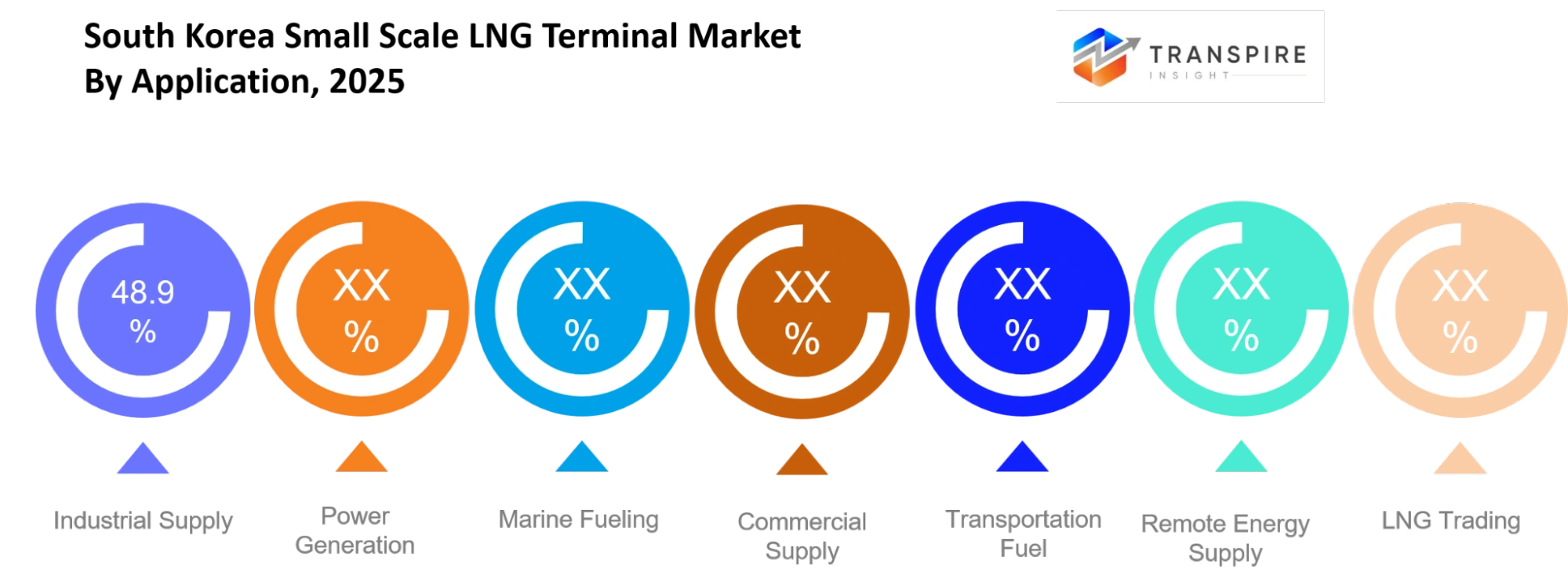
Industrial fuel is the predominant application as this type of LNG is used to power manufacturing facilities, refining and other heavy processing sectors that require secure and reliable fuel supply and reduce dependency on oil-based fuel sources while helping lower energy costs for energy-intensive sectors within industrial parks.
LNG is also used within the power and commercial supply sectors as a means to moderate demand during peak periods. Marine fueling demand accounts for the need of LNG as a fuel at ports and within other areas while transportation fuel and remote energy supply also generate new LNG demand from regions without access to pipeline fuel sources.
By Capacity:
Terminals below 50 K m3 address small industrial consumers and local points of energy need small storage capacity and frequent refilling cycles, are simple to be implemented, and help the early-stage development across South Korea Small Scale LNG Terminal Market (distributed energy model).
Terminals within the mid-range capacity of 50 K m3 - 200 K m3 support balanced demand from the industrial clusters and regional distributors.Terminals greater than 200 K m3 are for the zones with high demand. Expandable and multi-user terminals support development phased by consumption requirements over a long time span.
By End User:
Utilities are the dominant sector to end use, LNG enables a steady balance of the electricity grid and efficient regional gas distribution. These institutions need a steady supply for maintaining balancing of power to support peaking demand and serve customers in urban areas and in areas of industrialization.
Industrial users of LNG include those with interests in fuel switching and managing operational costs while traders of energy are attracted to flexible acquisition and sales. Others such as shipping companies, governments, commercial sector consumers, and logistics providers also demand this commodity in response to opportunities to provide locally available energy, align with governmental targets and meet on-board needs.
What are the Key Use Cases Driving the South Korea Small Scale LNG Terminal Market?
Industry continues to be the primary application for the Small Scale LNG Terminal Market in South Korea driven by manufacturing zones requiring constant fuel for heat intensive sources. The application drive for the LNG is to facilitate productivity maintenance and cost control and enable industries to move away from Heavy Polluting fuels under increasingly stringent emission norms which sustains robust application growth in the marine-focused East Coast industrial zones.
Maritime fuel and power generation represent growing applications, driven by shipping companies and utilities adapting to the new cleaner fuel regulations. LNG supply linked to ports is becoming more common as ships opt for cleaner, lower-sulfur fuels, and smaller scale terminals provide a hedge against high loads in regional power grids.
The applications that are gaining stronger prospects along the forecast period are remote energy supply and LNG as transport fuel. Islands and remote industrial locations are being supplied with modular LNG systems, and first applications in heavy-duty transport fleets are only beginning to gain momentum.
|
Report Metrics |
Details |
|
Market size value in 2025 |
USD 420.2 Million |
|
Market size value in 2026 |
USD 451.3 Million |
|
Revenue forecast in 2033 |
USD 743.7 Million |
|
Growth rate |
CAGR of 7.40% from 2026 to 2033 |
|
Base year |
2025 |
|
Historical data |
2021 - 2024 |
|
Forecast period |
2026 - 2033 |
|
Report coverage |
Revenue forecast, competitive landscape, growth factors, and trends |
|
Country scope |
South Korea |
|
Key company profiled |
KOGAS, SK E&S, GS Energy, POSCO Energy, Korea East-West Power, Hyundai LNG Shipping, Shell, TotalEnergies, ExxonMobil, Mitsui O.S.K., Samsung Heavy Industries, Hyundai Heavy Industries, Hanwha Ocean, BP, Chevron |
|
Customization scope |
Free report customization (country, regional & segment scope). Avail customized purchase options to meet your exact research needs. |
|
Report Segmentation |
By Terminal Type (Onshore Terminals, Floating Terminals, Satellite Terminals, Modular Terminals, Import Terminals, Bunkering Terminals, Distribution Hubs, Others); By Application (Industrial Supply, Power Generation, Marine Fueling, Commercial Supply, Transportation Fuel, Remote Energy Supply, LNG Trading, Others); By Capacity (Below 50 K m3, 50-100 K m3, 101-200 K m3, 201-300 K m3, Above 300 K m3, Expandable Terminals, Multi-user Terminals, Others); By End User (Utilities, Industrial Companies, Shipping Firms, Energy Traders, Government Agencies, Commercial Users, Logistics Providers, Others) |
Which Regions are Driving the South Korea Small Scale LNG Terminal Market Growth?
The south-eastern coastal belt of Busan, Ulsan and the Gyeongnam industrial corridor is at the vanguard of the South Korea Small Scale LNG Terminal Market. With robust port infrastructure facilitating high volume LNG imports, storage and bunkering activities. The concentration of petrochemical complexes and shipbuilding facilities within the area drive constant fuel requirements. The strict compliance of maritime emissions through IMO regulations encourages quicker and wider utilization of LNG throughout this region and has secured their lead.
With the Incheon and surrounding Gyeonggi region consistently ranking second for having the highest rate in the Small Scale LNG Terminal Market the market is dominated by the south-east but this region still holds a respectable position with a good concentration of LNG demand from proximity to Seoul and its vast residential-industrial base to support LNG for use at utility and industrial complexes. It is a stable but less dynamic market as it is not tied to the same heavy export focused LNG markets as the south-east, but consistent utilities demand will always exist.
However, growth is picking up speed in several, more isolated regions of South Korea; for example within the numerous smaller southern island regions as well as the several pockets in the western coastal regions of the Korean coast where, historically LNG was largely unavailable due to limitations on LNG supply Infrastructure. Increased policy and central and local government backing to facilitate distributed energy systems and smaller,modular LNG infrastructure and a move away from reliance on diesel is becoming apparent with this a sector expected to grow at the fastest rate of over the projected timeline to 2033, it is the area most attractive to infrastructure development companies and those seeking the earliest opportunities within the LNG networks.
Who are the Key Players in the South Korea Small Scale LNG Terminal Market and How Do They Compete?
2.4 Market Concentration South Korea’s Small-Scale LNG Terminal Market is moderately concentrated, heavily dominated by state-owned energy giants and big industrial conglomerates, thus, infrastructure and integration capabilities rather than price determine competition. Competitors strive for superior terminal adaptability, LNG terminal efficiencies and strong linkage capabilities between industrial sites, distribution networks, and ports. High barriers of capital-intensive infrastructure and complex regulatory approvals continue to preclude market entry by many players, thereby restricting the risk posed by new small competitors. Player strategies in terms of their offerings include; Korea Gas Corporation strategises by leveraging its advantage of controlling and operating a dispersed portfolio of domestic LNG terminals and its significant influence over LNG procurement and LNG import supply networks.
The firm has a strong capacity for coordinating its supply network for the needs of utility companies and various industrial clients; SK E&S focuses on offering integrated LNG solutions that comprise LNG procurement, supply, terminal operation, and logistics, expanding into decentralized energy sector; Hyundai Heavy Industries and Samsung Heavy Industries aim to capitalise on their shipbuilding capabilities to deploy offshore and land based-based LNG infrastructure that includes, for example, LNG carriers, LNG bunkering vessel and floating LNG facilities, by incorporating LNG terminal facilities into these assets; Hanwha Ocean focuses on innovation and expanding its LNG offerings with sophisticated offshore LNG technologies that improve integration capabilities for smart ports and decentralized energy systems.
Company List
- KOGAS
- SK E&S
- GS Energy
- POSCO Energy
- Korea East-West Power
- Hyundai LNG Shipping
- Shell
- TotalEnergies
- ExxonMobil
- Mitsui O.S.K.
- Samsung Heavy Industries
- Hyundai Heavy Industries
- Hanwha Ocean
- BP
- Chevron
Recent Development News
In April 2026, Korea Gas Corporation announced cooperation initiatives with Japan’s JERA to optimize LNG terminal operations and cargo swapping frameworks. The partnership improves cross-border terminal efficiency and strengthens supply flexibility across South Korea’s LNG network, directly supporting small-scale terminal utilization and balancing regional LNG flows.Source https://www.jera.co.jp/en/
In December 2025, POSCO International signed a long-term LNG supply agreement with Glenfarne’s Alaska LNG project. The deal secures 1 mtpa of LNG supply and strengthens upstream-to-terminal integration for South Korean importers, indirectly supporting stable feedstock for domestic LNG terminal operations. Sourcehttps://www.reuters.com/
What Strategic Insights Define the Future of the South Korea Small Scale LNG Terminal Market?
The South Korea Small Scale LNG Terminal Market will also see its underlying structure shifting into the distributed energy framework, with demand increasingly met through modular terminals that can be easily integrated with ports, industrial complexes, and offshore bunkering operations. In the next 5 to 7 years, the key drivers of this will be maritime decarbonization pressures and demands for adaptable fuel logistical capabilities, not merely the need to rely on a few LNG-centric solutions. Increased LNG bunkering activities and the consistent substitution of oil-based industrial fuels with cleaner substitutes will continue to fuel demand.
A less obvious, more implicit threat includes risk of capital concentration; the infrastructure space will be dictated by a handful of large utilities and conglomerates, limiting any opportunity for competitive entry or disruption and also posing a potential for synchronized delay during prolonged periods of softLNG price cycles.
There will be an underlying, burgeoning opportunity from hybrid-energy port frameworks wherein the LNG terminal could seamlessly coexist with hydrogen-enabled infrastructure in places like Busan and Ulsan. The goal of building future resilient LNG systems needs to be about transition capability, not solely- fuel dependence. A key focus for market participants will have to be in the areas of the modular, upgradeable LNG infrastructure that permits transition over phased intervals and minimizes the risks associated with long-term investments, given uncertain future fuel standards.
South Korea Small Scale LNG Terminal Market Report Segmentation
By Terminal Type
- Onshore Terminals
- Floating Terminals
- Satellite Terminals
- Modular Terminals
- Import Terminals
- Bunkering Terminals
- Distribution Hubs
By Application
- Industrial Supply
- Power Generation
- Marine Fueling
- Commercial Supply
- Transportation Fuel
- Remote Energy Supply
- LNG Trading
By Capacity
- Below 50 K m3
- 50-100 K m3
- 101-200 K m3
- 201-300 K m3
- Above 300 K m3
- Expandable Terminals
- Multi-user Terminals
By End User
- Utilities
- Industrial Companies
- Shipping Firms
- Energy Traders
- Government Agencies
- Commercial Users
- Logistics Providers
Frequently Asked Questions
Find quick answers to common questions.
The South Korea Small Scale LNG Terminal Market size is USD 743.7 Million in 2033.
Key segments for the South Korea Small Scale LNG Terminal Market are By Terminal Type (Onshore Terminals, Floating Terminals, Satellite Terminals, Modular Terminals, Import Terminals, Bunkering Terminals, Distribution Hubs, Others); By Application (Industrial Supply, Power Generation, Marine Fueling, Commercial Supply, Transportation Fuel, Remote Energy Supply, LNG Trading, Others); By Capacity (Below 50 K m3, 50-100 K m3, 101-200 K m3, 201-300 K m3, Above 300 K m3, Expandable Terminals, Multi-user Terminals, Others); By End User (Utilities, Industrial Companies, Shipping Firms, Energy Traders, Government Agencies, Commercial Users, Logistics Providers, Others).
Major South Korea Small Scale LNG Terminal Market players are KOGAS, SK E&S, GS Energy, POSCO Energy, Korea East-West Power, Hyundai LNG Shipping, Shell, TotalEnergies, ExxonMobil, Mitsui O.S.K., Samsung Heavy Industries, Hyundai Heavy Industries, Hanwha Ocean, BP, Chevron.
The South Korea Small Scale LNG Terminal Market size is USD 420.2 Million in 2025.
The South Korea Small Scale LNG Terminal Market CAGR is 7.40% from 2026 to 2033.
- KOGAS
- SK E&S
- GS Energy
- POSCO Energy
- Korea East-West Power
- Hyundai LNG Shipping
- Shell
- TotalEnergies
- ExxonMobil
- Mitsui O.S.K.
- Samsung Heavy Industries
- Hyundai Heavy Industries
- Hanwha Ocean
- BP
- Chevron
About the Authors

Avinash Kumar
I’m Avinash Kumar, a Senior Research Analyst at Transpire Insight, with expertise in the Electronics and Semiconductor and Energy & Power industry. My work focuses on analyzing emerging technologies, market trends, industry developments, and innovation across these sectors. I specialize in transforming complex technical and market insights into clear, research-backed content that helps professionals, businesses, and decision-makers stay informed. Through continuous industry research and data-driven analysis, I strive to deliver accurate, reliable, and practical perspectives on the latest advancements shaping the semiconductor and energy landscape.

Chakradhar Khansole
Chakradhar serves as the Research Director at Transpire Insight, bringing over 8 years of experience in technology, innovation, and strategic market intelligence. He specializes in transforming complex market data into actionable business insights that enable organizations to make informed, growth-oriented decisions. Recognized for his strategic vision and analytical expertise, Chakradhar leads high-impact research initiatives, delivering comprehensive market assessments, competitive intelligence, and forward-looking industry analysis.
Recently Published Reports
-
Apr 2026
Active Power Filter Market
Active Power Filter Market Size, Share & Analysis Report By Type (Shunt Active Power Filters, Series Active Power Filter, Hybrid Active Power Filter), By Application (Harmonics Mitigation, Reactive Power Compensation, Voltage Regulation, Power Factor Correction), By Phase (Single Phase, Three Phase), By End-User Industry (Manufacturing, Healthcare, Commercial, Automotive, Oil and Gas, Others), and Geography (North America, Europe, Asia-Pacific, Middle East and Africa, South and Central America), 2021 - 2031
-
Apr 2026
Electrical Transformer Market
Electrical Transformer Market Size, Share & Analysis Report By Core (Closed, Shell, and Berry), By Insulation (Gas, Oil, Solid, Air, and Other), By Phase (Single, and Three), By Rating (100 MVA to 500 MVA, 501 MVA to 800 MVA, and 801 MVA to 1200 MVA), and Geography (North America, Europe, Asia-Pacific, Middle East and Africa, South and Central America), 2021 – 2031
-
Apr 2026
Hydraulic Piston Pumps Market
Hydraulic Piston Pumps Market Size, Share & Analysis Report By Type (Axial Piston Pumps, Radial Piston Pumps), By Operating Pressure (Low Pressure, Medium Pressure, High Pressure), By Application (Construction, Mining, Agriculture, Automotive, Oil & Gas, Industrial Machinery, Others), By End-User (OEMs, Aftermarket), and Geography (North America, Europe, Asia-Pacific, Middle East and Africa, South and Central America), 2021 – 2031
-
Apr 2026
Laboratory Gas Generators Market
Laboratory Gas Generators Market Size, Share & Analysis Report By Product (Nitrogen Gas Generator, Hydrogen Gas Generator, Zero Air Gas Generator, Purge Gas Generator, TOC Gas Generators, Others), By Application (Gas Chromatography, Liquid Chromatography-mass Spectrometry (LC-MS), Gas Analyzers, Others), By End-user (Life Science, Chemical & Petrochemical, Food & Beverage, Others), and Geography (North America, Europe, Asia-Pacific, Middle East and Africa, South and Central America), 2021 – 2031