
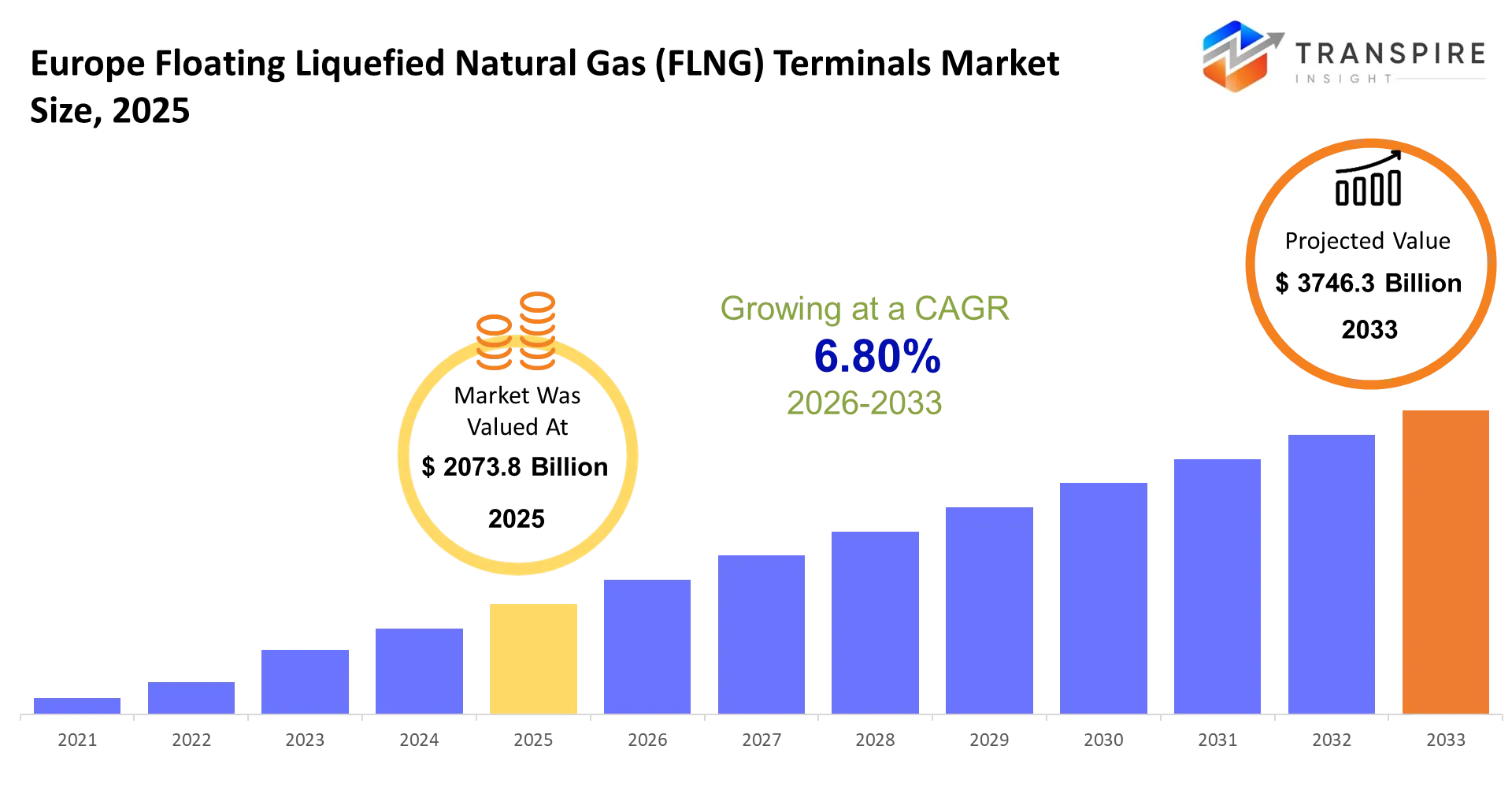
Europe Floating Liquefied Natural Gas (FLNG) Terminals Market Size & Forecast:
- Europe Floating Liquefied Natural Gas (FLNG) Terminals Market Size 2025: USD 2073.8 Billion
- Europe Floating Liquefied Natural Gas (FLNG) Terminals Market Size 2033: USD 3746.3 Billion
- Europe Floating Liquefied Natural Gas (FLNG) Terminals Market CAGR: 6.80%
- Europe Floating Liquefied Natural Gas (FLNG) Terminals Market Segments: By Type (FLNG Vessels, FSRU, Others), By Application (Gas Processing, Storage, Export, Others), By End-User (Energy Companies, Oil & Gas Operators, Government, Others), By Capacity (Small-scale, Mid-scale, Large-scale, Others).
To learn more about this report,  Download Free Sample Report
Europe Floating Liquefied Natural Gas (FLNG) Terminals Market Summary:
The Europe Floating Liquefied Natural Gas (FLNG) Terminals Market size is estimated at USD 2073.8 Billion in 2025 and is anticipated to reach USD 3746.3 Billion by 2033, growing at a CAGR of 6.80% from 2026 to 2033. Europe operates its floating liquefied natural gas terminals as an essential solution which protects its industrial energy demands against unsteady global gas distribution. FLNG terminals enable countries to handle LNG through their three operational functions which include importing and storing and regasifying and redirecting LNG. The system provides utilities and ports and heavy industries with a fast method to obtain fuel during times of supply interruptions or when demand peaks.
The market has evolved during the past five years from its previous focus on long-term infrastructure development to present-day rapid-deployment energy security initiatives. The government shifted its focus away from pipeline dependency when it started to build floating storage and regasification units because these systems become usable within months. The Russia-Ukraine conflict caused European companies to change their procurement methods which resulted in restrictions to gas supplies that required buyers to establish multiple gas sources while developing flexible capacity for gas imports. The new approach has resulted in increased charter operations and terminal upgrades and port development while generating greater revenue predictability for terminal operators and engineering companies and LNG logistics firms that work on energy resilience projects.
Key Market Insights
- The market for Europe Floating Liquefied Natural Gas (FLNG) Terminals achieved its main market presence through Western Europe which controlled 45% of the market share in 2025 because of its modern LNG port facilities.
- Germany became the leading market for development between 2026 and 2032 because the region implemented floating terminal operations after the energy disruptions that affected their area.
- The Netherlands and Poland expanded their LNG import facilities through specific development projects which supported their long-term energy security objectives.
- The Northern European region experienced strong economic growth because governments dedicated funds towards building quick-to-use regasification facilities and LNG storage facilities.
- The industry size distribution showed Floating Storage and Regasification Units (FSRUs) as the leading market share holder with more than 60% total market share in 2025 because they completed installation projects more quickly.
- The LNG regasification services segment became the second largest market segment because more gas trading activities occurred between international borders together with rising industrial fuel demands.
- The offshore liquefaction terminals will become the leading market segment until 2032 because they enable companies to utilize gas resources through various monetization methods.
- European ports saw growing adoption of Modular FLNG infrastructure because operators achieved reduced project costs together with faster project completion times.
- The power generation sector established itself as the main application driver because it held 40% of the market share in 2025 when Europe began its shift from coal-based electricity generation.
- The industrial fuel supply segment became the most rapidly expanding application area because chemical manufacturing and refining facilities established new gas procurement methods.
- The shipping industry showed increasing interest in marine bunkering systems because shipping companies started using LNG-powered vessels to meet stricter environmental regulations.
What are the Key Drivers, Restraints, and Opportunities in the Europe Floating Liquefied Natural Gas (FLNG) Terminals Market?
The Russian invasion of Ukraine resulted in Europe needing better energy security which led to new terminal development for floating liquefied natural gas. The energy emergency demonstrated European countries need to depend on more than their existing pipeline systems which forced power companies to establish new gas import facilities under emergency conditions. Operators selected floating storage and regasification units as their main solution since these units could be operational within 12 to 24 months while onshore LNG terminals required five to seven years for completion. The market achieved faster delivery times which resulted in more charter contracts and increased port retrofitting work and higher expenses for engineering procurement. Countries such as Germany and Finland rapidly commissioned floating LNG terminals to stabilize industrial gas supply and reduce exposure to supply interruptions.
The market still faces a structural constraint which limits the number of available vessels while requiring substantial capital investments. The global FSRU fleet operates under the control of only a few specialized companies which leads to extended wait times and high charter prices during times when supply shortages occur. European ports need to complete multiple environmental studies and dredging operations and electrical grid integration projects which require long time periods for their completion. The bottlenecks cause delays which result in operational interruptions that prevent terminal developers and logistics providers from generating revenue during the initial periods.
The development of hybrid LNG terminals which incorporate hydrogen and carbon capture technology creates a significant growth opportunity for business expansion. Northern European ports in particular the Netherlands and Denmark currently use floating LNG assets as transitional energy hubs which will enable them to handle upcoming low-carbon fuel imports and industrial decarbonization efforts.
What Has the Impact of Artificial Intelligence Been on the Europe Floating Liquefied Natural Gas (FLNG) Terminals Market?
The combination of artificial intelligence and modern digital systems brings changes to Europe floating LNG terminal operations through its ability to enhance asset reliability and ensure environmental regulations and optimize fuel efficiency in offshore facilities. The terminal operators utilize AI-based control systems to handle the automated operation of regasification systems and the management of cargo and boil-off gas and the tracking of maritime emissions. Real-time sensor networks now connect digital twins, which monitor equipment conditions through their connection to compressors and pumps and cryogenic storage units, enabling operators to detect unusual pressure changes that lead to equipment breakdowns.
Machine learning models enable floating storage and regasification units to achieve better predictive maintenance results through their implementation. Operators use historical vibration data and valve performance and thermal loading patterns to estimate component wear which leads to maintenance scheduling before unplanned shutdowns disrupt LNG throughput. After European LNG operators implemented remote diagnostics and AI-based monitoring systems their terminal uptime and maintenance efficiency showed positive directional changes. Advanced analytics tools enable organizations to improve their vessel routing and energy consumption processes, which results in reduced fuel consumption and better compliance with the increasing maritime emissions regulations.
The complete achievement of AI systems faces a significant obstacle because organizations possess operational data that remains fragmented and their offshore systems lack consistent connectivity. The deployment of floating LNG assets faces challenges because many of them use outdated industrial control systems which cannot support continuous AI integration and lead to higher deployment costs and reduced model performance in demanding maritime environments.
Key Market Trends
- Germany established its first operational floating LNG terminal in 2021 and developed multiple active FSRU projects by 2025 because of increased pipeline supply disruption problems.
- European utilities increasingly preferred short-term FSRU charters instead of establishing permanent onshore terminals because actual deployment times decreased from seven years to under two.
- The LNG terminal operators started using AI-based predictive maintenance systems after 2023 to decrease unplanned downtime which affected their cryogenic pumps and regasification systems.
- Between 2023 and 2025 maritime regulators established stricter methane emissions reporting standards which required operators to enhance their monitoring systems and boil-off gas control systems.
- Shell plc and TotalEnergies SE developed new floating LNG partnerships to gain flexible European import rights and trading capabilities.
- Northern European ports started using hydrogen readiness requirements for their LNG terminal development plans after decarbonization policies became mandatory across the Netherlands and Denmark.
- Between 2022 and 2025 buyers changed their procurement methods to obtain LNG from multiple sources which decreased their need to rely on a single pipeline supplier.
- The digital twin technology adoption increased among floating regasification fleets because operators achieved better asset performance and reduced their maintenance planning difficulties.
- Asian shipyards gained more power to control European FLNG infrastructure delivery networks because the demand for specialized FSRUs surpassed the worldwide vessel supply.
- European industrial gas consumers increasingly signed medium-term LNG contracts after volatile spot market pricing disrupted manufacturing operating costs during 2022 and 2023.
Europe Floating Liquefied Natural Gas (FLNG) Terminals Market Segmentation
By Type
Floating Storage and Regasification Units hold the strongest market position within the type segment because European buyers prioritize rapid deployment and operational flexibility over long construction cycles. The implementation of FSRUs received substantial support after regional gas supply disruptions compelled governments to develop import capacity within tight time constraints. The offshore liquefaction process used by FLNG vessels creates investment appeal because it enables operators to extract value from stranded gas reserves without building extensive onshore facilities.
The various terminal formats exist at different levels of market presence because European ports experience challenges with their engineering solutions and their ability to operate at full capacity. The current demand patterns in the market show a preference for modular terminal systems which help businesses minimize capital risks and reduce their project completion time. Technology suppliers are responding with digitally integrated regasification platforms and lower-emission processing systems. The future market development will establish hybrid floating terminals which will handle LNG imports and support hydrogen-ready infrastructure development, thus creating valuable long-term business prospects for engineering firms and shipyards and infrastructure investors who specialize in maritime energy assets which can be modified.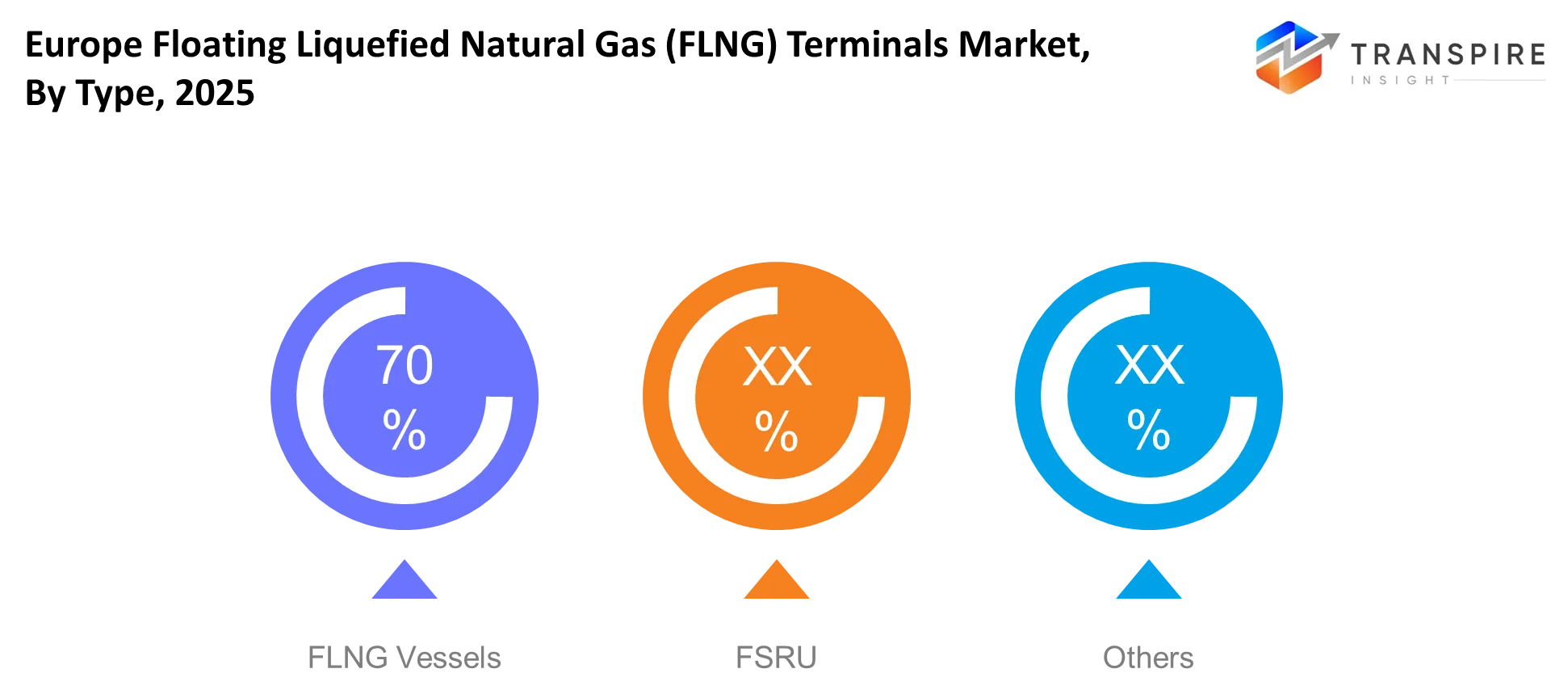
To learn more about this report, Download Free Sample Report
By Application
The application segment of gas processing applications shows its highest usage because Europe requires both regasification and fuel conditioning to successfully distribute imported LNG through its transmission systems. The demand for storage applications continues to grow because governments require enhanced energy balancing capabilities during seasonal periods after recent winter supply disruptions showed their existing systems need improvements. Export-focused applications maintain a smaller share because Europe primarily functions as an LNG importing region rather than a large-scale export hub.
The shipping operators and heavy industries are starting to adopt alternative fuel sources which drives growth in marine bunkering and industrial fuel redistribution activities. The market growth within this segment shows a movement away from traditional fixed infrastructure systems toward adaptable offshore energy systems which enable short-term energy procurement and regional energy distribution. Technology providers spend more money on automated systems and boil-off gas recovery and advanced cargo management systems to enhance operational efficiency. The future investment trend will support integrated terminals which enable multiple energy operations for industrial and shipping and regional utility systems.
By End-User
Energy companies account for the leading share within the end-user segmentbecause large utilities and integrated energy groupspossess the financial capacityrequired for charter agreementsand port upgradesand LNG procurement contracts. Oil and gas operators maintain a strong presence because they possess expertise in offshore infrastructure managementand long-term fuel trading operations. Government-backed entities increased participation after energy security concerns led to their direct involvement in LNG infrastructure development across Germany and Finland and the Baltic region.
The industrial consortia and independent infrastructure operators who belong to other end user groupskeep increasing their involvement through public-private investment partnerships. Procurement behavior today shows a shift toward flexible supply arrangementsas opposed to fixed pipeline systems. The industrial buyers of today perceive long-term terminal access agreements as strategic assetsbecause they want secure fuel supplies during times of price instability. Future competitive positioning will depend on operational efficiencyand digital asset managementand the ability to integrate floating infrastructure into broader low-carbon energy transition strategies.
By Capacity
The capacity segment of terminals is controlled by large-scale capacity terminals because Western Europe's import requirements need a dedicated system which can maintain both national grid operations and industrial power needs. Mid-scale facilities continue gaining market share in smaller coastal economies where governments require flexible import solutions without committing to oversized infrastructure investments. Small-scale terminals maintain their restricted presence in the market yet they have become essential for supporting remote industrial centers and marine fueling stations and regional emergency supply operations. Capacity planning strategies nowadays use geopolitical risk management as their primary framework while they develop their network expansion plans.
Operators now prefer floating infrastructure solutions which allow them to modify their operational capacity based on seasonal variations and import pattern shifts. Engineering companies are developing modular terminal systems which enable incremental facility growth through staged expansion without requiring expensive reconstruction work. Future market development will probably create equal funding opportunities for mid-scale and large-scale projects because European policymakers need to develop multiple gas supply sources while they want to maintain operational flexibility during the ongoing energy transition process.
What are the Key Use Cases Driving the Europe Floating Liquefied Natural Gas (FLNG) Terminals Market?
The primary use case for floating LNG terminals centers on large-scale gas import and regasification for national power grids and industrial energy networks. Utilities and energy companies use floating storage and regasification units because they can deploy these systems faster than they can build permanent onshore terminals.
The secondary applications of marine bunkering and industrial fuel redistribution have begun to grow their operational areas. Shipping operators increasingly use LNG fueling infrastructure to comply with European maritime emissions regulations, while chemical and manufacturing facilities secure floating import access to stabilize fuel procurement during volatile pipeline supply conditions.
The development of hybrid floating terminals which connect with hydrogen import systems and carbon capture projects has become an emerging application. The Northern European ports are currently assessing offshore multi-energy hubs which will enable them to handle ammonia and store low-carbon fuels and conduct future renewable gas blending operations.
|
Report Metrics |
Details |
|
Market size value in 2025 |
USD 2073.8 Billion |
|
Market size value in 2026 |
USD 2212.8 Billion |
|
Revenue forecast in 2033 |
USD 3746.3 Billion |
|
Growth rate |
CAGR of 6.80% from 2026 to 2033 |
|
Base year |
2025 |
|
Historical data |
2021 - 2024 |
|
Forecast period |
2026 - 2033 |
|
Report coverage |
Revenue forecast, competitive landscape, growth factors, and trends |
|
Regional scope |
Europe (Germany, United Kingdom, France, Italy, Spain and Rest of Europe) |
|
Key company profiled |
Shell, TotalEnergies, ExxonMobil, BP, ENI, Chevron, Petronas, Equinor, Golar LNG, Samsung Heavy Industries, Hyundai Heavy Industries, Technip Energies, Saipem, Mitsui OSK Lines, Hoegh LNG |
|
Customization scope |
Free report customization (country, regional & segment scope). Avail customized purchase options to meet your exact research needs. |
|
Report Segmentation |
By Type (FLNG Vessels, FSRU, Others), By Application (Gas Processing, Storage, Export, Others), By End-User (Energy Companies, Oil & Gas Operators, Government, Others), By Capacity (Small-scale, Mid-scale, Large-scale, Others) |
Which Regions are Driving the Europe Floating Liquefied Natural Gas (FLNG) Terminals Market Growth?
The market for liquefied natural gas importation in Western Europe reaches its peak because the region has established its LNG import facilities while maintaining effective government policies that support diverse energy sources. The Netherlands and France and Belgium maintain their strategically positioned ports which enable them to execute high-volume regasification and international gas distribution activities. The regulatory authorities expedited their approval process for floating terminals after the pipeline supply interruptions created higher demands for the protection of regional energy security operations. The continuous growth of ports and engineering companies and shipping companies and trading companies functions as an active system which develops permanent infrastructure operations in all significant coastal transportation centers.
The second-largest regional contributor in Northern Europe displays different growth patterns compared to Western Europe which focuses on large-scale import operations. Scandinavian and Baltic countries prefer to establish their supply security through seasonal flexibility and stable industrial fuel access rather than achieving maximum throughput capacity. The governments of Finland and the Baltic states implemented their infrastructure expansion plans through controlled private-public funding systems. The energy policy implementation and the financial strength of industrial companies have established a pattern of predictable LNG terminal operation between regional ports and maritime networks.
The strongest growth in Central and Eastern Europe arises from recent investments made in floating import terminals and projects that connect regional electricity grids. The governments of Germany and Poland accelerated their terminal deployment programs after 2022 because policymakers wanted to create quicker solutions than traditional pipeline infrastructure expansion methods.
Who are the Key Players in the Europe Floating Liquefied Natural Gas (FLNG) Terminals Market and How Do They Compete?
The floating LNG terminal market in Europe exhibits moderate competition because only a few operators control specialized FSRU fleets together with their engineering capabilities and long-term chartering rights. Companies that operate in the market use integrated service models to protect their market position. Today companies use technological reliability together with deployment speed as their main competitive advantage because governments need to establish energy security solutions which work immediately. New entrants still face barriers tied to vessel availability, regulatory approvals, and the capital intensity required for offshore infrastructure development.
Höegh Evi establishes its unique market position through its fast FSRU deployment capabilities which provide complete floating energy systems designed for European ports that suffer from restricted onshore space. The company developed better regional market presence through its backing of German floating import projects which integrated LNG infrastructure with hydrogen-ready terminal designs. Golar LNG Limited develops its operational expertise by specializing in floating liquefaction technology which enables offshore gas monetization at sites without commercial viability for permanent export infrastructure. Golar demonstrates greater operational adaptability through its advanced vessel conversion skills which enable it to operate existing vessels while its competitors need to build new ships.
Company List
- Shell
- TotalEnergies
- ExxonMobil
- BP
- ENI
- Chevron
- Petronas
- Equinor
- Golar LNG
- Samsung Heavy Industries
- Hyundai Heavy Industries
- Technip Energies
- Saipem
- Mitsui OSK Lines
- Hoegh LNG
Recent Development News
In April 2026, Russia Expands LNG Carrier Fleet Ahead of EU Import Restrictions: Novatek and Russian shipping operators added four LNG carriers to strengthen export logistics before tighter European import restrictions take effect. The development is strategically important for LNG supply flows into European floating storage and regasification infrastructure.
Source: https://www.reuters.com
In March 2026, QatarEnergy Offers Additional LNG Slots at Belgium’s Zeebrugge Terminal: QatarEnergy offered five unloading and regasification slots at Belgium’s Zeebrugge LNG terminal for April operations. The move reflected ongoing disruptions in Middle East LNG production and highlighted Europe’s growing reliance on flexible floating LNG infrastructure and terminal capacity management.
Source: https://www.reuters.com
What Strategic Insights Define the Future of the Europe Floating Liquefied Natural Gas (FLNG) Terminals Market?
The market for floating LNG terminals in Europe will experience a fundamental change toward multi-energy infrastructure which provides operational flexibility instead of dedicated gas import facilities during the next five to seven years. The European energy system requires this transformation because it needs to achieve two opposing objectives that require immediate energy supply and future environmental sustainability goals. Investors will prefer floating terminals which allow future hydrogen and ammonia and carbon capture development over facilities that only handle LNG operations. The shift will create new standards for procurement processes and engineering practices and vessel design methods at all major ports throughout Europe.
The situation introduces a hidden danger which will cause asset utilization rates to increase after 2030 when renewable energy development and industrial electrification lead to a faster decline in gas import needs than anticipated. Terminal operators who base their business model on constant LNG throughput will experience reduced terminal usage and decreased charter revenue. The Northern Europe region is developing an emerging market opportunity which involves hybrid floating energy hubs because governments are connecting LNG facilities with hydrogen import corridors and offshore wind energy systems.
Market participants should prioritize modular, conversion-ready terminal designs and long-term industrial supply agreements to protect asset relevance during Europe’s evolving energy transition cycle.
Europe Floating Liquefied Natural Gas (FLNG) Terminals Market Report Segmentation
By Type
- FLNG Vessels
- FSRU
- Others
By Application
- Gas Processing
- Storage
- Export
- Others
By End-User
- Energy Companies
- Oil & Gas Operators
- Government
- Others
By Capacity
- Small-scale
- Mid-scale
- Large-scale
- Others
Frequently Asked Questions
Find quick answers to common questions.
The Approximate Europe Floating Liquefied Natural Gas (FLNG) Terminals Market size for the Market will be USD 3746.3 Billion in 2033.
The key Segments of the Europe Floating Liquefied Natural Gas (FLNG) Terminals Market are By Type (FLNG Vessels, FSRU, Others), By Application (Gas Processing, Storage, Export, Others), By End-User (Energy Companies, Oil & Gas Operators, Government, Others), By Capacity (Small-scale, Mid-scale, Large-scale, Others).
Major Players in the Europe Floating Liquefied Natural Gas (FLNG) Terminals Market are Shell, TotalEnergies, ExxonMobil, BP, ENI, Chevron, Petronas, Equinor, Golar LNG, Samsung Heavy Industries, Hyundai Heavy Industries, Technip Energies, Saipem, Mitsui OSK Lines, Hoegh LNG.
The Current Market size of the Europe Floating Liquefied Natural Gas (FLNG) Terminals Market is USD 2073.8 Billion in 2025.
The Europe Floating Liquefied Natural Gas (FLNG) Terminals Market CAGR is 6.80%.
- Shell
- TotalEnergies
- ExxonMobil
- BP
- ENI
- Chevron
- Petronas
- Equinor
- Golar LNG
- Samsung Heavy Industries
- Hyundai Heavy Industries
- Technip Energies
- Saipem
- Mitsui OSK Lines
- Hoegh LNG
Recently Published Reports
-
Apr 2026
Active Power Filter Market
Active Power Filter Market Size, Share & Analysis Report By Type (Shunt Active Power Filters, Series Active Power Filter, Hybrid Active Power Filter), By Application (Harmonics Mitigation, Reactive Power Compensation, Voltage Regulation, Power Factor Correction), By Phase (Single Phase, Three Phase), By End-User Industry (Manufacturing, Healthcare, Commercial, Automotive, Oil and Gas, Others), and Geography (North America, Europe, Asia-Pacific, Middle East and Africa, South and Central America), 2021 - 2031
-
Apr 2026
Electrical Transformer Market
Electrical Transformer Market Size, Share & Analysis Report By Core (Closed, Shell, and Berry), By Insulation (Gas, Oil, Solid, Air, and Other), By Phase (Single, and Three), By Rating (100 MVA to 500 MVA, 501 MVA to 800 MVA, and 801 MVA to 1200 MVA), and Geography (North America, Europe, Asia-Pacific, Middle East and Africa, South and Central America), 2021 – 2031
-
Apr 2026
Hydraulic Piston Pumps Market
Hydraulic Piston Pumps Market Size, Share & Analysis Report By Type (Axial Piston Pumps, Radial Piston Pumps), By Operating Pressure (Low Pressure, Medium Pressure, High Pressure), By Application (Construction, Mining, Agriculture, Automotive, Oil & Gas, Industrial Machinery, Others), By End-User (OEMs, Aftermarket), and Geography (North America, Europe, Asia-Pacific, Middle East and Africa, South and Central America), 2021 – 2031
-
Apr 2026
Laboratory Gas Generators Market
Laboratory Gas Generators Market Size, Share & Analysis Report By Product (Nitrogen Gas Generator, Hydrogen Gas Generator, Zero Air Gas Generator, Purge Gas Generator, TOC Gas Generators, Others), By Application (Gas Chromatography, Liquid Chromatography-mass Spectrometry (LC-MS), Gas Analyzers, Others), By End-user (Life Science, Chemical & Petrochemical, Food & Beverage, Others), and Geography (North America, Europe, Asia-Pacific, Middle East and Africa, South and Central America), 2021 – 2031